| Asset | Level | Change |
|---|---|---|
| IPC Bolsa | 68,929.72 | +1.87% |
| USD/MXN | 18.44 | -0.12% |
| EUR/MXN | 20.77 | +0.44% |
| WTI Crude | 98.21 | -3.16% |
| Silver | 57.75 | +1.32% |
| Gold | 4,188.50 | +0.18% |
| Brent Crude | 108.43 | -1.30% |
| Bitcoin | 82,283.12 | +0.32% |
| Mexico 10Y Govt Yield | - | - |
| Data | Prior | Cons | Actual |
|---|---|---|---|
| No events available | |||
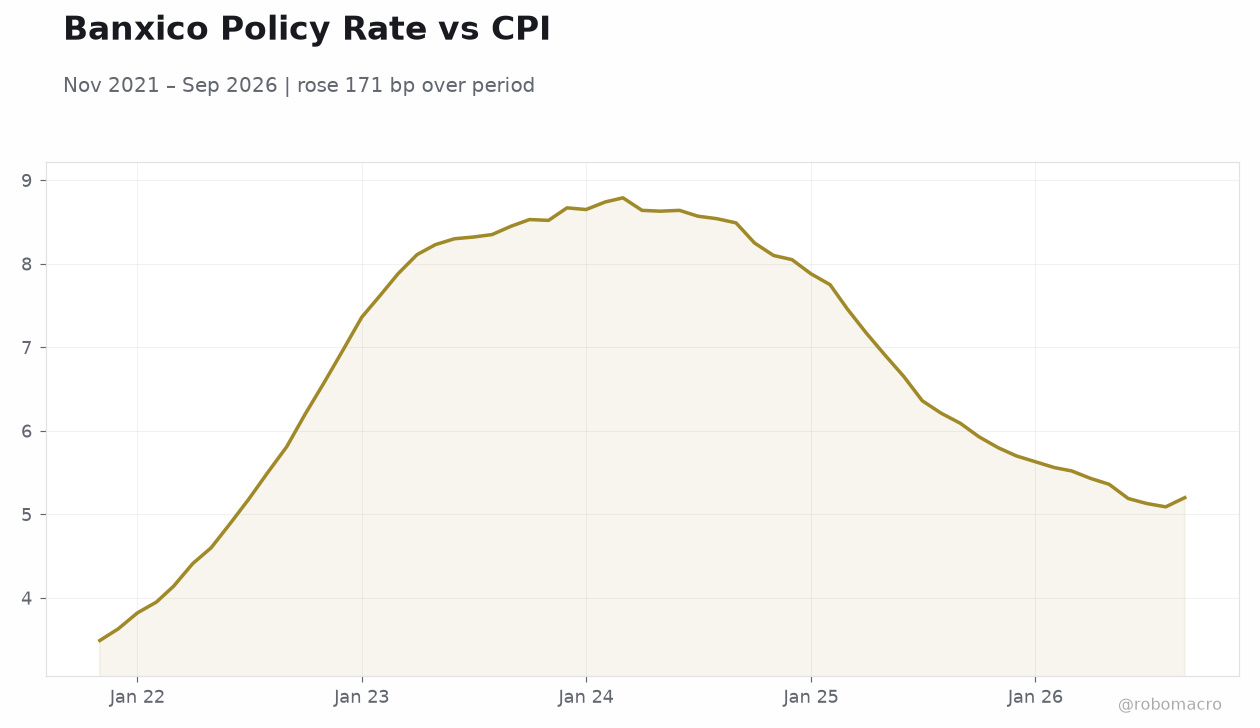
Banxico Policy Rate vs CPI | Type: macro_line | Short-Term Rate (%): 5.2 (2026-09-01) | Range: 3.49–8.79 | Trend(6pt): 3.49,7.36,8.79,6.91,5.13,5.2
| Data | Prior | Cons | Time |
|---|---|---|---|
| No events available | |||
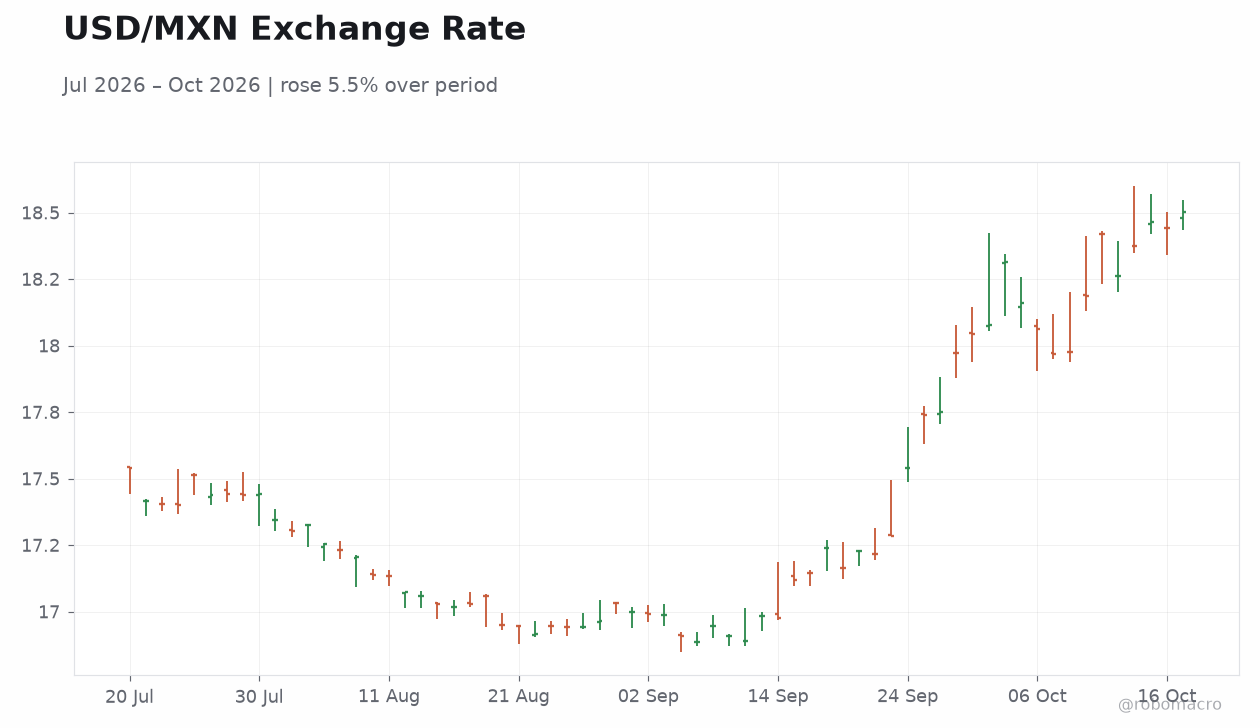
Friday's session ended on a constructive note for Mexican assets, with the IPC Bolsa advancing 1.87% to close at 68,929.72, extending the equity market's rebound. The peso firmed modestly, with USD/MXN slipping 0.12% to 18.44, while EUR/MXN rose 0.44% to 20.77, reflecting dollar softness against a basket of currencies rather than peso-specific strength. Commodity markets were mixed: WTI crude fell 3.16% to 98.21 and Brent lost 1.30% to 108.43, a headwind for PEMEX-linked revenue expectations, though gold added 0.18% to 4,188.50 and silver jumped 1.32% to 57.75, supporting Mexico's mining complex.
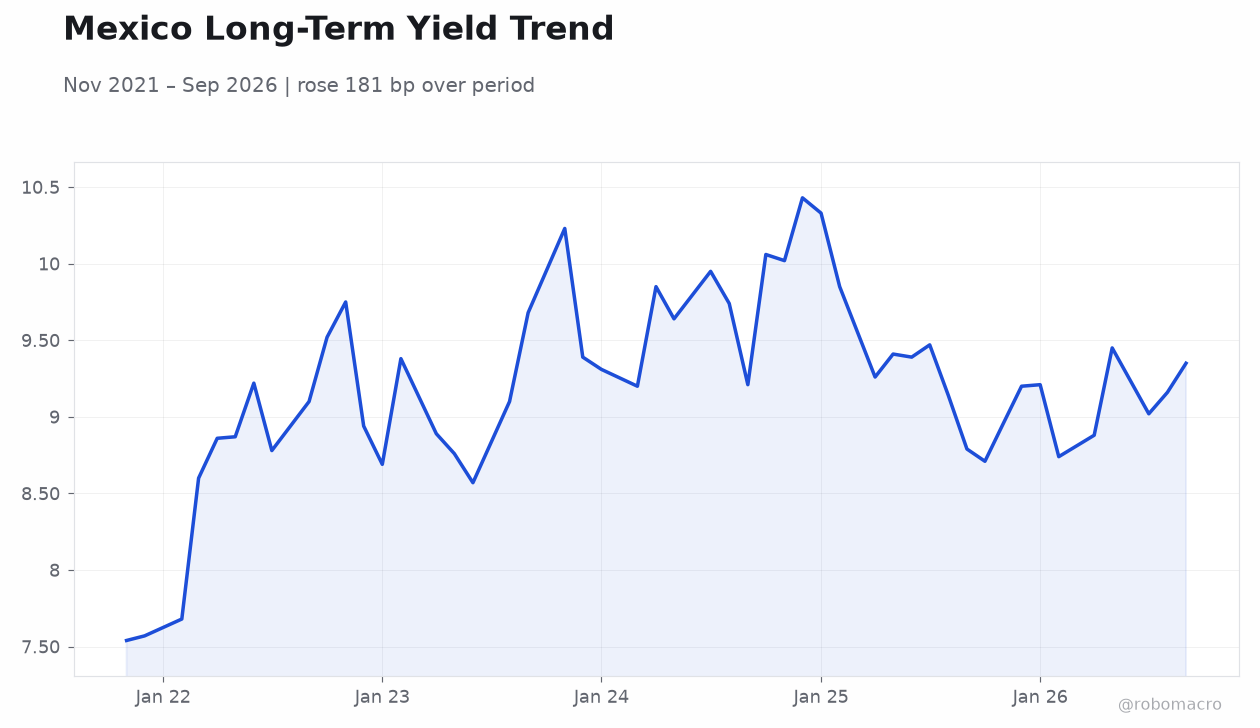
Bitcoin rose 0.32% to 82,283.12, keeping crypto-adjacent sentiment neutral. No macroeconomic prints were scheduled for release, leaving the session driven by flows and global cues. The absence of a Mexico 10-year government yield close in the data leaves term-premium assessment incomplete heading into the new week.
Attention now shifts to whether equity gains can hold without fresh domestic catalysts.
Monday's calendar is sparse, with no scheduled Mexican economic releases, leaving the session to secondary market dynamics and positioning ahead of later-week data. Traders will monitor the peso for follow-through after Friday's firming, particularly against a backdrop of softer crude prices that weigh on the oil-export narrative. Banxico communications remain the key domestic watch item, with any speeches or minutes offering scope to refine the path from the current 6.50% policy rate.
Equity desks will assess whether the IPC's 1.87% Friday advance extends or consolidates, with the index at 68,929.72 approaching levels where profit-taking emerged in prior episodes. US data and Fed commentary will shape the USD/MXN trajectory, given the pair's sensitivity to rate differentials. Hurricane Trudy's aftermath on the Pacific coast may generate regional economic impact assessments as the week progresses.
Subscribe to Mexico Macro Daily and get each new issue delivered to your inbox.
Already a member? Visit robomacro.com to log in and manage subscriptions, or use Forgot Password to set a password.
Mexico Long-Term Yield Trend | Type: macro_line | 10Y Yield (%): 9.35 (2026-09-01) | Range: 7.54–10.43 | Trend(5pt): 7.54,8.69,9.64,9.47,9.35
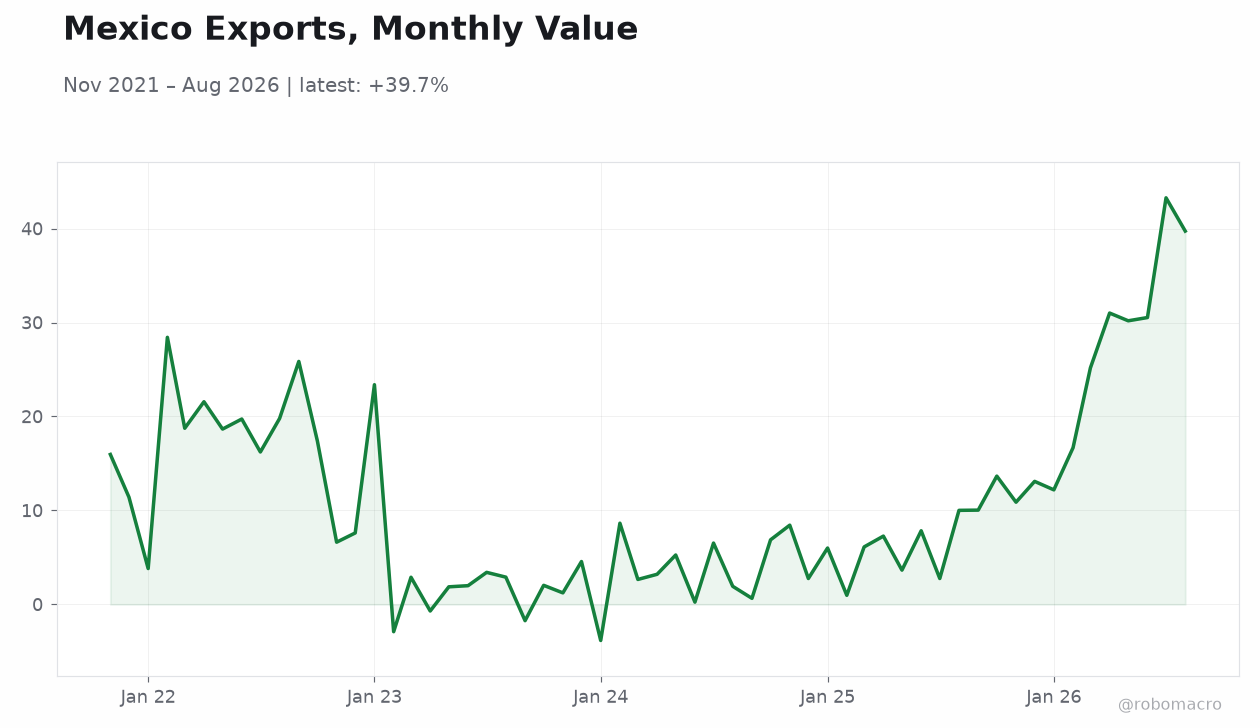
Mexico Exports, Monthly Value | Type: macro_line | Exports (USD mn): 39.73 (2026-08-01) | Range: -3.843–43.27 | Trend(6pt): 15.96,23.38,2.654,3.644,43.27,39.73
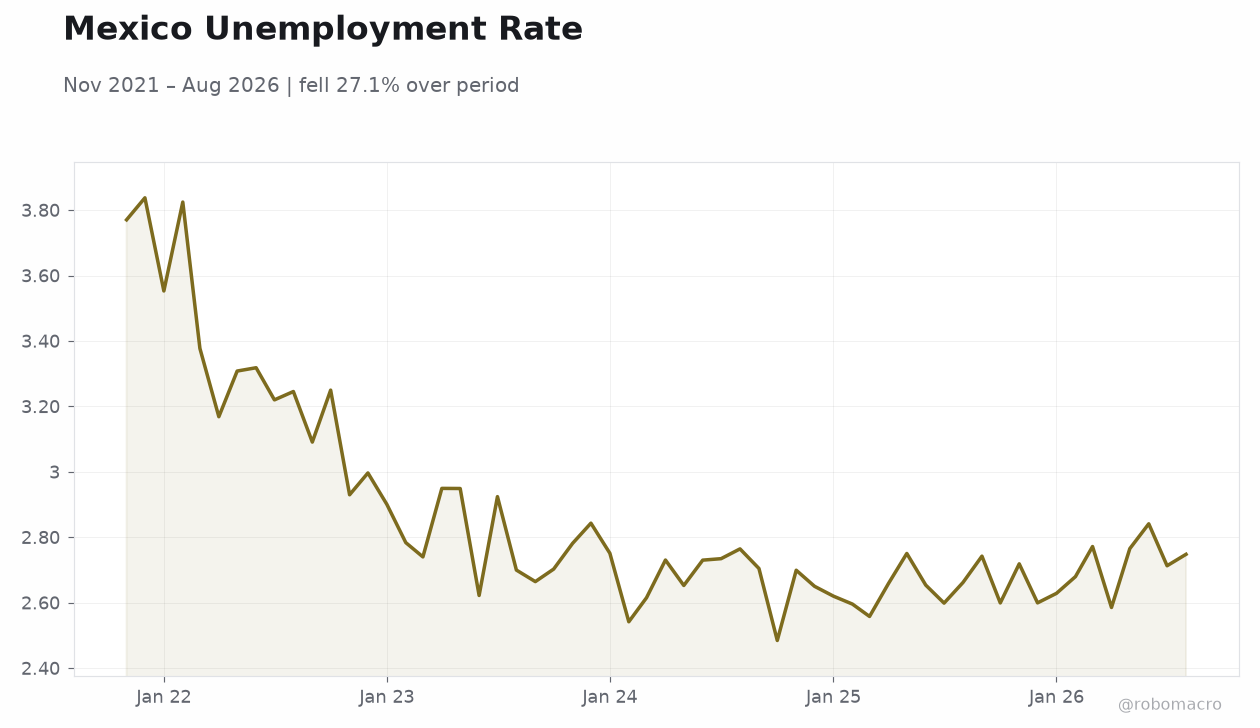
Mexico Unemployment Rate | Type: macro_line | Unemployment Rate (%): 2.748 (2026-08-01) | Range: 2.485–3.837 | Trend(6pt): 3.77,2.901,2.615,2.75,2.713,2.748
USD/MXN Exchange Rate | Type: market_hloc | USD/MXN: 18.5 (2026-10-19) | Range: 16.89–18.5 | Trend(6pt): 17.54,17.13,16.99,17.54,18.44,18.5
Mexico's inflation position at 3.45% year-on-year keeps the consumer price trajectory within striking distance of Banxico's 3% target, a milestone that would have seemed ambitious during the post-pandemic supply shocks. The 305-basis-point gap between the 6.50% policy rate and headline inflation represents meaningful real restriction, giving the central bank room to ease further if growth data soften without jeopardizing the inflation anchor. The nearshoring thesis continues to underpin medium-term capital flow expectations, though its realization depends on USMCA stability and energy infrastructure delivery.
Remittances and manufacturing exports remain the twin pillars of the external accounts, both hostage to US demand conditions. Fiscal execution into year-end will be scrutinized for adherence to consolidation targets.
Federal Reserve Chair Kevin Warsh declined to signal the rate path, leaving markets to price the November meeting with elevated uncertainty less than two weeks out — a key driver for EM currency direction including the peso. Vietnam's State Bank ordered banks to cut deposit rates by at least 50 basis points and lending rates by 150-200 basis points annually, part of a broader Asian easing wave that contrasts with Mexico's more measured cycle. Iran's conflict has triggered inflation and a central bank rate hike, adding a geopolitical premium to energy markets where Brent at 108.43 remains historically elevated.
Saudi Arabia's growth outlook for 2027 remains robust despite inflationary pressures, per regional commentary. ↓ p.3
Gold's advance to 4,188.50 and silver's 1.32% pop reflect persistent safe-haven and industrial demand. The dollar's mixed performance — weaker against MXN, firmer versus EUR crosses — suggests rotation rather than trend.
Banxico's October 13 decision left the policy rate at 6.50%, and the intervening communications have emphasized data dependence rather than a pre-committed path. With CPI at 3.45% year-on-year, the bank's convergence narrative toward the 3% target is intact, but the pace of further easing hinges on core inflation persistence and the pass-through from a stable peso. The 18.44 USD/MXN level reduces imported inflation pressure, giving the board flexibility to extend cuts if activity data warrant.
Minutes from recent meetings have reportedly balanced growth concerns against services inflation stickiness, the classic late-cycle tension. Market pricing for the next meeting should anchor on the real rate cushion of roughly 300 basis points, which remains among the wider EM spreads. Any signal that the terminal rate sits near 6% would compress front-end yields and support duration.
The absence of fresh guidance this week elevates the importance of upcoming minutes for path clarity. Watch for board member speeches that could test the consensus around a gradual approach.