Nordics Macro Daily(Beta Mode)
Riksbank Hike Eyed as Brent Plunges 6.6%
Market Snapshot
| Asset | Level | Change |
|---|---|---|
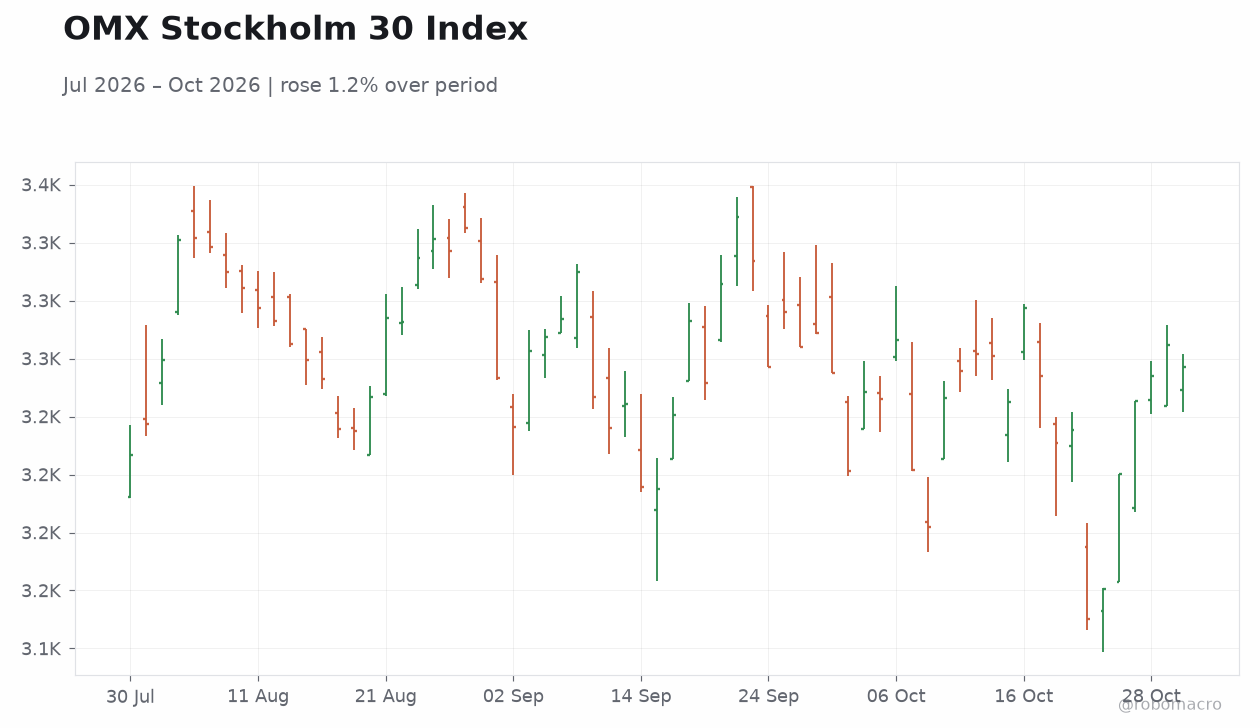
| OMX Stockholm 30 | 3,271.40 | -0.29% |
| Oslo Bors | 2,144.97 | +0.34% |
| OMX Copenhagen 25 | 1,974.38 | +0.07% |
| OMX Helsinki 25 | 6,191.03 | -1.25% |
| USD/SEK | 9.84 | -0.59% |
| USD/NOK | 9.21 | -0.43% |
| EUR/SEK | 10.96 | -0.45% |
| EUR/NOK | 10.30 | -0.43% |
| Brent Crude | 109.87 | -6.60% |
| Gold | 3,912.50 | +0.35% |
| Bitcoin | 78,180.01 | +0.96% |
| Sweden 10Y Govt Yield | 3.14% | 0 bp |
| Norway 10Y Govt Yield | - | - |
Prior Economic Events
| Data | Prior | Cons | Actual |
|---|---|---|---|
| No events available | |||
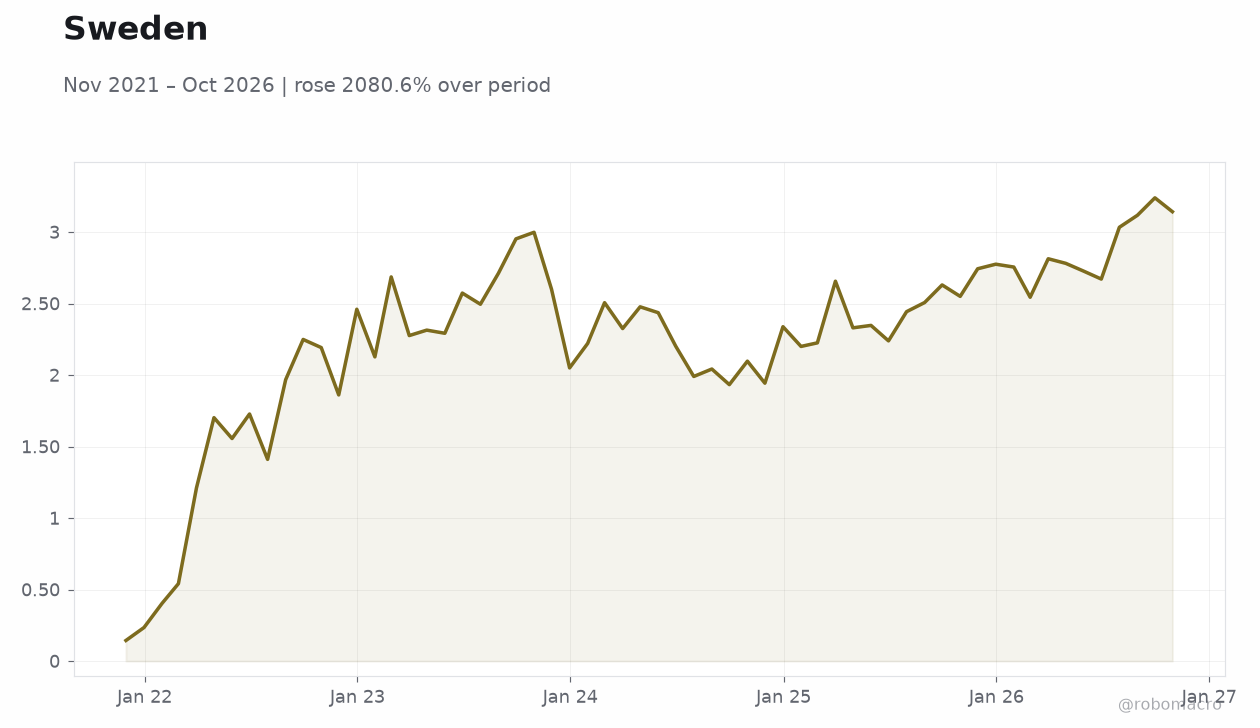
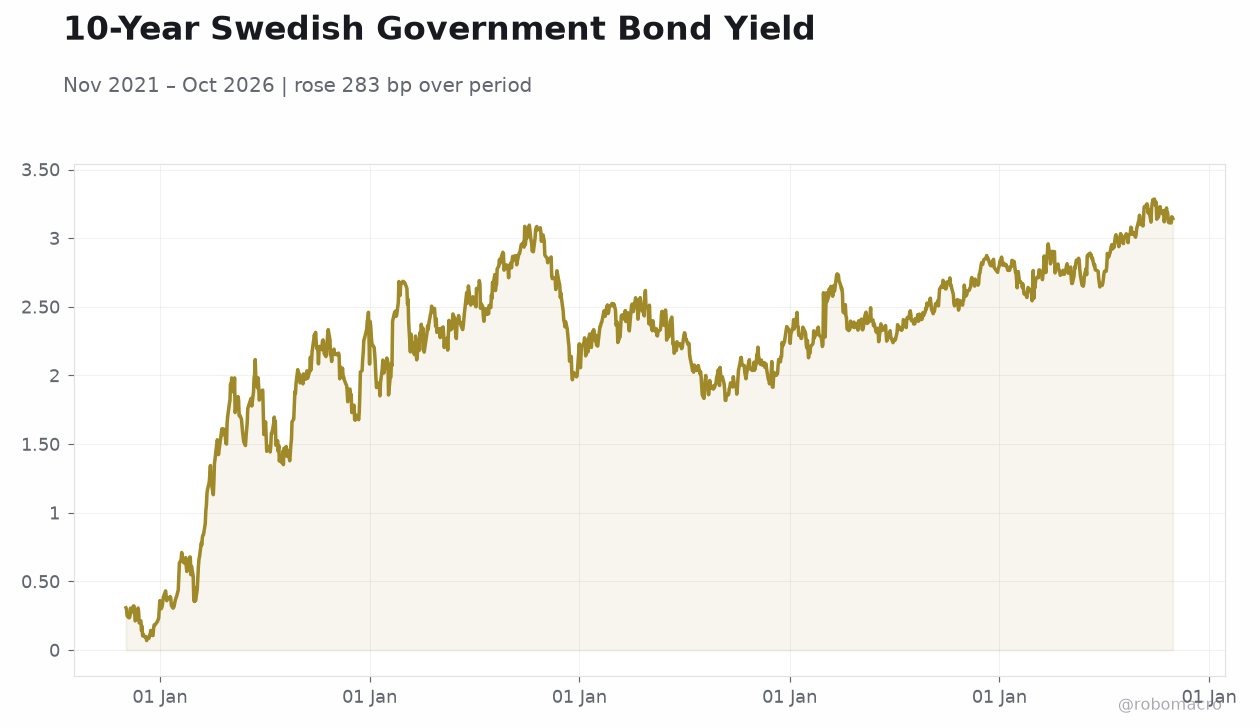 10-Year Swedish Government Bond Yield | Type: macro_line | 10-Year Swedish Government Bond Yield: 3.142 (2026-10-30) | Range: 0.06946–3.285 | Trend(5pt): 0.3082,2.093,2.512,2.403,3.142
Today's Economic Events
| Data | Prior | Cons | Time |
|---|---|---|---|
| No events available | |||
- Riksbank widely expected to hike this week despite soft Swedish CPI at 1.50% YoY, with a rallying krona complicating the inflation outlook; Goldman and Nordea both flag a November move.
- Norges Bank seen holding policy steady, with Nordea expecting an unchanged rate path; the krone has strengthened materially this year and FX sales are being held unchanged.
- Brent crude collapsed 6.60% to $109.87, a direct hit to Norway's fiscal outlook, while Nordic equities diverged sharply — Helsinki fell 1.25% even as Finnish Q3 GDP expanded 0.5% QoQ.
Yesterday's Recap
Nordic markets closed the week mixed, with Oslo Bors up 0.34% and Copenhagen's OMX 25 edging 0.07% higher, while Stockholm's OMX 30 slipped 0.29% and Helsinki's OMX 25 dropped 1.25% — the sharpest move in the bloc. The divergence came despite Finnish Q3 GDP expanding 0.5% QoQ, a print that confirms the economy is picking up even as the public sector remains in need of reform. Currency markets saw broad krone and krona strength: USD/SEK fell 0.59% to 9.84 and USD/NOK dropped 0.43% to 9.21, with EUR/SEK at 10.96 and EUR/NOK at 10.30.
The Swedish 10-year yield held at 3.14%, unchanged on the day, offering no fresh directional signal. The dominant cross-asset story was oil: Brent crude plunged 6.60% to $109.87, a move that directly undercuts Norway's fiscal revenue outlook and adds a disinflationary impulse to the krone complex. Norges Bank confirmed it is holding its krone sales unchanged, noting the currency has strengthened significantly this year.
The Day Ahead
The calendar is empty for the Nordic bloc today, leaving markets to position ahead of this week's central bank events. The Riksbank decision dominates the near-term agenda, with a hike widely trailed by sell-side desks including Goldman Sachs and Nordea, whose preview is titled "Going up, going gently." Norges Bank's own decision follows, with Nordea's preview pointing to unchanged policy and a steady rate path. With no domestic data to trade, direction will be set by global risk appetite and the oil complex following Friday's Brent collapse.
Watch EUR/SEK and EUR/NOK for positioning flows into the decisions, and keep an eye on the Riksbank's government bond auction conditions for any shift in its balance-sheet operations.
Other Economic Notes
Finland's 0.5% QoQ Q3 expansion is a constructive signal for the bloc's eurozone periphery, though Helsinki's equity market failed to celebrate it. The EU's new banking law is prompting operational changes for Swedish residents holding accounts with non-EU banks, a reminder of the bloc's deepening regulatory integration. Norway's $2 trillion oil fund remains in focus, with CEO Nicolai Tangen pushing back on proposed tech caps — a governance debate with implications for the fund's equity allocation footprint across global markets.
↓ p.2