Nordics Macro Daily(Beta Mode)
Riksbank Hikes to 2%, Norges Bank Holds at 4.50%
Market Snapshot
| Asset | Level | Change |
|---|---|---|
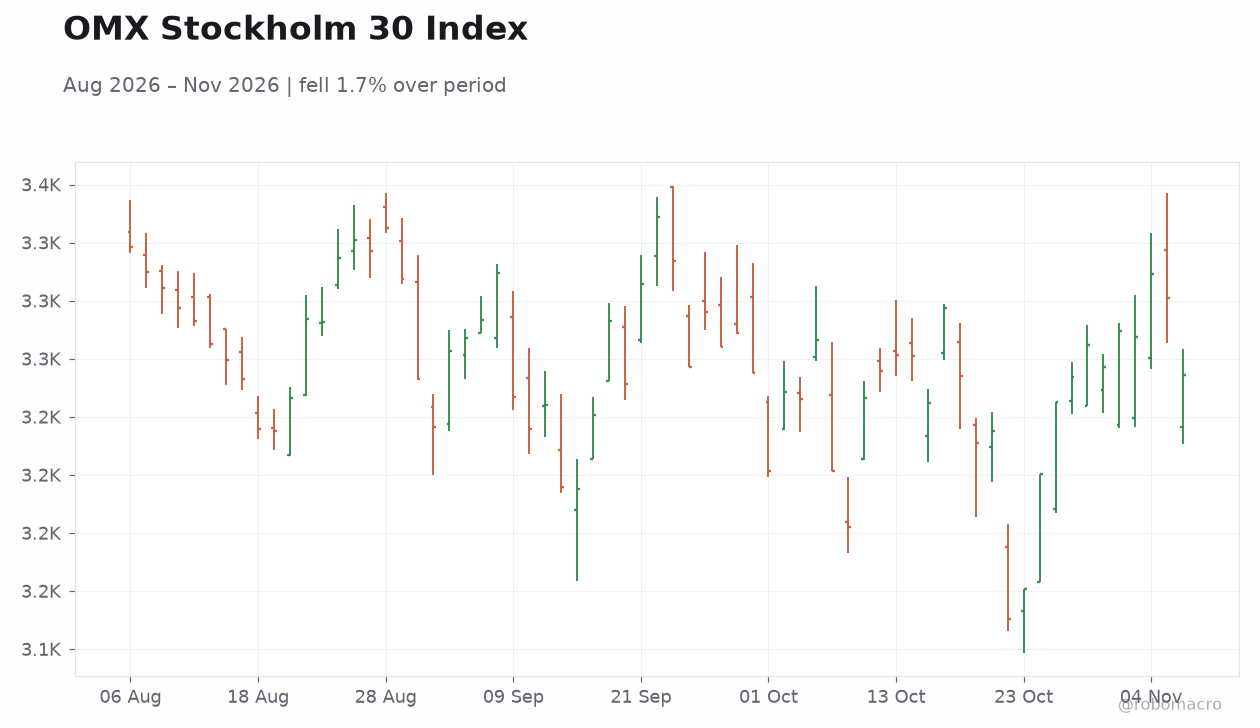
| OMX Stockholm 30 | 3,267.88 | -1.01% |
| Oslo Bors | 2,053.36 | -1.31% |
| OMX Copenhagen 25 | 2,008.97 | -0.64% |
| OMX Helsinki 25 | 6,221.79 | -0.52% |
| USD/SEK | 9.87 | +0.62% |
| USD/NOK | 9.44 | +1.50% |
| EUR/SEK | 11.02 | +0.03% |
| EUR/NOK | 10.54 | +0.91% |
| Brent Crude | 98.26 | -0.06% |
| Gold | 4,132.30 | +1.41% |
| Bitcoin | 74,598.03 | -1.52% |
| Sweden 10Y Govt Yield | 2.97% | -1 bp |
| Norway 10Y Govt Yield | - | - |
Prior Economic Events
| Data | Prior | Cons | Actual |
|---|---|---|---|
| No events available | |||
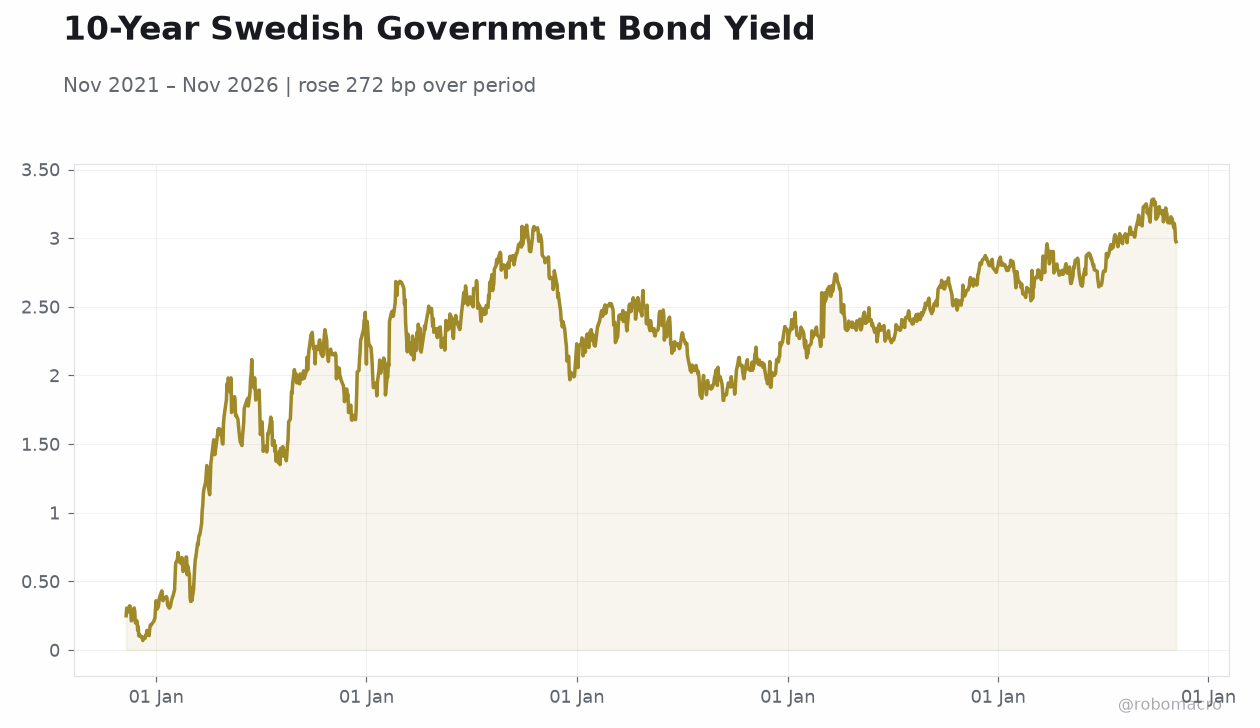 10-Year Swedish Government Bond Yield | Type: macro_line | 10-Year Swedish Government Bond Yield: 2.974 (2026-11-06) | Range: 0.06946–3.285 | Trend(5pt): 0.25,2.071,2.339,2.404,2.974
Today's Economic Events
| Data | Prior | Cons | Time |
|---|---|---|---|
| No events available | |||
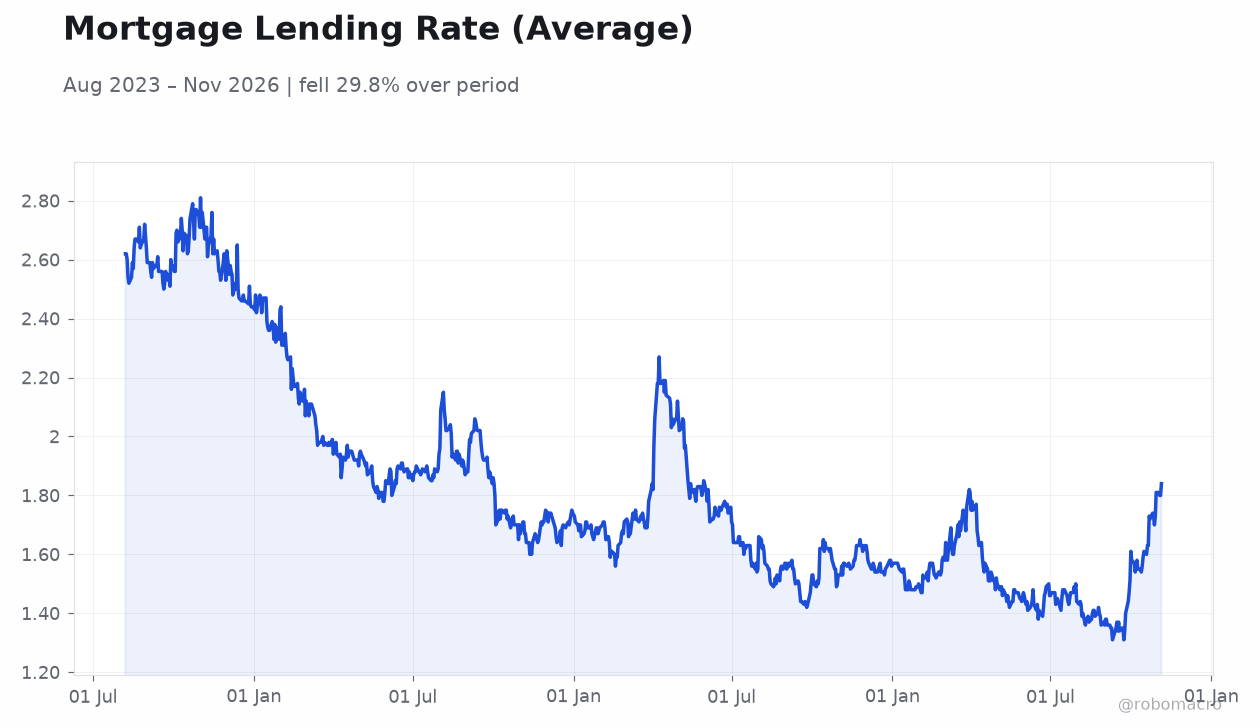
- Riksbank raised its policy rate to 2.00% and signalled further tightening ahead, lifting Swedish mortgage rates in its wake
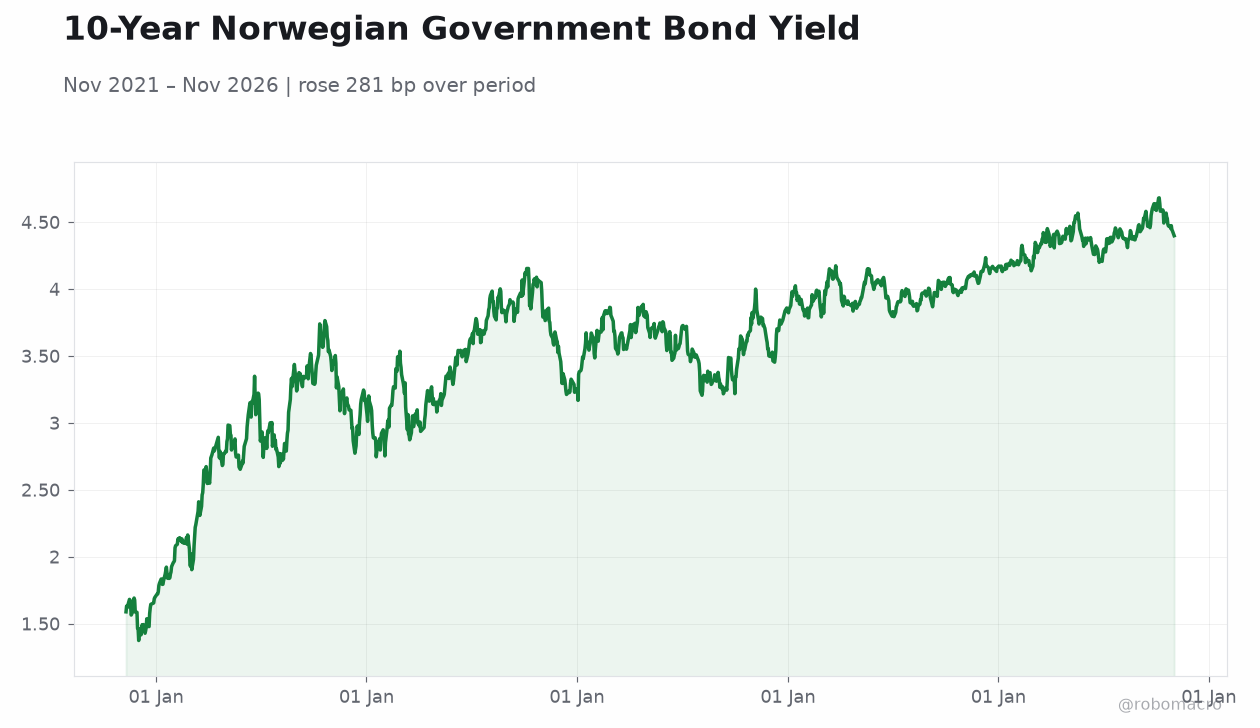
- Norges Bank held at 4.50% with oil-price risk now the dominant driver of NOK; EUR/NOK jumped 0.91% and USD/NOK 1.50%
- Nordic equities sold off across the board — Oslo Bors -1.31%, OMX Stockholm -1.01% — as Sweden's political uncertainty compounded rate-hike pressure
Yesterday's Recap
Sweden dominated the Nordic macro tape as the Riksbank delivered a hike to a 2.00% policy rate and explicitly signalled more tightening to come, prompting Swedish banks to lift mortgage rates almost immediately. The move landed alongside a fresh political twist in Stockholm, where the Sweden Democrats dropped their demand for cabinet posts and agreed to unconditionally tolerate Ulf Kristersson as prime minister, removing a near-term government-formation risk but leaving policy direction uncertain. Swedish markets absorbed both stories poorly: the OMX Stockholm 30 fell 1.01% to 3,267.88, while the 10-year government yield eased 1 bp to 2.97% — a modest flattening rather than the selloff a hike might imply.
Sweden's October CPI reading of 1.10% YoY sits well below target, underscoring the Riksbank's concern that easing inflation is not yet durable. In Norway, Norges Bank held its policy rate at 4.50%, with Commerzbank and UBS flagging oil-linked risk as the dominant krone driver; the NOK weakened sharply, with USD/NOK up 1.50% to 9.44 and EUR/NOK up 0.91% to 10.54. Oslo Bors fell 1.31% to 2,053.36.
Denmark and Finland were quieter: OMX Copenhagen 25 slipped 0.64% and OMX Helsinki 25 lost 0.52%, with no domestic data prints to explain the moves.
The Day Ahead
No scheduled Nordic macro releases appear on the calendar for today, leaving markets to digest the Riksbank's hike and the Norwegian krone's slide. With the policy decision now public, attention shifts to how Swedish mortgage lenders and housing-market participants respond to the 2.00% rate over the coming sessions. For Norway, the focus is on oil-price sensitivity: Brent at $98.26 remains elevated, and the krone's sharp depreciation will be watched for imported-inflation pass-through ahead of the next Norges Bank assessment.
Danish and Finnish markets will take their cue from euro-area rates and ECB communication, with the EUR/DKK peg likely steady. Sweden's political backdrop — Kristersson now tolerated by the Sweden Democrats — bears monitoring for fiscal signals, though no formal event is scheduled.
Other Economic Notes
Sweden's inflation picture is the key puzzle: October CPI at 1.10% YoY is comfortably below the Riksbank's target, yet the central bank is tightening — a signal it views the disinflation as fragile rather than entrenched. ↓ p.2