Riksbank Hike Bets Tested as Inflation Nears Zero
OMX Stockholm 303,359.37-0.02%
Oslo Bors2,106.54+0.00%
OMX Copenhagen 252,014.73+0.36%
OMX Helsinki 256,341.71+0.22%
Market Snapshot
| Asset | Level | Change |
|---|
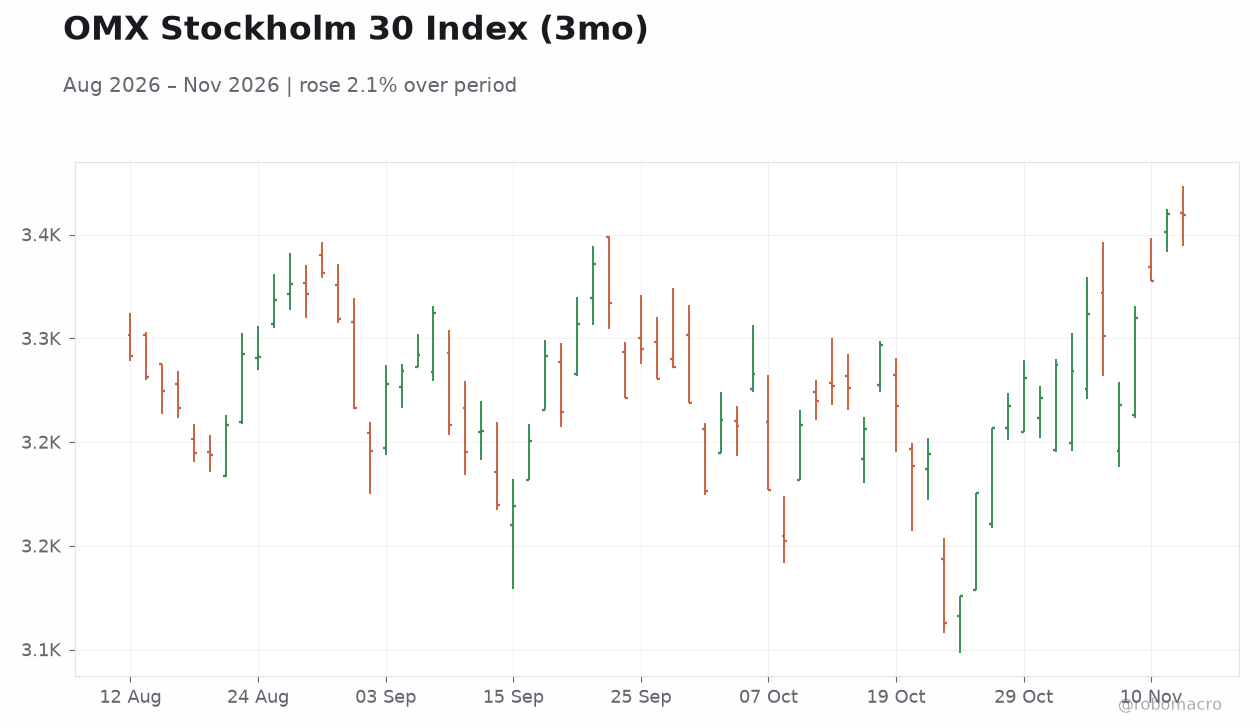
| OMX Stockholm 30 | 3,359.37 | -0.02% |
| Oslo Bors | 2,106.54 | +0.00% |
| OMX Copenhagen 25 | 2,014.73 | +0.36% |
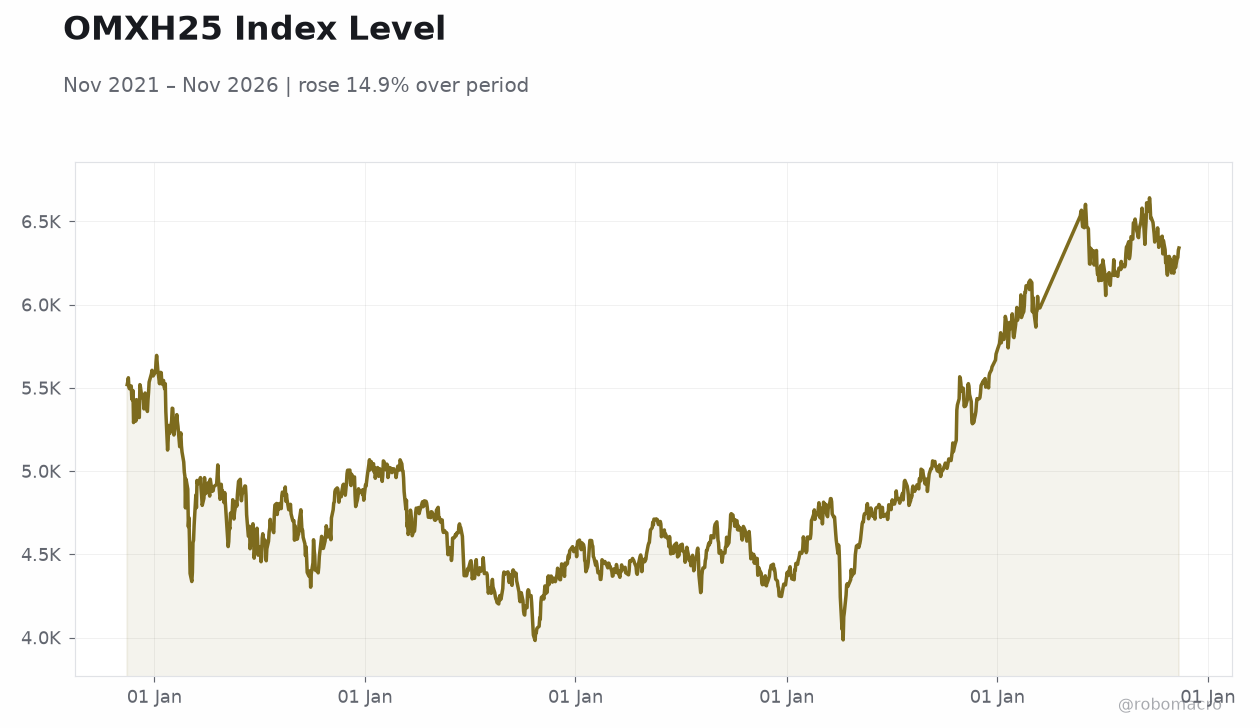
| OMX Helsinki 25 | 6,341.71 | +0.22% |
| USD/SEK | 10.02 | +0.59% |
| USD/NOK | 9.57 | +0.14% |
| EUR/SEK | 11.08 | +0.27% |
| EUR/NOK | 10.58 | -0.18% |
| Brent Crude | 95.59 | -0.24% |
| Gold | 3,918.00 | +0.84% |
| Bitcoin | 68,657.18 | -7.18% |
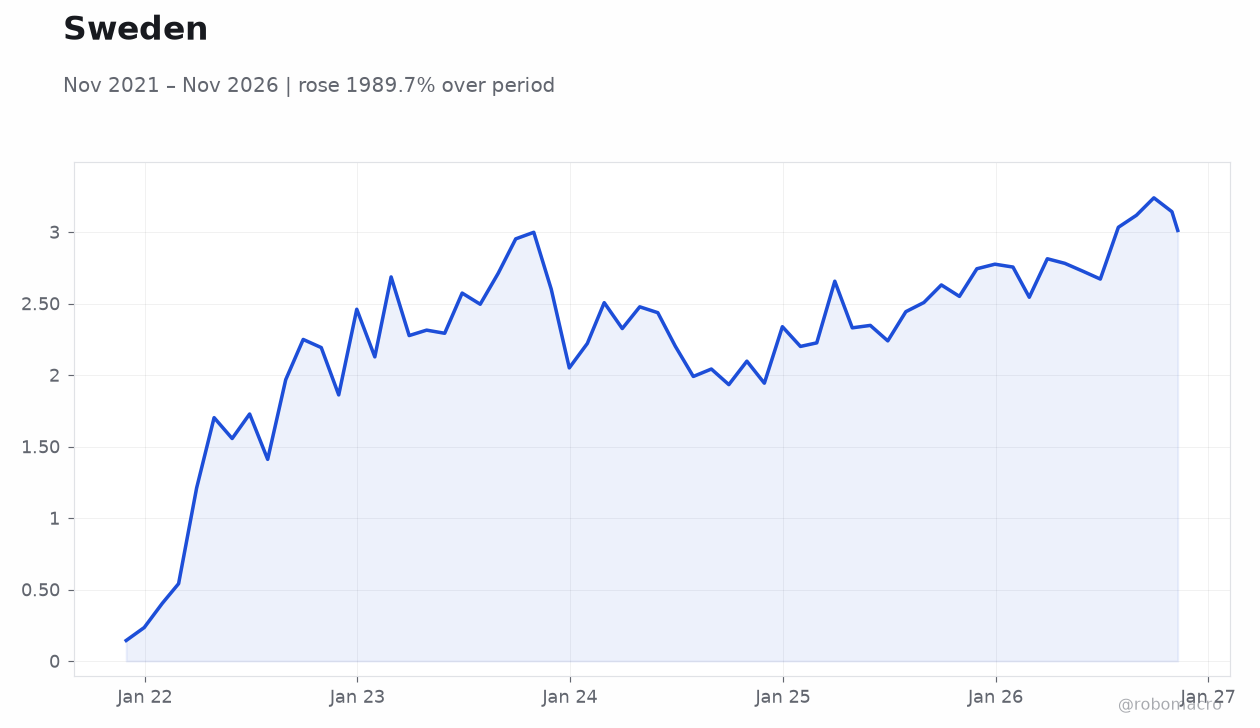
| Sweden 10Y Govt Yield | 3.01% | +6 bp |
| Norway 10Y Govt Yield | - | - |
Prior Economic Events
| Data |
Prior |
Cons |
Actual |
| No events available |
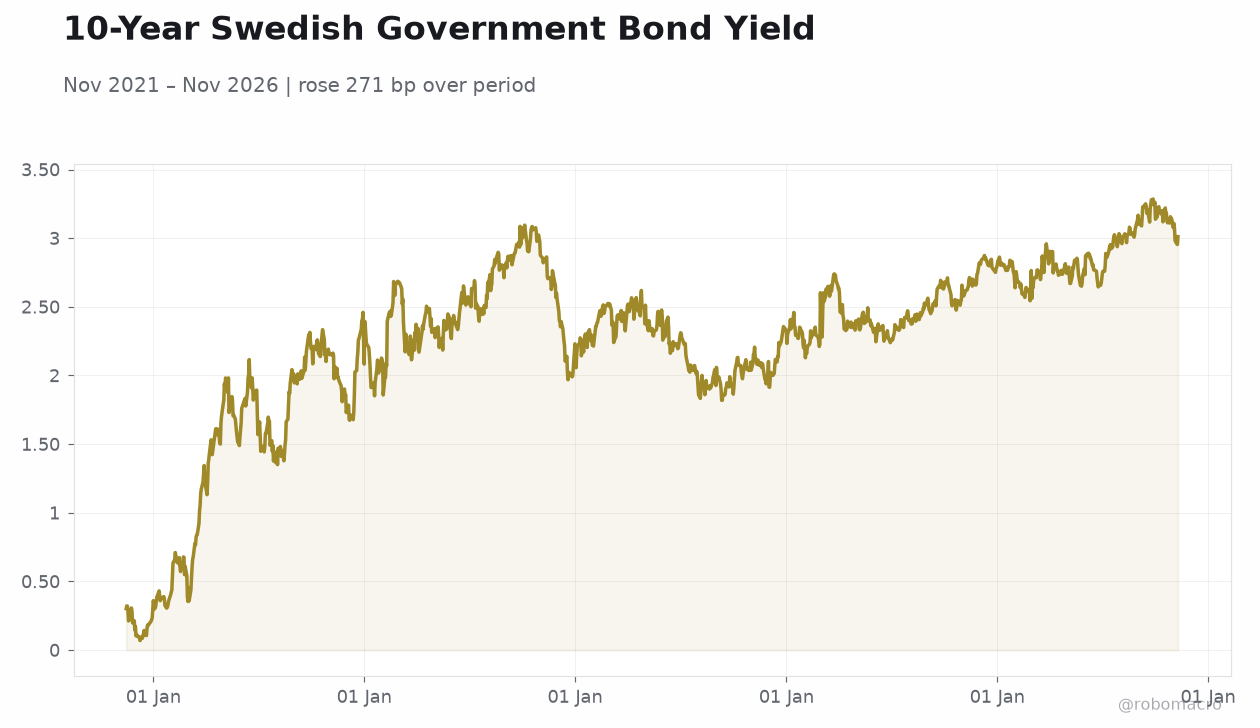 10-Year Swedish Government Bond Yield | Type: macro_line | 10-Year Swedish Government Bond Yield: 3.011 (2026-11-10) | Range: 0.06946–3.285 | Trend(6pt): 0.3017,2.451,2.32,2.404,2.974,3.011
Today's Economic Events
| Data |
Prior |
Cons |
Time |
| No events available |
- Sweden's Riksbank raised its policy rate to 2.00% on November 4 despite headline CPI at 1.10%, with Deputy Governor Aino Bunge signalling gradual, cautious adjustments ahead.
- Swedish unemployment fell to its lowest level since 2023 in October, while the caretaker government presented a restrained 2027 budget bill.
- Nordic equities were mixed (Copenhagen +0.36%, Helsinki +0.22%, Stockholm -0.02%), the Swedish 10-year yield rose 6 bp to 3.01%, and USD/SEK climbed 0.59% to 10.02.
Yesterday's Recap
Sweden dominated the Nordic macro narrative on November 12. Fresh figures from the Swedish Public Employment Service showed unemployment falling to its lowest level since 2023 in October, reinforcing the labour-market recovery that has underpinned the Riksbank's November 4 decision to hike the policy rate by 25 bp to 2.00%. That move came even as headline CPI printed at just 1.10% year-on-year in October, with underlying inflation near zero once energy is stripped out — a combination that has fuelled debate over whether the Riksbank is front-loading tightening against a supply-driven inflation backdrop.
Deputy Governor Aino Bunge reinforced the cautious tone, arguing rates should be adjusted gradually given elevated uncertainty. On the fiscal side, Finance Minister Elisabeth Svantesson presented a caretaker budget bill for 2027 that puts large spending commitments on ice, signalling fiscal restraint into the election cycle. Markets reflected the tension: the OMX Stockholm 30 closed essentially flat at 3,359.37 (-0.02%), the Swedish 10-year government yield rose 6 bp to 3.01%, and the krona weakened, with USD/SEK up 0.59% to 10.02 and EUR/SEK 0.27% higher at 11.08.
Elsewhere, Oslo Bors was unchanged at 2,106.54, OMX Copenhagen 25 gained 0.36% to 2,014.73, and OMX Helsinki 25 added 0.22% to 6,341.71, with Brent crude easing 0.24% to $95.59.
The Day Ahead
No scheduled Nordic statistical releases appear on the calendar for November 13, leaving markets to digest the Swedish labour-market print and the caretaker budget. Attention turns to the Riksbank's communication ahead of its December 16 meeting, with markets parsing Bunge's remarks for signals on the pace of any further adjustment. In Norway, focus remains on the krone and the oil-price backdrop ahead of Norges Bank's December 17 decision, with Brent near $95.59 shaping the fiscal and FX outlook.
Danish and Finnish markets will track euro-area rate expectations, given the Nationalbank's peg mandate and Finland's direct exposure to ECB policy. Swedish weather alerts — with up to 80 centimetres of snow forecast — pose a near-term risk to activity data.
Page 1
Never miss an issue
Subscribe to Nordics Macro Daily and get each new issue delivered to your inbox.
Already a member? Visit robomacro.com
to log in and manage subscriptions, or use Forgot Password to set a password.