Nordics Macro Daily(Beta Mode)
Riksbank Hike Passes Through; Oslo Court Curbs Licences
Market Snapshot
| Asset | Level | Change |
|---|---|---|
| OMX Stockholm 30 | 3,356.87 | -0.07% |
| Oslo Bors | 2,111.77 | +0.25% |
| OMX Copenhagen 25 | 2,017.10 | +0.12% |
| OMX Helsinki 25 | 6,332.69 | -0.14% |
| USD/SEK | 10.07 | +0.39% |
| USD/NOK | 9.57 | +0.09% |
| EUR/SEK | 11.10 | +0.16% |
| EUR/NOK | 10.55 | -0.14% |
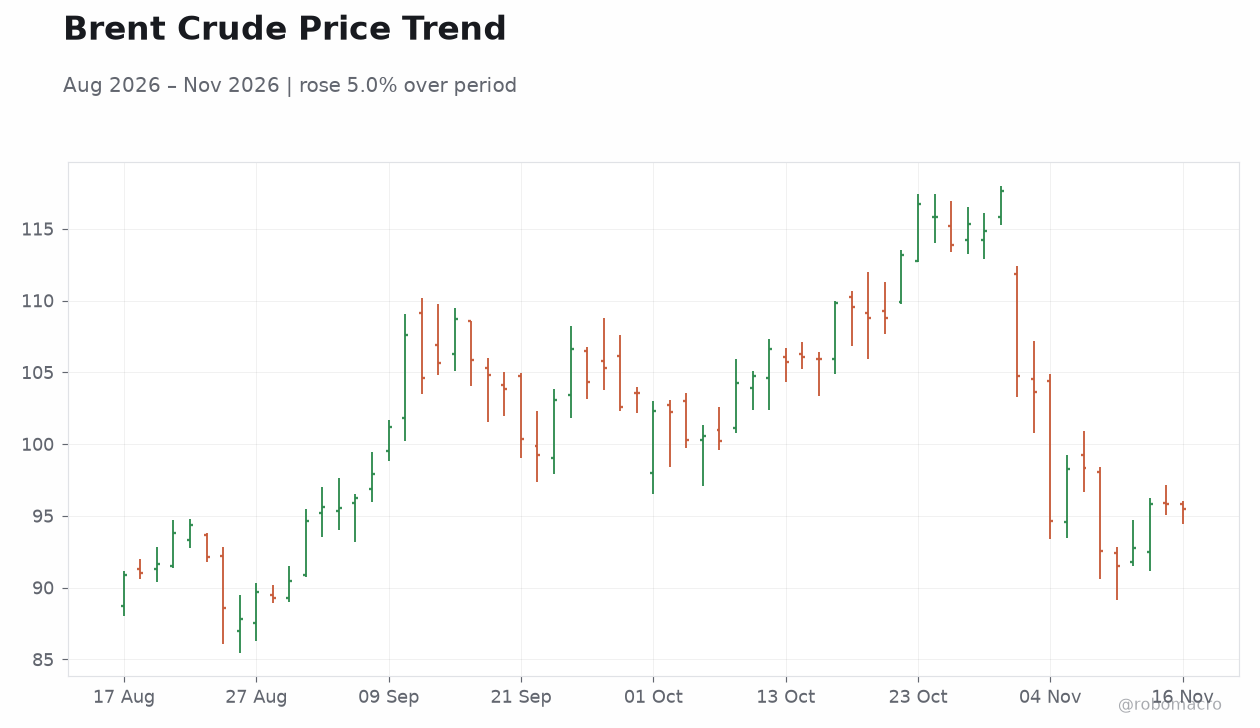
| Brent Crude | 95.37 | -0.49% |
| Gold | 3,877.10 | -0.24% |
| Bitcoin | 64,755.66 | +0.98% |
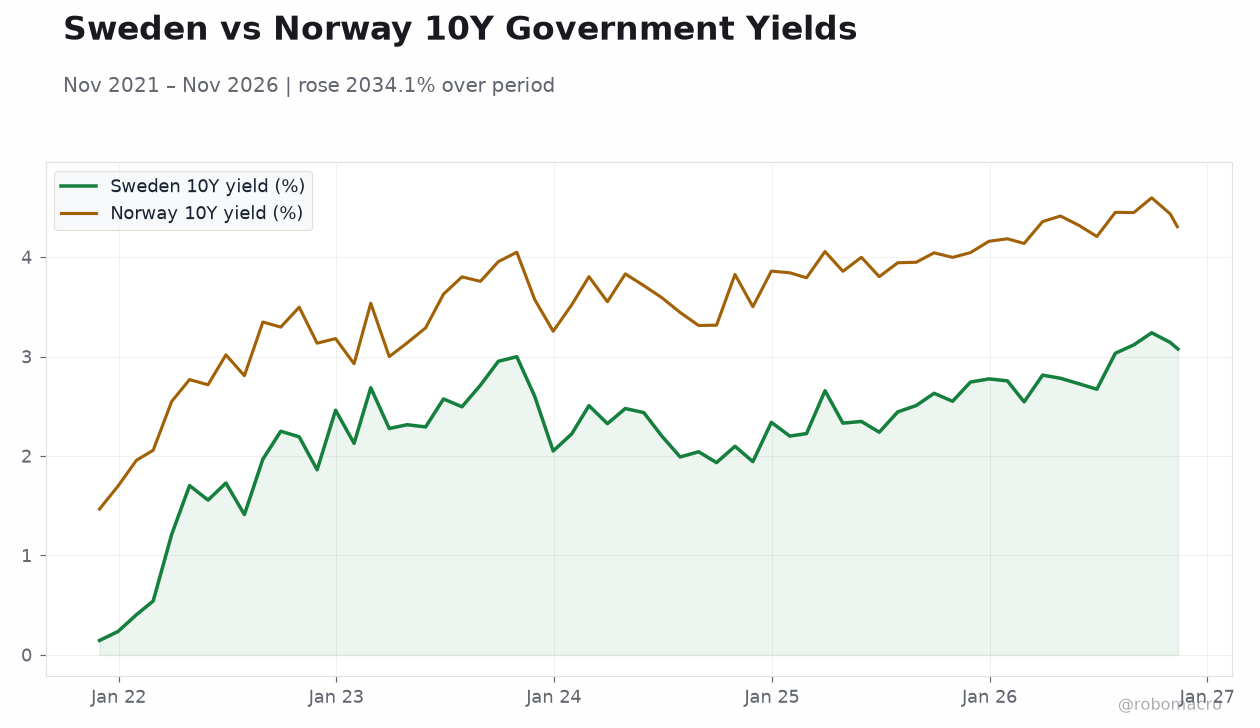
| Sweden 10Y Govt Yield | 3.08% | 0 bp |
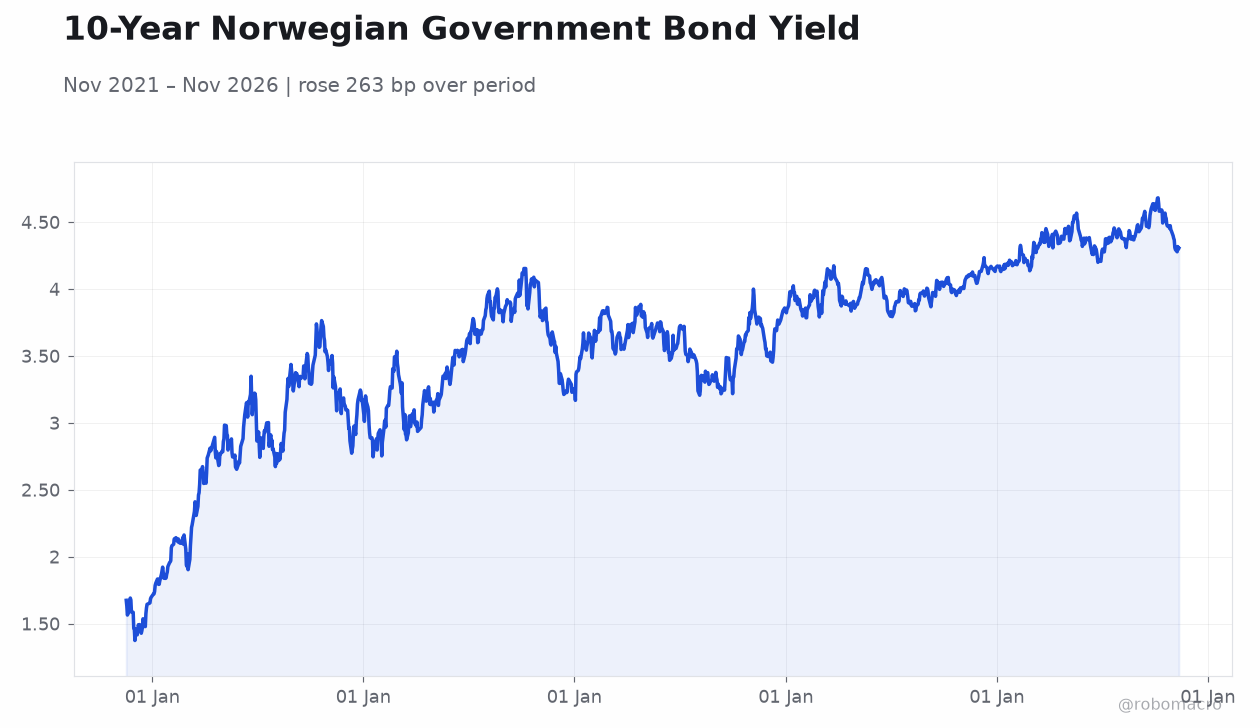
| Norway 10Y Govt Yield | 4.31% | +1 bp |
Prior Economic Events
| Data | Prior | Cons | Actual |
|---|---|---|---|
| No events available | |||
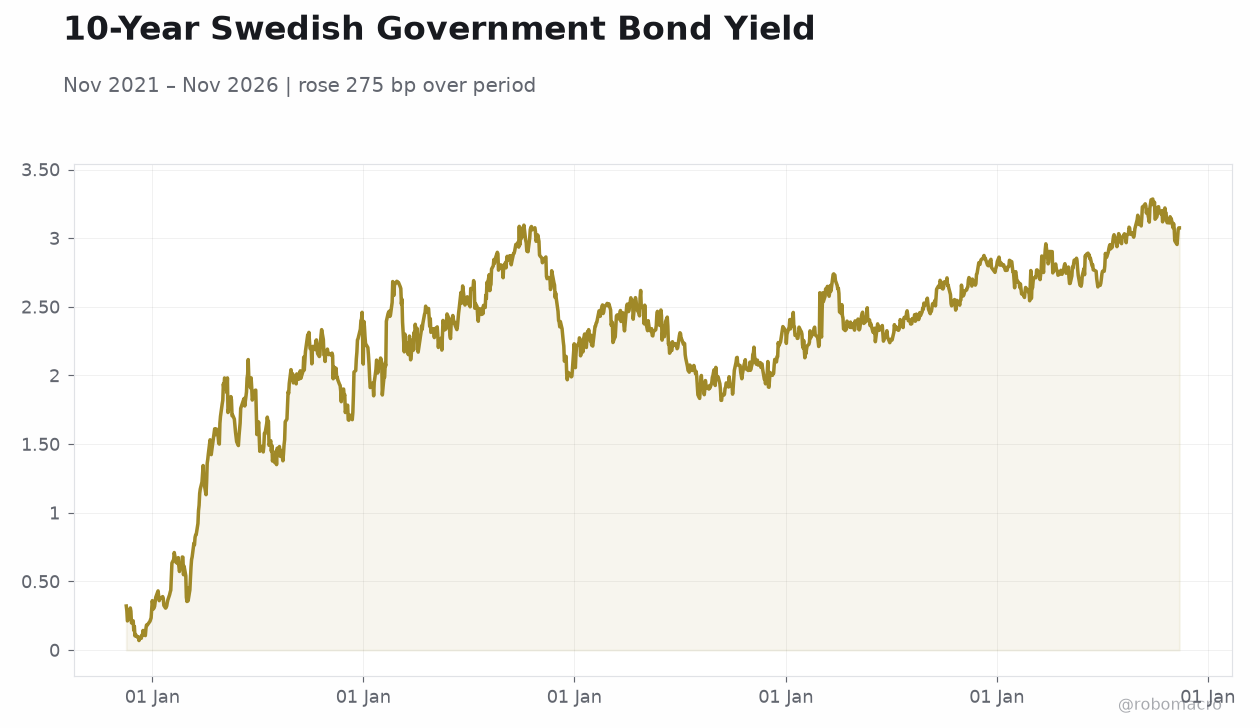 10-Year Swedish Government Bond Yield | Type: macro_line | 10-Year Swedish Government Bond Yield: 3.075 (2026-11-13) | Range: 0.06946–3.285 | Trend(5pt): 0.3211,2.43,2.319,2.425,3.075
Today's Economic Events
| Data | Prior | Cons | Time |
|---|---|---|---|
| No events available | |||
- Riksbank's 4 November +25bp hike to 2.00% is feeding through: EUR/SEK at 11.10 and USD/SEK 10.07 as the krona softens despite tighter policy.
- Norway's Supreme Court invalidated three North Sea oil licences on emissions grounds, a structural risk to the upstream pipeline; Brent at $95.37 (-0.49%).
- Nordic equities mixed: Oslo Bors +0.25%, Copenhagen +0.12%, Stockholm -0.07%, Helsinki -0.14%; Norway 10Y at 4.31% (+1bp), Sweden 10Y steady at 3.08%.
Yesterday's Recap
Nordic markets closed the week with little directional conviction. Oslo Bors outperformed, gaining 0.25%, while OMX Copenhagen rose 0.12%; Sweden's OMX Stockholm slipped 0.07% and Helsinki's OMX 25 fell 0.14%. FX was the more telling signal: the krona weakened on both legs, with USD/SEK up 0.39% to 10.07 and EUR/SEK 0.16% firmer at 11.10, an odd pairing given the Riksbank's 4 November +25bp hike to 2.00% — markets appear to be questioning whether the hike survives into 2027.
The krone was steadier, USD/NOK +0.09% to 9.57 and EUR/NOK -0.14% to 10.55. Rates were quiet: Sweden's 10-year held at 3.08% (0bp) while Norway's edged 1bp higher to 4.31%, leaving the SEK-NOK spread wide. The dominant story was legal rather than macro — Norway's Supreme Court ruled three North Sea oil licences invalid because their emissions impact had not been adequately assessed, a precedent that could slow future licensing rounds.
Sweden's 1.10% October CPI remains well below the Riksbank's target, and Norway's 3.60% print keeps Norges Bank's 4.50% rate firmly restrictive.
The Day Ahead
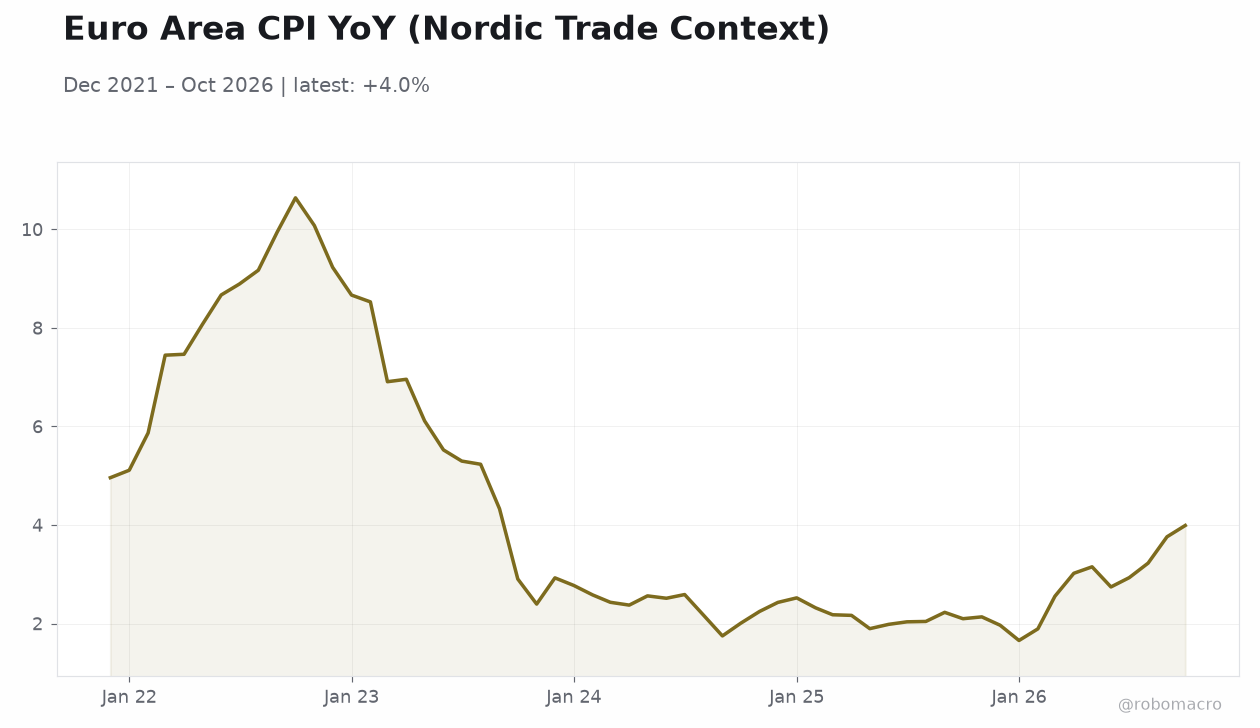
The calendar is empty across all four countries for 16 November, with no tier-one releases scheduled and nothing carried over from the weekend. With no domestic prints to trade, attention shifts to positioning ahead of the 16 December Riksbank and 17 December Norges Bank decisions — the last meetings of 2026. SEK and NOK will likely take their cue from euro-area rates and Brent, with the krona's recent softness the key tell on whether markets believe the November hike sticks.
Norwegian upstream names remain in focus as the market digests the licence ruling's read-across to project timelines. Danish and Finnish markets will track ECB pricing, with the EUR/DKK peg untested near current levels.
Other Economic Notes
The IMF's concluding statement on Finland, published via the Bank of Finland, puts the eurozone member's competitiveness and fiscal trajectory under external scrutiny — relevant given Finland's exposure to Russian trade disruption and its participation in ECB policy. ↓ p.2