Riksbank Hike Fallout, NOK Weakens as Yields Diverge
OMX Stockholm 303,341.95-0.44%
Oslo Bors2,103.15-0.41%
OMX Copenhagen 252,019.09+0.10%
OMX Helsinki 256,289.67-0.68%
Market Snapshot
| Asset | Level | Change |
|---|
| OMX Stockholm 30 | 3,341.95 | -0.44% |
| Oslo Bors | 2,103.15 | -0.41% |
| OMX Copenhagen 25 | 2,019.09 | +0.10% |
| OMX Helsinki 25 | 6,289.67 | -0.68% |
| USD/SEK | 10.08 | +0.11% |
| USD/NOK | 9.64 | +0.84% |
| EUR/SEK | 11.10 | -0.04% |
| EUR/NOK | 10.62 | +0.68% |
| Brent Crude | 91.69 | -0.81% |
| Gold | 3,885.40 | +0.84% |
| Bitcoin | 64,940.92 | -0.56% |
| Sweden 10Y Govt Yield | 3.08% | 0 bp |
| Norway 10Y Govt Yield | 4.36% | +5 bp |
Prior Economic Events
| Data |
Prior |
Cons |
Actual |
| No events available |
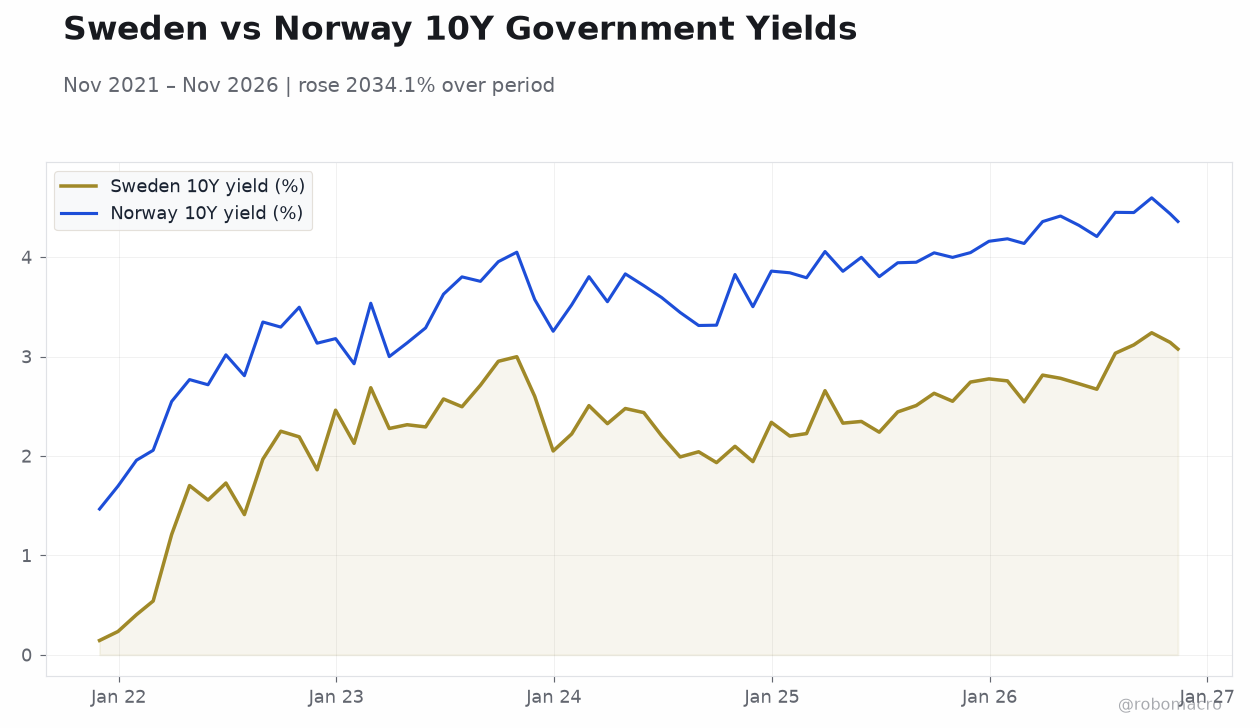 Sweden vs Norway 10Y Government Yields | Type: macro_line | Sweden 10Y yield (%): 3.075 (2026-11-13) | Range: 0.1441–3.239 | Trend(5pt): 0.1441,2.686,2.436,2.507,3.075 | Norway 10Y yield (%): 4.358 (2026-11-13) | Range: 1.466–4.596 | Trend(5pt): 1.466,3.536,3.713,3.948,4.358
Today's Economic Events
| Data |
Prior |
Cons |
Time |
| No events available |
- Nordic equities closed broadly lower Monday, with OMX Helsinki 25 down 0.68% and OMX Stockholm 30 off 0.44%, while OMX Copenhagen 25 edged up 0.10%.
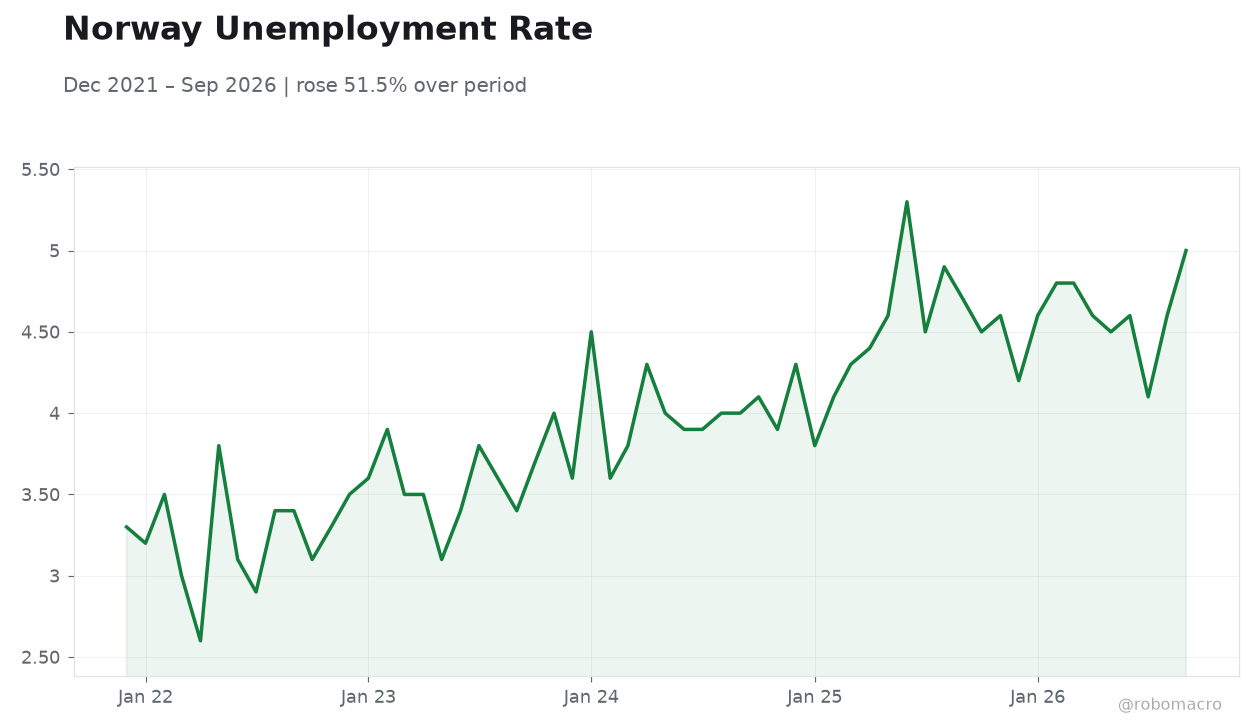
- Norwegian 10-year yields rose 5 bp to 4.36% as the krone weakened sharply, USD/NOK up 0.84% to 9.64 and EUR/NOK up 0.68% to 10.62.
- Sweden's political uncertainty deepened as the Left Party said government negotiations are "back to square one," with the Centre Party backing the red-green bloc.
Yesterday's Recap
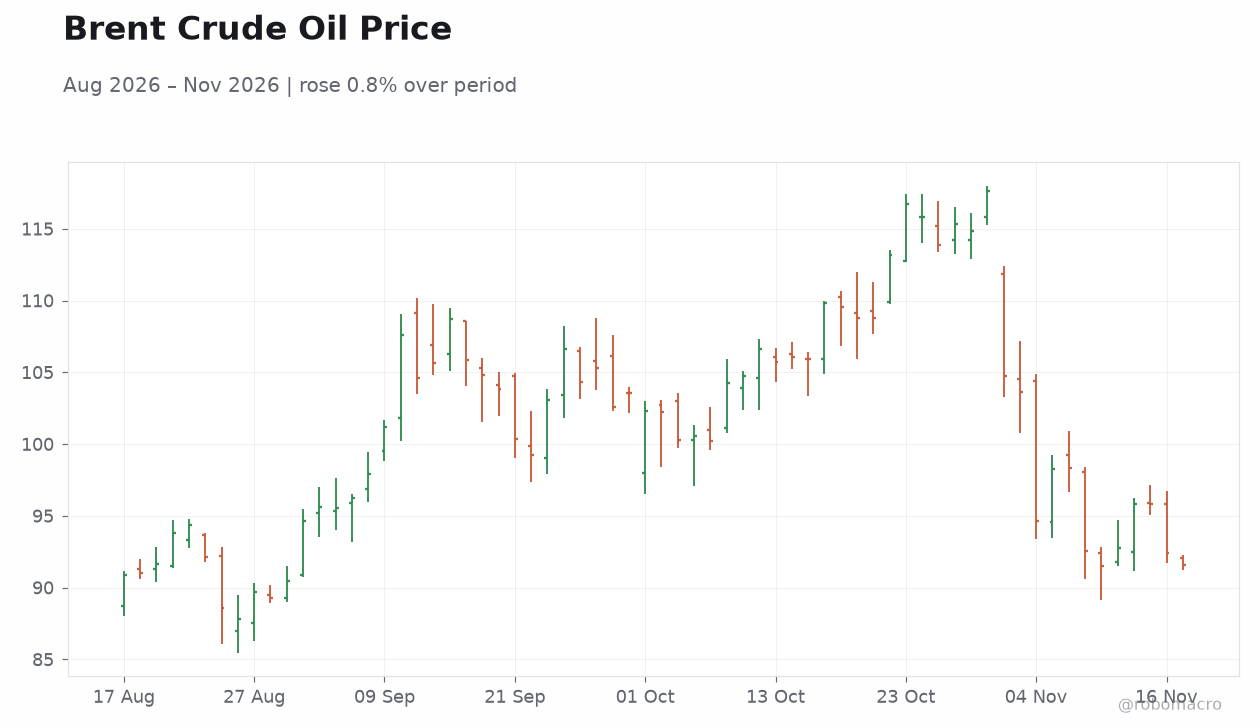
Nordic markets opened the week on a defensive footing, with Sweden and Norway dominating the tape. The OMX Stockholm 30 fell 0.44% to 3,341.95 and Oslo Bors slipped 0.41% to 2,103.15, while OMX Helsinki 25 underperformed at -0.68% to 6,289.67; OMX Copenhagen 25 was the lone gainer at +0.10% to 2,019.09. FX markets delivered the clearest signal: USD/NOK jumped 0.84% to 9.64 and EUR/NOK rose 0.68% to 10.62, a notable krone selloff that coincided with Brent crude falling 0.81% to $91.69 — a double hit to Norway's terms of trade and fiscal outlook.
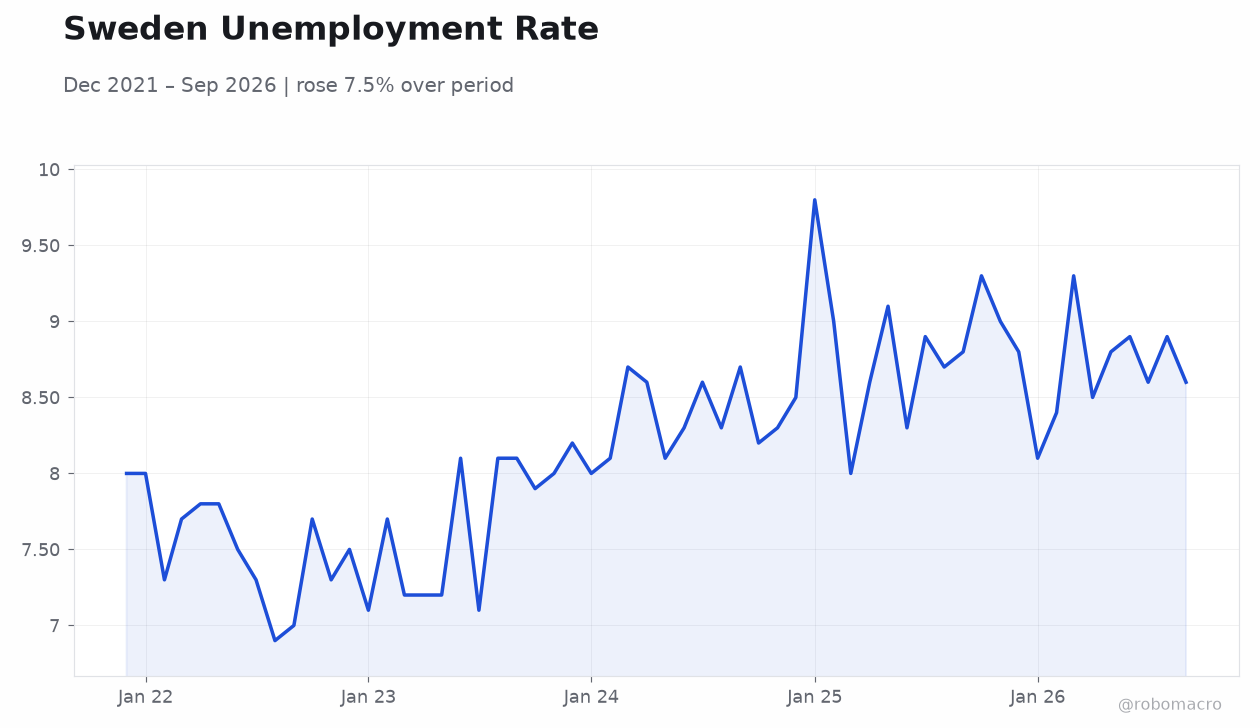
Swedish FX was comparatively stable, with USD/SEK up just 0.11% to 10.08 and EUR/SEK essentially flat at 11.10. Rates diverged: Norway's 10-year government yield climbed 5 bp to 4.36%, while Sweden's 10-year held at 3.08% — a spread of 128 bp that underscores the divergent policy paths of Norges Bank and the Riksbank. On the political front, Sweden's Left Party declared cabinet negotiations "back to square one" after the Centre Party backed the red-green bloc, reviving the prospect of prolonged government formation uncertainty in Stockholm.
In Norway, DNB drew attention with plans to raise card fees, a reminder that domestic price pressures remain embedded even as headline CPI sits at 3.60%.
The Day Ahead
The Nordic calendar is empty for Tuesday, November 17, leaving markets to trade off external catalysts and positioning ahead of a dense late-November data window. With no domestic prints to anchor sentiment, Swedish and Norwegian rates will likely take their cue from euro-area and US developments, particularly any moves in Bunds and Treasuries that could widen or compress the 128 bp SE-NO spread. Equity markets will remain sensitive to Brent crude, given the krone's demonstrated correlation with oil; a further slide toward the $90 handle would keep NOK under pressure and complicate Norges Bank's inflation fight.
Denmark's OMX Copenhagen 25 will trade in the shadow of the EUR/DKK peg, with Nationalbank policy effectively locked to the ECB. Finnish markets will track euro-area sentiment, with OMX Helsinki 25's underperformance Monday suggesting continued caution on export-oriented names. Attention also turns to the Riksbank's December 16 meeting and Norges Bank's December 17 decision, both now within a month.
Page 1
Never miss an issue
Subscribe to Nordics Macro Daily and get each new issue delivered to your inbox.
Already a member? Visit robomacro.com
to log in and manage subscriptions, or use Forgot Password to set a password.