RoboMacro ResearchAlso todaySee the Commodities Daily

Nordics Macro Daily(Beta Mode)

November 23, 2026 robomacro.com

Nordic Equities Slump as Yields Ease, Brent Retreats

OMX Stockholm 303,175.06-2.51%
Oslo Bors2,037.68-1.50%
OMX Copenhagen 251,920.56-1.55%
OMX Helsinki 255,905.12-3.04%

Market Snapshot

AssetLevelChange
OMX Stockholm 303,175.06-2.51%
Oslo Bors2,037.68-1.50%
OMX Copenhagen 251,920.56-1.55%
OMX Helsinki 255,905.12-3.04%
USD/SEK10.21+0.10%
USD/NOK9.74-0.28%
EUR/SEK11.21+0.25%
EUR/NOK10.70-0.13%
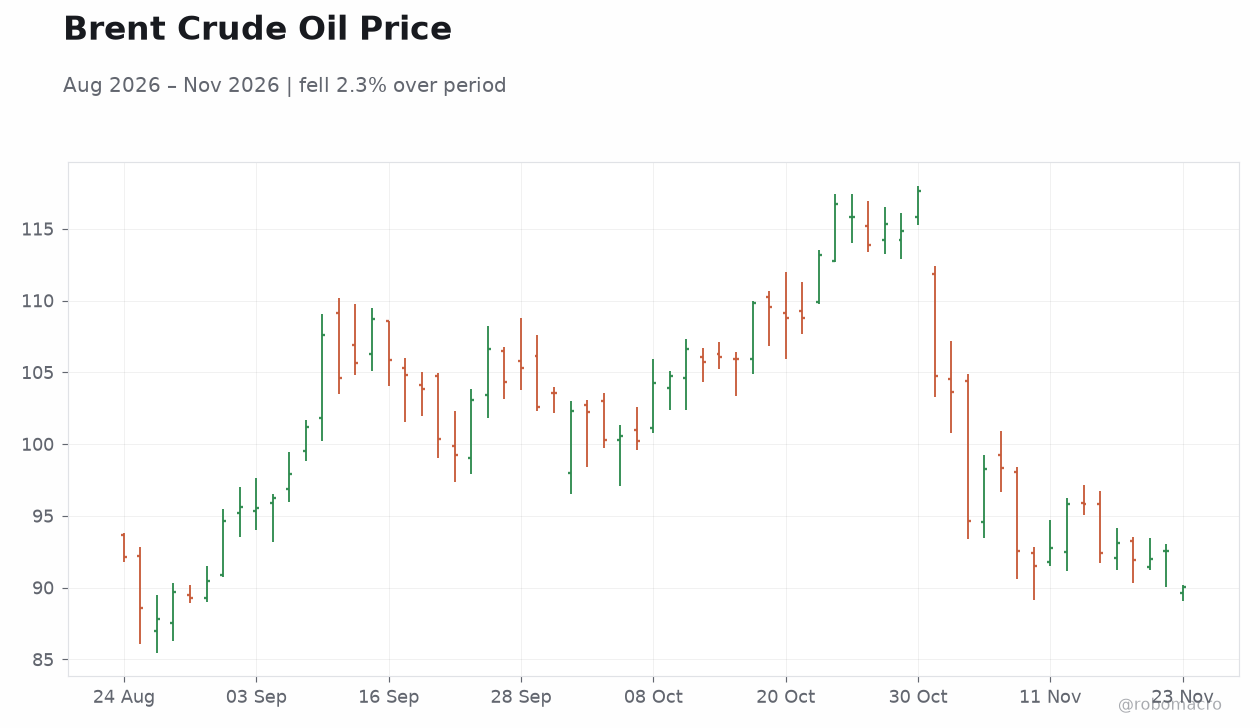
Brent Crude90.03-2.74%
Gold3,605.90+2.57%
Bitcoin61,242.44+1.91%
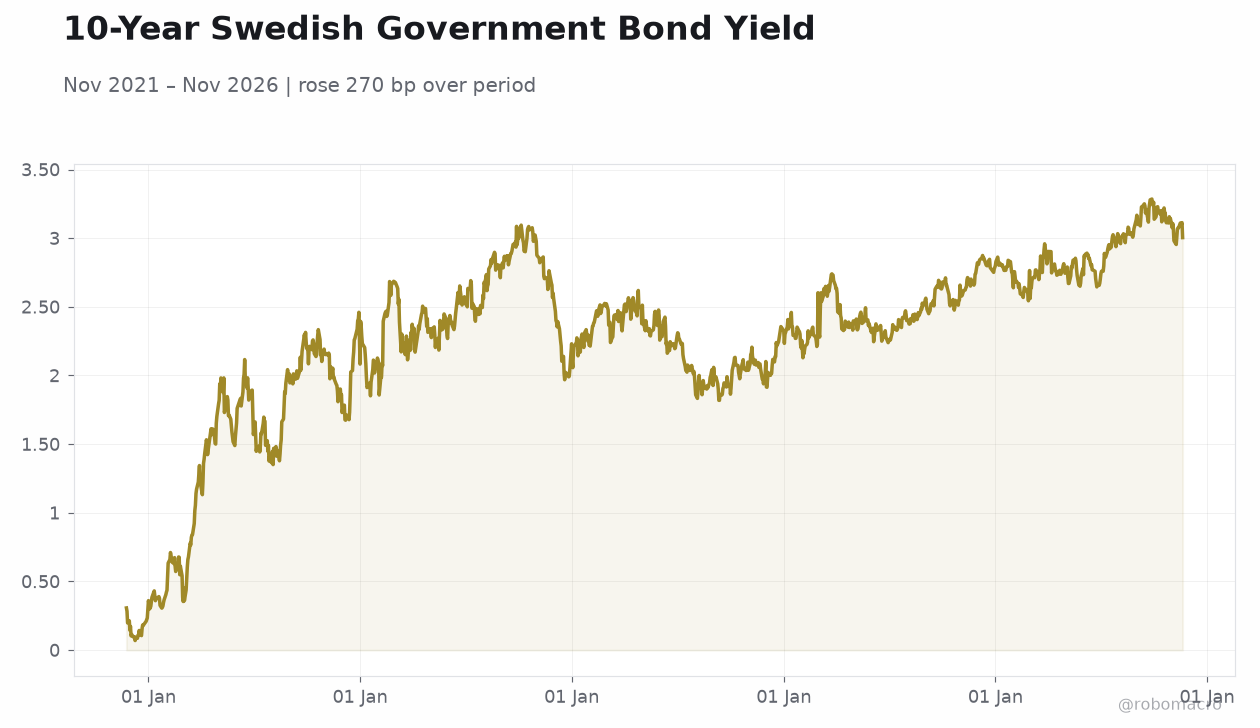
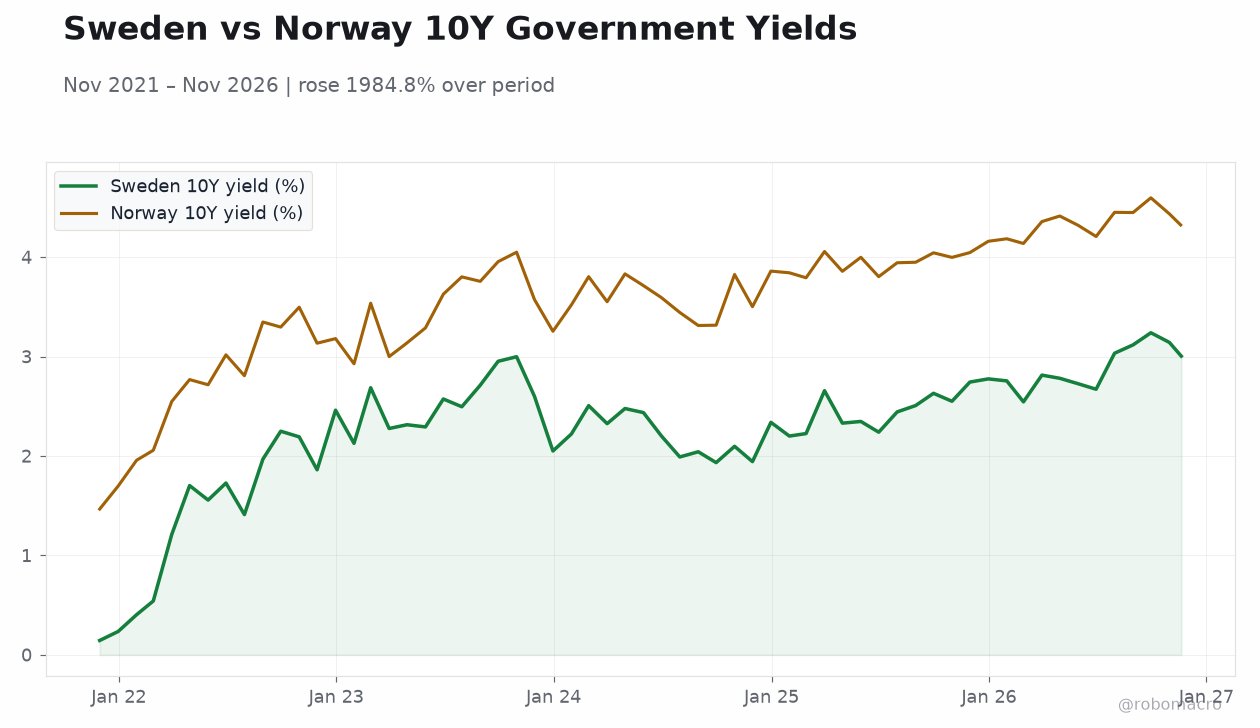
Sweden 10Y Govt Yield3.00%-11 bp
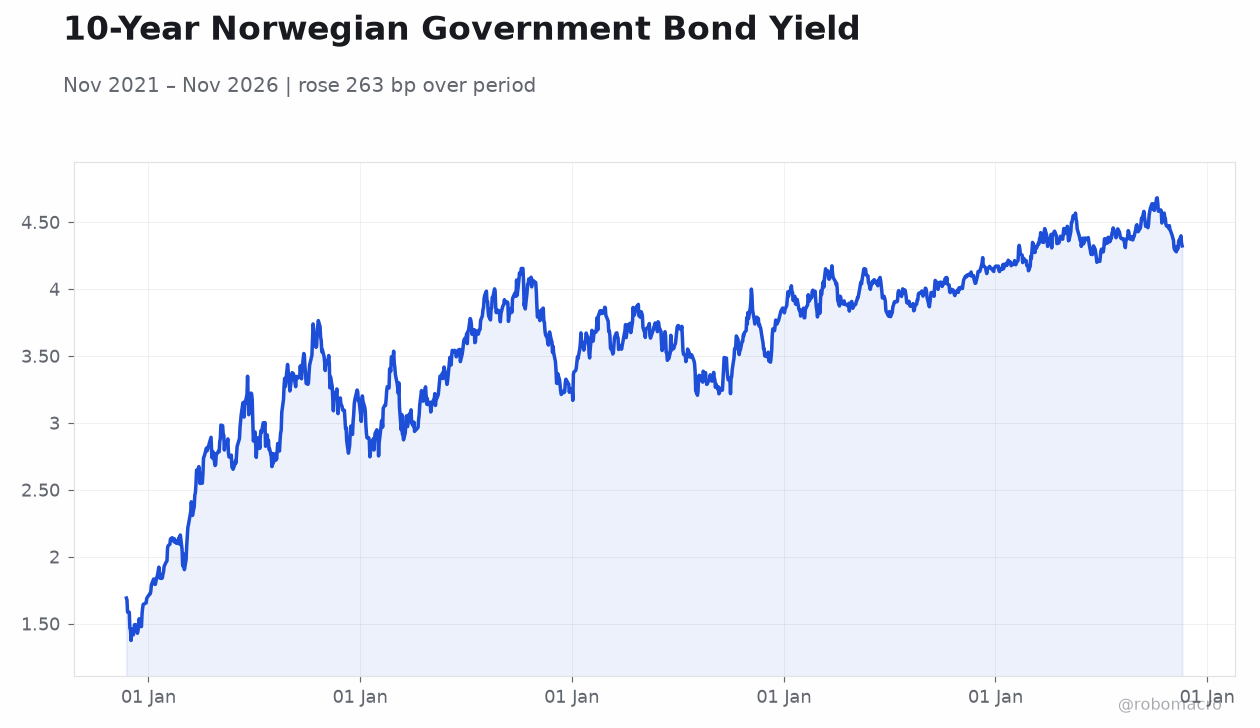
Norway 10Y Govt Yield4.32%-2 bp

Prior Economic Events

Data Prior Cons Actual
No events available
10-Year Swedish Government Bond Yield10-Year Swedish Government Bond Yield | Type: macro_line | 10-Year Swedish Government Bond Yield: 3.004 (2026-11-20) | Range: 0.06946–3.285 | Trend(5pt): 0.307,2.583,2.467,2.464,3.004

Today's Economic Events

Data Prior Cons Time
No events available
  • Nordic bourses sold off sharply, with OMX Helsinki 25 down 3.04% and OMX Stockholm 30 off 2.51%, while Sweden's 10-year yield fell 11 bp to 3.00%
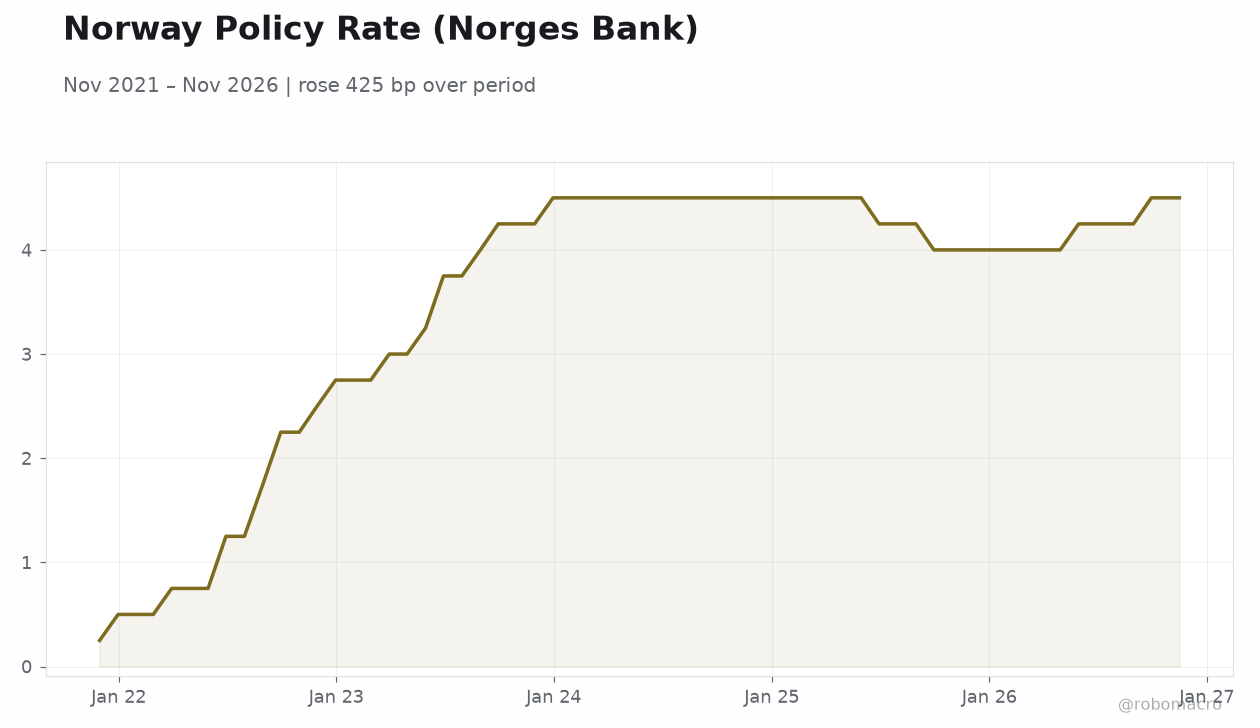
  • Brent crude dropped 2.74% to $90.03, weighing on Oslo Børs (-1.50%) and the NOK outlook despite Norges Bank's hawkish 4.50% stance
  • Riksbank's November 4 hike to 2.00% and Norges Bank's September hike to 4.50% frame a Nordic policy backdrop diverging sharply from the ECB

Yesterday's Recap

Nordic equity markets suffered a broad-based risk-off session on November 22, with Finland the worst hit as OMX Helsinki 25 tumbled 3.04% to 5,905.12, followed by Sweden's OMX Stockholm 30 down 2.51% to 3,175.06. Copenhagen's OMX 25 fell 1.55% to 1,920.56 and Oslo Børs slipped 1.50% to 2,037.68, the relative outperformance reflecting energy-sector support as Brent held above $90 intraday before settling lower. Swedish fixed income rallied hard, with the 10-year government yield easing 11 bp to 3.00%, a move consistent with falling global rates and safe-haven demand rather than any domestic catalyst.

Norway's 10-year yield edged just 2 bp lower to 4.32%, leaving the NOK curve steep and the krone softer against the dollar at 9.74 even as EUR/NOK drifted to 10.70. The Swedish krona weakened modestly, USD/SEK at 10.21 (+0.10%) and EUR/SEK at 11.21 (+0.25%), suggesting the equity drawdown carried limited FX contagion. No Nordic tier-one data printed on the day, leaving price action driven by global risk sentiment and commodity moves.

Gold's 2.57% surge to $3,605.90 underscored the defensive tone across markets.

The Day Ahead

The Nordic calendar is empty for November 23, with no scheduled tier-one releases from Statistics Sweden, Statistics Norway, Danmarks Statistik or Statistics Finland. Market direction will therefore be set by global risk appetite and energy pricing, with Brent's slide below $91 the key variable for Oslo Børs and the NOK. Swedish rate markets will continue to digest the Riksbank's November 4 hike to 2.00%, with the 3.00% 10-year yield and 1.10% October CPI framing a real-rate picture that remains restrictive.

Norwegian markets will watch the krone closely, with EUR/NOK at 10.70 and Norges Bank's 4.50% policy rate keeping the carry story intact ahead of the December 17 meeting. Danish and Finnish markets will track euro-area sentiment, with the EUR/DKK peg and ECB policy path the dominant external anchors.

Other Economic Notes

Sweden's October CPI at 1.10% sits well below the Riksbank's target, yet the central bank raised rates to 2.00% on November 4, implying a forward-looking concern about inflation re-acceleration rather than current price pressure. ↓ p.2
Page 1

Nordics Macro Daily(Beta Mode)

November 23, 2026 robomacro.com
10-Year Norwegian Government Bond Yield 10-Year Norwegian Government Bond Yield | Type: macro_line | 10-Year Norwegian Government Bond Yield: 4.323 (2026-11-19) | Range: 1.375–4.682 | Trend(6pt): 1.692,3.271,3.747,3.962,4.343,4.323
Sweden vs Norway 10Y Government Yields Sweden vs Norway 10Y Government Yields | Type: macro_line | Sweden 10Y yield (%): 3.004 (2026-11-20) | Range: 0.1441–3.239 | Trend(5pt): 0.1441,2.686,2.436,2.507,3.004 | Norway 10Y yield (%): 4.323 (2026-11-19) | Range: 1.466–4.596 | Trend(5pt): 1.466,3.536,3.713,3.948,4.323
Norway Policy Rate (Norges Bank) Norway Policy Rate (Norges Bank) | Type: macro_line | Norges Bank policy rate (%): 4.5 (2026-11-16) | Range: 0.25–4.5 | Trend(5pt): 0.25,2.75,4.5,4.25,4.5
Brent Crude Oil Price Brent Crude Oil Price | Type: market_hloc | Brent crude (USD/bbl): 90.04 (2026-11-23) | Range: 87.84–117.6 | Trend(5pt): 92.17,105.8,104.3,117.6,90.04

Other Economic Notes (continued)

Norway's CPI at 3.60% remains materially above target, consistent with Norges Bank's 4.50% rate and its September hike, and the krone's sensitivity to energy prices keeps the inflation outlook tied to Brent. Denmark's export-oriented manufacturing base and its EUR/DKK peg leave Copenhagen importing ECB conditions, while Finland's eurozone membership means Helsinki's 3.04% equity slump reflects broader European growth worries rather than domestic policy. The divergence between Swedish and Norwegian policy settings — 2.00% versus 4.50% — is among the widest in the developed world and continues to drive cross-border flow dynamics.

Global Macro News

Global markets were in defensive mode, with gold surging 2.57% to $3,605.90 and Bitcoin up 1.91% to $61,242.44 even as equities sold off, a configuration suggesting hedging demand rather than outright liquidation. Brent's 2.74% decline to $90.03 reflects demand concerns and is directly negative for Norway's fiscal outlook and krone, though the NOK has so far held relatively firm. Bloomberg Economics reported Japan's economy shrank slightly in Q3 as record rainfall from late August weighed on consumer spending, adding to the global growth narrative that pressured cyclical Nordic exporters.

Bundesbank's Nagel argued the ECB has raised rates to a restrictive level, reinforcing expectations that euro-area policy is near its peak — a framework that constrains Danmarks Nationalbank and the Bank of Finland. ECB supervision flagged demographic change as a growing risk for Europe's economy and banks, a structural theme relevant to all four Nordic economies. Denmark's expulsion of a Russian diplomat over an attempt to kill a Ukrainian rapper added a geopolitical overlay to Copenhagen sentiment.

Sponsored by Arbitrage Search
Page 2

Nordics Macro Daily(Beta Mode)

November 23, 2026 robomacro.com

Continuation

Nordic Central Banks Watch

The Riksbank raised its policy rate by 25 bp to 2.00% at the November 4 decision, its most recent move, with the next meeting set for December 16; the hike came despite October CPI at just 1.10%, signaling the committee's focus on guarding against a rebound rather than responding to current inflation. Norges Bank holds its policy rate at 4.50%, set at the September 24 decision following a 25 bp hike, with the most recent decision on November 5 a hold and the next meeting on December 17; Norwegian CPI at 3.60% keeps the committee firmly in restrictive territory and any future reduction should be framed as a possible reversal of the September hike. Danmarks Nationalbank continues to mirror the ECB to defend the EUR/DKK peg, with no independent rate signal expected while euro-area policy sits at restrictive levels per Nagel's assessment.

The Bank of Finland operates directly under the ECB, so Helsinki's rate path is set in Frankfurt, and Finland's 3.04% equity decline reflects euro-area growth concerns rather than domestic monetary conditions. The policy divergence between Sweden at 2.00% and Norway at 4.50% remains the defining Nordic macro theme, with the krone's energy-linked sensitivity and the krona's equity-driven weakness both consistent with that gap.

Sponsored by Arbitrage Search
Page 3