| Asset | Level | Change |
|---|---|---|
| JSE Top 40 | 102,102.80 | +0.66% |
| USD/ZAR | 16.80 | +0.53% |
| EUR/ZAR | 19.10 | +0.31% |
| Platinum | 1,612.90 | -0.48% |
| Gold | 4,046.70 | -0.68% |
| Brent Crude | 87.39 | -1.10% |
| Naspers | 78,960.00 | -0.69% |
| Bitcoin | 63,222.09 | -3.24% |
| South Africa Short-term Rate | 7.00% | +3.55% |
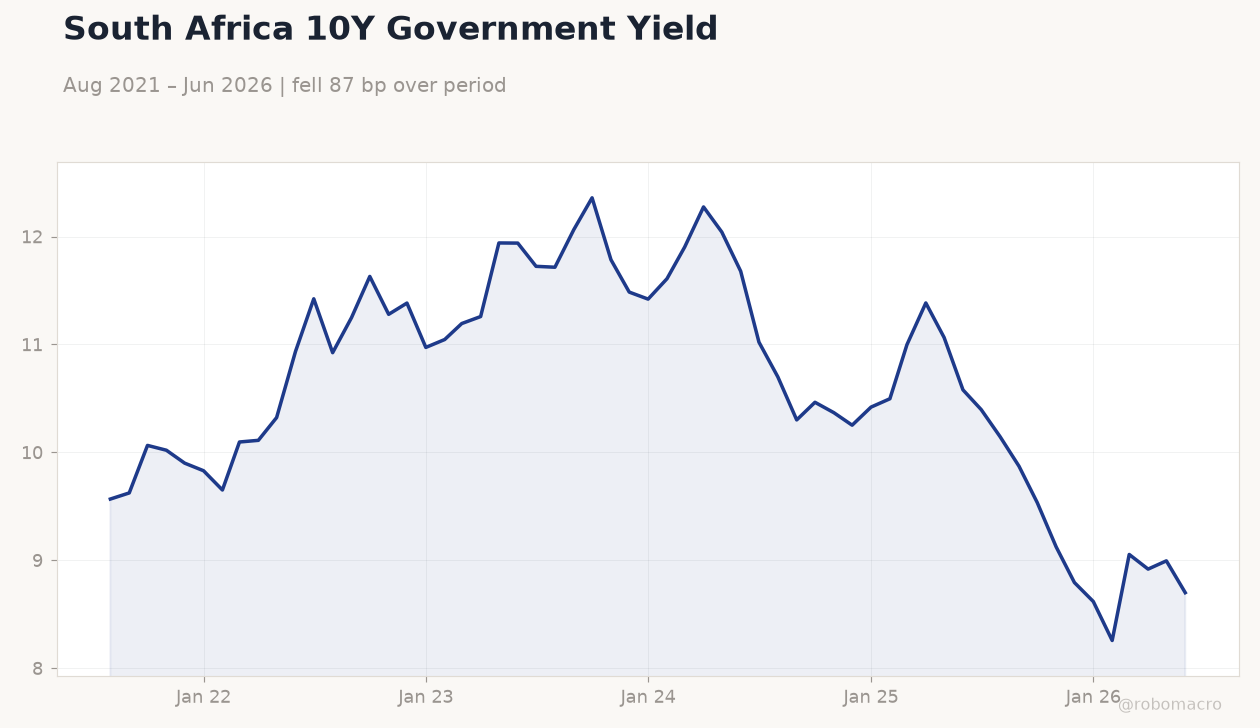
| South Africa Long-term Rate | 8.70% | -3.28% |
| Data | Prior | Cons | Actual |
|---|---|---|---|
| No events available | |||
South Africa 10Y Government Yield | Type: macro_line | 10Y Yield %: 8.7 (2026-06-01) | Range: 8.257–12.36 | Trend(6pt): 9.568,11.63,11.49,10.5,8.918,8.7
| Data | Prior | Cons | Time |
|---|---|---|---|
| Friday (2026-07-31) | |||
| Trade Balance | -1,790m | - | 04:00 |
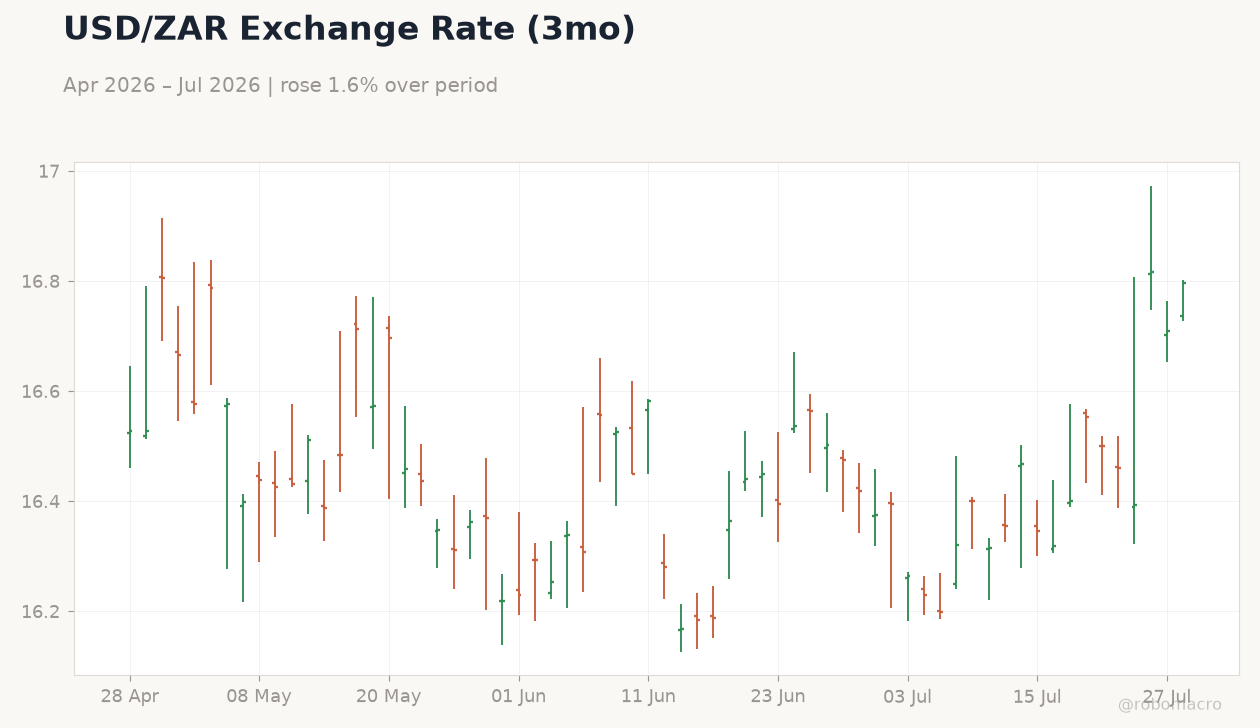
South African markets showed mixed moves on thin liquidity. The JSE Top 40 advanced 0.66% to 102,102.80, supported by resource names despite platinum falling 0.48% to 1,612.90. USD/ZAR climbed 0.53% to 16.80 while EUR/ZAR added 0.31% to 19.10, reflecting rand underperformance versus EM peers.
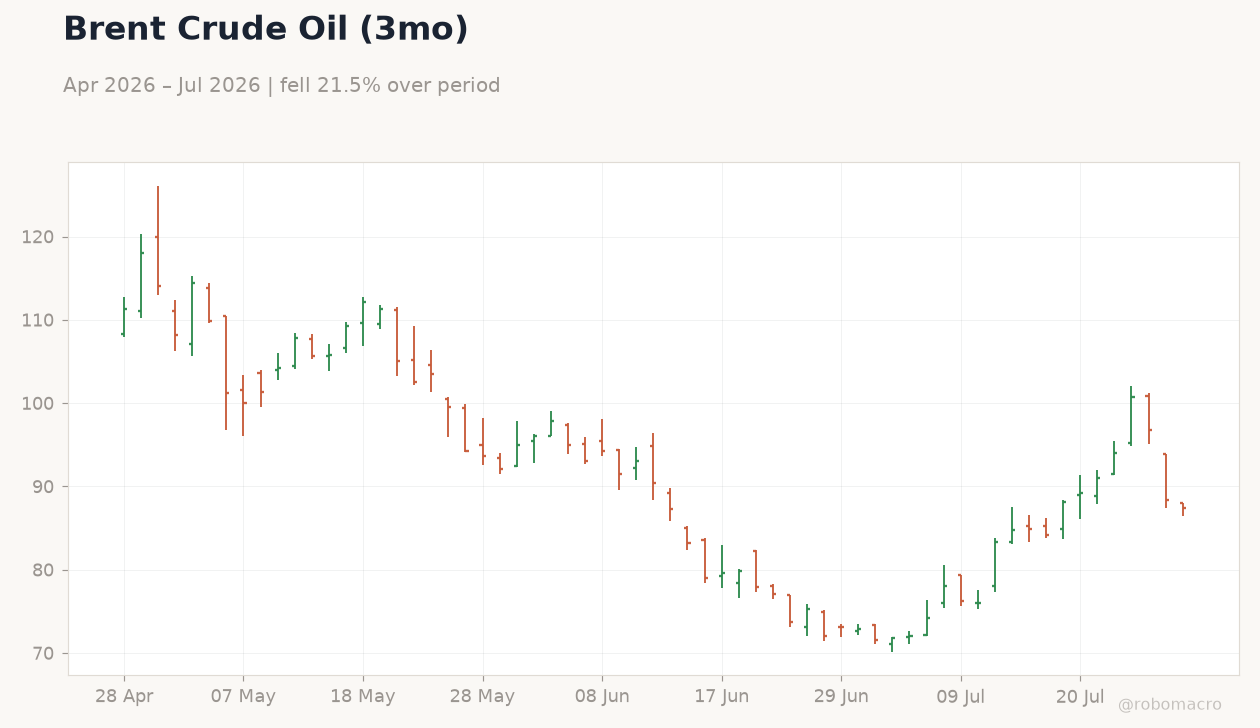
Brent crude slipped 1.10% to 87.39, easing imported inflation pressures. The short-term rate held at 7.00% while the long-term rate eased 3.28% to 8.70%. Naspers declined 0.69% to 78,960.00 and Bitcoin dropped 3.24% to 63,222.09.
No major data prints occurred, leaving focus on external risk sentiment and the recent SARB decision to hold. Eskom’s ongoing stage-2 load-shedding continues to weigh on manufacturing and mining output, though coal-plant availability has improved modestly. Finance Minister Godongwana reiterated the 3.0% of GDP fiscal deficit target for FY26/27 while flagging wage-bill pressures that could limit fiscal space.
Regional payment system integration advanced with the inclusion of the Angolan kwanza, supporting local-currency trade initiatives. Mining firms such as Anglo American Platinum have signaled possible further production cuts at key assets. These supply-side constraints keep medium-term growth forecasts anchored near 0.4% q/q for Q2.
The June trade balance is scheduled for release on Friday at 04:00 ET, with markets watching for any improvement from the prior -1.79 billion rand print. Private-sector credit and BER consumer confidence data are also due this week and will inform growth momentum. The SARB quarterly bulletin may provide additional color on credit conditions and inflation dynamics.
Load-shedding remains at stage 2, with Eskom availability still constraining industrial output. No MPC speeches are listed, keeping attention on external drivers such as oil and global risk appetite. A weaker-than-expected trade print could reinforce expectations for measured policy easing later in the year.
Improved global risk sentiment lifted EM currencies, including the rand, after Iran-US talks reduced geopolitical tensions. Falling oil prices further supported risk assets by lowering imported inflation risks for South Africa. Bank Indonesia’s unexpected governor resignation triggered volatility in Asian FX markets, indirectly affecting rand flows.
<i>↓ p.2</i>
Subscribe to South Africa Macro Daily and get each new issue delivered to your inbox.
Already a member? Visit robomacro.com to log in and manage subscriptions, or use Forgot Password to set a password.
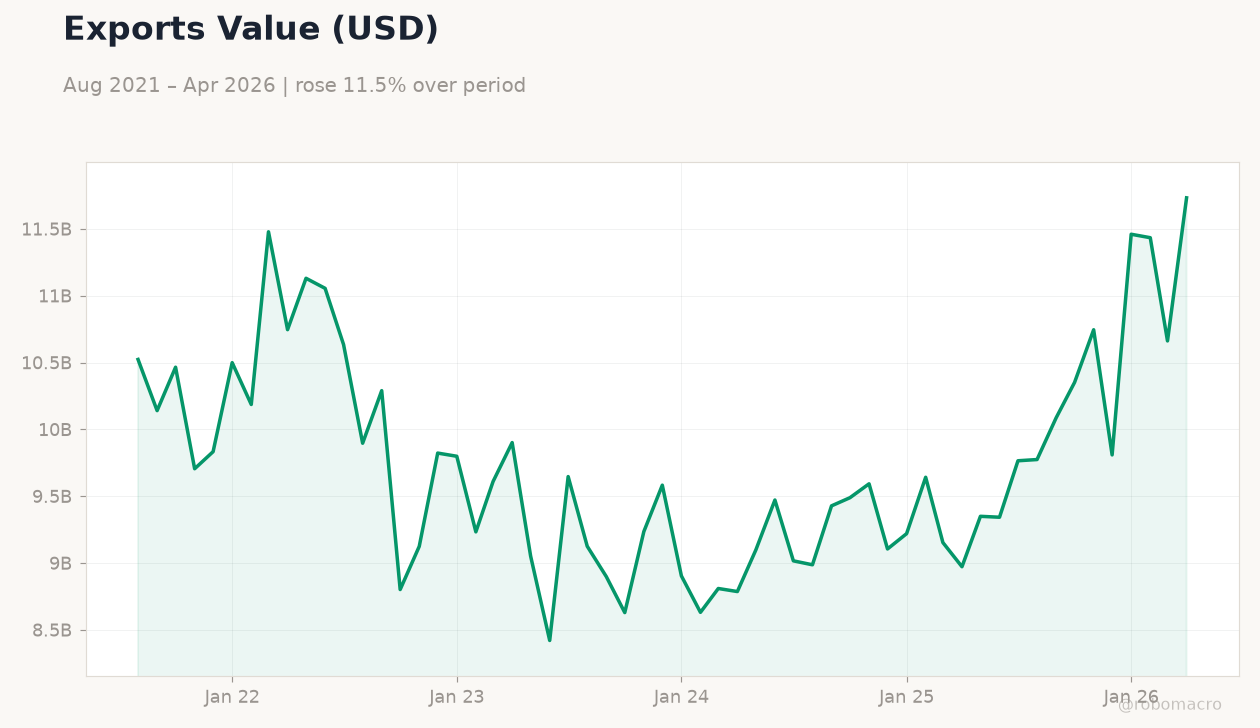
Exports Value (USD) | Type: macro_line | Exports (USD mn): 1.173e+10 (2026-04-01) | Range: 8.421e+09–1.173e+10 | Trend(5pt): 1.052e+10,8.802e+09,9.582e+09,9.642e+09,1.173e+10
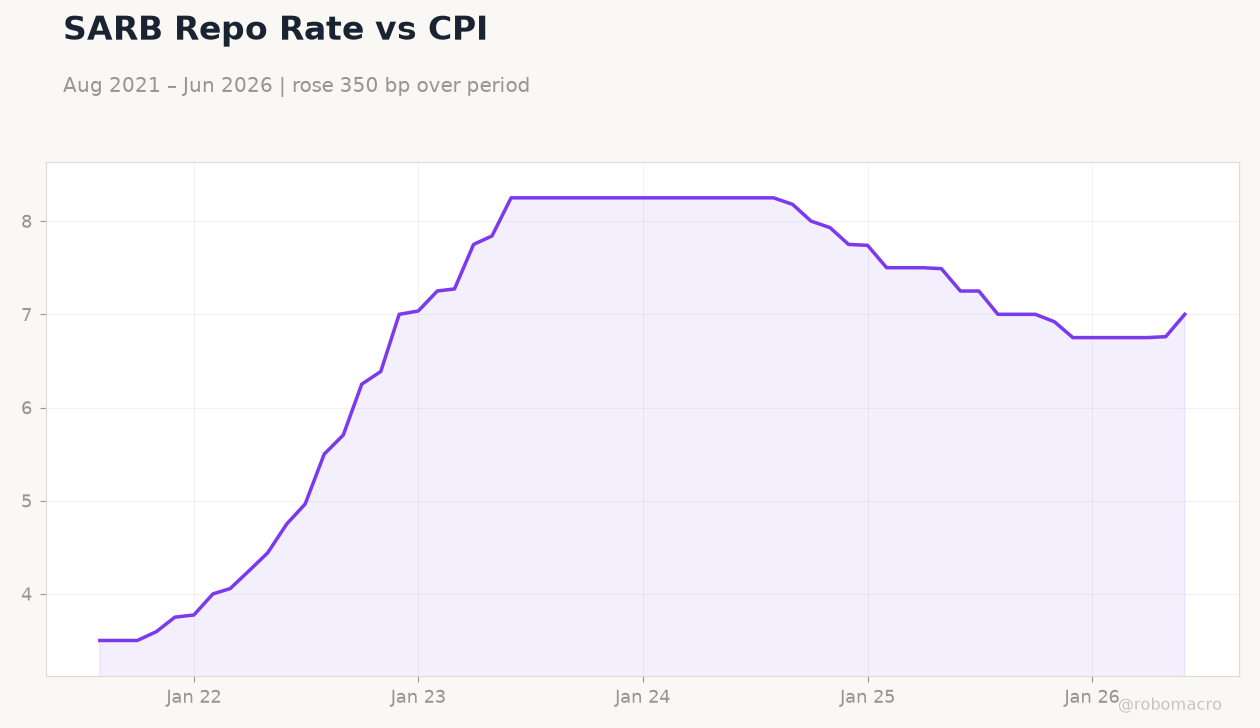
SARB Repo Rate vs CPI | Type: macro_line | Policy Rate %: 7 (2026-06-01) | Range: 3.5–8.25 | Trend(6pt): 3.5,6.25,8.25,7.5,6.75,7
USD/ZAR Exchange Rate (3mo) | Type: market_hloc | USD/ZAR: 16.8 (2026-07-28) | Range: 16.17–16.82 | Trend(6pt): 16.53,16.7,16.58,16.26,16.71,16.8
Brent Crude Oil (3mo) | Type: market_hloc | Brent $/bbl: 87.39 (2026-07-28) | Range: 71.57–118 | Trend(6pt): 111.3,111.3,93.1,71.8,96.78,87.39
Chinese PMI weakness weighed on commodity demand, pressuring platinum and gold prices lower.
Ghana’s repatriation of migrant workers from South Africa highlights ongoing social tensions that could affect regional labor supply. Nigeria urged stronger action against xenophobic incidents, adding diplomatic pressure on Pretoria. Broader EM sentiment remains sensitive to US policy signals and commodity price swings that directly influence South Africa’s terms of trade.
The mixed May production data and stable long-term yields suggest the bar for earlier easing remains elevated. Forward guidance continues to point to a gradual path rather than aggressive cuts, with OIS curves reflecting measured policy normalization. The rand’s recent recovery on external factors has reduced immediate imported inflation concerns, supporting the hold decision.
The SARB maintained the repo rate at 7.00% following the latest MPC meeting, consistent with inflation at 4.98% y/y remaining inside the target band. Markets continue to price a 25 bp cut by September, though the committee has emphasized data dependence and the need for sustained disinflation. Recent communications highlight vigilance on second-round effects from administered prices and wage settlements.
The committee voted to hold. Eskom reported stage-2 load-shedding through the weekend; coal-plant availability improved modestly. Anglo American Platinum flagged possible further curtailments at Mogalakwena.
Finance Minister Godongwana reiterated the 3.0% of GDP deficit target for FY26/27, but warned of wage-bill pressures. No major corporate earnings surprised. Key releases include June private-sector credit (consensus +4.9% y/y), July BER consumer confidence, and the SARB’s quarterly bulletin.
Credit and confidence prints are the most market-relevant; a sharp credit slowdown could reinforce cut expectations and support the rand.