US Macro Daily(Beta Mode)
Hot October CPI Lifts Yields, Weighs on Stocks
Market Snapshot
| Asset | Level | Change |
|---|---|---|
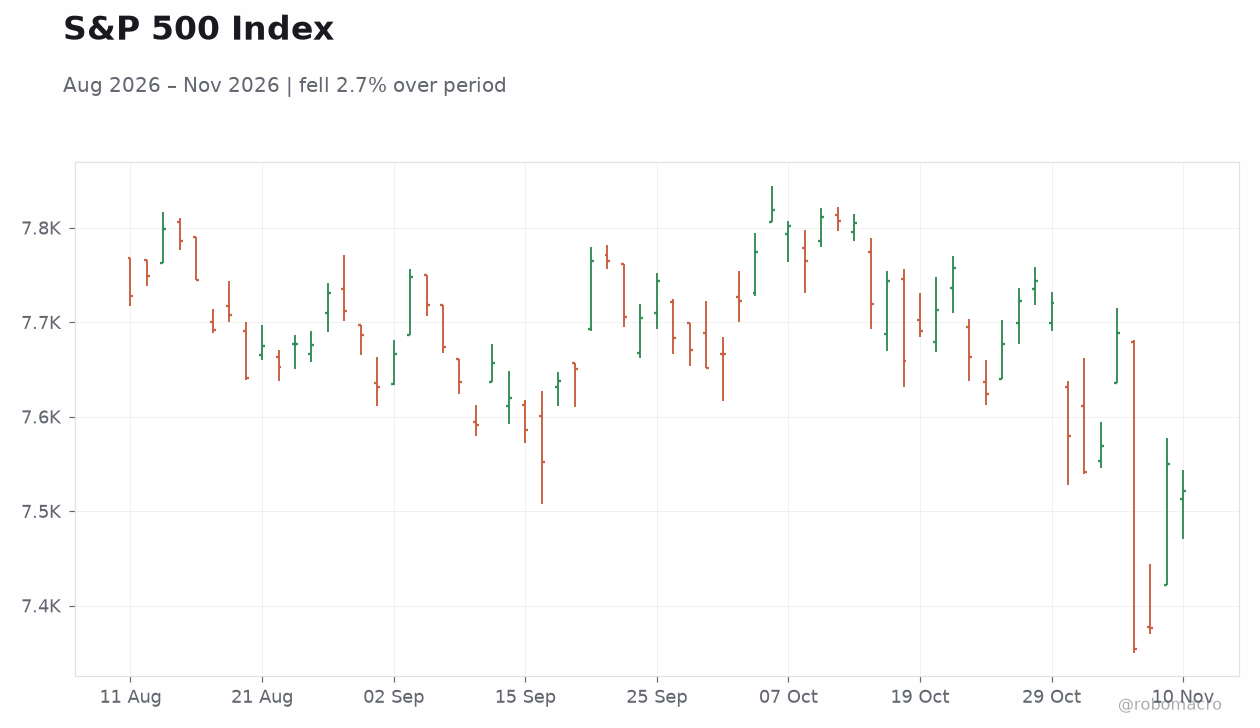
| S&P 500 | 7,520.93 | -0.38% |
| Nasdaq 100 | 27,740.79 | -0.60% |
| Dow Jones | 52,231.89 | -0.30% |
| Russell 2000 | 2,821.38 | -0.68% |
| USD/JPY | 159.11 | +0.71% |
| EUR/USD | 1.11 | -0.74% |
| GBP/USD | 1.33 | -0.94% |
| Gold | 4,061.90 | +0.79% |
| WTI Crude | 86.79 | +0.87% |
| Bitcoin | 73,960.40 | +0.33% |
| US 2Y Treasury | 4.73% | +17 bp |
| US 10Y Treasury | 4.98% | +10 bp |
Prior Economic Events
| Data | Prior | Cons | Actual |
|---|---|---|---|
| Fed Goolsbee Speech | - | - | - |
| Speech by Fed's Waller | - | - | - |
| ADP Employment Change Weekly | 16,750 | - | 19,750 |
| Core Inflation Rate Month-over-Month | 0.30 | 0.20 | 0.30 |
| Core Inflation Rate Year-over-Year | 2.60 | 2.80 | "" |
| Inflation Rate Month-over-Month | 0.60 | 0.30 | 0.40 |
| Inflation Rate Year-over-Year | 3.70 | 3.90 | "" |
| CPI s.a | 336.30 | - | 337.48 |
| Consumer Price Index | 336.94 | 337.02 | 337.51 |
| Speech by Fed's Logan | - | - | - |
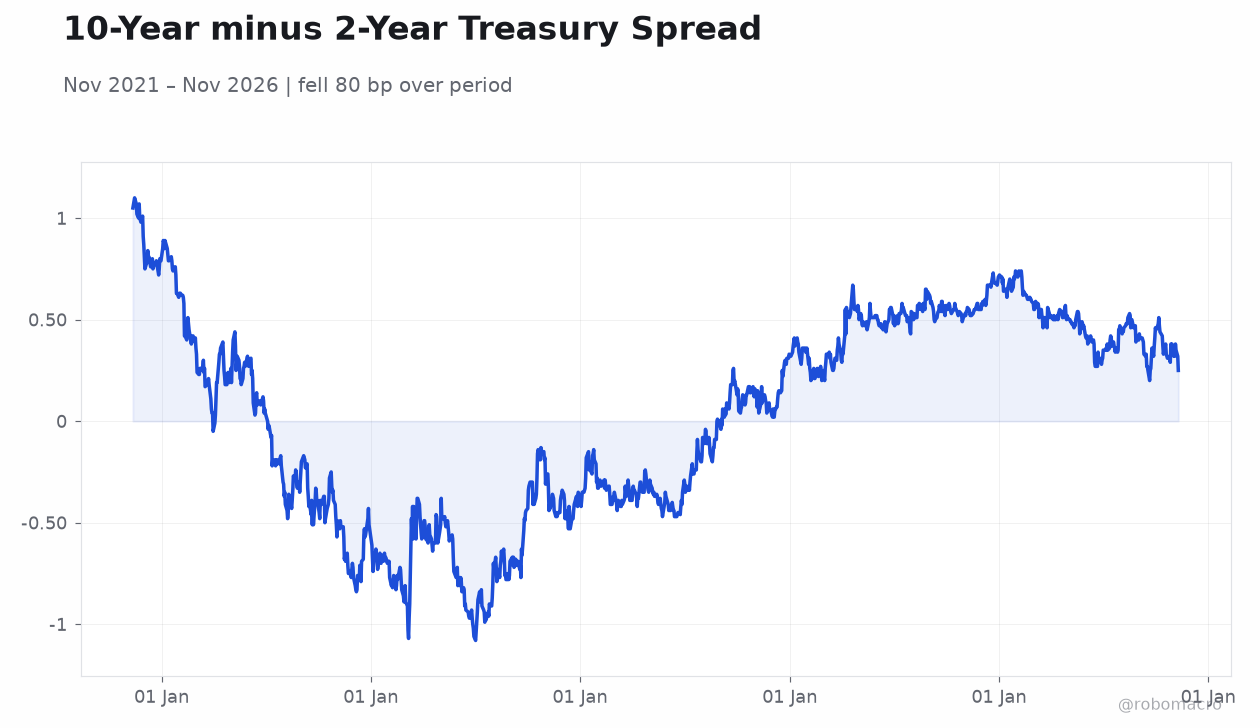
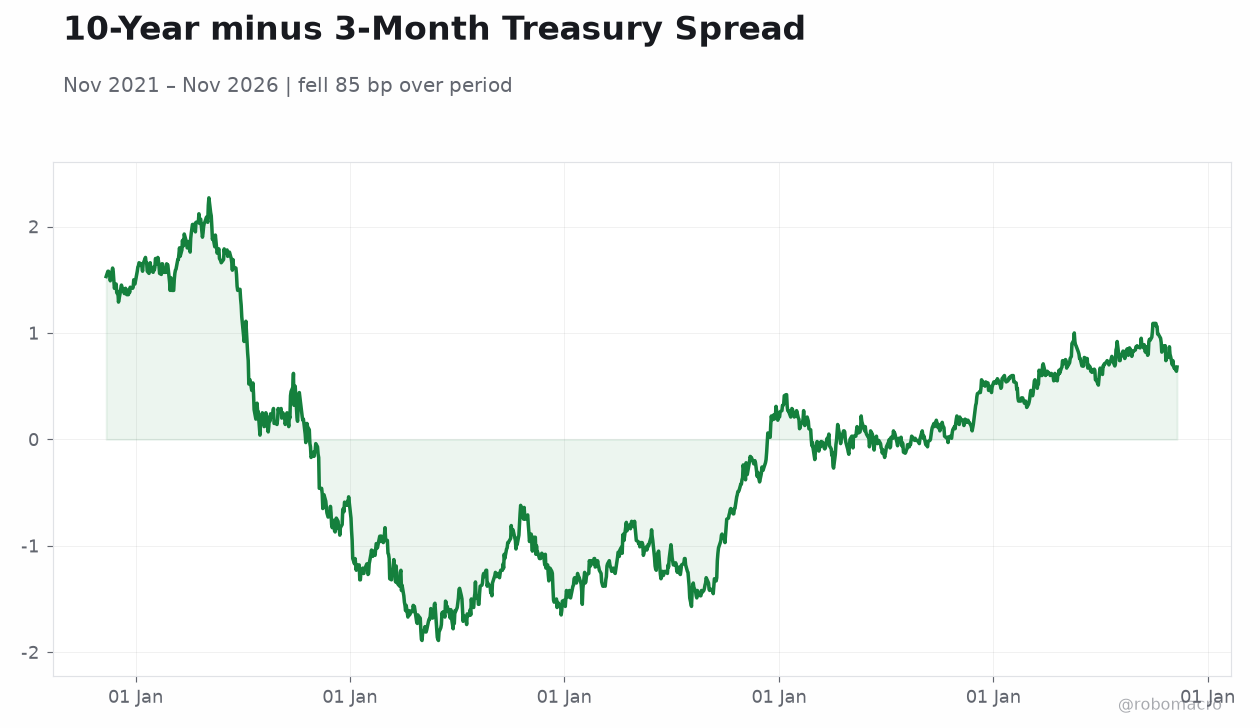
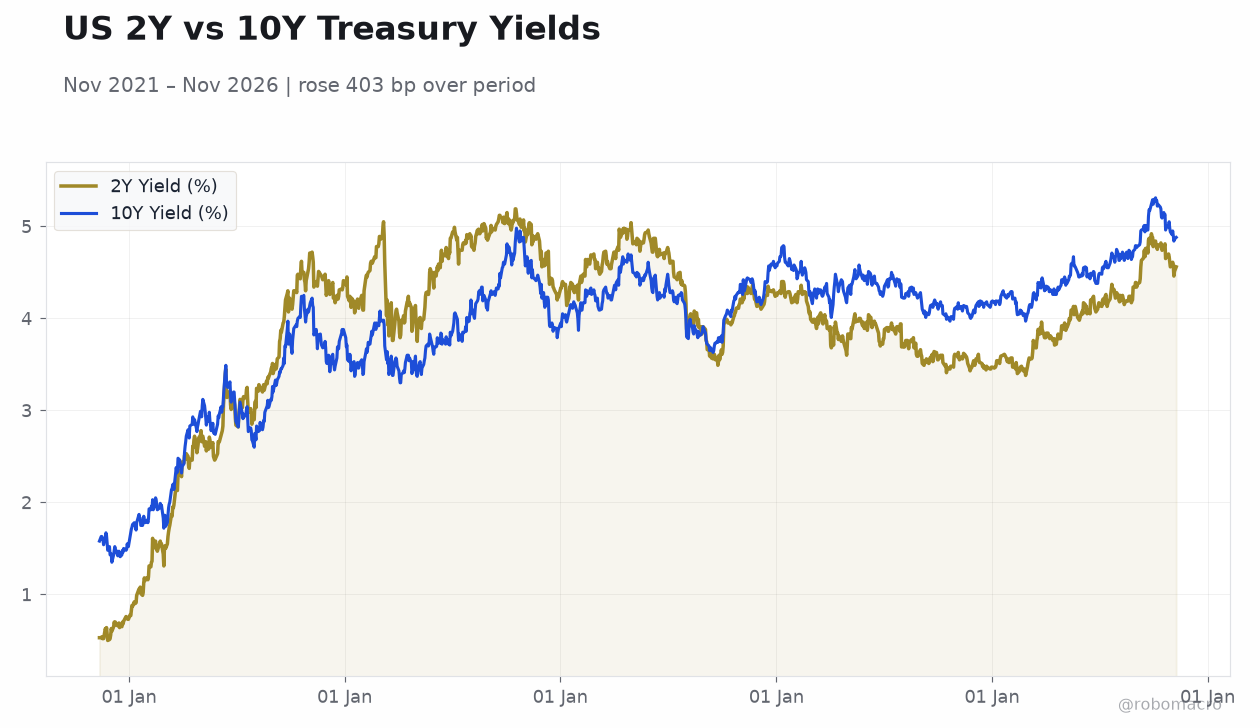 US 2Y vs 10Y Treasury Yields | Type: macro_line | 2Y Yield (%): 4.73 (2026-11-10) | Range: 0.5–5.19 | Trend(6pt): 0.53,4.52,4.8,3.76,4.46,4.56 | 10Y Yield (%): 4.98 (2026-11-10) | Range: 1.35–5.31 | Trend(6pt): 1.58,3.72,4.45,4.27,4.84,4.88
Today's Economic Events
| Data | Prior | Cons | Time |
|---|---|---|---|
| MBA 30-Year Mortgage Rate | 7.30 | - | 07:00 |
| Thursday (2026-11-12) | |||
| Weekly Jobless Claims | 189,000 | 195,000 | 08:30 |
| Fed Hammack Speech | - | - | 09:00 |
| Existing Home Sales | 4.0m | 4.0m | 10:00 |
| Existing Home Sales Month-over-Month | 1.50 | - | 10:00 |
| Speech by Fed's Barr | - | - | 10:00 |
| Fed Goolsbee Speech | - | - | 11:30 |
| EIA Weekly Crude Oil Inventory | -865,000 | -1.1m | 12:00 |
| EIA Weekly Gasoline Inventory | -222,000 | -100,000 | 12:00 |
- October CPI rose 0.4% m/m, above the 0.3% consensus, with core CPI at 0.3% m/m versus 0.2% expected, keeping headline inflation on a firm trajectory.
- Treasury yields jumped sharply, with the 2-year up 17 bp to 4.73% and the 10-year up 10 bp to 4.98%, as markets priced a firmer Fed path.
- Equities softened across the board, with the S&P 500 down 0.38% and the Nasdaq 100 off 0.60%, while the dollar strengthened against major crosses.
Yesterday's Recap
October CPI printed hotter than expected, with the headline index up 0.4% m/m against a 0.3% consensus and core CPI at 0.3% m/m versus 0.2% expected, while the seasonally adjusted CPI level rose to 337.48 from 336.30. The elevated core reading keeps inflation sticky well above target and complicates the Fed's restrictive stance following its September hike. ADP's weekly employment change came in at 19,750, up from the prior 16,750, suggesting the labor market remains resilient.
Markets reacted decisively: the 2-year Treasury yield jumped 17 bp to 4.73% and the 10-year rose 10 bp to 4.98%, reflecting higher expected policy rates. Equities sold off, with the S&P 500 down 0.38% to 7,520.93, the Nasdaq 100 off 0.60%, and the Russell 2000 down 0.68% as rate-sensitive small caps underperformed. The dollar firmed, with USD/JPY up 0.71% to 159.11 and EUR/USD down 0.74% to 1.11, while gold rose 0.79% to $4,061.90 and WTI gained 0.87% to $86.79.
API weekly crude stocks showed a build of 9 million barrels against a 1 million draw expected.
The Day Ahead
Markets observe the Veterans Day holiday, with Treasury cash markets closed and no major federal data releases scheduled, leaving the CPI-driven repricing to settle without fresh catalysts. Attention turns to Thursday's flow of releases, including weekly jobless claims and any scheduled Fed communications, which will be scrutinized for signals on whether the hot October print alters the committee's December posture. With the next FOMC meeting set for December 9, the coming sessions will be dominated by Fed speak and inflation-expectation surveys as investors recalibrate the odds of further tightening.
Liquidity will be thinner on the holiday, so any moves in futures should be read with caution.
Other Economic Notes
The October CPI surprise reinforces the broader picture of persistent inflation pressure, with core prices running at a pace inconsistent with a rapid return to target. The labor market continues to show resilience, underscored by the ADP weekly gain of 19,750, which supports the case for the Fed maintaining a restrictive stance. ↓ p.2