US Macro Daily(Beta Mode)
Yields Climb as Fed Speakers Dominate
Market Snapshot
| Asset | Level | Change |
|---|---|---|
| S&P 500 | 7,561.67 | -0.40% |
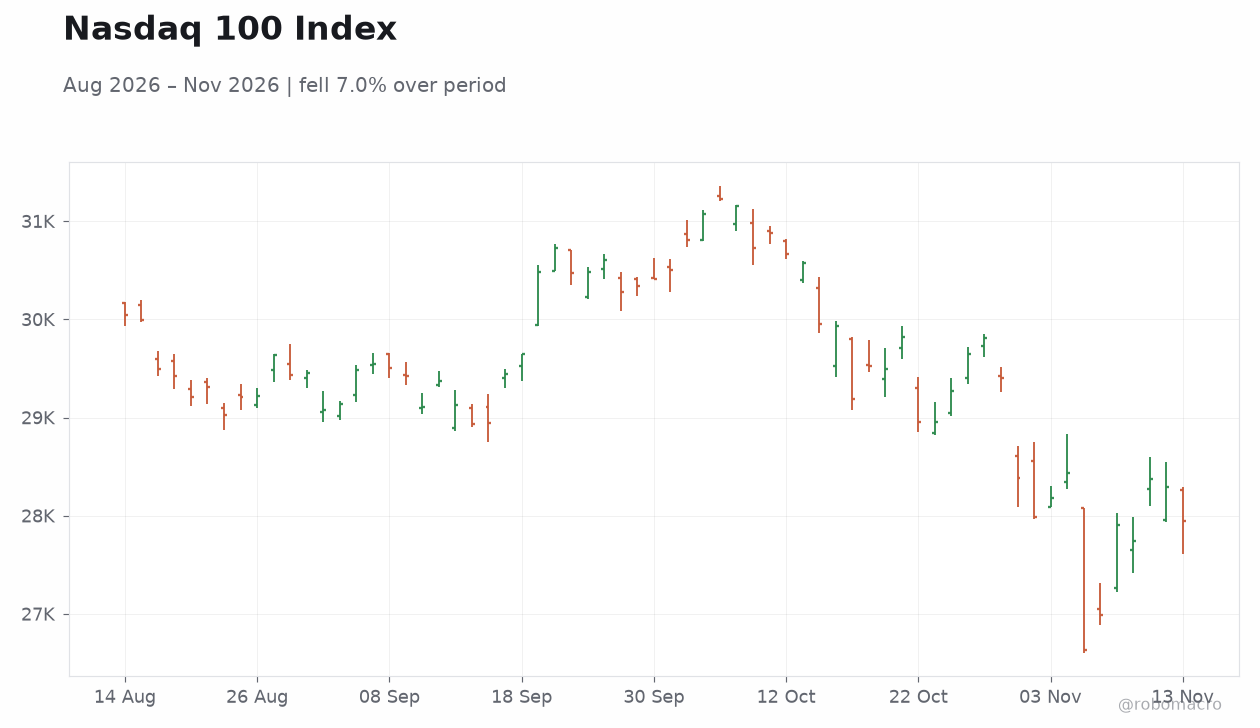
| Nasdaq 100 | 27,943.74 | -1.22% |
| Dow Jones | 52,347.55 | +0.10% |
| Russell 2000 | 2,790.49 | -0.31% |
| USD/JPY | 159.61 | -0.17% |
| EUR/USD | 1.10 | -0.37% |
| GBP/USD | 1.32 | -0.29% |
| Gold | 3,879.10 | -0.19% |
| WTI Crude | 88.18 | -0.43% |
| Bitcoin | 64,606.80 | -1.07% |
| US 2Y Treasury | 4.88% | +2 bp |
| US 10Y Treasury | 5.15% | +5 bp |
Prior Economic Events
| Data | Prior | Cons | Actual |
|---|---|---|---|
| Speech by Fed's Barr | - | - | - |
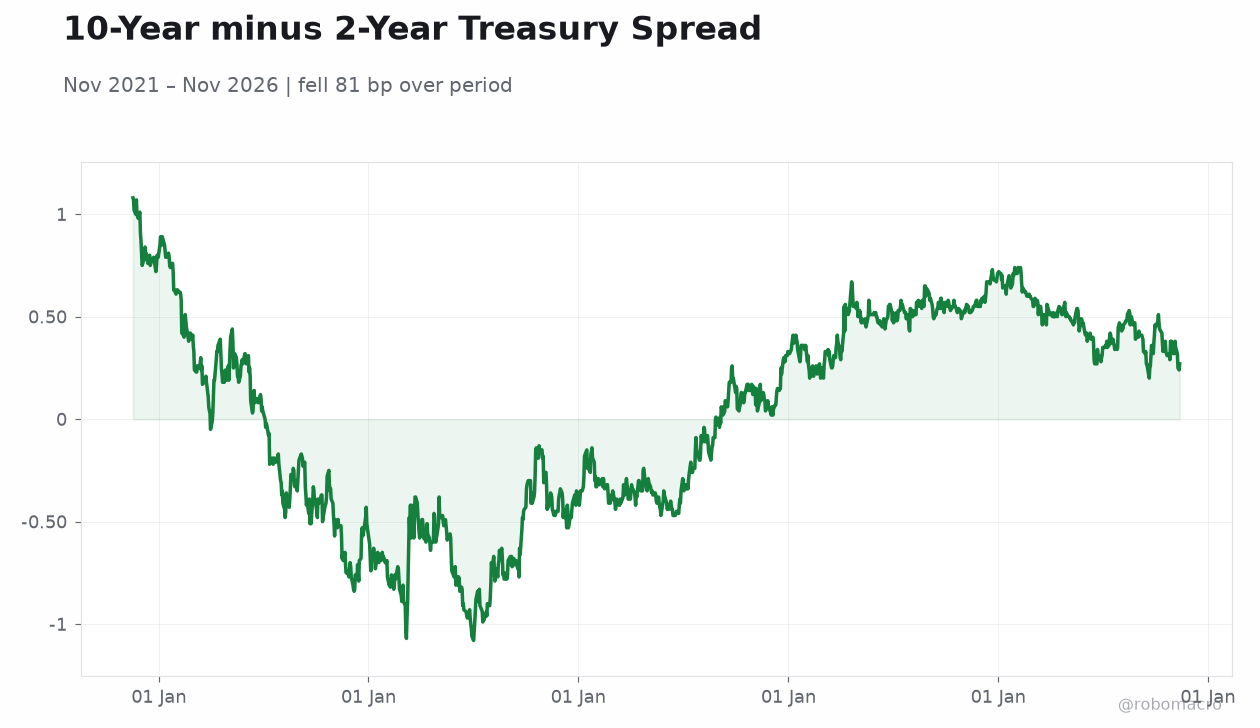
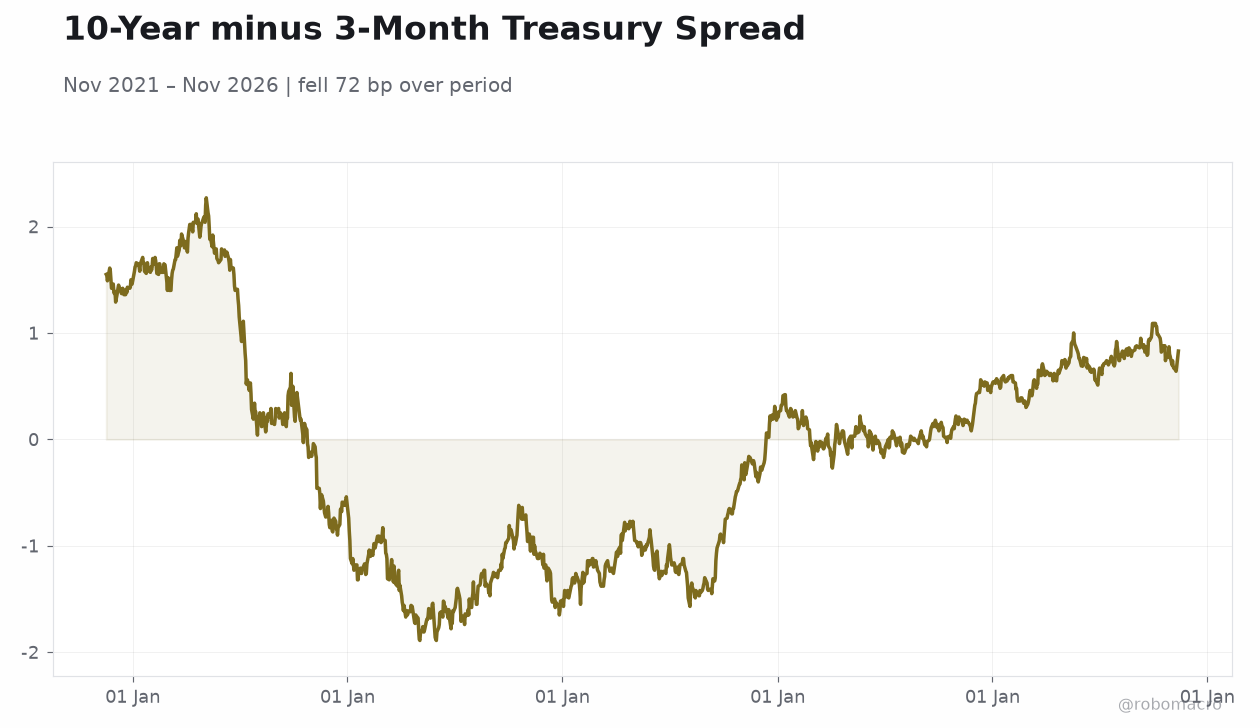
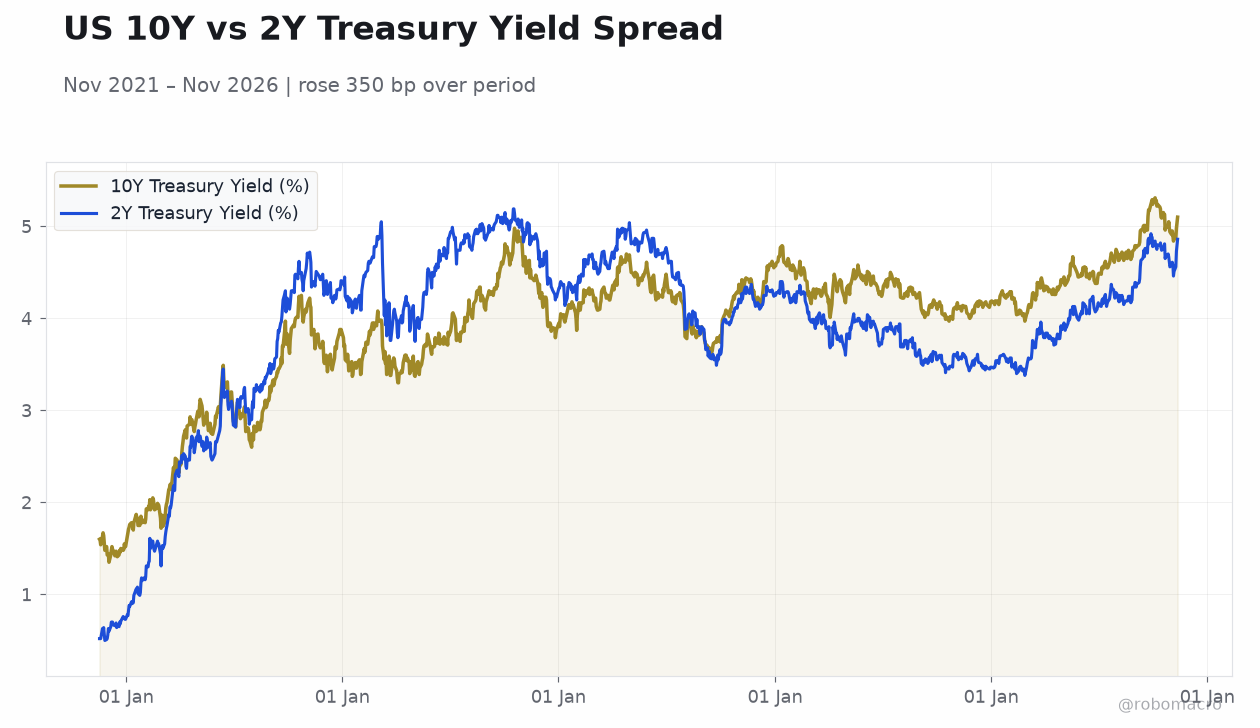 US 10Y vs 2Y Treasury Yield Spread | Type: macro_line | 10Y Treasury Yield (%): 5.1 (2026-11-12) | Range: 1.35–5.31 | Trend(6pt): 1.6,3.86,4.45,4.24,4.98,5.1 | 2Y Treasury Yield (%): 4.86 (2026-11-12) | Range: 0.5–5.19 | Trend(6pt): 0.52,4.62,4.81,3.67,4.73,4.86
Today's Economic Events
| Data | Prior | Cons | Time |
|---|---|---|---|
| NY Empire State Manufacturing Index | 25.50 | - | 08:30 |
| Speech by Fed's Williams | - | - | 09:05 |
| Fed Chair Warsh Speech | - | - | 12:00 |
| Speech by Fed's Barkin | - | - | 18:10 |
| Tuesday (2026-11-17) | |||
| Speech by Fed's Musalem | - | - | 07:30 |
| ADP Employment Change Weekly | 19,750 | - | 08:15 |
| Retail Sales Month-over-Month | 0.80 | 0 | 08:30 |
| Export Prices Month-over-Month | 2.20 | - | 08:30 |
| Import Prices Month-over-Month | 1.10 | - | 08:30 |
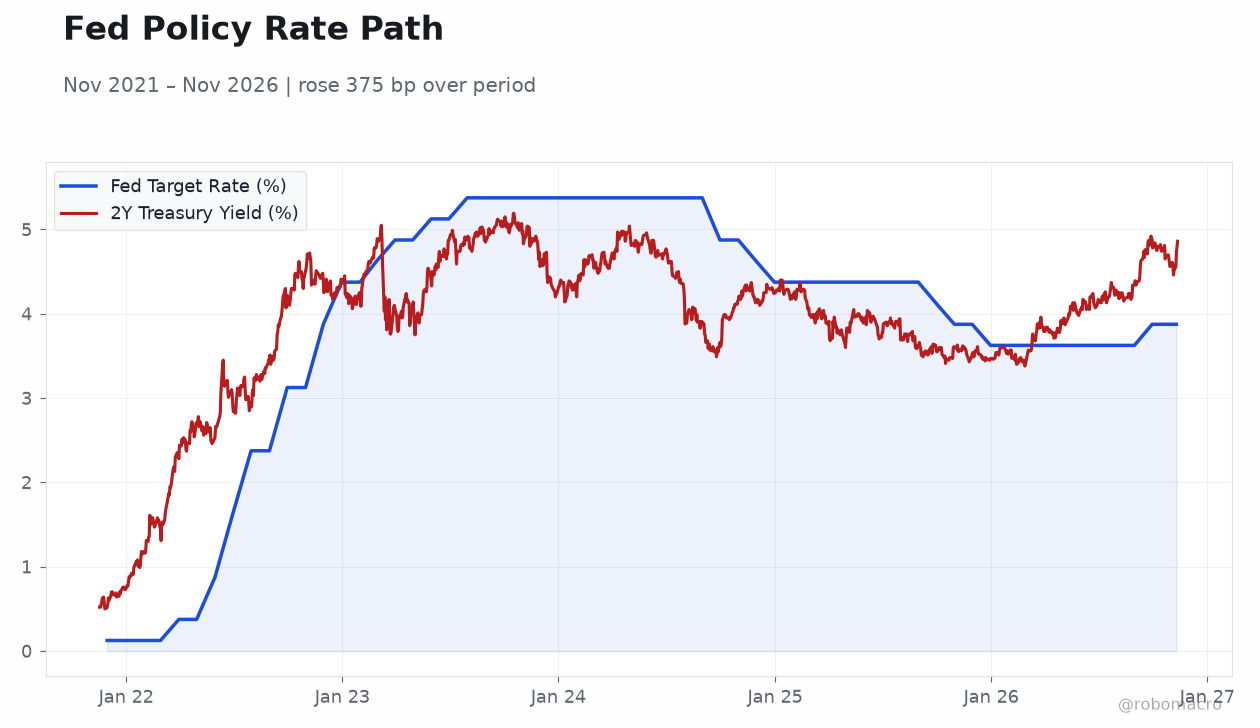
- US 10Y yield rose 5 bp to 5.15% and 2Y added 2 bp to 4.88% Friday, steepening the curve as markets await a heavy Fed speaker slate.
- Equity markets were mixed: Nasdaq 100 fell 1.22% while Dow Jones edged up 0.10%, with tech weakness offsetting cyclical strength.
- Four Fed speakers today, including Chair Warsh at 12:00 ET, headline a quiet data day featuring only the NY Empire State Manufacturing Index.
Yesterday's Recap
Friday's session was defined by a bearish tone in rates, with the 10-year Treasury yield climbing 5 bp to 5.15% and the 2-year adding 2 bp to 4.88%, extending the recent steepening trend. Equity performance diverged sharply: the Nasdaq 100 dropped 1.22% as technology stocks faced renewed selling pressure, while the Dow Jones managed a modest 0.10% gain on rotation into defensives and cyclicals. The Russell 2000 slipped 0.31%, reflecting broader risk aversion in small caps.
The dollar strengthened against major peers, with EUR/USD falling 0.37% to 1.10 and GBP/USD declining 0.29% to 1.32, while USD/JPY eased 0.17% to 159.61. Commodities were softer, with WTI crude down 0.43% to $88.18 and gold off 0.19% at $3,879.10. Bitcoin declined 1.07% to $64,606.80, tracking the broader risk-off tone.
Fed's Barr spoke early in the session, though his remarks did not materially shift market pricing.
The Day Ahead
The calendar opens with the NY Empire State Manufacturing Index at 08:30 ET, with the prior reading at 25.5 and no consensus published. Attention then shifts to a dense Fed speaker schedule: Williams at 09:05 ET, Chair Warsh at 12:00 ET (high impact), and Barkin at 18:10 ET. Chair Warsh's midday remarks carry the most weight given his position and the market's sensitivity to any signal on the policy path.
With no major tier-one data releases, trading flows will likely be driven by speaker commentary and positioning ahead of Tuesday's retail sales print. Volumes may be lighter as markets digest the prior week's rate moves.
Other Economic Notes
The US economy continues to show resilience, with GDP growth at 3.40% QoQ SAAR as of Q3 and unemployment at 4.10% in October. Retail sales YoY stands at 6.29% as of September, indicating consumer spending remains robust despite elevated borrowing costs. CPI at 3.70% YoY as of September remains above target, keeping the Fed's inflation-fighting stance intact.
The combination of solid growth and sticky inflation complicates the case for any near-term policy easing, reinforcing the higher-for-longer narrative. Tuesday's retail sales data will be closely watched for signs of consumer fatigue at current rate levels.