US Macro Daily(Beta Mode)
Tech Rout Deepens as Yields Slide
Market Snapshot
| Asset | Level | Change |
|---|---|---|
| S&P 500 | 6,910.39 | -3.70% |
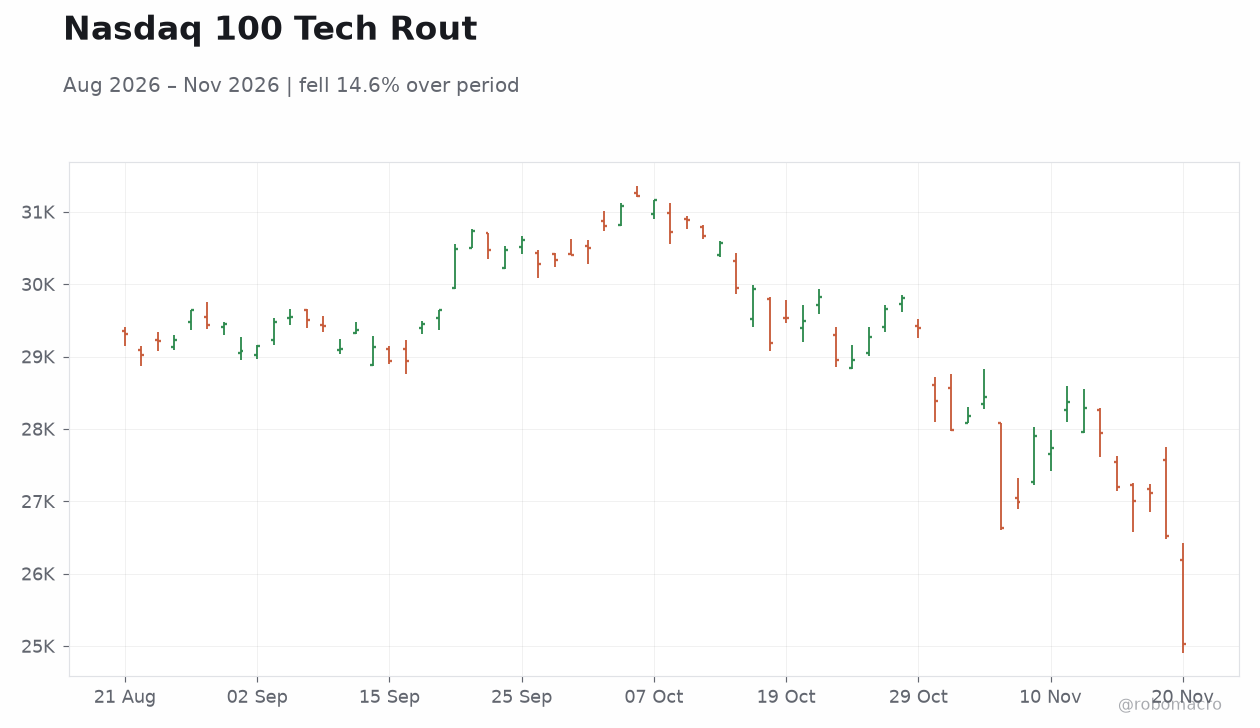
| Nasdaq 100 | 25,028.98 | -5.61% |
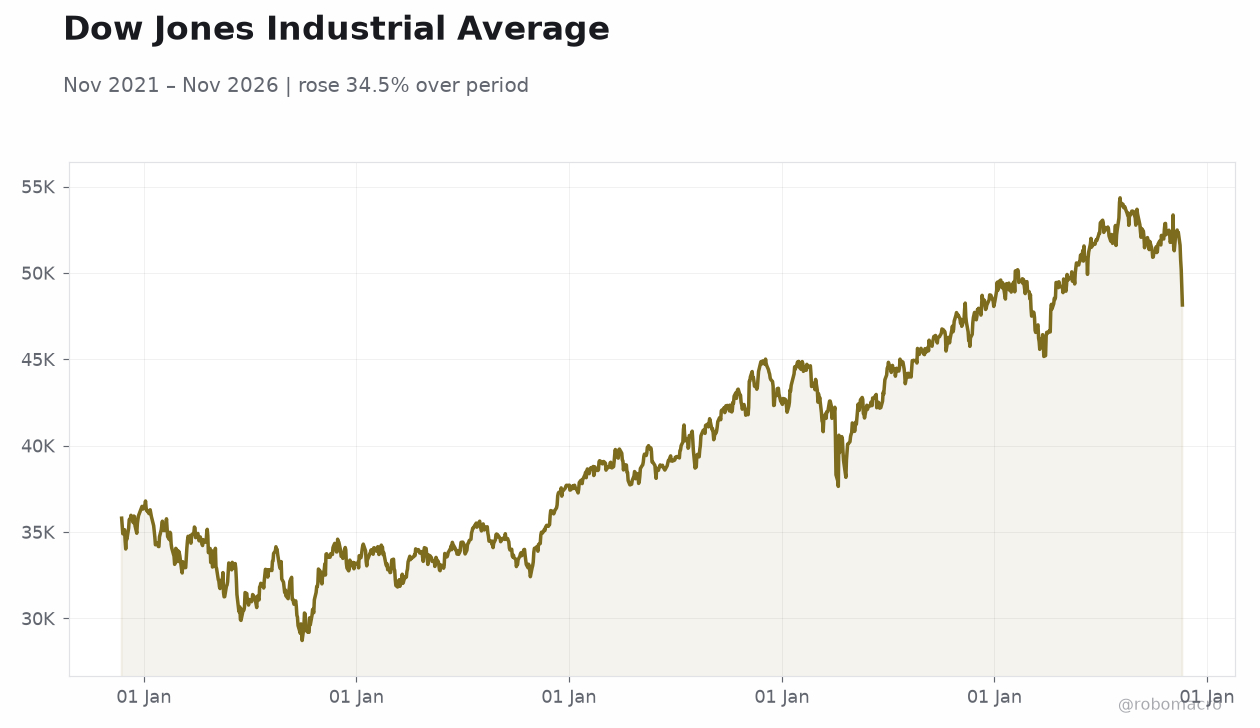
| Dow Jones | 48,147.33 | -1.93% |
| Russell 2000 | 2,581.79 | -2.76% |
| USD/JPY | 159.08 | -0.39% |
| EUR/USD | 1.10 | -0.01% |
| GBP/USD | 1.31 | +0.17% |
| Gold | 3,625.30 | +3.13% |
| WTI Crude | 82.53 | -1.73% |
| Bitcoin | 61,340.58 | +0.29% |
| US 2Y Treasury | 4.63% | -13 bp |
| US 10Y Treasury | 4.92% | -12 bp |
Prior Economic Events
| Data | Prior | Cons | Actual |
|---|---|---|---|
| No events available | |||
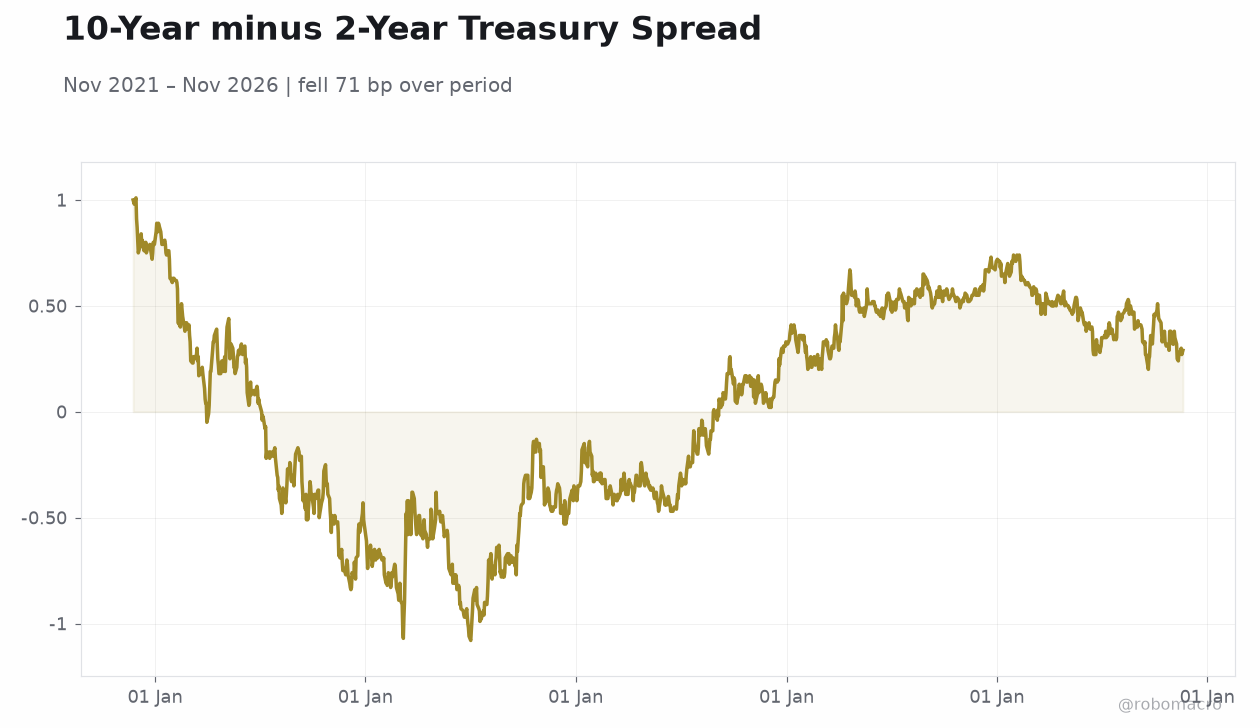 10-Year minus 2-Year Treasury Spread | Type: macro_line | 10-Year minus 2-Year Treasury Spread: 0.29 (2026-11-20) | Range: -1.08–1.01 | Trend(6pt): 1,-0.83,-0.41,0.55,0.27,0.29
Today's Economic Events
| Data | Prior | Cons | Time |
|---|---|---|---|
| Chicago Fed National Activity Index | 0.07 | - | 08:30 |
| S&P Global Composite PMI Flash | 55.90 | - | 09:45 |
| S&P Global Manufacturing PMI Flash | 54.90 | 54.60 | 09:45 |
| S&P Global Services PMI Flash | 56.10 | 55.80 | 09:45 |
| Speech by Fed's Williams | - | - | 16:00 |
- S&P 500 and Nasdaq 100 suffered sharp Friday losses, with the Dow and S&P entering correction territory as all 11 S&P sectors fell more than 1% for the first time since April 2025
- Treasury yields fell sharply (2Y -13bp to 4.63%, 10Y -12bp to 4.92%) as risk-off flows dominated, while gold surged 3.13% to $3,625/oz
- Flash PMIs and a Williams speech headline today's calendar; tomorrow brings Case-Shiller, CB Consumer Confidence, and ADP weekly employment data
Yesterday's Recap
Friday's session delivered a broad and violent risk-off move, with the S&P 500 falling 3.70% to 6,910.39 and the Nasdaq 100 collapsing 5.61% to 25,028.98 — its worst week since 2020. The Dow dropped 1.93% to 48,147.33 and the Russell 2000 lost 2.76%, with all 11 S&P sectors finishing more than 1% lower, the first such sweep since April 2025. Both the Dow and S&P 500 entered correction territory, and the S&P now sits below its 200-day moving average, a technical threshold traders treat as a make-or-break line.
Treasuries rallied hard as investors sought safety: the 2-year yield eased 13 bp to 4.63% and the 10-year fell 12 bp to 4.92%. Gold jumped 3.13% to $3,625.30/oz, WTI crude slipped 1.73% to $82.53, and Bitcoin was roughly flat at $61,340. The dollar was mixed, with USD/JPY down 0.39% to 159.08 and GBP/USD up 0.17% to 1.31.
No major US data releases were scheduled Friday, leaving positioning and sentiment as the dominant drivers.
The Day Ahead
Attention turns to this morning's flash PMI suite, where consensus looks for manufacturing at 54.6 (prior 54.9) and services at 55.8 (prior 56.1), with the composite prior at 55.9 — still firmly expansionary but pointing to modest cooling. The Chicago Fed National Activity Index for October follows at 08:30 ET, with the prior reading at 0.07. New York Fed President Williams speaks at 16:00 ET, and given the market's fragile tone, any commentary on the policy path will be scrutinized for signals on the December 9 FOMC.
Tomorrow's slate includes Case-Shiller home prices (consensus 2.7% YoY, unchanged), CB Consumer Confidence (consensus 92.0 vs. prior 91.7), ADP weekly employment, and API crude stocks. With equities in correction, today's data carries outsized potential to either stabilize or extend the selloff.
Other Economic Notes
The macro backdrop remains uncomfortably stagflationary: CPI at 3.70% YoY sits well above target while GDP growth of 3.40% QoQ SAAR shows the economy is hardly collapsing. Retail sales growth of 6.82% YoY and unemployment at 4.10% suggest the consumer is holding up, which complicates the case for aggressive easing. ↓ p.2