The data suggests we are in a transitional phase of the global cycle, characterized by moderating inflation in key economies but persistent sticky price dynamics elsewhere. In Japan, headline inflation eased below prior readings, with core inflation slowing versus consensus, signaling a potential pivot toward normalization as the Nikkei 225 rallied 4.05% to 53,603.65 early in the week before closing down 3.0% overall. Similarly, Australia's inflation cooled more than expected, yet flash PMIs disappointed with services dropping into contraction, underscoring softening demand that tempered the RBA's hawkish tone. Across emerging markets, commodity strength provided a buffer; for example, copper rose 2.31% to $5.47 per pound, supporting Andean equities like MSCI Peru's 3.24% gain to 76.68. However, this was offset by broader risk-off flows, evident in Bitcoin's 6.53% decline to 65,918.22 amid geopolitical jitters.
We observe that these tensions are exacerbating divergences in the global recovery trajectory. Developed markets showed mixed PMI signals, with Germany's manufacturing PMI beating consensus, yet the UK's services PMI disappointed below expectations, highlighting uneven momentum amid cost pressures. In emerging Asia, the PBoC allowed USD/CNY to rise 0.16% to 6.91, tolerating mild yuan depreciation to stabilize credit amid Brent's 5.35% drop to 106.19. This week's narrative thus points to a world where geopolitical risks are not only driving asset volatility but also complicating policy responses, as central banks weigh easing inflation against potential energy-driven reacceleration. Gold's 0.84% decline to 4532.1 in the US, despite haven demand, further reflects investor caution, suggesting a cycle where growth fears are tempered but not eclipsed by tail risks. Looking ahead, if Middle East de-escalation materializes, it could alleviate some pressures, but persistent volatility—as seen in oil's weekly swings—may prolong the global economy's fragile balancing act through Q2 2026.
Published 2026-03-27 | 100% AI-generated — not financial advice
Opening Theme: Navigating Geopolitical Turbulence in a Fragile Global Cycle As we survey the global macro landscape for the week ending March 27, 2026, the dominant narrative revolves around heightened geopolitical risks stemming from the ongoing Iran war and broader Middle East tensions, which have injected volatility into commodity markets and spilled over into financial assets worldwide. We note that this week's developments underscore a global economy still grappling with the late stages of a post-pandemic recovery, where uneven growth signals are compounded by external shocks. Brent crude prices, for instance, declined 5.2% to 106.36 in the Eurozone context, reflecting hopes for de-escalation, yet WTI crude rose 2.57% to 100.85 in the US, highlighting persistent supply concerns that could sustain inflationary pressures. This divergence in oil benchmarks illustrates the precarious balance: while some regions benefit from easing energy costs, others face amplified import risks, as seen in the UK's Brent crude drop of 5.01% to 106.57, which contributed to sterling's 1.15% weekly depreciation against the dollar.
The data suggests we are in a transitional phase of the global cycle, characterized by moderating inflation in key economies but persistent sticky price dynamics elsewhere. In Japan, headline inflation eased below prior readings, with core inflation slowing versus consensus, signaling a potential pivot toward normalization as the Nikkei 225 rallied 4.05% to 53,603.65 early in the week before closing down 3.0% overall. Similarly, Australia's inflation cooled more than expected, yet flash PMIs disappointed with services dropping into contraction, underscoring softening demand that tempered the RBA's hawkish tone. Across emerging markets, commodity strength provided a buffer; for example, copper rose 2.31% to $5.47 per pound, supporting Andean equities like MSCI Peru's 3.24% gain to 76.68. However, this was offset by broader risk-off flows, evident in Bitcoin's 6.53% decline to 65,918.22 amid geopolitical jitters.
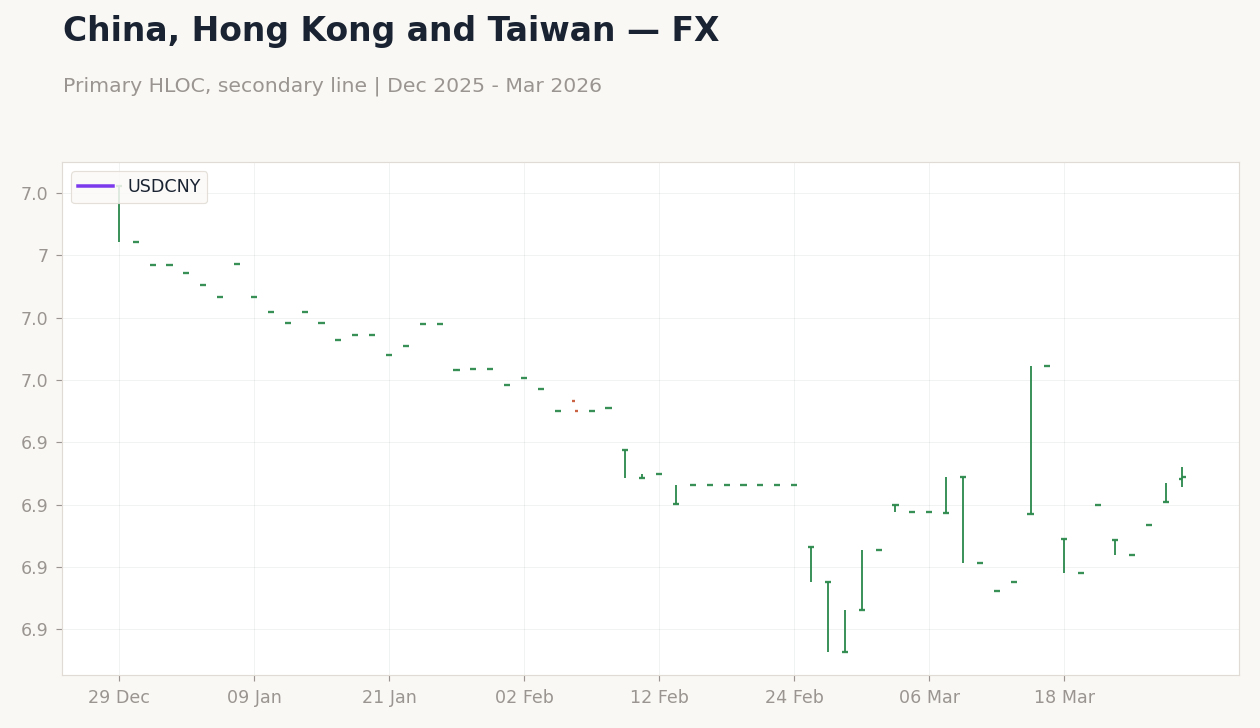
We observe that these tensions are exacerbating divergences in the global recovery trajectory. Developed markets showed mixed PMI signals, with Germany's manufacturing PMI beating consensus, yet the UK's services PMI disappointed below expectations, highlighting uneven momentum amid cost pressures. In emerging Asia, the PBoC allowed USD/CNY to rise 0.16% to 6.91, tolerating mild yuan depreciation to stabilize credit amid Brent's 5.35% drop to 106.19. This week's narrative thus points to a world where geopolitical risks are not only driving asset volatility but also complicating policy responses, as central banks weigh easing inflation against potential energy-driven reacceleration. Gold's 0.84% decline to 4532.1 in the US, despite haven demand, further reflects investor caution, suggesting a cycle where growth fears are tempered but not eclipsed by tail risks. Looking ahead, if Middle East de-escalation materializes, it could alleviate some pressures, but persistent volatility—as seen in oil's weekly swings—may prolong the global economy's fragile balancing act through Q2 2026.
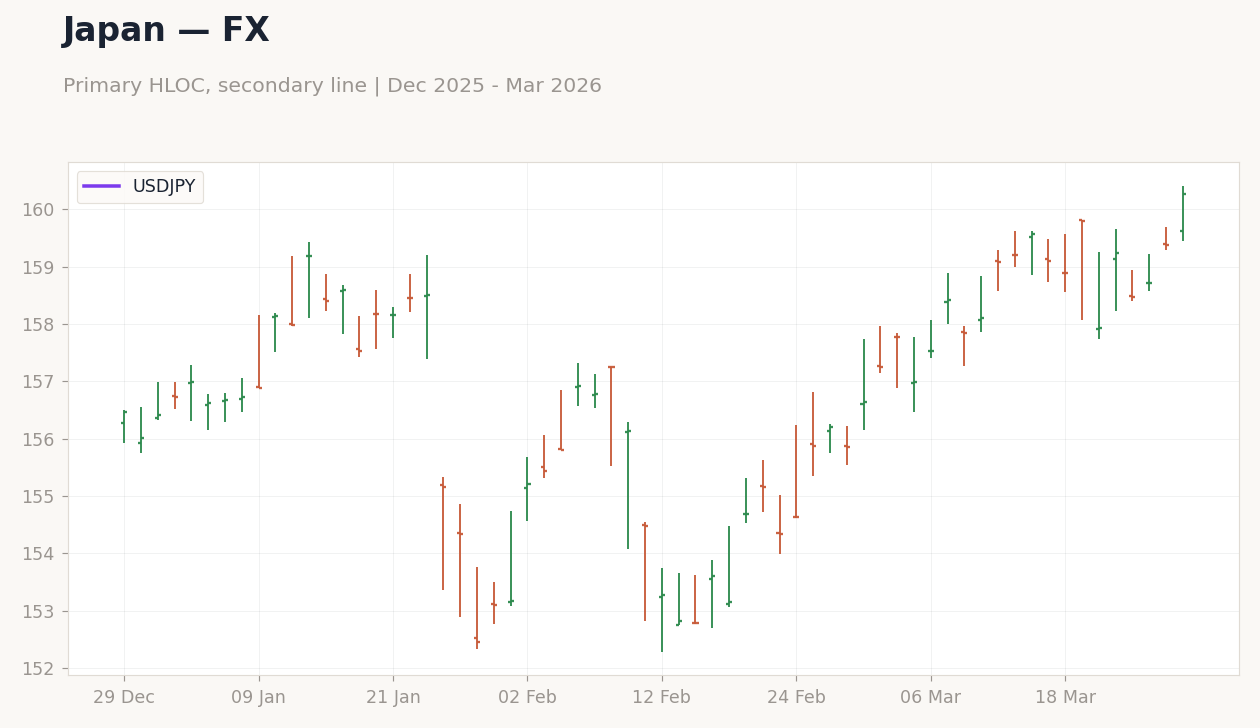
DM Theme: Uneven Recovery Signals Amid Rising Yields and Policy Caution In developed markets, the week's data revealed a patchwork of economic resilience overshadowed by geopolitical spillovers, with implications for monetary policy diverging across the US, Eurozone, Japan, and UK. We note that US equity markets exhibited volatility, with the S&P 500 falling 2.1% to 6,369, while the dollar strengthened, pushing USD/JPY up 1.5% to 160.25. This dollar rally, coupled with a 5bp rise in 10Y Treasury yields to 4.44%, suggests markets are pricing in sustained Fed caution amid mixed signals; for instance, WTI's 2.57% gain to 100.85 underscores supply risks that could delay rate cuts beyond the current OIS-implied path.
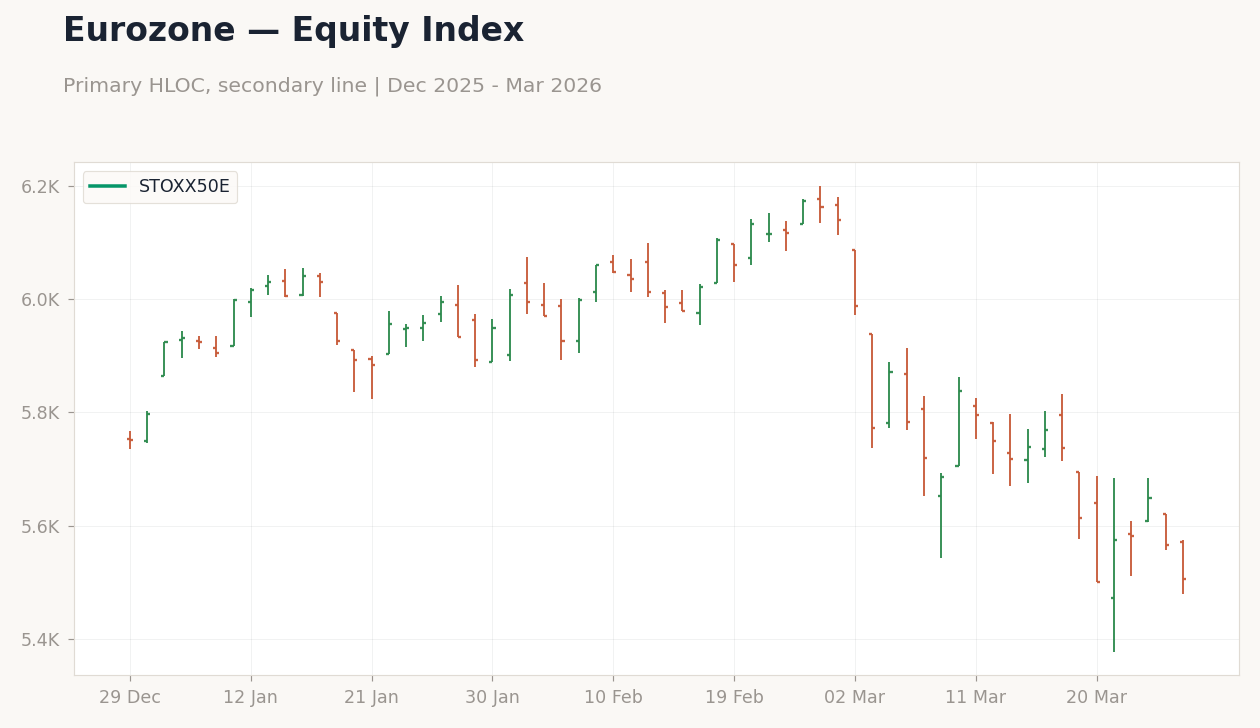
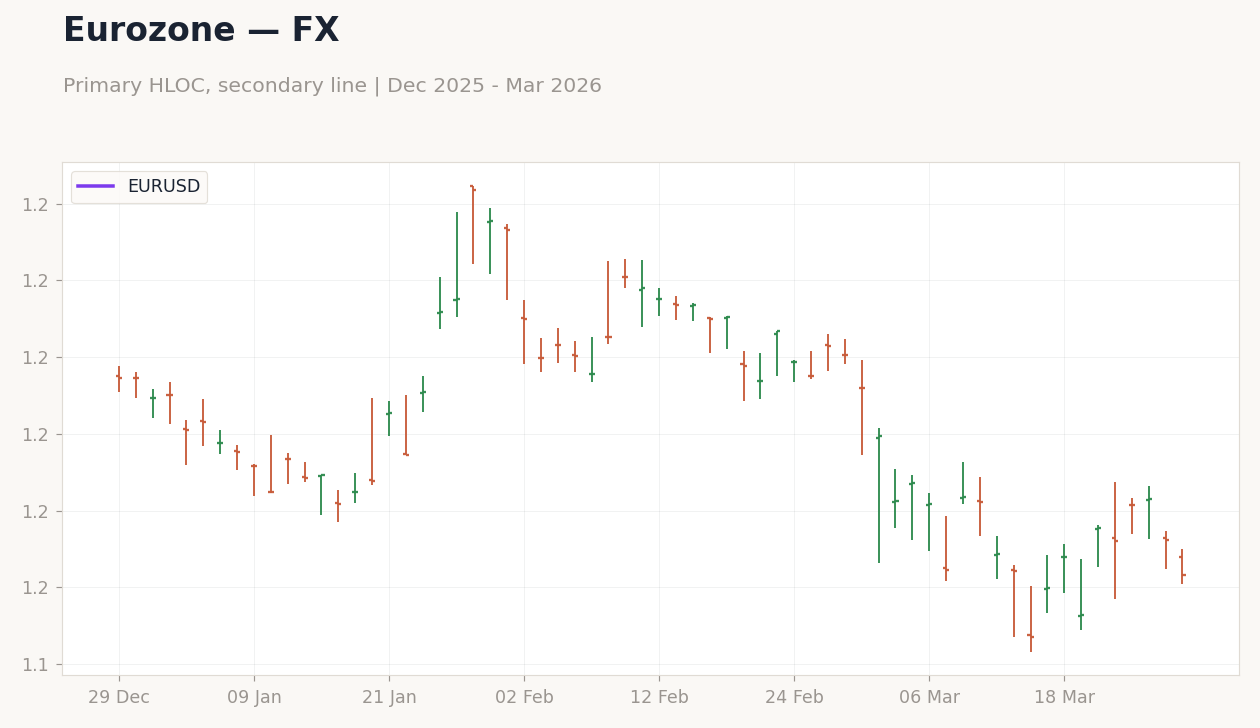
In the Eurozone, PMIs delivered mixed messages, as German manufacturing beat consensus, yet overall consumer confidence fell, intensifying dovish ECB expectations that drove German 10Y Bund yields down, though globally yields rose with France's 10Y up 15bp to 3.80%. Equities edged higher modestly, with the Euro Stoxx 50 up 0.1% to 5,506, but EUR/USD declined 0.6% to 1.1511, pressured by Brent's 5.2% drop to 106.36. This points to an uneven recovery, where energy concerns from the Iran war could prolong ECB easing bets into mid-2026, potentially widening spreads with the Fed.
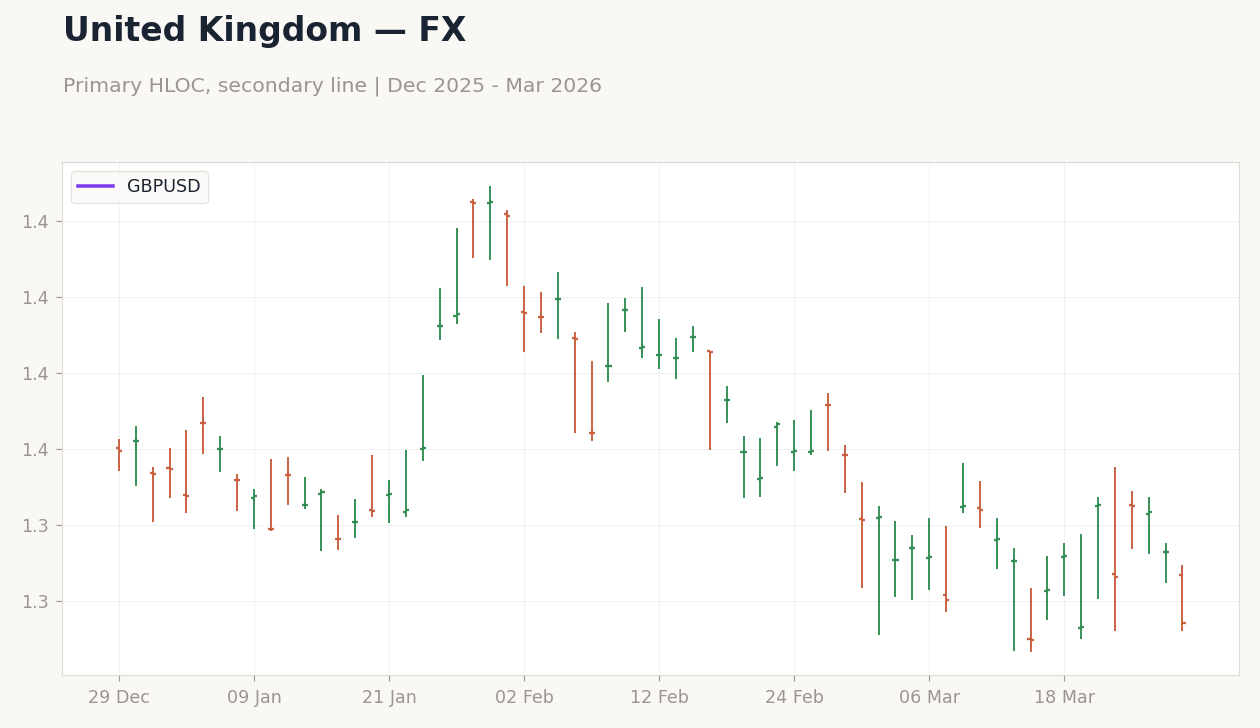
Japan's narrative centered on moderating inflation, with core measures slowing, as Bank of Japan minutes indicated no immediate hikes, tempering OIS pricing despite the Nikkei 225's initial 4.05% rally to 53,603.65 before a 3.0% weekly close. In the UK, core inflation edged higher than expected, prompting BoE Chief Economist Pill's emphasis on inflation risks, which aligned with a 13bp rise in 10Y Gilt yields to 4.92% and GBP/USD's 1.2% drop to 1.3261. Nordic markets echoed this caution, with USD/NOK up 2.64% to 9.74 amid Brent's 4.95% decline to 106.64, pressuring energy exporters like Norway, where the Oslo Bors gained 0.77% to 1,981.56.
Overall, DM policy implications hinge on these divergences: while the ECB and BoJ lean dovish, the Fed and BoE's hawkish tilts—evident in rising yields like Canada's 10Y up 12bp to 3.56%—suggest a read-across of prolonged higher-for-longer rates, potentially constraining growth if geopolitical risks persist through April 2026.
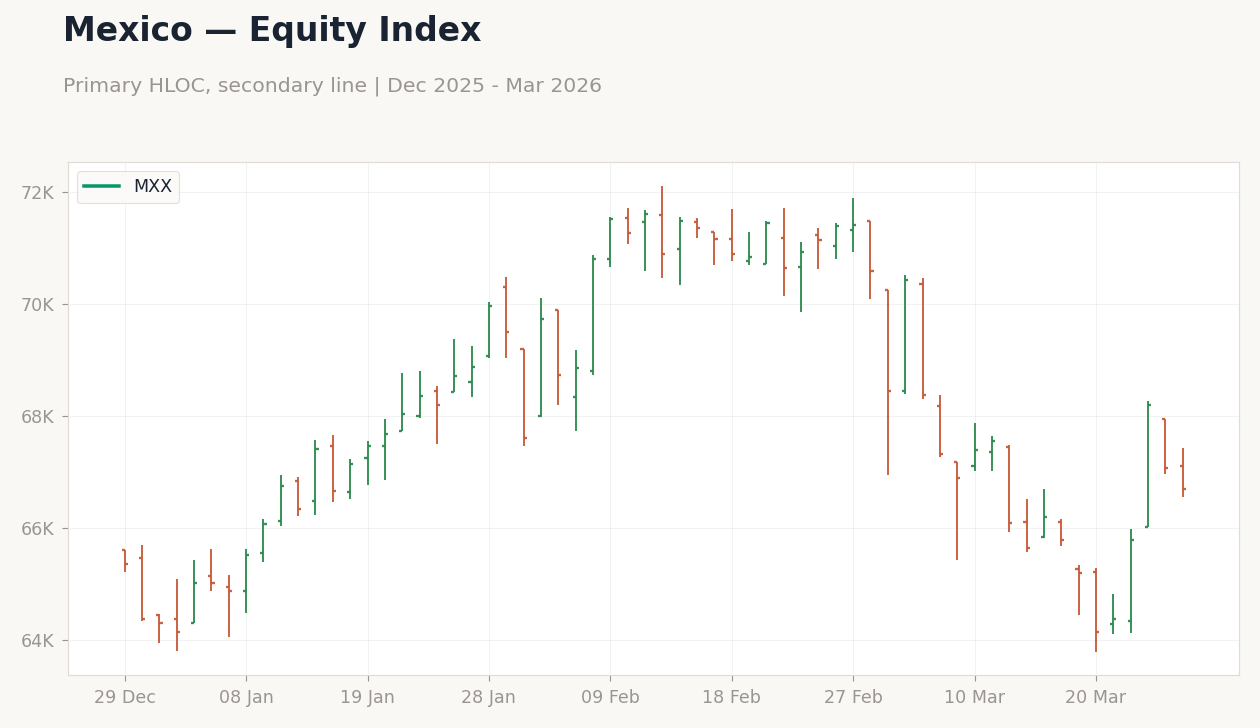
EM Theme: Commodity Resilience Offsets Currency Pressures Emerging markets displayed notable resilience in commodity-linked sectors this week, though currency depreciations amplified by dollar strength posed challenges, with policy responses focusing on stability amid geopolitical volatility. In Latin America, equities surged on energy and metals strength; Mexico's IPC Bolsa rose 4.0% to 66,686, supported by WTI's 2.84% gain to 101.11, while USD/MXN declined 6.6% to 65,868.7, reflecting broad dollar dynamics. Brazil's Bovespa advanced 3.0% to 181,557, driven by Vale's 6.98% climb to 15.03 amid iron ore demand, and Petrobras's 2.12% rise to 18.11.
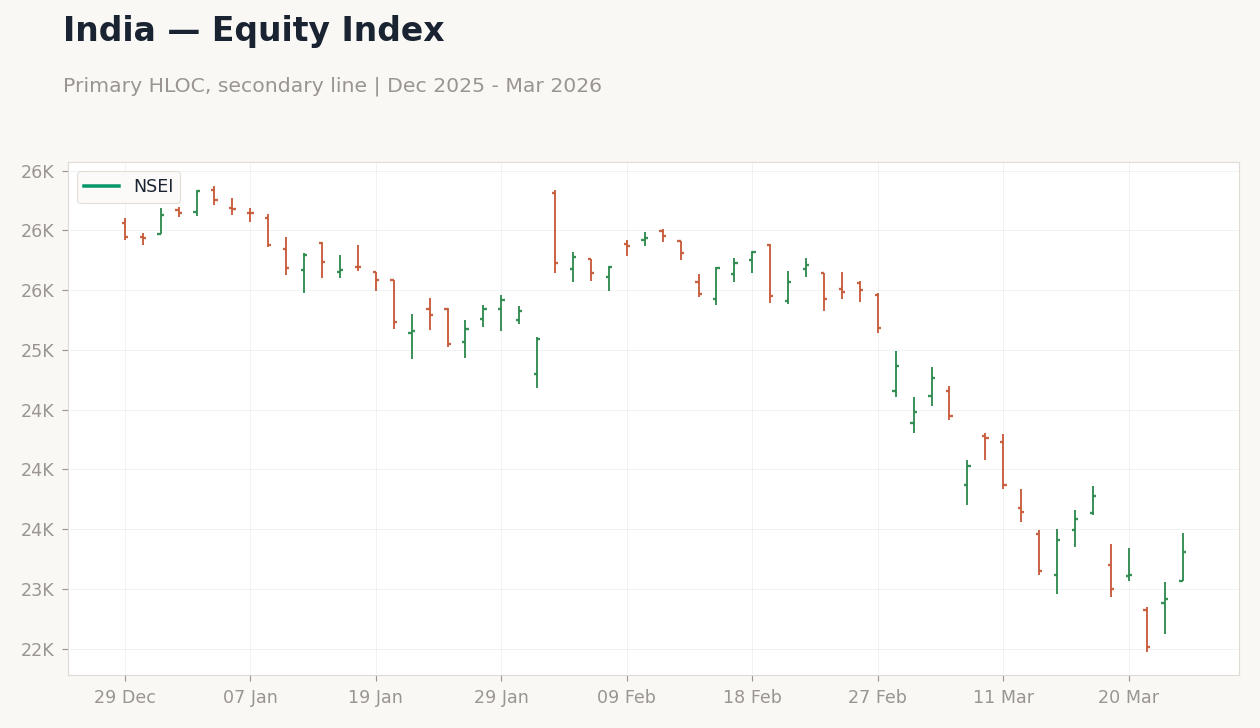
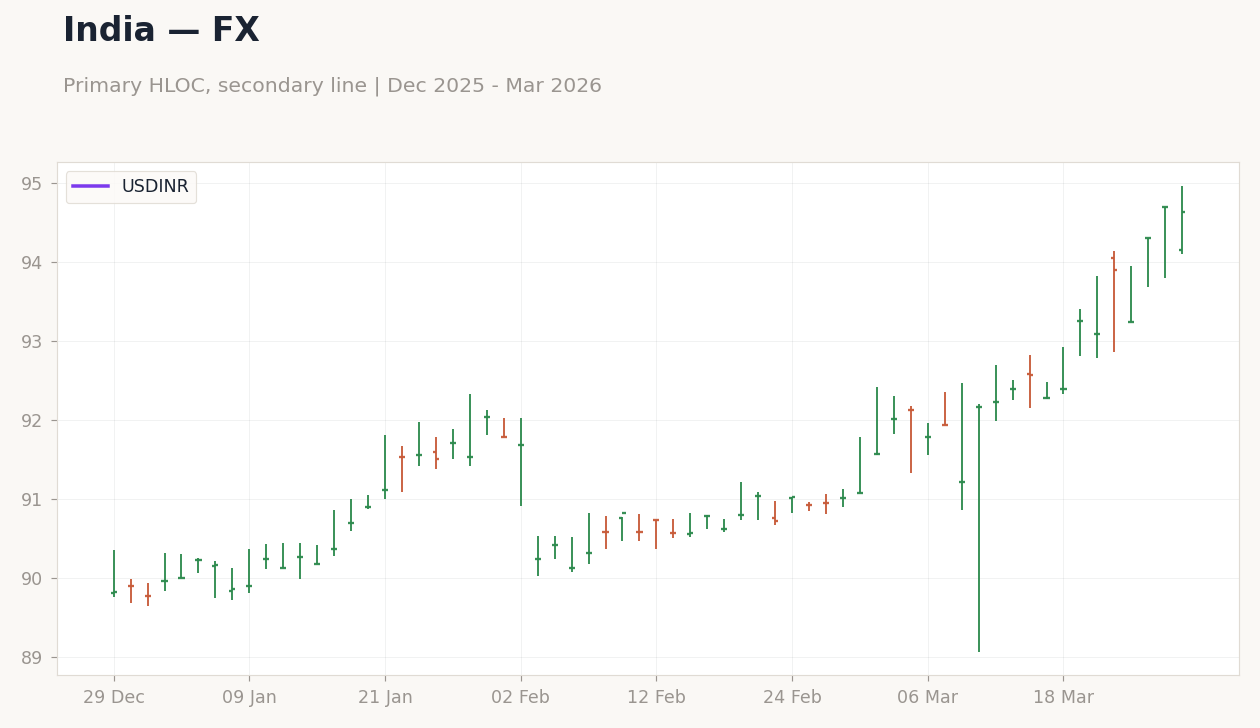
Andean markets benefited from copper's 2.31% increase to $5.47 per pound, lifting MSCI Peru 3.24% to 76.68, though currencies diverged with USD/CLP up 1.12% to 922.71. In Asia, India's Nifty 50 fell 2.0% to 23,306 despite Brent's 5.34% decline to 106.2 easing import pressures, while USD/INR rose 1.66% to 94.63. Greater China's Shanghai Composite dropped 1.72% to 3,889.08, with PBoC allowing USD/CNY to edge up 0.16% to 6.91 for liquidity support.
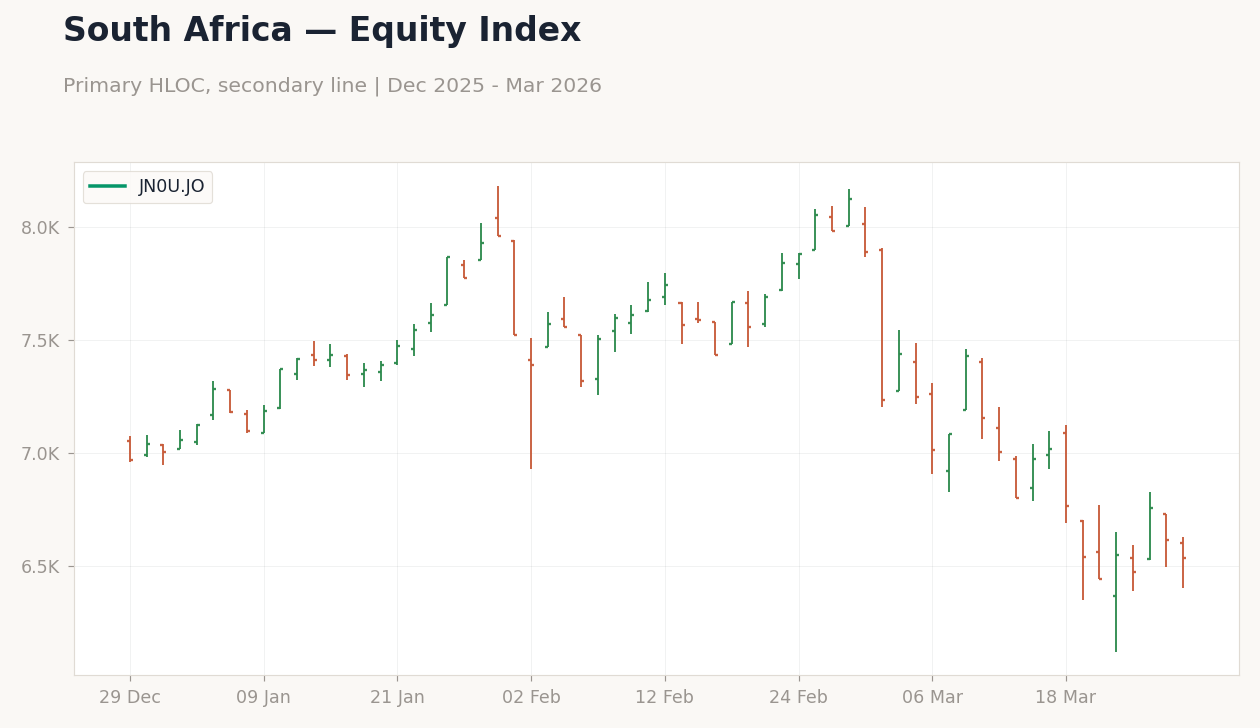
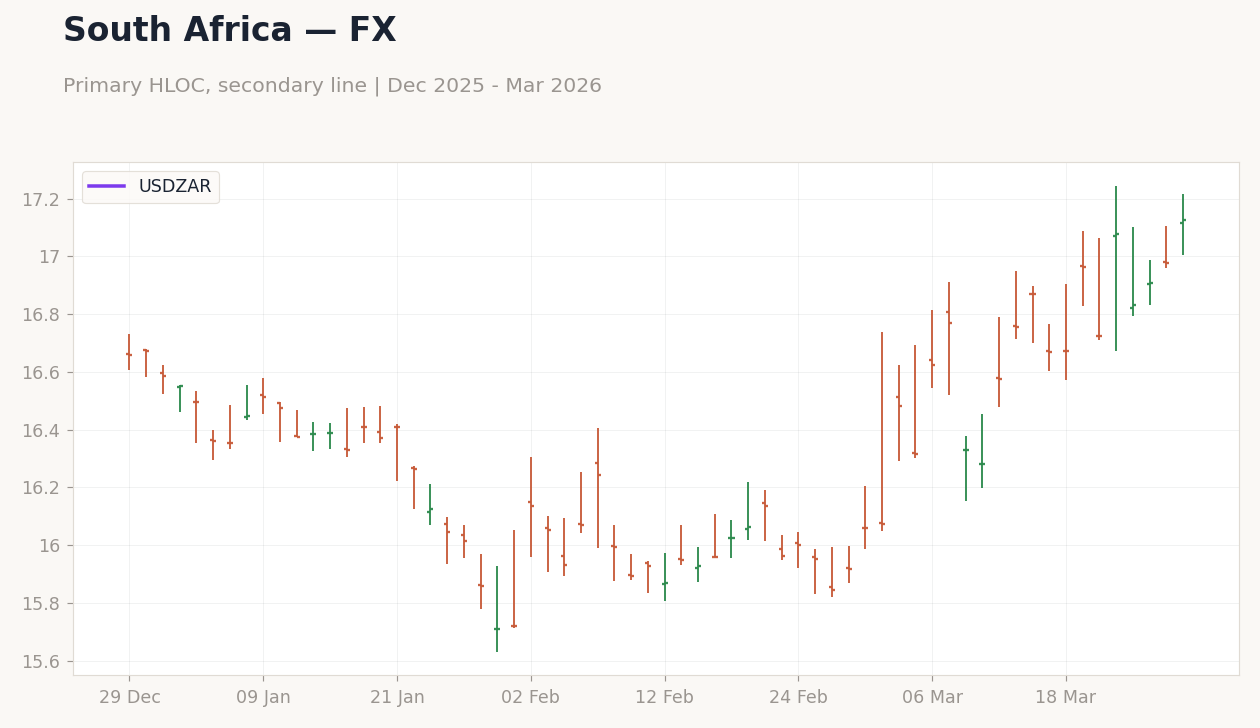
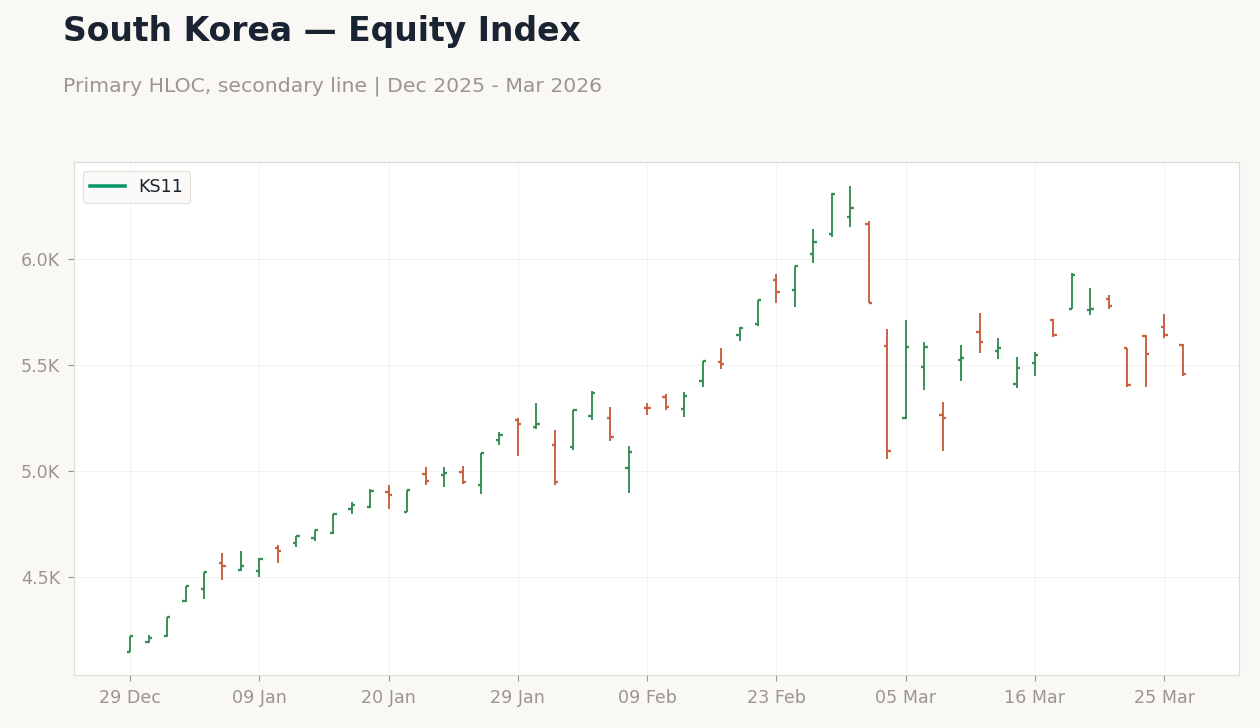
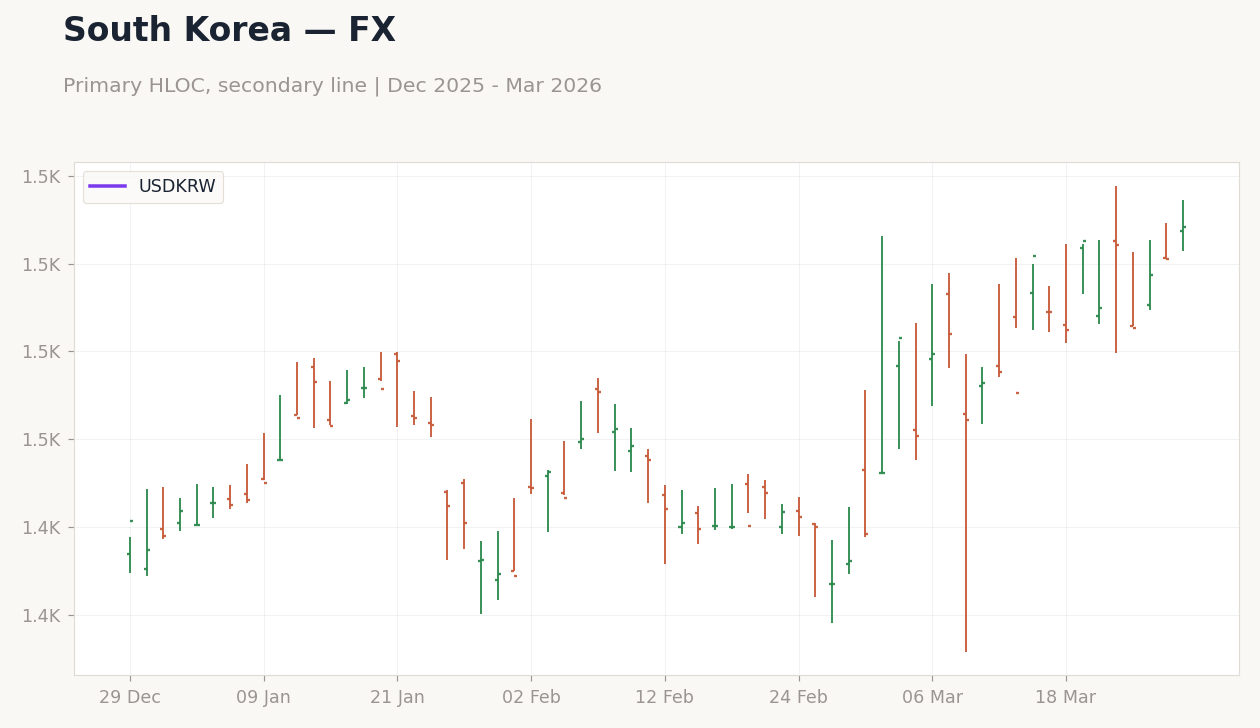
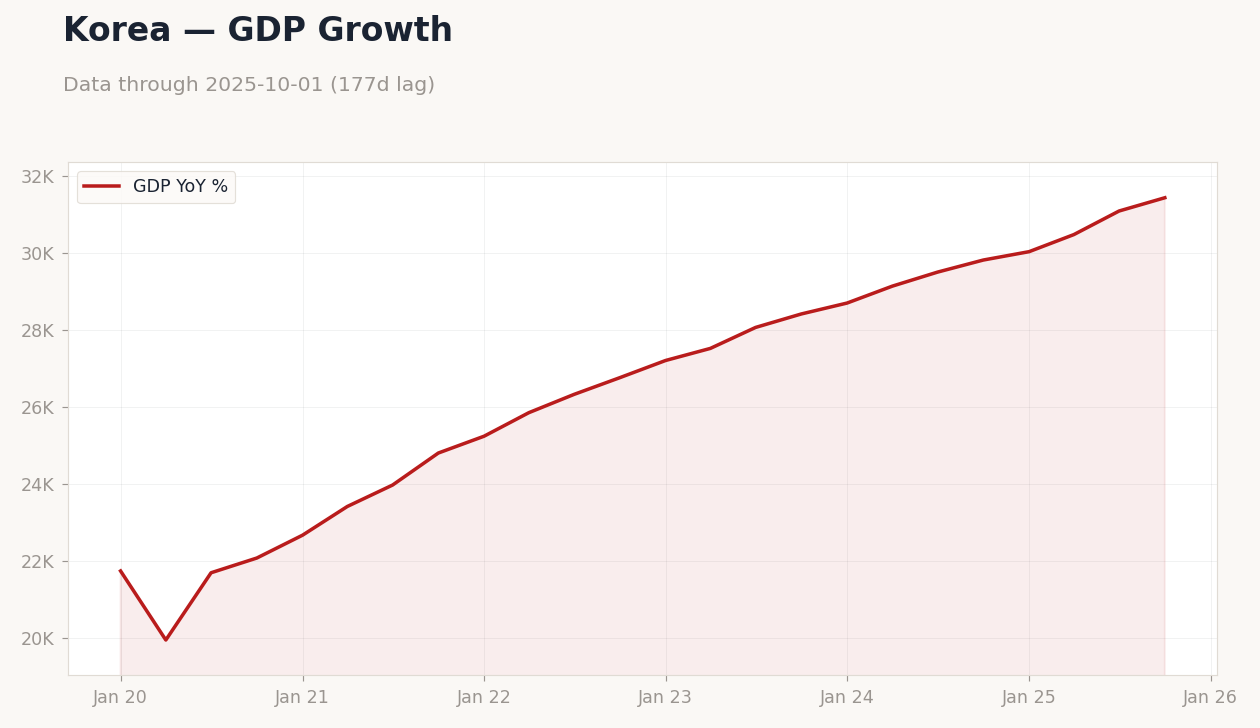
South Korea's KOSPI plunged 5.2% to 5,460 amid foreign outflows, with USD/KRW surging 1.24% to 1,508.26, hitting 17-year lows and prompting Bank of Korea warnings on inflation from oil dependency. ASEAN held steady, with Bank Indonesia maintaining rates as Brent fell 5.23% to 106.32, supporting gains like PSEi's 1.44% to 5,984.20. In Africa, South Africa's rand depreciated 2.36% to 17.12 against USD, yet JSE Top 40 rose 1.5% to 6,538 on mining resilience.
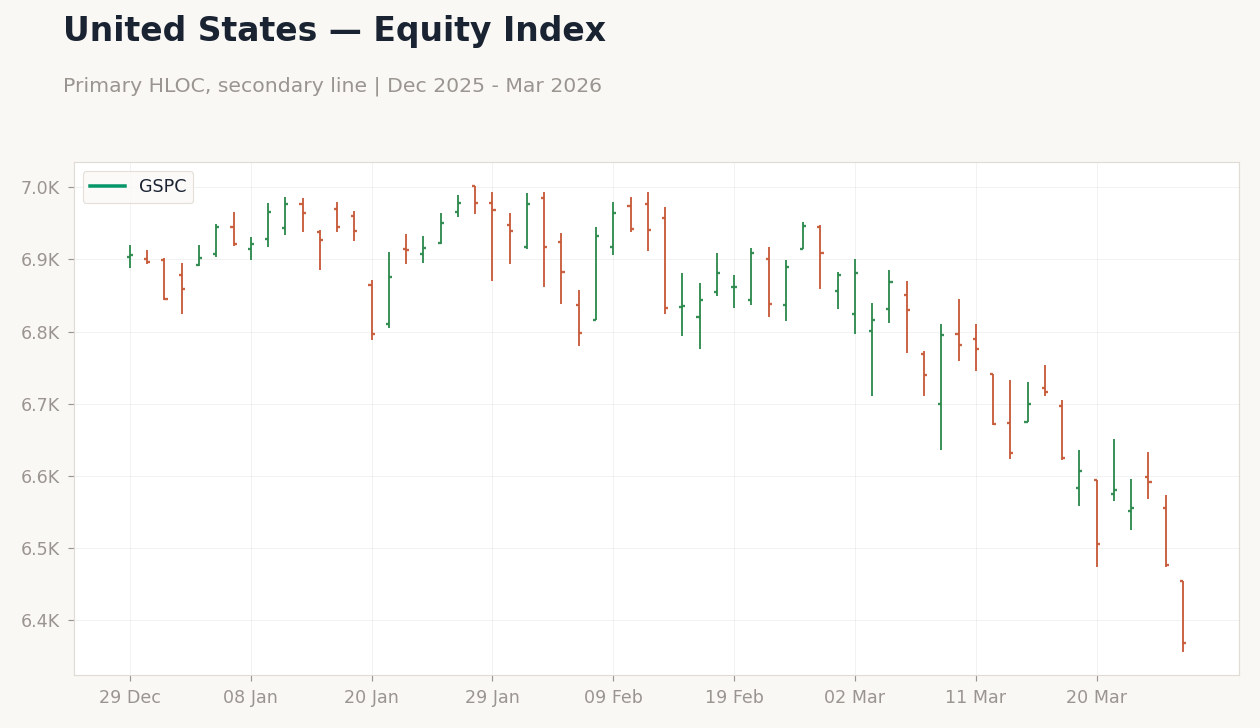
These patterns imply EM central banks, like Banxico's dovish path, will prioritize FX stability, potentially delaying easing until Q3 2026 if dollar strength persists.
Cross-Asset Theme: Volatility Highlights Risk-Off Positioning Cross-asset signals this week painted a picture of cautious positioning, with geopolitical risks driving divergences in rates, FX, equities, and commodities, signaling broader market repricing of growth and inflation outlooks. Fixed income markets saw yields climb broadly, as US 2Y rose 6bp to 4.07% and Italy's 10Y surged 23bp to 4.02%, reflecting inflation concerns amid oil volatility; conversely, China's 30Y fell 2bp to 2.34%, underscoring policy divergence.
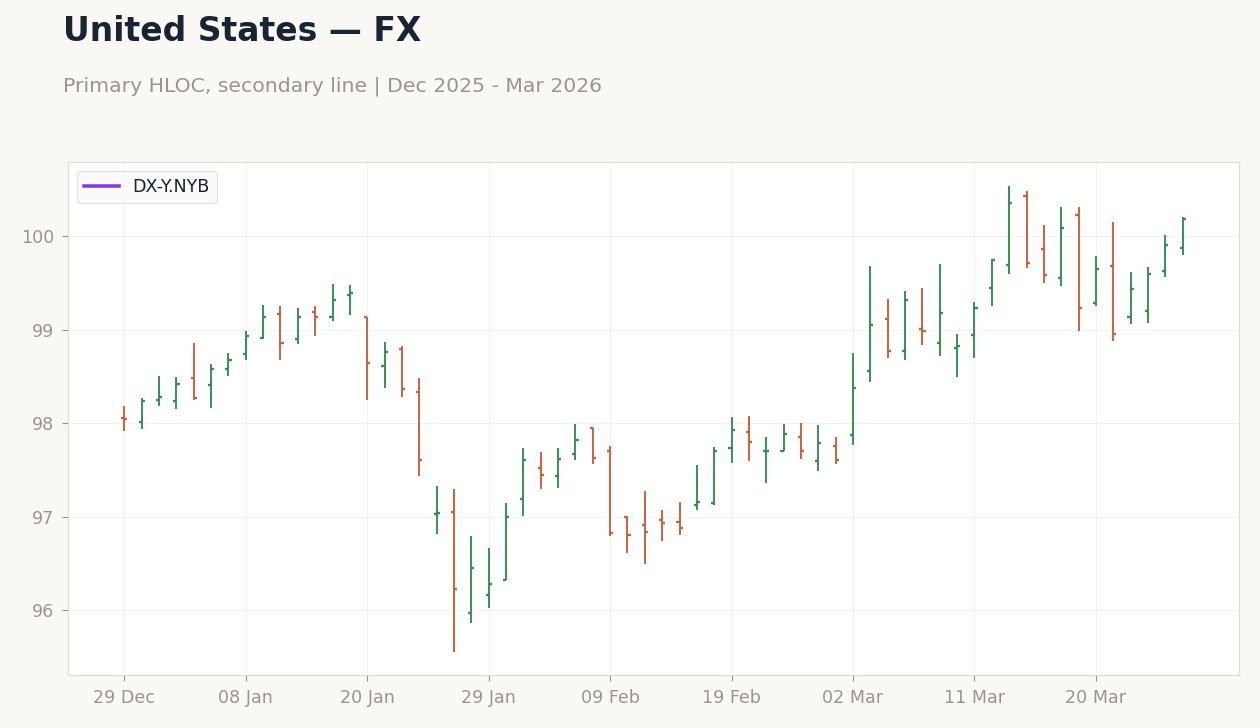
FX markets underscored dollar dominance, with DXY up 0.5% to 100.15, pressuring pairs like AUD/USD down 2.9% to 0.6876 and USD/TRY implied in Turkey's 2Y yield jump of 182bp to 38.78%. Equities were mixed, with Nasdaq 100 down 3.2% to 23,133 tracking risk-off flows, while GCC's MSCI Saudi rose 3.07% to 37.91 on Brent's 5.05% decline to 106.52 supporting fiscal resilience.
Commodities diverged sharply, as gold fell 0.84% to 4532.1 despite haven bids, and Bitcoin dropped 6.53% to 65,918.22, contrasting copper's 2.32% gain to 5.47. These moves suggest investors are hedging against prolonged volatility, with implications for tighter financial conditions if yields like South Korea's 10Y up 16bp to 3.86% persist into April 2026.
Policy Outlook: Divergent Rate Paths Amid Steady Holdings The global central bank landscape this week featured widespread policy stability, but with emerging divergences in rate paths shaped by geopolitical and data flows, setting the stage for potential shifts by mid-2026. We note that the Bank of Canada held steady with a dovish stance, aligning with WTI's 2.57% rise to 100.85, while the ECB's easing bets intensified amid falling consumer confidence and German 10Y yields up 11bp to 3.06%.
In EM, Banxico's dovish path persisted amid USD/MXN's 6.6% drop to 65,868.7, and SARB anticipated hikes supported lower yields like South Africa's 10Y down 6bp to 8.99%. The BoJ's minutes showed no hike signals, with Japan's 10Y up 1bp to 2.27%, contrasting the RBA's hawkish tone despite cooling inflation. Hungary's MNB held rates while lowering growth outlooks, citing energy risks from Brent's declines.
These dynamics imply a fragmented outlook, with DM-EM divergences widening; OIS pricing in Korea shifted toward fewer cuts as yields climbed, potentially delaying global synchronization until Q4 2026.
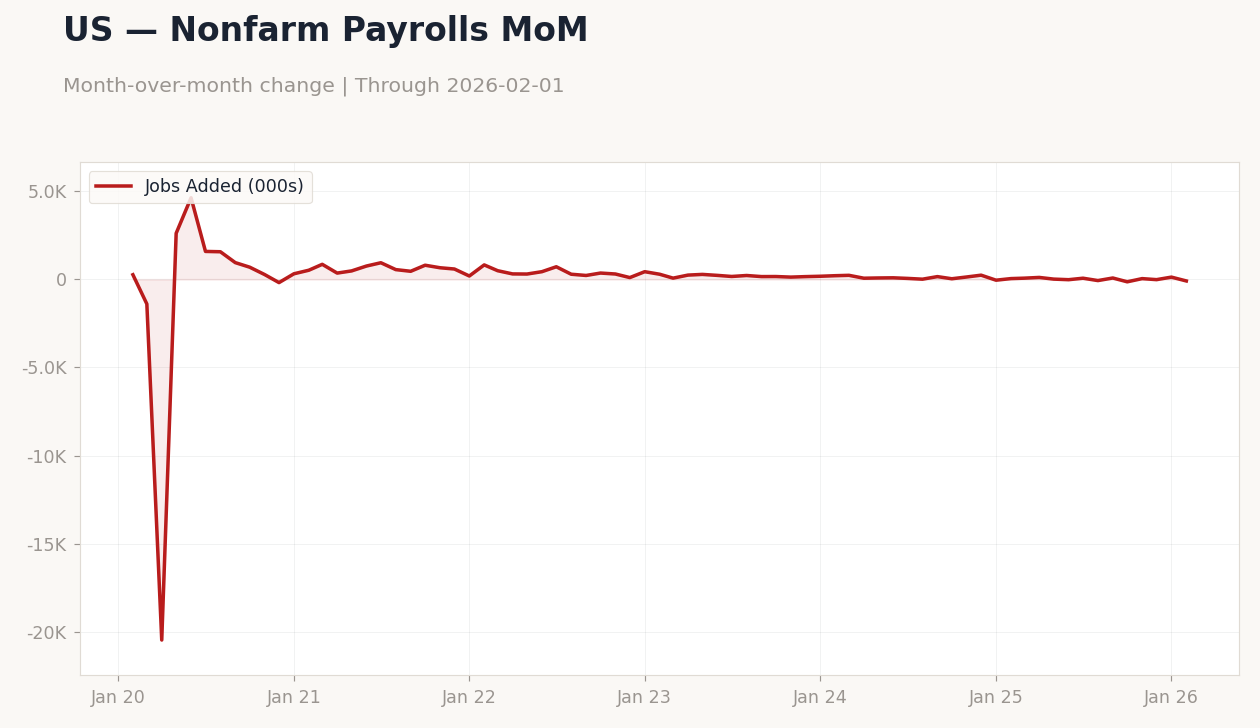
Forward Look: Monitoring Geopolitical and Data Catalysts Looking to the week ahead, we anticipate continued focus on Middle East developments, with any escalation in the Iran war potentially reversing Brent's 5.2% decline to 106.36 and amplifying FX volatility, such as further USD/JPY gains beyond 160.25. Key data releases, including US payrolls on April 3, 2026, could influence Fed pricing if they echo this week's mixed equities, where S&P 500 fell 2.1% to 6,369.
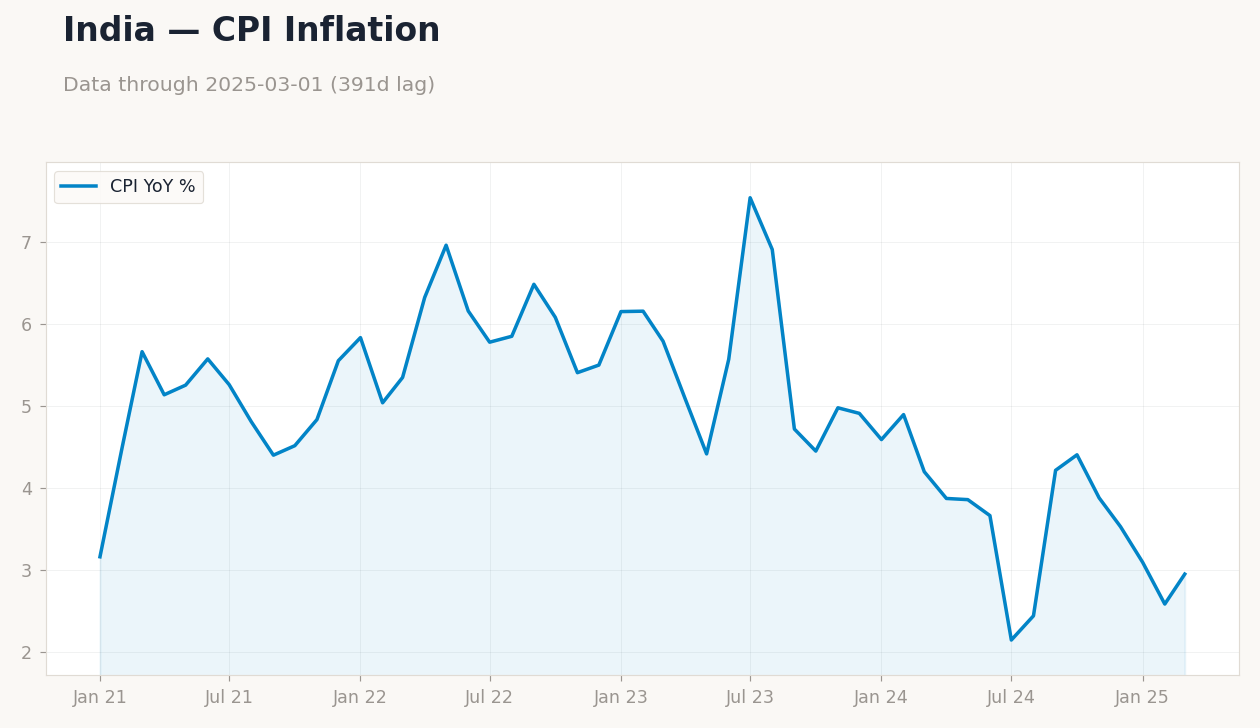
In EM, watch China's credit data around April 1, 2026, for PBoC signals amid USD/CNY at 6.91, and India's inflation print on April 2, which may pressure USD/INR beyond 94.63 if oil rebounds. Policy meetings, like the ECB's April 4 update, could solidify dovish bets if PMIs remain weak.
Overall, if commodity stability holds, as in copper's 2.31% rise to $5.47, it may ease global pressures, but persistent tensions could sustain risk-off flows into Q2 2026.
| Economy | Real GDP (% y/y) | Consumer Prices (% y/y) | ||||
|---|---|---|---|---|---|---|
| 2026E | 2027E | 2028E | 2026E | 2027E | 2028E | |
| Americas | ||||||
| United States | 2.1 | 2.3 | 2.4 | 2.2 | 2.1 | 2.0 |
| Canada | 1.8 | 2.0 | 2.1 | 2.3 | 2.2 | 2.1 |
| Mexico | 2.5 | 2.7 | 2.8 | 3.5 | 3.2 | 3.0 |
| Brazil | 2.2 | 2.4 | 2.5 | 4.0 | 3.8 | 3.5 |
| Argentina | 3.0 | 3.5 | 4.0 | 55.0 | 40.0 | 30.0 |
| Colombia | 3.1 | 3.3 | 3.4 | 4.5 | 4.0 | 3.8 |
| Chile | 2.8 | 3.0 | 3.2 | 3.2 | 3.0 | 2.8 |
| Peru | 3.5 | 3.7 | 3.8 | 2.5 | 2.3 | 2.2 |
| Asia / Pacific | ||||||
| Japan | 1.0 | 1.2 | 1.3 | 1.5 | 1.4 | 1.3 |
| China | 4.5 | 4.3 | 4.2 | 1.8 | 1.7 | 1.6 |
| India | 6.5 | 6.7 | 6.8 | 4.5 | 4.2 | 4.0 |
| Australia | 2.0 | 2.2 | 2.3 | 2.5 | 2.4 | 2.3 |
| New Zealand | 1.9 | 2.1 | 2.2 | 2.3 | 2.2 | 2.1 |
| South Korea | 2.4 | 2.6 | 2.7 | 2.0 | 1.9 | 1.8 |
| Indonesia | 5.0 | 5.2 | 5.3 | 3.0 | 2.8 | 2.7 |
| Malaysia | 4.2 | 4.4 | 4.5 | 2.5 | 2.4 | 2.3 |
| Philippines | 6.0 | 6.2 | 6.3 | 3.5 | 3.3 | 3.2 |
| Singapore | 2.5 | 2.7 | 2.8 | 2.0 | 1.9 | 1.8 |
| Thailand | 3.0 | 3.2 | 3.3 | 1.8 | 1.7 | 1.6 |
| Taiwan | 2.8 | 3.0 | 3.1 | 1.5 | 1.4 | 1.3 |
| Vietnam | 6.5 | 6.7 | 6.8 | 3.5 | 3.3 | 3.2 |
| Western Europe | ||||||
| Euro area | 1.5 | 1.7 | 1.8 | 2.0 | 1.9 | 1.8 |
| Germany | 1.2 | 1.4 | 1.5 | 2.1 | 2.0 | 1.9 |
| France | 1.4 | 1.6 | 1.7 | 1.8 | 1.7 | 1.6 |
| Italy | 1.0 | 1.2 | 1.3 | 1.9 | 1.8 | 1.7 |
| Spain | 2.0 | 2.2 | 2.3 | 2.2 | 2.1 | 2.0 |
| United Kingdom | 1.6 | 1.8 | 1.9 | 2.3 | 2.2 | 2.1 |
| Sweden | 1.7 | 1.9 | 2.0 | 1.5 | 1.4 | 1.3 |
| Norway | 1.8 | 2.0 | 2.1 | 2.0 | 1.9 | 1.8 |
| Denmark | 1.9 | 2.1 | 2.2 | 1.6 | 1.5 | 1.4 |
| Switzerland | 1.3 | 1.5 | 1.6 | 1.2 | 1.1 | 1.0 |
| Netherlands | 1.4 | 1.6 | 1.7 | 2.0 | 1.9 | 1.8 |
| Poland | 3.0 | 3.2 | 3.3 | 3.5 | 3.3 | 3.2 |
| Czech Republic | 2.5 | 2.7 | 2.8 | 2.2 | 2.1 | 2.0 |
| Hungary | 2.8 | 3.0 | 3.1 | 4.0 | 3.8 | 3.5 |
| Romania | 3.5 | 3.7 | 3.8 | 4.5 | 4.2 | 4.0 |
| EMEA Emerging | ||||||
| Turkey | 3.2 | 3.5 | 3.7 | 25.0 | 20.0 | 15.0 |
| South Africa | 1.5 | 1.7 | 1.8 | 4.5 | 4.3 | 4.2 |
| Israel | 3.0 | 3.2 | 3.3 | 2.5 | 2.4 | 2.3 |
| Saudi Arabia | 3.5 | 3.7 | 3.8 | 2.0 | 1.9 | 1.8 |
| UAE | 4.0 | 4.2 | 4.3 | 2.2 | 2.1 | 2.0 |
| Egypt | 4.5 | 4.7 | 4.8 | 15.0 | 12.0 | 10.0 |
| Nigeria | 3.0 | 3.2 | 3.3 | 20.0 | 18.0 | 15.0 |
| Kenya | 5.5 | 5.7 | 5.8 | 6.0 | 5.8 | 5.5 |
| Global Aggregates | ||||||
| Global | 3.2 | 3.3 | 3.4 | 3.5 | 3.3 | 3.2 |
| Developed markets | 1.8 | 1.9 | 2.0 | 2.0 | 1.9 | 1.8 |
| Emerging markets | 4.2 | 4.3 | 4.4 | 4.5 | 4.3 | 4.2 |
| Central Bank | Instrument | Current Rate |
Last Change |
bp | Next Meeting |
Expected Move |
Q1 2026 |
Q2 2026 |
Q3 2026 |
Q4 2026 |
|---|---|---|---|---|---|---|---|---|---|---|
| The Americas | ||||||||||
| Federal Reserve | Fed funds upper | 3.00% | Feb 2026 | -25 | May 1 | Hold | 3.00 | 3.00 | 2.75 | 2.50 |
| Bank of Canada | O/N rate | 3.25% | Mar 2026 | -25 | Apr 10 | Hold | 3.25 | 3.00 | 2.75 | 2.50 |
| BCB (Brazil) | SELIC | 10.50% | Mar 2026 | -50 | May 8 | -25bp | 10.50 | 10.00 | 9.50 | 9.00 |
| Banxico | O/N rate | 9.00% | Feb 2026 | -25 | May 9 | Hold | 9.00 | 8.75 | 8.50 | 8.00 |
| BCRA (Argentina) | Repo rate | 40.00% | Jan 2026 | -500 | Apr 15 | -200bp | 40.00 | 35.00 | 30.00 | 25.00 |
| BanRep (Colombia) | Repo | 8.50% | Mar 2026 | -50 | Apr 30 | -25bp | 8.50 | 8.00 | 7.50 | 7.00 |
| BCCh (Chile) | MPR | 5.00% | Jan 2026 | -50 | Apr 2 | Hold | 5.00 | 4.75 | 4.50 | 4.25 |
| Europe / Africa | ||||||||||
| ECB | Depo rate | 2.50% | Mar 2026 | -25 | Apr 11 | Hold | 2.50 | 2.25 | 2.00 | 2.00 |
| Bank of England | Bank rate | 3.50% | Feb 2026 | -25 | May 9 | Hold | 3.50 | 3.25 | 3.00 | 2.75 |
| Riksbank | Repo rate | 2.00% | Feb 2026 | -25 | Apr 25 | Hold | 2.00 | 1.75 | 1.50 | 1.50 |
| Norges Bank | Dep rate | 3.00% | Mar 2026 | 0 | May 2 | Hold | 3.00 | 3.00 | 2.75 | 2.50 |
| SNB | Policy rate | 0.75% | Mar 2026 | -25 | Jun 20 | Hold | 0.75 | 0.50 | 0.50 | 0.25 |
| CNB (Czech) | 2-wk repo | 3.50% | Feb 2026 | -50 | May 2 | -25bp | 3.50 | 3.00 | 2.75 | 2.50 |
| NBH (Hungary) | Base rate | 5.00% | Mar 2026 | -50 | Apr 23 | -25bp | 5.00 | 4.50 | 4.00 | 3.50 |
| NBP (Poland) | Ref rate | 4.25% | Jan 2026 | 0 | Apr 4 | Hold | 4.25 | 4.00 | 3.75 | 3.50 |
| SARB | Repo rate | 6.50% | Jan 2026 | -25 | May 30 | Hold | 6.50 | 6.25 | 6.00 | 5.75 |
| CBRT (Turkey) | 1-wk repo | 35.00% | Mar 2026 | -250 | Apr 25 | -100bp | 35.00 | 32.00 | 28.00 | 25.00 |
| Asia / Pacific | ||||||||||
| RBA | Cash rate | 3.10% | Feb 2026 | -25 | May 7 | Hold | 3.10 | 2.85 | 2.60 | 2.35 |
| RBNZ | OCR | 3.50% | Feb 2026 | -50 | Apr 10 | Hold | 3.50 | 3.25 | 3.00 | 2.75 |
| BoJ | Pol rate | 0.25% | Mar 2026 | +15 | Apr 26 | Hold | 0.25 | 0.25 | 0.50 | 0.50 |
| PBoC | 1-yr LPR | 3.35% | Jan 2026 | -10 | Apr 20 | Hold | 3.35 | 3.25 | 3.15 | 3.05 |
| RBI (India) | Repo rate | 5.50% | Feb 2026 | -25 | Apr 5 | Hold | 5.50 | 5.25 | 5.00 | 4.75 |
| BoK (Korea) | Base rate | 2.50% | Jan 2026 | -25 | Apr 12 | Hold | 2.50 | 2.25 | 2.00 | 2.00 |
| BI (Indonesia) | BI-Rate | 5.00% | Mar 2026 | -25 | Apr 24 | Hold | 5.00 | 4.75 | 4.50 | 4.25 |
| BSP (Philippines) | Rev repo | 4.75% | Feb 2026 | -25 | Apr 4 | Hold | 4.75 | 4.50 | 4.25 | 4.00 |
| BoT (Thailand) | 1-day repo | 1.75% | Feb 2026 | -25 | Apr 10 | Hold | 1.75 | 1.50 | 1.50 | 1.25 |
| CBC (Taiwan) | Disc rate | 1.50% | Mar 2026 | 0 | Jun 20 | Hold | 1.50 | 1.50 | 1.25 | 1.25 |
| MAS (Singapore) | SGD NEER | 0% slope% | Jan 2026 | 0 | Apr 12 | Hold | 0% slope | 0% slope | slight appreciation | slight appreciation |
| Country | 2Y | 2Y WoW | 10Y | 10Y WoW | 30Y | 30Y WoW | 2s10s |
|---|---|---|---|---|---|---|---|
| United States | 4.07% | +6bp | 4.44% | +5bp | 4.98% | +2bp | +37bp |
| United Kingdom | 4.53% | +13bp | 4.92% | +13bp | 5.57% | +13bp | +39bp |
| Germany | 2.71% | +15bp | 3.06% | +11bp | 3.50% | +5bp | +35bp |
| France | 2.87% | +15bp | 3.80% | +15bp | 4.55% | +11bp | +92bp |
| Italy | 3.02% | +17bp | 4.02% | +23bp | 4.70% | +17bp | +100bp |
| Spain | 2.88% | +13bp | 3.62% | +17bp | 4.21% | +8bp | +74bp |
| Japan | 1.34% | +6bp | 2.27% | +1bp | 3.52% | -0bp | +94bp |
| Canada | 2.98% | +13bp | 3.56% | +12bp | 3.93% | +7bp | +58bp |
| Australia | 4.80% | +10bp | 5.08% | +7bp | 5.43% | +2bp | +28bp |
| China | 1.28% | -1bp | 1.81% | -0bp | 2.34% | -2bp | +53bp |
| India | 6.25% | +24bp | 6.87% | +15bp | 7.64% | +15bp | +62bp |
| Brazil | 14.07% | +25bp | 14.22% | +3bp | — | — | +15bp |
| Mexico | — | — | 9.45% | 0bp | — | — | — |
| South Korea | 3.47% | +25bp | 3.86% | +16bp | 3.75% | +18bp | +39bp |
| Indonesia | — | — | 6.85% | -8bp | 6.84% | 0bp | — |
| Turkey | 38.78% | +182bp | 31.49% | +50bp | — | — | -729bp |
| South Africa | — | — | 8.99% | -6bp | 9.44% | -7bp | — |
| Poland | — | — | 5.78% | +1bp | — | — | — |
Government bond yields rose broadly last week, with Turkey's 2Y surging +182bp amid policy tightening signals, while Italy's 10Y jumped +23bp on fiscal concerns. India's 2Y climbed +24bp, driven by inflation data, and South Korea's 2Y rose +25bp following hawkish central bank rhetoric. In contrast, Indonesia's 10Y fell -8bp on capital inflows, and South Africa's 10Y and 30Y declined -6bp and -7bp respectively, buoyed by easing commodity pressures. European curves steepened, with Italy's 2s10s at +100bp versus Germany's +35bp, highlighting periphery risk premia. EM divergences were stark, as Brazil's 2Y +25bp outpaced Mexico's flat 10Y at 0bp. DM front-ends led gains, with Germany's 2Y +15bp versus Japan's modest +6bp. Watch next week's ECB minutes and US payrolls for policy cues.
| Index | Level | WoW | MTD | YTD |
|---|---|---|---|---|
| S&P 500 | 6,369 | -2.1% | -7.5% | -7.1% |
| Nasdaq 100 | 23,133 | -3.2% | -7.4% | -8.2% |
| Dow Jones | 45,167 | -0.9% | -7.6% | -6.7% |
| Russell 2000 | 2,450 | +0.5% | -7.8% | -2.3% |
| S&P/TSX | 31,961 | +2.0% | -7.5% | +0.2% |
| FTSE 100 | 9,967 | +0.5% | -7.5% | +0.2% |
| Euro Stoxx 50 | 5,506 | +0.1% | -8.0% | -7.0% |
| DAX | 22,301 | -0.3% | -9.5% | -9.1% |
| FTSE MIB | 43,379 | +1.3% | -6.3% | -4.4% |
| IBEX 35 | 16,802 | +0.5% | -6.0% | -3.9% |
| Nikkei 225 | 53,604 | -3.0% | -7.7% | +3.4% |
| Hang Seng | 24,856 | -2.5% | -4.6% | -5.6% |
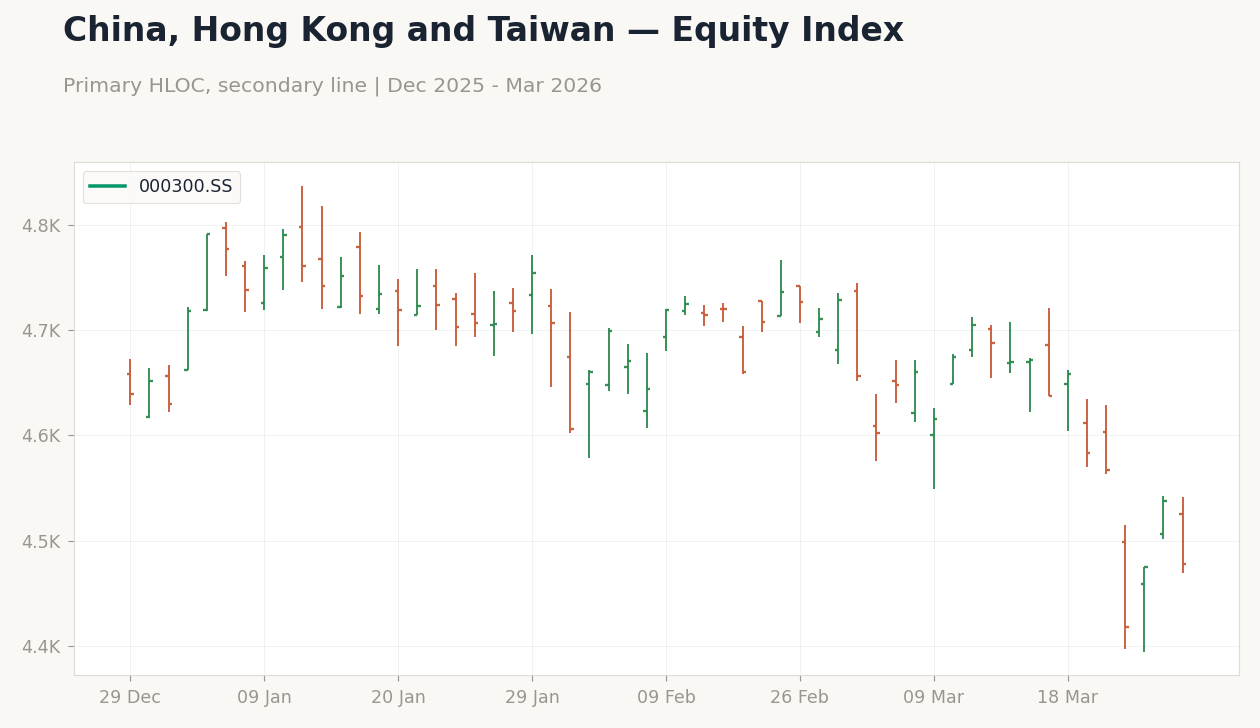
| CSI 300 | 4,478 | -2.3% | -5.3% | -5.1% |
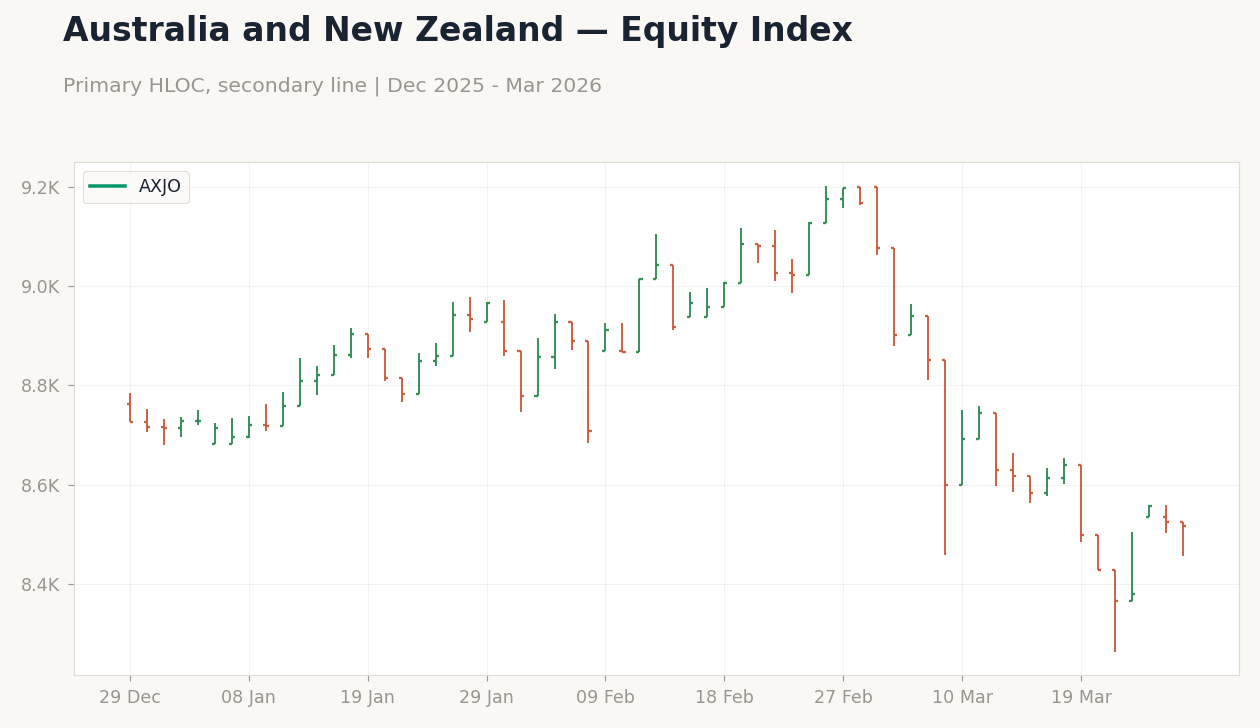
| S&P/ASX 200 | 8,516 | +1.0% | -7.1% | -2.4% |
| KOSPI | 5,460 | -5.2% | -5.7% | +26.7% |
| Nifty 50 | 23,306 | -2.0% | -6.3% | -10.9% |
| Ibovespa | 181,557 | +3.0% | -4.1% | +13.1% |
| IPC Mexico | 66,686 | +4.0% | -5.5% | +4.0% |
| JSE Top 40 | 6,538 | +1.5% | -17.1% | -7.3% |
Global equities posted mixed results for the week ending March 27, with Mexico's IPC leading gains at +4.0% and Brazil's Ibovespa up +3.0%, while South Korea's KOSPI plunged -5.2% and the Nasdaq 100 fell -3.2%. Smaller U.S. benchmarks bucked the trend, as the Russell 2000 rose +0.5% amid rotation into value stocks. Moves were driven by softer U.S. payroll data stoking recession fears, pressuring tech-heavy indices like the Nasdaq 100, while Latin American markets benefited from commodity flows and policy easing signals. European bourses showed resilience, with Italy's FTSE MIB up +1.3% on fiscal stimulus hopes, contrasting Asia's broader weakness where the Hang Seng dropped -2.5%. Divergences highlighted EM outperformance, as Ibovespa's +3.0% gain outpaced the S&P 500's -2.1% decline. Looking ahead, watch U.S. inflation prints and ECB rate decisions for potential volatility in Euro Stoxx 50, currently at 5,506.
| Index | WoW | MTD | YTD |
|---|---|---|---|
| S&P 500 | -2.1% | -7.5% | -7.1% |
| Nasdaq 100 | -3.2% | -7.4% | -8.2% |
| Dow Jones | -0.9% | -7.6% | -6.7% |
| Russell 2000 | +0.5% | -7.8% | -2.3% |
| S&P/TSX | +2.0% | -7.5% | +0.2% |
| FTSE 100 | +0.5% | -7.5% | +0.2% |
| Euro Stoxx 50 | +0.1% | -8.0% | -7.0% |
| DAX | -0.3% | -9.5% | -9.1% |
| FTSE MIB | +1.3% | -6.3% | -4.4% |
| IBEX 35 | +0.5% | -6.0% | -3.9% |
| Nikkei 225 | -3.0% | -7.7% | +3.4% |
| Hang Seng | -2.5% | -4.6% | -5.6% |
| CSI 300 | -2.3% | -5.3% | -5.1% |
| S&P/ASX 200 | +1.0% | -7.1% | -2.4% |
| KOSPI | -5.2% | -5.7% | +26.7% |
| Nifty 50 | -2.0% | -6.3% | -10.9% |
| Ibovespa | +3.0% | -4.1% | +13.1% |
| IPC Mexico | +4.0% | -5.5% | +4.0% |
| JSE Top 40 | +1.5% | -17.1% | -7.3% |
| Pair | Level | WoW | MTD | YTD |
|---|---|---|---|---|
| DXY | 100.16 | +0.5% | +1.8% | +1.8% |
| EUR/USD | 1.1510 | -0.6% | -2.1% | -2.0% |
| GBP/USD | 1.3260 | -1.2% | -1.1% | -1.6% |
| USD/JPY | 160.29 | +1.5% | +2.3% | +2.3% |
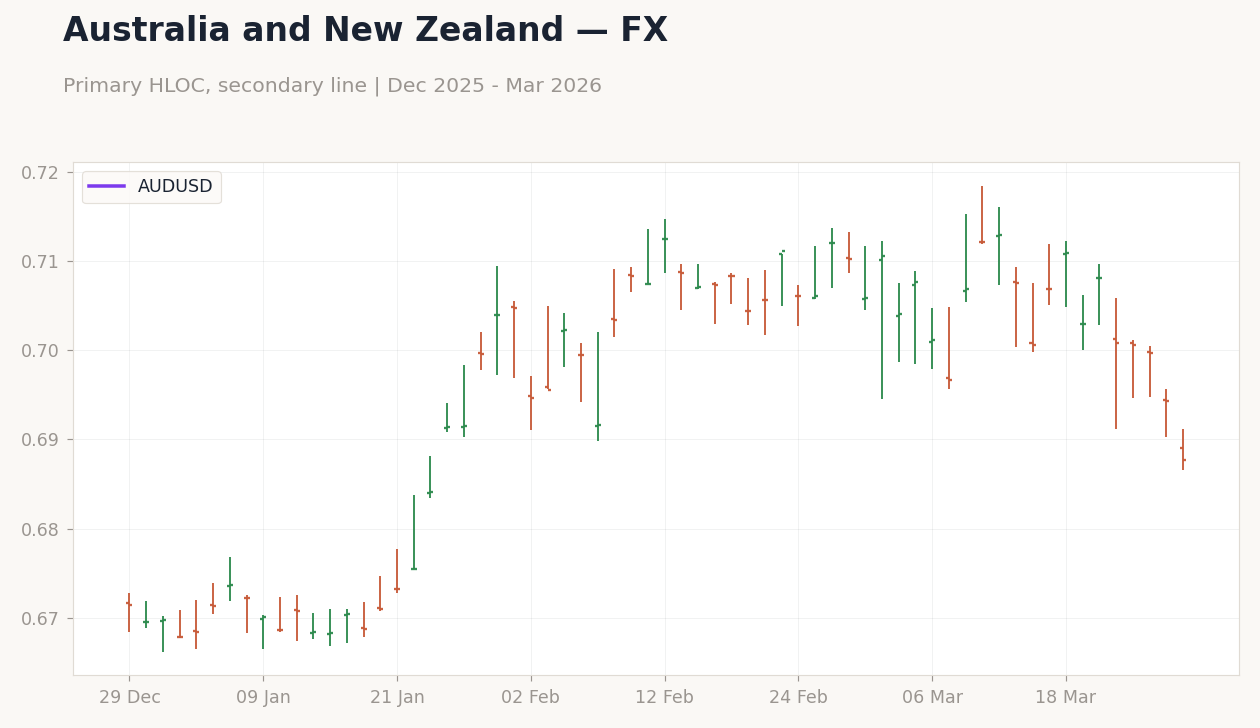
| AUD/USD | 0.6876 | -2.9% | -2.6% | +3.0% |
| NZD/USD | 0.5747 | -2.1% | -3.5% | -0.2% |
| USD/CAD | 1.3892 | +1.1% | +1.6% | +1.3% |
| USD/CHF | 0.7984 | +1.2% | +3.8% | +0.8% |
| USD/CNY | 6.9111 | +0.2% | +0.8% | -1.2% |
| USD/BRL | 5.2389 | +0.4% | +2.1% | -5.0% |
| USD/MXN | 18.10 | +2.0% | +4.5% | +0.6% |
| USD/INR | 94.76 | +1.8% | +4.0% | +5.3% |
| USD/ZAR | 17.10 | +2.2% | +6.5% | +3.3% |
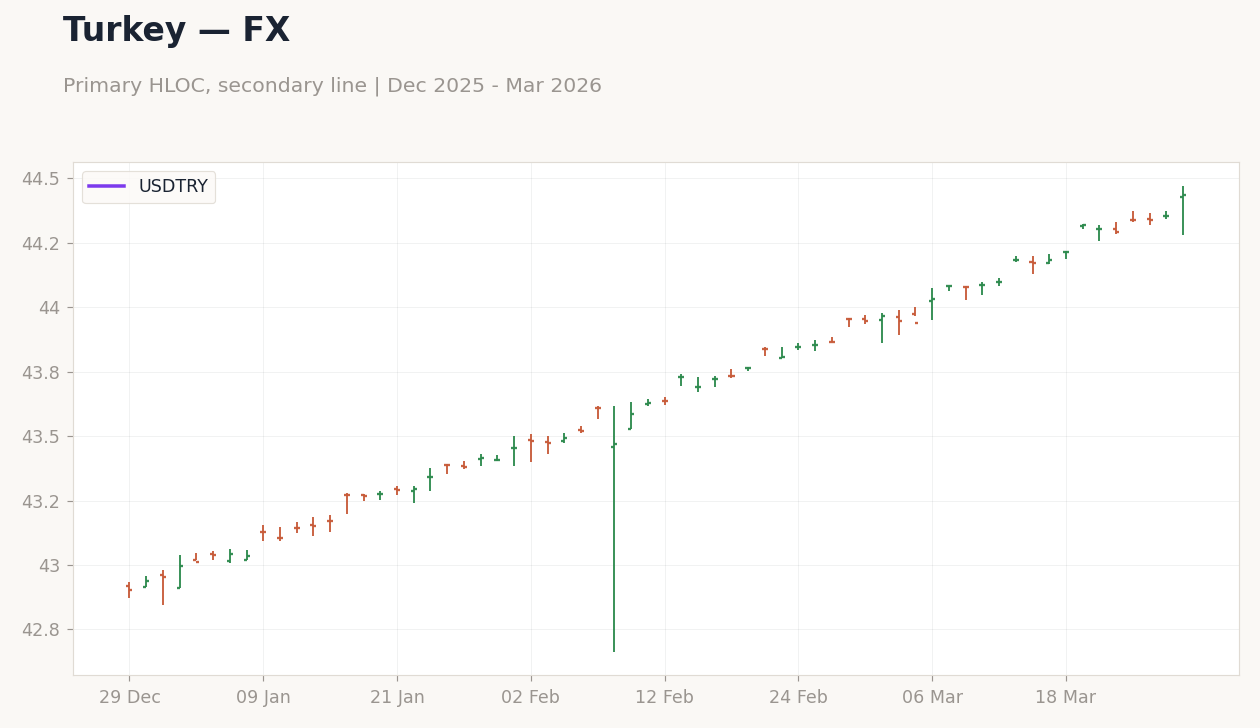
| USD/TRY | 44.43 | +0.3% | +1.1% | +3.3% |
| Commodity | Level | WoW | MTD | YTD |
|---|---|---|---|---|
| WTI Crude | 100.63 | +2.4% | +41.3% | +75.6% |
| Brent Crude | 106.51 | -5.1% | +37.0% | +75.3% |
| Gold | 4523.10 | -1.0% | -14.6% | +4.8% |
| Silver | 69.74 | +0.6% | -21.0% | -1.2% |
| Copper | 5.47 | +2.4% | -7.2% | -3.0% |
| Natural Gas | 3.03 | -2.2% | +2.2% | -16.4% |
| Wheat | 605.75 | +1.8% | +5.4% | +19.6% |
| Iron Ore | 106.14 | +0.5% | +6.3% | -1.0% |
| Asset | Level | WoW | MTD | YTD |
|---|---|---|---|---|
| Bitcoin | $65,981 | -2.8% | +0.4% | 0.0% |
| Ethereum | $1,984 | -3.3% | +2.3% | -33.9% |
| Solana | $83 | -3.9% | -1.0% | -34.7% |
| XRP | $1 | -4.3% | -1.9% | -29.4% |
The dollar index (DXY) firmed +0.5% WoW to 100.15, buoyed by resilient US data and hawkish Fed signals, while Antipodean currencies underperformed amid commodity weakness and RBA/RBNZ policy caution. USD/ZAR surged +2.4% to 17.12 and USD/MXN +2.1% to 18.10 as EM flows reversed on risk-off sentiment, contrasting with modest USD/CNY gains of +0.2% to 6.9111 amid PBOC stability measures. AUD/USD plunged -2.9% to 0.6876 and NZD/USD -2.1% to 0.5747, driven by soft China demand and global growth fears, while GBP/USD slid -1.2% to 1.3261 on BoE dovishness. In DM crosses, USD/JPY climbed +1.5% to 160.25 and USD/CHF +1.3% to 0.7988, reflecting yield differentials and safe-haven bids. EM divergences widened, with USD/BRL +0.3% to 5.2384 lagging behind sharper USD/INR +1.8% to 94.76 moves tied to RBI interventions. Looking ahead, watch US payrolls, ECB meeting, and China PMI for directional cues on DXY and commodity pairs.
| Asset | Level | WoW |
|---|---|---|
| S&P 500 | 160.27 | +1.5% |
| Nasdaq 100 | 6368.85 | -2.1% |
| Dow Jones | 23132.77 | -3.2% |
| Russell 2000 | 45166.64 | -0.9% |
| USD/JPY | 160.27 | +1.5% |
| EUR/USD | 184.51 | +0.9% |
| GBP/USD | 106.36 | -5.2% |
| Gold | 4532.1 | -0.8% |
| WTI Crude | 100.85 | +2.6% |
| Bitcoin | 65893.19 | -6.6% |


US markets navigated volatility ending March 29, 2026, as mixed economic signals and global risks prompted rotations across assets. Equities diverged, with large-cap outperformance offsetting small-cap declines, while bonds saw yield moves tied to growth views and commodities reflected supply dynamics, linking to Fed rate expectations and global spillovers.
Market Volatility Set the Tone The week opened with risk aversion weighing on equities, as the S&P 500 declined amid global uncertainties. Technology-heavy indices fell sharply, while the dollar strengthened against the yen. Sentiment stabilized mid-week on softer activity signals, supporting selective rebounds.
Data Releases Highlighted Divergence Economic indicators pointed to uneven momentum, with activity measures signaling a late-cycle slowdown that tempers growth outlooks and supports Fed easing prospects.
Market Rotations and Adjustments Equities rotated toward value mid-week, with broader indices showing resilience. Yields moved higher by week end, reflecting inflation persistence. Cryptocurrencies declined amid risk aversion. Overall closes reflected net caution, underscoring maturing cycle dynamics amid trade resilience.
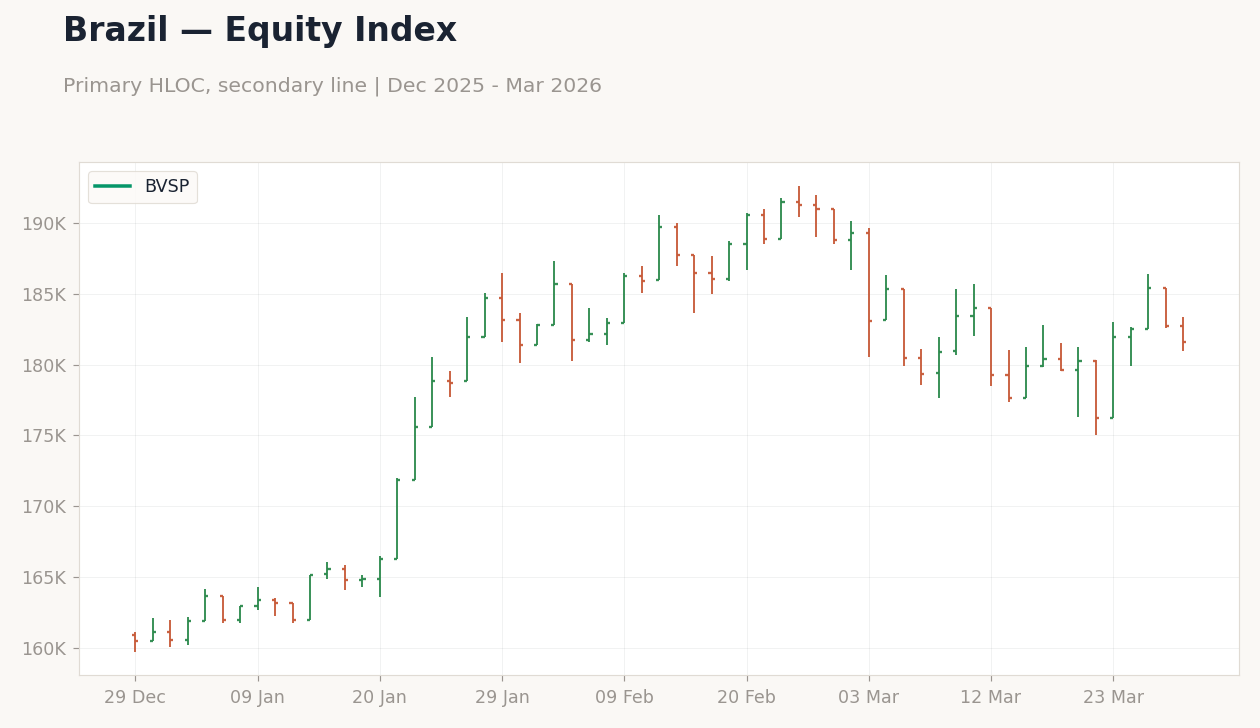
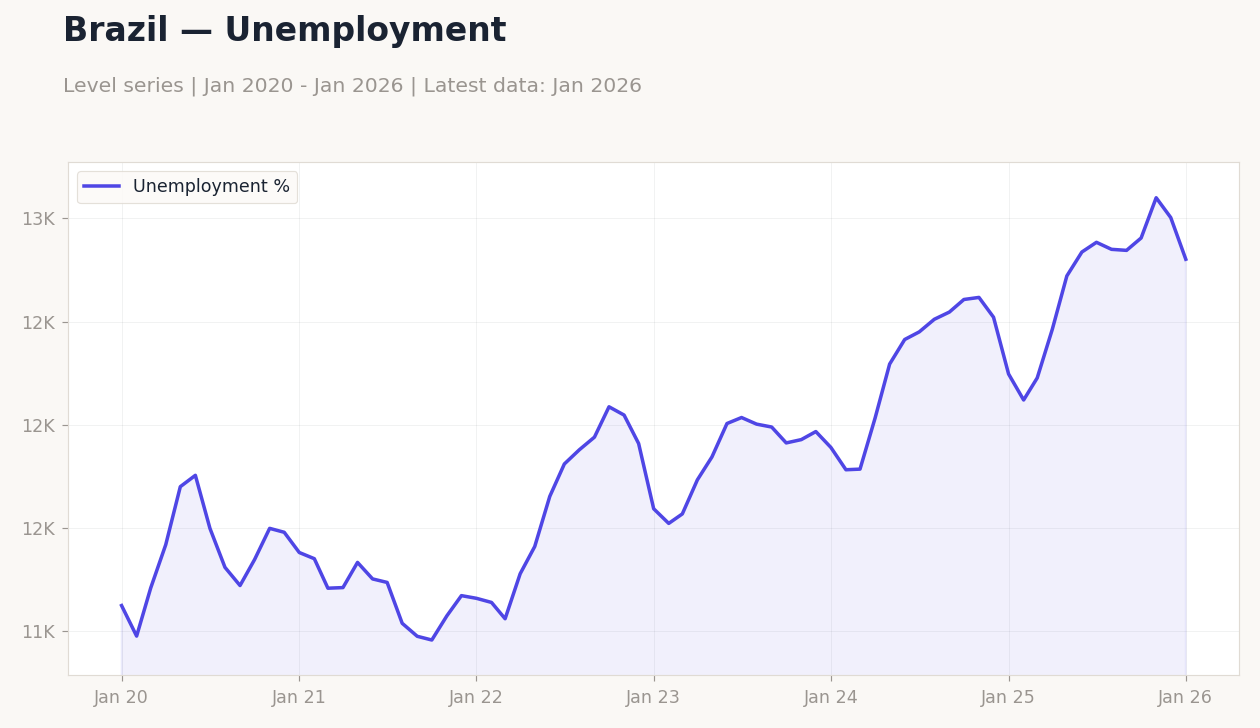
Policy and Outlook Ties Fed speakers reinforced a steady rate path amid uncertainty. The arc indicated resilient but moderating growth, amplifying volatility where misses outnumbered beats.
The Federal Reserve maintained its policy rate this week, with forward guidance emphasizing caution amid uncertainties. Speakers highlighted balanced risks aligning with data, suggesting room for dovish tilts if growth slows, though resilient trade indicates persistent inflation, capping cuts to one by year-end. Rhetoric remains data-dependent, underscoring vigilance on spillovers.
This week's US economic data indicated moderating growth in the late-cycle phase, signaling downward pressure on the Fed's rate path. These releases suggest a slowdown, paving the way for Fed cuts if inflation eases, though energy risks add upside variance.
| Event | Prior | Cons. | Actual |
|---|---|---|---|
| Chicago Fed National Activit | 0.20 | - | -0.11 |
| Construction Spending Month- | 0.80 | 0.10 | -0.30 |
| 3-Month Treasury Bill Auctio | 3.6 | - | 3.6 |
| 6-Month Treasury Bill Auctio | 3.6 | - | 3.6 |
| ADP Employment Change Weekly | 9000 | - | 10K |
| Nonfarm Productivity Quarter | 5.2 | 2.0 | 1.8 |
| Unit Labour Costs Quarter-ov | 1.0 | 3.5 | 4.4 |
| Redbook Retail Sales Year-ov | 6.4 | - | 6.7 |
| Ny Fed Bill Purchases 1 To 4 | - | - | - |
| S&P Global Composite PMI Fla | 51.9 | - | 51.4 |
| S&P Global Manufacturing PMI | 51.6 | 51.3 | 52.4 |
| S&P Global Services PMI Flas | 51.7 | 51.5 | 51.1 |
| Richmond Fed Manufacturing I | -10.0 | -5.0 | 0 |
| Richmond Fed Manufacturing S | -13.0 | - | -2.0 |
| Date | Release | Prior | Cons. |
|---|---|---|---|
| 2026-03-30 | Dallas Fed Manufacturing Index | 0.20 | - |
| 2026-03-30 | Speech by Fed's Williams | - | - |
| 2026-03-31 | S&P/Case-Shiller Home Price Year-ov | 1.4 | - |
| 2026-03-31 | Chicago PMI | 57.7 | - |
| 2026-03-31 | JOLTs Job Openings | 6.9mn | - |
| 2026-03-31 | Cb Consumer Confidence | 91.2 | - |
| 2026-03-31 | Fed Goolsbee Speech | - | - |
| 2026-03-31 | API Weekly Crude Oil Stocks | 2.3mn | - |
| 2026-04-01 | MBA 30-Year Mortgage Rate | 6.4 | - |
| 2026-04-01 | ADP Employment Change | 63K | - |


Next week's US calendar, spanning March 30 to April 3, 2026, features key labor and inflation data that could refine the Fed's rate path, with consensus eyeing resilient but moderating growth amid global risks. On Monday, March 30, Japan's housing starts YoY (prior -0.4%) and South Africa's M3 money supply YoY (prior 7.44%) provide global context, but US focus shifts to potential Fed speakers if scheduled. Tuesday, March 31, brings Conference Board Consumer Confidence at 10:00 ET, with consensus at 104.5 versus prior 102.9, critical for gauging spending trends that drive 70% of GDP. Also on Tuesday, JOLTS Job Openings at 10:00 ET (consensus 8.75 million, prior 8.86 million) will signal labor market tightness, potentially influencing wage inflation if below expectations. Wednesday, April 1, highlights ISM Manufacturing PMI at 10:00 ET (consensus 48.5, prior 47.8), a bellwether for cycle positioning that could confirm expansion if above 50. Thursday, April 2, features Initial Jobless Claims at 8:30 ET (consensus 215,000, prior 210,000), offering weekly labor insights amid recent subdued gains. Friday, April 3, delivers Nonfarm Payrolls at 8:30 ET (consensus 190,000, prior 275,000), Unemployment Rate (consensus 3.9%, prior 3.9%), and Average Hourly Earnings YoY (consensus 4.2%, prior 4.3%), pivotal for rate bets—if payrolls miss below 150,000, it could boost odds of a Fed cut. ISM Services PMI at 10:00 ET on Friday (consensus 52.8, prior 52.6) matters for services-driven growth. Fed speakers, potentially including Powell if announced, will parse these for guidance on rates. Overall, beats in labor data could delay cuts, while misses might accelerate dovish pricing toward one 25bp easing by mid-year.
This week's mixed signals shift the US outlook toward softer late-cycle growth, raising downside risks if tensions escalate oil higher. Upside scenarios include manufacturing resilience driving exports, potentially lifting Q2 GDP and delaying Fed cuts. Downside risks center on supply gluts fueling deflationary pressures. Positioning appears crowded in safe havens, signaling overbought conditions that might trigger equity flows if risks de-escalate. Volatility considerations include FX swings like USD/JPY at 160.27, while flows suggest rotations into small-caps that could amplify rebounds if payrolls next week beat consensus.
US equities diverged amid volatility, with the S&P 500 up 1.48% to 160.27 but the Nasdaq 100 down 2.12% to 6368.85 as tech reacted to risk flows. The Dow Jones fell 3.2% to 23132.77, while the Russell 2000 declined 0.9% to 45166.64. Bonds saw yields climb, reflecting inflation views. The USD gained 1.48% against JPY to 160.27, while EUR/USD rose 0.92% to 184.51. Commodities diverged, with WTI crude up 2.57% to 100.85 contrasting gold's 0.84% decline to 4532.1. Bitcoin fell 6.56% to 65893.19.
Global spillovers pressured US assets over the last seven days, with oil rising 2.57% to 100.85 on supply fears, potentially importing inflation. Trade dynamics shifted positively amid global demand, though EUR/USD's 0.92% gain to 184.51 reflects dollar dynamics. Cross-border energy flows highlight vulnerabilities if escalations persist.
| Asset | Level | WoW |
|---|---|---|
| Euro Stoxx 50 | 5505.8 | +0.1% |
| DAX | 22300.75 | -0.3% |
| CAC 40 | 7701.95 | +0.5% |
| EUR/USD | 1.15 | -0.5% |
| EUR/GBP | 0.87 | +0.6% |
| EUR/JPY | 184.5 | +0.9% |
| Gold | 4532.2 | -0.8% |
| Brent Crude | 106.36 | -5.2% |
| Bitcoin | 65893.19 | -6.6% |


The Eurozone economy navigated a turbulent week ending March 27, 2026, marked by softening sentiment indicators amid persistent energy price volatility tied to the Iran war. Markets opened with sharp equity declines on March 23, as the Euro Stoxx 50 fell driven by global risk aversion. Yields eased early as dovish ECB bets grew. Sentiment soured further with Dutch consumer confidence plunging to -30.0 from -24.0 on March 23, reflecting household pessimism over inflation and uncertainties. Spain's trade balance improved, offering a rare positive note on export resilience. Mixed PMI Signals Emerge: French HCOB Composite PMI flash dropped on March 25, signaling contraction, while German S&P Global Manufacturing PMI flash beat expectations. Equities rebounded modestly mid-week, with the DAX rising as weak data fueled ECB cut hopes. Gold surged that day as a safe haven amid deflation fears. Geopolitical Pressures Intensify: Brent crude slumped due to easing Middle East tensions, but energy shocks raised stagflation risks. German Ifo Business Climate held steady, beating consensus despite labor shortages. Markets closed mixed on March 27, with the CAC 40 down amid broader commodity weakness. Broader Narrative Arc: The through-line was a shift from initial risk-off sentiment to cautious optimism on ECB support, though consensus misses in services PMIs and consumer indices pointed to downward revisions in Q1 growth forecasts. Bitcoin declined 6.56% to 65,893.19 by week's end, underscoring crypto's sensitivity to macro risks. Overall, the week reinforced trends of decelerating activity, with positioning for potential ECB easing if energy disruptions persist.
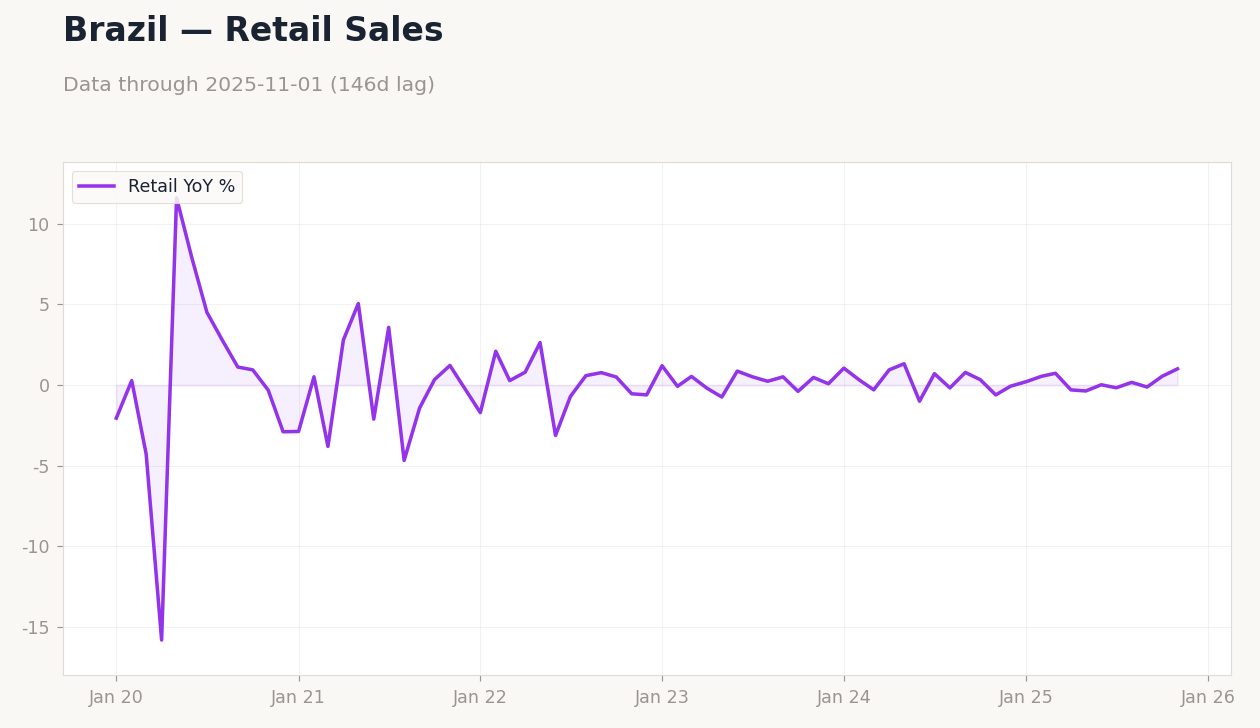
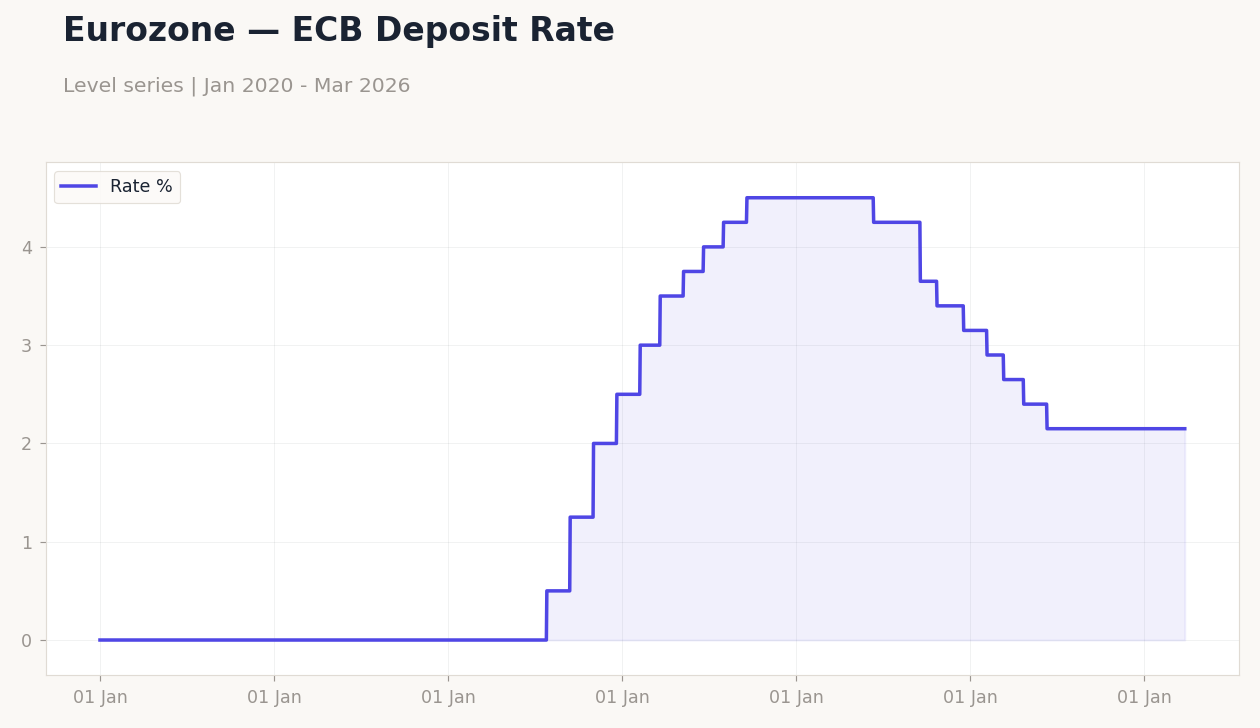
We observed no formal ECB decisions or minutes this week, but market pricing for ECB OIS implied growing dovish expectations amid bets on potential easing. ECB commentary noted productivity gains could support policy flexibility, with possible tweaks if the Iran war prolongs energy disruptions. This week's soft PMI data reinforces our view that the ECB may hold rates steady in the near term but signal cuts if growth weakens further. Forward guidance remains data-dependent, limiting aggressive moves. Overall, the medium-term rate path points to gradual normalization, potentially starting with a 25 basis point cut in Q2 2026 if energy shocks abate.
This week's economic data painted a picture of softening Eurozone momentum, with key indicators signaling contraction in parts of the bloc. Dutch consumer confidence index fell sharply to -30.0 on March 23 from -24.0 prior, highlighting growing household pessimism amid high energy costs and global uncertainties. Spain's trade balance narrowed on March 23, beating expectations and suggesting export strength despite weak demand. French HCOB Composite PMI flash dropped, missing consensus and down prior, indicating accelerating contraction. French HCOB Manufacturing PMI edged up above consensus, providing a modest offset. German S&P Global Manufacturing PMI surprised positively, exceeding consensus and pointing to expansion in industrial activity. However, German S&P Global Composite PMI slipped below consensus, with services missing forecast. German Ifo Business Climate held steady, beating consensus but unchanged from prior, underscoring stable business sentiment amid labor and energy pressures. Collectively, these releases suggest the Eurozone is in a late-cycle slowdown, with inflation risks from the Iran war potentially delaying ECB rate cuts, while growth outlook revisions point to subdued GDP expansion in 2026.
| Event | Prior | Cons. | Actual |
|---|---|---|---|
| Consumer Confidence Index | -24.0 | - | -30.0 |
| Trade Balance | -5.6bn | - | -4.0bn |
| Bundesbank Mauderer Speech | - | - | - |
| Consumer Confidence Index | 1.0 | - | -6.0 |
| 2032 Olo Auction | - | - | 3.3 |
| 2036 OLO Auction | 3.2 | - | 3.7 |
| 2045 Olo Auction | - | - | 4.2 |
| Wholesale Prices Month-over- | 1.4 | - | -1.1 |
| Wholesale Prices Year-over-Y | -5.2 | - | -5.5 |
| 12-Month BTF Auction | 2.4 | - | 2.6 |
| 3-Month BTF Auction | 2.1 | - | 2.2 |
| 6-Month BTF Auction | 2.2 | - | 2.4 |
| Export Prices Year-over-Year | -1.1 | - | -0.40 |
| Headline Unemployment Rate | 10.4 | - | 10.9 |
| Date | Release | Prior | Cons. |
|---|---|---|---|
| 2026-03-30 | Business Confidence Index | -2.6 | - |
| 2026-03-30 | Inflation Rate Year-over-Year Preli | 1.9 | - |
| 2026-03-30 | Inflation Rate Month-over-Month Pre | 0.20 | - |
| 2026-03-31 | Inflation Rate Year-over-Year Preli | 2.4 | - |
| 2026-03-31 | Retail Sales Month-over-Month | -0.90 | - |
| 2026-03-31 | Retail Sales Year-over-Year | 1.2 | - |
| 2026-03-31 | Inflation Rate Year-over-Year Preli | 0.90 | - |
| 2026-03-31 | Inflation Rate Month-over-Month Pre | 0.60 | - |
| 2026-03-31 | Headline Unemployment Rate | 6.3 | - |
| 2026-03-31 | Unemployed Persons Level | 3.0mn | - |
Next week's calendar, spanning March 30 to April 3, 2026, features key releases that could shape ECB rate expectations and growth outlooks amid ongoing geopolitical tensions. On Monday, March 30, Japan's housing starts year-over-year at 01:00 ET, with prior -0.4%, will offer Asia-Pacific context for global demand affecting Eurozone exports. South Africa's M3 money supply year-over-year at 02:00 ET, previously 7.44%, matters for emerging market spillovers into European commodity trades. Tuesday, March 31, brings Germany's retail sales month-over-month at 03:00 ET, consensus 0.3% from prior 0.2%, a high-impact gauge of consumer spending that could influence ECB inflation views if it beats. China's Caixin manufacturing PMI at 21:45 ET on March 31, expected at 50.8 from 50.9, is critical for Eurozone supply chains and export demand. Wednesday, April 1, includes Eurozone CPI year-over-year flash at 06:00 ET, consensus 2.5% from 2.3%, potentially shifting rate path bets if it surprises higher amid energy risks. Thursday, April 2, features US initial jobless claims at 08:30 ET, consensus 215k from 210k, with implications for dollar strength and EUR/USD pressures. Friday, April 3, highlights Germany's factory orders month-over-month at 03:00 ET, expected 0.5% from -0.1%, essential for assessing industrial recovery post-PMIs.
This week's mixed PMIs, including German manufacturing beating consensus, shift the outlook toward cautious optimism but heighten downside risks from energy volatility tied to the Iran war. Upside scenarios include stronger export data if Spain's trade balance improvement continues, potentially boosting growth in Q2. Downside risks loom if consumer confidence deteriorates further from -30.0 in the Netherlands, exacerbating stagflation with Brent at 106.36. Market mispricing signals appear in elevated ECB cut bets, with positioning flows showing net long euro crosses like EUR/JPY up 0.92% to 184.5 weekly. Volatility could spike if gold's 0.84% decline reverses amid safe-haven demand, while crowded shorts in equities like the DAX down 0.35% suggest potential squeezes. Overall, we see flow considerations favoring bonds, with German 10Y yields indicating undervalued duration risks.
Eurozone equities ended the week with small net gains, as the Euro Stoxx 50 rose 0.08% to 5,505.8, supported by ECB easing expectations despite early risk aversion. Standout daily moves included a plunge on March 23 amid global sentiment weakness, followed by a rebound on March 24 on Mideast de-escalation. The DAX declined 0.35% weekly to 22,300.75, with a notable drop on March 23 driven by growth concerns. Bond markets saw yields ease, reflecting safe-haven flows and dovish bets amid soft PMIs. FX markets weakened, as EUR/USD fell 0.54% to 1.15, pressured by dollar strength and a daily dip on March 26. Commodities were volatile, with Brent crude down 5.2% weekly to 106.36 on de-escalation news. Gold declined 0.84% net to 4,532.2 but saw a surge on March 25 as a hedge against deflation fears.
Geopolitical risks dominated the last seven days, with the Iran war noted as a challenge for global economies and energy prices. Cross-border spillovers intensified as Brent crude fell 5.2% weekly to 106.36 amid Mideast de-escalation, easing some Eurozone inflation pressures but raising deflation fears. Trade dynamics shifted with Spain's balance improving on March 23, though broader demand slowdowns from China could pressure exports. De-escalation stabilized EUR/USD at 1.15.
| Asset | Level | WoW |
|---|---|---|
| Nikkei 225 | 53603.65 | +4.0% |
| USD/JPY | 45166.64 | -0.9% |
| EUR/JPY | 2449.7 | +0.5% |
| GBP/JPY | 160.27 | +1.5% |
| Gold | 184.51 | +0.9% |
| Brent Crude | 4532.3 | -0.8% |
| Bitcoin | 1.33 | -1.2% |


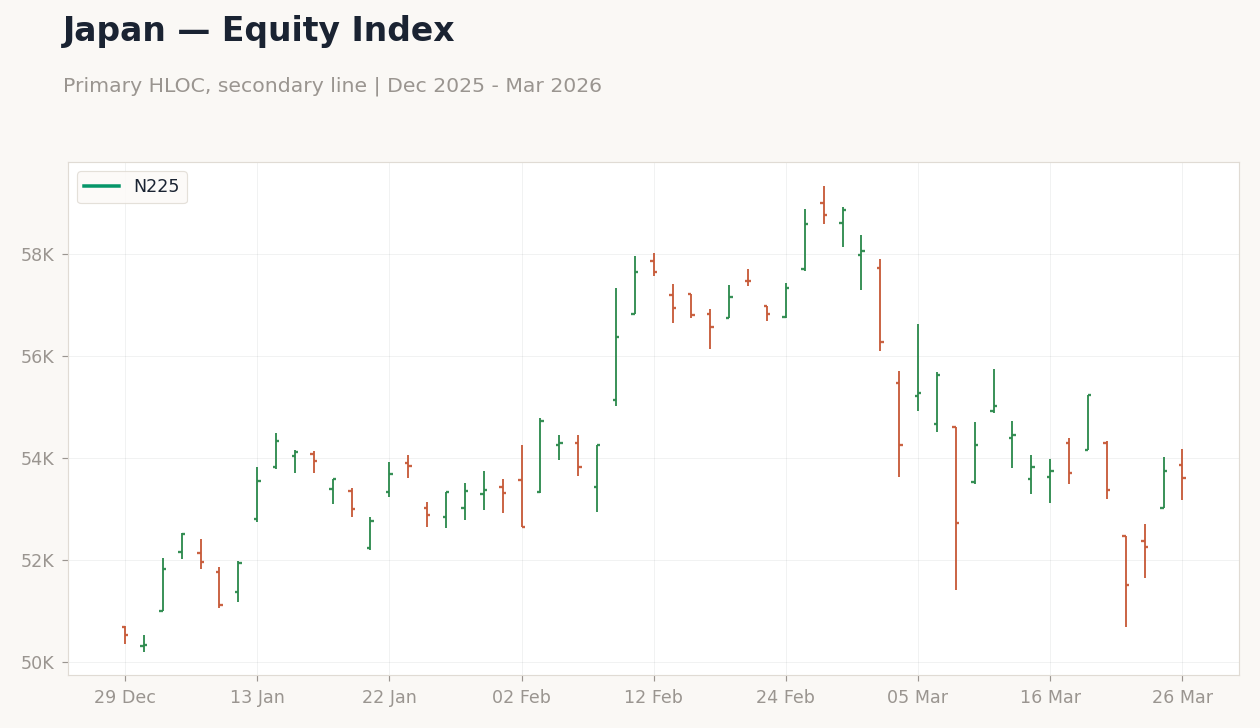
Japanese markets navigated a volatile week ending March 27, 2026, marked by initial risk-off tone before rebounding on softer data and policy clarity. The Nikkei 225 ended with a 4.05% week-over-week gain to 53,603.65 as global risk appetite returned. The yen strengthened, with USD/JPY declining 0.9% week-over-week, easing import cost pressures.
Inflation and Activity Softening. Headline inflation cooled below prior reading, while core inflation printed below consensus and previous, challenging the sustainability of the Bank of Japan's 2% target. Flash PMIs disappointed versus consensus and prior, indicating a slowdown tied to export weakness. Services PMI eased, remaining expansionary but highlighting tempered momentum. These misses suggest uneven price dynamics.
Policy Signals and Market Rebounds. The Bank of Japan released Monetary Policy Meeting Minutes on Tuesday, emphasizing gradual normalization without near-term hikes, contributing to declining JGB yields. Equity markets rebounded mid-week amid tech gains and a stronger yen. Short-tenor yields moved higher. Overall, the data confirmed moderating growth.
Geopolitical Overhang Persists. Brent crude declined 0.83% week-over-week. EUR/JPY rose 0.46% week-over-week to 2449.7, while GBP/JPY advanced 1.48% to 160.27, reflecting mixed currency flows. Gold climbed 0.92% to 184.51, underscoring safe-haven demand. The week's through-line was data underperformance versus consensus, reinforcing a narrative of cooling inflation that may delay policy tightening.
The Bank of Japan released Monetary Policy Meeting Minutes on Tuesday, revealing internal discussions on gradual normalization and yield curve adjustments, with no surprises on immediate rate hikes. The minutes highlighted concerns over yen depreciation but emphasized data-dependent forward guidance without committing to faster tightening. This week's softer inflation data suggests challenges to achieving sustainable 2% inflation, potentially pushing back the rate path. BoJ OIS pricing shifted modestly dovish amid the slowdown. The upcoming Summary of Opinions on March 29 may provide further hawkish cues on wage growth, though persistent yen weakness could prompt verbal interventions. Overall, the data tempers expectations for aggressive moves.
| Event | Prior | Cons. | Actual |
|---|---|---|---|
| Inflation Rate Year-over-Yea | 1.5 | - | 1.3 |
| Core Inflation Rate Year-ove | 2.0 | 1.7 | 1.6 |
| Inflation Rate Excluding Foo | 2.6 | - | 2.5 |
| Inflation Rate Month-over-Mo | -0.20 | - | -0.20 |
| S&P Global Manufacturing PMI | 53.0 | 52.8 | 51.4 |
| S&P Global Services PMI Flas | 53.8 | - | 52.8 |
| S&P Global Composite PMI Fla | 53.9 | - | 52.5 |
| 40-Year JGB Auction | 3.7 | - | 3.6 |
| BoJ Monetary Policy Meeting | - | - | - |
| Coincident Index Final | 114 | - | 118 |
| Leading Economic Index Final | 110 | 112 | 112 |
| Foreign Bond Investment Leve | -986.9bn | - | -635.3bn |
| Foreign Stock Investment Lev | -1772.5bn | - | -2509.7bn |
| 3-Month Treasury Bill Auctio | 0.81 | - | 0.84 |
| Date | Release | Prior | Cons. |
|---|---|---|---|
| 2026-03-30 | Housing Starts Year-over-Year | -0.40 | - |
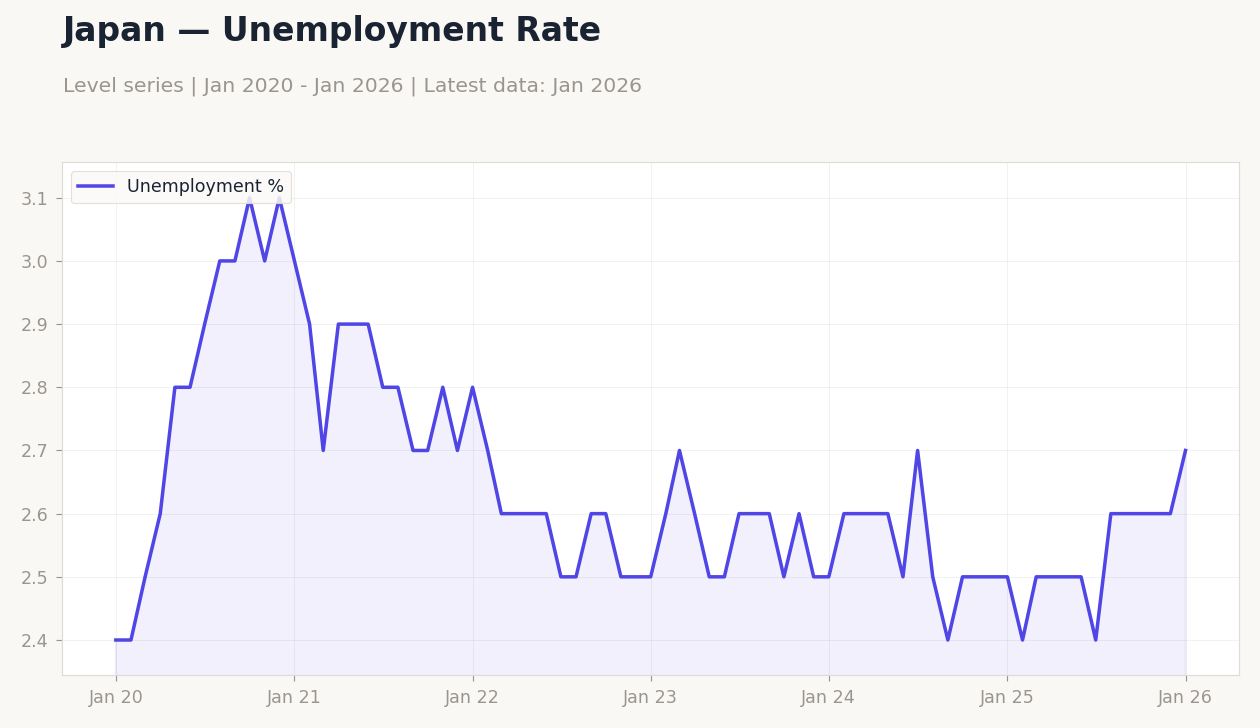
| 2026-03-30 | Headline Unemployment Rate | 2.7 | - |
| 2026-03-30 | Industrial Production Month-over-Mo | 4.3 | - |
| 2026-03-30 | Retail Sales Year-over-Year | 1.8 | - |
| 2026-03-31 | Tankan Large Manufacturers Index | 15.0 | - |
Next week's calendar kicks off on Monday with Housing Starts YoY, where prior -0.4% sets a low bar, and Construction Orders YoY at prior 5.7%, both critical for gauging residential investment. These could signal if building activity supports growth recovery, influencing Bank of Japan views on domestic demand resilience for the rate path. Tuesday brings Unemployment Rate, alongside Industrial Production MoM prelim and Retail Sales YoY; stronger prints would bolster case for hikes by evidencing consumption strength. Wednesday features Tankan Large Manufacturers Index, Tankan Large Non-Manufacturers Index, and Tankan Large All Industry Capex, offering forward-looking insights into business sentiment that could shift OIS pricing if they confirm moderating momentum. No major releases on Thursday, allowing digestion of prior data, while Friday is light, keeping focus on any spillover from global events. These indicators matter for the Bank of Japan's upcoming decisions, as upside surprises in activity could revive normalization bets, while further softness might extend the pause in tightening.
This week's cooling inflation and misses shift the outlook toward a more gradual Bank of Japan normalization path, reducing upside risks to yields. Downside scenarios center on higher Brent crude exacerbating import inflation and stagflation. Upside risks include stronger wage data reviving core inflation, supporting earlier hikes. The market may be mispricing the probability of a dovish pivot if growth softens further. Broader themes center on oil-yen dynamics amid volatility. Monitoring intervention signals remains key.
| Asset | Level | WoW |
|---|---|---|
| S&P/TSX | 31960.65 | +2.0% |
| USD/CAD | 1.39 | +1.1% |
| EUR/CAD | 1.6 | +0.6% |
| WTI Crude | 100.85 | +2.6% |
| Natural Gas | 3.03 | -2.1% |
| Gold | 4532.1 | -0.8% |
| Brent Crude | 106.36 | -5.2% |
| Bitcoin | 65893.19 | -6.6% |


Canadian markets navigated a turbulent week ending March 27, 2026, dominated by geopolitical tensions and resulting commodity volatility that shaped equity and currency moves. The narrative arc began with downside pressure but shifted toward resilience, as early oil slumps gave way to recoveries without major domestic data surprises. Absent significant consensus misses in a light economic calendar, focus remained on external drivers confirming inflation and growth uncertainties.
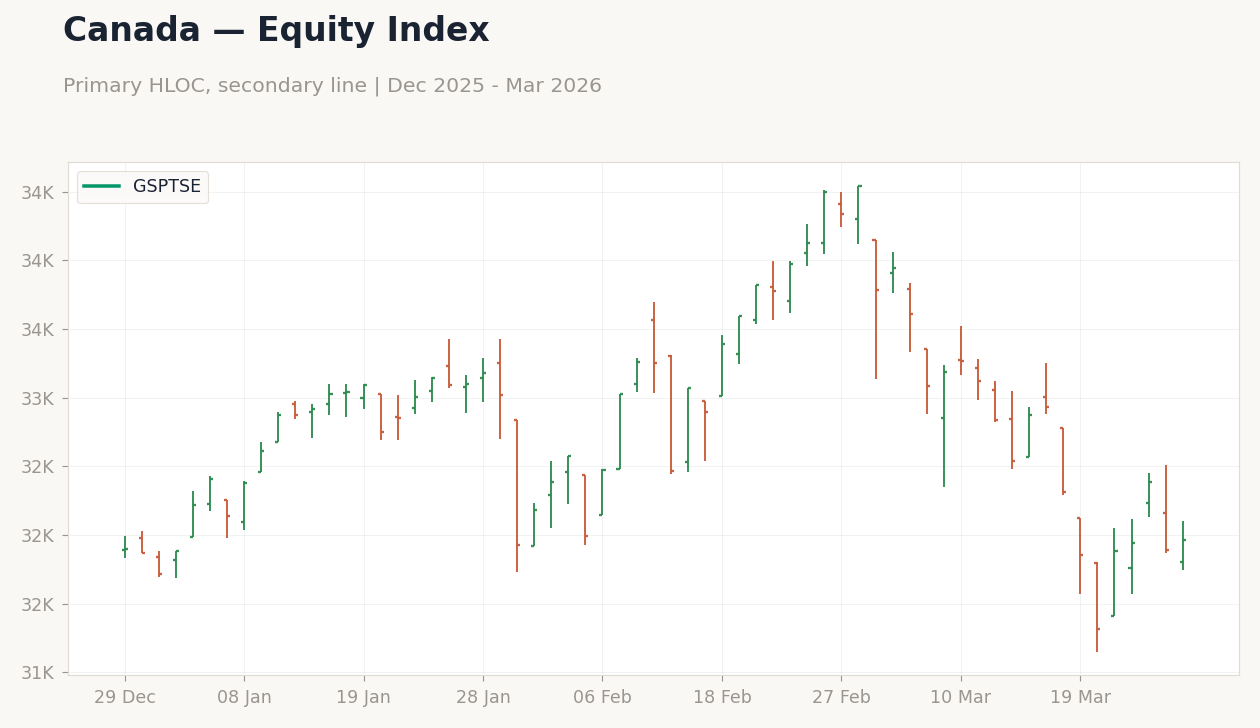
Geopolitical Jitters and Equity Volatility The S&P/TSX index fluctuated amid Iran war developments and sharp oil moves, with energy sectors rallying on recoveries. Safe-haven demand boosted gold, which ended down 0.84% week-over-week at 4,532.10. The index closed with a net 2.05% week-over-week gain amid persistent Middle East risks.
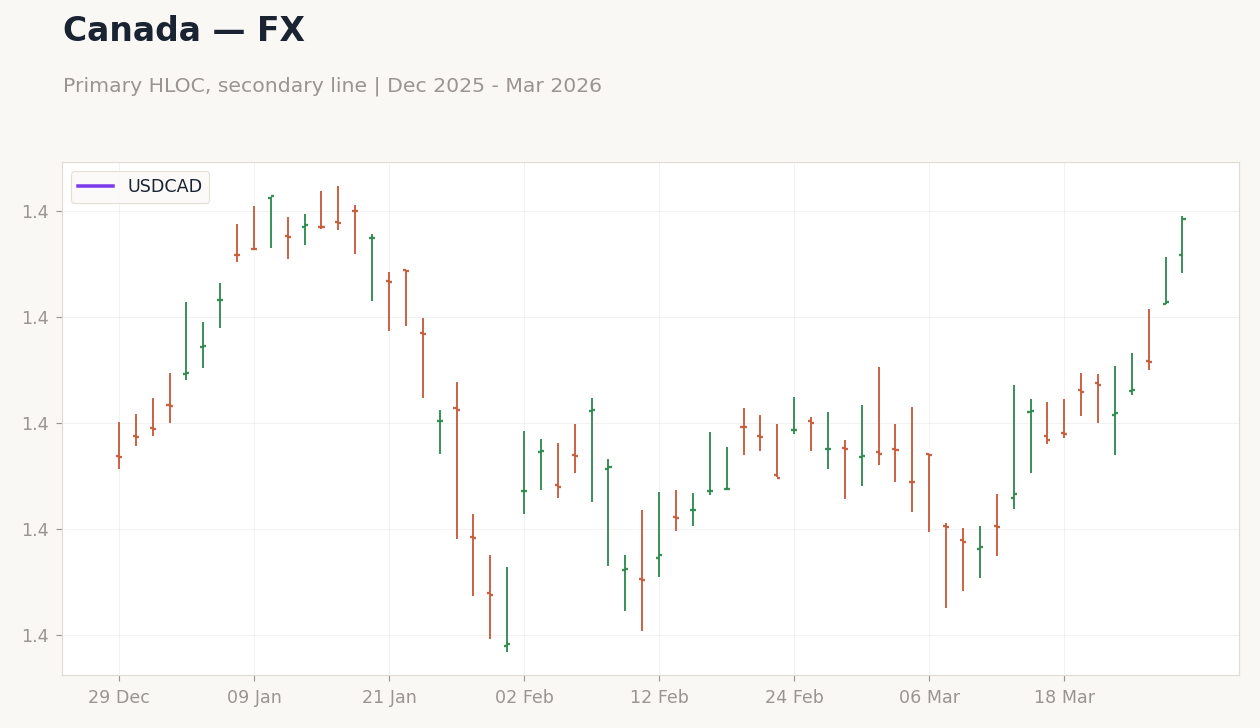
Currency Pressures from Commodities USD/CAD rose 1.13% week-over-week to 1.39, driven by CAD weakness from easing oil prices and natural gas declining 2.10% to 3.03.
Bond Yields and Broader Sentiment Bond yields declined amid global tensions, aligning with Bank of Canada policy. Bitcoin closed down 6.56% week-over-week at 65,893.19, underscoring risk-off undercurrents.
The Bank of Canada held policy steady, emphasizing global economic risks and forward guidance maintaining a dovish tone. Commodity volatility, including WTI crude swings, reinforces the cautious stance, as energy shocks sustain CPI pressures. Money markets adjusted rate hike bets, reflecting inflation concerns from Middle East tensions. Data supports a stable near-term rate path, though oil instability may delay easing.
| Event | Prior | Cons. | Actual |
|---|---|---|---|
| CFIB Business Barometer | 65.3 | - | 55.8 |
| Manufacturing Sales Month-ov | -3.0 | - | 3.8 |
| 10-Year Bond Auction | 3.6 | - | 3.5 |
| Average Weekly Earnings Year | 1.9 | - | 2.0 |
| Wholesale Sales Month-over-M | -1.0 | - | 2.3 |
| Government Budget Balance | 200.0mn | - | -5.1bn |
| Date | Release | Prior | Cons. |
|---|---|---|---|
| 2026-03-31 | GDP Month-over-Month | 0.20 | 0 |
| 2026-03-31 | GDP Month-over-Month Prel | 0 | - |
| 2026-04-01 | S&P Global Manufacturing PMI Index | 51.0 | - |
| 2026-04-02 | Trade Balance | -3.6bn | - |


The week of March 30 to April 3, 2026, features a light calendar for Canadian data, shifting focus to global events that could influence the Bank of Canada's rate path through commodity and trade channels. On Monday, March 30, Japan's Housing Starts YoY follows a prior -0.4% reading, signaling global growth that affects Canadian exports. South Africa's Private Sector Credit YoY, after 8.83% prior, indicates emerging market demand trends impacting commodity prices central to BoC inflation monitoring. Mid-week, unscheduled BoC speakers could address oil volatility's implications for coming quarters. Consensus anticipates steady global indicators, but surprises like Austria's Producer Price Index MoM could signal input cost pressures relevant to the BoC outlook. Markets will parse external data for hints on inflation risks and rate path.
Oil volatility shifts the outlook toward cautious growth, with upside risks from sustained Middle East tensions driving WTI crude higher and fueling inflation. Downside includes commodity corrections, as seen in Brent crude's 5.2% week-over-week drop to 106.36, easing price pressures and opening room for rate cuts. Markets misprice global risk persistence, underestimating BoC emphasis on productivity lags. Trade strains highlight export vulnerabilities amid US dynamics. External shocks remain the key watchpoint.
| Asset | Level | WoW |
|---|---|---|
| IPC Bolsa | 20.77 | +10.5% |
| USD/MXN | 65868.7 | -6.6% |
| EUR/MXN | 20.86 | +1.6% |
| WTI Crude | 101.11 | +2.8% |
| Silver | 69.94 | +0.8% |
| Gold | 4532.9 | -0.8% |
| Brent Crude | 106.56 | -5.0% |
| Bitcoin | 65868.7 | -6.6% |


Mexican markets posted strong equity gains amid mixed commodity moves. IPC Bolsa advanced 10.48% week-over-week to 20.77, signaling investor optimism on nearshoring amid global risk aversion. USD/MXN weakened 6.6% to 65,868.7.
Equity Resilience Amid Volatility. IPC Bolsa gained 10.48% week-over-week to 20.77, underscoring energy-linked strength.
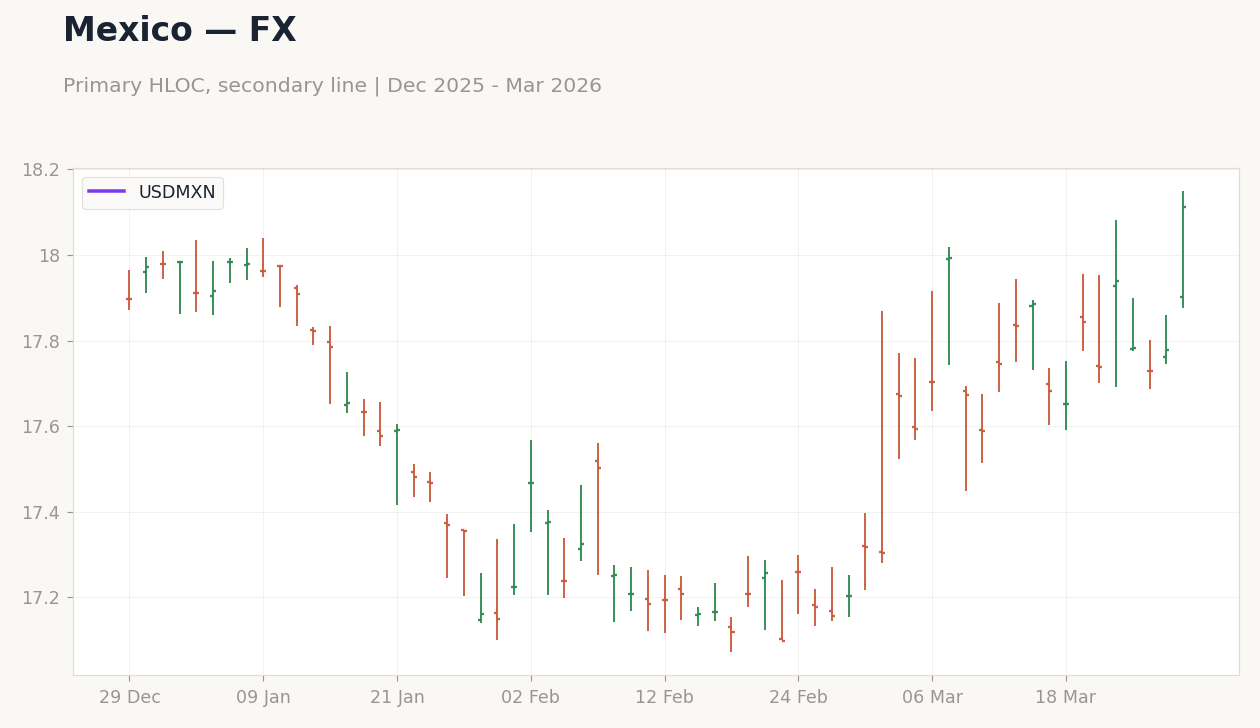
Currency Pressures from Trade Tensions. USD/MXN declined 6.6% to 65,868.7. EUR/MXN rose 1.56% to 20.86, reflecting EM currency dynamics.
Commodity Swings Impact Exports. WTI crude climbed 2.84% to 101.11, bolstering Mexico's export outlook despite Brent crude's 5.02% drop to 106.56. Gold fell 0.82% to 4,532.9, while silver rose 0.84% to 69.94. Bitcoin dropped 6.6% to 65,868.7, amplifying risk-off sentiment.
Rates and Policy Surprise. Rate markets signaled easing bets. This data supports moderating external pressures, aligning with nearshoring momentum and dovish policy path.
No Banxico decision this week. Commodity data, including WTI crude up 2.84% to 101.11, underscores balanced inflation risks. Markets price dovish rate path, supporting gradual normalization amid external resilience. Persistent commodity swings warrant vigilance for next meeting.
| Event | Prior | Cons. | Actual |
|---|---|---|---|
| Retail Sales Month-over-Mont | -0.10 | - | 1.0 |
| Retail Sales Year-over-Year | 4.3 | 3.1 | 5.0 |
| Economic Activity Month-over | 0.20 | -0.40 | -0.90 |
| Economic Activity Year-over- | 3.3 | 1.6 | -0.30 |
| Mid-month Core Inflation Rat | 0.22 | 0.22 | 0.22 |
| Mid-month Core Inflation Rat | 4.5 | 4.5 | 4.5 |
| Mid-month Inflation Rate Mon | 0.25 | 0.37 | 0.62 |
| Mid-month Inflation Rate Yea | 3.9 | 4.3 | 4.6 |
| Central Bank Interest Rate D | 7.0 | 7.0 | 6.8 |
| Trade Balance | -6.5bn | 1.2bn | -463.0mn |
| Headline Unemployment Rate | 2.7 | 2.6 | 2.6 |
| Fiscal Balance | -19.3bn | - | - |
| Date | Release | Prior | Cons. |
|---|---|---|---|
| 2026-04-01 | Business Confidence Index | 48.1 | - |
Next week's calendar features limited Mexican data, shifting focus to global indicators that could sway Banxico's rate path via commodity and trade channels. Monday's Japan housing starts year-over-year, prior -0.4%, gauges Asia-Pacific demand trends for Mexico's exports. Weaker global data could accelerate Banxico cuts, while firmer figures support measured easing.
Commodity swings shift outlook toward easing, with WTI up 2.84% to 101.11 boosting exports and room for Banxico pauses if inflation firms. Downside risks center on Brent crude at 106.56 and peso volatility beyond recent USD/MXN lows near 65,868.7. Markets underprice spillovers, as IPC Bolsa's 10.48% rally to 20.77 overlooks disruptions. Data points to dovish Banxico lean, though energy volatility could alter trajectory.
| Asset | Level | WoW |
|---|---|---|
| Bovespa | 181556.77 | +3.0% |
| USD/BRL | 5.24 | +0.4% |
| EUR/BRL | 6.03 | -0.1% |
| Vale | 15.03 | +7.0% |
| Petrobras | 18.11 | +2.1% |
| WTI Crude | 101.1 | +2.8% |
| Gold | 4532.9 | -0.8% |
| Bitcoin | 20.86 | +1.6% |


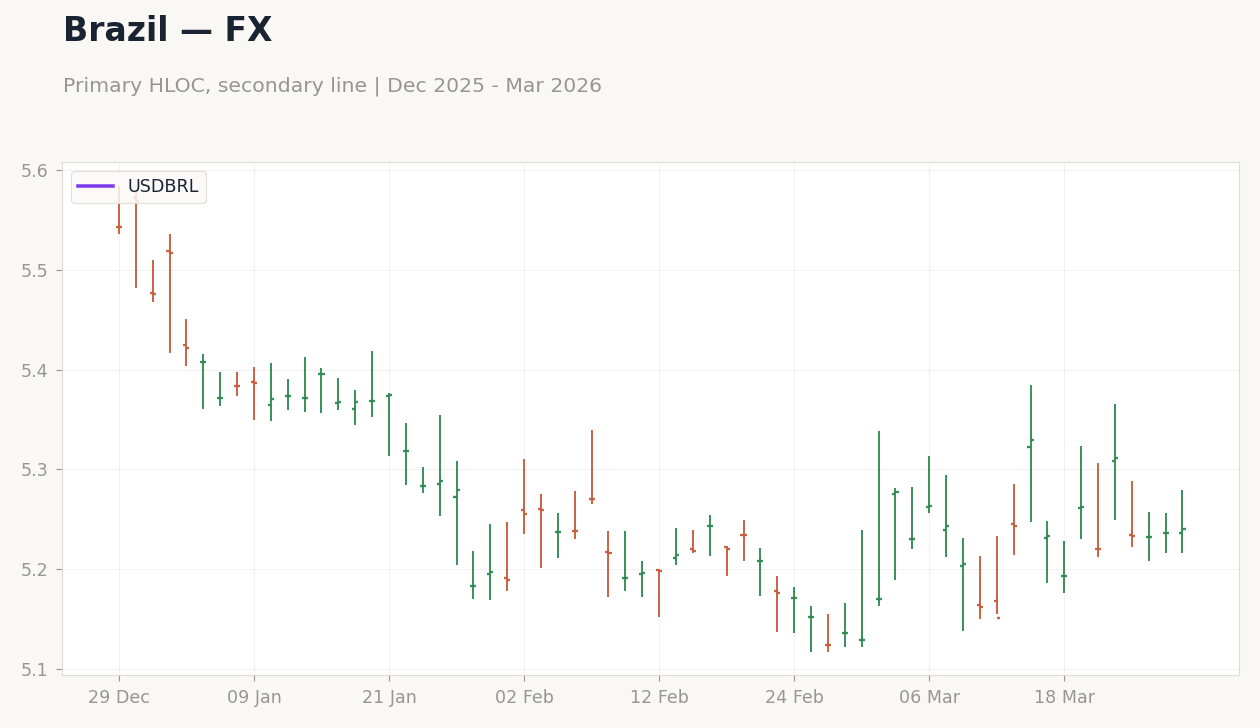
Brazilian markets navigated a volatile week ending March 27, 2026, with commodity fluctuations shaping sentiment, culminating in net positive equity performance. The Bovespa index advanced 3.03% week-over-week to 181,556.77, reflecting resilience in key sectors. USD/BRL appreciated 0.4% over the week to 5.24, pressured by inflation fears, while EUR/BRL dipped 0.08% to 6.03. Vale shares climbed 6.98% week-over-week to 15.03, buoyed by iron ore demand, and Petrobras gained 2.12% to 18.11 amid WTI crude's 2.83% rise to 101.1.
Commodity Volatility Drives Market Swings The week featured risk-off sentiment early, reversing later on commodity recovery. WTI crude ended higher, supporting energy and materials sectors.
Policy Signals and Data Misses Emerge The week's data confirmed moderating growth pressures but did not derail commodity-driven optimism, with WTI crude ending up 2.83% week-over-week at 101.1.
The Banco Central do Brasil followed a data-dependent approach amid inflation risks. Emerging labor slack could ease wage pressures and support a dovish tilt in the rate path over coming quarters. Fiscal uncertainties may complicate inflation targeting, potentially delaying cuts. OIS pricing adjusted modestly hawkish, though easing hints tempered expectations for prolonged tightness.
| Event | Prior | Cons. | Actual |
|---|---|---|---|
| BCB Focus Market Readout | - | - | "" |
| BCB Copom Meeting Minutes | - | - | - |
| FGV Consumer Confidence | 86.1 | - | 88.1 |
| IPCA mid-month CPI Month-ove | 0.84 | 0.29 | 0.44 |
| IPCA mid-month CPI Year-over | 4.1 | 3.7 | 3.9 |
| IGP-M Inflation Month-over-M | -0.73 | - | "" |
| Current Account Balance | -8.4bn | -5.4bn | -5.6bn |
| Foreign Direct Investment Fl | 8.2bn | 7.6bn | 6.8bn |
| Headline Unemployment Rate | 5.4 | 5.7 | 5.8 |
| Date | Release | Prior | Cons. |
|---|---|---|---|
| 2026-04-02 | Industrial Production Month-over-Mo | 1.8 | - |

Next week's calendar features several Brazilian releases that could influence the Banco Central do Brasil's rate path by providing insights into inflation dynamics and economic momentum. On Monday, March 30, the BCB Focus Report offers market expectations for inflation and growth; downward revisions could signal room for Selic easing. Tuesday, March 31, brings the Markit Manufacturing PMI, a key gauge of industrial activity that might reinforce dovish bets if indicating expansion. Midweek on April 1, trade balance data releases, highlighting export resilience that could mitigate fiscal risks and support BCB confidence in stability. Thursday, April 2, features industrial production year-over-year, critical for assessing whether high Selic levels are curbing output and warranting policy adjustments. Friday, April 3, rounds out with FGV consumer confidence, potentially easing concerns over domestic demand. These indicators matter for the rate path as stronger readings could delay easing, while softer data might accelerate cuts amid growth signals. Markets will parse these for clues on inflation convergence to the target.
This week's data shifts the outlook toward softer growth, potentially accelerating BCB easing if inflation remains contained. Upside risks include persistent commodity strength, with WTI crude up 2.83% week-over-week to 101.1, which could fuel imported inflation and force a hawkish stance. Downside scenarios involve escalating fiscal strains, eroding investor confidence and pressuring USD/BRL higher from 5.24. The market underestimates probability of near-term Selic cuts. Key signals to watch include export trends, suggesting resilience but vulnerability to global demand slowdowns. Commodity volatility and policy caution point to balanced risks, with Bovespa's 3.03% gain potentially overestimating recovery absent sustained oil price support.
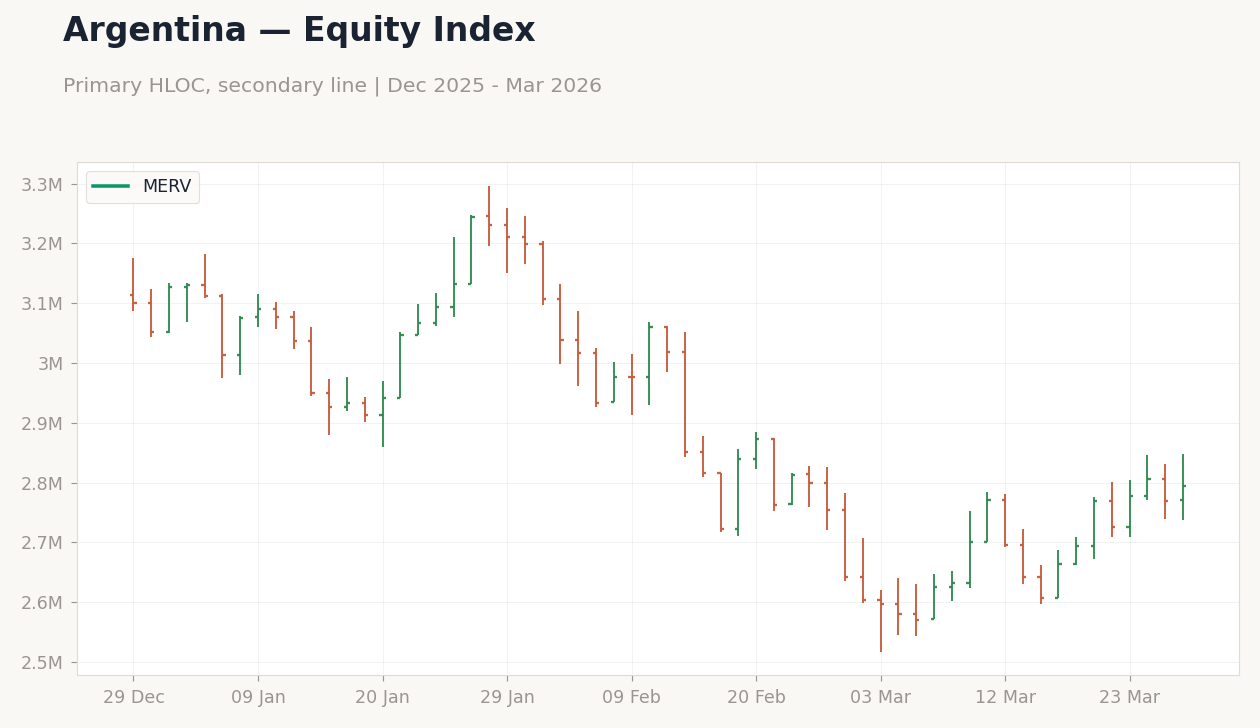
| Asset | Level | WoW |
|---|---|---|
| MERVAL | 2793846.5 | +2.5% |
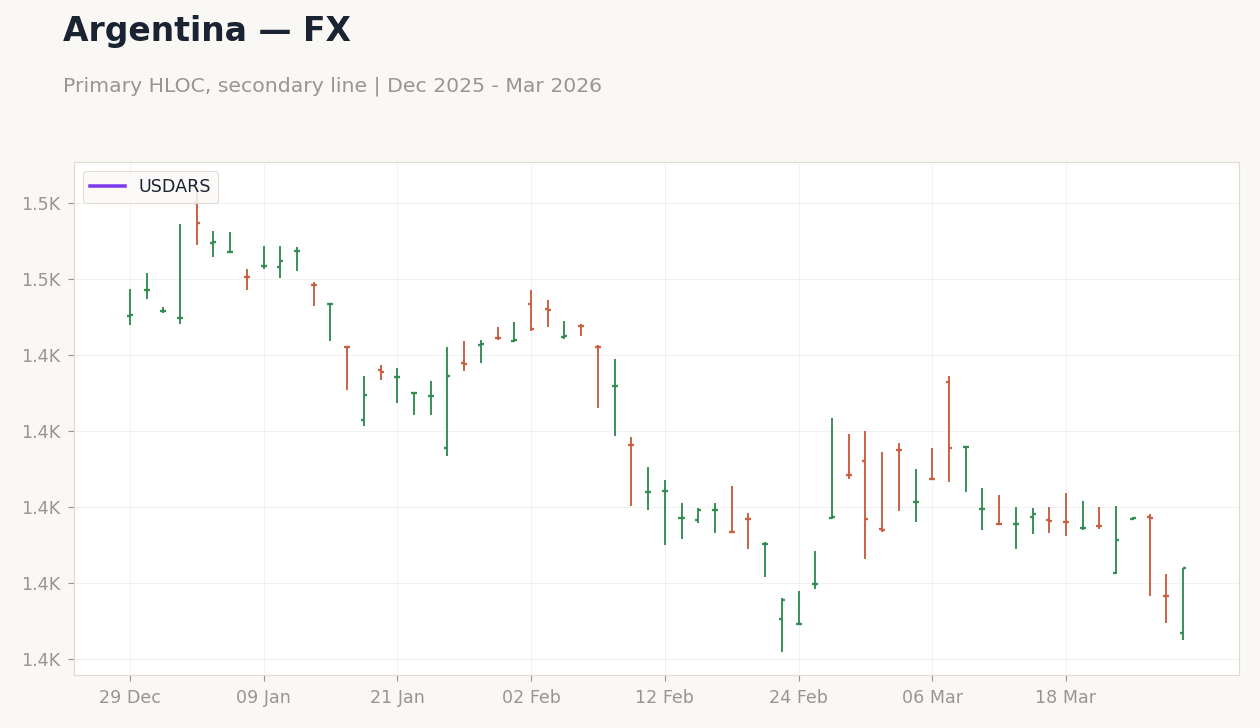
| USD/ARS | 1384.0 | -0.8% |
| YPF | 45.17 | +7.8% |
| MercadoLibre | 1599.52 | -2.2% |
| Globant | 44.52 | -0.4% |
| Soybeans | 1159.5 | -0.1% |
| Gold | 4532.6 | -0.8% |
| Bitcoin | 65868.7 | -6.6% |


Argentine markets posted net gains in equities while the peso held firm amid global risk dynamics. The MERVAL index rose 2.51% week-over-week to 2,793,846.50, led by energy sector strength including YPF's 7.75% advance to 45.17.
Lithium and Energy Sectors Drive Momentum Lithium and energy gains underpinned equity momentum, with commodity-linked sentiment supporting the rally despite softer soybeans, which declined 0.15% to 1,159.50. Gold fell 0.83% week-over-week to 4,532.60, while Bitcoin dropped 6.6% to 65,868.70 amid crypto caution.
Peso Stability Amid Retail and Fiscal Narratives USD/ARS declined 0.79% week-over-week to 1,384.00 under BCRA oversight. MercadoLibre eased 2.22% to 1,599.52, while Globant slipped 0.42% to 44.52. The absence of data releases allowed corporate narratives like lithium earnings to dominate, reinforcing resource-led growth prospects. Fiscal discipline supports ongoing surpluses aligning with IMF goals, bolstering peso stability and reserve accumulation.
The Banco Central de la Republica Argentina (BCRA) made no formal policy decisions this week, maintaining its crawling peg regime to ensure peso stability amid global tensions. USD/ARS fluctuations reflected effective oversight without significant interventions, as informal signals focused on reserve accumulation strategies. Forward guidance remained unchanged, emphasizing fiscal compliance and export-driven inflows, with no speaker events or minutes released. This week's market calm, absent data surprises, suggests limited pressure on the rate path, potentially delaying any tightening in coming quarters. BCRA OIS pricing showed no notable shifts, as traders priced in steady policy amid commodity volatility.
| Event | Prior | Cons. | Actual |
|---|---|---|---|
| Economic Activity Year-over- | 3.5 | 1.6 | 1.9 |
| Current Account Balance | -1.6bn | - | - |
Next week's calendar remains light for Argentina-specific releases, directing attention to global indicators that could influence BCRA's rate path through commodity and FX channels. On Monday, Japan's Housing Starts Year-over-Year data, with a previous reading of -0.4%, may signal Asia-Pacific demand trends affecting Argentina's soybean exports, potentially impacting foreign reserves and peso dynamics. Tuesday brings South Africa's Private Sector Credit Year-over-Year, previously at 8.83%, which could highlight emerging market credit conditions relevant to Argentina's IMF-linked fiscal outlook. Midweek, Hungary's Trade Balance, last at 12,000,000, offers insights into CEEMEA trade flows that might parallel Argentina's export recovery, informing BCRA's forward guidance on inflation control. Thursday features Austria's Producer Price Index Month-over-Month, building on broader Eurozone trends that could affect global risk sentiment and BCRA OIS pricing. These releases matter for the next meeting, as stronger global growth signals might ease pressure on BCRA to adjust rates amid ongoing stabilization efforts. Overall, consensus expectations point to moderate readings, but upside surprises in credit or trade data could challenge BCRA's neutral stance in upcoming decisions.
This week's equity gains, including MERVAL's 2.51% week-over-week rise to 2,793,846.50, shift the outlook toward cautious optimism, signaling resource sector resilience but exposing vulnerabilities to global commodity swings like gold's -0.83% week-over-week drop to 4,532.60. Upside scenarios include sustained lithium and energy boosts, potentially lifting growth in coming quarters, while downside risks stem from pressures on inflation via energy trends. USD/ARS's -0.79% week-over-week decline to 1,384.00 supports parallel rate stability. Themes of deregulation support fiscal surplus narratives, but Bitcoin's -6.6% week-over-week fall to 65,868.70 highlights crypto-linked risk aversion that could amplify EM outflows. Monitoring IMF programme talks remains key, as any delays might heighten downside scenarios for BCRA's rate path.
| Asset | Level | WoW |
|---|---|---|
| MSCI Chile | 38.88 | +2.1% |
| MSCI Peru | 76.68 | +3.2% |
| USD/COP | 3671.75 | -0.5% |
| USD/CLP | 922.71 | +1.1% |
| USD/PEN | 3.49 | +1.0% |
| Copper | 5.47 | +2.3% |
| Gold | 4536.4 | -0.7% |
| Brent Crude | 106.55 | -5.0% |
| Bitcoin | 65849.63 | -6.6% |
The Andean region experienced a volatile week dominated by commodity swings and limited data, starting with sharp equity declines before a mid-week rebound that lifted Chilean and Peruvian stocks on metals gains, though Colombian assets lagged amid oil weakness. Copper and gold recovered mid-week, underscoring the region's export dependencies while highlighting fiscal strains from Brent crude's 5.03% week-over-week drop to $106.55 per barrel. No major economic releases occurred, allowing markets to focus on external drivers that contributed to currencies' mixed performance.
Commodity-Driven Equity Rebound Andean equities reversed early losses, with MSCI Chile climbing 2.15% week-over-week to 38.88 on copper's 2.31% gain to $5.47. MSCI Peru advanced 3.24% to 76.68, despite gold's overall 0.74% decline to 4536.4. Colombian assets remained under pressure from Brent crude's weakness. Copper's net gain supported mining sectors in Chile and Peru.
FX Volatility Amid Oil Headwinds Currencies reflected commodity divergences, as USD/COP depreciated 0.52% week-over-week to 3,671.75 despite Brent's weakness. USD/CLP appreciated 1.12% to 922.71, weighing on Chilean exporters. USD/PEN strengthened 0.98% to 3.49 despite gold's support.
Policy and Event Risks Central banks issued no new guidance amid the light data calendar. The data reinforced Andean economies' ties to commodities, with no significant releases but challenges to oil revenue expectations for Colombia.
BanRep and BCRP remained silent without decisions, minutes, or statements, as the light data calendar shifted focus to commodity impacts on monetary paths. This week's copper rally to $5.47 and Brent decline to $106.55 suggest upside inflation risks for Chile and Peru via export channels, potentially delaying BCCh and BCRP cuts, while oil weakness may afford BanRep more room for accommodation if growth softens.
| Event | Prior | Cons. | Actual |
|---|---|---|---|
| Producer Price Index Year-ov | 14.2 | - | 12.9 |
| Central Bank Interest Rate D | 4.5 | 4.5 | 4.5 |
| Business Confidence Index | -1.5 | - | 0.90 |

The Andean calendar picks up modestly next week with key releases that could influence BanRep, BCCh, and BCRP rate paths by clarifying inflation and growth trajectories. On Monday, attention turns to potential unscheduled updates, though no major data is slated, setting the tone for commodity-sensitive sentiment. Tuesday brings Chile's unemployment rate, which matters for BCCh's upcoming decisions as softer labor data could accelerate easing bets. Wednesday features Peru's inflation rate year-over-year, critical for BCRP's path as upside surprises might delay cuts. Colombia's producer price index on Thursday will test BanRep's inflation outlook, where upside risks could challenge dovish guidance. Friday rounds out with Chile's industrial production year-over-year, offering insights into export-driven growth that could support BCCh's stance if it beats expectations. Overall, these prints matter for rate paths by confirming disinflation trends or highlighting commodity-fueled pressures, with markets eyeing BCRP interventions if PEN weakens further.
This week's commodity rebound shifts the Andean outlook toward cautious optimism, with copper's 2.31% gain supporting Chile and Peru's growth cycles while Brent's 5.03% drop poses downside fiscal risks for Colombia. Upside scenarios include sustained metals rallies boosting export revenues and enabling BCCh and BCRP to ease sooner, whereas downside risks feature renewed oil volatility, exacerbating COP depreciation and pressuring BanRep's reserves. Broader themes center on global recession signals, which might amplify Andean vulnerabilities if commodity demand softens, though current data suggests resilience in mining sectors.
| Asset | Level | WoW |
|---|---|---|
| FTSE 100 | 9967.35 | +0.5% |
| FTSE 250 | 20964.75 | -1.8% |
| GBP/USD | 1.33 | -1.1% |
| GBP/EUR | 1.15 | -0.6% |
| GBP/JPY | 212.64 | +0.3% |
| Brent Crude | 106.57 | -5.0% |
| Gold | 4536.5 | -0.7% |
| UK Nat Gas | 3.03 | -2.1% |
| Bitcoin | 65849.63 | -6.6% |


The UK economy navigated a week of mixed signals, with softening activity indicators overshadowed by persistent inflation and geopolitical headwinds from the Middle East. Markets opened on March 23 with sharp declines, as the FTSE 100 fell amid energy sector losses tied to Brent crude's drop. Sterling weakened notably that day, with GBP/USD reflecting broader risk aversion. By March 24, sentiment shifted modestly, as the FTSE 250 dipped while Brent crude rebounded on supply disruption fears. Geopolitical Pressures Mount: Escalating Iran-US-Israel tensions amplified energy shocks, contributing to UK natural gas rising on March 24. Flash PMIs released on March 25 showed manufacturing beating consensus but below prior, while services missed expectations. This data drove the FTSE 100 lower, with GBP/EUR slipping. CBI distributive trades plunged below consensus, highlighting retail strains from inflation. Inflation Data Reinforces Caution: Late on March 25, headline inflation matched expectations, but core rose above consensus, lifting the FTSE 100 on March 26 amid mining gains. Retail sales on March 27 beat consensus but declined from prior. GFK consumer confidence improved above expectations, providing some relief. Market Reactions and Policy Echoes: BoE's Pill speech on March 25 stressed inflation action, tempering dovish bets and contributing to gilt yields easing. Overall, the FTSE 100 ended the week up 0.49% at 9,967.35, but the narrative arc revealed decelerating growth against sticky prices, with Middle East volatility capping upside. This points to prolonged BoE caution, as evidenced by sterling's weekly 1.15% decline to 1.33 against the USD.
The Bank of England maintained its hawkish posture this week, with no rate decisions but key speeches underscoring inflation vigilance. Chief Economist Pill, speaking on March 25, stressed action on inflation risks, directly addressing geopolitical-driven price pressures without altering forward guidance. This reinforced market bets for sustained high rates. Taylor's speech on March 26 offered no new signals, focusing on balanced risks, but aligned with Pill's tone amid core inflation's rise. This week's data, including services PMI's miss, supports a medium-term hold on rates, potentially extending into Q3 if energy shocks persist. Overall, the absence of dovish pivots suggests the BoE remains data-dependent, with sticky core inflation likely capping easing expectations.
This week's flash PMIs on March 25 highlighted uneven economic momentum, with manufacturing beating consensus but down from prior, suggesting resilient output despite supply chain frictions. Services PMI disappointed versus expectations and prior, indicating a slowdown in the sector that comprises over 80% of UK GDP, driven by elevated input costs. CBI distributive trades index on March 25 plunged below consensus and worsened from prior, underscoring retail weakness amid energy-driven inflation. Inflation data late on March 25 showed headline year-over-year matching consensus and prior, while month-over-month rose as expected from prior decline. Core inflation surprised higher than consensus and prior, signaling persistent pressures in non-volatile components. GFK consumer confidence on March 26 improved above consensus but down from prior, reflecting slight optimism despite cost-of-living strains. Retail sales on March 27 beat consensus but declined from prior. These releases point to a mid-cycle slowdown, with inflation stickiness likely extending the BoE's hold on rates into the medium term, potentially delaying cuts until growth risks intensify further.
| Event | Prior | Cons. | Actual |
|---|---|---|---|
| S&P Global Manufacturing PMI | 51.7 | 50.1 | 51.4 |
| S&P Global Services PMI Flas | 53.9 | 53.0 | 51.2 |
| S&P Global Composite PMI Fla | 53.7 | 52.9 | 51.0 |
| Treasury Gilt 2035 Auction | 4.6 | - | 4.9 |
| CBI Distributive Trades | -43.0 | -40.0 | -52.0 |
| BoE Pill Speech | - | - | - |
| Inflation Rate Year-over-Yea | 3.0 | 3.0 | 3.0 |
| Core Inflation Rate Year-ove | 3.1 | 3.1 | 3.2 |
| Inflation Rate Month-over-Mo | -0.50 | 0.40 | 0.40 |
| Core Inflation Rate Month-ov | -0.60 | 0.50 | 0.60 |
| PPI Core Output Month-over-M | 0.20 | - | -0.80 |
| PPI Core Output Year-over-Ye | 2.9 | - | 1.9 |
| PPI Input Month-over-Month | 0.30 | 0.50 | 0.70 |
| PPI Input Year-over-Year | -0.40 | 0.40 | 0.50 |
| Date | Release | Prior | Cons. |
|---|---|---|---|
| 2026-03-30 | BoE Consumer Credit | 1.8bn | - |
| 2026-03-30 | Mortgage Approvals | 60K | - |
| 2026-03-30 | Mortgage Lending Level | 4.1bn | - |
| 2026-03-31 | Current Account Balance | -12.1bn | - |
| 2026-03-31 | Nationwide Housing Prices Month-ove | 0.30 | - |
| 2026-03-31 | Nationwide Housing Prices Year-over | 1.0 | - |


Next week's calendar kicks off quietly on March 30 with no major UK releases, allowing focus on global spillovers like US consumer confidence, which could influence sterling via risk sentiment. March 31 brings high-impact GDP data, critical for assessing Q1 growth trajectory amid PMI softness. The same day features mortgage approvals, offering insights into housing demand under high rates. On April 1, S&P Global manufacturing PMI final is expected to confirm flash readings, potentially shifting BoE bets if revised lower. Nationwide house prices anticipate faster year-over-year growth, highlighting property sector resilience. April 2 includes S&P Global services PMI final, key for gauging the economy's largest driver. No BoE speakers are scheduled, but any surprises in GDP could amplify volatility. The week wraps on April 3 with composite PMI, underscoring cycle positioning; upside risks if data beats could firm sterling above 1.33.
This week's PMI disappointments and core inflation rise shift the outlook toward prolonged BoE caution, raising downside risks to growth if energy prices spike further from Middle East tensions. Upside scenarios include stronger-than-expected retail sales recovery. Volatility remains elevated, with Brent's 5.01% weekly swing highlighting positioning risks for importers. Flow considerations point to gilt inflows as yields declined, but sterling's 1.15% drop suggests crowded shorts. Overall, themes center on geopolitical spillovers, with potential for upside surprises if consumer confidence sustains its improvement.
UK equities posted mixed weekly performances, with the FTSE 100 gaining 0.49% to 9,967.35 driven by mining and banking rebounds, while the FTSE 250 declined 1.77% to 20,964.75 amid broader mid-cap vulnerability to domestic slowdown signals. Standout daily moves included sharp FTSE 100 surges fueled by positive inflation interpretations, contrasted by drops on profit-taking. In bonds, the UK 10-year gilt yield declined over the week, reflecting safe-haven flows amid geopolitical tensions, with consistent daily declines signaling tempered rate hike expectations post-PMI misses. Sterling weakened across majors, dropping 1.15% weekly against the USD to 1.33, with a notable daily fall on March 23 tied to energy shocks, though it recovered on March 24 on hawkish BoE bets. GBP/EUR eased 0.59% weekly to 1.15, while GBP/JPY rose 0.3% to 212.64, buoyed by safe-haven yen dynamics. Commodities saw Brent crude tumble 5.01% weekly to 106.57 amid demand worries, including a sharp plunge on March 23, while gold dipped 0.74% to 4,536.5 despite a rebound on March 27. UK natural gas fell 2.13% weekly to 3.03, with volatility like the drop on March 23 linked to global supply risks.
Middle East tensions drove global energy volatility, pressuring UK imports and contributing to Brent's 5.01% weekly decline to 106.57. US-Israel conflicts over the March 23-27 period amplified safe-haven flows that supported gold's movements and weighed on sterling to 1.33 against the USD. Trade dynamics shifted with EU inflation data on March 25 fostering GBP/EUR weakness to 1.15. Geopolitical risks from Gulf attacks heightened cross-border spillovers, capping FTSE 100 gains at 0.49%.
| Asset | Level | WoW |
|---|---|---|
| OMX Stockholm 30 | 2863.92 | -0.0% |
| Oslo Bors | 1981.56 | +0.8% |
| OMX Copenhagen 25 | 1638.13 | +0.9% |
| OMX Helsinki 25 | 5763.57 | -1.3% |
| USD/SEK | 9.46 | +1.9% |
| USD/NOK | 9.74 | +2.6% |
| EUR/SEK | 10.9 | +1.4% |
| EUR/NOK | 11.22 | +2.2% |
| Brent Crude | 106.64 | -5.0% |
| Gold | 4536.5 | -0.7% |
| Bitcoin | 65854.02 | -6.6% |


The Nordic region faced volatility in the week ending March 27, 2026, with Brent crude's decline driving currency weakness and mixed equity performance that confirmed softening growth trends in export-dependent economies. Denmark's consumer confidence edged lower to -13.8 from -13.1, signaling reduced sentiment. No significant consensus misses occurred in major releases.
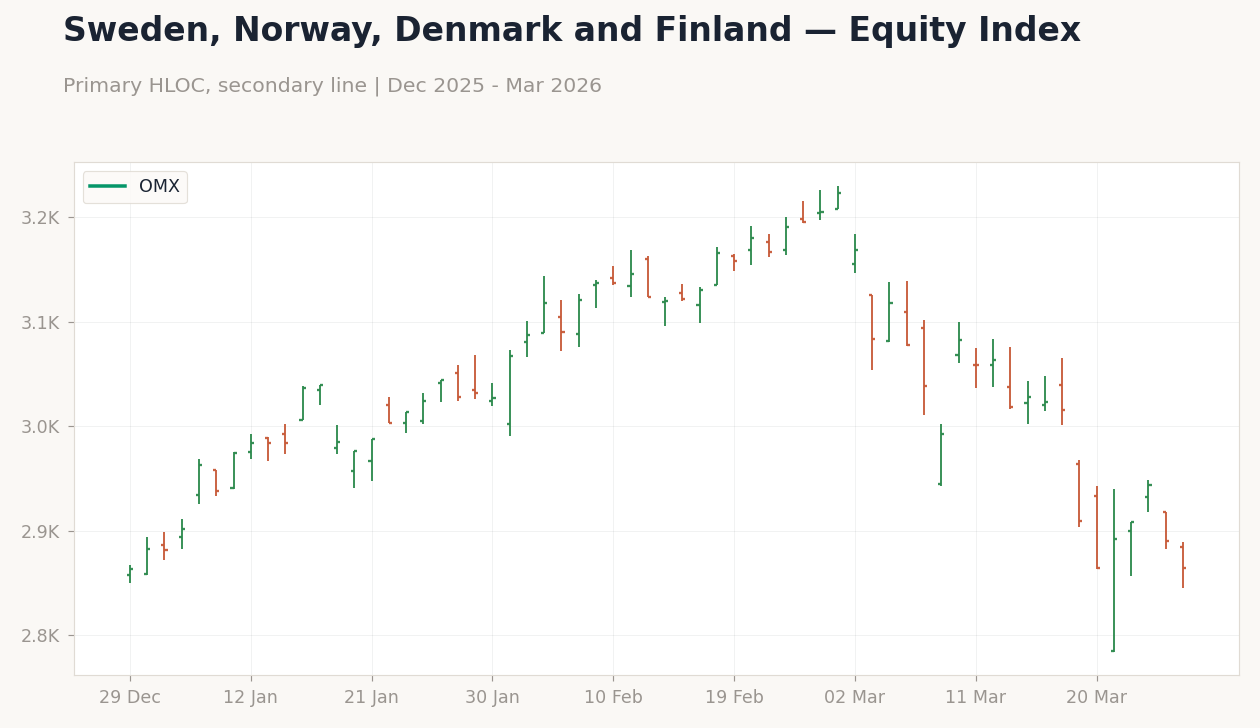
Equity Markets Volatile Amid Commodity Shifts Nordic stocks posted mixed results, with OMX Stockholm 30 down 0.03% week-over-week to 2,863.92. Norway's Oslo Bors rose 0.77% to 1,981.56, supported by energy sector strength despite Brent's decline. Denmark's OMX Copenhagen 25 gained 0.88% to 1,638.13, while Finland's OMX Helsinki 25 declined 1.26% to 5,763.57. These moves highlighted sensitivity to global commodity prices.
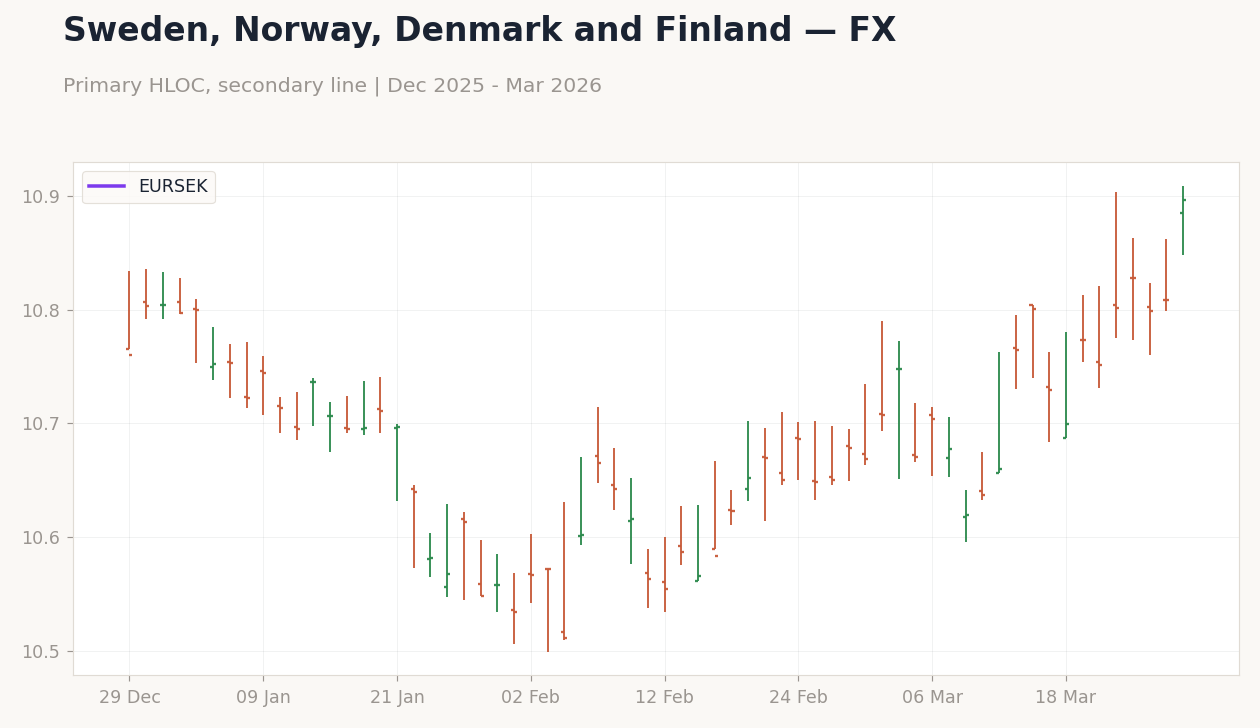
Currency Weakness Tied to Oil and Safe-Haven Flows Nordic currencies depreciated against the USD, with USD/SEK advancing 1.91% to 9.46 and USD/NOK surging 2.64% to 9.74. EUR/SEK gained 1.39% week-over-week to 10.90, while EUR/NOK climbed 2.22% to 11.22, aiding exporters but raising import costs.
Policy and Economic Headwinds from Commodity Volatility Brent crude's 4.95% week-over-week decline dominated, amplifying risk-off flows as gold dipped 0.74% to 4,536.50 and Bitcoin fell 6.62% to 65,854.02. The data confirmed moderated growth expectations, challenging export recovery outlooks.
Nordic central banks maintained a cautious stance amid Brent crude's decline to $106.64 and krone weakness, with USD/NOK up 2.64% week-over-week. Riksbank, Danmarks Nationalbank, and Bank of Finland remained aligned with eurozone dynamics without decisions. The data suggests a stable rate path for coming quarters, though oil volatility warrants vigilance.
| Event | Prior | Cons. | Actual |
|---|---|---|---|
| Consumer Confidence Index | -13.1 | - | -13.8 |
| Loan Growth Year-over-Year | 4.5 | - | 4.6 |
| Export Prices Year-over-Year | -1.1 | - | -0.40 |
| Headline Unemployment Rate | 10.4 | - | 10.9 |
| Import Prices Year-over-Year | -2.4 | - | -2.1 |
| Producer Price Index Year-ov | 1.9 | - | 3.8 |
| Snap Parliamentary Election | - | - | "" |
| Retail Sales Month-over-Mont | 0.80 | - | -0.30 |
| Retail Sales Year-over-Year | 3.8 | - | 2.2 |
| Producer Price Index Month-o | 2.4 | - | 0.20 |
| Producer Price Index Year-ov | -2.0 | - | -1.7 |
| Business Confidence Index | 104 | - | 102 |
| Consumer Confidence Index | 96.3 | - | 95.2 |
| Consumer Inflation Expectati | 6.6 | - | 7.3 |


Attention turns to Sweden's Producer Price Index Month-over-Month on March 30, with no consensus available but prior at -0.3%, a key gauge of input costs that could influence Riksbank's inflation outlook and OIS pricing if it signals persistent disinflation. On March 31, Norway releases its Retail Sales Month-over-Month, previously at 0.2% with consensus at 0.1%, mattering for Norges Bank's assessment of consumer demand amid krone weakness and potential rate path adjustments. Denmark's GDP Quarter-over-Quarter final reading arrives April 1, prior at 0.4% and consensus at 0.4%, critical for Danmarks Nationalbank's peg stability and any ECB-aligned signals on growth resilience. Finland's Unemployment Rate for February follows on April 2, with prior at 7.2% and no consensus, directly impacting Bank of Finland's ECB input on labor market trends that could sway eurozone rate expectations. Sweden's PMI Manufacturing on April 1, prior at 49.2 and consensus at 49.5, will test industrial momentum, potentially challenging Riksbank's steady guidance if it misses. Norway's Unemployment Rate on April 2, prior at 3.9% and consensus at 3.9%, bears watching for Norges Bank's wage-inflation dynamics. Overall, these releases matter for calibrating upside risks to rates if growth surprises positively, informing the banks' approaches at upcoming decisions.
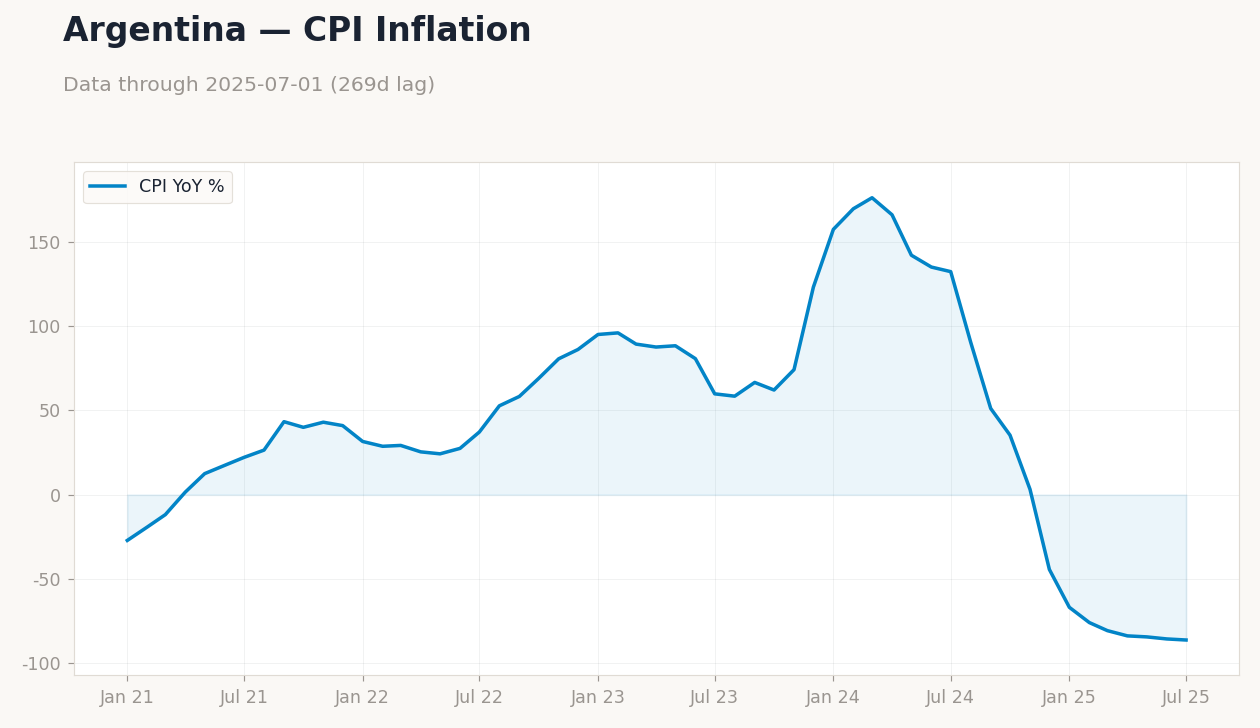
This week's data, including Brent's 4.95% decline and currency weakening like USD/NOK's 2.64% rise, shifts the Nordic outlook toward downside risks from commodity volatility, cooling growth from elevated levels. Upside scenarios hinge on oil price stabilization, bolstering Norway's fiscal position and easing pressure on Norges Bank's rate path, while persistent unemployment trends amplify caution for Finland and Denmark. Themes center on energy dependency and export challenges, suggesting opportunities in hedging NOK shorts if recession odds rise. Monitoring signals include OIS shifts, which could validate stable rates over coming quarters.
| Asset | Level | WoW |
|---|---|---|
| BIST 100 | 12698.19 | -3.6% |
| iShares Poland | 34.58 | +0.3% |
| EUR/PLN | 4.28 | +0.4% |
| EUR/HUF | 389.68 | -0.1% |
| EUR/CZK | 24.51 | +0.2% |
| Brent Crude | 106.54 | -5.0% |
| Gold | 4539.3 | -0.7% |
| Bitcoin | 65872.95 | -6.6% |


Emerging Europe navigated a week of mixed economic signals and geopolitical headwinds ending March 27, 2026, with Poland's robust growth story contrasting Turkey's softening sentiment and Hungary's policy caution. The through-line centered on resilience in core CEE economies like Poland and the Czech Republic, while peripheral pressures from energy volatility weighed on Hungary and Turkey. Consensus misses were evident in Turkey's confidence data, with clear trend changes toward pessimism. Markets reacted variably, connecting data releases to FX and equity moves amid falling Brent crude prices.
Poland's Economic Milestone Drives Optimism Poland's unemployment rate met expectations on March 25, up slightly from prior, confirming labor strength with no consensus miss. EUR/PLN fluctuated amid broader risk aversion. By week's end, iShares Poland closed at 34.58, up 0.29% WoW.
Turkey Grapples with Confidence Erosion Turkey's consumer confidence dipped on March 23 from prior, followed by business confidence falling on March 24. These misses highlighted inflation strains, pressuring BIST 100 lower. The index ended at 12,698.19, down 3.57% WoW, tied to global energy risks.
Hungary's Policy Hold Amid Geopolitical Strains The MNB held rates on March 25, lowering its growth outlook due to energy disruptions. EUR/HUF appreciated that day but closed the week at 389.68, down 0.08% WoW. No data revisions emerged, but energy risks amplified FX volatility.
Quiet Week for Czech Republic and Romania EUR/CZK rose 0.21% WoW to 24.51, with minimal data flow but stable moves. Romania saw no releases, though regional spillovers from Brent's 5.04% WoW decline to 106.54 pressured import-dependent assets. Overall, the week connected data to a narrative of CEE divergence, with Poland's gains offsetting Turkey's pressures.
The National Bank of Poland (NBP) saw no meetings this week, but the unemployment data on March 25 reinforces a stable rate path, with OIS pricing in no changes until mid-2026. The Czech National Bank (CNB) remained quiet without speakers or decisions, though stable EUR/CZK at 24.51 WoW suggests OIS-implied easing could commence in Q2 if inflation holds low. Hungary's MNB held its key rate on March 25, with forward guidance emphasizing caution due to energy risks. Romania's BNR issued no updates, but absent data implies steady policy. The Central Bank of the Republic of Turkey (CBRT) had no rate decision, but confidence declines heighten inflation risks, likely delaying any easing per OIS curves. This week's data shifts the medium-term path toward prolonged holds for MNB and CBRT, while NBP and CNB may eye gradual normalization if global energy stabilizes by Q3.
This week's economic data for Emerging Europe was light but revealing, with key releases centered on Turkey and Poland amid no high-impact events for the Czech Republic, Hungary, or Romania. Turkey's consumer confidence index fell on March 23, missing implied stability from prior and signaling household caution in a high-inflation environment. The business confidence index followed on March 24, dropping from prior, a notable miss that underscores manufacturing strains and points to a softening growth cycle. Poland's headline unemployment rate met consensus on March 25, up from prior, indicating steady labor conditions in the expansion phase with no surprise to the upside. These figures suggest the region remains in a mid-cycle recovery, though Turkey's misses highlight downside risks to inflation outlooks. For central bank rate paths, the data supports NBP's steady stance with OIS implying no cuts before Q3, while CBRT faces pressure for tighter policy given confidence erosion. In Hungary, the MNB's rate hold aligns with absent data but lowered growth forecasts, tying into energy disruptions. Overall, the releases point to resilient growth in Poland contrasting Turkey's potential slowdown if sentiment trends persist, with CNB and BNR likely maintaining neutral guidance amid stable FX.
| Event | Prior | Cons. | Actual |
|---|---|---|---|
| Retail Sales Year-over-Year | 4.4 | 6.1 | 5.0 |
| External Debt | 228.2bn | - | 234.4bn |
| M3 Money Supply Year-over-Ye | 10.0 | 10.0 | 10.6 |
| Business Confidence Index | 99.8 | - | 110 |
| Consumer Confidence Index | 108 | - | 110 |
| Headline Unemployment Rate | 6.0 | 6.1 | 6.1 |
| 3-Month Dtb Auction | 6.2 | - | 6.3 |
| Central Bank Interest Rate D | 6.2 | 6.2 | 6.2 |
| Deposit Interest Rate | 5.2 | 5.2 | 5.2 |
| 6-Month Dtb Auction | 6.2 | - | 6.4 |
| 12-Month Dtb Auction | 6.2 | - | 6.4 |
| Current Account Balance | 1.1bn | -400.0mn | 320.0mn |
| Headline Unemployment Rate | 4.6 | - | 4.9 |
| Date | Release | Prior | Cons. |
|---|---|---|---|
| 2026-03-31 | Inflation Rate Year-over-Year Preli | 2.1 | - |

Next week's calendar for March 30 to April 3 brings a denser slate of releases, starting with Hungary's trade balance on March 30, where consensus expects a surplus similar to the prior €12 million, crucial for assessing export resilience amid energy disruptions. Turkey's economic confidence index follows on March 30, with prior implying potential further dips that could pressure CBRT policy. On March 31, Turkey's trade balance is due, forecasted to widen versus prior, highlighting import strains from Brent volatility and mattering for lira stability. April 1 features manufacturing PMIs across the region: Czech, Poland, and Hungary readings key for gauging industrial cycles and CNB/NBP/MNB rate paths. Romania's producer price index arrives on April 2, offering inflation insights for BNR. The highlight is Turkey's CPI on April 3, a potential market-mover if it surprises estimates and delays CBRT cuts. No central bank decisions are scheduled, but MNB speakers may address growth outlooks on April 1. These releases matter for confirming mid-cycle trends, with upside surprises in PMIs possibly strengthening FX like EUR/HUF. Downside in Turkey's CPI could exacerbate BIST 100 volatility, building on this week's 3.57% decline.
This week's data, including Turkey's confidence misses, shifts the outlook toward heightened downside risks, with positioning in CEE FX showing overcrowding in shorts on EUR/TRY. Upside scenarios include Poland's labor resilience driving zloty strength if PMI beats consensus next week, potentially mispricing NBP OIS curves that embed no hikes. Downside risks center on Hungary, where MNB's lowered growth forecast amplifies volatility if trade balance disappoints on March 30. Themes of energy dependency persist, with Brent's 5.04% WoW fall to 106.54 reducing inflation tails but raising recession odds for Turkey. Positioning in iShares Poland, up 0.29% WoW to 34.58, appears stretched, warranting caution on reversals if global risk-off intensifies.
Regional equities displayed volatility this week ending March 27, with BIST 100 declining 3.57% WoW to 12,698.19, driven by Turkey's confidence misses and Brent crude's 5.04% drop to 106.54 amid escalations. iShares Poland edged up 0.29% WoW to 34.58, buoyed by the unemployment data meet and economic news. FX moves were mixed, as EUR/PLN rose 0.44% WoW to 4.28, while EUR/HUF dipped 0.08% WoW to 389.68. EUR/CZK increased 0.21% WoW to 24.51 amid quiet data. Commodities pressured the region, as gold fell 0.68% WoW to 4,539.3, while Bitcoin tumbled 6.59% WoW to 65,872.95, reflecting global risk-off sentiment spilling into CEE assets.
Global macro developments over the last seven days spilled into Emerging Europe via energy channels, with Brent crude declining 5.04% WoW to 106.54 and pressuring Hungary's oil import costs. Trade dynamics weakened amid EU consultations gaps. Geopolitical risks fostered risk-off flows. Cross-border effects included commodity weakness, as gold fell 0.68% WoW to 4,539.3, benefiting Turkey's import bill but raising inflation passthrough concerns.
| Asset | Level | WoW |
|---|---|---|
| JSE Top 40 | 103938.53 | +1.8% |
| USD/ZAR | 17.12 | +2.4% |
| EUR/ZAR | 19.7 | +1.7% |
| Platinum | 1869.8 | -5.1% |
| Gold | 4539.5 | -0.7% |
| Brent Crude | 106.54 | -5.0% |
| Naspers | 85832.0 | -3.5% |
| Bitcoin | 65872.95 | -6.6% |


The rand depreciated 2.36% week-over-week to 17.12 against the USD amid dollar strength and oil volatility, pressuring import costs and inflation outlook. The JSE Top 40 advanced 1.78% to 103,938.53, reflecting resource stock resilience despite commodity declines. Brent crude fell 5.04% week-over-week to 106.54, platinum dropped 5.12% to 1,869.80, and gold eased 0.68% to 4,539.50, underscoring volatility that challenges growth and elevates SARB inflation risks.
Commodity Volatility and Market Resilience Brent crude declined 5.04% week-over-week to 106.54, sustaining fuel cost pressures for import-dependent South Africa. Platinum fell 5.12% to 1,869.80 and gold eased 0.68% to 4,539.50, yet the JSE Top 40's 1.78% advance to 103,938.53 highlighted mining strength. Naspers declined 3.45% week-over-week to 85,832.00, tracking global tech weakness, while EUR/ZAR rose 1.70% to 19.70 and Bitcoin fell 6.59% to 65,872.95. No major economic data releases occurred, with commodity trends affirming upside in stocks but persistent inflation risks.
Domestic Pressures and Governance Concerns Long-term yields declined across the week, signaling market expectations for steady SARB policy amid bond demand. Focus remained on commodity-driven inflation, challenging rand stability while supporting resource-led equity gains.
The South African Reserve Bank maintained policy unchanged amid anticipation of tightening driven by rand weakness and oil-induced inflation. Forward guidance remained absent, but market speculation intensified around hawkish tones, given USD/ZAR's climb to 17.12 and +2.36% week-over-week depreciation. Commodity pressures suggest a tighter rate path ahead, delaying easing if inflation persists above targets. Pricing reflects bets on vigilance against currency strains.
| Event | Prior | Cons. | Actual |
|---|---|---|---|
| 182-Day T-Bill Auction | 7.3 | - | 7.4 |
| 273-Day T-Bill Auction | 7.4 | - | 7.6 |
| 364-Day T-Bill Auction | 7.4 | - | 7.6 |
| 91-Day T-Bill Auction | 6.8 | - | 6.9 |
| Leading Business Cycle Indic | -0.40 | - | 0.40 |
| Consumer Confidence Index | -9.0 | - | -7.0 |
| 2033 Bond Auction | 7.6 | - | 8.6 |
| 2038 Bond Auction | 9.3 | - | 9.2 |
| 2053 Bond Auction | 9.3 | - | 9.3 |
| Producer Price Index Month-o | -0.20 | - | 0 |
| Producer Price Index Year-ov | 2.2 | - | 1.8 |
| Central Bank Interest Rate D | 6.8 | 6.8 | 6.8 |
| Prime Overdraft Rate | 10.2 | - | 10.2 |
| Date | Release | Prior | Cons. |
|---|---|---|---|
| 2026-03-31 | Trade Balance | 9.3bn | - |

Monday features South Africa's M3 Money Supply Year-over-Year, with a previous reading of 7.44%, and Private Sector Credit Year-over-Year at a prior 8.83%, both low-impact indicators that could signal liquidity trends influencing the South African Reserve Bank's assessment of domestic demand pressures. These releases matter for the rate path as accelerating credit growth might reinforce hawkish biases, potentially supporting tighter policy at the next meeting if they exceed expectations. Tuesday brings no major South African events, allowing focus on global cues, but any surprises in international data could indirectly affect rand volatility and SARB's inflation outlook. On Wednesday, the Manufacturing PMI is due, a medium-impact gauge of industrial activity that could challenge or confirm growth expectations, impacting bets on rate adjustments in upcoming decisions. Stronger PMI readings would ease downside risks to the economy, possibly allowing more flexibility in monetary stance over coming quarters. Thursday includes Total Vehicle Sales Year-over-Year, offering insights into consumer spending resilience amid fuel price hikes, which directly ties to SARB's inflation monitoring and potential policy responses.
This week's rand depreciation to 17.12 and commodity volatility shift the outlook toward heightened inflation risks, with Brent crude's -5.04% week-over-week decline to 106.54 still leaving elevated levels that could sustain fuel cost pressures. Upside scenarios include a sustained JSE rally if platinum and gold stabilize above 1,869.80 and 4,539.50, respectively, bolstering export revenues and reducing SARB's urgency for hikes. Downside risks center on persistent oil-driven inflation eroding investor confidence and amplifying rand weakness. Markets misprice inflation persistence, underestimating tighter policy likelihood despite declining long-term yields. Geopolitical tensions and credit data signals will dominate, tilting toward hawkish SARB repricing.
| Asset | Level | WoW |
|---|---|---|
| ASX 200 | 8516.3 | +1.0% |
| NZX 50 | 12935.39 | -0.4% |
| AUD/USD | 0.69 | -2.9% |
| NZD/USD | 0.57 | -2.1% |
| AUD/NZD | 1.2 | -0.8% |
| BHP | 50.37 | +6.1% |
| Gold | 4540.8 | -0.7% |
| Brent Crude | 106.19 | -5.3% |
| Bitcoin | 65918.22 | -6.5% |


The week of March 23-27, 2026, unfolded with initial market weakness giving way to mixed recoveries, as softer Australian data challenged RBA expectations amid volatile commodities. Cooling activity signals contrasted with external risks, pressuring currencies lower while equities showed resilience. Consensus misses across key releases reinforced moderating growth, easing the RBA's tightening path.
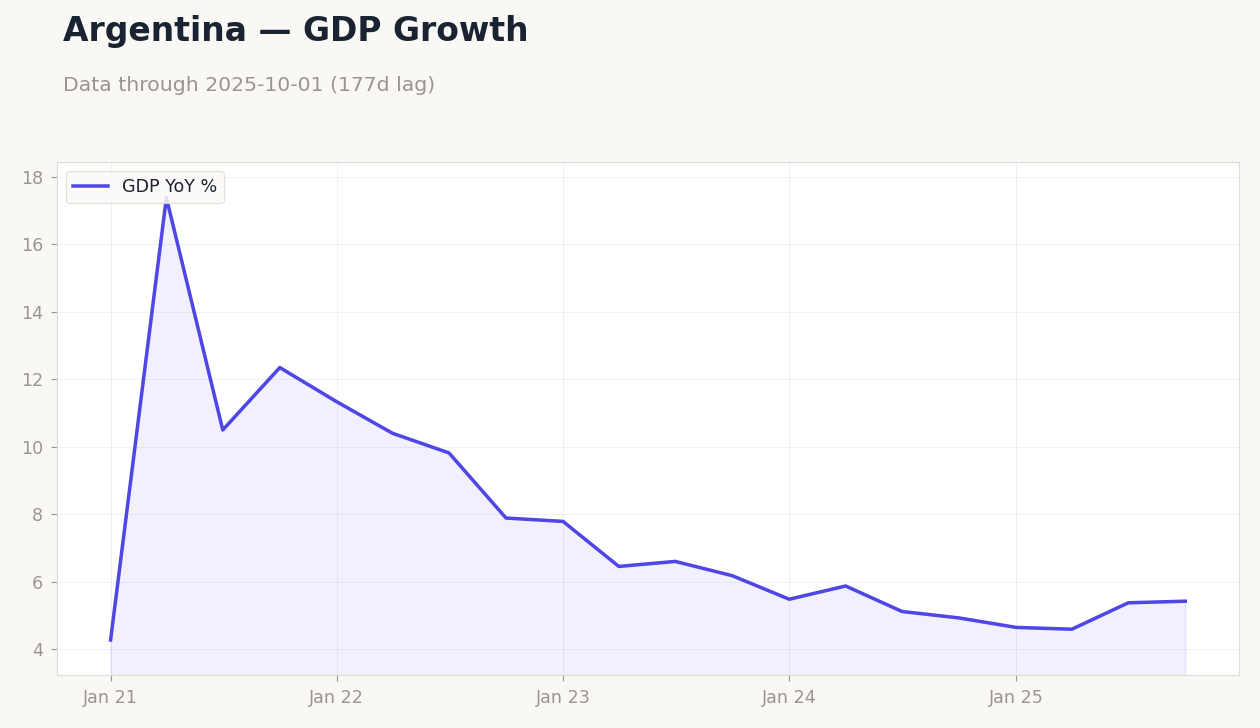
Softening Activity Indicators Emerge Early Australian flash PMIs on March 23 revealed a slowdown, with services plunging into contraction and manufacturing easing, underscoring weakness in consumer-facing sectors due to high borrowing costs. This data challenged expectations for robust first-quarter growth. Meanwhile, New Zealand's NZX 50 declined.
Inflation Data Undershoots, Easing Policy Pressure February inflation figures released on March 24 came in softer than expected, with headline and trimmed mean measures confirming a disinflationary trend supportive of a potential pause in RBA hikes.
Central Bank Rhetoric Remains Hawkish RBA officials emphasized inflation vigilance amid external risks. This forward guidance failed to bolster the AUD.
Market Reactions: Equities Rebound, Currencies Slide Equities recovered mid-week, driven by miners like BHP. Over the full week, the ASX 200 advanced 1.04% to 8,516.30, while the NZX 50 dipped 0.42% to 12,935.39. Currencies weakened significantly, as AUD/USD fell 2.88% week-over-week to 0.69 and NZD/USD declined 2.06% to 0.57, pressured by Brent crude's 5.35% drop to 106.19. Bitcoin dropped 6.53% to 65,918.22. The data challenged growth expectations, shifting focus to downside risks.
The RBA dominated this week's policy narrative, underscoring a data-dependent stance, but softer figures suggest reduced urgency for tightening. RBNZ activity was muted. This week's disinflationary data eases pressure on both central banks, implying fewer hikes ahead.
| Event | Prior | Cons. | Actual |
|---|---|---|---|
| S&P Global Manufacturing PMI | 51.0 | - | 50.1 |
| S&P Global Services PMI Flas | 52.8 | - | 46.6 |
| S&P Global Composite PMI Fla | 52.4 | - | 47.0 |
| 3-Month Treasury Bill Auctio | 2.4 | - | 2.5 |
| 6-Month Treasury Bill Auctio | 2.5 | - | 2.6 |
| Inflation Rate Month-over-Mo | 0.40 | 0 | 0 |
| Inflation Rate Year-over-Yea | 3.8 | 3.8 | 3.7 |
| RBA Trimmed Mean CPI Month-o | 0.30 | 0.30 | 0.20 |
| RBA Trimmed Mean CPI Year-ov | 3.4 | 3.4 | 3.3 |
| Consumer Price Index | 101 | - | 101 |
| RBA Weighted Median CPI Mont | 0.30 | - | 0.20 |
| RBA Weighted Median CPI Year | 3.6 | - | 3.5 |
| RBA Jones Speech | - | - | - |
| RBA Kent Speech | - | - | - |
| Date | Release | Prior | Cons. |
|---|---|---|---|
| 2026-03-30 | ANZ Business Confidence | 59.2 | - |
| 2026-03-30 | RBA Meeting Minutes | - | - |
| 2026-03-31 | Ai Group Industry Index | -1.5 | - |
| 2026-03-31 | Building Permits Month-over-Month P | -7.2 | - |
| 2026-04-01 | Trade Balance | 2.6bn | - |


The week of March 30-April 3, 2026, features a relatively light calendar for Australia and New Zealand, with focus on activity and credit indicators that could influence RBA and RBNZ assessments of domestic demand. On Monday, Australia's private sector credit is due, with consensus at "-", offering insights into lending trends that might signal softening consumption and reduce odds of near-term RBA hikes. Tuesday brings New Zealand's building consents, expected at "-", which matters for RBNZ's housing market outlook. Mid-week, Australia's monthly CPI indicator releases on Wednesday, with consensus "-", a key gauge for core inflation that could reinforce disinflation or revive hawkish bets. Thursday highlights Australia's building approvals, projected at "-", critical for construction sector health. No major Friday releases, but surprises could shift rate path expectations. These prints could validate softening trends, supporting dovish pivots.
This week's softer data shifts the RBA outlook toward balance, with downside growth risks outweighing inflation surprises. Upside scenarios include escalating conflicts driving Brent crude above 106.19, forcing RBA hikes and AUD/USD recovery from 0.69, while downside risks feature prolonged PMI contraction, amplifying recession fears and pressuring NZD/USD below 0.57. Markets may underprice RBNZ vulnerability, as the NZX 50's 0.42% weekly decline signals strains. Key themes revolve around commodity volatility, with gold's -0.65% weekly drop to 4,540.80 masking intra-week gains.
| Asset | Level | WoW |
|---|---|---|
| Shanghai Composite | 3889.08 | -1.7% |
| CSI 300 | 4477.53 | -2.0% |
| Hang Seng | 24856.43 | -1.7% |
| TAIEX | 33337.62 | -0.6% |
| USD/CNY | 6.91 | +0.2% |
| USD/HKD | 7.83 | -0.0% |
| Copper | 5.47 | +2.3% |
| Brent Crude | 106.19 | -5.3% |
| Gold | 4540.3 | -0.7% |
| Bitcoin | 65918.22 | -6.5% |


Greater China markets navigated a turbulent week ending March 27, 2026, dominated by fallout from the Iran war, which drove volatile commodity prices and mixed equity reactions without major data releases to anchor sentiment. Markets saw initial risk-off moves early in the week, partial rebounds mid-week, renewed declines late in the week, and modest gains on Friday, though weekly net losses persisted across most indices.
Geopolitical Pressures Intensify: The Iran conflict tested China's trade surplus narrative, with war-related supply chain fractures weighing on sentiment. Hong Kong's Hang Seng endured the steepest weekly drop of -1.67% to 24,856.43, heightening investor unease.
Commodity Swings and Deflation Dynamics: Surging oil initially eased deflationary pressures, pushing inflation forecasts higher and delaying rate cut bets. By week's end, Brent's net -5.35% decline to 106.19 underscored volatility risks, while copper's 2.32% rise to 5.47 signaled industrial resilience. Gold's -0.66% weekly drop to 4,540.30 mirrored broader haven asset shifts, as Bitcoin fell -6.53% to 65,918.22.
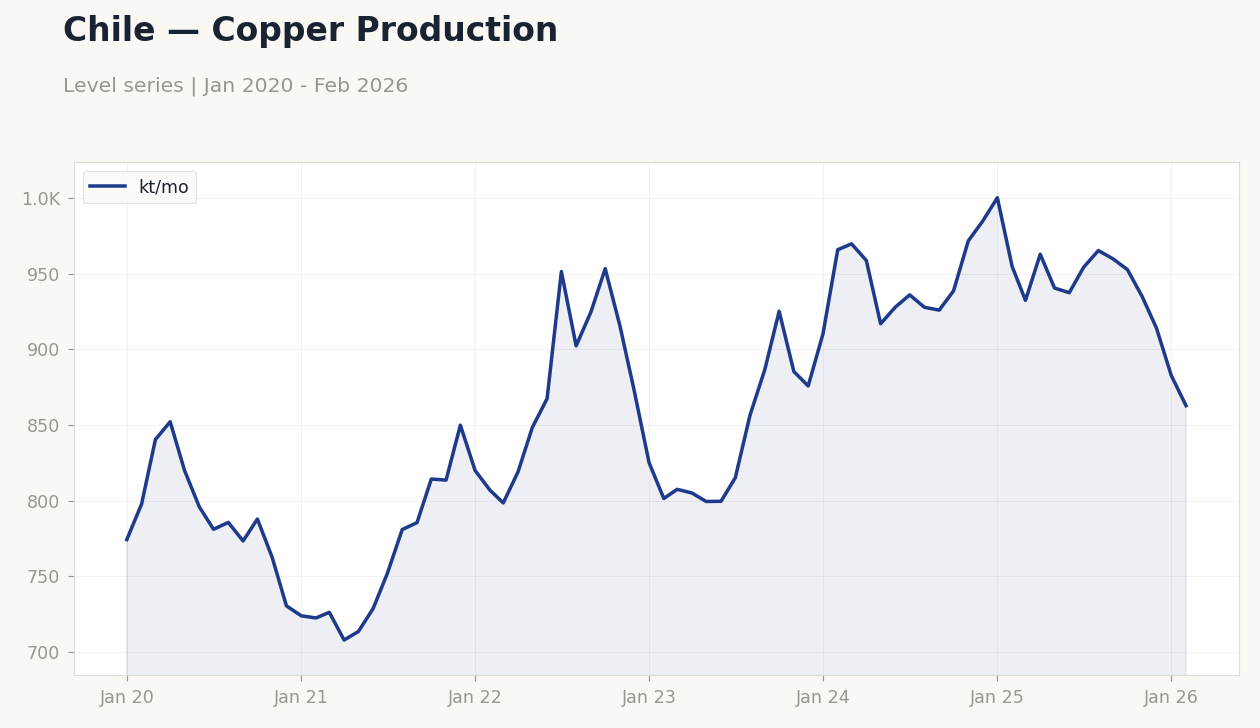
Regional Divergence Emerges: Taiwan's TAIEX showed relative strength with a -0.61% weekly decline to 33,337.62, driven by AI investments offsetting war shocks, unlike mainland indices where the CSI 300 fell -1.96% to 4,477.53. Hong Kong's USD/HKD peg held steady at 7.83 with a -0.01% weekly change, but aggregate balance dynamics hinted at HKMA monitoring. Overall, the week revealed a through-line of geopolitical fragility tempering growth hopes.
The People's Bank of China (PBoC) maintained a steady stance this week, tolerating mild yuan depreciation as USD/CNY rose to 6.91, with no formal decisions but signals of potential open market injections to support liquidity. Hong Kong Monetary Authority (HKMA) focused on peg defense, holding USD/HKD at 7.83 with minimal volatility. Taiwan's Central Bank (CBC) remained quiet, with no speakers or minutes, but TAIEX strength at 33,337.62 implies implicit support for semiconductor-led growth without rate signals. This week's commodity swings, like Brent at 106.19, could pressure the PBoC's medium-term rate path toward caution, delaying cuts if oil boosts inflation. Overall, central banks emphasized stability, with PBoC eyeing petroyuan opportunities from Iran conflict, potentially strengthening yuan's global role without immediate policy pivots.
This week featured no major economic data releases for China, Hong Kong, or Taiwan, leaving markets to interpret news flow amid the Iran war's shadow. Without fresh prints, focus shifted to commodity proxies, where Brent crude's volatility suggests upside risks to inflation, potentially shifting the PBoC's rate path toward fewer cuts in 2026. This data vacuum highlights a stabilizing but fragile growth outlook. For Hong Kong, steady USD/HKD at 7.83 implies peg stability supporting liquidity. In Taiwan, semiconductor sentiment drove TAIEX moves, tying into global AI demand that could bolster Q1 2026 growth. Overall, the lack of releases reinforces a neutral cycle position, keeping inflation expectations anchored low.
| Event | Prior | Cons. | Actual |
|---|---|---|---|
| Industrial Production Year-o | 27.9 | - | 17.8 |
| Retail Sales Year-over-Year | -3.4 | - | 7.7 |
| Headline Unemployment Rate | 3.4 | - | 3.3 |
| Exports Year-over-Year | 33.8 | - | 24.7 |
| Imports Year-over-Year | 38.1 | - | 29.9 |
| Trade Balance | -14.1bn | - | -64.2bn |
| Industrial Profits (YTD) Yea | 0.60 | - | 15.2 |
| Consumer Confidence Index | 66.6 | - | 62.3 |
| Current Account Final | 198.7bn | - | 243.8bn |
| Date | Release | Prior | Cons. |
|---|---|---|---|
| 2026-03-30 | NBS Manufacturing PMI | 49.0 | - |
| 2026-03-30 | NBS Non-Manufacturing PMI | 49.5 | - |
| 2026-03-31 | RatingDog Manufacturing PMI | 52.1 | - |
| 2026-04-02 | RatingDog Services PMI | 56.7 | - |

Looking to March 30 - April 3, 2026, Greater China faces another light data calendar, with no major releases scheduled for mainland China on Monday, allowing focus on global spillovers like Japan's housing starts YoY previous at -0.4%, which could signal regional demand trends. Tuesday brings potential volatility from unscheduled PBoC operations, while South Africa's M3 money supply YoY at 7.44% prior may indirectly affect commodity flows to China. We anticipate Wednesday's quiet slate, but Hungary's trade balance at 12,000,000 previous could highlight export parallels. Thursday offers Austria's producer price index MoM, building on broader inflation themes relevant to Hong Kong's peg at 7.83. Friday might see ad-hoc CBC commentary on Taiwan's semiconductor sector, tying into TAIEX at 33,337.62, though no formal events are listed. Key to watch is any PBoC liquidity injection announcements, which matter for yuan stability at 6.91 and could shift rate path expectations. Central bank speakers remain absent, but HKMA monitoring of USD/HKD could emerge if war jitters intensify. Overall, the week's sparse releases underscore reliance on geopolitical developments, with upside from AI trade resilience supporting growth outlooks.
Geopolitical risks from the Iran war dominate the outlook, with Brent crude volatility at 106.19 signaling upside inflation scenarios that could force PBoC rate holds. We see downside risks if exports dip, though AI investments offer upside for Taiwan's TAIEX at 33,337.62. Positioning appears cautious, with equity net flows risk-off as Hang Seng fell -1.67%, mispricing potential petroyuan gains that could strengthen USD/CNY below 6.91. Volatility spiked in commodities like gold at 4,540.30, suggesting flow considerations for havens if conflict escalates, while Bitcoin's -6.53% drop indicates crypto positioning unwind. This week's data vacuum shifts the medium-term theme toward trade resilience. Downside risks include prolonged oil disruptions damaging infrastructure, potentially raising volatility and prompting defensive positioning in FX pegs like USD/HKD at 7.83.
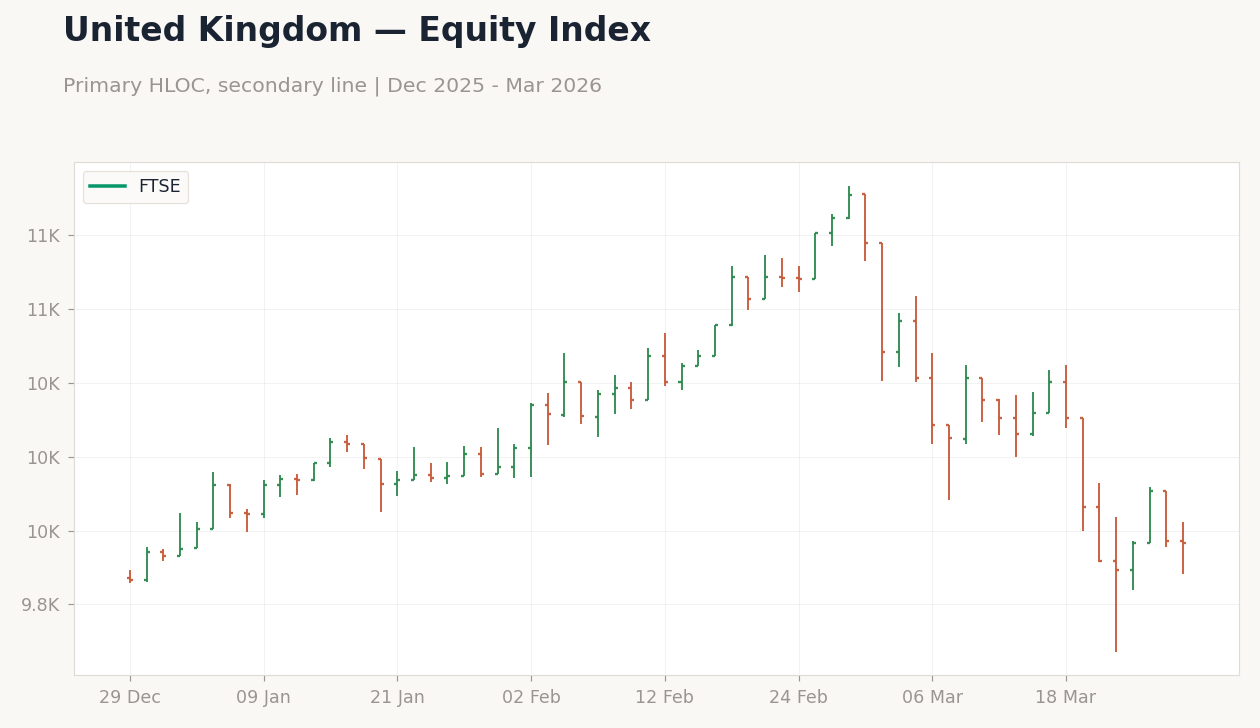
Greater China cross-asset markets exhibited volatility this week ending March 27, with equities netting losses amid Iran war jitters, as the Shanghai Composite declined -1.72% to 3,889.08. The CSI 300 fell -1.96% to 4,477.53, while the Hang Seng dropped -1.67% to 24,856.43 in risk-off flows. Taiwan's TAIEX bucked the trend slightly with a -0.61% weekly decline to 33,337.62 on AI export hopes. In FX, USD/CNY rose 0.16% to 6.91, while USD/HKD edged -0.01% to 7.83, stable within the peg. Commodities provided mixed signals, with copper up 2.32% to 5.47 on demand resilience, but Brent crude fell -5.35% to 106.19 amid war disruptions. Gold declined -0.66% to 4,540.30, while Bitcoin dropped -6.53% to 65,918.22, syncing with equity weakness. Bond yields were unavailable, but broader rate stability supported FX peg dynamics without notable shifts.
The Iran war over the past seven days battered global energy markets, with Brent crude closing at 106.19 after swings, directly impacting China's imports and fueling petroyuan discussions. Cross-border spillovers intensified, threatening China's export surplus, while Asia-Pacific trade dynamics highlighted regional concerns. Geopolitical risks escalated amid energy crises that could boost Hong Kong's retail via lower costs if Brent stabilizes below 106.19. Taiwan's semiconductor sector faced supply chain fractures from Middle East conflict, as seen in TAIEX volatility to 33,337.62, tying into fractured global chains.
| Asset | Level | WoW |
|---|---|---|
| KOSPI | 5460.46 | -5.5% |
| KOSDAQ | 1136.64 | -2.1% |
| USD/KRW | 1508.26 | +1.2% |
| Samsung | 180100.0 | -9.7% |
| SK Hynix | 933000.0 | -7.3% |
| Brent Crude | 106.32 | -5.2% |
| Gold | 4539.2 | -0.7% |
| Bitcoin | 65974.58 | -6.5% |


South Korean markets endured a tumultuous week ending March 27, 2026, dominated by geopolitical volatility from the Iran crisis, which triggered sharp equity selloffs and won depreciation despite intermittent relief rallies. Overall, data releases challenged expectations of resilient domestic demand, while export strength provided some offset amid global risks.
Geopolitical Volatility Drives Market Swings The KOSPI declined 5.55% weekly to 5,460.46, driven by escalating Mideast tensions and heavy foreign outflows. KOSDAQ mirrored this pattern, ending down 2.14% weekly at 1,136.64.
Currency and Rates Under Pressure USD/KRW climbed 1.24% weekly to 1,508.26 as dollar safe-haven flows dominated. Yields climbed, reflecting inflation fears from Brent crude's volatility, which ended the week down 5.23% at 106.32.
Data Misses Signal Softening Sentiment Consumer Confidence fell sharply, missing expectations of stability and highlighting household strains from rising living costs and won weakness. Business Confidence dipped, underscoring corporate unease over export disruptions from Middle East trade routes. These misses challenged narratives of domestic resilience, fueling inflationary pressures in a high-debt environment.
Sector and Commodity Impacts Tech giants bore the brunt, with Samsung dropping 9.68% weekly to 180,100 won and SK Hynix declining 7.35% to 933,000 won, hit by energy cost concerns despite positive AI demand outlooks. Gold fluctuated as a safe haven, ending down 0.68% weekly at 4,539.2, while Bitcoin fell 6.45% to 65,974.58 amid risk-off sentiment. The data confirmed mounting headwinds to growth, shifting focus to potential policy responses in coming quarters.
The Bank of Korea highlighted risks of inflation and sluggish growth from Middle East spillovers, warning of oil-driven pressures on the export-reliant economy. Forward guidance implied vigilance on currency interventions amid won weakness to 1,508.26. This week's soft data suggests a delayed pivot to easing, potentially pushing back rate cuts. OIS pricing shifted toward a flatter curve, pricing in fewer cuts as inflation threats mount. The rate path now leans restrictive, contingent on geopolitical resolutions.
| Event | Prior | Cons. | Actual |
|---|---|---|---|
| Producer Price Index Month-o | 0.70 | - | 0.60 |
| Producer Price Index Year-ov | 1.9 | - | 2.4 |
| 20-Year KTB Auction | 3.6 | - | 3.8 |
| Consumer Confidence Index | 112 | - | 107 |
| Business Confidence Index | 72.0 | - | 71.0 |
| Date | Release | Prior | Cons. |
|---|---|---|---|
| 2026-03-31 | Exports Year-over-Year | 29.0 | - |
| 2026-03-31 | S&P Global Manufacturing PMI Index | 51.1 | - |
| 2026-04-01 | Inflation Rate Year-over-Year | 2.0 | - |

Next week's calendar features key indicators that could shape Bank of Korea expectations, starting with Manufacturing PMI on Monday, testing industrial resilience amid export strains. This high-impact release matters for the rate path, as weakness could bolster easing bets. Tuesday brings Trade Balance data, crucial for assessing won stability and growth momentum. Mid-week, CPI inflation on Wednesday is eyed, directly influencing policy as elevation above target could delay cuts. Thursday's GDP advance estimate will gauge overall expansion and fiscal space. Friday rounds out with Industrial Production, providing signals on manufacturing health. These releases collectively matter for the next meeting, as upside surprises could reinforce a hold stance, while misses might accelerate easing discussions. Markets will watch for any surprise BoK commentary tying data to currency interventions.
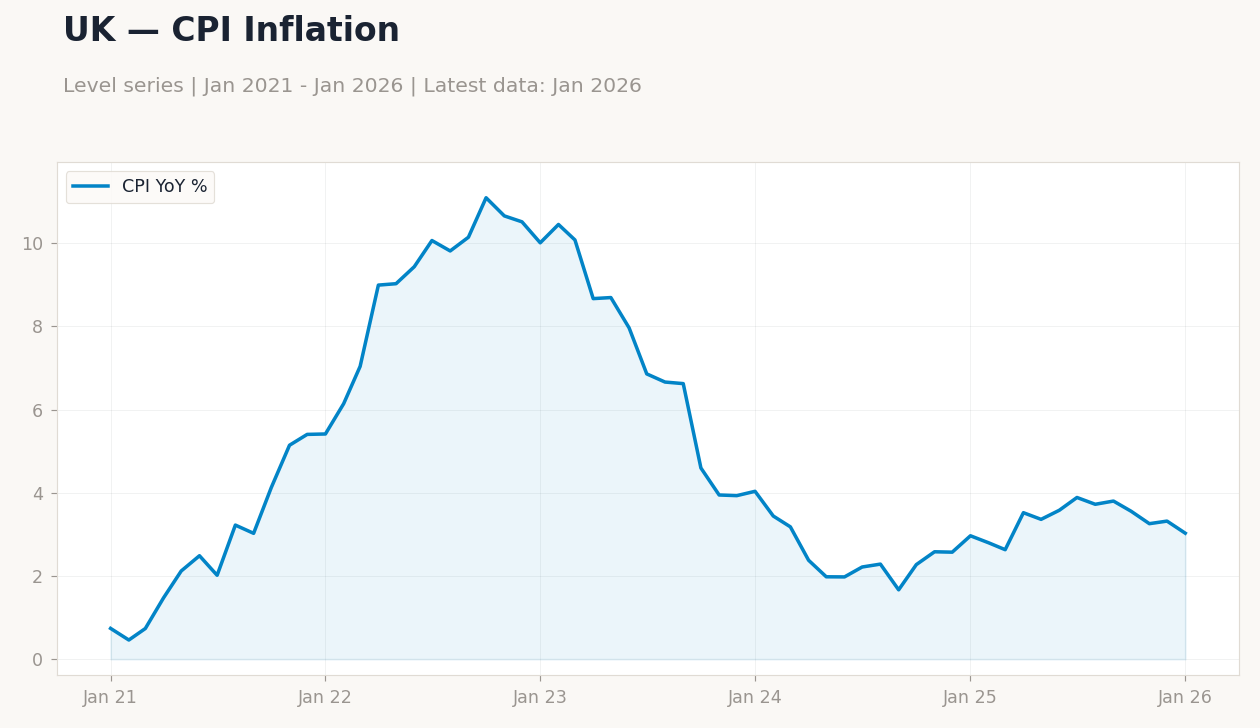
This week's data shifts the outlook toward stagflation risks, with softening domestic confidence underscoring headwinds against oil-driven inflation from Brent at 106.32. Upside scenarios include rapid Mideast de-escalation boosting exports and capping won depreciation, potentially allowing earlier rate normalization. Downside risks center on prolonged Iran tensions spiking energy costs, exacerbating growth slowdowns and forcing BoK interventions that could widen fiscal deficits. Markets misprice easing odds, as OIS curves undervalue persistent inflation threats in coming quarters. Monitoring signals like tech sector rebounds could indicate resilience, though current pricing overlooks export vulnerabilities.
| Asset | Level | WoW |
|---|---|---|
| JCI | 7164.09 | -1.9% |
| SET | 1442.92 | +0.7% |
| KLCI | 1710.89 | +0.1% |
| PSEi | 5984.2 | +1.4% |
| STI | 4887.76 | -1.2% |
| USD/IDR | 16952.0 | +0.2% |
| USD/THB | 32.59 | +0.3% |
| USD/MYR | 4.01 | +1.9% |
| USD/PHP | 60.48 | +1.6% |
| USD/SGD | 1.29 | +0.8% |
| Brent Crude | 106.32 | -5.2% |
| Gold | 4539.2 | -0.7% |


The week ending March 27, 2026, saw geopolitical-driven volatility in ASEAN markets, with Middle East conflicts amplifying currency pressures and commodity swings; resilient equity rallies mid-week reflected optimism on ceasefire prospects. Sparse data releases showed no major consensus misses, challenging quick inflation relief expectations, as Brent crude declined 5.23% weekly to $106.32 amid intra-week volatility. ASEAN currencies broadly weakened against the USD, with USD/IDR rising 0.21% week-over-week to 16,952.00 and USD/MYR climbing 1.92% to 4.01, underscoring vulnerability to capital outflows. Equity markets traced a volatile path, with JCI falling 1.89% weekly to 7,164.09, SET rising 0.69% to 1,442.92, PSEi gaining 1.44% to 5,984.20, KLCI up 0.12% to 1,710.89, and STI down 1.23% to 4,887.76.
Geopolitical Pressures Dominate Currencies and Commodities Rupiah risks escalated as BI highlighted prolonged holds to mitigate war-induced depreciation, while USD/THB edged up 0.28% weekly to 32.59. Brent crude exhibited stark daily moves, closing down 5.23% overall to $106.32, which alleviated inflation fears in import-reliant Philippines and Singapore but pressured Malaysia's palm oil exports. Gold prices fluctuated sharply, down 0.68% weekly to $4,539.20, reflecting safe-haven demand amid Bitcoin's 6.45% weekly slide to $65,974.58.
Central Bank Holds and Growth Signals Emerge BI maintained its policy rate on Thursday to shield against rupiah slides, while BSP held the prior day to balance growth and inflation during energy pressures. Singapore's inflation data on March 23 showed core YoY at 1.4%, up from 1.0% previous, with overall YoY easing to 1.2% from 1.4%, suggesting MAS may tolerate modest appreciation in the SGD nominal effective exchange rate despite USD/SGD rising 0.79% weekly to 1.29. Thailand's consumer sector optimism boosted SET mid-week, while Malaysia's KLCI eked out a 0.12% weekly gain to 1,710.89 on surging local currency trade with China. Vietnam's manufacturing strength drew FDI interest, confirming broader ASEAN trends of fiscal strains amid oil volatility.
Equity Resilience Amid Profit-Taking The week's arc confirmed expectations of protracted tight policy, with no significant data surprises but geopolitical events challenging growth outlooks; Philippines' PSEi rose 1.44% weekly, supported by remittance inflows, while Indonesia's JCI fell 1.89% weekly to 7,164.09.
Bank Indonesia held its policy rate steady on Thursday, emphasizing a hawkish stance to defend the rupiah amid Middle East war risks, with forward guidance pointing to prolonged tightness; Singapore's 1.4% core inflation rise suggests BI may extend its hold. The Bank of Thailand vowed baht volatility curbs without rate changes, while Bangko Sentral ng Pilipinas maintained its policy rate to support growth during energy woes, on peso weakness of 1.60% weekly. Bank Negara Malaysia and the Monetary Authority of Singapore issued no decisions, but MAS could hint at nominal effective exchange rate tweaks following USD/SGD's 0.79% rise, as inflation eased to 1.2% YoY; the State Bank of Vietnam remained quiet, though regional FX pressures imply steady policy ahead. Commodity volatility and currency depreciations reinforced a cautious rate path across the region.
| Event | Prior | Cons. | Actual |
|---|---|---|---|
| Core Inflation Rate Year-ove | 1.0 | - | 1.4 |
| Inflation Rate Month-over-Mo | -0.50 | - | 0.60 |
| Inflation Rate Year-over-Yea | 1.4 | - | 1.2 |
| Exports Year-over-Year | 24.4 | 15.1 | 9.9 |
| Imports Year-over-Year | 29.4 | 24.5 | 31.8 |
| Trade Balance | -3.3bn | 960.0mn | -2.8bn |
| New Car Sales Year-over-Year | 53.8 | - | -2.2 |
| MAS 12-Week Bill Auction | 1.4 | - | 1.5 |
| MAS 4-Week Bill Auction | 1.4 | - | 1.4 |
| 6-Month T-Bill Auction | 1.4 | - | 1.5 |
| Industrial Production Month- | 2.0 | - | -7.2 |
| Industrial Production Year-o | 12.9 | - | -0.10 |
| Central Bank Interest Rate D | 4.2 | - | 4.2 |
| Exports Year-over-Year | 8.7 | - | 8.0 |
| Date | Release | Prior | Cons. |
|---|---|---|---|
| 2026-04-01 | Inflation Rate Year-over-Year | 4.8 | - |
| 2026-04-01 | Trade Balance | 960.0mn | - |


The week of March 30 to April 3, 2026, features key ASEAN releases starting Monday with Vietnam's Q1 GDP growth, which matters for SBV's rate path by signaling manufacturing resilience amid regional FX strains. Tuesday brings Thailand's February current account balance, critical for BoT's baht management and potential interventions if deficits widen, influencing volatility curbs. Wednesday highlights include Indonesia's March manufacturing PMI, offering BI insights into export-driven growth that could delay rate cuts if strong. Thursday sees Philippines' March inflation rate YoY, a pivotal gauge for BSP's hold by testing if energy risks exceed target. Friday rounds out with Singapore's March manufacturing PMI, important for MAS's exchange rate band adjustments if expansion accelerates, and Vietnam's March trade balance, bolstering SBV's outlook on FDI inflows and currency stability. These indicators could confirm or challenge the consensus hold path for BI, BoT, BNM, BSP, MAS, and SBV, with upside growth surprises potentially easing downside risks.
This week's data shifts the ASEAN outlook toward heightened geopolitical risks, as Brent's 5.23% decline to $106.32 cools near-term inflation but underscores vulnerability to Middle East flare-ups, potentially mispricing upside oil shocks in markets like Indonesia where USD/IDR rose 0.21% to 16,952.00. Upside scenarios include sustained ceasefire hopes boosting equities, with SET's 0.69% weekly gain to 1,442.92 signaling consumer recovery; downside risks loom from renewed conflicts weakening currencies further, as seen in USD/MYR's 1.92% climb to 4.01. Markets may be mispricing BI and BSP's prolonged holds, overlooking fiscal buffers. Themes center on energy security, with Philippines highlighting import reliance, while Singapore's 1.2% YoY inflation suggests MAS tolerance for SGD strength. Signals point to resilient growth in Malaysia, but Vietnam's manufacturing FDI could falter if global risk-off persists, tilting toward cautious policy.
| Asset | Level | WoW |
|---|---|---|
| Nifty 50 | 23306.45 | +0.8% |
| Sensex | 75273.45 | +1.0% |
| USD/INR | 94.63 | +1.7% |
| EUR/INR | 108.98 | +1.4% |
| Reliance | 1413.1 | -0.1% |
| HDFC Bank | 782.3 | +0.2% |
| Brent Crude | 106.2 | -5.3% |
| Gold | 4538.0 | -0.7% |
| Bitcoin | 65956.71 | -6.5% |


India’s markets demonstrated resilience this week, with equities advancing despite rupee depreciation, bolstered by falling oil prices. The narrative reflected currency headwinds offset by commodity relief, affirming buffers against external shocks and steady growth prospects ahead of quarter-end.
Equities Rally Amid Volatility. The Nifty 50 rose 0.83% week-over-week to 23,306.45. The Sensex advanced 0.99% to 75,273.45. HDFC Bank gained 0.24% to 782.3, while Reliance Industries fell 0.09% to 1,413.1. These gains signal market confidence in domestic fundamentals despite external pressures.
Rupee Pressures and Oil Relief. USD/INR climbed 1.66% week-over-week to 94.63, with EUR/INR up 1.39% to 108.98. Brent crude dropped 5.34% to 106.2, mitigating inflation risks from imports. Gold declined 0.71% to 4,538.0, and Bitcoin fell 6.47% to 65,956.71.
Broader Context and Policy Echoes. No major domestic data releases occurred, focusing attention on global commodity trends and currency dynamics. Rupee weakness underscores RBI vigilance on external balances, while oil relief supports disinflation and a stable rate path. Equity strength reinforces optimism for RBI accommodation.
The RBI held policy steady amid rupee depreciation to 94.63 and Brent crude at 106.2. Equity resilience underscores growth durability, tilting toward extended pause. Rupee pressures reinforce focus on external stability, with lower oil aiding disinflation. Markets price minimal near-term shifts, with RBI guidance to prioritize global risks over domestic moderation.
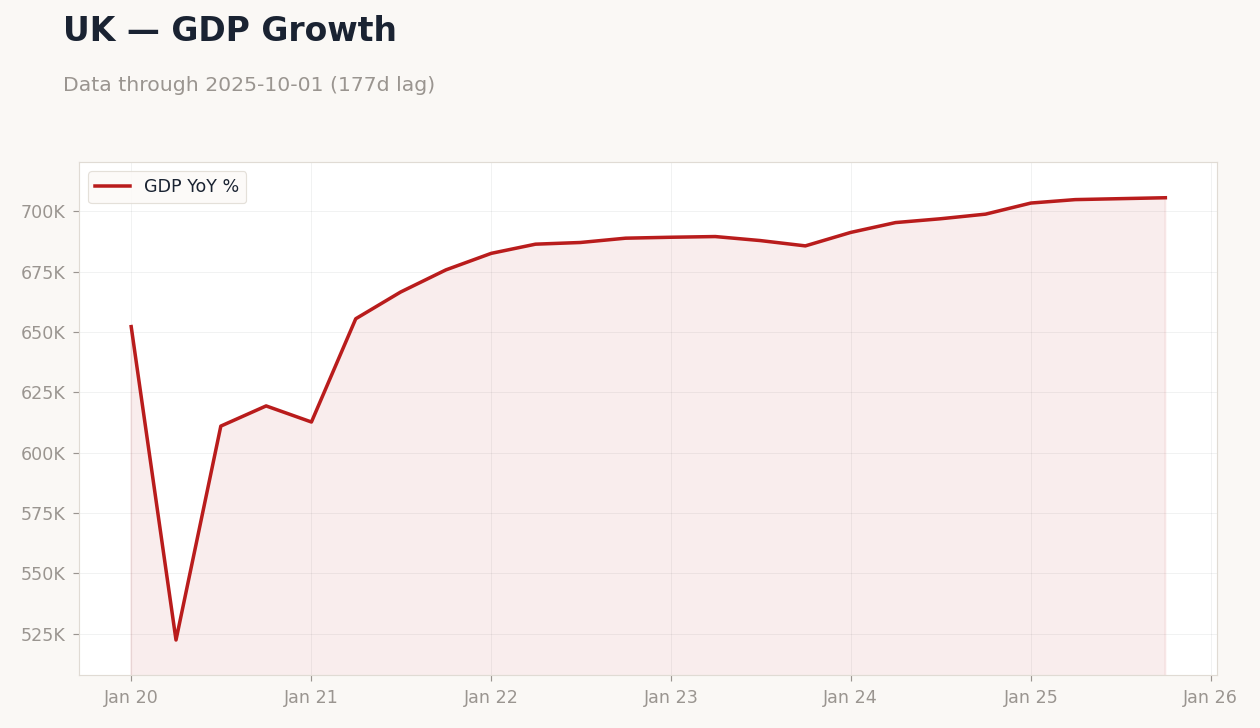
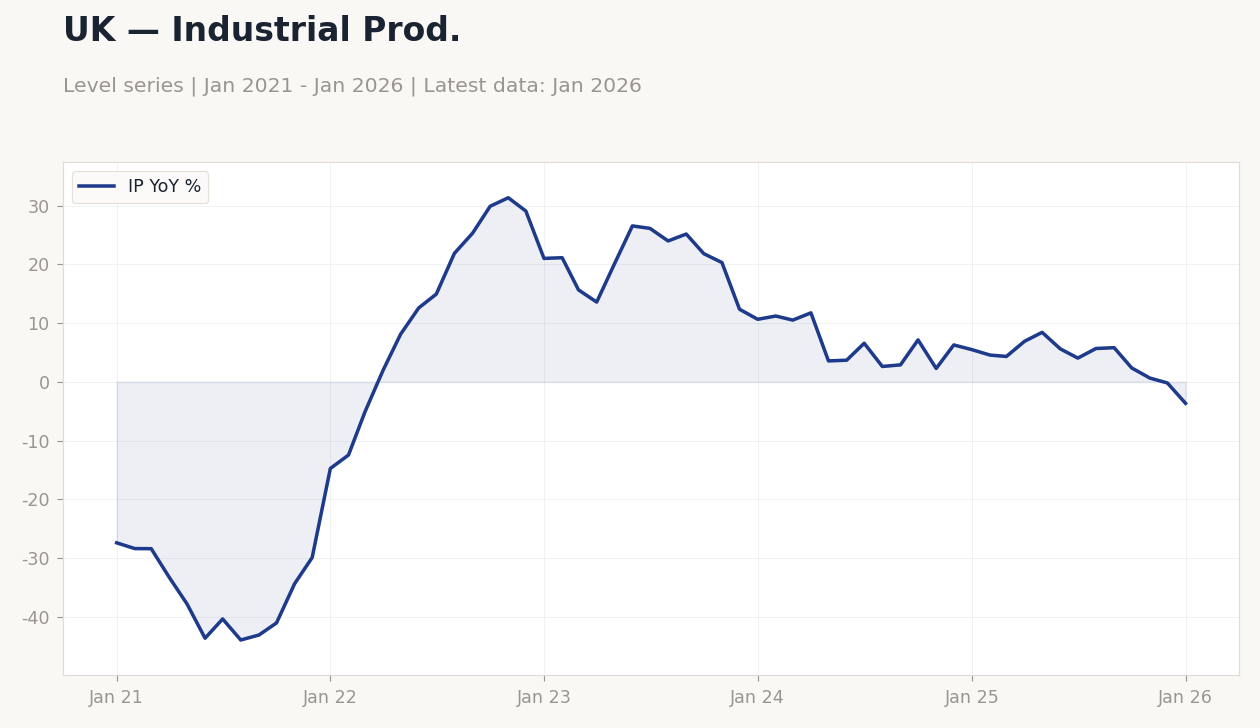
| Event | Prior | Cons. | Actual |
|---|---|---|---|
| HSBC Composite PMI Flash | 58.9 | 58.7 | 56.5 |
| HSBC Manufacturing PMI Flash | 56.9 | 56.8 | 53.8 |
| HSBC Services PMI Flash | 58.1 | 58.3 | 57.2 |
| Rbi Market Borrowing Auction | - | - | - |
| M3 Money Supply Year-over-Ye | 11.5 | - | 10.7 |
| Bank Loan Growth Year-over-Y | 14.5 | - | 13.8 |
| Deposit Growth Year-over-Yea | 11.9 | - | 10.8 |
| Foreign Exchange Reserves Le | 709.8bn | - | 698.4bn |
| Rbi Market Borrowing Auction | - | - | - |
| Date | Release | Prior | Cons. |
|---|---|---|---|
| 2026-03-30 | Industrial Production Year-over-Yea | 4.8 | - |
| 2026-03-30 | Manufacturing Production Year-over- | 4.8 | - |


The week ahead features a light domestic calendar for India, shifting focus to global indicators influencing RBI inflation and growth views. On Monday, March 30, Japan's Housing Starts Year-over-Year (previous -0.4%) and Construction Orders Year-over-Year (previous 5.7%), South Africa's M3 Money Supply Year-over-Year (previous 7.44%) and Private Sector Credit Year-over-Year (previous 8.83%), Hungary's Trade Balance (previous 12 million), and Austria's Producer Price Index Month-over-Month offer signals on Asia-Pacific demand, emerging liquidity, and European supply chains. Tuesday likely includes China PMIs, gauging trading partner strength and commodity impacts on India's inflation. By Friday, April 3, surprises in emerging data could sway RBI guidance on oil or growth, with implications for liquidity measures. Absent domestic catalysts, the RBI rate path depends on global cooling or volatility.
Rupee weakening to 94.63 elevates external pressures, while Brent at 106.2 sustains inflation monitoring despite the decline. Upside risks from further oil drops favor prolonged RBI pause; downside from geopolitical flares risks deeper USD/INR moves. Equity gains like Nifty's 0.83% advance misprice currency strains, understating slowdown potential. Themes highlight energy import exposure and RBI readiness to manage outflows, pointing to a cautious path with policy buffers intact.
| Asset | Level | WoW |
|---|---|---|
| BIST 100 | 12698.19 | -3.6% |
| USD/TRY | 44.45 | +0.3% |
| EUR/TRY | 51.2 | -0.2% |
| GBP/TRY | 59.0 | -0.8% |
| Gold (TRY) | 4536.1 | -0.8% |
| Brent Crude | 106.52 | -5.0% |
| EUR/USD | 1.15 | -0.5% |
| Bitcoin | 65956.71 | -6.5% |


The week began with early releases underscoring a softening in sentiment, setting a cautious tone that persisted through market movements. Declining confidence metrics challenged prior stability, with equity markets reacting negatively while the lira showed resilience against major crosses. The data confirmed expectations of moderating momentum without upending growth narratives.
Softening Sentiment Indicators Consumer Confidence Index declined early in the week from the previous reading, highlighting eroding household optimism amid ongoing economic pressures. Similarly, Business Confidence Index fell from prior level, suggesting businesses anticipated slower activity. These figures contributed to a risk-off mood, as evidenced by BIST 100's subsequent declines.
Equity and FX Dynamics BIST 100 extended losses mid-week before closing lower, culminating in a 3.57% week-over-week drop to 12,698.19. USD/TRY edged up 0.34% week-over-week to 44.45, reflecting mild depreciation pressures on the lira. EUR/TRY dipped 0.20% week-over-week to 51.2, while GBP/TRY fell 0.84% to 59.0 over the week.
Commodity Influences Gold priced in TRY ended the week down 0.75% at 4,536.1, mirroring global swings without providing clear directional cues for Turkish inflation. Brent Crude declined 5.05% week-over-week to 106.52, offering relief on imported energy costs. These movements, alongside Bitcoin's 6.47% weekly decline to 65,956.71, underscored external risk aversion impacting local assets. The data challenged optimistic views on recovery, suggesting potential headwinds to consumption and investment in coming quarters, though FX stability prevented sharper sell-offs.
The Central Bank of the Republic of Turkey (CBRT) made no policy announcements or rate decisions this week, with speakers remaining silent on forward guidance amid the light data calendar. The softer Consumer Confidence Index and Business Confidence Index reinforced a narrative of steady rates, indicating no urgent inflationary pressures warranting hikes. Minutes from prior meetings were not released, leaving markets to interpret the data as supportive of the current stance without shifts in rhetoric. For the rate path, this week's indicators suggest limited scope for easing in upcoming decisions, potentially delaying any cuts if sentiment continues to weaken. CBRT OIS pricing showed negligible adjustments, with implied rates holding steady as traders discounted aggressive moves. Overall, the data points to a cautious CBRT monitoring external factors like Brent Crude's 5.05% weekly decline for disinflationary signals.
| Event | Prior | Cons. | Actual |
|---|---|---|---|
| Consumer Confidence Index | 85.7 | - | 85.0 |
| Tourist Arrivals Year-over-Y | 3.5 | - | -2.1 |
| Foreign Exchange Reserves Le | 62.8bn | - | 55.5bn |
| Central Government Debt | 14264.0bn | - | 14396.0bn |
| Business Confidence Index | 104 | - | 101 |
| Capacity Utilization Rate | 73.5 | - | 73.3 |
| Foreign Exchange Reserves Le | 55.5bn | - | 61.3bn |
| Date | Release | Prior | Cons. |
|---|---|---|---|
| 2026-03-31 | Balance of Trade Final | -8.4bn | - |
| 2026-03-31 | Headline Unemployment Rate | 8.1 | - |
| 2026-04-03 | Inflation Rate Month-over-Month | 3.0 | - |
| 2026-04-03 | Inflation Rate Year-over-Year | 31.5 | - |
Next week's calendar features a mix of global and regional data, though Turkey-specific releases are absent, shifting focus to external influences on the lira and inflation. On Monday, Japan's Housing Starts Year-over-Year and Construction Orders Year-over-Year will provide insights into Asia-Pacific demand, potentially affecting commodity flows that impact CBRT's imported inflation outlook. South Africa's M3 Money Supply Year-over-Year and Private Sector Credit Year-over-Year on the same day could signal emerging market trends, relevant for CBRT rate path assessments amid global liquidity dynamics. Tuesday brings Hungary's Trade Balance, which matters for CEEMEA peer comparisons, as any surprises might influence regional currency pressures on TRY pairs. Austria's Producer Price Index Month-over-Month rounds out early-week highlights, offering a gauge of Eurozone input costs that could filter into Turkey's trade channels. These releases collectively matter for the CBRT rate path by highlighting potential upside risks to energy and goods prices if global growth indicators beat expectations, or downside if they miss, informing the next meeting's stance on steady policy. Without domestic data, we anticipate markets will price CBRT OIS based on these proxies, with consensus absent for most but prior figures like Japan's -0.4% Housing Starts setting a baseline for monitoring.
This week's softer confidence data shifts the outlook toward downside risks, suggesting potential moderation in growth that could pressure CBRT to maintain rates longer than anticipated. Upside scenarios include a rebound in sentiment if external factors like Brent Crude's 5.05% decline sustains disinflation, allowing for earlier policy normalization in coming quarters. Conversely, downside risks escalate if equity weakness persists beyond BIST 100's 3.57% drop, amplifying lira depreciation as seen in USD/TRY's 0.34% rise. The market misprices resilience in FX crosses, such as EUR/TRY's 0.20% decline, by not fully accounting for imported cost relief from commodities. Key themes revolve around sentiment recovery signals, with Gold in TRY's -0.75% weekly change underscoring hedging demands amid uncertainty. Overall, risks balance, but persistent weak data could tilt toward a more dovish CBRT path if global headwinds intensify.
| Asset | Level | WoW |
|---|---|---|
| Saudi Aramco | 27.0 | +1.3% |
| MSCI Saudi | 37.91 | +3.1% |
| MSCI UAE | 17.8 | +2.0% |
| DFM General | 5510.99 | +2.4% |
| MSCI Qatar | 18.16 | -0.7% |
| MSCI Kuwait | 35.58 | -1.0% |
| Brent Crude | 106.52 | -5.0% |
| WTI Crude | 100.87 | +2.6% |
| Gold | 4533.1 | -0.8% |
| USD/SAR | 3.75 | +0.1% |
| USD/AED | 3.67 | +0.0% |
| USD/KWD | 0.31 | +0.3% |


GCC markets demonstrated resilience amid commodity swings. No major economic data releases occurred, shifting focus to asset price movements and external risks. Equities posted uneven gains while oil volatility tested fiscal outlooks. Overall, asset prices confirmed persistent risk premia in commodities, underscoring diversification efforts.
Geopolitical Risks Dominate Headlines Regional security concerns elevated volatility, with Brent crude declining 5.05% to 106.52 and WTI crude rising 2.59% to 100.87. No disruptions to oil infrastructure occurred. Gold fell 0.82% to 4533.1. DFM General rose 2.38% to 5510.99.
Equity Markets Exhibit Volatility GCC stocks showed mixed performance, with MSCI Saudi advancing 3.07% to 37.91 supported by energy strength; Saudi Aramco rose 1.28% to 27.0. MSCI UAE gained 2.01% to 17.8 driven by real estate momentum. MSCI Qatar declined 0.70% to 18.16, while MSCI Kuwait fell 1.04% to 35.58, reflecting oil-linked pressures. Markets weighed fiscal boosts from WTI gains.
Commodity and Currency Stability Amid Swings Brent crude declined 5.05% to 106.52 amid demand uncertainties, while WTI crude rose 2.59% to 100.87, bolstering GCC fiscal positions. Gold fell 0.82% to 4533.1. Pegged currencies remained stable, with USD/SAR at 3.75 showing a 0.05% gain, USD/AED at 3.67 with a 0.03% rise, and USD/KWD at 0.31 up 0.28%. Bitcoin declined 6.46% to 65965.21.
Sectoral and Regional Nuances Energy sector strength supported Aramco's 1.28% gain to 27.0. Regional gold reserves provided a buffer. Equities confirmed resilience, with DFM General up 2.38% to 5510.99. The week ended in consolidation, reinforcing diversification amid oil dependency.
GCC central banks issued no rate decisions or guidance, with pegged policies tied to the US Federal Reserve unchanged; USD/SAR at 3.75 and USD/AED at 3.67 showed minimal volatility. Oil swings, including Brent's 5.05% drop to 106.52, imply limited inflation pressure, supporting steady rates. OIS pricing reflected stable alignment expectations. The rate path remains data-dependent on global indicators, with risks adding caution.
| Event | Prior | Cons. | Actual |
|---|---|---|---|
| Exports Level | 97.2bn | - | 98.7bn |
| Imports Level | 84.2bn | - | 81.4bn |
| Trade Balance | 13.0bn | - | 17.3bn |
Attention turns to Monday's light calendar, with no major GCC releases but global data like Japan's Housing Starts Year-over-Year (previous -0.4%) potentially influencing commodity demand for oil-dependent GCC economies. Tuesday brings Saudi Arabia's M3 Money Supply Year-over-Year, signaling liquidity trends amid pegged policies. Wednesday's UAE CPI Year-over-Year gauges inflation pressures for rate stability. Thursday features Qatar's PPI Month-over-Month, offering insights into producer costs tied to GCC growth. Friday includes potential Kuwait trade balance updates, impacting fiscal health and OIS pricing. These releases assess the rate path, with stronger inflation or money supply prompting tighter global alignment.
Upside risks emerge for oil prices above Brent's 106.52 level if tensions prolong, mispricing current levels. Downside scenarios include export disruptions pressuring fiscal balances in oil-reliant states. Upside includes equity resilience, with MSCI Saudi's 3.07% gain signaling diversification. Pegged currencies like USD/KWD at 0.31 underestimate global rate spillovers. Absent data points to neutral rate outlook, with security themes warranting inflationary monitoring.
| Monday Mar 30 | Tuesday Mar 31 | Wednesday Apr 01 | Thursday Apr 02 | Friday Apr 03 |
|---|---|---|---|---|
| US & Canada 34 releases, 7 high-impact | ||||
10:30 Uni Dallas Fed Manufacturing Index 16:00 Uni Speech by Fed's Williams | 08:30 Can GDP Month-over-Month 08:30 Can GDP Month-over-Month Prel 09:00 Uni S&P/Case-Shiller Home Price Year-over-Year 09:45 Uni Chicago PMI 10:00 Uni JOLTs Job Openings 10:00 Uni Cb Consumer Confidence 12:00 Uni Fed Goolsbee Speech | 07:00 Uni MBA 30-Year Mortgage Rate 08:15 Uni ADP Employment Change 08:30 Uni Retail Sales Month-over-Month 08:30 Uni Retail Sales Control Group Month-over-Mont 08:30 Uni Retail Sales Excluding Autos Month-over-Mo 09:05 Uni Speech by Fed's Musalem 09:30 Can S&P Global Manufacturing PMI Index | 08:30 Can Trade Balance 08:30 Uni Exports Level 08:30 Uni Goods Trade Balance Adv 08:30 Uni Imports Level 08:30 Uni Trade Balance 08:30 Uni Weekly Jobless Claims | 08:30 Uni Headline Unemployment Rate 08:30 Uni Payroll Jobs Growth 08:30 Uni Annual Wage Growth 08:30 Uni Labor Force Participation 08:30 Uni Monthly Wage Growth 10:00 Uni Services Sector PMI |
| LatAm 2 releases | ||||
08:00 Mex Business Confidence Index | 08:00 Bra Industrial Production Month-over-Month | |||
| Europe 29 releases, 3 high-impact | ||||
03:00 Swi KOF Leading Indicators 04:30 Uni BoE Consumer Credit 04:30 Uni Mortgage Approvals 04:30 Uni Mortgage Lending Level 07:00 Spa Business Confidence Index 08:00 Ger Inflation Rate Year-over-Year Preliminary 08:00 Ger Inflation Rate Month-over-Month Preliminar | 00:30 Net Inflation Rate Year-over-Year Preliminary 02:00 Ger Retail Sales Month-over-Month 02:00 Ger Retail Sales Year-over-Year 02:00 Uni Current Account Balance 02:00 Uni Nationwide Housing Prices Month-over-Month 02:00 Uni Nationwide Housing Prices Year-over-Year 02:45 Fra Inflation Rate Year-over-Year Preliminary | 02:30 Swi Retail Sales Year-over-Year 03:15 Spa HCOB Manufacturing PMI 03:30 Swi procure.ch Manufacturing PMI 03:45 Ita HCOB Manufacturing PMI 04:00 Ita Headline Unemployment Rate | 02:30 Swi Inflation Rate Year-over-Year 05:00 Ita Retail Sales Month-over-Month | 02:45 Fra Industrial Production Month-over-Month |
| Monday Mar 30 | Tuesday Mar 31 | Wednesday Apr 01 | Thursday Apr 02 | Friday Apr 03 |
|---|---|---|---|---|
| EMEA 8 releases | ||||
09:00 Isr Central Bank Interest Rate Decision | 03:00 Tur Balance of Trade Final 03:00 Tur Headline Unemployment Rate 08:00 Sou Trade Balance | 02:00 Rus S&P Global Manufacturing PMI Index 12:00 Rus Headline Unemployment Rate | 03:00 Tur Inflation Rate Month-over-Month 03:00 Tur Inflation Rate Year-over-Year | |
| Asia 21 releases, 5 high-impact | ||||
01:00 Jap Housing Starts Year-over-Year 06:30 Ind Industrial Production Year-over-Year 06:30 Ind Manufacturing Production Year-over-Year 19:30 Jap Headline Unemployment Rate 19:50 Jap Industrial Production Month-over-Month Pre 19:50 Jap Retail Sales Year-over-Year 20:00 New ANZ Business Confidence | 18:00 Aus Ai Group Industry Index 19:50 Jap Tankan Large Manufacturers Index 20:00 Sou Exports Year-over-Year 20:30 Aus Building Permits Month-over-Month Prel 20:30 Sou S&P Global Manufacturing PMI Index 21:45 Chi RatingDog Manufacturing PMI | 00:00 Ind Inflation Rate Year-over-Year 00:00 Ind Trade Balance 19:00 Sou Inflation Rate Year-over-Year 21:30 Aus Trade Balance | 21:45 Chi RatingDog Services PMI | |
AI-Generated Content: This publication is 100% generated by artificial intelligence systems (xAI Grok) and should not be considered as financial advice, investment recommendation, or professional research. All analysis, forecasts, and commentary are algorithmically produced.
Data Sources: Market data sourced from Yahoo Finance, CBOE, FinanceFlow API, FRED, and national statistics offices. Economic calendar data from RoboMacro Economic Calendar. Forecast data based on IMF WEO, OECD Economic Outlook, and consensus surveys. All data subject to revision and may be delayed.
No Warranty: RoboMacro makes no warranty, express or implied, regarding the accuracy, completeness, or reliability of the information contained in this publication. Data may be delayed, incomplete, or contain errors. Past performance is not indicative of future results.
Not Financial Advice: Nothing in this publication constitutes investment advice, tax advice, legal advice, or any other form of professional advice. Any opinions expressed are AI-generated and do not represent the views of any individual or organisation. Readers should consult qualified professionals before making investment decisions.
Forecast Methodology: GDP and CPI forecasts are derived from IMF World Economic Outlook projections, OECD estimates, and real-time consensus surveys. Central bank rate paths incorporate OIS market pricing, forward guidance analysis, and Taylor rule estimates. All forecasts are point estimates and carry significant uncertainty.
Contact: [email protected] | robomacro.com
Publication: Global Macro Watch is published weekly on Fridays. © 2026 RoboMacro. All rights reserved.