RoboMacro AI Economic Research

Global Macro Watch

BETA
May 17, 2026 robomacro.com
Global Macro Watch
May 17, 2026
  • US CPI and PPI both exceeded forecasts, confirming the clearest inflation upside surprise of the week and reversing prior-week oil-relief momentum.
  • Brent crude climbed 4.85% to 109.26, providing fiscal support to exporters while raising imported-inflation risks for importers.
  • Norges Bank delivered a surprise hike while the BoJ flagged near-term rate discussions, underscoring divergent DM policy vigilance.
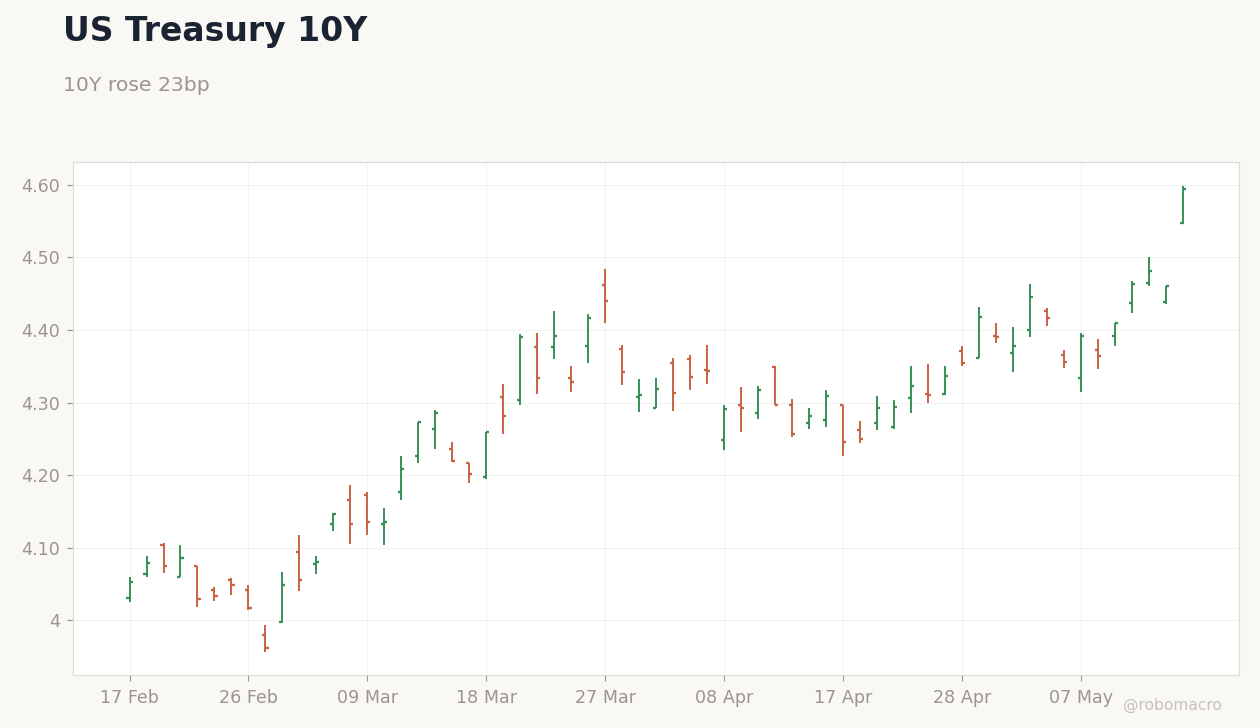
  • DXY rose 1.5% to 99.27 as Treasury 10-year yields climbed 23bp to 4.59%, driving broad equity weakness and EM currency pressure.
US Inflation Surprise and Oil Rally Lift Yields

We enter the third week of May 2026 with the global cycle shifting from the oil-relief narrative that dominated the prior period. Last week’s sharp Brent decline had eased near-term inflation concerns and supported risk assets; this week’s reversal, with Brent advancing 4.85% to 109.26, has reintroduced upside price pressure at precisely the moment US inflation data surprised to the high side. The data suggests the expansion remains intact yet faces a fresh test: resilient demand continues to meet tighter energy supply, pushing headline and upstream prices higher and forcing investors to reassess the timing of monetary easing. Across regions, the dominant thread is therefore one of re-pricing rather than outright contraction, with markets now embedding fewer cuts and higher terminal rates than they did seven days earlier.

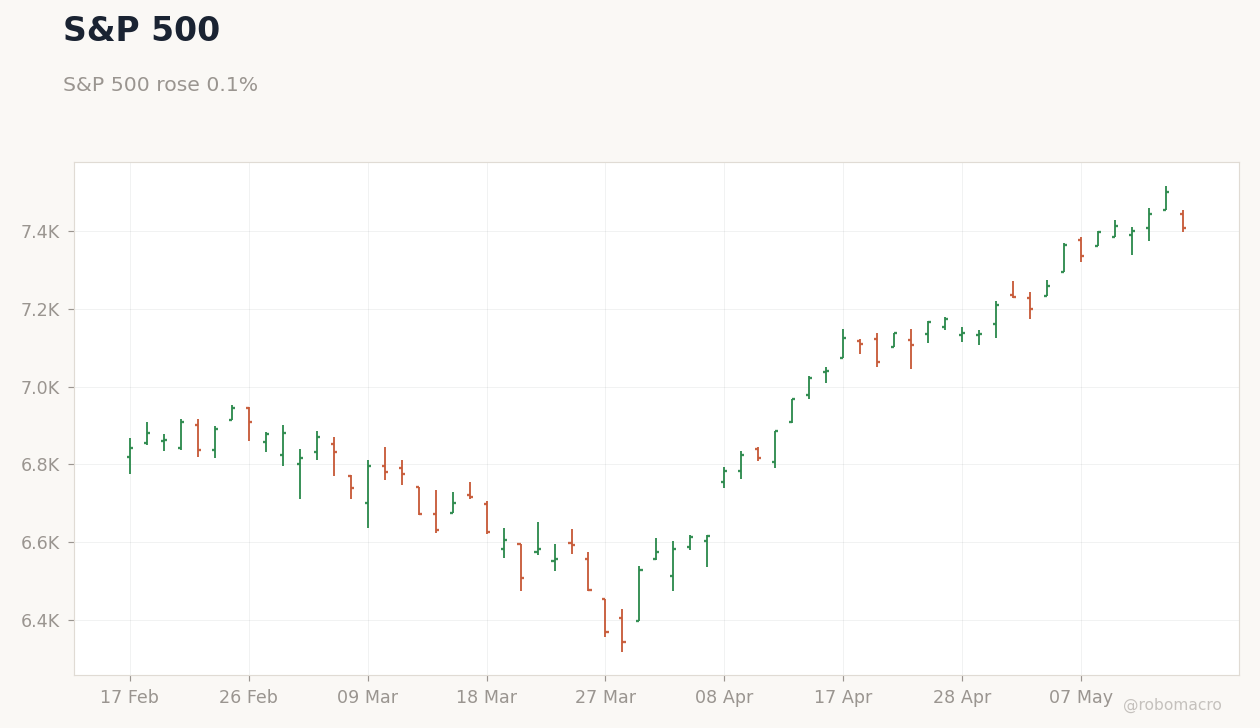
In developed markets the read-across is clearest in the United States and the Nordic bloc. US CPI and PPI both beat expectations, with upstream pressures particularly pronounced, while Federal Reserve speakers maintained a data-dependent stance without softening their vigilance language. This combination lifted the 2-year Treasury yield 24bp to 4.26% and the 10-year 23bp to 4.59%, steepening the curve and pushing the S&P 500 to a modest 0.1% weekly gain that masked broader rotation away from rate-sensitive sectors. Across the Atlantic, Norges Bank surprised with a policy-rate increase that drove EUR/NOK lower mid-week, while Sweden and Norway 10-year yields also moved higher. The Bank of England left Bank Rate unchanged and the BoJ highlighted ongoing rate-hike deliberations, pushing Japan’s 10-year yield up 23bp to 2.70%. The common DM signal is therefore one of selective tightening or extended holds rather than coordinated easing, even as labor-market data in Canada showed job losses and a rising unemployment rate that kept BoC cut expectations alive.
Join the AIeconomist.app Waitlist

Published every Sunday afternoon 100% AI-generated — not financial advice
RoboMacro AI Economic Research

Global Macro Watch

May 17, 2026 robomacro.com

We enter the third week of May 2026 with the global cycle shifting from the oil-relief narrative that dominated the prior period. Last week’s sharp Brent decline had eased near-term inflation concerns and supported risk assets; this week’s reversal, with Brent advancing 4.85% to 109.26, has reintroduced upside price pressure at precisely the moment US inflation data surprised to the high side. The data suggests the expansion remains intact yet faces a fresh test: resilient demand continues to meet tighter energy supply, pushing headline and upstream prices higher and forcing investors to reassess the timing of monetary easing. Across regions, the dominant thread is therefore one of re-pricing rather than outright contraction, with markets now embedding fewer cuts and higher terminal rates than they did seven days earlier.
In developed markets the read-across is clearest in the United States and the Nordic bloc. US CPI and PPI both beat expectations, with upstream pressures particularly pronounced, while Federal Reserve speakers maintained a data-dependent stance without softening their vigilance language. This combination lifted the 2-year Treasury yield 24bp to 4.26% and the 10-year 23bp to 4.59%, steepening the curve and pushing the S&P 500 to a modest 0.1% weekly gain that masked broader rotation away from rate-sensitive sectors. Across the Atlantic, Norges Bank surprised with a policy-rate increase that drove EUR/NOK lower mid-week, while Sweden and Norway 10-year yields also moved higher. The Bank of England left Bank Rate unchanged and the BoJ highlighted ongoing rate-hike deliberations, pushing Japan’s 10-year yield up 23bp to 2.70%. The common DM signal is therefore one of selective tightening or extended holds rather than coordinated easing, even as labor-market data in Canada showed job losses and a rising unemployment rate that kept BoC cut expectations alive.
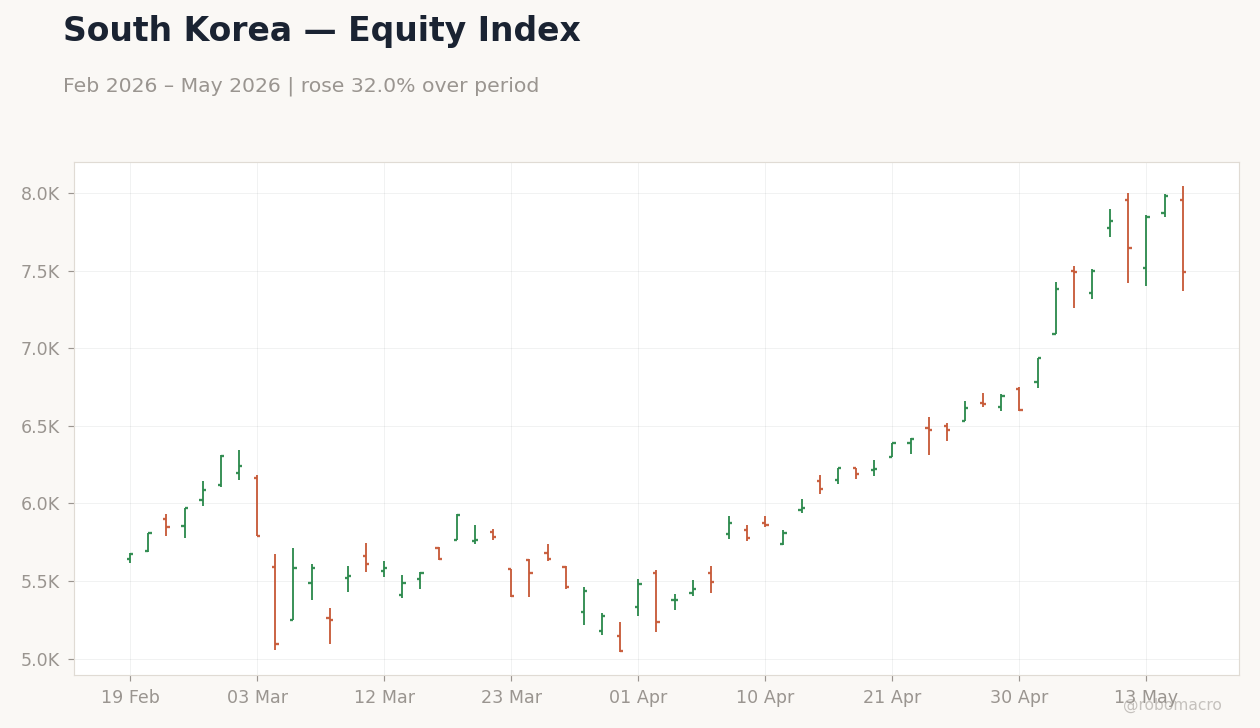
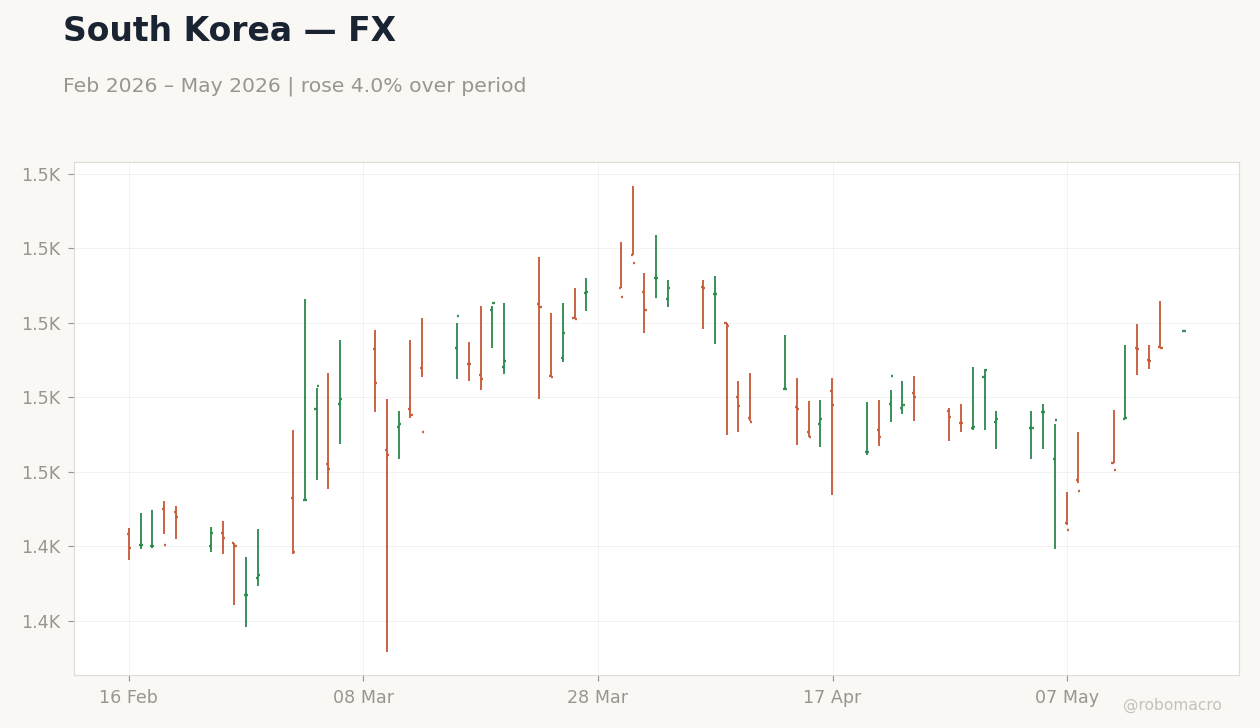
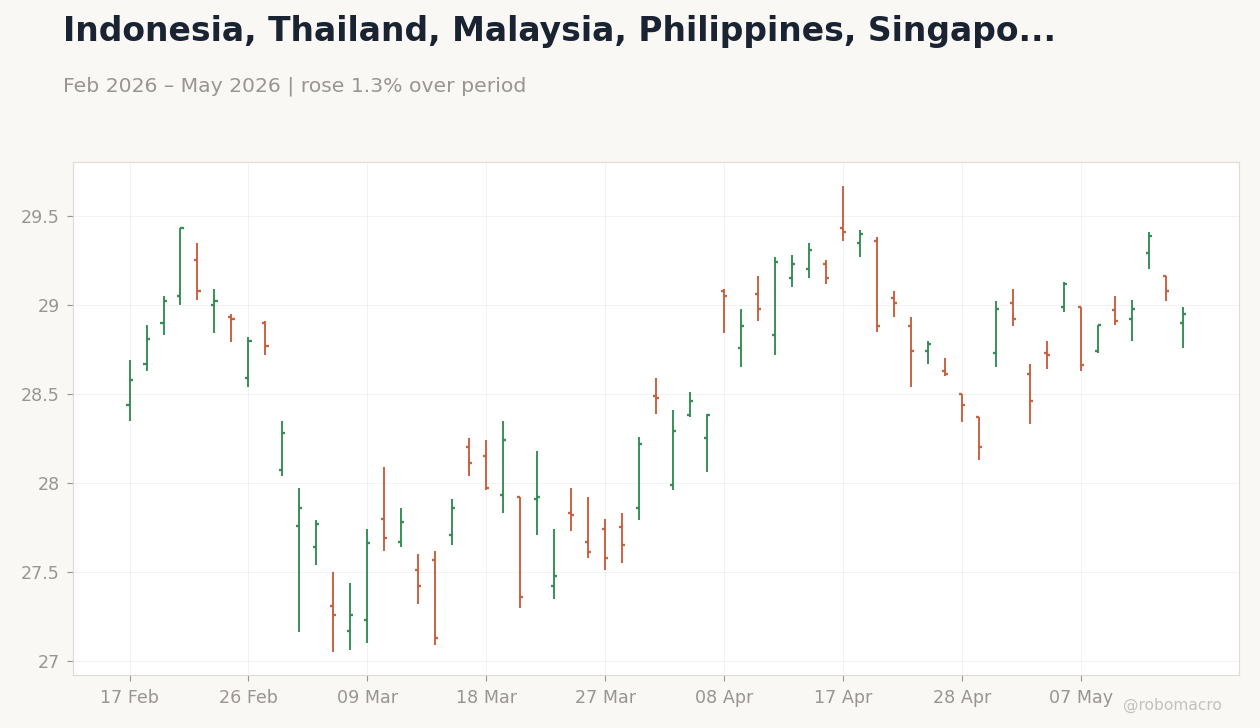
Emerging-market data flows reveal a bifurcated response to the same oil and inflation impulses. Brazil’s April inflation undershot consensus and retail sales beat expectations, allowing BCB OIS pricing to ease modestly and providing a buffer against the global risk-off tone. India likewise printed April inflation below forecasts, opening modest room for the Reserve Bank of India to stay on hold while forex reserves rose further. In contrast, South Korea’s unemployment rate increased and the KOSPI fell 4.21% to 7,493.18 as foreign outflows accelerated with USD/KRW climbing 2.55% to 1,497.76. Indonesia’s Q1 GDP beat expectations, yet USD/IDR strengthened alongside regional peers. The pattern is one of commodity-linked resilience in parts of Latin America and India offset by external-financing pressure in Asia, with central banks largely on hold pending clearer signals on the durability of the oil move.

RoboMacro AI Economic Research

Global Macro Watch

May 17, 2026 robomacro.com

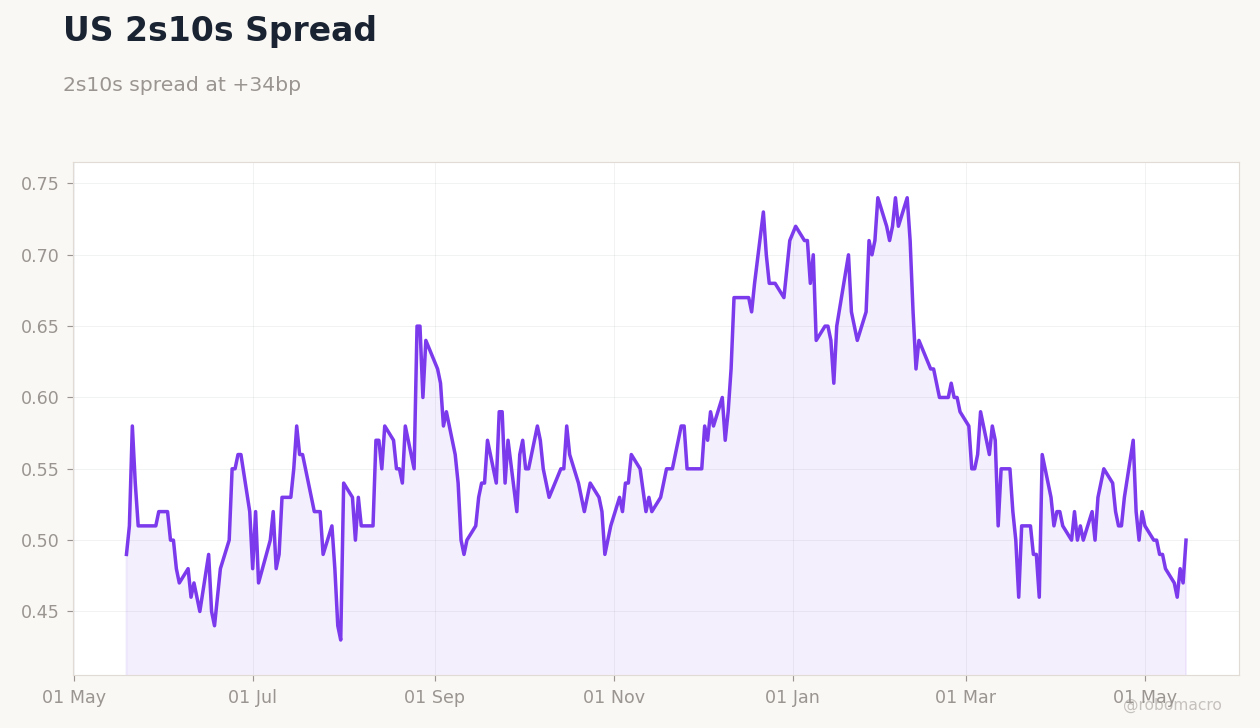
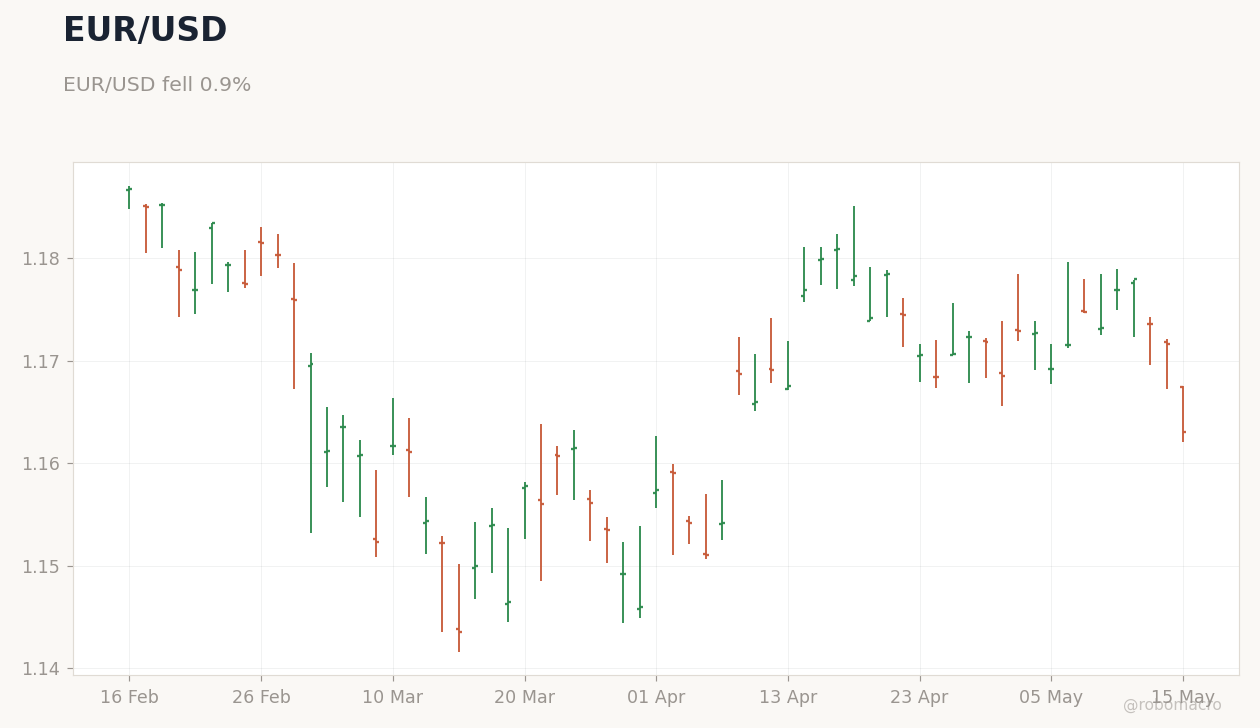
Cross-asset pricing tells a consistent story of higher real yields and a stronger dollar. Treasury, Bund, and gilt curves all steepened, with the US 2s10s spread reaching +34bp and the UK 2s10s reaching +62bp. Equities closed lower across most major indices, Euro Stoxx 50 falling 1.15% to 5,827.76 and the FTSE 100 declining 0.72% to 10,195.4, while energy names outperformed. WTI advanced in tandem with Brent, supporting GCC fiscal outlooks and Aramco shares yet failing to lift broader risk appetite. In FX, DXY rose 1.5% to 99.27, EUR/USD fell 0.9% to 1.1631, and GBP/USD dropped 1.98% to 1.33, with EM currencies such as USD/ZAR up 1.57% to 16.68 and USD/MXN up 0.5% to 17.3. Commodity markets showed internal divergence: copper slipped to 6.30 while silver and gold posted sharp losses, illustrating that the oil-driven inflation impulse is not yet feeding through to precious metals as a hedge.

Policy outlooks now reflect greater dispersion than at any point since the start of the year. The Federal Reserve remains on hold with an upward bias to its reaction function, the ECB and BoE appear content to wait for clearer inflation moderation, and Norges Bank has already acted. In emerging markets, the BCB and RBI have gained breathing room from soft inflation prints, while the Bank of Korea and several Asian central banks face renewed imported-price concerns. The result is a global rate-path landscape in which cuts are being pushed later in the US and parts of Europe, held steady or delayed in Asia, and selectively advanced only where domestic demand has clearly cooled.

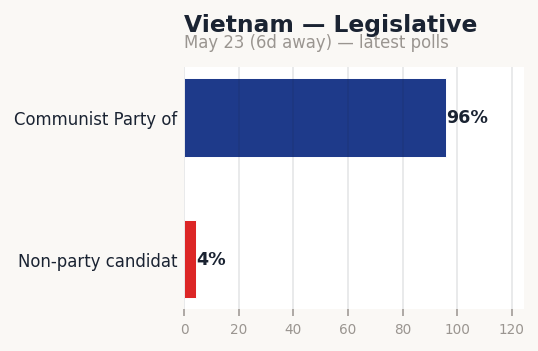
Looking ahead, markets will focus on the Vietnamese National Assembly election scheduled for 23 May, where the Communist Party is expected to secure 95.8% of seats and thereby lock in the current export-led manufacturing and foreign-investment framework. Next week’s US employment data, Australian employment release, and Bank Indonesia decision will provide the next concrete tests of whether the oil-driven inflation pulse persists or fades. We continue to monitor the interaction between energy prices and core measures; any further upside in Brent above 109 would intensify the re-pricing already visible in yields and the dollar.

RoboMacro AI Economic Research

Global Macro Watch

May 17, 2026 robomacro.com
Global Economic Outlook Summary
Consensus forecasts, % change year-on-year. Sources: IMF WEO, OECD, World Bank, national central bank projections. Generated by xAI Grok from public institutional data as of May 17, 2026.
Economy Real GDP (% y/y) Consumer Prices (% y/y)
2026E2027E2028E 2026E 2027E2028E
Americas
United States2.22.12.02.42.32.2
Canada1.81.91.82.12.02.0
Mexico2.02.12.23.53.33.2
Brazil2.32.22.14.03.83.5
Argentina3.53.02.845.025.015.0
Colombia2.82.72.64.53.83.5
Chile2.52.42.33.23.02.8
Peru2.72.62.52.82.62.5
Asia / Pacific
Japan1.00.90.81.81.61.5
China4.54.34.01.81.92.0
India6.56.36.24.54.34.2
Australia2.32.22.12.52.42.3
New Zealand2.02.12.02.32.22.1
South Korea2.22.12.02.02.02.0
Indonesia5.05.15.02.82.72.6
Malaysia4.54.44.32.52.42.3
Philippines5.85.75.63.02.92.8
Singapore2.82.72.62.22.12.0
Thailand2.82.92.81.51.61.7
Taiwan2.52.42.31.81.92.0
Vietnam6.56.46.33.53.43.3
Western Europe
Euro area1.21.31.42.02.02.0
Germany0.81.01.22.12.02.0
France1.11.21.31.91.91.9
Italy0.70.91.02.02.02.0
Spain1.81.71.62.32.22.1
United Kingdom1.31.41.52.22.12.0
Sweden1.81.91.82.02.02.0
Norway1.51.61.52.32.22.1
Denmark1.41.51.42.02.02.0
Switzerland1.21.31.21.01.11.2
Netherlands1.31.41.32.12.02.0
Poland3.23.02.83.53.02.8
Czech Republic2.52.42.32.52.32.2
Hungary2.82.72.64.03.53.2
Romania3.02.92.84.53.83.5
EMEA Emerging
Turkey3.03.23.525.015.010.0
South Africa1.51.82.04.54.34.2
Israel3.53.33.22.52.42.3
Saudi Arabia3.53.33.22.02.02.0
UAE4.03.83.72.02.02.0
Egypt4.04.24.520.015.012.0
Nigeria3.23.53.822.018.015.0
Kenya5.05.25.35.55.04.8
Global Aggregates
Global3.23.33.23.53.33.2
Developed markets1.61.71.72.12.02.0
Emerging markets4.04.14.04.54.24.0
E = estimate/forecast. Sources: IMF WEO, OECD Economic Outlook, World Bank GEP, FOMC SEP, ECB staff projections, national MPRs. Median consensus where sources diverge. Data synthesised by Grok from publicly available institutional forecasts.
RoboMacro AI Economic Research

Global Macro Watch

May 17, 2026 robomacro.com
Global Central Bank Watch
Policy rates and quarterly forecasts as of May 17, 2026. Sources: central bank official releases, OIS market pricing, consensus surveys.
Central Bank Instrument Current
Rate
Last
Change
bp Next
Meeting
Expected
Move
Q1
2026
Q2
2026
Q3
2026
Q4
2026
The Americas
Federal ReserveFed funds upper3.75%Mar 2026-25Jun 17-18Hold4.003.753.503.25
Bank of CanadaO/N rate2.75%Apr 2026-25Jun 3Hold3.002.752.502.50
BCB (Brazil)SELIC10.50%May 2026-25Jun 18-25bp11.0010.5010.009.50
BanxicoO/N rate8.00%Mar 2026-25May 28Hold8.508.007.507.00
BCRA (Argentina)Repo rate40.00%Apr 2026-500Jun 12-500bp50.0040.0035.0030.00
BanRep (Colombia)Repo9.25%Apr 2026-25May 29Hold9.509.258.758.25
BCCh (Chile)MPR5.00%Jan 2026-25Jun 5Hold5.255.004.754.50
Europe / Africa
ECBDepo rate2.50%Apr 2026-25Jun 4Hold2.752.502.252.00
Bank of EnglandBank rate4.00%Feb 2026-25Jun 18Hold4.254.003.753.50
RiksbankRepo rate2.25%Mar 2026-25Jun 25Hold2.502.252.001.75
Norges BankDep rate4.25%Mar 2026-25Jun 18Hold4.504.254.003.75
SNBPolicy rate0.50%Mar 2026-25Jun 19Hold0.750.500.250.00
CNB (Czech)2-wk repo3.50%Feb 2026-25Jun 25Hold3.753.503.253.00
NBH (Hungary)Base rate6.50%Apr 2026-25May 27-25bp6.756.506.005.50
NBP (Poland)Ref rate5.75%Apr 2026-25Jun 4Hold6.005.755.505.25
SARBRepo rate7.50%Jan 20260May 29Hold7.507.507.257.00
CBRT (Turkey)1-wk repo42.50%Apr 2026-250Jun 26-250bp47.5042.5037.5032.50
Asia / Pacific
RBACash rate3.85%Feb 2026-25Jun 3Hold4.103.853.603.35
RBNZOCR3.25%Apr 2026-25May 28Hold3.503.253.002.75
BoJPol rate0.50%Jan 2026+25Jun 18Hold0.250.500.751.00
PBoC1-yr LPR3.10%Sep 20240Jun 20Hold3.103.103.002.90
RBI (India)Repo rate6.25%Feb 20250Jun 4Hold6.256.256.005.75
BoK (Korea)Base rate3.00%Feb 2026-25May 28Hold3.253.002.752.50
BI (Indonesia)BI-Rate5.75%Apr 2026-25Jun 18Hold6.005.755.505.25
BSP (Philippines)Rev repo5.75%Apr 2026-25Jun 26Hold6.005.755.505.25
BoT (Thailand)1-day repo1.75%Apr 2026-25Jun 25Hold2.001.751.501.25
CBC (Taiwan)Disc rate2.00%Mar 2026-12.5Jun 18Hold2.1252.001.8751.75
MAS (Singapore)SGD NEER0% slope%Apr 20250Jul 2026Hold0% slope0% slope0% slope0% slope
Rate forecasts: OIS market pricing + central bank forward guidance + consensus surveys. Generated by xAI Grok from publicly available sources. Shaded rows denote regional groupings. Data as of May 17, 2026.
RoboMacro AI Economic Research

Global Macro Watch

May 17, 2026 robomacro.com
Markets in ReviewRates & Fixed Income
Rates & Fixed Income Chart 1
Rates & Fixed Income Chart 2
Rates & Fixed Income Chart 3
Rates & Fixed Income Chart 4

Week in Review

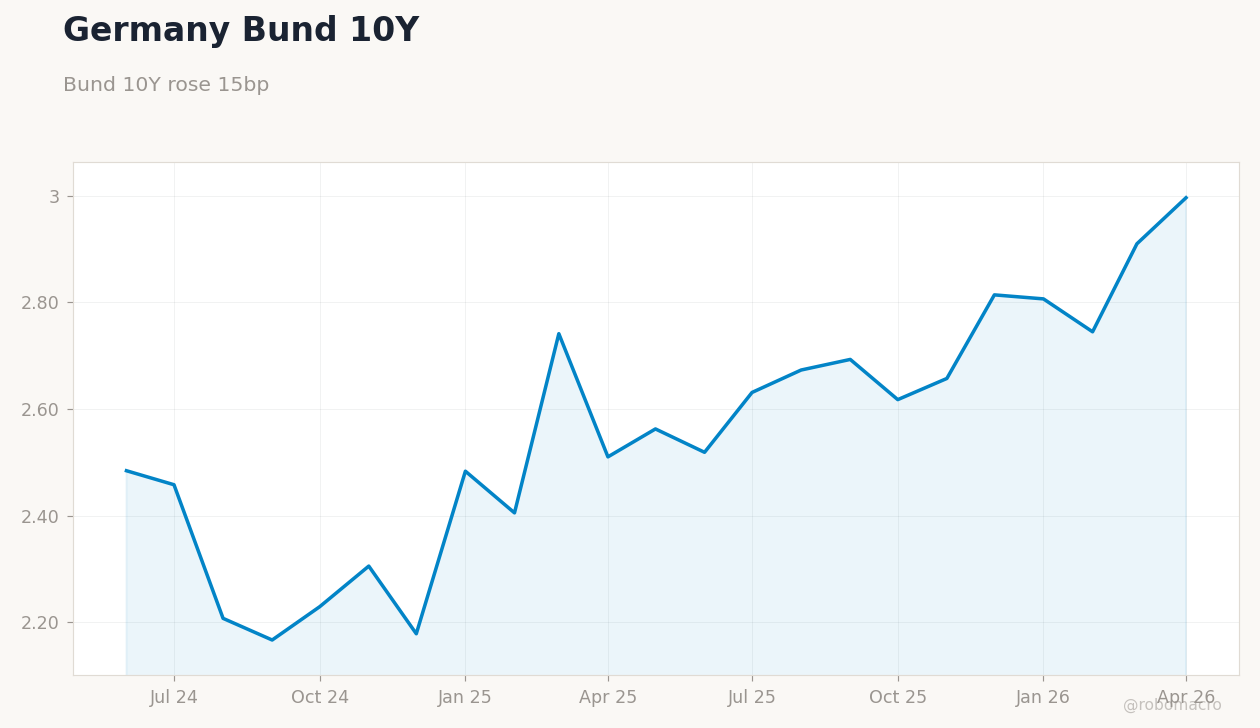
U.S. Treasury yields led the move higher in DM rates this week with the 10-year rising 23bp to 4.59%. The intra-week path showed limited movement until Friday's surge, as the yield rose from 4.4610 on Thursday to close at 4.5950. The 30-year yield similarly increased 18bp to 5.13%. UK 10-year Gilt yields rose 26bp to 5.18% while German 10-year Bund yields climbed 15bp to 3.15%. Japanese 10-year yields increased 23bp to 2.70%. This broad-based increase occurred alongside equity weakness and persistent inflation concerns.

Curve & Spreads

The U.S. 2s10s spread stands at +34bp, narrower than Germany's +43bp and the UK's +62bp. These positively sloped curves imply expectations of solid growth ahead as investors require additional yield for longer maturities. The steeper UK curve compared to the U.S. suggests relatively stronger growth expectations in the UK. Similar patterns in Germany reinforce this directional view on economic prospects.

EM Bonds

In EM, yields traded at much higher levels than in DM. Brazil's 10-year yield stands at 14.46% and Turkey's at 35.08% after the latter moved significantly higher. South Africa's 10-year yield is at 8.81%, Mexico's at 9.32% and Indonesia's at 6.71%. These compare to DM yields such as 4.59% in the U.S. and 3.15% in Germany, pointing to wide spread differentials. Turkey's 2s10s spread remains deeply inverted at -770bp.

Central Bank Read

Curve shapes suggest differing policy biases. In the U.S. the 2-year yield rose 24bp versus 23bp for the 10-year, implying a limited shift but overall neutral stance. Japan's limited front-end move of just 4bp against 23bp in the 10-year implies an easing bias. The UK saw its 10-year rise 26bp versus 18bp in the 2-year, a steepening that implies an easing bias. German front-end yields rose 13bp while 10-year rose 15bp, suggesting balanced policy expectations. Central banks continue to stress data dependence following this week's inflation and growth surprises.

Week Ahead

The economic calendar for the coming week is light with no major CPI or inflation prints, payrolls or jobs data, or central bank meetings listed. Treasury auctions will still require attention given the recent rise in yields to assess demand at these levels. Any unexpected releases could nonetheless sway duration risk. Markets will remain focused on how such events might influence the recent upward move in yields.

RoboMacro AI Economic Research

Global Macro Watch

May 17, 2026 robomacro.com
Markets in ReviewFixed Income
Global Government Bond Yields
Yields in %. WoW change in basis points. Source: CBOE/yfinance (US), FinanceFlowAPI (international).
Country2Y2Y WoW10Y10Y WoW30Y30Y WoW2s10s
United States4.26%+24bp4.59%+23bp5.13%+18bp+34bp
United Kingdom4.56%+18bp5.18%+26bp5.85%+27bp+62bp
Germany2.73%+13bp3.15%+15bp3.67%+12bp+43bp
France2.93%+20bp3.80%+18bp4.65%+15bp+87bp
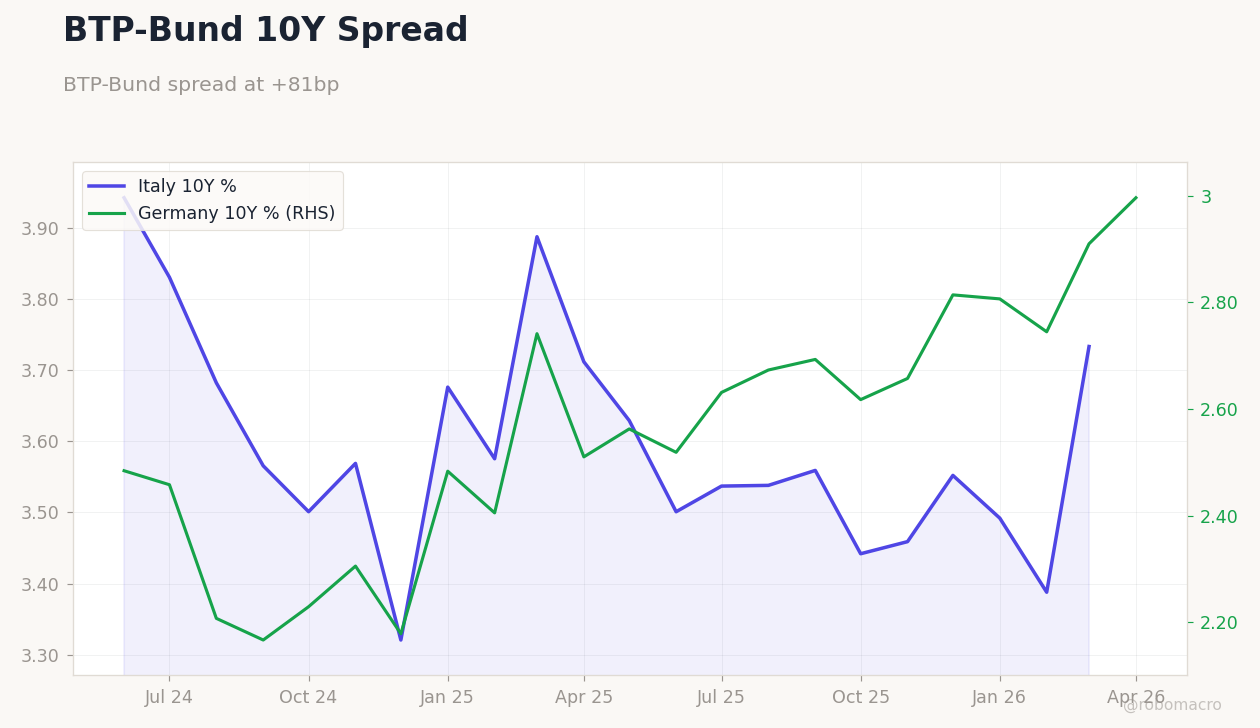
Italy2.95%+18bp3.96%+23bp4.75%+18bp+101bp
Spain2.83%+14bp3.61%+20bp4.33%+16bp+78bp
Japan1.41%+4bp2.70%+23bp4.00%+28bp+129bp
Canada3.06%+20bp3.69%+22bp4.02%+16bp+63bp
Australia4.79%+12bp5.12%+15bp5.51%+7bp+33bp
China1.27%-1bp1.75%-1bp2.25%-4bp+48bp
India6.47%+22bp7.09%+13bp7.66%+13bp+62bp
Brazil14.03%+50bp14.46%+56bp+43bp
Mexico9.32%+25bp
South Korea3.62%+16bp4.25%+34bp4.18%+34bp+63bp
Indonesia6.71%+1bp6.87%-0bp
Turkey42.78%+207bp35.08%+142bp-770bp
South Africa8.81%+18bp9.40%+20bp
Poland5.95%+34bp

US Treasury yields rose sharply, with the 2Y up 24bp to 4.26% and the 10Y gaining 23bp to 4.59%. Turkey led the moves, its 2Y surging 207bp to 42.78% and 10Y climbing 142bp to 35.08%. UK 10Y yields advanced 26bp to 5.18%, while Japan’s 30Y increased 28bp to 4.00%. Germany’s 10Y rose a more modest 15bp to 3.15%, highlighting core-periphery divergence as Italy’s 2s10s widened to +101bp. China eased in contrast, its 10Y slipping 1bp to 1.75%. Brazil’s 10Y jumped 56bp to 14.46%, amplifying EM pressure. Curve steepening was widespread, with South Korea’s 2s10s reaching +63bp. Next week’s focus is on US CPI and potential BoE signals that may extend the repricing.

RoboMacro AI Economic Research

Global Macro Watch

May 17, 2026 robomacro.com
Markets in ReviewGlobal Equities
Global Equities Chart 1
Global Equities Chart 2
Global Equities Chart 3
Global Equities Chart 4

Week in Review

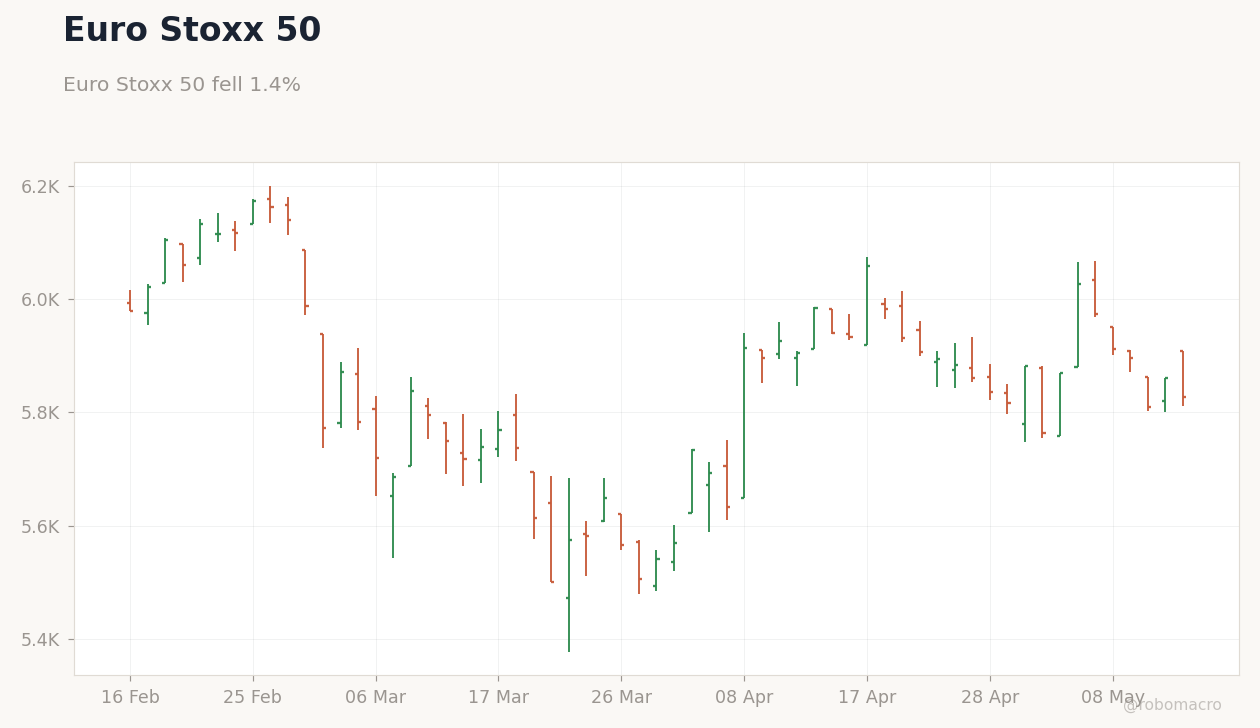
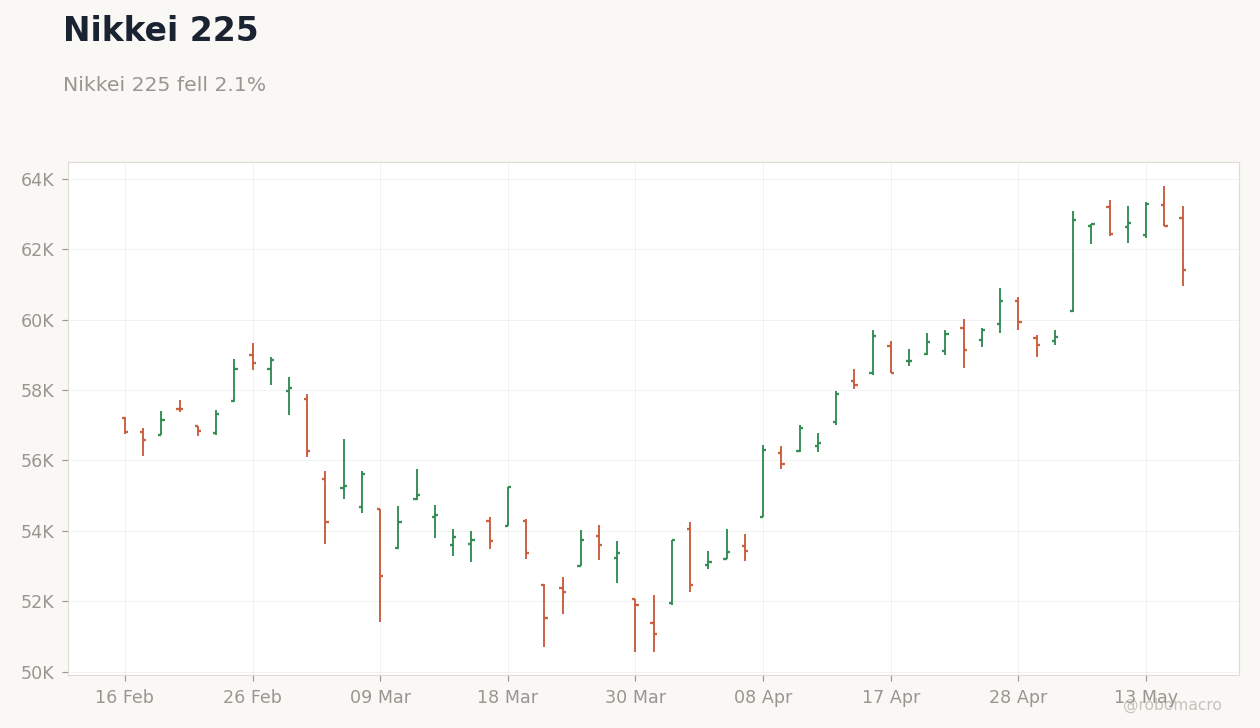
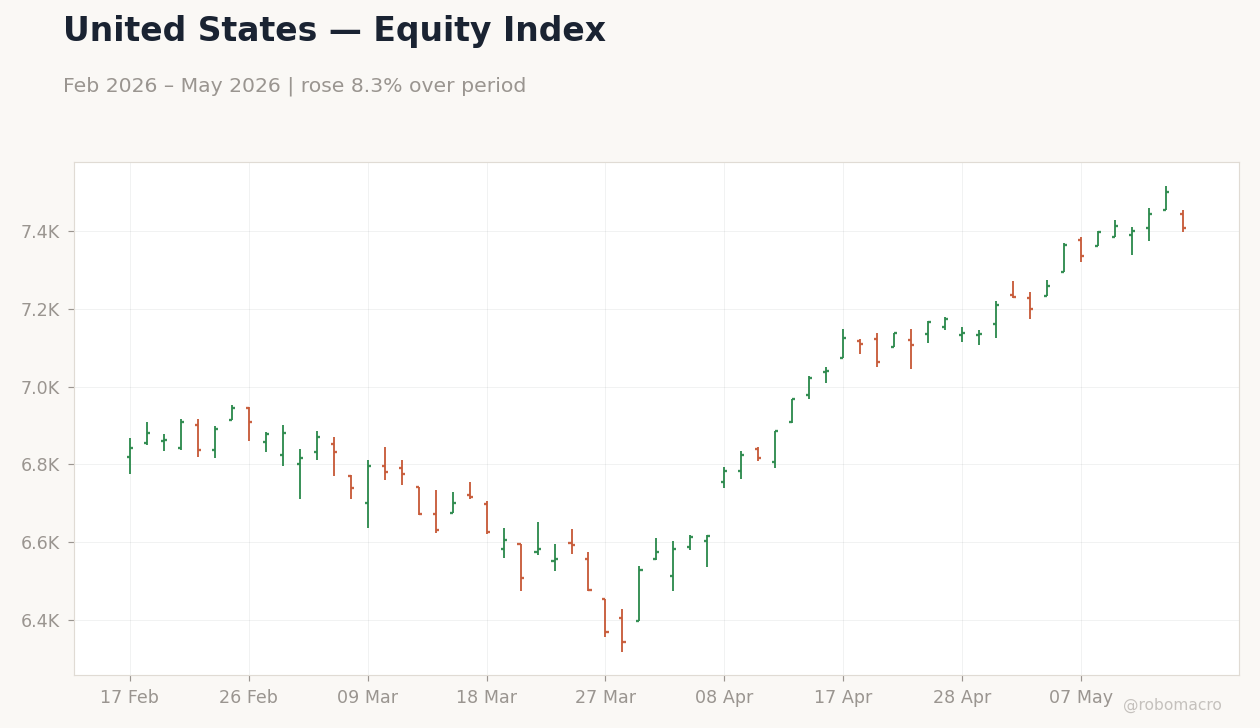
The S&P 500 rose +0.1% on the week to close at 7,408. The index started at 7,413 on Monday, fell to 7,401 on Tuesday, recovered to 7,444 on Wednesday, climbed to 7,501 on Thursday, and pulled back to finish at 7,408 on Friday. In Europe the Euro Stoxx 50 fell -1.4% to 5,828 after moving from 5,895 on Monday to 5,808 on Tuesday, rebounding to 5,861 on Wednesday, and settling at 5,828 on Friday. Asian equities weakened as the Nikkei 225 declined -2.1% to 61,409 after trading at 62,418 on Monday and reaching 63,272 on Wednesday before closing lower on Friday. Emerging market indices posted larger losses with the Russell 2000 down -2.4% to 2,793, Ibovespa falling -3.7% to 177,284, IPC Mexico declining -2.7% to 67,976, and JSE Top 40 dropping -4.4% to 6,890.

Regional Divergences

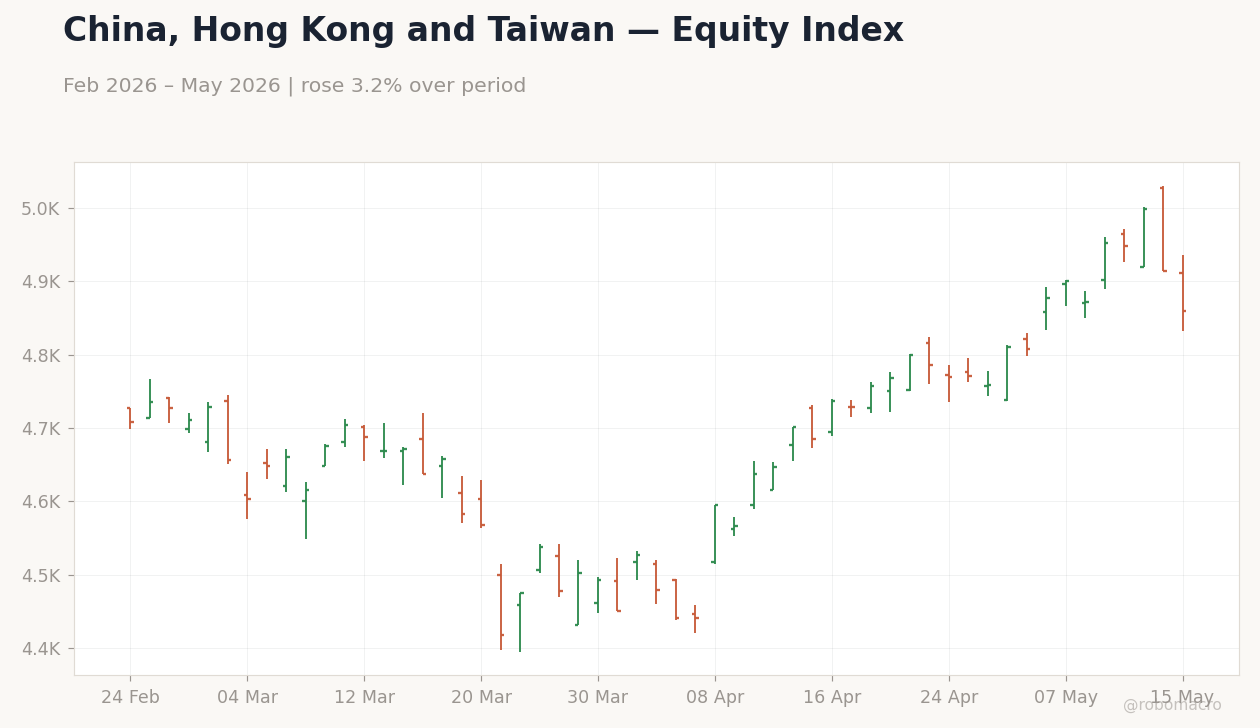
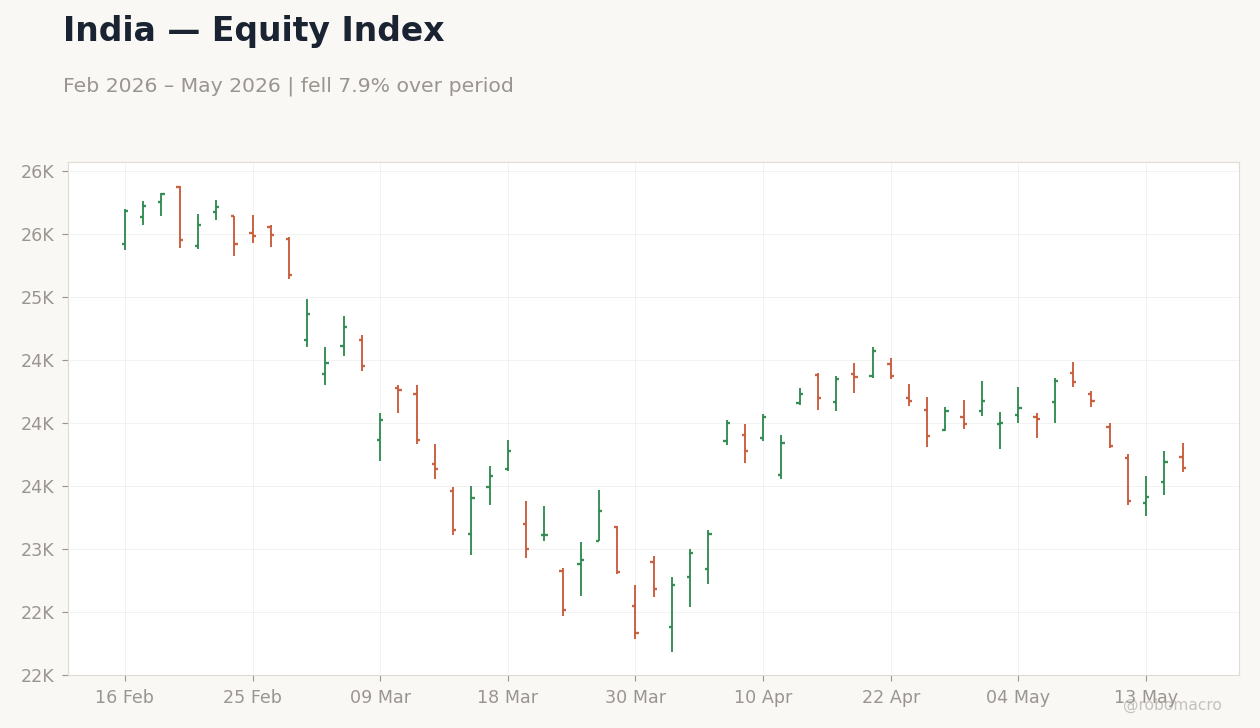
US equities proved most resilient with the S&P 500 up +0.1% and Dow Jones down only -0.2%. This stood in contrast to Europe where the Euro Stoxx 50 fell -1.4%, DAX -1.6%, CAC 40 -2.0%, and FTSE 100 -0.4%. Asian benchmarks also lagged with the Nikkei 225 down -2.1%, Hang Seng -1.6%, and CSI 300 nearly unchanged at -0.2%. Emerging markets underperformed further as seen in the Nifty 50 -2.2%, S&P/ASX 200 -1.3%, and Ibovespa -3.7%. These divergences aligned with macro catalysts including US CPI and PPI exceeding forecasts which lifted yields and tempered risk appetite, ZEW Economic Sentiment surpassing expectations in Europe, failed yen interventions in Japan, and softening Canadian labor data that weighed on regional sentiment.

Volatility & Risk Appetite

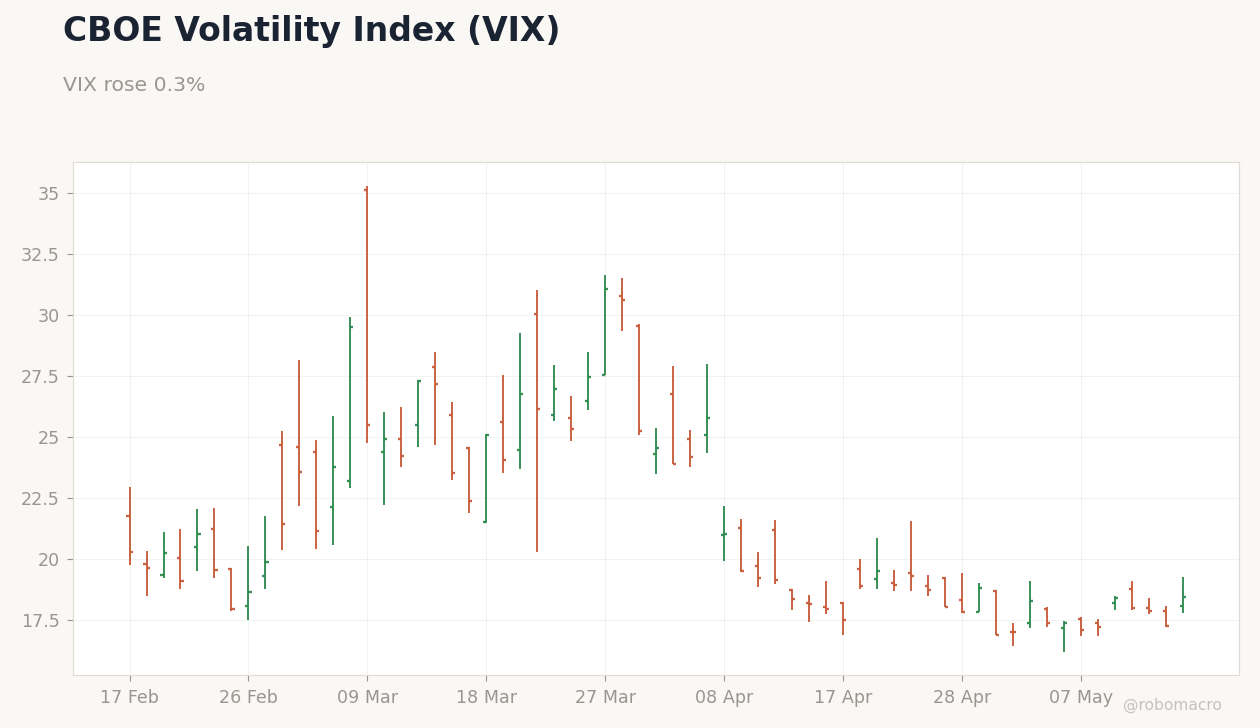
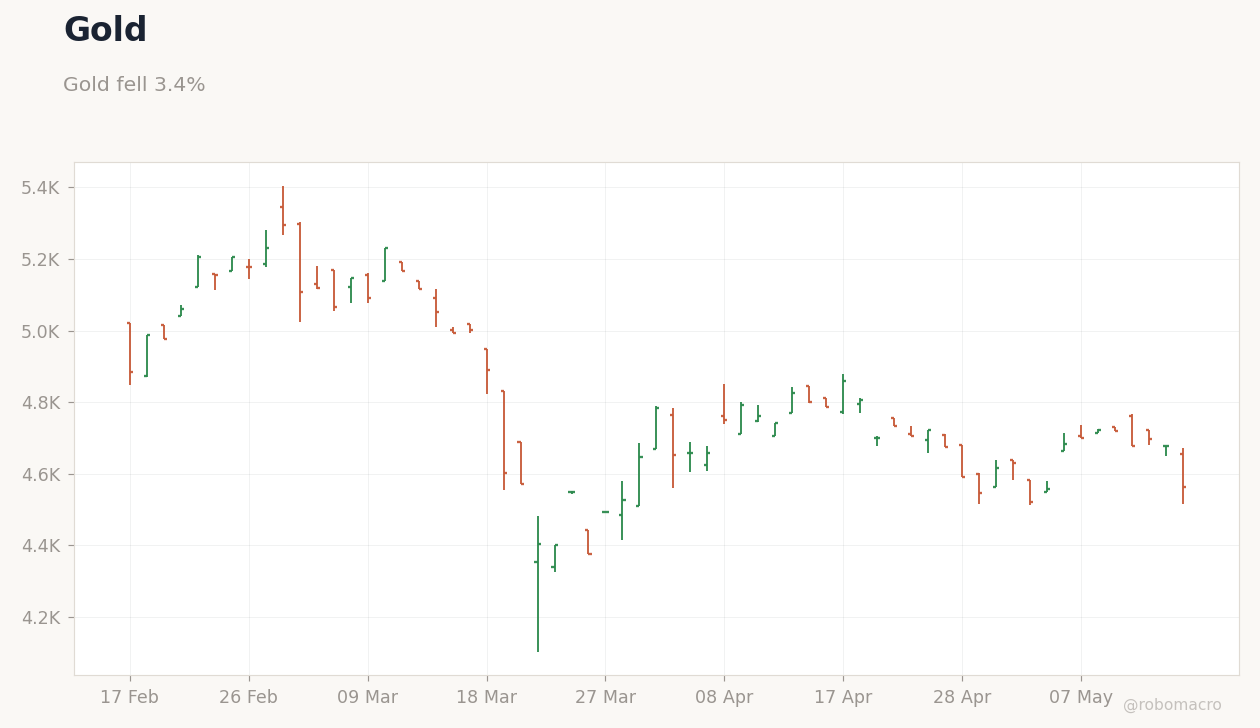
The VIX closed the week at 18.4 after reaching an intra-week low of 17.3 on Thursday. Growth underperformed value with the Nasdaq 100 down -0.4% versus the Dow Jones -0.2%. Small caps lagged large caps as the Russell 2000 fell -2.4% against the S&P 500 +0.1%. Sector signals reflected strength in commodities where WTI Crude rose +5.9% to 101.02 and Brent Crude rose +7.9% to 109.26, supporting energy names, while broad increases in government bond yields pressured rate-sensitive sectors. Declines in precious metals with Gold down -3.4% to 4561.90 and Silver down -3.5% to 77.55 added to the mixed risk appetite.

Week Ahead

The week ahead features limited high impact releases on the economic calendar. Investors will nonetheless watch for PMI releases and any GDP prints across major economies for fresh growth signals. Earnings reports from prominent companies are also due and could sway market direction depending on results. Should inflation data or central bank communications reinforce rate hike fears, these events would pose the biggest risk to equity markets and likely favour risk-off positioning.

RoboMacro AI Economic Research

Global Macro Watch

May 17, 2026 robomacro.com
Markets in ReviewGlobal Equities
Global Equity Indices
Week-on-week, month-to-date, year-to-date. Source: Yahoo Finance.
IndexLevelWoWMTDYTD
S&P 5007,408+0.1%+2.5%+8.0%
Nasdaq 10029,125-0.4%+5.1%+15.6%
Dow Jones49,526-0.2%+0.1%+2.4%
Russell 20002,793-2.4%-0.7%+11.4%
S&P/TSX33,833-0.7%-0.2%+6.1%
FTSE 10010,195-0.4%-1.6%+2.5%
Euro Stoxx 505,828-1.4%+1.1%-1.6%
DAX23,951-1.6%-0.2%-2.4%
CAC 407,953-2.0%-0.3%-3.0%
FTSE MIB49,116-0.3%+3.5%+8.2%
IBEX 3517,623-1.5%+1.5%+0.7%
Nikkei 22561,409-2.1%+3.2%+18.5%
Hang Seng25,963-1.6%-0.5%-1.4%
CSI 3004,860-0.2%-0.4%+3.0%
S&P/ASX 2008,631-1.3%-1.1%-1.1%
KOSPI7,493-0.1%+8.0%+73.9%
Nifty 5023,644-2.2%-2.0%-9.6%
Ibovespa177,284-3.7%-4.5%+10.4%
IPC Mexico67,976-2.7%+1.0%+6.0%
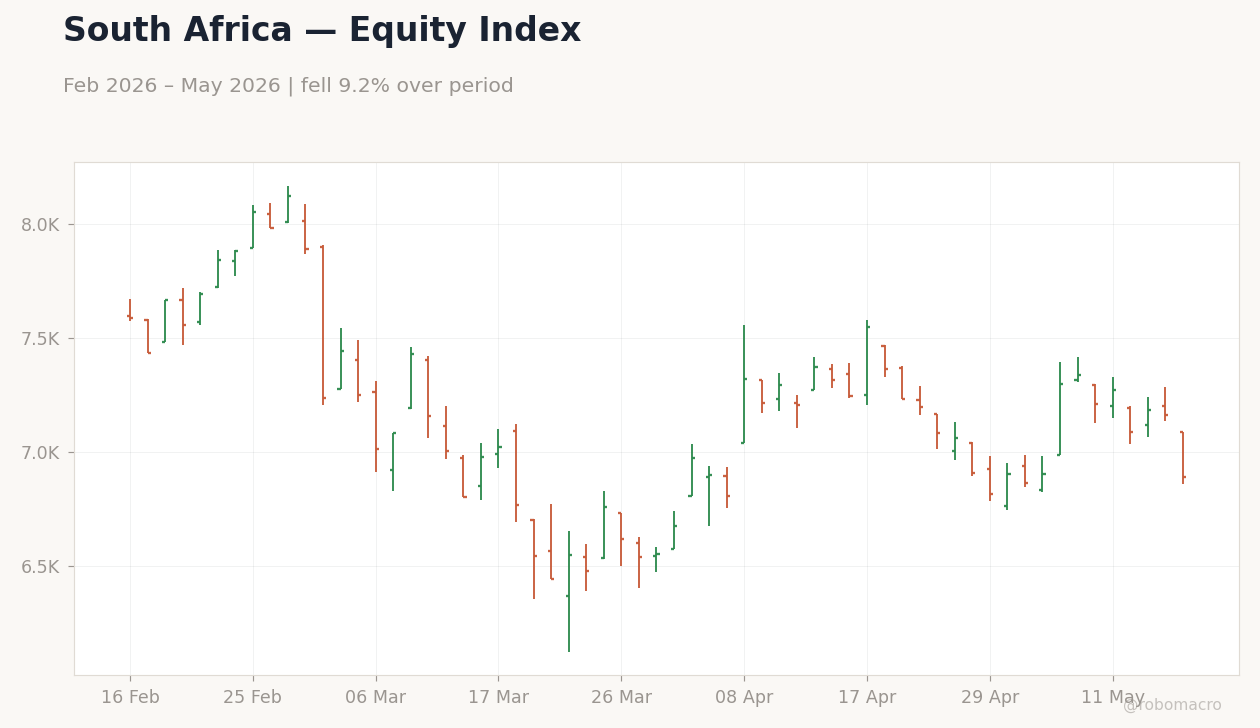
JSE Top 406,890-4.4%+0.4%-2.4%

Global equities closed mixed, with the S&P 500 edging up 0.1% while the Russell 2000 fell 2.4%. The JSE Top 40 led declines, dropping 4.4%, followed by the Ibovespa which slid 3.7%. European benchmarks underperformed, as the CAC 40 lost 2.0% and the DAX declined 1.6%, contrasting with the FTSE MIB which eased just 0.3%. In Asia, the Nikkei 225 fell 2.1% and the Hang Seng dropped 1.6%, while the KOSPI held nearly flat at minus 0.1%. Small-cap and emerging-market indices diverged from large-cap US names amid rotation and risk-off flows. Next week, attention turns to fresh inflation data and central-bank speeches for further direction.

Equity Performance Heat Map
IndexWoWMTDYTD
S&P 500+0.1%+2.5%+8.0%
Nasdaq 100-0.4%+5.1%+15.6%
Dow Jones-0.2%+0.1%+2.4%
Russell 2000-2.4%-0.7%+11.4%
S&P/TSX-0.7%-0.2%+6.1%
FTSE 100-0.4%-1.6%+2.5%
Euro Stoxx 50-1.4%+1.1%-1.6%
DAX-1.6%-0.2%-2.4%
CAC 40-2.0%-0.3%-3.0%
FTSE MIB-0.3%+3.5%+8.2%
IBEX 35-1.5%+1.5%+0.7%
Nikkei 225-2.1%+3.2%+18.5%
Hang Seng-1.6%-0.5%-1.4%
CSI 300-0.2%-0.4%+3.0%
S&P/ASX 200-1.3%-1.1%-1.1%
KOSPI-0.1%+8.0%+73.9%
Nifty 50-2.2%-2.0%-9.6%
Ibovespa-3.7%-4.5%+10.4%
IPC Mexico-2.7%+1.0%+6.0%
JSE Top 40-4.4%+0.4%-2.4%
RoboMacro AI Economic Research

Global Macro Watch

May 17, 2026 robomacro.com
Markets in ReviewFX & Digital Assets
FX & Digital Assets Chart 1
FX & Digital Assets Chart 2
FX & Digital Assets Chart 3
FX & Digital Assets Chart 4

Week in Review

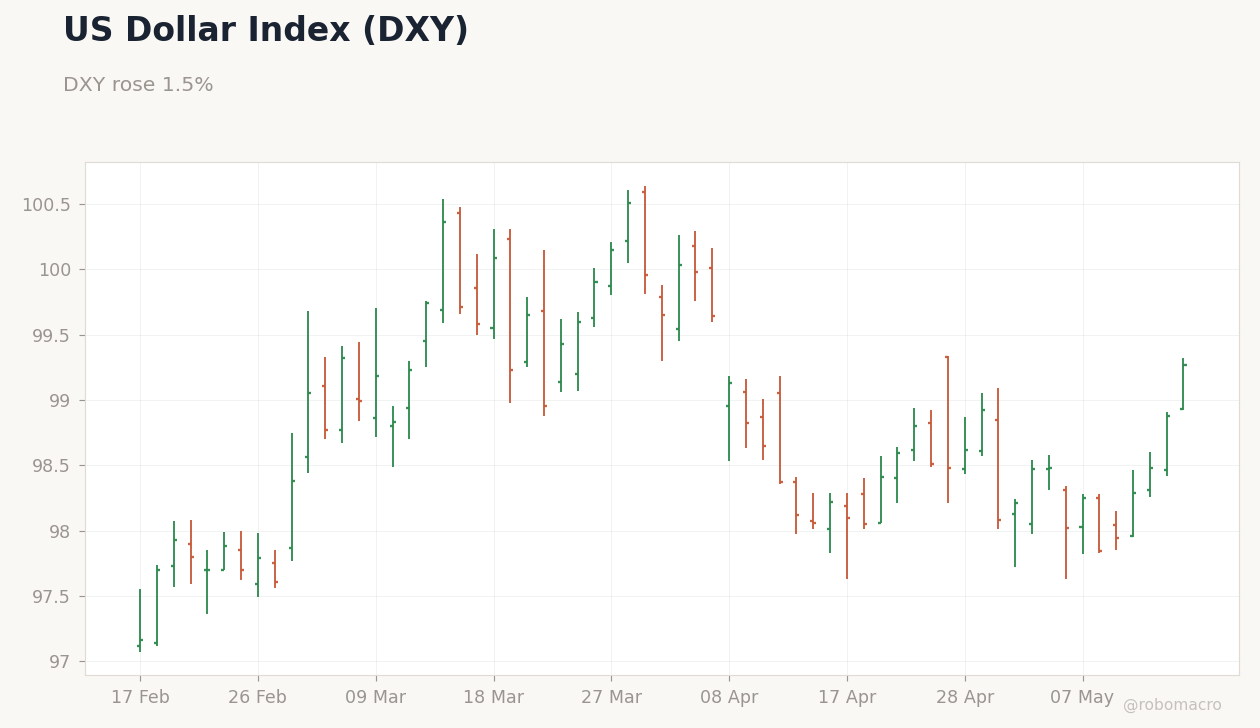
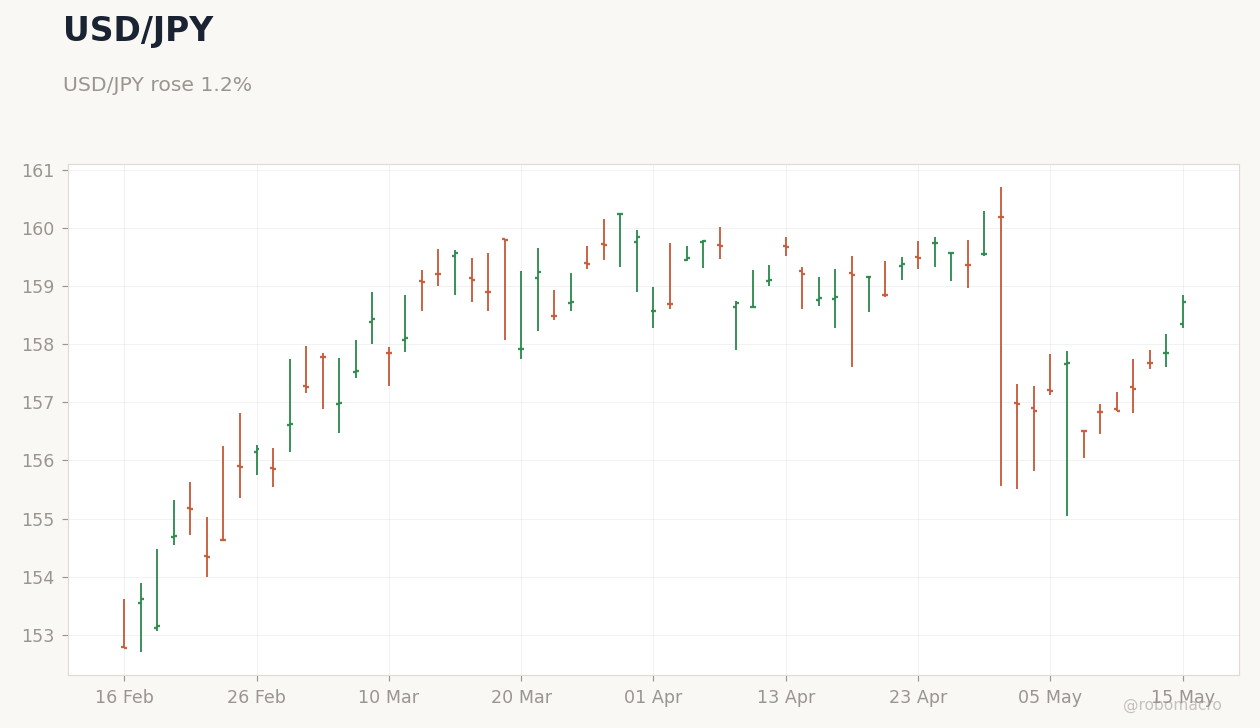
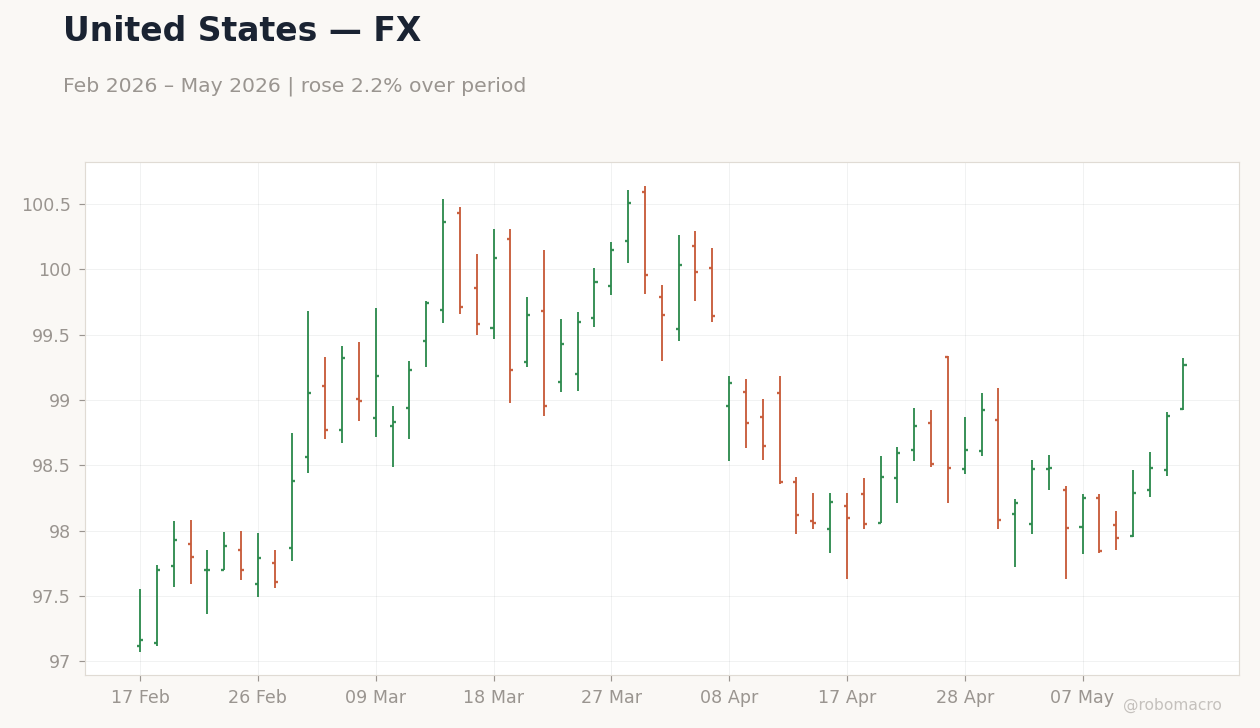
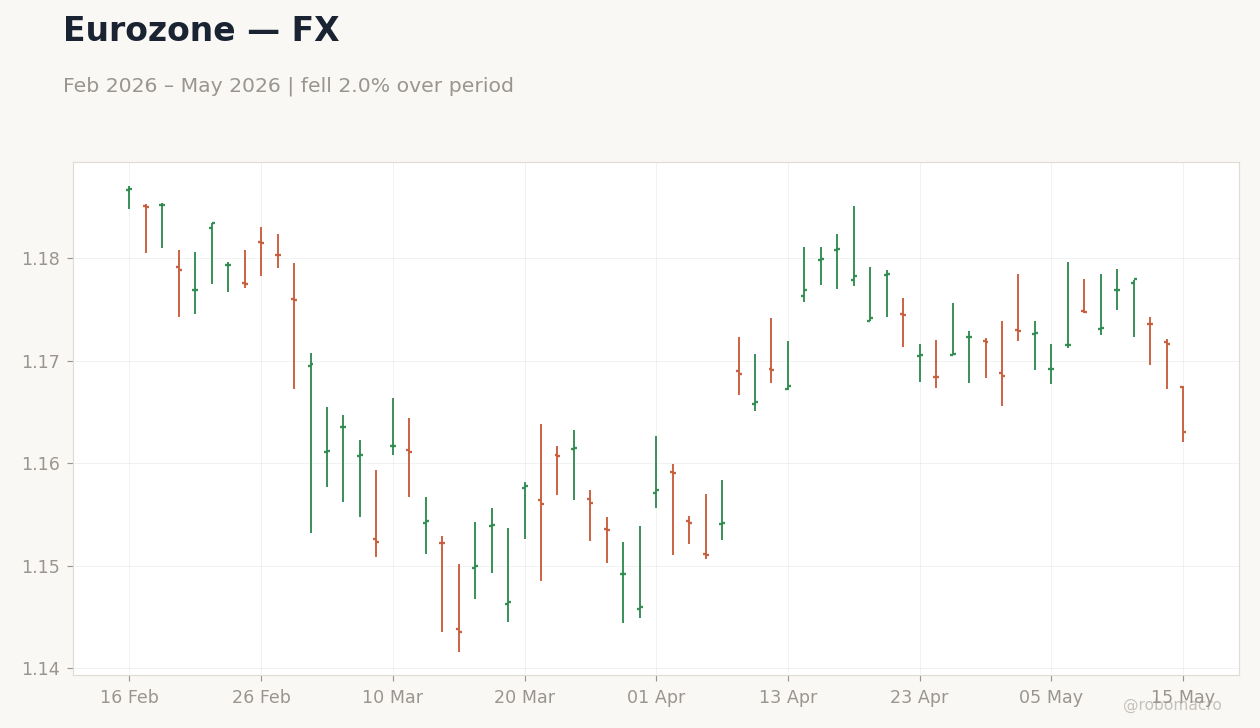
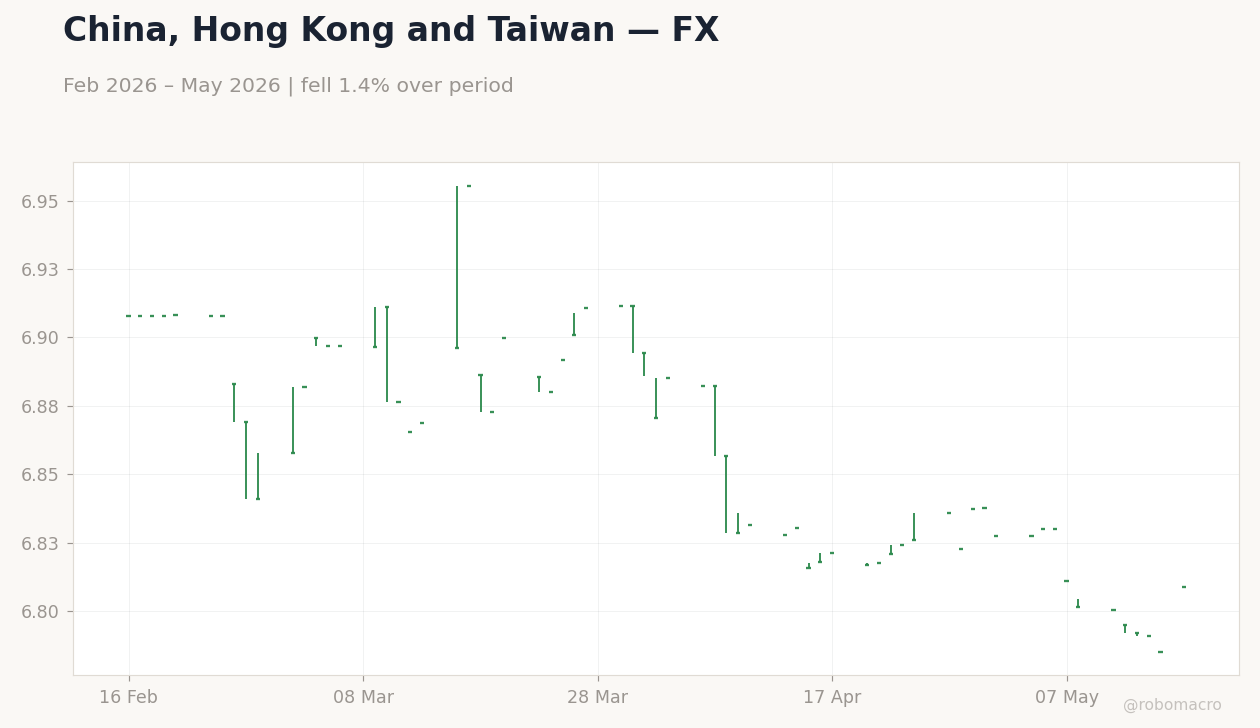
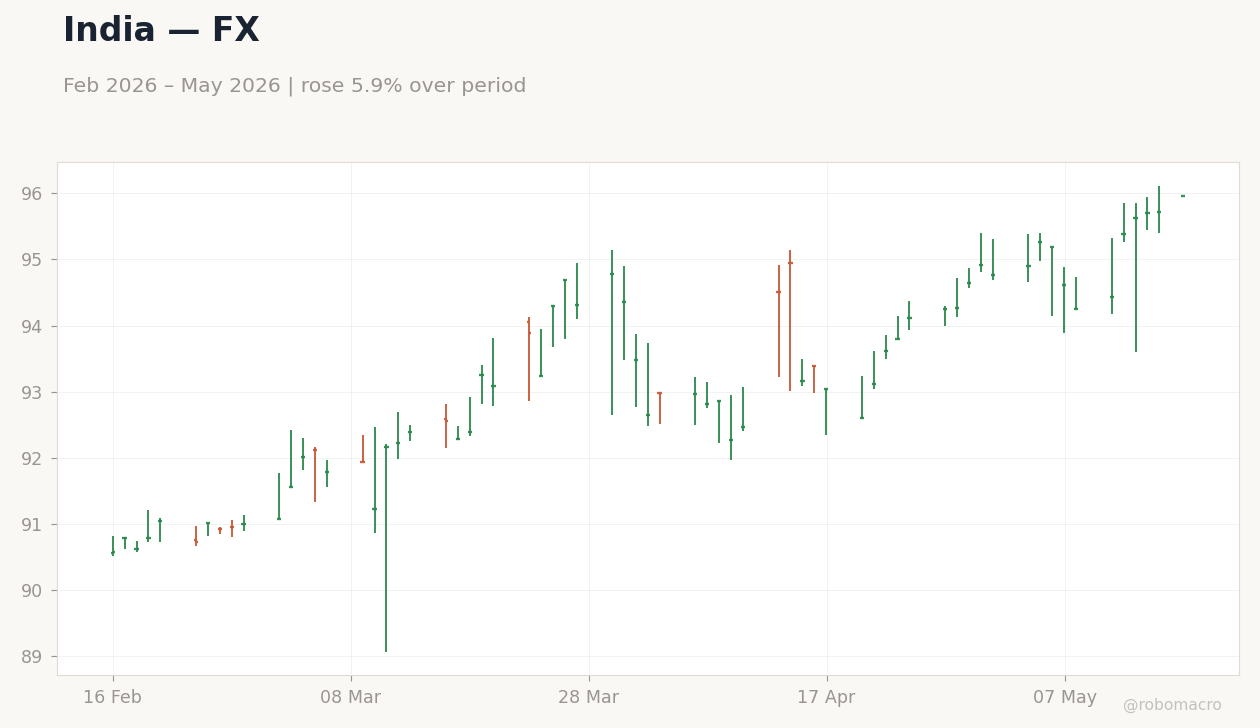
The DXY rose 1.5% on the week to 99.27. The index moved higher through the week, closing at 98.3 on Tuesday, 98.5 on Wednesday, 98.9 on Thursday and 99.3 on Friday. Among G10 currencies, EUR/USD declined 0.9% to 1.1631, GBP/USD fell 2.0% to 1.3326, USD/JPY gained 1.2% to 158.73, AUD/USD fell 1.2% to 0.7153 and NZD/USD dropped 1.9% to 0.5840. USD/CAD rose 0.5% to 1.3747, USD/CHF advanced 1.1% to 0.7860 and USD/CNY gained 0.1% to 6.8087. In EM FX, USD/BRL surged 3.2% to 5.0693, USD/INR rose 1.6% to 95.95, USD/ZAR gained 1.6% to 16.68, USD/MXN increased 0.6% to 17.32 and USD/TRY rose 0.3% to 45.49.

Dollar & G10

DXY strength reflected widening rate differentials as United States 2Y yields rose 24bp and 10Y yields rose 23bp while the 2s10s widened to +34bp. German 2Y yields rose 13bp and Japanese 2Y yields rose 4bp with Japan 2s10s reaching +129bp, reinforcing dollar bid. EUR/USD fell 0.9% week-over-week to close at 1.1631 after trading at 1.1769 on Monday and 1.1780 on Tuesday before declining steadily through Friday. GBP/USD dropped 2.0% to 1.3326 with daily closes showing a fall from 1.3605 on Tuesday to 1.3391 on Friday. USD/JPY rose 1.2% to 158.73, advancing from 157 on Monday and Tuesday to 159 on Friday.

EM FX

EM currencies weakened selectively against the dollar. USD/BRL surged 3.2% to 5.0693 alongside Brazil 2Y yields rising 50bp and Brazil 10Y yields rising 56bp. USD/MXN rose 0.6% to 17.32 while Mexico 10Y yields rose 25bp. USD/ZAR gained 1.6% to 16.68 and USD/TRY rose 0.3% to 45.49 even as Turkey 2Y yields rose 207bp and Turkey 10Y yields rose 142bp. USD/CNY was little changed, up 0.1% at 6.8087. These moves occurred against a backdrop of shifting bond yield differentials across emerging markets and divergent commodity performance that affected export revenues in Brazil and Mexico.

Bitcoin & Crypto

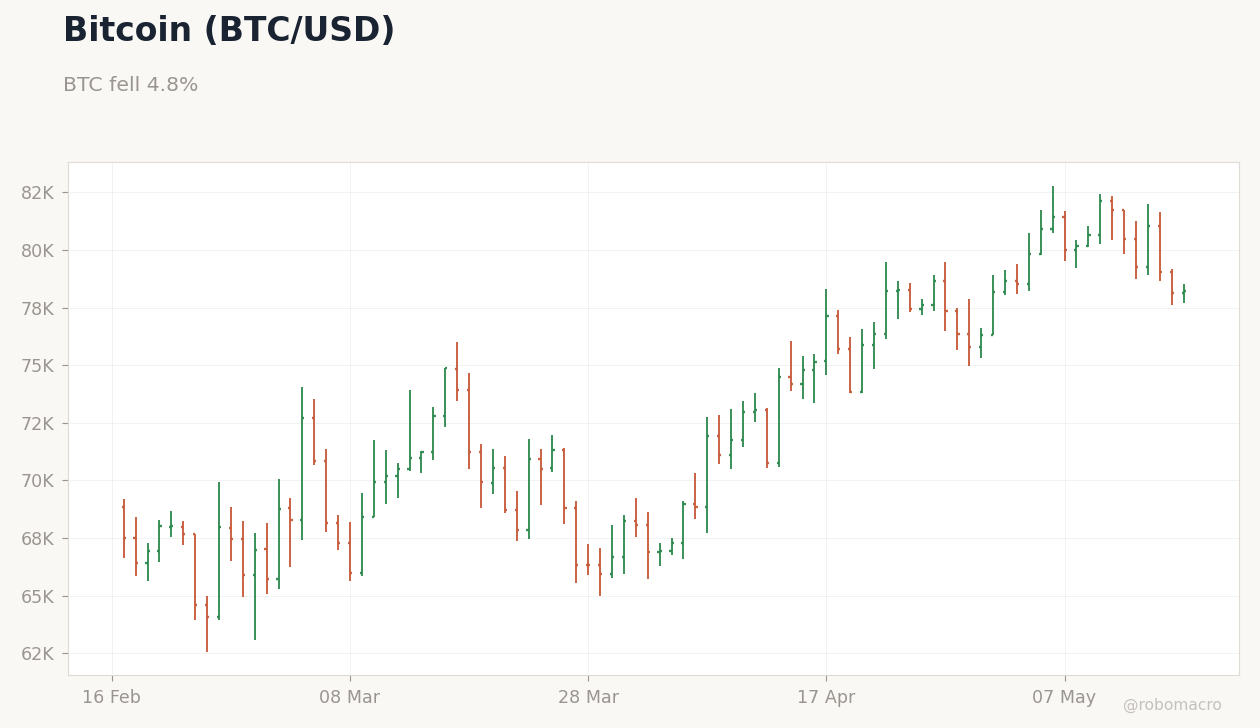
Bitcoin fell 4.8% on the week to $78,230. The cryptocurrency rose from 79,277 on Wednesday to 81,051 on Thursday before reversing to 79,066 on Friday and 78,131 on Saturday. Ethereum declined 7.6% to $2,188. Solana dropped 10.3% to $86 and XRP fell 3.9% to $1. Digital assets faced pressure amid institutional views on Bitcoin and other crypto-assets together with broader risk-off flows evident in equity and EM FX moves.

Week Ahead

With no central bank rate decisions or CPI releases listed on next week’s calendar, attention will remain on any shifts in rate differentials that could influence G10 and EM FX. Trade balance data for EM countries may offer direction for pairs such as USD/MXN and USD/BRL. Crypto markets will monitor regulatory sentiment and any protocol or on-chain developments. Overall positioning appears data-dependent with focus on how global yield moves affect dollar and Bitcoin correlation.

RoboMacro AI Economic Research

Global Macro Watch

May 17, 2026 robomacro.com
Markets in ReviewCommodities
Commodities Chart 1
Commodities Chart 2
Commodities Chart 3
Commodities Chart 4

Week in Review

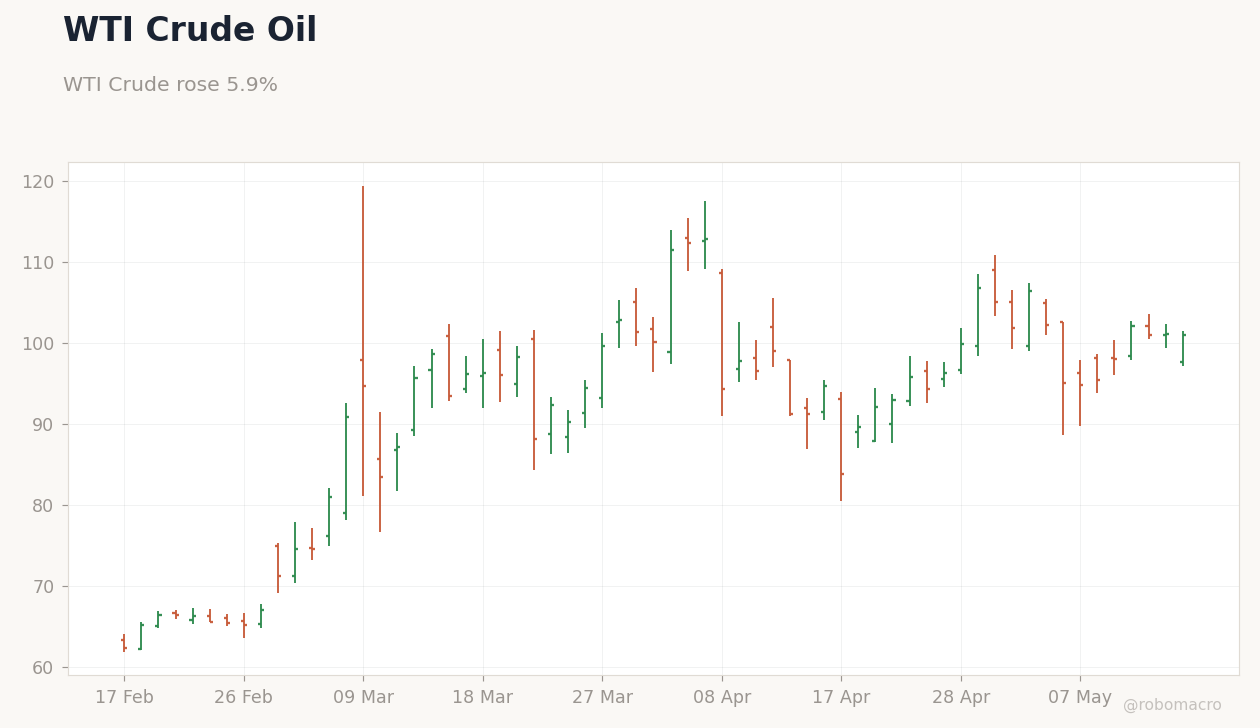
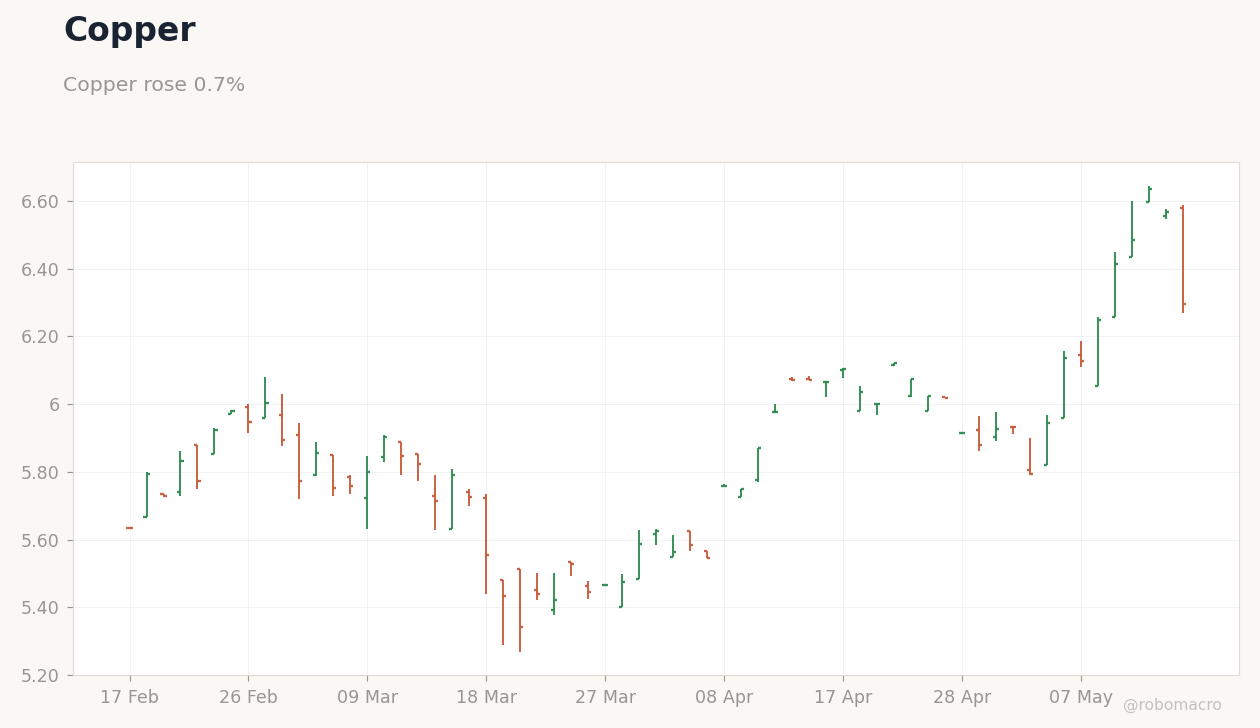
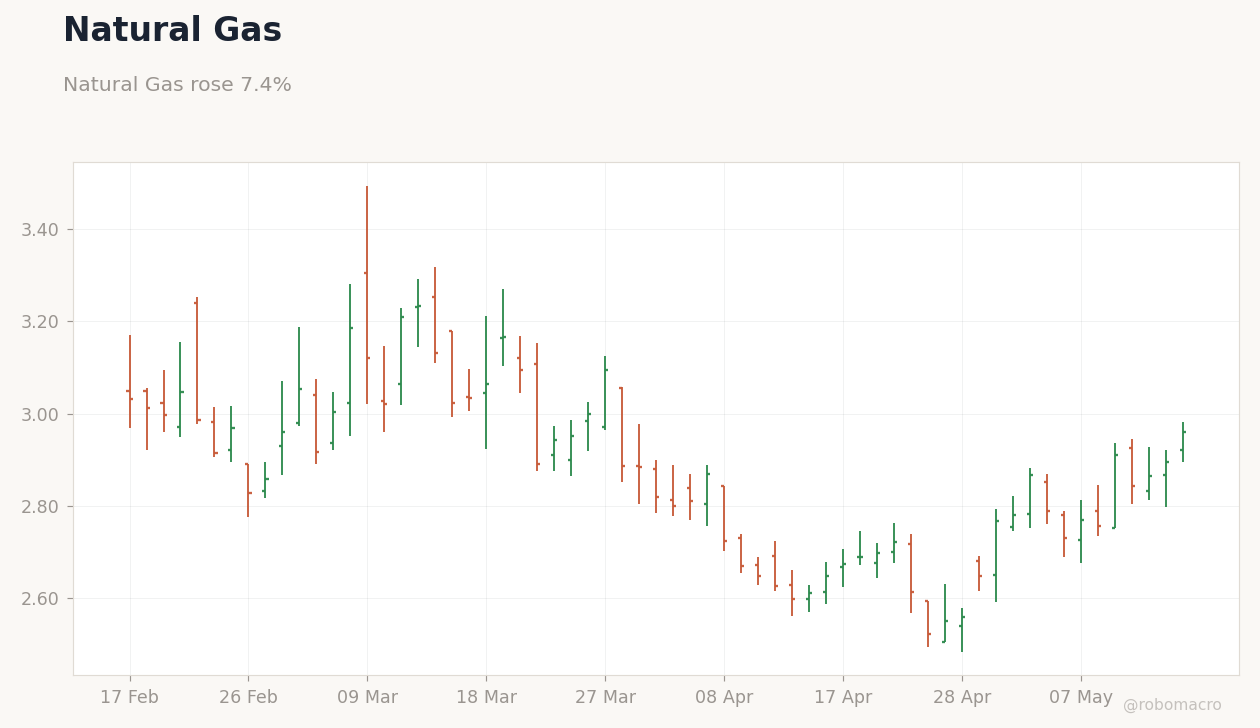
Brent Crude was the biggest mover, rising 7.9% week-over-week to 109.26. WTI Crude advanced 5.9% to 101.02, trading at 102 on Tuesday before closing at 101 on Wednesday, Thursday, and Friday. Natural Gas rose 7.4% to 2.96, with daily closes showing consistent gains from 2.8430 on Tuesday to 2.8640 on Wednesday, 2.8940 on Thursday, and 2.9600 on Friday. Gold fell 3.4% to 4561.90, climbing from 4,678 on Tuesday to 4,698 on Wednesday before reversing to 4,678 on Thursday and dropping sharply to 4,562 on Friday. Silver declined 3.5% to 77.55 while Copper gained 0.7% to 6.29 after reaching 6.6355 mid-week. Wheat rose 4.7% to 635.75, underscoring broad strength across energy and agriculture amid an oil crisis narrative and inflation pressures.

Energy Complex

WTI Crude settled at 101.02 after rising 5.9% on the week while Brent Crude climbed 7.9% to 109.26. Both grades drew support from geopolitical tensions and fuel hike concerns that kept upward pressure on the complex. Natural Gas rose 7.4% to 2.96, extending its recovery as inventories and demand dynamics remained supportive. OPEC and broader supply diplomacy stayed in focus as markets weighed longer-term balances against near-term disruptions. The advance occurred alongside broader inflation themes that reinforced commodity resilience.

Metals & Ags

Gold declined to 4561.90, down 3.4% week-over-week, while Silver fell 3.5% to 77.55, pushing the gold-silver ratio higher. Copper rose 0.7% to 6.29 after intra-week highs near 6.6355, offering a modestly positive growth signal despite mixed global equity performance. Wheat advanced 4.7% to 635.75, reflecting weather-related supply worries and demand for staples. The metals retreat aligned with a stronger dollar and shifting real-yield expectations even as industrial metals held near recent ranges. Iron Ore was little changed at 110.77, down 0.1% on the week.

Week Ahead

The economic calendar for next week contains no commodity-relevant events, with no EIA crude or gas inventories, no OPEC meetings, no China PMI or industrial production releases, no US CPI, and no central-bank meetings that directly affect commodity currencies such as CAD, AUD, or BRL. In the absence of scheduled catalysts, attention will turn to non-calendar risks including geopolitical developments, weather patterns across key agricultural regions, and potential OPEC diplomacy. Any escalation in oil-market tensions could extend recent energy gains while shifts in growth expectations may weigh on Copper. Participants will also monitor dollar moves and inflation narratives for their impact on Gold.

RoboMacro AI Economic Research

Global Macro Watch

May 17, 2026 robomacro.com
Markets in ReviewFX, Commodities & Crypto
Foreign Exchange
PairLevelWoWMTDYTD
DXY99.27+1.5%+1.1%+0.9%
EUR/USD1.1631-0.9%-0.8%-1.0%
GBP/USD1.3326-2.0%-2.0%-1.1%
USD/JPY158.73+1.2%+1.1%+1.3%
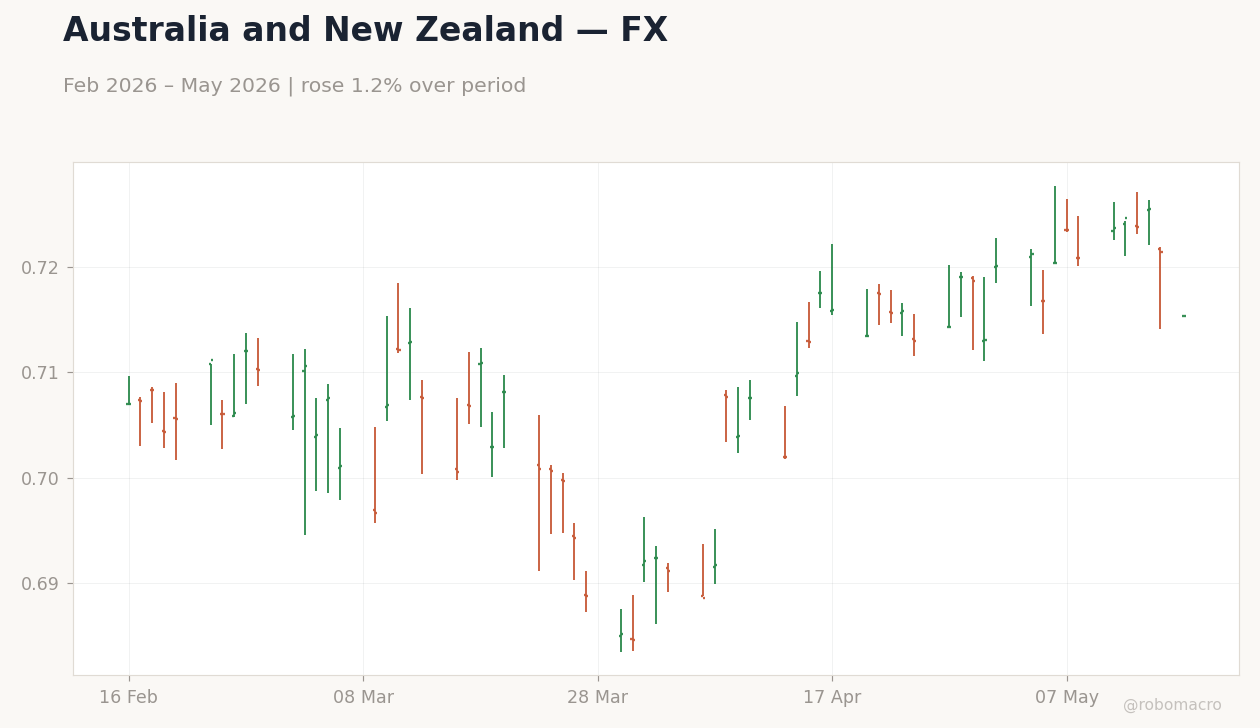
AUD/USD0.7153-1.2%-0.7%+7.1%
NZD/USD0.5840-1.9%-1.1%+1.4%
USD/CAD1.3747+0.5%+1.2%+0.2%
USD/CHF0.7860+1.1%+0.6%-0.8%
USD/CNY6.8087+0.1%-0.3%-2.7%
USD/BRL5.0693+3.2%+2.0%-8.1%
USD/MXN17.32+0.6%-0.8%-3.7%
USD/INR95.95+1.6%+1.3%+6.7%
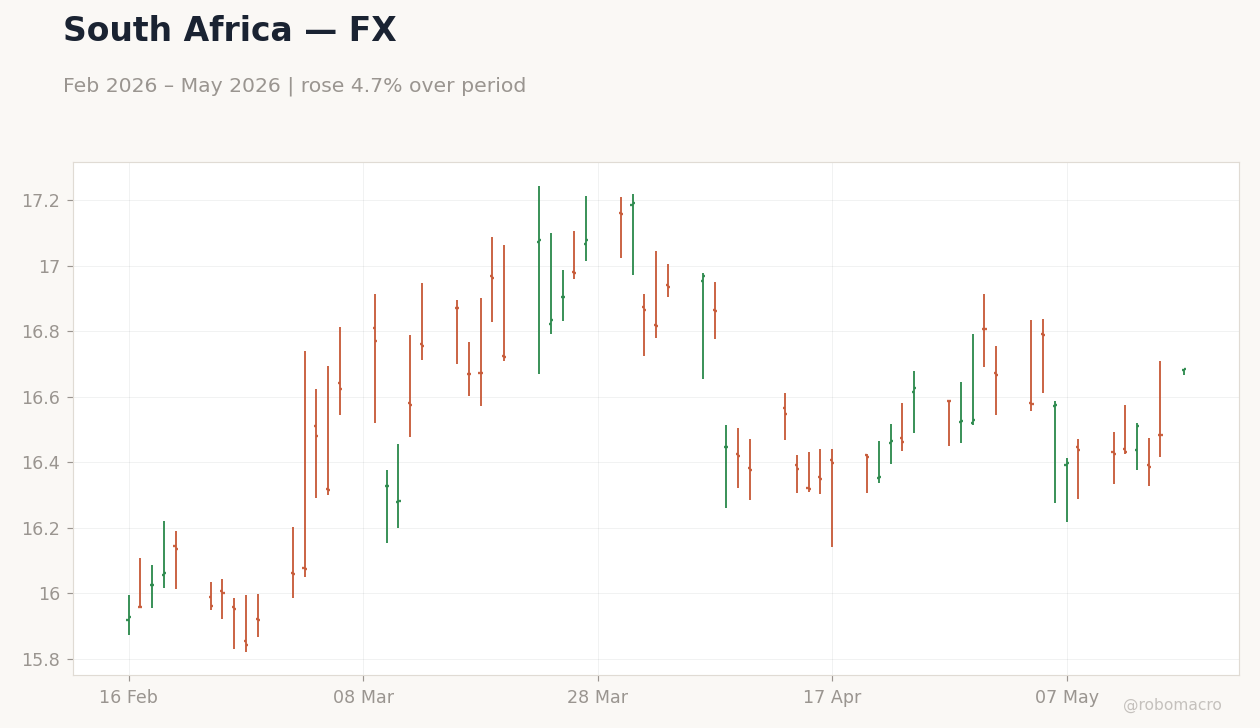
USD/ZAR16.68+1.6%+0.1%+0.8%
USD/TRY45.49+0.3%+0.8%+5.8%
Commodities
CommodityLevelWoWMTDYTD
WTI Crude101.02+5.9%-0.9%+76.2%
Brent Crude109.26+7.9%+1.0%+79.8%
Gold4561.90-3.4%-1.5%+5.7%
Silver77.55-3.5%+2.1%+9.9%
Copper6.29+0.7%+6.1%+11.6%
Natural Gas2.96+7.4%+6.5%-18.2%
Wheat635.75+4.7%+1.8%+25.5%
Iron Ore110.77-0.1%+2.7%+3.4%
Crypto Assets
AssetLevelWoWMTDYTD
Bitcoin$78,231-4.8%+0.1%-11.8%
Ethereum$2,188-7.7%-4.7%-27.1%
Solana$86-10.4%+3.2%-31.8%
XRP$1-3.9%+2.2%-24.6%

The dollar index climbed 1.5% to 99.27, driven by broad USD strength. USD/BRL jumped 3.2%, while USD/INR and USD/ZAR each rose 1.6%. GBP/USD dropped 2.0% to 1.3326 and NZD/USD fell 1.9%, marking the sharpest G10 declines. EUR/USD eased 0.9% to 1.1631 even as USD/JPY advanced 1.2% to 158.73. AUD/USD declined 1.2% against a nearly flat USD/CNY, highlighting EM divergence. Policy differentials and portfolio flows supported the moves. Next week, focus shifts to fresh inflation data and central-bank signals. Yield spreads will remain the key driver.

RoboMacro AI Economic Research

Global Macro Watch

May 17, 2026 robomacro.com
United States
Market Scorecard
AssetLevelWoW
S&P 5000.87+0.8%
Nasdaq 100184.56-0.0%
Dow Jones4561.9-3.3%
Russell 20002793.3-2.7%
USD/JPY109.26+4.8%
EUR/USD158.73+1.2%
GBP/USD78232.91-4.8%
Gold4561.9-3.3%
WTI Crude1.16-1.2%
Bitcoin78232.01-4.8%
Chart 1
Chart 2
Chart 3
Chart 4
  • US CPI headline rose more than expected y/y while core also exceeded forecasts, marking the clearest inflation upside surprise of the week.
  • PPI surged more than anticipated m/m and core PPI climbed sharply, confirming upstream price pressures.
  • Federal Reserve speakers reiterated data dependence and vigilance on inflation metrics without altering forward guidance.
  • Equities closed mixed while Treasury yields moved higher and WTI crude advanced.

Week in Review

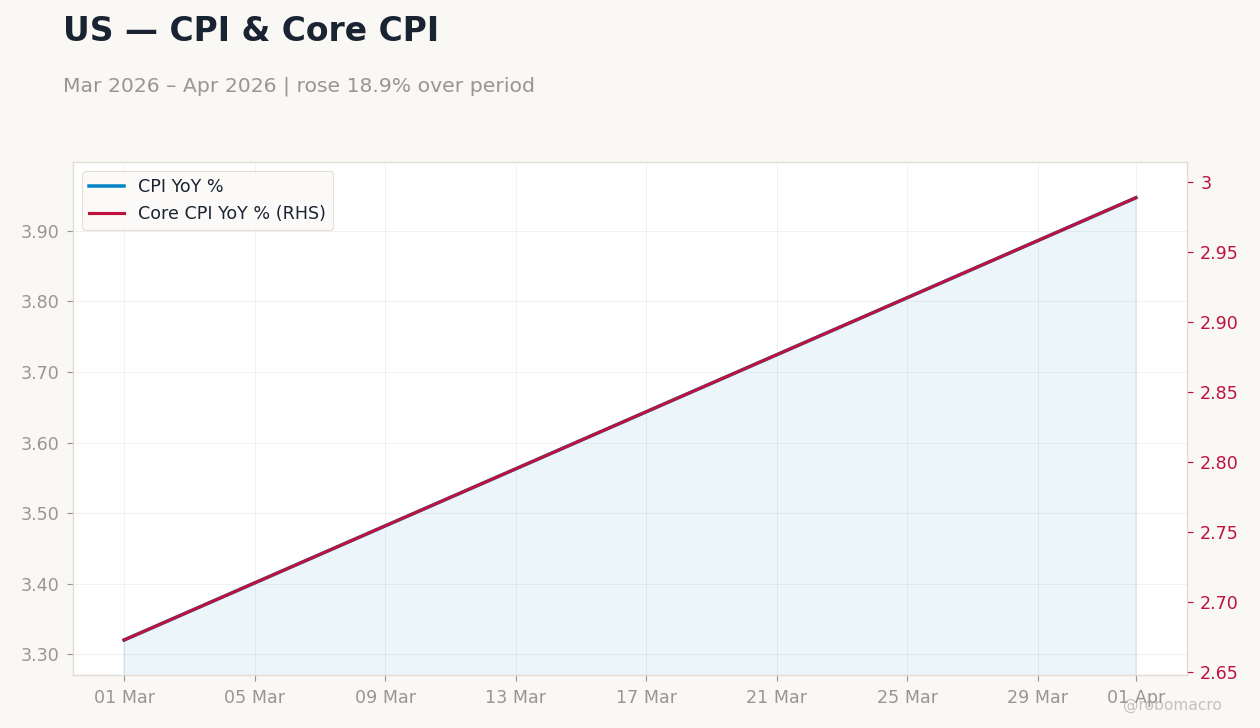
Inflation data delivered consecutive upside surprises. US headline CPI exceeded consensus for the latest reading, lifting market pricing for fewer near-term rate cuts. Core CPI also came in above expectations, with the monthly core rate exceeding forecasts.

Producer prices reinforced the upstream signal. PPI jumped more than consensus while core PPI reached its largest monthly increase in the recent sequence. Existing home sales matched consensus but reversed the prior month’s decline with a modest gain.

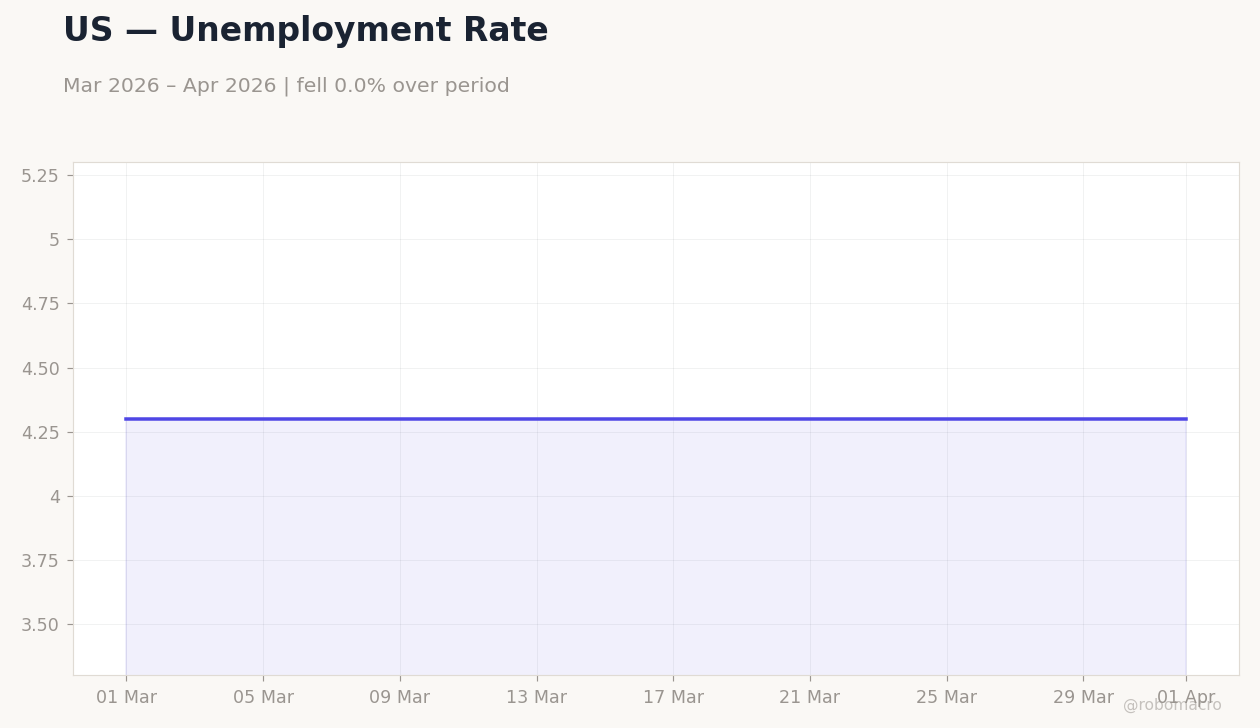
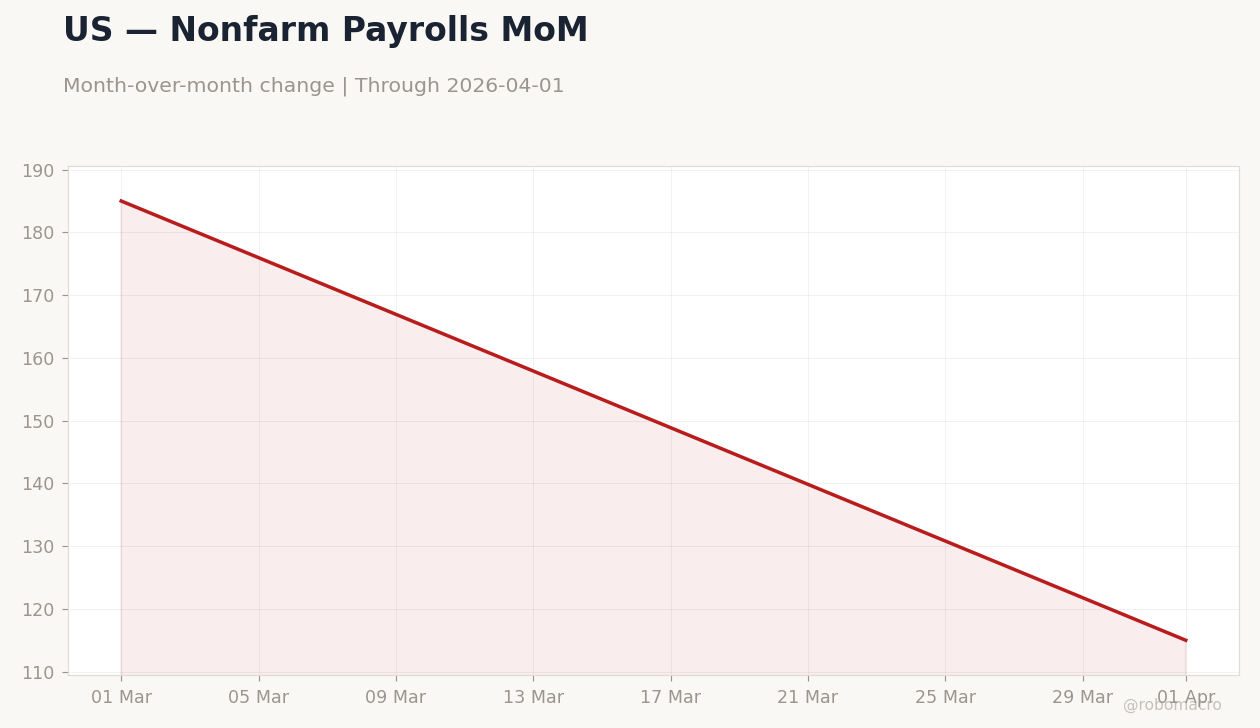
Labor indicators remained steady. ADP weekly employment change rose from the prior reading, while initial jobless claims hovered in a narrow range. The monthly budget statement recorded a surplus narrower than consensus yet improved from the prior deficit.

Markets absorbed the hotter prints through higher yields. The 10-year Treasury yield finished the week higher after a sharp climb on the PPI day, and the 2-year yield also rose. Equity indices showed limited net movement after intraday swings tied to the inflation releases.

Oil prices added volatility to the inflation narrative. WTI crude advanced mid-week before easing, reflecting inventory draws larger than forecast. The combination of sticky services prices and energy volatility kept the medium-term growth and inflation outlook finely balanced.

Fed Watch

Federal Reserve speakers throughout the week emphasized data dependence without shifting explicit guidance. Officials highlighted the need for vigilance on inflation metrics following the CPI release and reiterated that policy remains focused on returning inflation sustainably to target.

The hotter CPI and PPI prints shifted market-implied Fed OIS pricing toward fewer cuts over the subsequent six months. Speakers avoided committing to any specific meeting outcome and instead stressed monitoring incoming labor and price data. Forward guidance remained unchanged, with officials noting that the current stance is appropriate given resilient growth and persistent price pressures. The week’s communications reinforced a patient approach to any adjustment in the policy rate path.

Data Review

US CPI data showed headline inflation above consensus and prior readings, while the monthly rate matched expectations. Core CPI accelerated from the prior print and exceeded consensus, with the m/m core print exceeding the call. These figures pointed to persistent underlying price pressures rather than a one-off energy spike.

PPI data delivered even larger beats, with headline m/m above consensus and prior levels. Core PPI rose more than expected, indicating broad-based cost increases feeding into final goods prices. Existing home sales printed in line with consensus and reversed the prior m/m decline with a modest gain.

Energy inventory reports showed larger-than-expected draws. These supply-side tightenings supported the observed crude price advance and contributed to the inflation upside.

Taken together, the week’s data releases suggest the economy remains in a late-cycle expansion where demand continues to support prices. The combination of firmer core CPI, surging PPI and steady labor readings implies the Federal Reserve will maintain a cautious stance on the rate path, with reduced probability of near-term easing priced into Fed OIS curves.

RoboMacro AI Economic Research

Global Macro Watch

May 17, 2026 robomacro.com

Calendar data unavailable

Chart 5
Chart 6
Chart 7
Chart 8

The Week Ahead

Monday features scheduled Fed remarks and the NAHB Housing Market Index, with the reading set to test whether higher mortgage rates are further weighing on builder sentiment. Tuesday brings ADP weekly employment, additional Fed commentary, and Pending Home Sales.

Wednesday includes the MBA 30-year mortgage rate update, speeches from Fed officials, and EIA crude inventory data. Thursday and Friday host additional Fed speakers. Markets will watch housing metrics and labor proxies for signs that the recent inflation upside is beginning to affect demand. Any hawkish tone could further lift yields and pressure rate-cut probabilities.

Risks & Themes

Hotter inflation prints have reduced the probability of near-term Fed easing and increased the risk of a steeper yield curve if growth remains resilient. Positioning in rate-sensitive assets appears light after the CPI and PPI surprises, suggesting potential for further volatility if subsequent housing or labor data continue to beat.

Upside inflation scenarios would pressure equities and support the dollar, while a rapid oil price reversal could ease near-term CPI concerns. Current market pricing still embeds more cuts than the data trajectory now implies, creating room for repricing. Volatility in energy inventories and geopolitical supply risks remain key swing factors for the inflation outlook over the coming weeks.

Cross-Asset

Equities posted modest net gains with the S&P 500 advancing while the Nasdaq 100 declined slightly. The Dow Jones and Russell 2000 both finished lower.

Bonds sold off across the curve as the 10-year Treasury yield climbed and the 2-year yield rose, reflecting reduced rate-cut expectations after the CPI and PPI beats.

In FX, USD/JPY advanced while EUR/USD and GBP/USD eased. Commodities saw WTI crude rise before closing lower, and gold declined. Bitcoin traded lower after mixed daily sessions.

Global Context

Oil price movements this week contrasted with the prior week’s sharp decline, as WTI rose amid larger inventory draws and ongoing geopolitical tensions. The shift reduced the disinflationary impulse from energy.

Global equity performance continued selectively despite the US inflation upside. Trade and commodity spillovers from energy volatility could affect US import prices in coming releases. Geopolitical developments around supply routes remain the dominant cross-border influence on US inflation and growth readings over the next seven days.

RoboMacro AI Economic Research

Global Macro Watch

May 17, 2026 robomacro.com
Eurozone
Market Scorecard
AssetLevelWoW
Euro Stoxx 505827.76-1.1%
DAX23950.57-1.6%
CAC 407952.55-1.3%
EUR/USD7408.5-0.1%
EUR/GBP29125.2-0.7%
EUR/JPY184.56-0.0%
Gold2793.3-2.7%
Brent Crude109.26+4.8%
Bitcoin158.73+1.2%
Chart 1
Chart 2
  • ZEW Economic Sentiment Index surpassed expectations, marking the clearest positive surprise of the week and lifting growth expectations.
  • French headline unemployment rate rose more than expected, highlighting uneven labor-market softening across member states.
  • German wholesale prices accelerated more than expected both month-over-month and year-over-year, pushing German 10-year Bund yields higher.
  • Euro Stoxx 50 closed the week at 5827.76, down 1.15% week-over-week, as rising Brent crude to 109.26 tempered risk appetite.

Week in Review

Labor market divergence emerges. French unemployment rose more than expected in April while broader Eurozone jobless claims remained contained. This split underscored peripheral weakness against core resilience. Sentiment indicators turn less negative. German ZEW Economic Sentiment Index improved sharply, beating consensus and signaling analyst optimism for the first time in several months. Italian industrial production rose more than expected, reinforcing manufacturing momentum. Inflation pressures reappear in producer prices. German wholesale prices jumped more than expected both month-over-month and year-over-year, feeding into higher Bund yields. Markets price tighter policy. German 10-year Bund yields rose on the week while the Euro Stoxx 50 fell 1.15% to 5827.76 amid the repricing. Brent crude advanced 4.85% to 109.26, adding imported cost concerns. The week’s data arc therefore shifted from prior oil-relief optimism toward renewed vigilance on domestic price pressures and uneven growth.

ECB Watch

No ECB rate decision or minutes were released this week, leaving markets focused on incoming data and the implications for the medium-term rate path. The ZEW beat and German wholesale-price upside together suggest the central bank will maintain a data-dependent stance rather than signal imminent easing. Speakers continued to emphasize vigilance on inflation persistence, consistent with the observed year-over-year wholesale-price print. Forward guidance remains anchored to the ECB OIS curve, which now prices fewer cuts through year-end after the yield rise. We view the week’s data as tilting the balance toward a later first cut, provided labor-market softening does not accelerate. The absence of new guidance leaves the door open for further repricing if upcoming PMI prints disappoint.

Data Review

Italian industrial production delivered a larger-than-expected month-over-month gain, confirming resilience in the bloc’s third-largest economy and supporting the view that manufacturing is stabilizing midway through the expansion. German ZEW sentiment beat expectations by a wide margin, which we interpret as evidence that forward-looking indicators are turning less pessimistic and consistent with a mid-cycle soft patch rather than outright contraction. French unemployment rose more than expected, pointing to labor-market softening that could eventually weigh on consumption. German wholesale prices accelerated more than expected both month-over-month and year-over-year, raising the risk that pipeline inflation will feed into core measures over coming quarters. These prints together suggest the Eurozone remains in an expansionary phase but with asymmetric momentum, where German price pressures could keep the ECB OIS curve from pricing aggressive cuts. The combination of stronger producer prices and mixed labor data leaves the growth-inflation trade-off more balanced than markets had assumed after the prior week’s oil decline.

RoboMacro AI Economic Research

Global Macro Watch

May 17, 2026 robomacro.com

Calendar data unavailable

The Week Ahead

Attention turns to Italy’s trade balance, which will test export resilience. Spain’s trade balance follows, with markets watching for any narrowing of the prior deficit. Germany’s producer-price index year-over-year release will provide the next read on pipeline pressures. Flash PMIs are expected to show German manufacturing and services readings alongside French equivalents; any downside surprise could reinforce growth concerns. GfK consumer confidence in Germany and the Ifo business climate are both key for assessing domestic demand momentum. No ECB speakers are scheduled, keeping the focus squarely on these high-impact releases.

Risks & Themes

Stronger-than-expected wholesale prices raise the possibility that the ECB will keep policy tighter for longer, a scenario markets appear to be underpricing given the modest move in OIS rates. Downside growth risks have increased following the French unemployment miss, which could amplify divergence between core and peripheral economies. Positioning remains light in euro-area equities after the weekly decline, leaving room for short-covering if PMIs hold up. Volatility in Brent crude, now at 109.26, could transmit further upside inflation surprises. Flow data suggest continued outflows from euro-denominated bond funds as yields rise, adding technical pressure. The balance of risks has tilted modestly toward higher terminal rates relative to the prior week’s oil-relief narrative.

Cross-Asset

Equities closed lower, with the Euro Stoxx 50 falling 1.15% to 5827.76, the DAX declining 1.64% to 23950.57, and the CAC 40 dropping 1.29% to 7952.55 as higher yields weighed on valuations. German 10-year Bund yields climbed, reflecting reduced expectations for near-term ECB easing. EUR/USD edged lower by 0.06% on a weekly basis amid the yield differential shift, while EUR/GBP fell 0.67%. Brent crude rose 4.85% to 109.26, providing support to energy names but pressuring broader risk assets, whereas gold declined 2.69% to 2793.30. Standout daily moves included the Euro Stoxx 50’s rebound after the ZEW beat, followed by a decline as Bund yields pushed higher.

Global Context

Rising Brent crude prices to 109.26 over the past seven days contrast with the sharp oil decline recorded in the prior week and could transmit imported inflation to the Eurozone. Geopolitical tensions in energy markets remain the dominant cross-border spillover, supporting safe-haven flows into Bunds. Trade data due next week will reveal whether global demand weakness is affecting Italian and Spanish export performance. Broader equity weakness outside the region adds to risk-off sentiment affecting euro crosses.

RoboMacro AI Economic Research

Global Macro Watch

May 17, 2026 robomacro.com
Japan
Market Scorecard
AssetLevelWoW
Nikkei 22561409.29-1.6%
USD/JPY158.73+1.2%
EUR/JPY184.56-0.0%
GBP/JPY211.53-0.8%
Gold4561.9-3.3%
Brent Crude109.26+4.8%
Bitcoin78232.01-4.8%
Chart 1
Chart 2
Chart 4
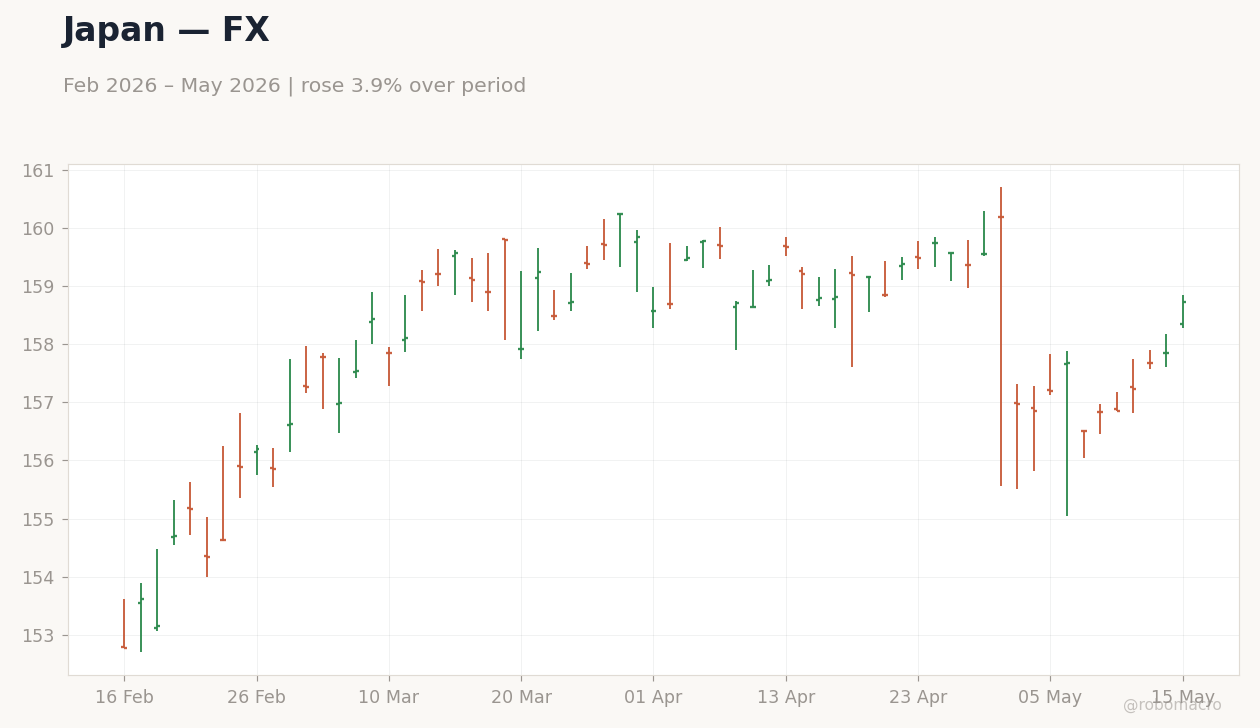
  • Suspected yen interventions failed to arrest USD/JPY advance to 158.73 as dollar resilience persisted through the week.
  • Household spending missed expectations while current account surplus exceeded forecasts.
  • BoJ communications highlighted near-term rate hike discussions, pushing Japan 10Y yields higher.

Week in Review

Yen Defense and Currency Pressure Suspected interventions produced only fleeting yen support, with USD/JPY closing the week at 158.73 after a 1.19% weekly gain. The currency pair traded above 157 throughout, reflecting limited impact from authorities’ actions.

Data Surprises and Domestic Demand Household spending delivered a downside surprise, while the current account surplus exceeded expectations, supported by export income and investment returns.

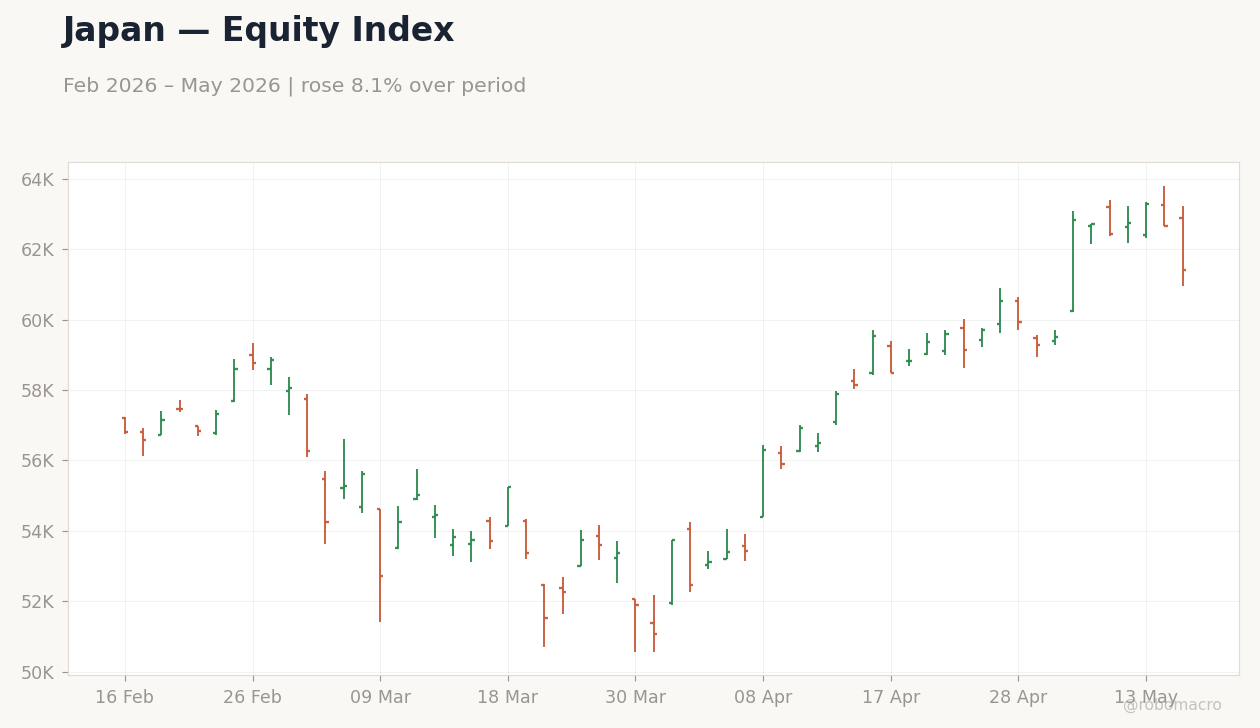
Equity and Yield Market Reaction Nikkei 225 closed the week at 61409.29 for a 1.62% weekly decline. Japan 10Y yields moved higher as markets repriced normalization odds following BoJ communications.

Commodity and External Backdrop Brent crude rose 4.85% to 109.26, adding imported cost pressure for Japan, while gold declined 3.32% to 4561.9 amid shifting safe-haven flows. The data arc shows external balances holding firmer than domestic consumption, tempering immediate growth concerns yet sustaining BoJ focus on wage and price momentum.

Policy Signal Consolidation Overall, the week reinforced expectations that incoming GDP prints and inflation readings will determine the timing of the next BoJ adjustment rather than isolated intervention effects.

BoJ Watch

BoJ communications from the recent meeting referenced possible rate action as early as the next policy gathering, with several members highlighting risks from prolonged yen weakness. Japan 10Y yields moved higher as markets adjusted BoJ OIS pricing for a near-term hike. Short-term rate indications remained anchored, consistent with the prevailing policy stance. The household spending shortfall and current account beat together suggest uneven domestic momentum that could delay but not derail the normalization path. Forward guidance continues to tie upcoming decisions to wage and inflation outcomes rather than calendar dates. OIS curves reflected modest repricing toward tighter settings over coming quarters.

RoboMacro AI Economic Research

Global Macro Watch

May 17, 2026 robomacro.com

Calendar data unavailable

The Week Ahead

Preliminary GDP growth is scheduled for release next week alongside trade balance and export data. These prints will provide a read on first-quarter activity and directly inform BoJ assessments of the growth-inflation balance. Flash manufacturing and services PMIs will update activity momentum, while inflation readings will show whether price pressures persist. BoJ speeches offer additional guidance on the rate path. Collectively these releases will shape expectations for the timing and magnitude of the next policy adjustment.

Risks & Themes

Persistent yen pressure risks amplifying imported inflation even as domestic demand shows softness, potentially pushing the Bank of Japan toward earlier tightening than currently priced. Upside growth surprises in next week’s GDP could accelerate OIS repricing, while downside misses might reinforce caution on the pace of normalization. Market positioning appears to underweight intervention limits below 160, leaving room for sharper yen moves if authorities escalate measures. Energy price gains add stagflationary tilt that could complicate the BoJ’s dual mandate focus. Overall, the data shift tilts risks toward faster policy response if inflation holds above target while growth stabilizes.

RoboMacro AI Economic Research

Global Macro Watch

May 17, 2026 robomacro.com
Canada
Market Scorecard
AssetLevelWoW
S&P/TSX33833.4-0.9%
USD/CAD1.37+0.4%
EUR/CAD1.6-0.7%
WTI Crude101.02+3.0%
Natural Gas2.96+1.7%
Gold4561.9-3.3%
Brent Crude109.26+4.8%
Bitcoin78232.01-4.8%
Chart 1
Chart 2
  • Canada's labor market data showed job losses and a rise in unemployment, softening CAD while lifting BoC hold expectations.
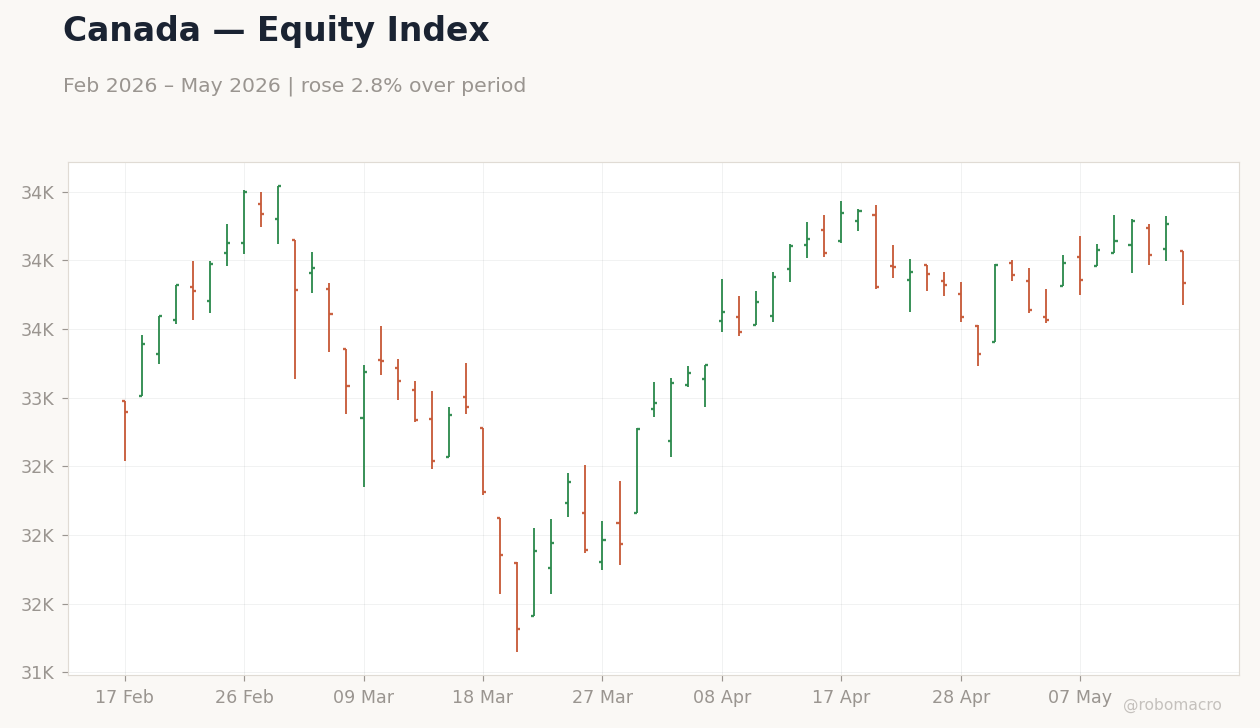
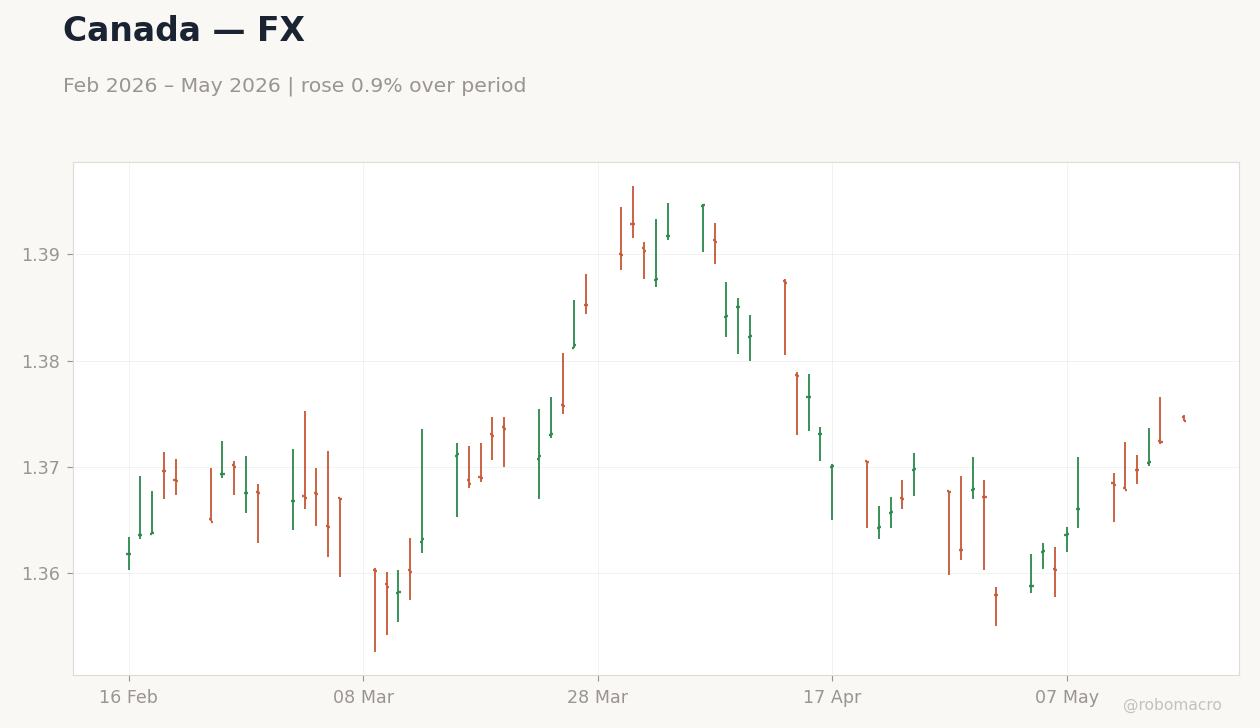
  • S&P/TSX ended the week at 33833.4 with a -0.89% weekly decline amid volatile energy prices, while the Canada 10Y yield climbed and USD/CAD held at 1.37.
  • BoC Market Participants Survey highlighted mixed growth and inflation views, reinforcing steady policy pricing in OIS markets ahead of the next decision.

Week in Review

Labor Market Weakness Emerges The jobs report delivered job losses and pushed unemployment higher, which directly weighed on CAD performance versus the USD. This outcome followed the prior month's contraction and reduced near-term rate-hike probabilities in BoC OIS curves. Commodity and Equity Divergence WTI Crude rose 3.01% to 101.02 over the week while Brent Crude gained 4.85% to 109.26, supporting resource names even as the S&P/TSX posted a net -0.89% decline to 33833.4. Gold fell 3.32% to 4561.9, reflecting a rotation out of safe-haven assets. Yield and Currency Response The Canada 10Y yield advanced and the 2Y yield eased, pricing sustained policy rates amid the softer labor print. USD/CAD rose 0.44% to 1.37 while EUR/CAD declined 0.74% to 1.6, illustrating CAD underperformance against the greenback. Survey and Forward Signals The BoC Market Participants Survey released mid-week showed cautious business views on hiring and pricing, aligning with the employment miss and tempering expectations for near-term easing. Overall the week's data flow confirmed a cooling labor market without derailing commodity support for equities, leaving the growth-inflation balance tilted toward policy patience.

BoC Watch

The Bank of Canada held its policy rate steady with no meeting this week, while the Market Participants Survey revealed tempered growth expectations that reinforced steady-rate pricing. OIS curves shifted modestly higher following the jobs miss and rising 10Y yields, reducing cut probabilities for the next decision. Forward guidance in recent communications continued to emphasize data dependence, with the employment weakness providing cover for a hold. Market participants now see limited scope for near-term moves unless inflation prints surprise materially on the downside. The survey's mixed inflation outlook further supported the view that the Bank will await clearer signals on both growth and price pressures before adjusting the path.

RoboMacro AI Economic Research

Global Macro Watch

May 17, 2026 robomacro.com

Calendar data unavailable

The Week Ahead

Inflation Rate Year-over-Year and Core Inflation Rate Year-over-Year both release next week, with prior readings serving as the key benchmarks for the next Bank of Canada decision. A softer-than-expected outcome would likely increase OIS-implied cut odds, while a firm print would reinforce the current hold stance. Retail Sales Excluding Autos Month-over-Month and Retail Sales Month-over-Month Final follow shortly after, offering fresh evidence on consumer resilience that feeds directly into growth assessments ahead of upcoming decisions. The Senior Loan Officer Survey the same day will provide bank-level insights on credit conditions and lending standards. These releases collectively shape the rate path by clarifying whether recent labor softness is translating into broader demand weakness. Markets will monitor deviations from consensus to recalibrate BoC OIS pricing for the balance of the quarter.

Risks & Themes

Persistent oil volatility around current levels introduces upside inflation risks that could delay easing even after the jobs miss. Housing data weakness signals downside growth risks if higher yields persist. Markets appear to underprice the probability of a prolonged hold if core inflation remains near recent levels. An upside surprise in the upcoming inflation print would widen the gap between current OIS pricing and Bank of Canada rhetoric, while a sharp retail sales beat could revive cut expectations. Broader global tensions continue to support energy prices, creating a bifurcated outlook where commodity strength offsets labor-market softness.

RoboMacro AI Economic Research

Global Macro Watch

May 17, 2026 robomacro.com
Mexico
Market Scorecard
AssetLevelWoW
IPC Bolsa67976.5-3.2%
USD/MXN17.3+0.5%
EUR/MXN20.15-0.5%
WTI Crude101.02+3.0%
Silver77.55-9.3%
Gold4561.9-3.3%
Brent Crude109.26+4.8%
Bitcoin78209.33-4.8%
Chart 1
Chart 2
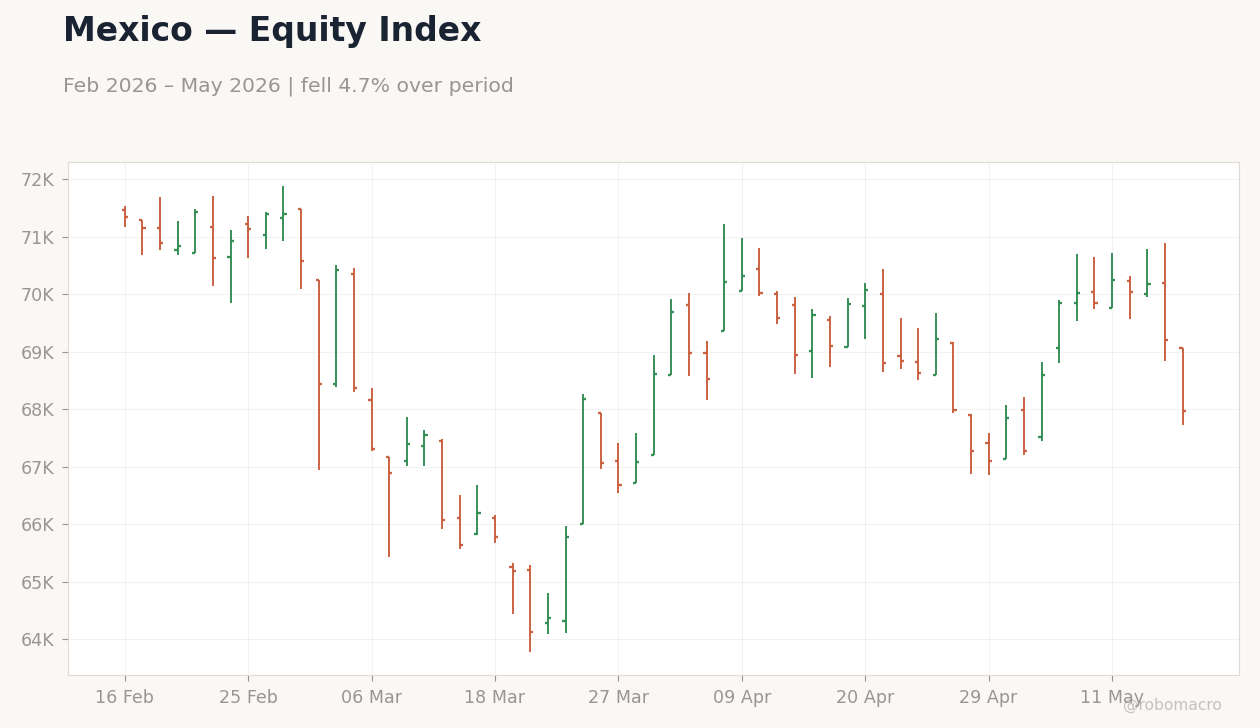
  • IPC Bolsa fell 3.23% to 67976.5 as global risk-off flows dominated.
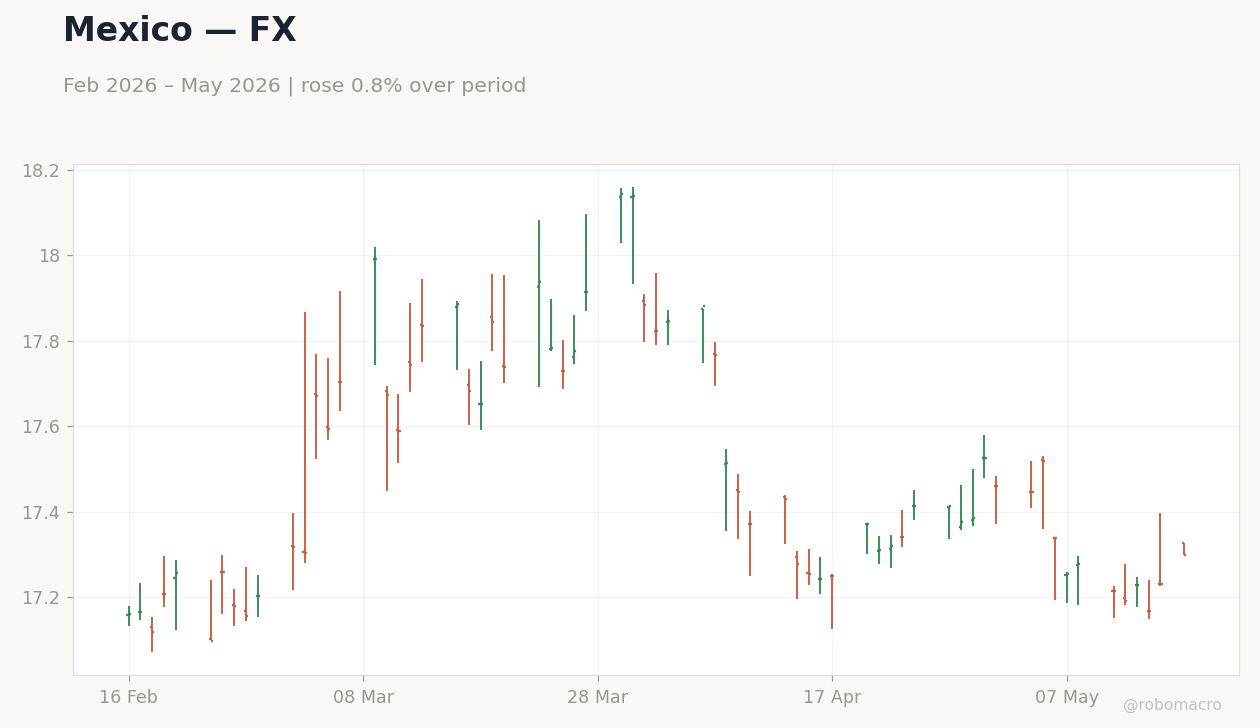
  • USD/MXN rose 0.5% to 17.3 while EUR/MXN declined 0.5%.
  • WTI and Brent crude advanced while silver and gold posted sharp losses, producing divergent effects on export revenues and IPC Bolsa components.

Week in Review

Equity and FX Pressure Amid Quiet Data Calendar Mexican equities posted consistent losses through the period, with the IPC Bolsa falling 3.23% to 67976.5. The peso showed resilience early but weakened later, as USD/MXN rose 0.5% to 17.3. EUR/MXN traded in a narrow band and ended 0.5% lower on the week.

Commodity Divergence and Export Implications WTI crude advanced 3.01% to 101.02 while Brent crude gained 4.85% to 109.26, providing partial support to energy-linked revenues. In contrast, silver fell 9.29% to 77.55 and gold declined 3.32% to 4561.9, pressuring mining-exposed components of the IPC Bolsa. These moves occurred against a backdrop of no scheduled Mexican data releases, leaving price action driven by external flows and US yield movements.

Yield Compression and Policy Anticipation Short-term rates eased while long-term rates rose, producing a modest steepening that markets interpreted as consistent with expected easing at upcoming Banxico decisions. The absence of inflation or activity prints left the data-dependent path for the next meeting unchanged from prior communications.

Nearshoring and External Backdrop Nearshoring momentum continued to underpin manufacturing sentiment even as trucking capacity constraints raised logistics costs for exporters. Remittances and auto-sector investment flows remained supportive, offsetting the lack of fresh domestic indicators. Overall, the week reinforced a narrative of resilient growth tempered by external volatility.

Banxico Watch

Markets priced additional easing into Banxico OIS curves as short-term rates declined and long-term yields moved higher. No speakers or minutes were released during the week, leaving forward guidance anchored to the prior data-dependent stance. The mixed commodity outcome, with energy prices firmer and precious metals weaker, reduced near-term imported inflation risks and supported expectations for measured cuts at the next meeting. OIS pricing shifted modestly dovish on the week, reflecting the continued absence of upside inflation surprises. The rate path remains tilted toward gradual easing through coming quarters provided growth stays above trend.

RoboMacro AI Economic Research

Global Macro Watch

May 17, 2026 robomacro.com

Calendar data unavailable

The Week Ahead

The calendar features limited Mexican releases, directing attention to US indicators that influence Banxico’s reaction function through trade linkages. Any updates on industrial production or external sector data will help calibrate the growth outlook ahead of the next policy decision. Consensus expectations remain for steady policy until incoming inflation prints clarify the trajectory. Commodity price stability will matter for fiscal revenues and peso volatility, with oil moves directly affecting Banxico’s inflation assessment. Cross-border logistics and nearshoring announcements could provide incremental support to activity forecasts. Overall, the quiet domestic slate leaves markets focused on external signals that shape the path for upcoming decisions. Volatility is expected to stay contained absent surprises in US data or global risk sentiment.

Risks & Themes

Downside risks center on further commodity weakness that could pressure IPC Bolsa components and fiscal balances, particularly if silver and gold extend recent declines. Upside scenarios include sustained oil strength that bolsters export revenues and reduces the urgency for aggressive easing. Markets appear to underprice the persistence of nearshoring-driven growth, which could keep inflation above target for longer than current OIS curves reflect. The steepening yield curve signals some repricing of fiscal risks that may challenge the dovish consensus if long-term rates continue higher. External US yield moves remain the dominant transmission channel for peso and rate volatility into the next meeting.

RoboMacro AI Economic Research

Global Macro Watch

May 17, 2026 robomacro.com
Brazil
Market Scorecard
AssetLevelWoW
Bovespa177284.0-2.5%
USD/BRL5.07+3.2%
EUR/BRL5.89+2.0%
Vale16.32-4.4%
Petrobras19.93-4.0%
WTI Crude101.02+3.0%
Gold4561.9-3.3%
Bitcoin78205.13-4.8%
Chart 1
Chart 2
  • April inflation undershot consensus, marking the clearest signal of moderating price pressures this week.
  • Retail sales rose, beating the flat consensus and underscoring resilient domestic demand despite elevated borrowing costs.
  • BCB OIS pricing shifted modestly lower as the short-term rate eased, reflecting reduced near-term tightening risks.

Week in Review

Inflation data softens the outlook. Brazil’s April inflation print delivered a clear downside surprise relative to consensus, reinforcing the narrative of cooling price pressures from food and energy components.

Consumer resilience persists. Retail sales expanded month-over-month, exceeding the flat consensus and indicating that household spending held up under the prevailing rate environment. The combination of softer inflation and firmer sales created a mixed but overall constructive domestic picture.

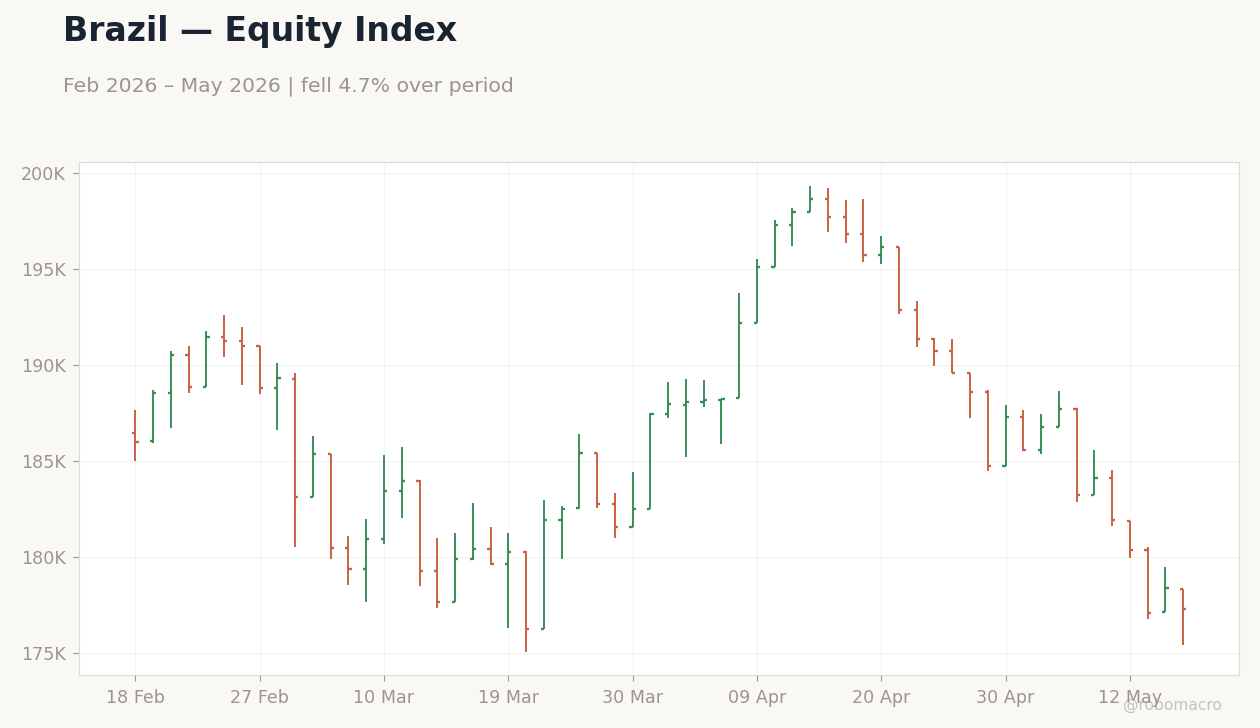
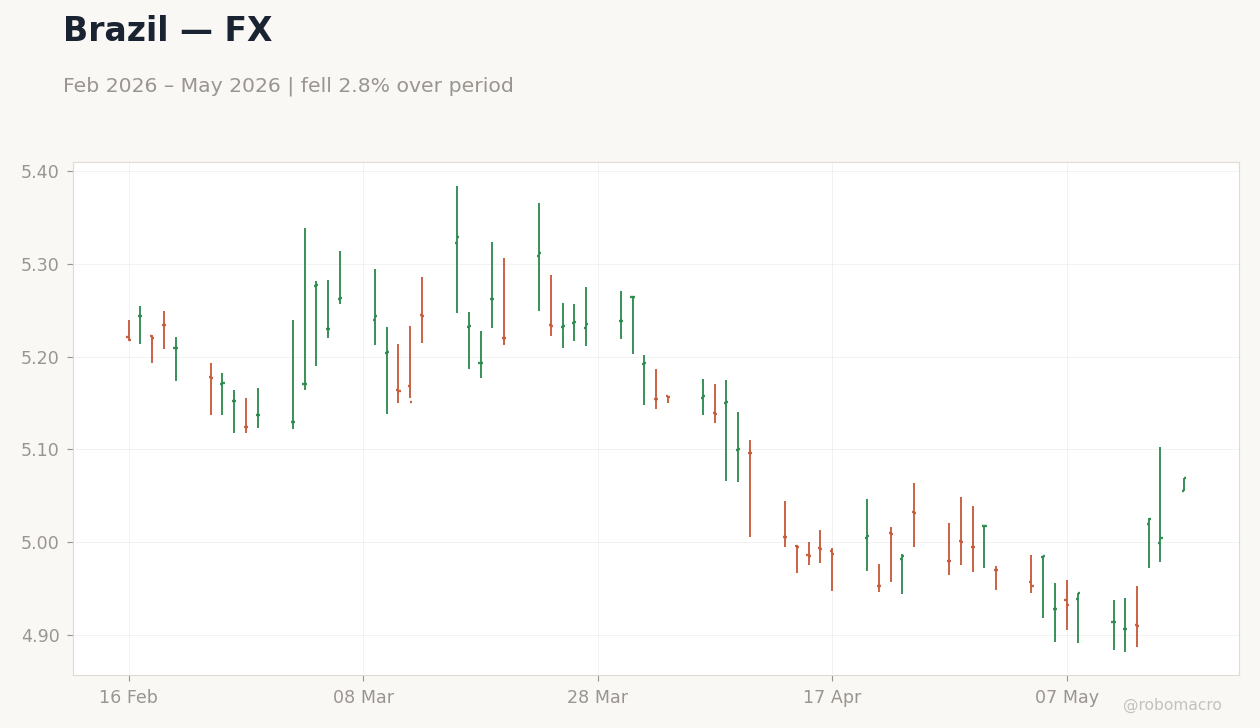
Equity and currency markets diverged. The Bovespa index fell 2.54% week-over-week to close at 177284, pressured by commodity-linked names, while USD/BRL rose 3.18% to 5.07 amid broader emerging-market flows. Vale declined 4.39% to 16.32 and Petrobras fell 3.95% to 19.93 as WTI crude rose 3.01% to 101.02.

Policy-sensitive assets reflected the data. Brazil’s short-term rate moved lower, consistent with market repricing of the easing path following the inflation undershoot. Gold’s 3.32% drop to 4561.9 provided an additional external signal of reduced inflation hedging demand. Overall, the week’s arc showed domestic data supporting a less urgent policy stance even as external volatility weighed on asset prices.

BCB Watch

The Banco Central do Brasil received dovish support from the April inflation undershoot, which lowered the immediate case for additional tightening. BCB OIS curves shifted modestly lower as the short-term rate declined, pricing a more gradual path ahead of upcoming decisions. Retail sales resilience tempered the dovish tilt by signaling sustained domestic demand, leaving the committee with balanced risks. Forward guidance is expected to remain data-dependent, with the inflation trajectory now viewed as more favorable for measured adjustments. No speaker events occurred this week, keeping attention on the next data releases and their implications for the rate path.

RoboMacro AI Economic Research

Global Macro Watch

May 17, 2026 robomacro.com

Calendar data unavailable

The Week Ahead

Attention will center on upcoming confidence and activity data releases early next week, which should provide an updated read on corporate and household sentiment following the recent inflation and sales prints. Markets will assess whether the softer price data sustains the recent easing in BCB OIS pricing or whether resilient activity indicators push expectations back toward caution. Subsequent days are likely to feature routine fiscal and trade updates that could influence real-yield differentials. The data flow will help refine views on the timing and pace of upcoming decisions, particularly how consumer and business readings interact with external commodity trends. Any surprise in confidence readings could shift the balance between growth resilience and disinflation signals. Overall, the week should keep focus on the interplay between domestic activity and the Banco Central do Brasil’s reaction function.

Risks & Themes

The week’s inflation undershoot reduces near-term upside risks to the rate path, yet persistent fiscal concerns could still anchor longer-term yields higher. A stronger-than-expected confidence print next week would support the view that growth remains resilient enough to delay easing, while further commodity weakness could amplify downside pressure on the real. Markets appear to be underpricing the durability of domestic demand given the retail sales beat, leaving room for repricing if activity data continue to surprise positively. External volatility in oil and equities remains the dominant swing factor for BRL and Bovespa direction into the next meeting cycle.

RoboMacro AI Economic Research

Global Macro Watch

May 17, 2026 robomacro.com
Argentina
Market Scorecard
AssetLevelWoW
MERVAL2707869.0-4.4%
USD/ARS1394.5-0.5%
YPF43.66-2.8%
MercadoLibre1546.81-0.7%
Globant38.91+4.6%
Soybeans1177.0-1.9%
Gold4561.9-3.3%
Bitcoin78205.13-4.8%
Chart 1
Chart 2
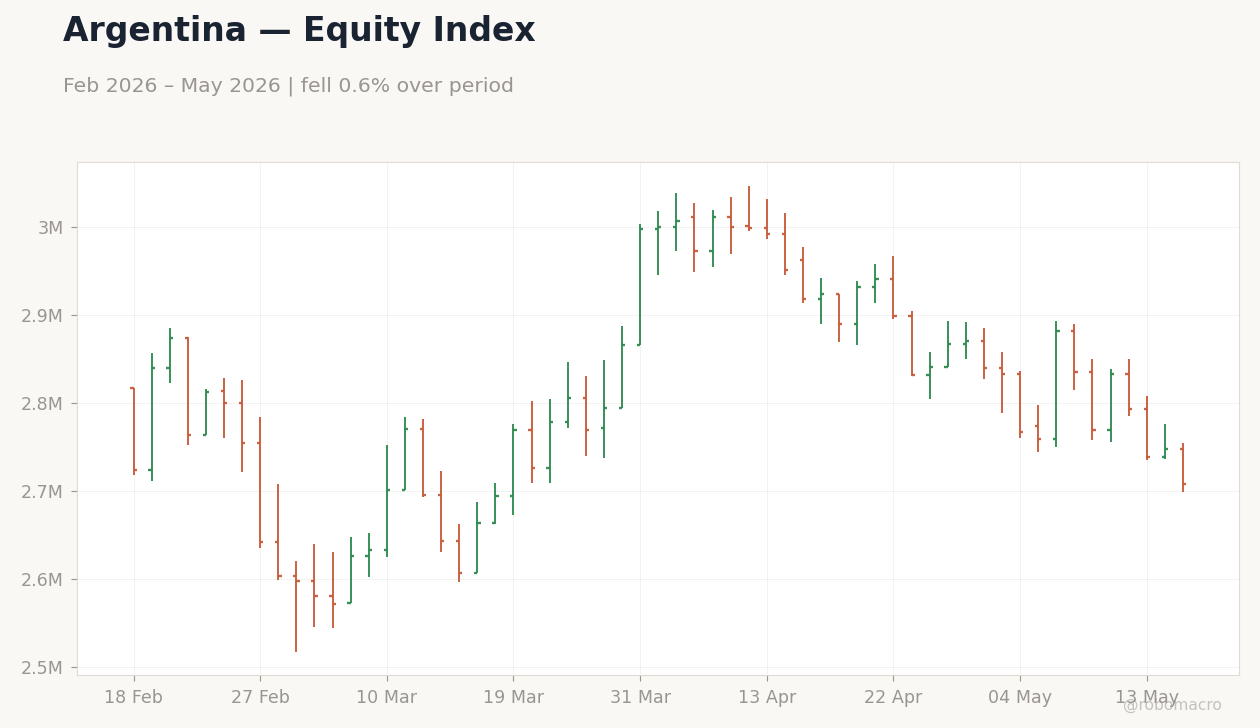
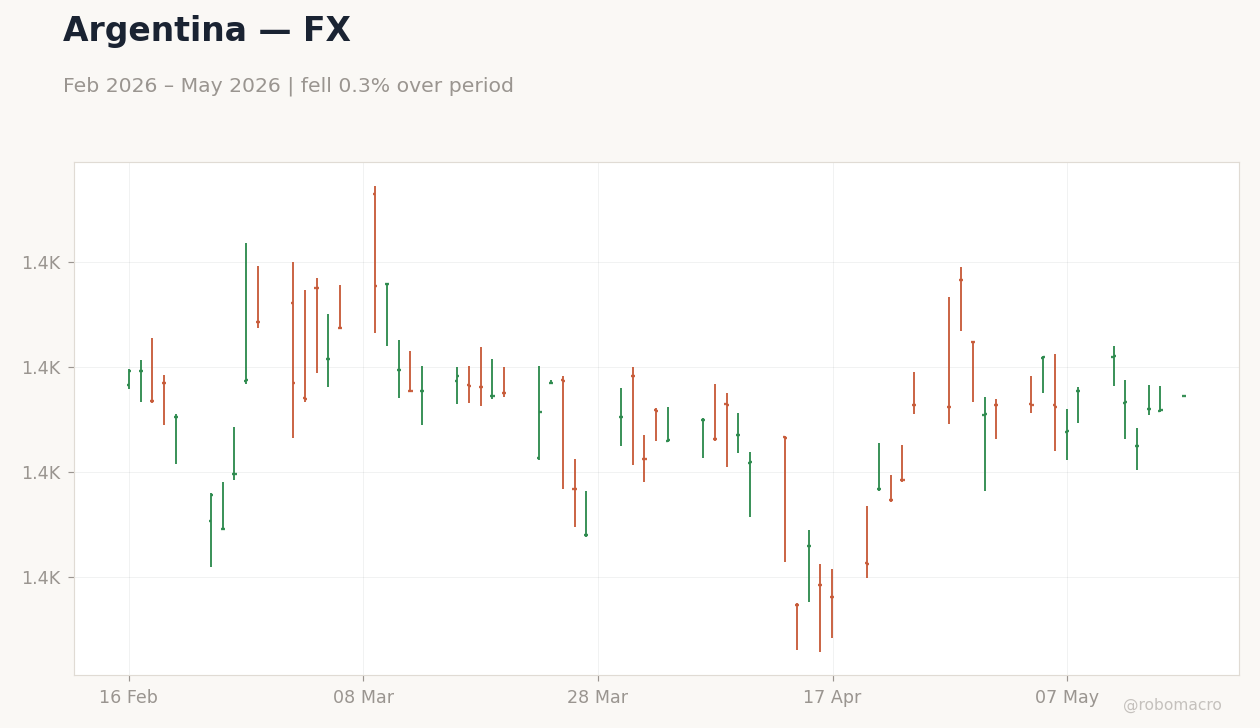
  • Merval fell 4.42% to 2,707,869 as global risk-off flows dominated, with Globant rising 4.57%.
  • USD/ARS eased 0.54% to 1,394.50 while the BCRA sustained its crawling peg and kept parallel spreads contained.
  • Soybean prices declined 1.9%, providing modest support to trade flows without altering reserve trends.

Week in Review

Equity Market Volatility The Merval index recorded a net 4.42% decline for the week. YPF shares posted a 2.83% weekly loss while Globant rose 4.57%.

Currency and Reserve Dynamics The official USD/ARS rate posted a net 0.54% appreciation. Soybean prices declined 1.9%, providing modest support to trade surpluses.

Policy and Political Crosscurrents Markets operated without scheduled data releases and took direction from global cues, producing contained but softer asset prices.

BCRA Watch

The Banco Central de la Republica Argentina maintained its crawling peg. USD/ARS moved modestly higher mid-week before closing the period little changed as interventions absorbed export inflows. No rate decision or minutes were released, leaving the BCRA OIS curve anchored to expectations of gradual easing once inflation permits.

RoboMacro AI Economic Research

Global Macro Watch

May 17, 2026 robomacro.com

Calendar data unavailable

RoboMacro AI Economic Research

Global Macro Watch

May 17, 2026 robomacro.com
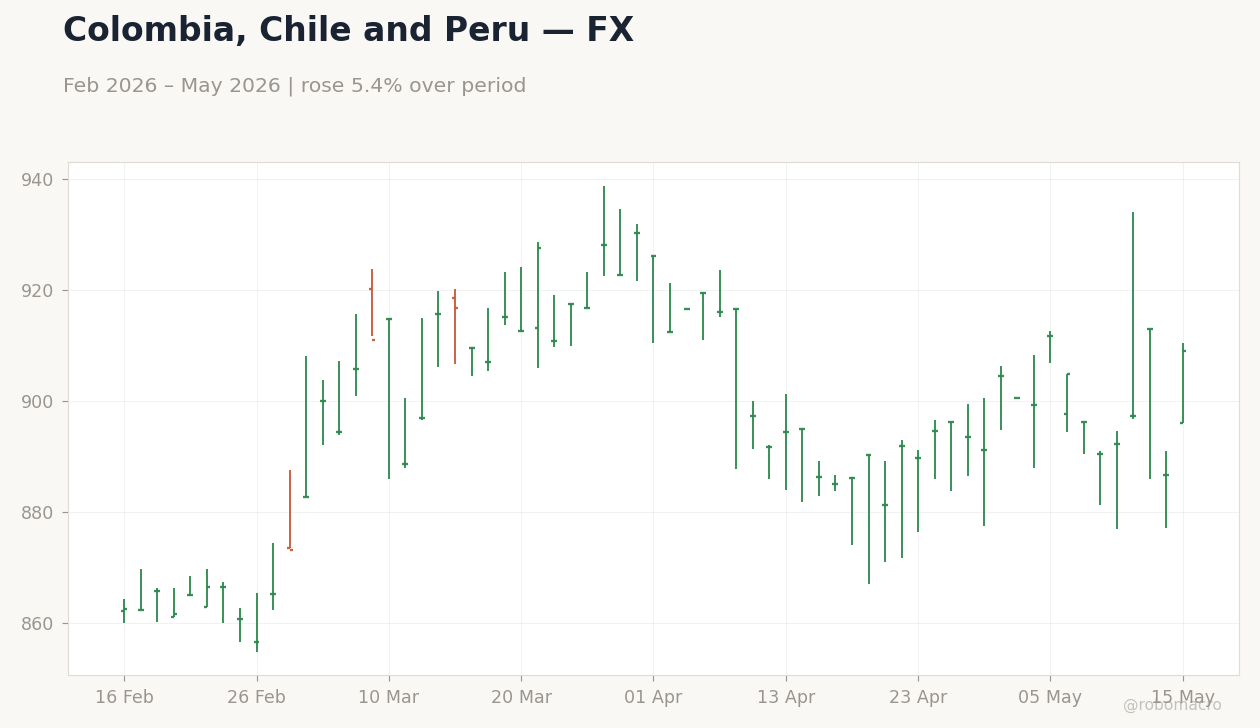
Colombia, Chile and Peru
Market Scorecard
AssetLevelWoW
MSCI Chile39.24-4.8%
MSCI Peru80.01-4.5%
USD/COP3791.92+1.1%
USD/CLP908.88+1.9%
USD/PEN3.43+1.4%
Copper6.3-1.9%
Gold4561.9-3.3%
Brent Crude109.26+4.8%
Bitcoin78208.21-4.8%
Chart 1
Chart 2
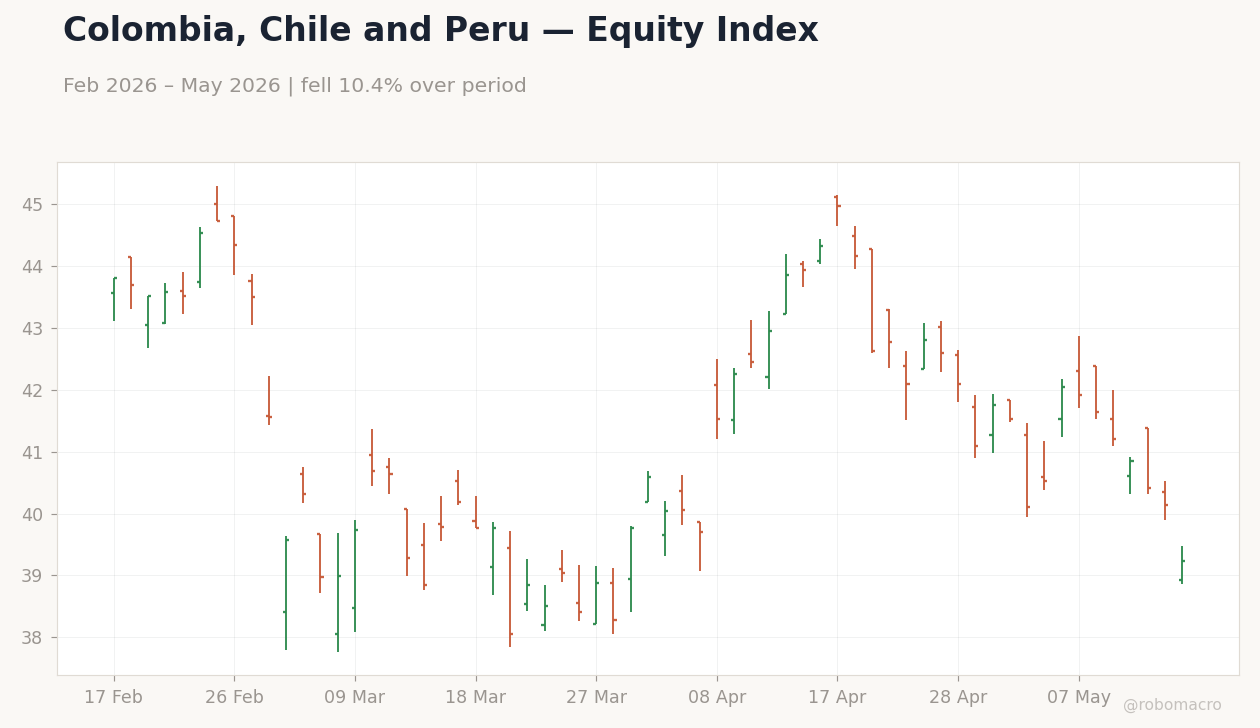
  • MSCI Peru fell to 80.01 with a 4.5% weekly drop as copper slipped to 6.30.
  • Brent crude advanced to 109.26, up 4.85% over the week, providing fiscal support for Colombia while USD/COP rose to 3,791.92.
  • Chile's policy rate remained unchanged with no BanRep, BCCh or BCRP meetings or shifts in OIS pricing observed.

Week in Review

Commodity swings dominate regional performance Andean equity indices closed the week lower amid volatile commodity prices, with MSCI Chile declining 4.76% to 39.24 and MSCI Peru falling 4.5% to 80.01. Copper traded at 6.30 after a sharp daily drop, weighing on mining-linked assets in Chile and Peru. Brent crude reached 109.26, delivering a 4.85% weekly gain that offered partial offset for Colombia's oil revenues.

FX markets reflect external pressures USD/CLP rose 1.87% over the week to 908.88, while USD/PEN increased 1.43% to 3.43 and USD/COP advanced 1.15% to 3,791.92. These moves occurred against a backdrop of no domestic data releases, leaving markets to price global commodity and risk sentiment directly into currencies.

Policy rates hold steady amid light calendar Chile's policy rate stayed fixed throughout the period with no adjustments from BanRep, BCCh or BCRP. The absence of inflation prints or growth indicators meant forward guidance remained unchanged.

Fiscal and external balance themes emerge Colombia's oil exposure benefited from Brent's net weekly gain, while Chile's copper revenues continued to exceed budget assumptions on the back of earlier production gains. Peru's mining surplus expanded on higher base-metal prices earlier in the week before the late sell-off.

Risk sentiment drives equity divergence MSCI Colombia held relatively steady even as regional peers declined, reflecting stability in oil-linked holdings versus pure copper exposure. Daily equity moves underscored the week's choppy price action.

Overall cycle positioning unchanged The data suggests the Andean economies remain in an expansionary phase supported by resilient external demand, though the week's commodity reversal tempers near-term inflation relief expectations.

Andean Central Banks Watch

BanRep, BCCh and BCRP held policy rates steady with no meetings or minutes released during the week. Speakers maintained data-dependent language, echoing the emphasis on monitoring imported inflation from commodities. OIS curves showed minimal shifts as markets priced unchanged paths into the next decisions, with no fresh forward guidance altering expectations for coming quarters. The week's Brent rise to 109.26 and copper dip to 6.30 left imported inflation risks balanced, supporting the view that rate cuts remain on hold until clearer disinflation signals emerge.

RoboMacro AI Economic Research

Global Macro Watch

May 17, 2026 robomacro.com

Calendar data unavailable

The Week Ahead

Attention turns to potential central bank communications and any unscheduled data releases that could inform the next BanRep, BCCh and BCRP decisions. Markets will monitor copper and Brent trends closely given their direct impact on fiscal balances and inflation outlooks for Chile and Colombia. Peru's mining exports remain sensitive to gold and copper price stability. Any global risk-off moves could pressure USD/COP, USD/CLP and USD/PEN further from current levels. Investors expect continued emphasis on data dependence ahead of upcoming decisions, with commodity volatility likely to shape OIS pricing revisions. Light domestic calendars mean external factors such as US or Canadian policy signals will dominate sentiment into the following week.

Risks & Themes

The week's late commodity reversal from earlier gains highlights downside risks to growth if copper remains near 6.30 and Brent fails to sustain recent levels. Upside scenarios center on continued oil strength supporting Colombia's fiscal position while moderating imported inflation across the bloc. Markets appear to underprice the persistence of commodity-driven inflation volatility, as evidenced by the flat OIS response despite Brent's weekly advance. Political developments in Peru and fiscal strains in Colombia could amplify FX swings if external risk appetite deteriorates further.

RoboMacro AI Economic Research

Global Macro Watch

May 17, 2026 robomacro.com
United Kingdom
Market Scorecard
AssetLevelWoW
FTSE 10010195.4-0.7%
FTSE 25022596.1-0.9%
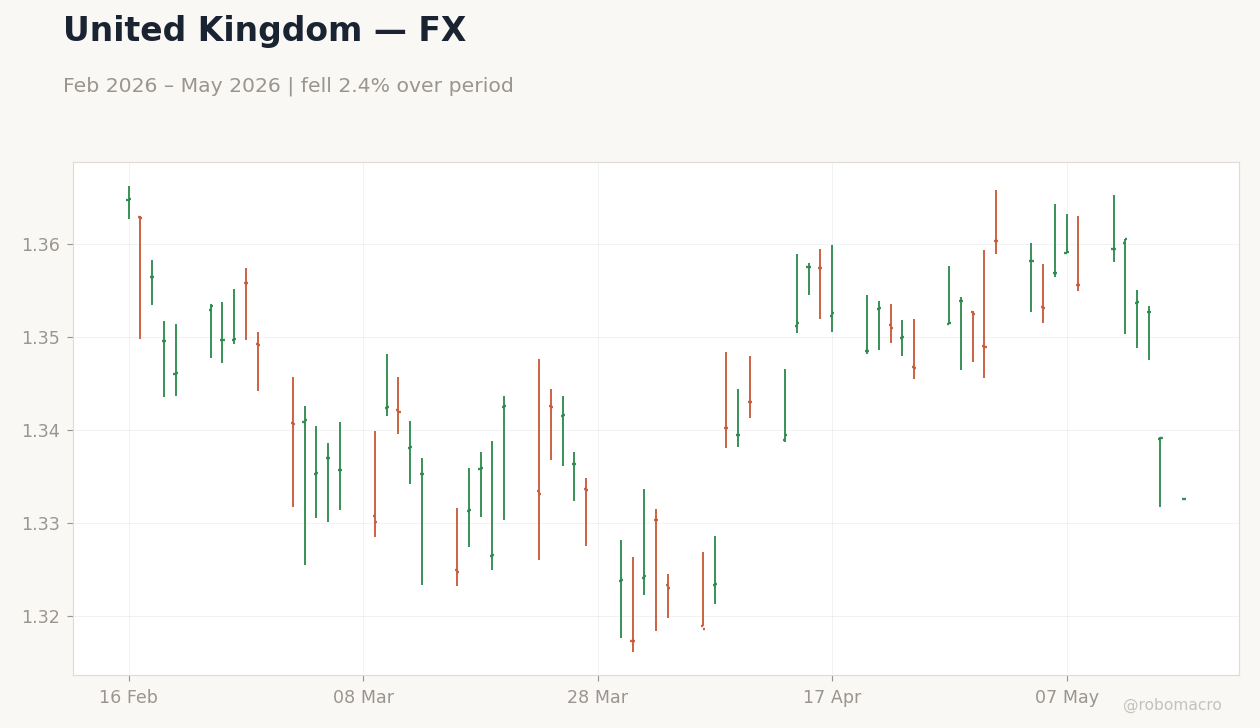
GBP/USD1.33-2.0%
GBP/EUR1.15-0.8%
GBP/JPY211.53-0.8%
Brent Crude109.26+4.8%
Gold4561.9-3.3%
UK Nat Gas2.96+1.7%
Bitcoin78213.58-4.8%
Chart 1
Chart 2
  • BRC Retail Sales Monitor plunged sharply year-over-year, marking the sharpest consumer spending contraction in the recent cycle.
  • RICS House Price Balance fell further, confirming accelerated housing market weakness.
  • Bank of England held Bank Rate steady with no change to forward guidance, leaving BoE OIS pricing for cuts unchanged through year-end.
  • FTSE 100 closed the week at 10195.4, down 0.72% week-over-week, while GBP/USD fell 1.98% to 1.33 amid broad sterling softening.

Week in Review

Retail spending contraction dominates sentiment. The BRC Retail Sales Monitor missed expectations by a wide margin and reversed the prior reading. This outcome aligned with elevated borrowing costs and modest wage growth, prompting immediate downward revisions to near-term consumption forecasts. Housing market fragility intensifies. The RICS House Price Balance slumped below consensus and the prior reading, reflecting mortgage rate pressures that continued to suppress buyer demand. GDP and investment data set a cautious tone. Preliminary Q1 GDP figures and business investment prints arrived mixed, with the 3-month average GDP positive but subdued and the goods trade balance widening, underscoring weak domestic momentum. Markets responded with gilt yields rising and sterling depreciation, as participants priced reduced odds of near-term policy easing. Equity indices diverged by size. The FTSE 100 advanced modestly mid-week before closing lower, while the FTSE 250 fell week-over-week on domestic cyclical exposure. Overall, the week reinforced a narrative of resilient but slowing UK growth, with data misses shifting focus toward downside risks in the expansion phase.

BoE Watch

The Bank of England maintained Bank Rate with no shift in forward guidance, leaving BoE OIS curves pricing limited cuts over the coming quarters. Scheduled speakers are expected to reiterate data-dependent guidance, but this week's data flow already tempered expectations for accelerated easing. Retail sales and housing misses reinforced the view that domestic demand is cooling without yet threatening the inflation target path. Minutes from the latest meeting continued to stress data dependence, with emphasis on wage and services inflation persistence. The week's GDP and trade figures suggest the medium-term rate path remains anchored around gradual normalization rather than rapid reversal. Market pricing for year-end rates showed only marginal adjustment despite the consumer weakness. Overall, the Bank appears comfortable holding steady while monitoring incoming inflation prints for confirmation of disinflation progress.

Data Review

The BRC Retail Sales Monitor delivered the clearest negative surprise, indicating consumer retrenchment amid persistent cost-of-living pressures. RICS House Price Balance followed with a larger-than-expected decline, extending the prior reading and highlighting mortgage affordability constraints that have now persisted for multiple quarters. Preliminary GDP prints showed below-consensus quarterly growth, with the 3-month average holding steady and monthly GDP positive but modest, collectively pointing to below-trend expansion. Business investment improved from the prior reading but remained short of forecasts, suggesting cautious corporate capex amid uncertainty. Goods trade balance widened while industrial production rose modestly. These releases together signal the UK economy remains in mid-cycle expansion but with clear softening in domestic demand components. The data reinforced expectations for a gradual Bank of England easing path rather than aggressive cuts, as inflation risks from commodities stayed contained. Growth outlook revisions now tilt modestly lower for the second half, with the cycle positioned between peak tightening and early reacceleration.

RoboMacro AI Economic Research

Global Macro Watch

May 17, 2026 robomacro.com

Calendar data unavailable

The Week Ahead

Central bank speeches early in the week are expected to reiterate data-dependent guidance. Labor market data due mid-week, including the unemployment rate, average earnings, and employment change, will be critical for wage-price dynamics. The inflation report later in the week, covering headline and core readings, represents the highest-impact release for rate path reassessment. Flash PMI prints for manufacturing and services, alongside industrial trends and consumer confidence indicators, will shape views on whether recent demand softness persists or shows early stabilization. Central bank commentary will likely focus on balancing growth risks against remaining inflation pressures.

Risks & Themes

This week's retail and housing misses shift the outlook toward greater downside risk in consumer-facing sectors, with positioning now favoring defensive equity tilts. Upside scenarios hinge on inflation prints coming in line with or below expectations, which could reopen BoE easing bets and support gilt rallies. Downside risks center on further sterling depreciation if labor data disappoints, potentially feeding imported inflation. Market mispricing signals appear in the limited move in BoE OIS despite clear demand weakness, suggesting participants remain anchored to prior resilient-growth narratives. Volatility remains contained but could rise around the CPI release. Flow considerations point to continued underweighting in UK cyclicals, with commodity strength providing only a partial hedge via energy exposure.

Cross-Asset

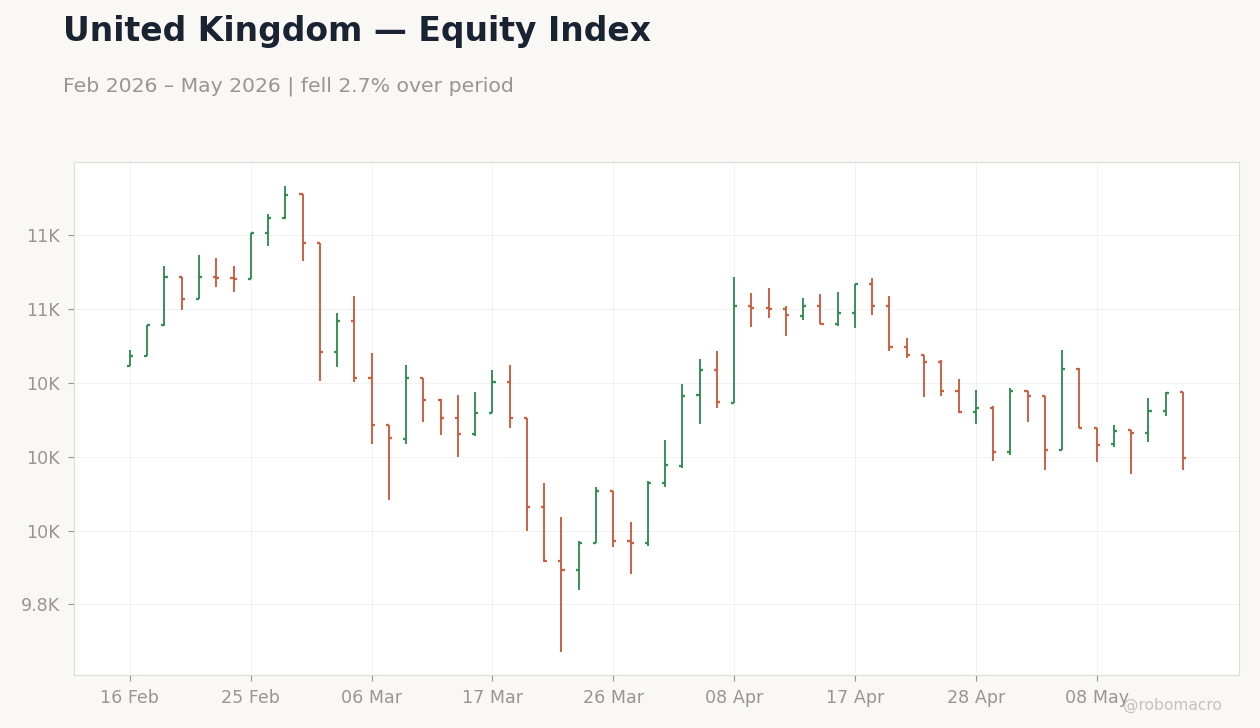
The FTSE 100 ended at 10195.4, down 0.72% week-over-week after closing higher mid-period, supported by energy exposure while broader risk sentiment faded. The FTSE 250 declined 0.93% to 22596.1, with domestic cyclical exposure weighing on performance. UK 10Y Gilt yields climbed, reflecting reduced easing bets after the retail and housing misses. GBP/USD fell 1.98% to 1.33 amid data that highlighted domestic softness. GBP/EUR eased 0.83% to 1.15 while GBP/JPY dropped 0.80% to 211.53. Brent Crude rose 4.85% to 109.26, providing a partial offset for energy-linked equities amid supply concerns. Gold declined 3.32% to 4561.9 as safe-haven flows moderated. UK Nat Gas gained 1.72% to 2.96, while Bitcoin fell 4.78% to 78213.58.

Global Context

Global oil prices rose sharply, with Brent offering relief to UK energy importers but adding mild upside pressure to near-term inflation metrics. Equity momentum from prior weeks carried into early UK trading before fading, consistent with broader international patterns. Geopolitical supply concerns supported commodity prices while gold declined, reducing safe-haven demand for sterling. Trade dynamics showed limited spillover from US or euro-area data, keeping UK-specific domestic prints as the dominant driver. Cross-border capital flows favored higher-yielding assets elsewhere, contributing to sterling weakness.

RoboMacro AI Economic Research

Global Macro Watch

May 17, 2026 robomacro.com
Sweden, Norway, Denmark and Finland
Market Scorecard
AssetLevelWoW
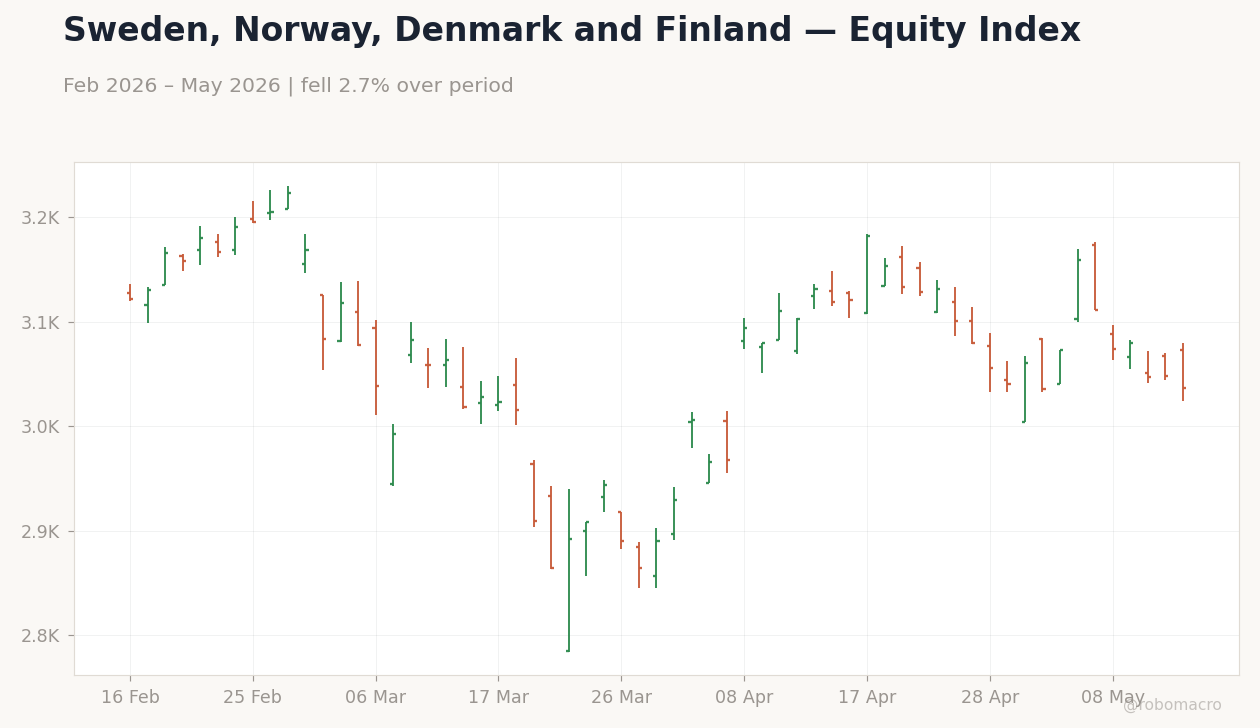
OMX Stockholm 303036.44-1.4%
Oslo Bors2017.85+2.0%
OMX Copenhagen 251768.0+0.3%
OMX Helsinki 256272.91-0.2%
USD/SEK9.43+2.1%
USD/NOK9.3+1.0%
EUR/SEK10.98+1.0%
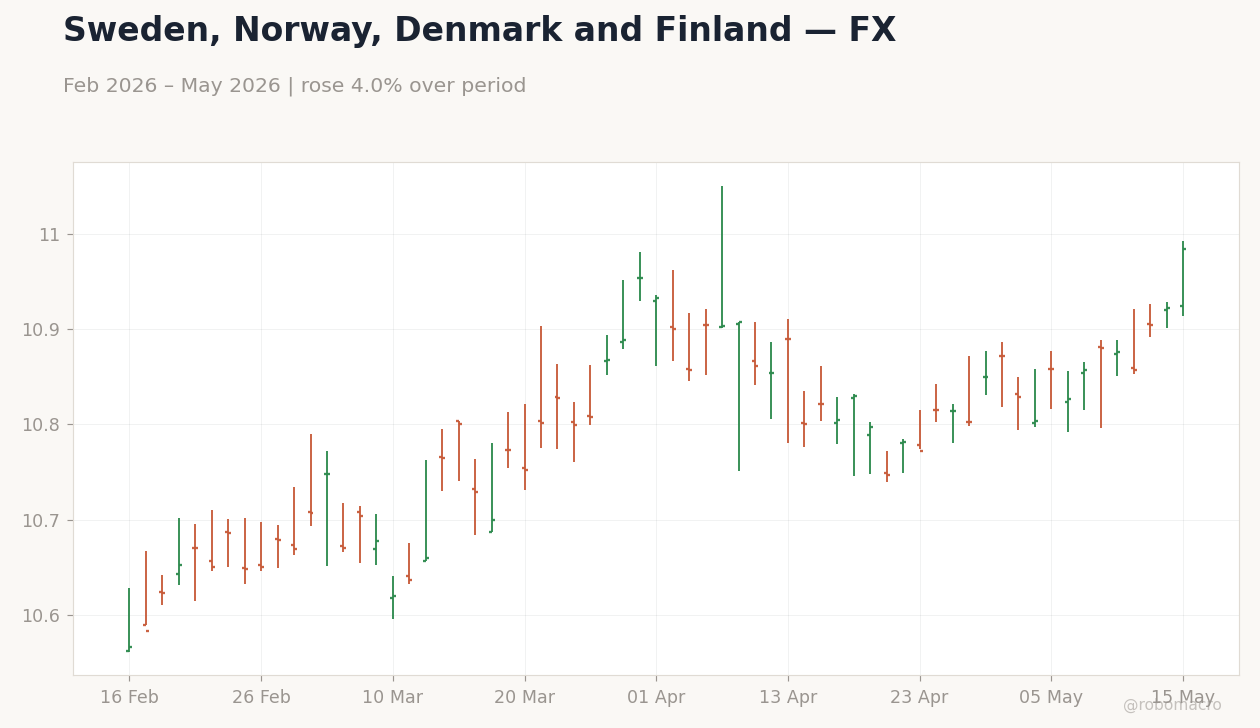
EUR/NOK10.82-0.1%
Brent Crude109.26+4.8%
Gold4561.9-3.3%
Bitcoin78221.47-4.8%
Chart 1
Chart 2
  • Norges Bank delivered a surprise hike, lifting the policy rate and driving EUR/NOK lower mid-week while Brent crude climbed.
  • Nordic equities diverged sharply, with Oslo Bors rising week-over-week on energy strength while OMX Stockholm 30 fell amid rising yields.
  • Sweden and Norway 10Y yields moved higher, reflecting persistent inflation vigilance across the region and modest upward shifts in Riksbank and Norges Bank OIS pricing.

Week in Review

Norges Bank Policy Surprise Anchors the Week Nordic markets absorbed Norges Bank's unexpected hike early in the period, which reinforced the bank's tightening bias amid tight labor markets and elevated oil revenues. The move strengthened the krone, with EUR/NOK closing the period at 10.82. Brent crude's rebound provided additional support for Norwegian assets and fiscal outlook.

Equity Markets Show Clear Divergence Oslo Bors advanced over the week as energy exposure offset modest daily moves. In contrast, OMX Stockholm 30 declined, pressured by a sharp drop mid-period and rising domestic yields. OMX Helsinki 25 posted a net negative finish after a rebound mid-period, while OMX Copenhagen 25 edged up.

Yields and Currencies Reflect Inflation Vigilance Sweden and Norway 10Y yields rose, with both benchmarks posting increases on the final session. USD/SEK climbed while USD/NOK gained, highlighting krona softening against the dollar. EUR/SEK advanced, underscoring regional currency differentiation.

Data Absence Leaves Markets Focused on External Drivers With no major economic releases across the four countries, attention remained on global commodity moves and prior central bank signals. Gold's weekly decline contrasted with Brent's gain, tempering imported inflation concerns for energy importers while supporting Norway's terms of trade.

Nordic Central Banks Watch

Norges Bank surprised markets with the rate decision, citing persistent capacity pressures and oil-driven income gains that justified further tightening. Subsequent remarks reinforced the data-dependent path, prompting modest upward repricing in Norges Bank OIS for the next two meetings. Riksbank stayed on hold with no new signals, though active bond sales continued at a faster pace than the Bank of England, keeping SEK swap rates anchored near recent highs. Danmarks Nationalbank maintained its euro peg without intervention as EUR/DKK stability held, while Bank of Finland commentary echoed the ECB's deposit rate stance. Overall, the week's data reinforced a steeper near-term rate path for Norway relative to Sweden and the euro area.

RoboMacro AI Economic Research

Global Macro Watch

May 17, 2026 robomacro.com

Calendar data unavailable

The Week Ahead

The coming sessions feature a light Nordic data calendar that will nevertheless shape expectations for the next Riksbank, Norges Bank, and ECB decisions. Early-week focus turns to any follow-up speeches from Norges Bank officials on inflation persistence and oil revenue effects, which could further adjust OIS pricing. Mid-week eurozone indicators will influence Bank of Finland and Danmarks Nationalbank views on the shared policy trajectory. Later in the period, attention shifts to Swedish and Norwegian inflation prints that typically inform the upcoming decisions, with consensus pointing to modest cooling that may temper further hikes. Markets will also monitor any Riksbank auction updates for signals on balance-sheet reduction pace. These releases matter because they directly feed into rate-path forecasts, with stronger-than-expected prints likely to support higher terminal-rate expectations in Norway and Sweden.

Risks & Themes

The week's oil rebound reduces downside risks for Norway's growth outlook while raising upside inflation risks that could justify additional Norges Bank tightening. Equity divergence highlights vulnerability in Sweden and Finland to global risk-off moves, especially if yields continue climbing. Currency markets appear to underprice further krone strength should Brent sustain elevated levels, creating potential for sharper EUR/NOK declines. Upside scenarios center on resilient Nordic growth supporting earlier rate cuts elsewhere in Europe, while downside risks include renewed commodity volatility that could challenge the current reflationary tilt in OIS curves.

RoboMacro AI Economic Research

Global Macro Watch

May 17, 2026 robomacro.com
Poland, Czech Republic, Hungary, Romania and Turkey
Market Scorecard
AssetLevelWoW
BIST 10014367.6-5.1%
iShares Poland38.66-2.6%
EUR/PLN4.24+0.1%
EUR/HUF361.43+2.2%
EUR/CZK24.28-0.1%
USD/TRY45.49+0.3%
Brent Crude109.26+4.8%
Gold4561.9-3.3%
Bitcoin78236.71-4.8%
Chart 2
  • Poland and Hungary 10Y yields rose sharply amid fiscal and inflation concerns, marking the largest weekly moves across CEE.
  • BIST 100 declined 5.06% to 14367.6 and iShares Poland fell 2.64% to 38.66 as risk-off flows prevailed even as Brent crude rose 4.85% to 109.26.
  • EUR/HUF advanced 2.24% to 361.43 while EUR/PLN held near 4.24, reflecting divergent CEE currency pressures.
  • No high-impact data releases occurred in Poland, Czech Republic, Hungary, Romania or Turkey.

Week in Review

Yield surge signals term-premium repricing. Poland and Hungary 10Y yields rose sharply, the largest weekly increases in the region, driven by persistent inflation concerns and limited central-bank easing signals. These moves contrasted with the prior week’s oil-relief narrative that had supported risk assets.

Equities decline under global caution. BIST 100 fell 5.06% to 14367.6 while iShares Poland declined 2.64% to 38.66 amid Brent crude volatility that reached 109.26.

FX markets show modest depreciation pressure. EUR/PLN edged 0.11% higher to 4.24 while EUR/CZK slipped 0.10% to 24.28, showing relative resilience compared with EUR/HUF’s 2.24% advance. USD/TRY rose 0.30% to 45.49, keeping Turkish external financing costs elevated.

Commodity crosscurrents add pressure. Brent crude gained 4.85% to 109.26, reversing part of the prior week’s decline and lifting imported inflation risks for Turkey and CEE importers. Gold fell 3.32% to 4561.9, reducing safe-haven support for regional bonds.

Cycle positioning remains expansionary yet fragile. This week’s equity declines and yield increases suggest investors are reassessing growth durability amid higher energy costs. No major data releases occurred, leaving markets to focus on external drivers.

Emerging Europe Central Banks Watch

NBP speakers remained data-dependent, with sticky inflation raising the possibility that policy rates stay on hold longer than markets had anticipated. CNB and BNR delivered no new signals, consistent with the quiet calendar and focus on eurozone linkages. CBRT continues to navigate lira pressure, with USD/TRY at 45.49 underscoring the need for sustained tight policy to anchor inflation expectations. Forward guidance across the region points to a gradual rate path, with this week’s yield increases indicating markets now price less aggressive easing than the prior oil-relief narrative had suggested.

Data Review

No high-impact releases printed across Poland, Czech Republic, Hungary, Romania or Turkey this week, leaving the narrative anchored to external factors. This trajectory aligns with the expansionary global cycle yet highlights sticky core pressures that could delay policy easing. Turkish consumer confidence and regional data remained absent, consistent with the light calendar that shifted attention to external spillovers such as eurozone unemployment. Overall, the data void reinforced market focus on yields and FX as proxies for growth and inflation outlooks, with the prior week’s oil relief now partially unwound by Brent’s 4.85% rebound.

RoboMacro AI Economic Research

Global Macro Watch

May 17, 2026 robomacro.com

Calendar data unavailable

The Week Ahead

Turkish consumer confidence and balance-of-trade prints will offer the first sentiment and external-adjustment gauges following recent readings. Business confidence data will provide a forward-looking signal for Turkish manufacturing amid elevated energy import costs. No rate decisions are scheduled for NBP, CNB, MNB or BNR, but speeches from regional central bankers could clarify responses to the week’s yield increases. Markets will monitor eurozone spillovers given the region’s trade linkages, with volatility likely in PLN and HUF around the Turkish prints.

Risks & Themes

This week’s yield increases signal markets may have underpriced fiscal and inflation risks relative to the prior week’s oil-relief narrative. Upside scenarios include faster EU fund inflows that could compress term premiums and support regional equities. Downside risks center on Brent crude sustaining higher levels, which would widen current-account deficits for Turkey and CEE importers and pressure policy space. Positioning appears light after consecutive equity declines, suggesting scope for short-covering on any positive Turkish confidence surprise. Volatility in EUR/HUF highlights flow sensitivity to external developments that could extend into next week’s data window.

Cross-Asset

Equities posted net weekly losses, with BIST 100 declining 5.06% to 14367.6 and iShares Poland falling 2.64% to 38.66, driven by global risk-off sentiment. Bonds sold off sharply, lifting Poland and Hungary 10Y yields, the largest weekly increases recorded. FX markets showed modest depreciation pressure, with EUR/HUF rising 2.24% to 361.43 while EUR/PLN advanced 0.11% to 4.24 and EUR/CZK slipped 0.10% to 24.28. Commodities diverged, Brent crude climbing 4.85% to 109.26 and gold declining 3.32% to 4561.9, reversing part of the prior week’s energy relief and supporting imported inflation concerns. Bitcoin fell 4.75% to 78236.71, adding to the broad risk-off tone.

Global Context

Global equities extended gains in the prior week, yet this week’s risk-off tone in CEE suggests spillovers from firmer US yields and energy price rebounds. Brent’s 4.85% advance to 109.26 reversed part of the prior oil decline, lifting imported inflation risks for energy-dependent economies such as Turkey and Poland. Eurozone unemployment remains a key external anchor for CEE growth outlooks, with any further softening potentially amplifying easing expectations.

RoboMacro AI Economic Research

Global Macro Watch

May 17, 2026 robomacro.com
South Africa
Market Scorecard
AssetLevelWoW
JSE Top 40106842.1-3.5%
USD/ZAR16.68+1.6%
EUR/ZAR19.39+0.3%
Platinum1991.8-5.8%
Gold4561.9-3.3%
Brent Crude109.26+4.8%
Naspers86842.0-2.5%
Bitcoin78235.54-4.8%
Chart 1
Chart 2
  • South Africa's labor market deteriorated as the unemployment rate rose, weighing on domestic sentiment.
  • JSE Top 40 fell 3.52% week-over-week to 106842.1 while USD/ZAR climbed 1.57% to 16.68, reflecting rand pressure amid mixed commodity moves.
  • South Africa short-term rate held steady with no SARB meetings or speakers, leaving OIS pricing stable but long-term yields easing.

Week in Review

Labor Market Deterioration The headline unemployment rate climbed from the prior reading, confirming deeper weakness in hiring across mining and manufacturing. This outcome exceeded prior expectations and highlighted persistent skills gaps that continue to constrain household spending.

Equity and Currency Volatility JSE Top 40 closed the week at 106842.1 after a 3.52% decline, with Naspers falling 2.46% to 86842.0 and amplifying index losses. USD/ZAR rose 1.57% to 16.68 while EUR/ZAR advanced 0.30% to 19.39, showing rand depreciation despite intermittent commodity support.

Commodity Divergence Platinum declined 5.85% to 1991.8 and gold fell 3.32% to 4561.9, removing a key buffer for resource equities. Brent crude, by contrast, advanced 4.85% to 109.26, providing limited offset through higher energy revenues but raising import-cost concerns.

Bond Market and Fiscal Signals South Africa long-term yields eased after earlier pressure, indicating modest relief in fiscal sentiment. The short-term rate remained anchored, underscoring policy stability amid the data flow.

Political and External Context Ongoing regional weather disruptions and social tensions added downside risks to near-term growth without immediate market repricing.

SARB Watch

The South Africa short-term rate stayed unchanged throughout the week with no SARB speakers or decisions, keeping the policy rate path steady. Unemployment rising reinforced downside risks to growth and reduced pressure for near-term tightening. Long-term yields declined, suggesting markets priced limited fiscal slippage. SARB OIS curves showed negligible shifts, reflecting steady expectations for the next meeting. Data prints continue to support a gradual easing bias in coming quarters provided inflation remains contained.

RoboMacro AI Economic Research

Global Macro Watch

May 17, 2026 robomacro.com

Calendar data unavailable

The Week Ahead

No major domestic data releases appear on the calendar. Global central-bank actions may influence commodity-linked rand flows. Markets will watch whether external developments support further OIS repricing toward cuts later this year. The period carries medium impact and could shift growth and rate forecasts.

Risks & Themes

Rising unemployment raises the probability of additional fiscal support measures that could widen budget deficits. Commodity volatility, with platinum down 5.85% and Brent up 4.85%, creates asymmetric risks for the current-account balance. Political stability may prove temporary. Markets appear to underprice downside growth scenarios given the labor-market print and weather-related losses. An inflation beat could delay any SARB easing signals and push OIS curves higher.

RoboMacro AI Economic Research

Global Macro Watch

May 17, 2026 robomacro.com
Australia and New Zealand
Market Scorecard
AssetLevelWoW
ASX 2008630.8-0.8%
NZX 5012965.01-1.9%
AUD/USD0.72-1.2%
NZD/USD0.58-1.9%
AUD/NZD1.22+0.7%
BHP60.46+3.6%
Gold4561.9-3.3%
Brent Crude109.26+4.8%
Bitcoin78231.13-4.8%
Chart 1
Chart 2
  • Australian home loans declined sharply quarter-over-quarter and investment lending fell, confirming housing-market cooling that challenges earlier momentum.
  • NAB Business Confidence improved while Brent crude rose, supporting commodity-linked AUD resilience despite equity weakness.
  • RBA Meeting Minutes and upcoming employment data will shape OIS pricing for the next policy decision, with 10-year yields moving higher.

Week in Review

Housing data signals cooling demand. Australian home loans contracted quarter-over-quarter while investment lending for homes dropped, underscoring the impact of elevated rates on property activity. Business sentiment shows modest recovery. The NAB Business Confidence Index rose, indicating a slight improvement in corporate outlook even as fiscal measures from the Federal Budget introduced deficit concerns. Equity markets closed lower on the week. The ASX 200 finished at 8630.8, down 0.82% week-over-week, while the NZX 50 declined 1.86% to 12965.01 amid profit warnings and external pressures. Commodity currencies displayed mixed performance. AUD/USD eased 1.16% to 0.72 and NZD/USD fell 1.85% to 0.58, though AUD/NZD advanced 0.69% to 1.22 as BHP gained 3.65% to 60.46 on iron-ore strength. Yields reflected persistent inflation focus. Australia’s 10-year government yield climbed on the week, while New Zealand’s short-term rate held steady. Consumer and manufacturing indicators remain in focus. Westpac Consumer Confidence and Business NZ PMI releases provided limited relief, with markets awaiting confirmation of whether the modest sentiment lift can offset housing weakness. Global commodity moves influenced local pricing. Brent crude advanced 4.85% to 109.26 while gold declined 3.32% to 4561.9, tempering imported inflation relief for Australia and New Zealand. Overall arc points to resilient growth with rate sensitivity. The data flow confirmed earlier expectations of housing moderation yet challenged views of broad-based consumer strength, leaving the growth-inflation balance delicately poised.

ANZ Central Banks Watch

RBA Meeting Minutes scheduled for release next week will clarify how the central bank views the housing slowdown and budget fiscal impulse ahead of the next decision. OIS pricing has shifted modestly higher in the front end as 10-year yields moved higher, reflecting reduced odds of near-term easing. RBNZ speakers have highlighted migration outflows and tech-sector risks, keeping the bank on a cautious path that aligns with softer NZD/USD at 0.58. The combination of improved NAB confidence and Brent crude strength at 109.26 suggests imported inflation pressures may persist, limiting scope for aggressive rate cuts in coming quarters. Markets now price a shallower easing trajectory for both the RBA and RBNZ than was anticipated prior to the housing data.

RoboMacro AI Economic Research

Global Macro Watch

May 17, 2026 robomacro.com

Calendar data unavailable

The Week Ahead

Westpac Consumer Confidence and the RBA Hunter Speech are due early in the period and will test whether household sentiment has stabilized after the budget. RBA Meeting Minutes follow immediately, offering fresh insight into the board’s reaction to the housing data and its implications for the next policy setting. Mid-week brings New Zealand Trade Balance data and Australia’s S&P Global Manufacturing and Services PMI Flash readings, which will gauge whether the expansionary phase remains intact. Employment figures close the week and will directly inform RBA and RBNZ assessments of labor-market slack. Stronger-than-expected jobs data would reinforce a higher-for-longer rate path, while downside surprises could accelerate OIS repricing toward earlier cuts.

Risks & Themes

The sharp housing contraction raises downside risks to consumption if wealth effects intensify, potentially forcing both central banks to reconsider the pace of any upcoming adjustments. Upside surprises in employment or PMI prints could reprice terminal rates higher and pressure AUD/NZD further above 1.22. Markets appear to underweight the inflation impulse from Brent crude’s weekly gain, leaving commodity-linked currencies vulnerable to reversal if global supply concerns ease. Fiscal spending outlined in the recent budget adds a medium-term upside bias to growth that could delay RBA easing relative to current OIS curves.

RoboMacro AI Economic Research

Global Macro Watch

May 17, 2026 robomacro.com
China, Hong Kong and Taiwan
Market Scorecard
AssetLevelWoW
Shanghai Composite4135.39-2.1%
CSI 3004859.59-1.9%
Hang Seng25962.73-1.7%
TAIEX41172.36-1.5%
USD/CNY6.81+0.1%
USD/HKD7.83+0.0%
Copper6.3-1.9%
Brent Crude109.26+4.8%
Gold4561.9-3.3%
Bitcoin78228.53-4.8%
Chart 1
Chart 2
  • China equities declined over the week with Shanghai Composite falling 2.12% to 4135.39 amid external risk factors.
  • Oil prices surged with Brent crude rising 4.85% to 109.26, raising imported inflation concerns for China.
  • PBoC maintained steady policy stance.
  • Global risk sentiment influenced Greater China assets with copper declining 1.85% to 6.30.

Week in Review

Equity markets face pressure from external shocks Greater China equities posted net declines through the week as the Shanghai Composite closed at 4135.39 after a 2.12% weekly drop. CSI 300 finished at 4859.59 for a 1.86% loss while the Hang Seng Index settled at 25962.73 down 1.68%. TAIEX recorded a 1.48% decline to 41172.36.

Commodity and currency crosscurrents intensify Brent crude advanced 4.85% to 109.26 over the seven days while copper slipped 1.85% to 6.30. Gold fell 3.32% to 4561.9. USD/CNY edged 0.12% higher to 6.81. These moves reflected shifting supply and demand signals.

Policy and trade developments provide partial offset Equity volumes remained moderate as participants awaited fresh data. The week closed with broad risk-off flows into safe-haven assets.

Greater China Central Banks Watch

The PBoC kept Loan Prime Rates unchanged ahead of the next decision. Speakers emphasized vigilance on imported inflation from Brent crude above 109. No HKMA or CBC rate moves occurred. OIS pricing continues to reflect steady policy through the summer. Data showing upstream price pressures supports the case for holding rates while monitoring downstream price pass-through.

Data Review

Upstream cost pressures from commodity rallies offset still-subdued domestic demand. The combination suggests the economy remains in a mid-cycle expansion phase with manufacturing holding up better than consumption.

RoboMacro AI Economic Research

Global Macro Watch

May 17, 2026 robomacro.com

Calendar data unavailable

The Week Ahead

Focus remains on upcoming China industrial production and retail sales prints. PBoC Loan Prime Rate decision is expected to hold steady. Follow-through market reaction and any additional PBoC or HKMA commentary will clarify whether consumption is accelerating enough to support the growth outlook.

Risks & Themes

Oil at 109.26 raises upside risks to imported inflation and could delay any easing bias. Equity positioning appears light after the 2.12% Shanghai Composite decline. Volatility in copper suggests demand signals remain fragile.

Cross-Asset

Equities closed the week lower with Shanghai Composite at 4135.39 down 2.12% and CSI 300 at 4859.59 off 1.86%. The Hang Seng Index fell 1.68% to 25962.73 while TAIEX declined 1.48% to 41172.36. Bonds rallied on abundant liquidity with China benchmark yields moving lower. USD/CNY rose 0.12% to 6.81 while USD/HKD held near 7.83. Copper fell 1.85% to 6.30. Brent crude climbed 4.85% to 109.26 on supply concerns. Gold dropped 3.32% to 4561.9.

Global Context

Middle East developments lifted Brent crude 4.85% and added imported inflation pressure for China. Broader risk-on equity moves elsewhere contrasted with Greater China underperformance. Geopolitical spillovers dominated the last seven days.

RoboMacro AI Economic Research

Global Macro Watch

May 17, 2026 robomacro.com
South Korea
Market Scorecard
AssetLevelWoW
KOSPI7493.18-4.2%
KOSDAQ1129.82-6.4%
USD/KRW1497.76+2.5%
Samsung270500.0-5.2%
SK Hynix1819000.0-3.2%
Brent Crude109.26+4.8%
Gold4561.9-3.3%
Bitcoin78208.22-4.8%
Chart 1
Chart 2
  • South Korea's headline unemployment rate rose in April, marking a modest labor-market softening against resilient export data.
  • The KOSPI declined 4.21% week-over-week to 7493.18 while USD/KRW climbed 2.55% to 1497.76, reflecting foreign outflows and external pressures.
  • New Bank of Korea board member comments flagged heightening inflation worries, shifting BoK OIS pricing toward a less dovish rate path.

Week in Review

Export Resilience Amid Record Surplus South Korea posted its largest-ever current account surplus in March, driven by semiconductor and shipbuilding export strength that offset softer domestic indicators. The data reinforced the external-demand pillar of growth even as global oil prices rose.

Labor Market Cooling Confirmed The headline unemployment rate increased in April from the prior month, delivering a clear consensus miss that pointed to gradual easing in employment conditions. This print arrived alongside mixed corporate news, including Samsung Electronics union negotiations that weighed on sentiment.

Equity and Currency Volatility Markets traced a volatile arc, with the KOSPI posting a sharp weekly decline amid swings in AI-related shares. SK Hynix and Samsung Electronics both finished lower, underscoring sector rotation pressures.

Yield Curve and Capital Flow Signals The Korea long-term rate edged higher while the short-term rate eased, widening the curve and reflecting inflation vigilance. USD/KRW advanced steadily, consistent with foreign-capital outflows noted in multiple sessions.

Through-Line Assessment The week's data confirmed export-led resilience yet challenged prior assumptions of a uniformly tight labor market, producing a net-neutral growth signal for the Bank of Korea. No major consensus beats occurred outside the current-account release, leaving the narrative centered on external strength offsetting domestic moderation.

BoK Watch

New Bank of Korea board member remarks explicitly flagged rising inflation concerns, tempering earlier market expectations for near-term easing. Short-term rates held steady with only modest BoK OIS repricing lower, while long-term yields rose, embedding a cautious policy tilt. Governor Shin Hyunsong's upcoming G7 participation adds visibility but is unlikely to alter the data-dependent stance ahead of the next meeting. The April unemployment uptick and persistent won depreciation together reduce the urgency for an immediate cut, keeping the BoK OIS curve modestly steeper than pre-week levels. Overall, the data flow supports a hold at upcoming decisions while leaving room for a shallow easing path only if inflation metrics moderate further in coming quarters.

RoboMacro AI Economic Research

Global Macro Watch

May 17, 2026 robomacro.com

Calendar data unavailable

The Week Ahead

The Consumer Confidence Index release will provide the first read on household sentiment following the labor-market softening, with implications for consumption forecasts that feed directly into Bank of Korea growth projections. Markets will parse any downside surprise for clues on whether domestic demand is decelerating faster than external demand can offset. No other high-impact Korean data are scheduled, shifting focus to global semiconductor and oil-price updates that influence export orders. Any further won weakness would heighten imported-inflation risks and could prompt verbal intervention from officials ahead of the next policy decision. Investors will also monitor corporate updates on SK Hynix supply deals and Samsung labor talks for equity-market spillovers. The light calendar leaves BoK OIS pricing sensitive to external risk sentiment, particularly Middle East developments that could alter the inflation outlook for coming quarters.

Risks & Themes

The week's labor softening and equity sell-off raise downside risks to the domestic-demand outlook, potentially accelerating BoK easing if consumer confidence disappoints next week. Upside risks center on sustained AI-driven chip demand that could keep export momentum intact and limit imported-inflation pass-through despite higher Brent levels. Markets appear to underprice the persistence of won depreciation, which could re-ignite inflation concerns and delay rate cuts even if growth moderates. Geopolitical oil spikes remain the dominant swing factor, capable of shifting the entire rate-path narrative within a single week.

RoboMacro AI Economic Research

Global Macro Watch

May 17, 2026 robomacro.com
Indonesia, Thailand, Malaysia, Philippines, Singapore and Vietnam
Market Scorecard
AssetLevelWoW
JCI6723.32-2.6%
SET1517.95+1.9%
KLCI1740.22-0.3%
PSEi5976.77-0.2%
STI4989.08+0.9%
USD/IDR17491.0+0.8%
USD/THB32.65+1.2%
USD/MYR3.95+0.8%
USD/PHP61.65+1.9%
USD/SGD1.28+1.0%
Brent Crude109.26+4.8%
Gold4561.9-3.3%
Chart 1
Chart 2
  • Indonesia Q1 GDP growth accelerated, beating expectations and underscoring resilience amid rupiah pressure.
  • SET index rose while Brent crude climbed, supporting commodity-linked assets across the region.
  • Bank Indonesia's upcoming rate decision and potential MAS band adjustments gained focus as USD/IDR and USD/THB both strengthened over the week.

Week in Review

Equity Divergence Amid Commodity Volatility ASEAN equity markets displayed clear bifurcation over the seven-day period. The SET index advanced after Thailand's finance minister projected growth on new investment inflows. In contrast, the JCI fell despite Indonesia's Q1 GDP print, the fastest pace in over three years. The KLCI slipped while the PSEi declined. Singapore's STI posted a modest gain, reflecting its role as a financial hub.

Currency Weakness and Oil Pressure Regional currencies depreciated against the USD throughout the week. USD/IDR rose while USD/THB increased. USD/MYR climbed and USD/PHP advanced. Brent crude surged, reversing earlier relief and adding imported inflation concerns for Thailand and the Philippines. Gold declined, reducing safe-haven demand.

Growth Data Confirming Resilience Indonesia's Q1 expansion exceeded consensus and highlighted strength in government spending plus commodity exports. Thailand's Q1 GDP figures will test whether tourism recovery offsets oil shocks. Malaysia's April inflation data follows earlier readings. These releases collectively reinforced the view of steady but uneven expansion across ASEAN economies.

Policy Signals and Market Positioning Foreign central banks continued adding Malaysian sovereign bonds, supporting the KLCI despite modest losses. Indonesia tightened FX purchase rules after the rupiah tested record lows. Thailand's government advanced plans for new borrowing to cushion Middle East-related oil impacts. The data arc suggests growth momentum persists even as external pressures from rising energy prices test external balances.

ASEAN Central Banks Watch

Bank Indonesia kept its policy rate ahead of the decision while markets priced modest tightening odds in BI OIS following the strong Q1 GDP outturn. The Bank of Thailand maintained a neutral stance as baht depreciation prompted discussion of stimulus measures tied to the upcoming GDP release. Bank Negara Malaysia held steady with no signals of near-term change, supported by steady foreign bond inflows. BSP and MAS showed limited movement in OIS curves despite peso and SGD weakening. SBV continued its gradual easing path without new data this week. Overall, the week's commodity-driven inflation risks tilted forward guidance toward caution at the next policy meetings.

RoboMacro AI Economic Research

Global Macro Watch

May 17, 2026 robomacro.com

Calendar data unavailable

The Week Ahead

Thailand's Q1 GDP growth figures, both quarter-over-quarter and year-over-year, will be released and are expected to show modest expansion near prior levels. Malaysia's April inflation data will provide the latest read on price stability after earlier prints. Indonesia's central bank interest rate decision will be watched for any shift in response to rupiah volatility and the Q1 GDP beat. These releases will inform the near-term rate path for BI, BoT, BNM, BSP, MAS and SBV by clarifying whether growth momentum offsets oil-driven price pressures. Markets will assess implications for upcoming decisions and the coming quarters' policy stance. Any surprises in the Thai GDP print could alter BoT stimulus expectations while Malaysian inflation data will test BNM's tolerance for imported cost increases.

Risks & Themes

Rising Brent crude introduces upside inflation risks that could delay easing at the next BI and BoT meetings. Rupiah weakness near record lows raises the probability of further FX intervention or a surprise BI rate adjustment. Equity outperformance in Thailand masks underlying baht pressure that may challenge the growth forecast if oil remains elevated. Markets appear to underprice the persistence of commodity shocks, as evidenced by the weekly Brent gain versus earlier relief narratives. Downside scenarios include sharper currency moves prompting coordinated policy responses across ASEAN central banks.

RoboMacro AI Economic Research

Global Macro Watch

May 17, 2026 robomacro.com
India
Market Scorecard
AssetLevelWoW
Nifty 5023643.5-0.7%
Sensex75237.99-1.0%
USD/INR95.96+1.6%
EUR/INR111.57+0.2%
Reliance1336.4-3.7%
HDFC Bank767.5+0.5%
Brent Crude109.26+4.8%
Gold4561.9-3.3%
Bitcoin78209.21-4.8%
Chart 1
Chart 2
  • April inflation came in below consensus, opening modest room for the Reserve Bank of India to maintain its current stance despite external pressures.
  • Brent crude rose 4.85% week-over-week to 109.26, driving USD/INR to 95.96 and prompting state oil companies to raise petrol and diesel prices.
  • Forex reserves increased, providing a buffer that the Reserve Bank of India can deploy to smooth rupee volatility without immediate policy adjustment.

Week in Review

Inflation Print Undershoots Expectations India’s April inflation rate came in below consensus and only modestly above the prior reading, confirming that food-price pressures remained contained even as monsoon risks loomed.

Oil Shock and Currency Strain Brent crude rose 4.85% to 109.26 over the week, widening the trade gap and lifting USD/INR 1.62% to 95.96.

Equity benchmarks absorbed the shock unevenly: Nifty 50 declined 0.72% to 23643.5 while Sensex fell 1.02% to 75237.99.

Policy Buffer from Reserves Higher forex reserves gave the Reserve Bank of India additional ammunition to defend the rupee, limiting the need for aggressive intervention or rate signals.

State-run oil companies raised petrol and diesel prices, passing through part of the cost shock to consumers and reinforcing the external headwind narrative.

Market Resilience Amid Volatility HDFC Bank shares rose 0.50% to 767.5 while Reliance fell 3.73% to 1336.4, illustrating sector rotation away from energy-sensitive names toward domestic lenders.

Gold declined 3.32% to 4561.9 as risk appetite partially returned, and Bitcoin fell 4.78% to 78209.21, consistent with broader de-risking across asset classes.

The data arc shows an economy that entered the week with contained domestic inflation but exited under renewed imported-price pressure, leaving growth and inflation forecasts only modestly revised.

RBI Watch

The April inflation print reinforced the Reserve Bank of India’s data-dependent posture and reduced the urgency for near-term easing even as oil prices rose. Speakers maintained a neutral tone, noting that imported inflation risks from Brent could offset the benign core reading. RBI OIS pricing shifted only marginally higher, reflecting market expectations that the policy rate will stay on hold through the next meeting. Forex reserves allow the central bank to manage rupee volatility at 95.96 without immediate liquidity tightening. Forward guidance continues to emphasize vigilance on both inflation and external balances rather than any pre-commitment to cuts.

RoboMacro AI Economic Research

Global Macro Watch

May 17, 2026 robomacro.com

Calendar data unavailable

The Week Ahead

HSBC Composite PMI Flash, Manufacturing PMI Flash, and Services PMI Flash are scheduled for release on May 21. Stronger-than-expected prints would support the view that domestic momentum remains intact and give the Reserve Bank of India further justification to keep rates steady at the next meeting. Conversely, any material downside surprise could revive cut expectations for coming quarters by signaling slower credit demand. Markets will also monitor daily oil and USD/INR moves for signs that the current shock is peaking or persisting. The Reserve Bank of India’s reaction function will focus on whether the PMI pulse confirms resilient growth or highlights downside risks that warrant earlier policy support. No other high-impact domestic releases are due, keeping attention on these forward-looking indicators and their implications for the upcoming rate decision.

Risks & Themes

The dominant risk remains a sustained oil price shock that could widen the current-account deficit and force faster rupee depreciation. Upside scenario centers on continued forex reserve accumulation and contained inflation allowing the Reserve Bank of India to stay on hold while growth holds above trend. Downside scenario involves further geopolitical escalation that pushes Brent materially higher and compresses RBI policy space. Markets appear to be under-pricing the second-round effects of the fuel-price hike on core inflation and rural demand, leaving OIS curves vulnerable to repricing if incoming PMI data disappoint.

RoboMacro AI Economic Research

Global Macro Watch

May 17, 2026 robomacro.com
Turkey
Market Scorecard
AssetLevelWoW
BIST 10014367.6-5.1%
USD/TRY45.49+0.3%
EUR/TRY52.91-0.8%
GBP/TRY60.64-1.6%
Gold (TRY)4561.9-3.3%
Brent Crude109.26+4.8%
EUR/USD1.16-1.2%
Bitcoin78231.62-4.8%
Chart 1
Chart 2
  • BIST 100 fell 5.06% week-over-week to close at 14367.6 amid successive daily declines.
  • USD/TRY rose 0.3% to 45.49 while EUR/TRY declined 0.75% to 52.91, reflecting contained TRY volatility despite Brent crude advancing 4.85% to 109.26.
  • No CBRT policy meetings or speaker events occurred, leaving OIS pricing stable and focused on upcoming data implications for the rate path.

Week in Review

Equity and currency consolidation. The BIST 100 posted a 5.06% weekly decline to 14367.6 after consecutive sessions of net losses. Commodity price rebound. Brent crude advanced 4.85% to 109.26. TRY cross-rate stability. USD/TRY rose 0.3% to 45.49 while EUR/TRY declined 0.75% to 52.91. Gold and risk-asset divergence. Gold priced in TRY fell 3.32% to 4561.9, underperforming the broader equity market and coinciding with Bitcoin’s 4.76% weekly decline to 78231.62. Inflation transmission channel. Higher Brent levels at 109.26 raise the prospect of renewed imported-price pressure in coming quarters. Growth-signal consistency. The absence of major data releases left market pricing anchored to the observed equity drawdown and contained FX moves. Portfolio rebalancing evidence. Cross-asset performance showed defensive rotation out of BIST 100 and TRY-denominated gold into USD/TRY holdings, consistent with the 0.3% USD/TRY advance. Forward-looking data gap. The current period served mainly as a consolidation phase ahead of potential revisions to growth and inflation forecasts. Cycle positioning update. The week’s price action suggests the Turkish market is digesting earlier global reflationary signals while awaiting confirmation from the next round of domestic indicators.

CBRT Watch

No CBRT rate decision or minutes were released during the period, leaving the policy rate unchanged and OIS curves largely static. Market participants therefore focused on the 0.3% USD/TRY increase and Brent advance to 109.26 as potential inputs for the inflation outlook ahead of the next meeting. Forward guidance remains data-dependent, with the modest TRY stability against the euro at 52.91 suggesting limited immediate pressure on imported inflation. OIS pricing showed no material shift in expected cuts or hikes, reflecting the quiet policy calendar. The data arc implies that stronger-than-expected prints next week could tilt the balance toward a more hawkish stance at upcoming decisions, while soft outcomes would reinforce the current easing bias.

RoboMacro AI Economic Research

Global Macro Watch

May 17, 2026 robomacro.com

Calendar data unavailable

The Week Ahead

Data releases next week will provide the first read on household sentiment after the equity market’s 5.06% decline. Trade balance and business confidence prints will offer direct evidence on external balances and corporate optimism. A narrower trade deficit would support the current-account outlook relevant to CBRT policy. Business confidence will be watched for signs of manufacturing resilience amid higher Brent levels at 109.26. These releases matter because they feed directly into the inflation and growth forecasts that guide the timing of upcoming decisions. A stronger trade print could ease imported-price concerns and allow more room for measured easing, whereas a wider deficit might reinforce caution. Markets will also monitor any follow-through in USD/TRY around 45.49 for clues on capital-flow sensitivity ahead of the next meeting.

Risks & Themes

The 4.85% Brent increase to 109.26 introduces upside risk to near-term inflation that could delay CBRT easing relative to current OIS pricing. Equity-market underperformance of 5.06% raises downside growth risks if sustained into the next quarter. A narrower trade deficit would support the base case of contained external vulnerability, while a miss could pressure TRY crosses beyond the observed 0.3% USD/TRY move. Markets appear to be under-pricing the commodity rebound’s second-round effects on the rate path, leaving scope for OIS curves to steepen if inflation data surprise higher.

RoboMacro AI Economic Research

Global Macro Watch

May 17, 2026 robomacro.com
Gulf Cooperation Council
Market Scorecard
AssetLevelWoW
Saudi Aramco27.78+1.3%
MSCI Saudi38.29-2.2%
MSCI UAE18.92-1.5%
DFM General5708.78-1.9%
MSCI Qatar18.68-2.2%
MSCI Kuwait37.96-1.0%
Brent Crude109.26+4.8%
WTI Crude101.02+3.0%
Gold4561.9-3.3%
USD/SAR3.75+0.8%
USD/AED3.67+0.0%
USD/KWD0.31-0.3%
Chart 1
Chart 2
  • **
  • Brent crude rose 4.85% week-over-week to 109.26, lifting fiscal outlooks across GCC states amid supply risks.
  • MSCI Saudi declined 2.2% to 38.29 while Aramco shares advanced 1.31% to 27.78, highlighting energy sector outperformance against broader equity weakness.
  • GCC central banks maintained stable FX pegs with USD/SAR holding at 3.75, implying unchanged near-term rate paths despite elevated oil revenues and absent policy meetings.

Week in Review

** Geopolitical Supply Risks Drive Oil Rebound Brent crude advanced 4.85% to 109.26 and WTI rose 3.01% to 101.02. Supply concerns supported prices, with Aramco maintaining maximum utilization of the East-West Pipeline to bypass the Strait of Hormuz.

Aramco Earnings Strength Offsets Equity Weakness Aramco shares advanced 1.31% to 27.78 even as MSCI Saudi fell 2.2% to 38.29 and DFM General declined 1.91% to 5708.78. MSCI UAE fell 1.46% to 18.92, MSCI Qatar declined 2.2% to 18.68, and MSCI Kuwait dropped 1.0% to 37.96, reflecting investor caution over regional security. Gold declined 3.32% to 4561.90.

Non-Oil Diversification Advances Amid Elevated Revenues Saudi Arabia advanced digital payment and tokenization initiatives. UAE and Qatar progressed on infrastructure projects to support long-term export resilience. GCC refinery utilization remained firm, supporting middle-distillate cracks while sovereign CDS spreads stayed steady.

Cycle Positioning and Fiscal Implications GCC economies benefited from higher oil prices while navigating security concerns. Stable FX pegs at USD/AED 3.67 and USD/KWD 0.31 point to sustained fiscal space for non-oil projects.

GCC Central Banks Watch

** GCC central banks delivered no rate decisions or minutes this week, leaving policy rates and forward guidance unchanged. Stable FX pegs, including USD/SAR at 3.75 and USD/AED at 3.67, indicate that GCC CBs OIS pricing incorporated no material shift in expected rate paths despite Brent trading above 109. Elevated oil revenues are likely to ease liquidity management pressures. The absence of meetings reinforces a data-dependent stance focused on inflation moderation and non-oil diversification progress. Markets priced limited near-term volatility in GCC CBs OIS curves given peg stability.

RoboMacro AI Economic Research

Global Macro Watch

May 17, 2026 robomacro.com

Calendar data unavailable

The Week Ahead

** Next week’s calendar centers on global oil inventory releases and Hormuz transit updates. OPEC+ monitoring of Saudi voluntary cuts through June will influence fiscal revenue expectations. Regional authorities may provide updates on LNG security and pipeline projects. G10 central bank announcements could offer indirect read-throughs for global easing cycles. Focus remains on tokenization initiatives and Hajj-related fiscal outlays ahead of the next policy reviews.

Risks & Themes

** Geopolitical escalation around Hormuz represents the dominant downside scenario, with potential for sharper Brent spikes that could challenge inflation moderation. Upside risks center on sustained oil prices supporting faster non-oil project execution. Equity underperformance versus Aramco gains points to sector bifurcation. Commodity price splits could signal shifting safe-haven demand that affects GCC fiscal resilience.

RoboMacro AI Economic Research

Global Macro Watch

May 17, 2026 robomacro.com
Week Ahead CalendarMay 18 – May 22, 2026
Time Country Event Consensus Prior Impact
●●● High impact    ●●○ Medium impact    CB Central bank event    All times ET    Source: RoboMacro Economic Calendar
RoboMacro AI Economic Research

Global Macro Watch

May 17, 2026 robomacro.com

Disclosures & Important Information

AI-Generated Content: This publication is 100% generated by artificial intelligence systems (xAI Grok) and should not be considered as financial advice, investment recommendation, or professional research. All analysis, forecasts, and commentary are algorithmically produced.

Data Sources: Market data sourced from Yahoo Finance, CBOE, FinanceFlow API, FRED, and national statistics offices. Economic calendar data from RoboMacro Economic Calendar. Forecast data based on IMF WEO, OECD Economic Outlook, and consensus surveys. All data subject to revision and may be delayed.

No Warranty: RoboMacro makes no warranty, express or implied, regarding the accuracy, completeness, or reliability of the information contained in this publication. Data may be delayed, incomplete, or contain errors. Past performance is not indicative of future results.

Not Financial Advice: Nothing in this publication constitutes investment advice, tax advice, legal advice, or any other form of professional advice. Any opinions expressed are AI-generated and do not represent the views of any individual or organisation. Readers should consult qualified professionals before making investment decisions.

Forecast Methodology: GDP and CPI forecasts are derived from IMF World Economic Outlook projections, OECD estimates, and real-time consensus surveys. Central bank rate paths incorporate OIS market pricing, forward guidance analysis, and Taylor rule estimates. All forecasts are point estimates and carry significant uncertainty.

Contact: [email protected] | robomacro.com

Publication: Global Macro Watch is published weekly on Fridays. © 2026 RoboMacro. All rights reserved.