ASEAN Macro Daily(Beta Mode)
Rupiah Hits 18,000 as BI Signals Defense
Market Snapshot
| Asset | Level | Change |
|---|---|---|
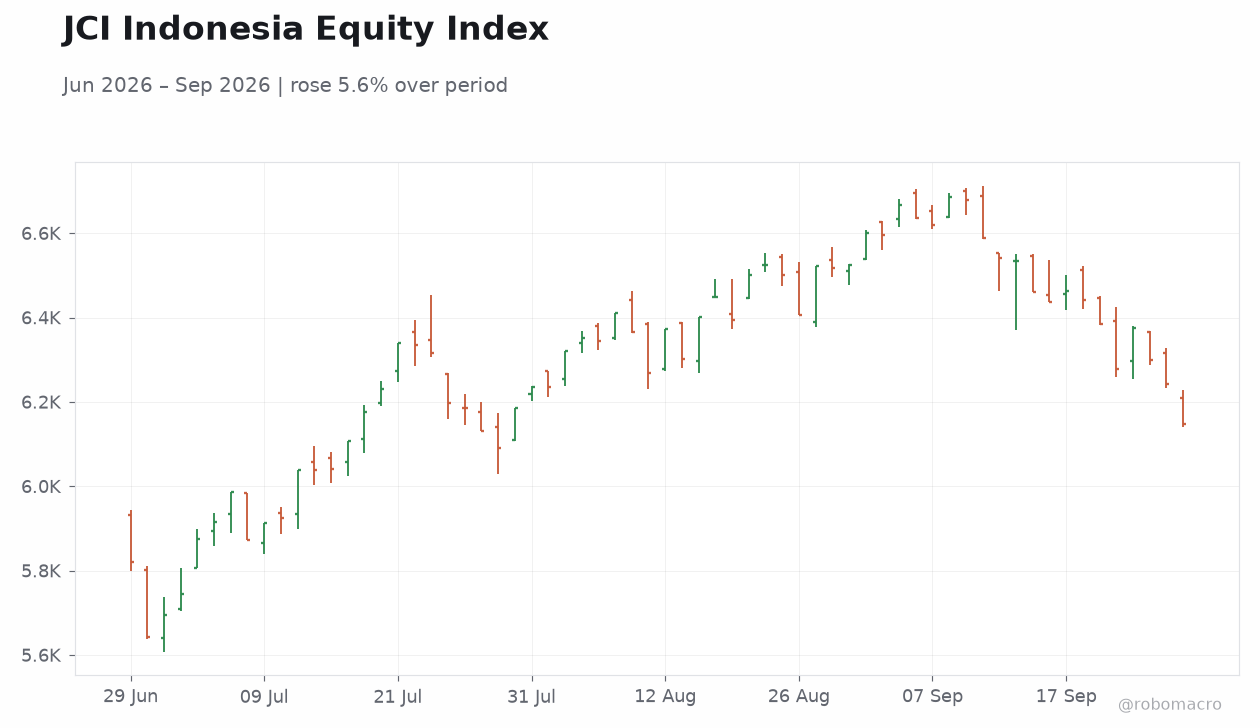
| JCI | 6,147.86 | -1.51% |
| KLCI | 1,670.02 | -0.10% |
| STI | 5,729.02 | +0.31% |
| USD/IDR | 17,993.00 | +0.24% |
| USD/THB | 33.51 | +0.24% |
| USD/MYR | 4.08 | +0.11% |
| USD/PHP | 62.45 | +0.13% |
| USD/SGD | 1.28 | -0.08% |
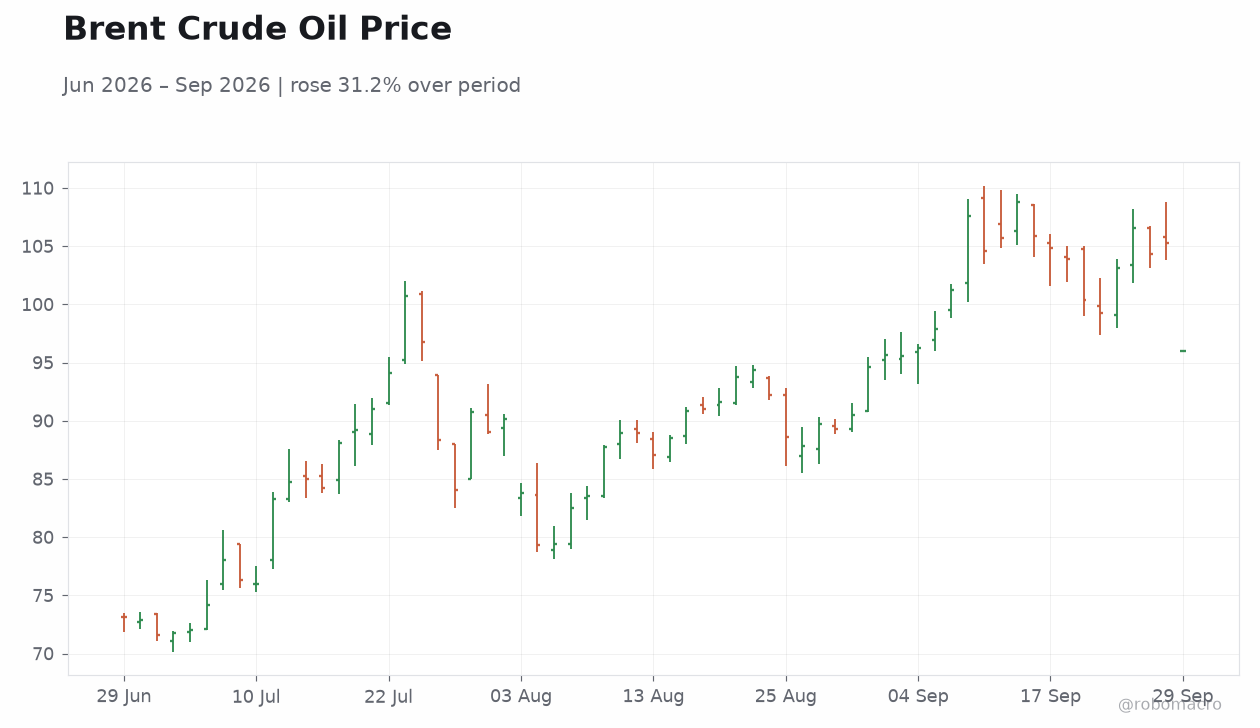
| Brent Crude | 95.67 | -9.13% |
| Gold | 4,215.00 | +1.12% |
| Bitcoin | 83,506.51 | +0.00% |
| Indonesia 10Y Govt Yield | - | - |
| Thailand 10Y Govt Yield | - | - |
Prior Economic Events
| Data | Prior | Cons | Actual |
|---|---|---|---|
| No events available | |||
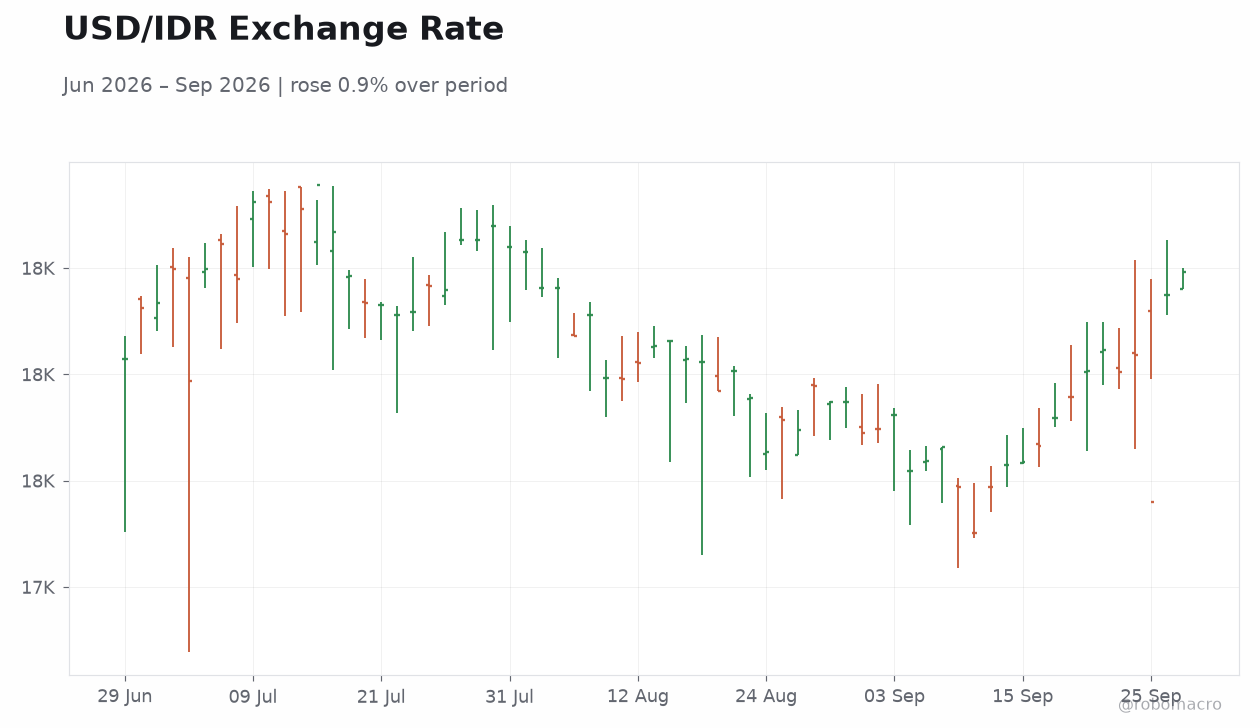 USD/IDR Exchange Rate | Type: market_hloc | USD per IDR: 1.799e+04 (2026-09-29) | Range: 1.75e+04–1.816e+04 | Trend(6pt): 1.783e+04,1.793e+04,1.782e+04,1.772e+04,1.756e+04,1.799e+04
Today's Economic Events
| Data | Prior | Cons | Time |
|---|---|---|---|
| Inflation Rate Year-over-Year | 3.19 | - | 20:00 |
| Trade Balance | 130m | - | 20:00 |
- Rupiah hits 18,000 threshold amid outflows, prompting BI intervention shift
- JCI drops 1.51% while STI gains 0.31% on regional divergence
- Indonesia inflation and trade data due tomorrow; Thailand advances US trade talks
Yesterday's Recap
Indonesian markets dominated ASEAN action as the rupiah breached the 18,000 level against the USD, closing at 17,993 after a 0.24% daily gain in USD/IDR. Portfolio outflows and sustained FX demand pressured the currency despite earlier rate support, with Bank Indonesia acknowledging fundamental problems behind the depreciation. The Jakarta Composite Index fell 1.51% to 6,147.86.
In contrast, Singapore’s STI rose 0.31% to 5,729.02 while Malaysia’s KLCI eased 0.10%. Thailand’s cabinet approved a 1.26 trillion baht FY2027 borrowing plan with public debt projected above 69% of GDP. The Thai baht also hit a two-month low as regional Asian currencies weakened.
No macro data releases occurred across the six ASEAN economies on 28 September.
The Day Ahead
Indonesia will publish August inflation year-over-year and trade balance figures at 20:00 ET on 30 September. The inflation print follows the prior 3.19% reading while trade balance data will update from the previous 130 billion rupiah surplus. No central bank meetings, policy announcements or bond auctions are scheduled for any ASEAN market.
Thailand continues implementation work on its high-income action plan targeting manufacturing and digital sectors by 2037. Regional traders will monitor USD strength and oil price movements for further currency implications.
Other Economic Notes
Persistent foreign outflows from Indonesia highlight eroding rate-support effects on the rupiah as BI reduces spot intervention to 30% of total FX operations. Thailand’s push for a US trade agreement ahead of the Section 301 review aims to secure supply-chain positioning amid ongoing China shifts. The sharp 9.13% drop in Brent crude to 95.67 offers relief to import-dependent ASEAN economies but pressures commodity exporters like Indonesia.
Gold’s 1.12% advance to 4,215 reflects safe-haven demand amid global uncertainty. No fresh PMI or FDI prints emerged to alter growth assessments.