ASEAN Macro Daily(Beta Mode)
Rupiah Holds Near 18k as BI Intervenes
Market Snapshot
| Asset | Level | Change |
|---|---|---|
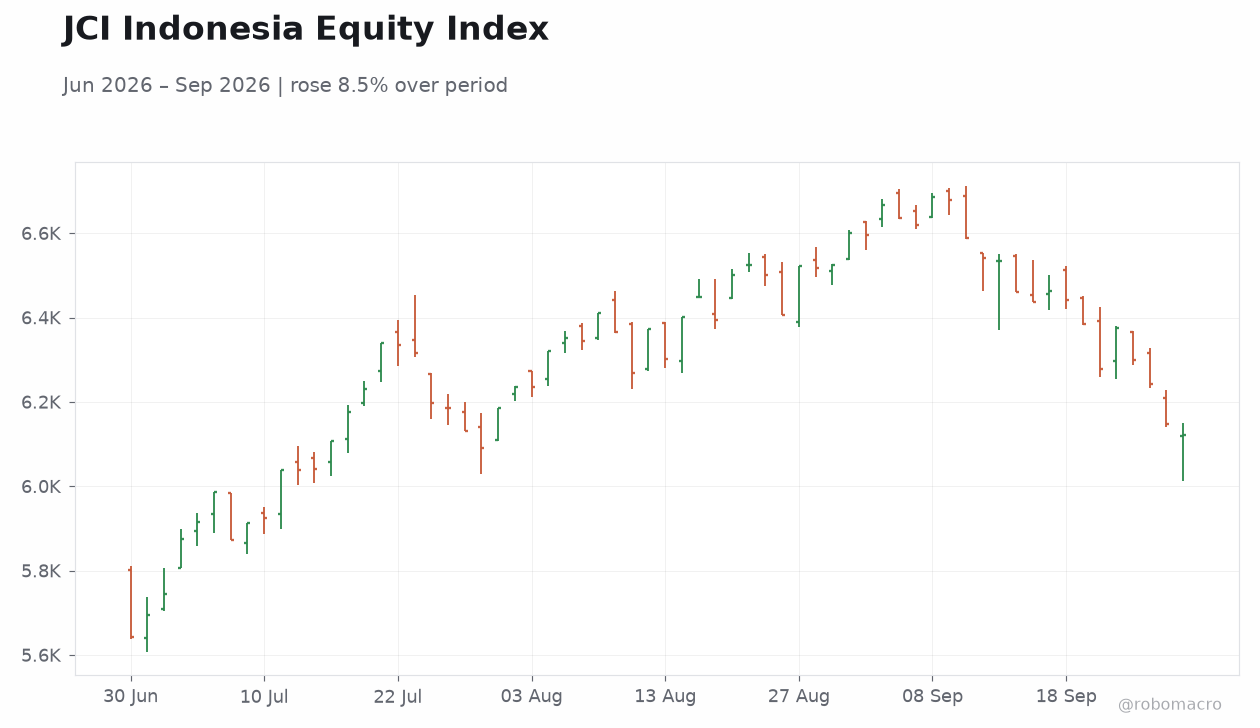
| JCI | 6,121.70 | -0.43% |
| KLCI | 1,643.96 | -1.56% |
| STI | 5,714.84 | -0.25% |
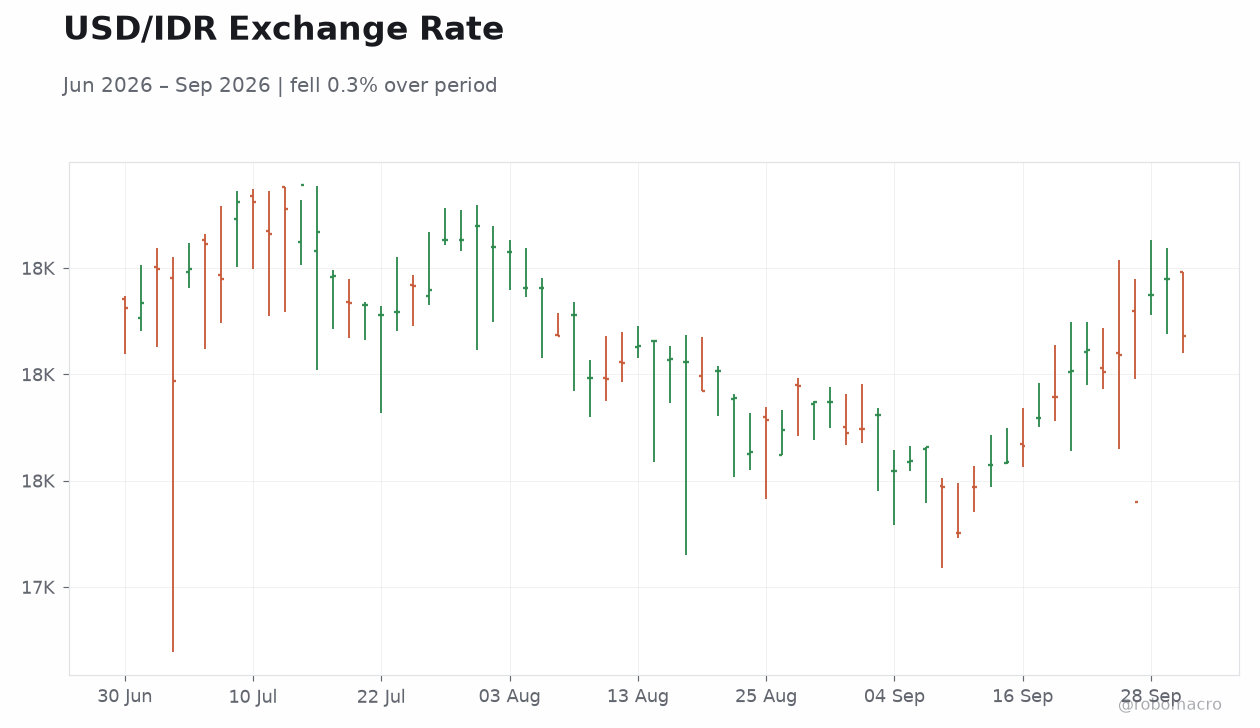
| USD/IDR | 17,872.00 | -0.60% |
| USD/THB | 33.53 | -0.21% |
| USD/MYR | 4.07 | -0.18% |
| USD/PHP | 62.68 | +0.48% |
| USD/SGD | 1.28 | +0.02% |
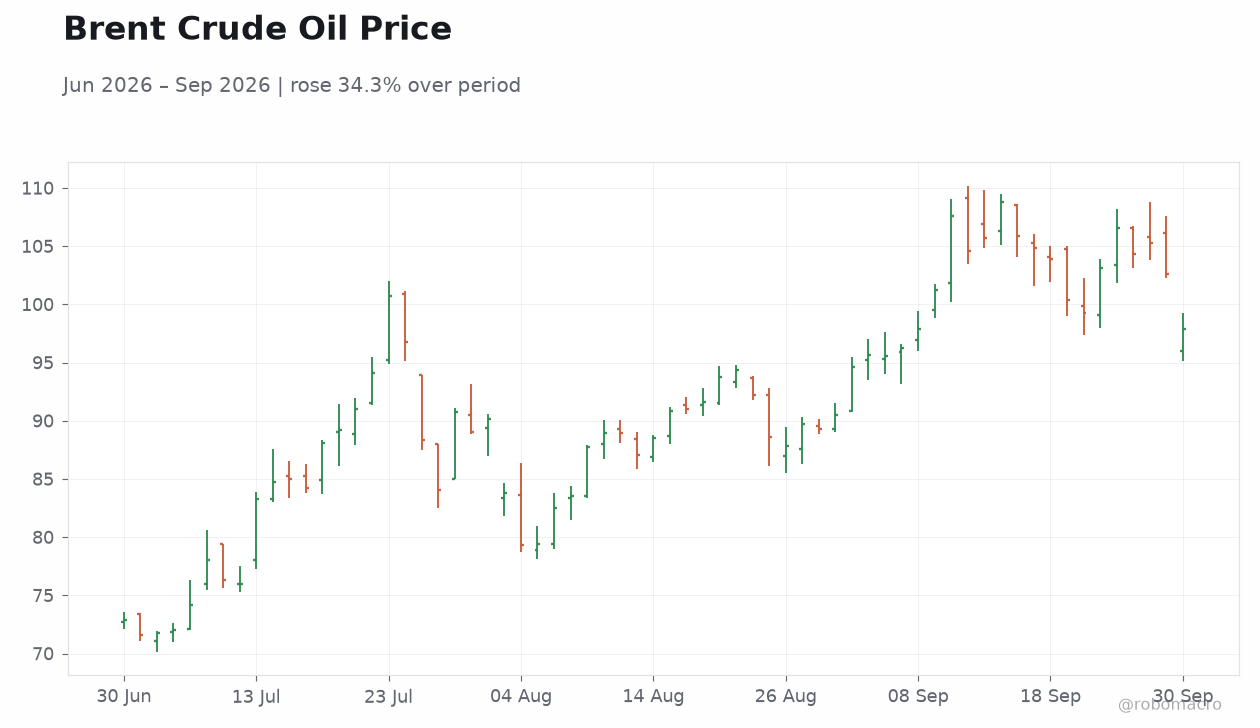
| Brent Crude | 97.92 | -4.55% |
| Gold | 4,189.10 | +0.22% |
| Bitcoin | 83,601.02 | -0.03% |
| Indonesia 10Y Govt Yield | - | - |
| Thailand 10Y Govt Yield | - | - |
Prior Economic Events
| Data | Prior | Cons | Actual |
|---|---|---|---|
| No events available | |||
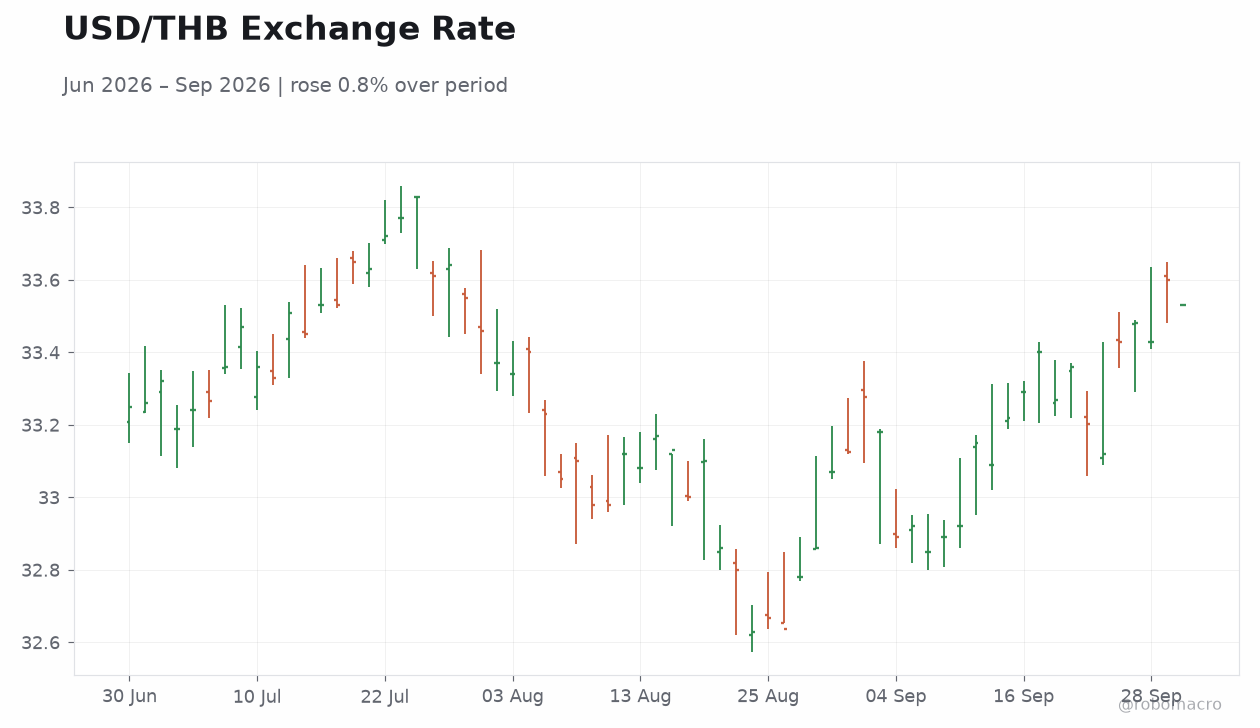 USD/THB Exchange Rate | Type: market_hloc | THB per USD: 33.53 (2026-09-30) | Range: 32.63–33.83 | Trend(6pt): 33.25,33.72,33.08,32.89,33.43,33.53
Today's Economic Events
| Data | Prior | Cons | Time |
|---|---|---|---|
| Inflation Rate Year-over-Year | 3.19 | - | 20:00 |
| Trade Balance | 130m | - | 20:00 |
| Thursday (2026-10-01) | |||
| Inflation Rate Year-over-Year | 3.19 | - | 20:00 |
| Trade Balance | 130m | - | 20:00 |
- Indonesia inflation YoY and trade balance due at 20:00 ET today
- Regional equities fell, with KLCI down 1.56% and JCI off 0.43%
- BI sustains spot-market intervention while rupiah closes at 17,872
Yesterday's Recap
No macroeconomic releases occurred across ASEAN on 29 September. Equity markets closed lower, with Indonesia’s JCI declining 0.43% to 6,121.70, Malaysia’s KLCI falling 1.56% to 1,643.96, and Singapore’s STI easing 0.25% to 5,714.84. Currencies showed mixed performance against the USD, as USD/IDR fell 0.60% to 17,872, USD/THB slipped 0.21% to 33.53, and USD/MYR declined 0.18% to 4.07 while USD/PHP rose 0.48% to 62.68.
Brent crude plunged 4.55% to 97.92, providing some relief to regional importers. News flow centered on Indonesia, where reports highlighted Bank Indonesia’s continued spot-market intervention to limit rupiah volatility near the 18,000 level. Thailand’s cabinet approved 1.26 trillion baht in FY2027 borrowing, with public debt projected above 69% of GDP.
No new data emerged from Malaysia, Philippines, Singapore, or Vietnam.
The Day Ahead
Indonesia’s September inflation rate YoY and trade balance will be released at 20:00 ET, following prior prints of 3.19% and USD 130 million respectively. Markets will assess implications for Bank Indonesia’s policy stance amid ongoing rupiah pressure. Thailand’s FY2027 borrowing plan enters the public domain after cabinet approval, highlighting fiscal expansion and debt trajectory above 69% of GDP.
No central-bank meetings are scheduled for the six ASEAN economies. Tourism Authority of Thailand will begin executing its 2027 marketing push targeting Japanese visitors to secure revenue targets. Focus remains on external data releases and any follow-through from Chinese PMI strength noted in recent sessions.
Other Economic Notes
Indonesia’s new economic leadership has publicly emphasized policy coordination following earlier rifts, supporting market sentiment despite export challenges. Thailand’s elevated public-debt forecast coincides with efforts to revive tourism inflows, particularly from Japan, to offset manufacturing softness. Malaysia’s ringgit posted modest gains on improved Fed-rate expectations and S&P rating support.
Broader ASEAN supply-chain dynamics continue to benefit from US-China shifts, though Vietnam and Philippines data remain quiet. Commodity-price weakness, especially the sharp Brent decline, offers a tailwind for current-account balances in Indonesia and Malaysia.