RoboMacro ResearchAlso todaySee the Commodities Daily

ASEAN Macro Daily(Beta Mode)

October 12, 2026 robomacro.com

Rupiah Firms on Oil, Eyes Singapore GDP, MAS

JCI6,093.76+1.04%
KLCI1,608.45+0.46%
STI5,401.89-0.20%
USD/IDR17,894.00+0.49%

Market Snapshot

AssetLevelChange
JCI6,093.76+1.04%
KLCI1,608.45+0.46%
STI5,401.89-0.20%
USD/IDR17,894.00+0.49%
USD/THB33.60-0.01%
USD/MYR4.08-0.18%
USD/PHP62.72-0.25%
USD/SGD1.28-0.02%
Brent Crude105.92+1.15%
Gold4,195.90-0.48%
Bitcoin82,647.16-1.23%
Indonesia 10Y Govt Yield--
Thailand 10Y Govt Yield--

Prior Economic Events

Data Prior Cons Actual
No events available
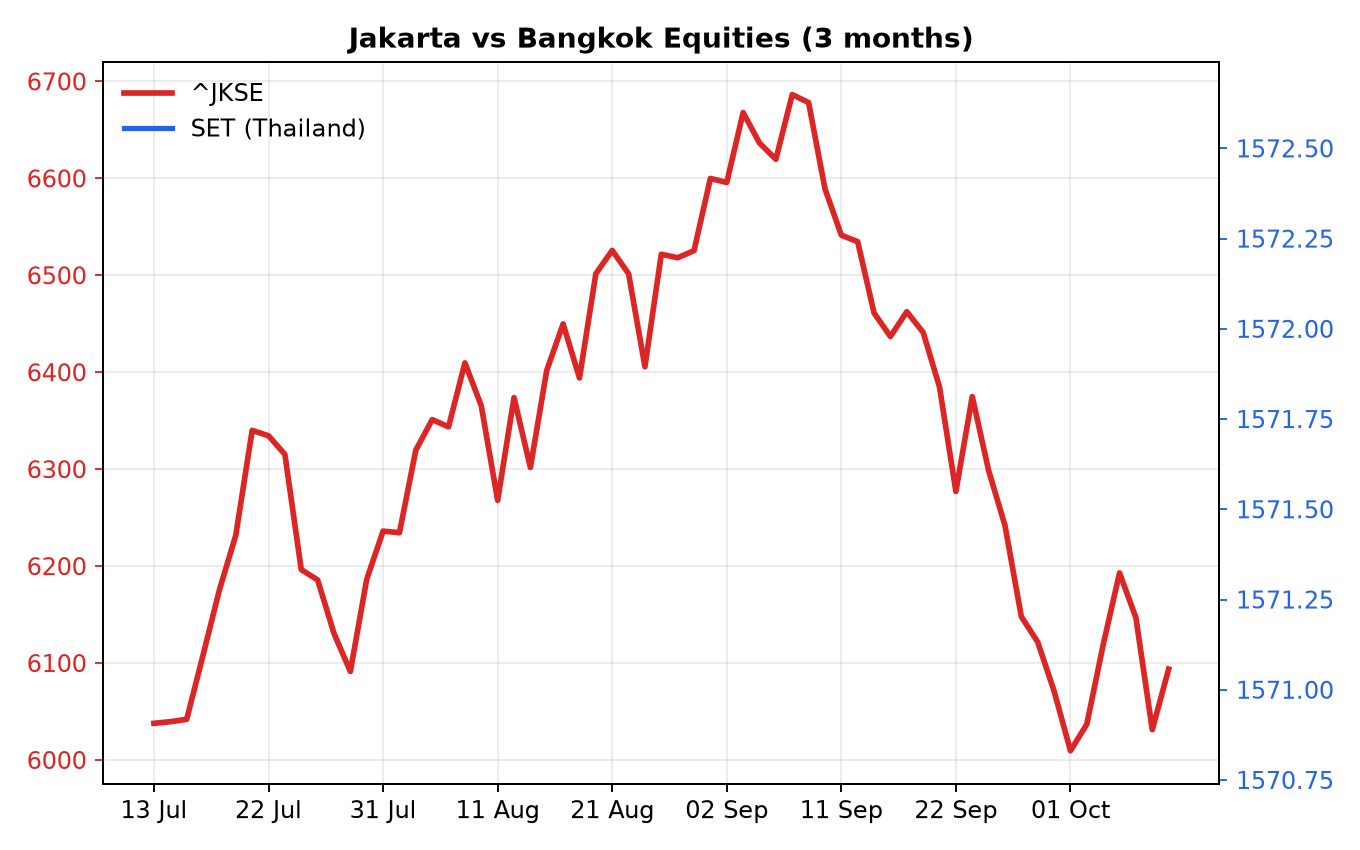
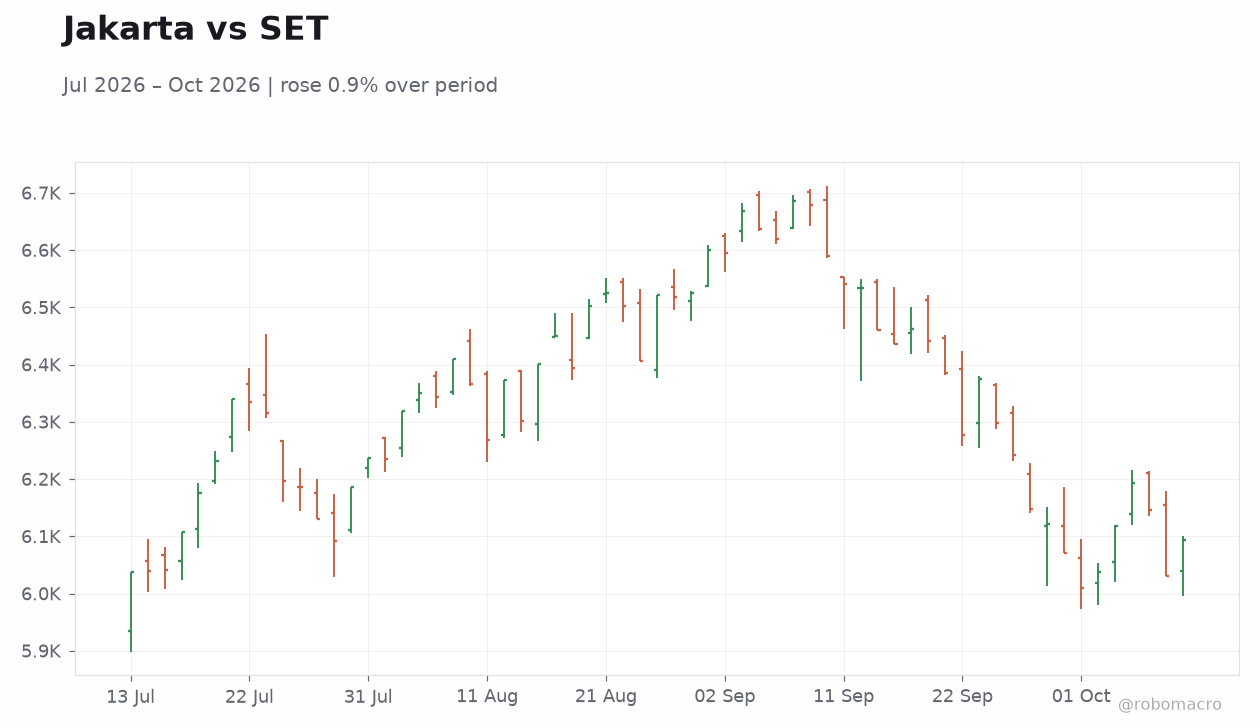
Jakarta vs SETJakarta vs SET | Type: market_hloc | JCI: 6094 (2026-10-09) | Range: 6010–6686 | Trend(6pt): 6038,6234,6406,6437,6147,6094

Today's Economic Events

Data Prior Cons Time
GDP Growth Quarter-over-Quarter Advance Estimate1.40-20:00
Monetary Policy Statement--20:00
Tuesday (2026-10-13)
GDP Growth Quarter-over-Quarter Advance Estimate1.40-20:00
Monetary Policy Statement--20:00
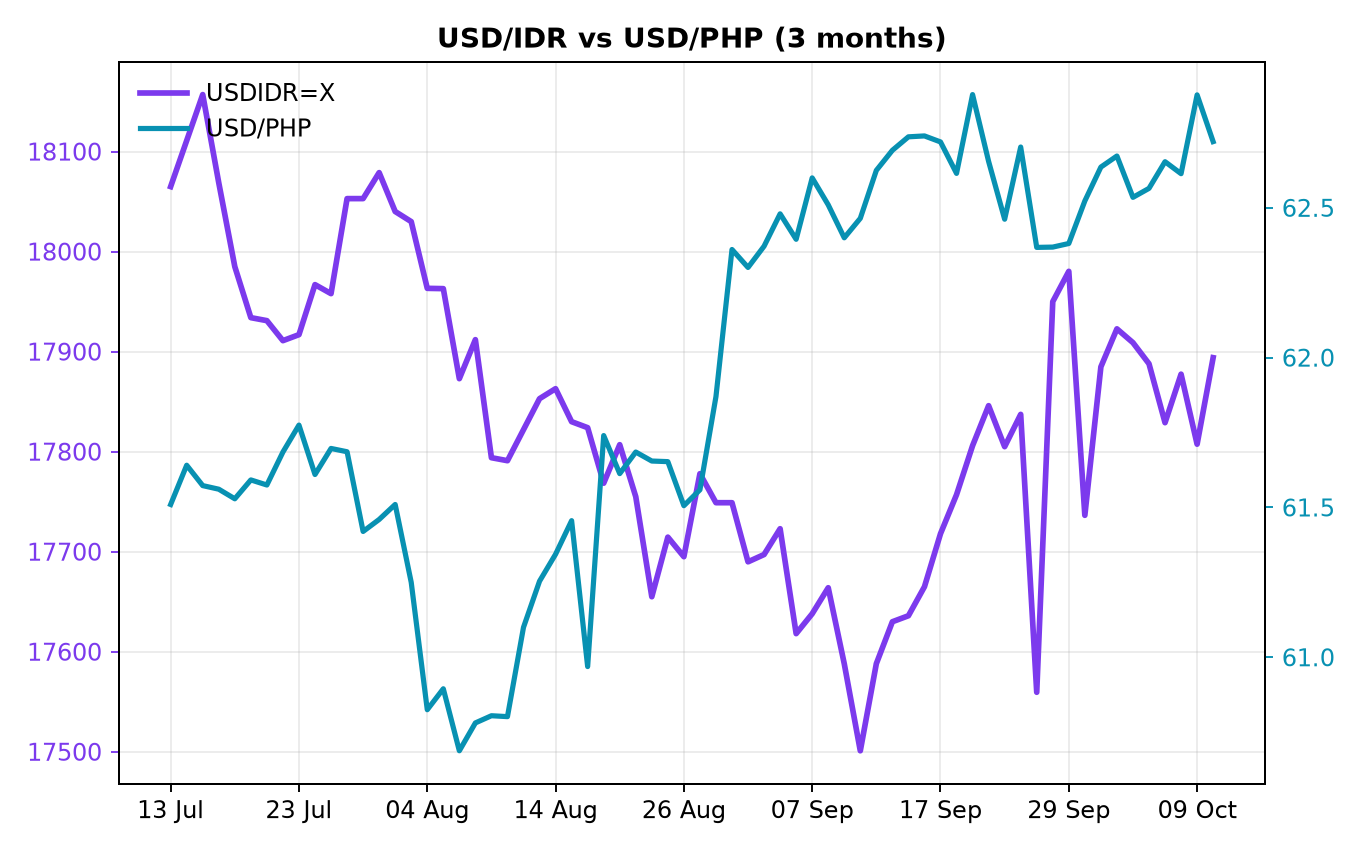
  • The rupiah strengthened 0.49% to 17,894 per dollar, aided by softer dollar sentiment and firm oil, while the JCI rallied 1.04% to 6,093.76 despite global jitters.
  • New BI leadership asserted full autonomy over interest-rate decisions, reinforcing credibility as Indonesia's finance ministry curbs state spending to anchor the fiscal deficit.
  • Singapore's advance Q3 GDP estimate and the Monetary Policy Statement headline Tuesday's calendar, with markets watching the S$NEER band stance.

Yesterday's Recap

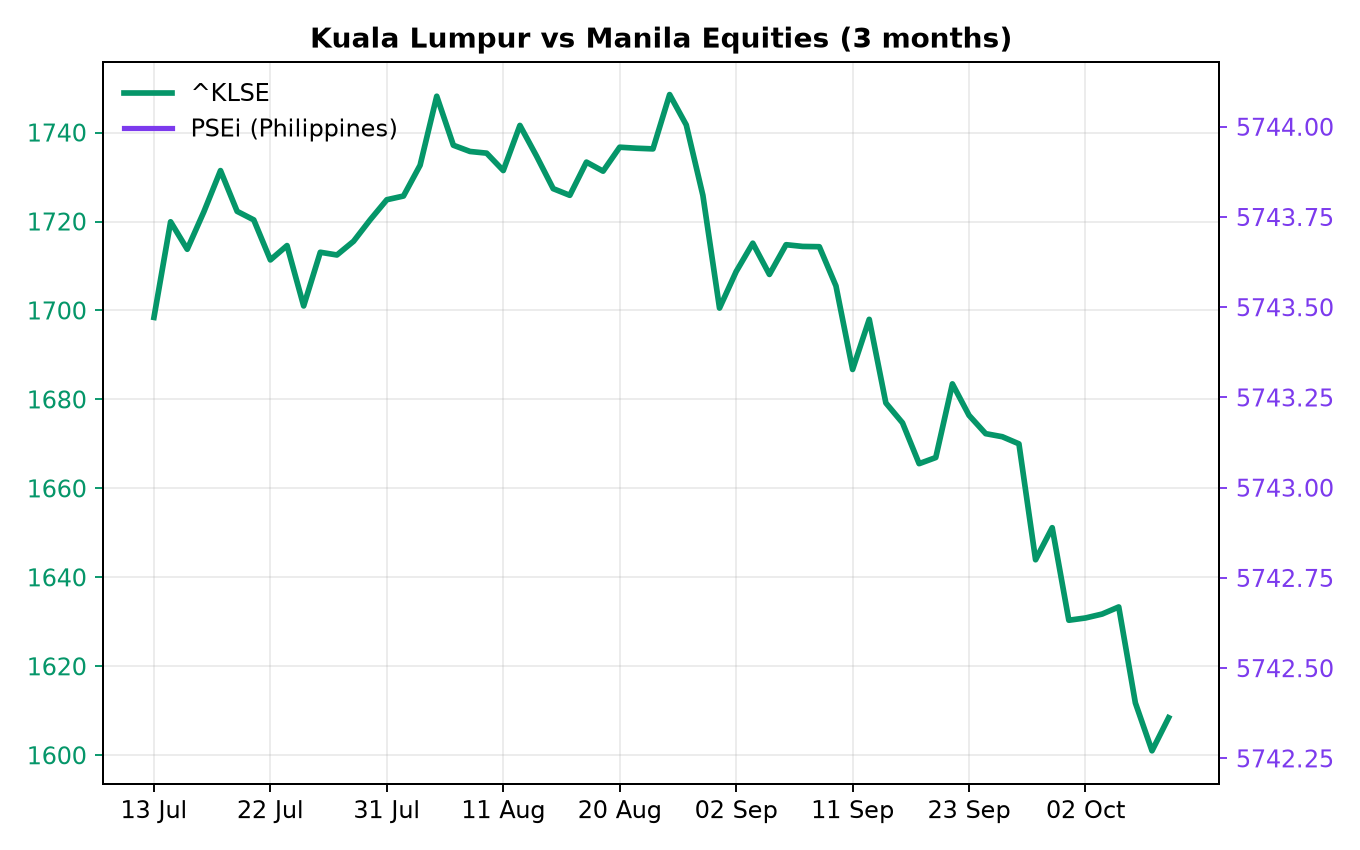
Indonesia set the tone for regional trade, with the rupiah firming 0.49% to 17,894 per dollar as a softer dollar index and resilient crude prices bolstered the terms-of-trade story for the commodity-heavy economy. The Jakarta Composite rallied 1.04% to 6,093.76, defying broader global market nerves, as investors welcomed the finance ministry's pledge to restrain state spending and contain the fiscal deficit. In Kuala Lumpur, the KLCI added 0.46% to 1,608.45 and the ringgit firmed against the dollar, supported by fiscal-discipline pledges around Budget 2027 and recent strong GDP data.

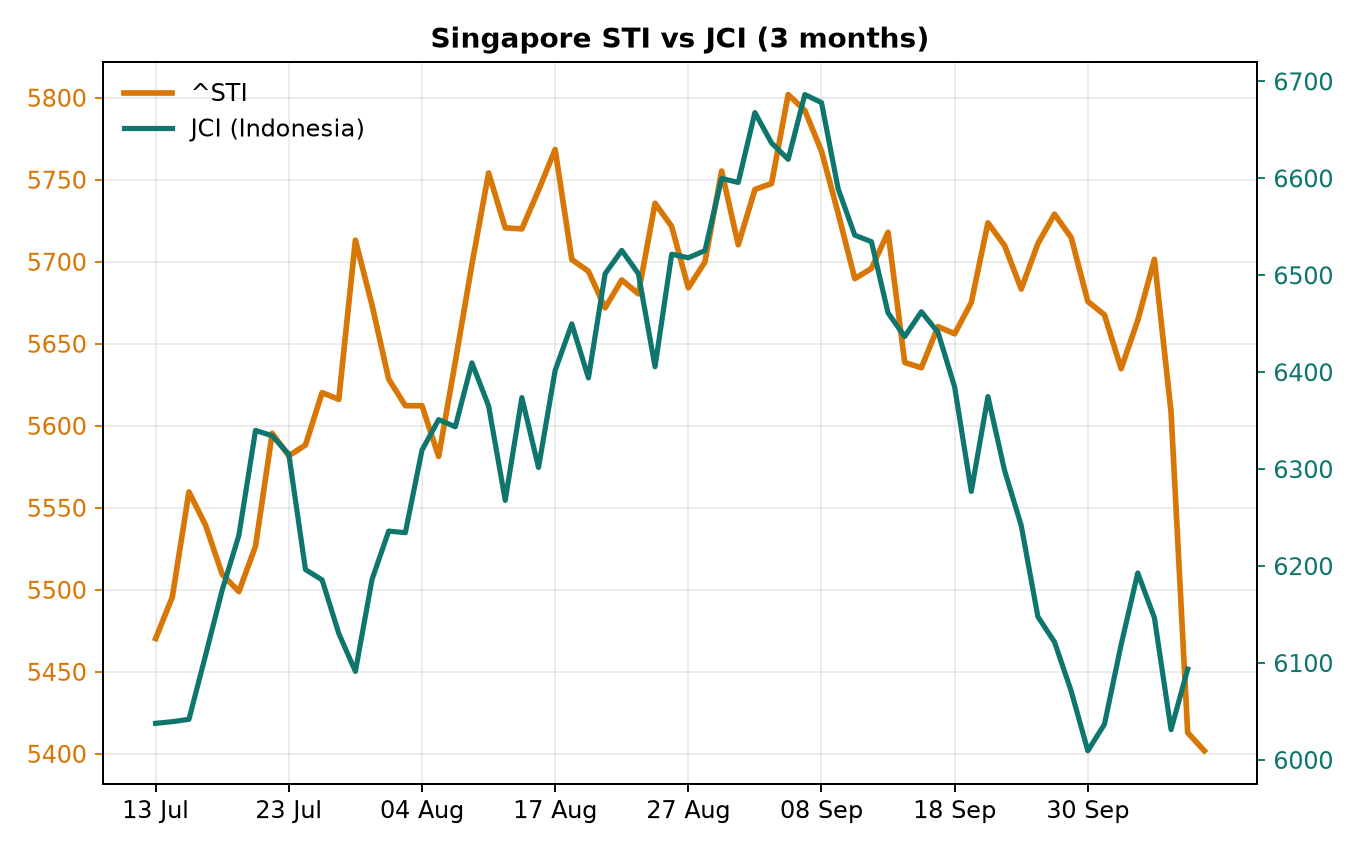
The Singapore dollar was marginally firmer at 1.28 per USD while the Straits Times Index slipped 0.20% to 5,401.89, a modest pullback ahead of Tuesday's key events. The baht was essentially flat at 33.60, and the Philippine peso gained 0.25% to 62.72. Brent crude climbed 1.15% to $105.92, a tailwind for Indonesia and Malaysia as net exporters, while gold eased 0.48% to $4,195.90 and bitcoin fell 1.23% to $82,647.

The calendar showed no completed ASEAN data prints for the prior session, leaving price action and policy commentary to carry the narrative into the new week.

The Day Ahead

The regional calendar is thin but high-impact, centered on Singapore. On Tuesday, Singapore releases its advance estimate for third-quarter GDP growth on a quarter-over-quarter basis, with the prior reading at 1.4% and no consensus yet published; the print will shape expectations for full-year growth in the trade-dependent city-state. Simultaneously, the Monetary Authority of Singapore issues its Monetary Policy Statement, the key scheduled policy event of the week for the region.

Markets will scrutinize the stance on the S$NEER band — its slope, width, and center — for signals on how the MAS balances imported inflation against a softening external demand picture. Given Singapore's role as the region's financial hub, the statement will also be parsed for read-throughs on regional currency management. Elsewhere, attention stays on Indonesia's fiscal consolidation narrative and Malaysia's Budget 2027 preparations.

The absence of major Philippine, Thai, or Vietnamese prints keeps focus squarely on the MAS decision.
Page 1

ASEAN Macro Daily(Beta Mode)

October 12, 2026 robomacro.com
Chart 1
Chart 2
Chart 3
Chart 4

Other Economic Notes

Indonesia's growth outlook remains a live debate, with the World Bank's 5.2% forecast for the economy drawing a cautious official response that only time will validate the projection. The finance ministry's move to curb state spending signals fiscal consolidation intent ahead of the 2027 budget cycle, a stance that has underpinned both the rupiah and local bonds. Malaysia's finance ministry reiterated that the country's financial markets remain resilient and supportive of economic activity, while Budget 2027 is expected to raise cash aid and the minimum wage to address cost-of-living pressures — a mix with implications for the fiscal deficit.

Thailand's SME lending revival after a four-year decline is being prioritized by policymakers, addressing a persistent credit gap in the domestic economy. Across the region, structural themes persist: supply-chain diversification continues to favor Vietnam and Malaysia, while AI adoption is being positioned as a new growth lever for Thailand's next economic phase.

Global Macro News

Global risk sentiment was mixed into the new week, with ASEAN equities diverging from softer US futures and a pullback in bitcoin to $82,647. Crude's advance to $105.92 — up 1.15% — is a double-edged sword for the region: supportive for Indonesian and Malaysian fiscal and external balances, but a cost headwind for importers like Thailand, the Philippines, and Singapore. The dollar's softer tone, reflected in broad ASEAN currency strength against the greenback, suggests markets are positioning cautiously ahead of a heavy week of central-bank communication globally.

↓ p.3

Sponsored by Arbitrage Search
Page 2

ASEAN Macro Daily(Beta Mode)

October 12, 2026 robomacro.com

Continuation

Global Macro News (continued)

Gold's dip to $4,195.90 indicates some rotation out of safe havens, consistent with the improved tone in Asian risk assets. The IMF-World Bank Annual Meetings, hosted by Thailand in Bangkok, are drawing finance ministers and central bankers to the region, putting ASEAN policy frameworks under the spotlight — nearly three decades after the 1997 Asian crisis reshaped the region's policy architecture. The World Bank's 5.2% growth forecast for Indonesia anchors the external view on the region's largest economy.

For ASEAN policymakers, the combination of firm oil, a softer dollar, and resilient domestic demand offers a window to rebuild policy buffers.

ASEAN Central Banks Watch

Bank Indonesia is in focus as its new governor publicly affirmed the central bank's full autonomy over interest-rate decisions, a statement aimed at reassuring markets amid fiscal-deficit scrutiny and reinforcing BI's credibility in defending the rupiah. The currency's firming to 17,894 against the dollar suggests the market is giving the new leadership the benefit of the doubt, with oil receipts and a disciplined fiscal stance providing cover. The Monetary Authority of Singapore dominates Tuesday's calendar: its Monetary Policy Statement will reveal whether the MAS holds the S$NEER band settings or adjusts the slope, with the prior quarter's 1.4% QoQ GDP advance framing the growth-inflation trade-off.

Bank Negara Malaysia enters the week with the ringgit firmer on fiscal-discipline pledges, the market reading BNM's stance as supportive while Budget 2027 takes shape. The Bank of Thailand is tightening scrutiny of foreign-currency inflows and gold transactions — a macroprudential measure to manage speculative flows — while warning that repeated shocks are eroding the economy's resilience; the baht held near 33.60. The Bangko Sentral ng Pilipinas emphasized that policy will prioritize the economy over public sentiment, signaling independence amid political noise, with the peso firming to 62.72.

SBV remains the least visible of the six this session, with no major policy signals, leaving the regional policy divergence narrative centered on BI's autonomy pledge versus the MAS's exchange-rate framework.

Sponsored by Arbitrage Search
Page 3