ASEAN Macro Daily(Beta Mode)
MAS Holds NEER, Rupiah Tests 18,000
Market Snapshot
| Asset | Level | Change |
|---|---|---|
| JCI | 5,943.02 | +0.29% |
| KLCI | 1,627.72 | +0.27% |
| STI | 5,423.33 | -0.13% |
| USD/IDR | 17,943.00 | +0.43% |
| USD/THB | 33.49 | -0.21% |
| USD/MYR | 4.08 | -0.07% |
| USD/PHP | 63.02 | +0.36% |
| USD/SGD | 1.28 | +0.19% |
| Brent Crude | 105.73 | -0.31% |
| Gold | 4,192.50 | +2.06% |
| Bitcoin | 82,372.21 | +0.99% |
| Indonesia 10Y Govt Yield | - | - |
| Thailand 10Y Govt Yield | - | - |
Prior Economic Events
| Data | Prior | Cons | Actual |
|---|---|---|---|
| GDP Growth Quarter-over-Quarter Advance Estimate | 1.40 | 1.20 | 1.10 |
| Monetary Policy Statement | - | - | - |
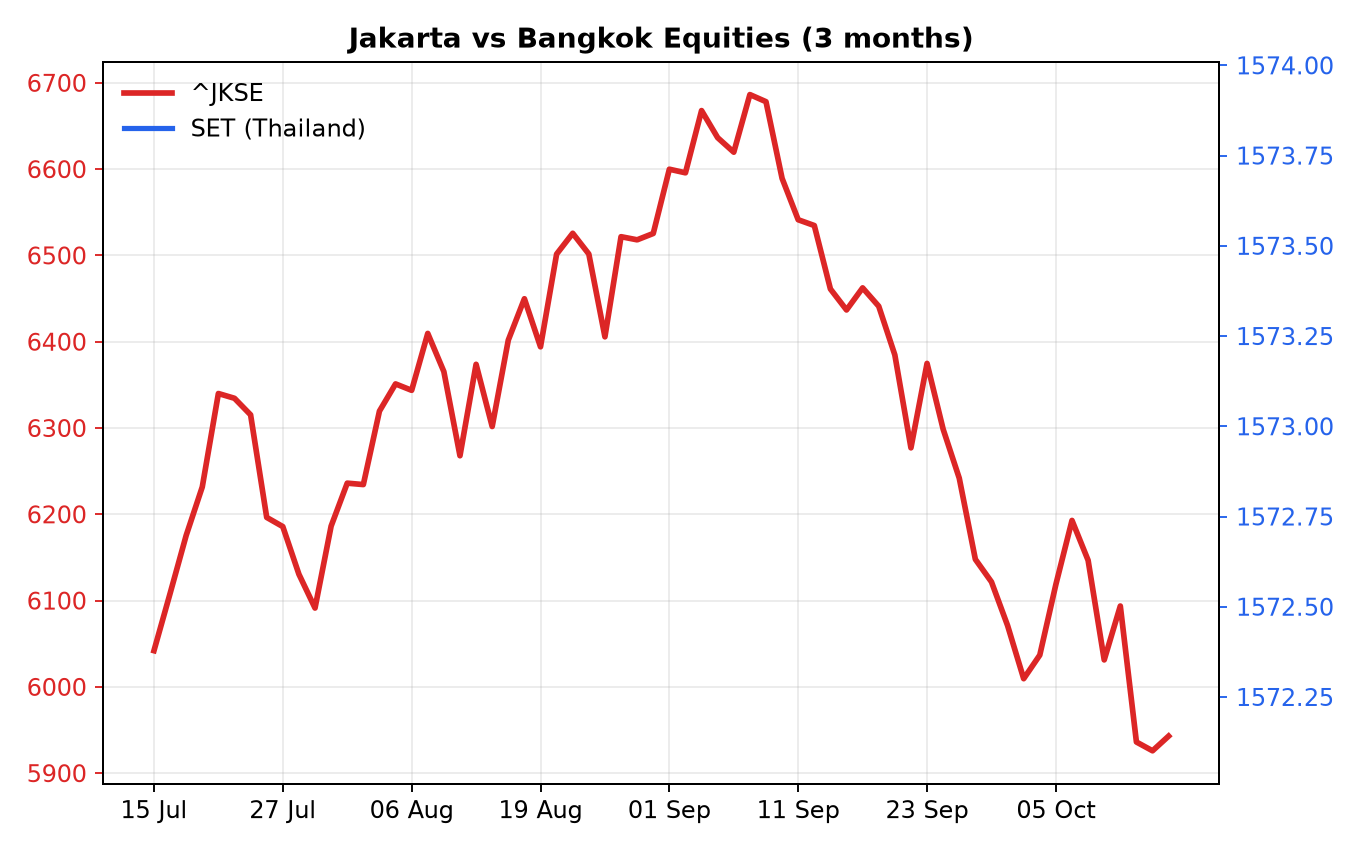
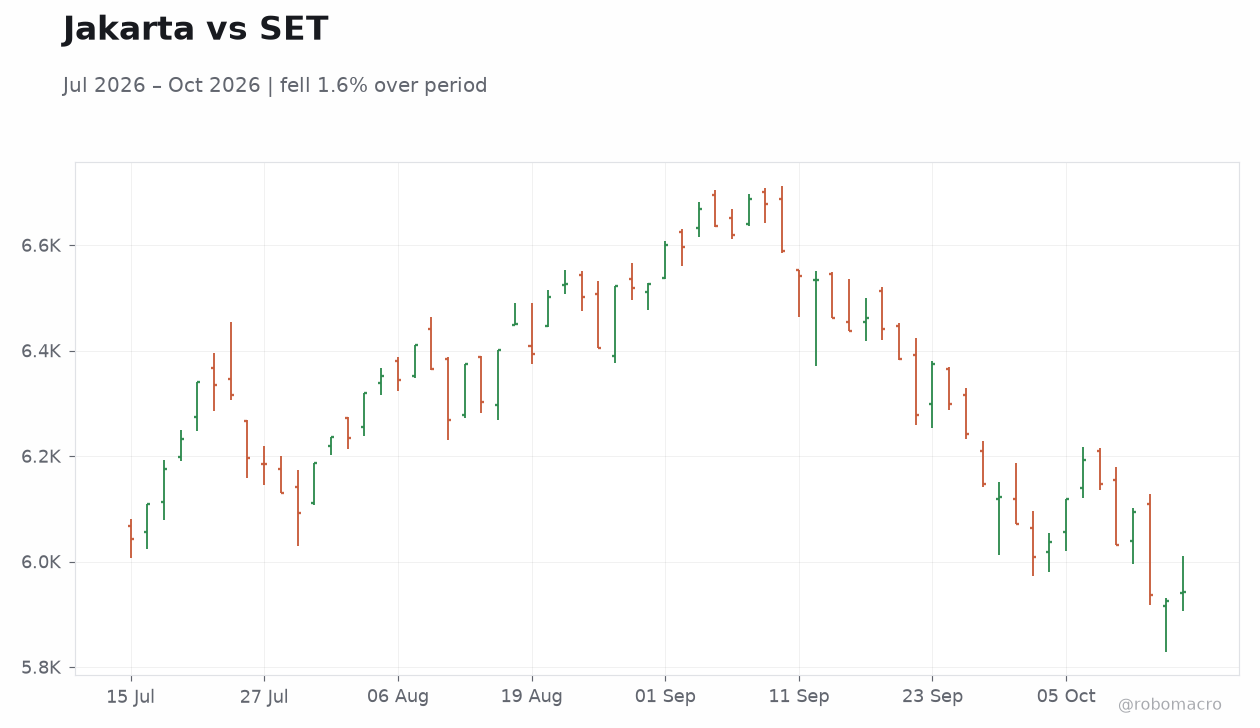 Jakarta vs SET | Type: market_hloc | JCI: 5943 (2026-10-14) | Range: 5926–6686 | Trend(5pt): 6042,6344,6600,6375,5943
Today's Economic Events
| Data | Prior | Cons | Time |
|---|---|---|---|
| No events available | |||
- Singapore's advance Q3 GDP slowed to 1.1% q/q from 1.4%, missing the 1.2% consensus, as MAS stood pat on its exchange-rate policy band.
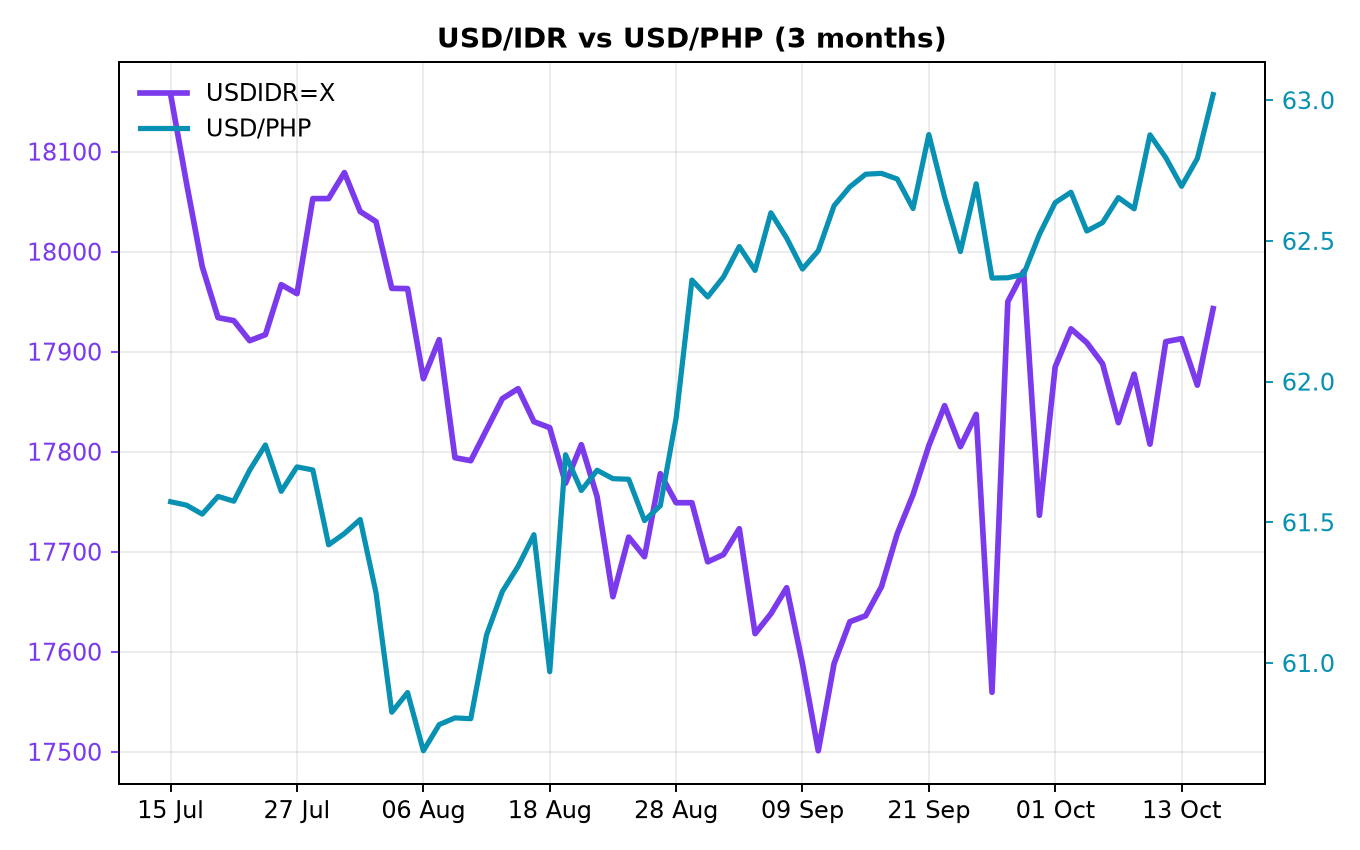
- Bank Indonesia intensified FX interventions to defend the rupiah near Rp18,000/USD, with USD/IDR up 0.43% to 17,943.
- BNM signalled room to adjust rates as inflation risks build, while Thailand's central bank flagged a 1% policy floor with eventual hikes.
Yesterday's Recap
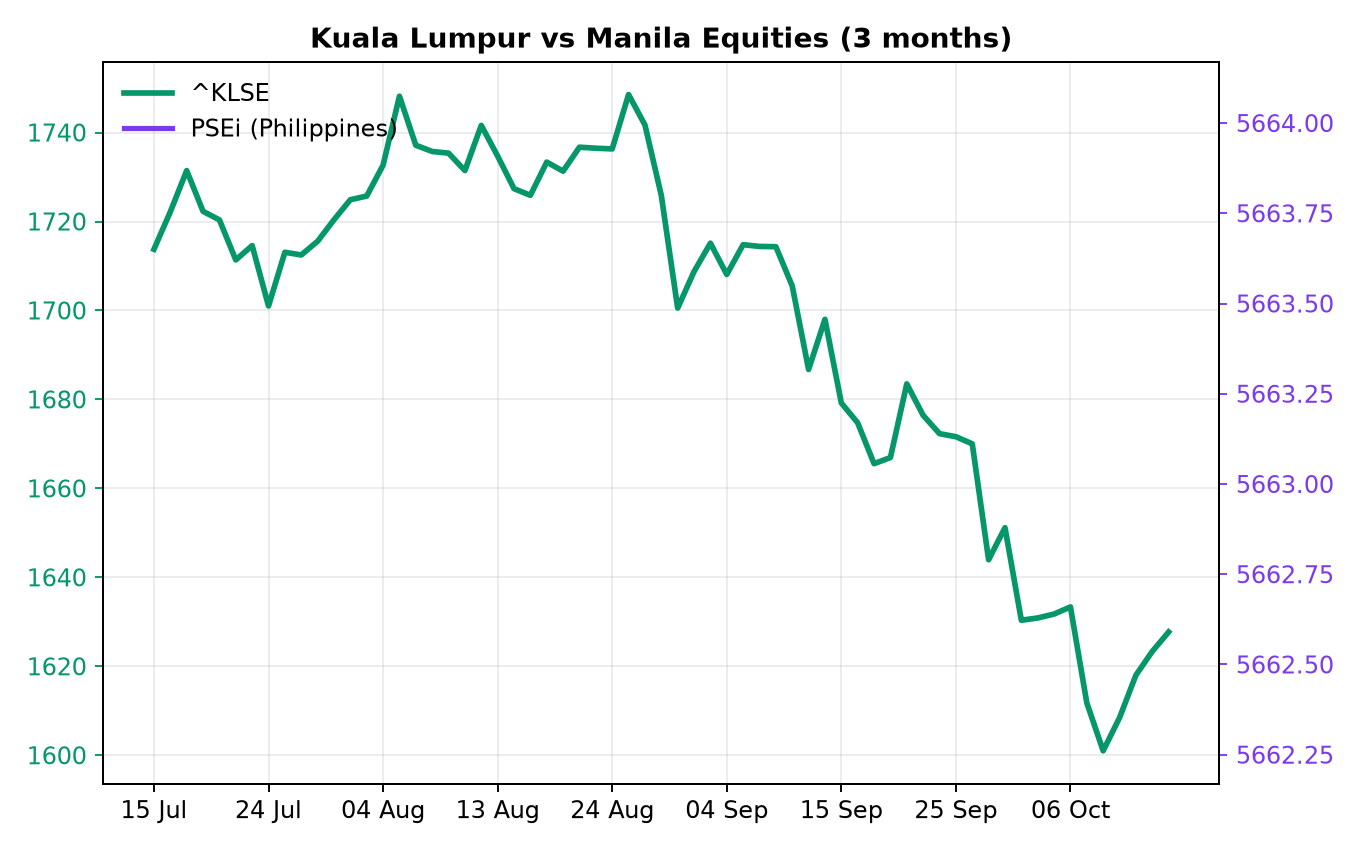
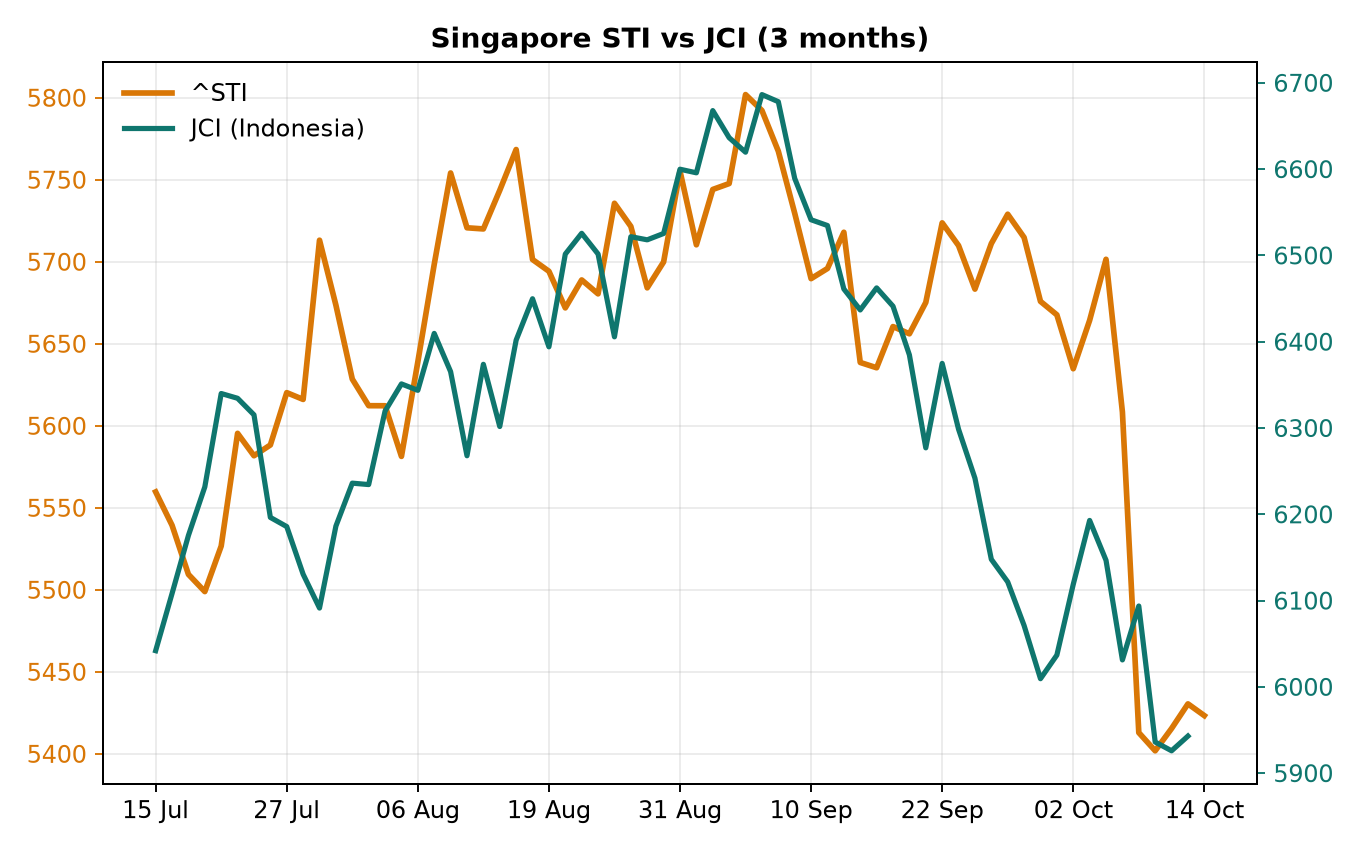
Singapore dominated the regional data calendar, printing advance-estimate Q3 GDP growth of 1.1% quarter-on-quarter, softer than both the 1.2% consensus and the prior 1.4% reading — a deceleration that reinforces the narrative of cooling momentum in the trade-exposed city-state. The print arrived alongside the Monetary Policy Statement, where MAS kept its exchange-rate policy band unchanged. Equity markets diverged: the Straits Times Index slipped 0.13% to 5,423.33, while Jakarta's JCI gained 0.29% to 5,943.02 and Malaysia's KLCI added 0.27% to 1,627.72.
In FX, the rupiah remained the focal point, with USD/IDR rising 0.43% to 17,943 as the dollar strengthened broadly; Bank Indonesia's intervention desk was active in smoothing volatility as spot approaches the psychologically significant Rp18,000 level. The baht firmed 0.21% to 33.49 and the ringgit edged up 0.07% to 4.08, while the peso weakened 0.36% to 63.02 and the Singapore dollar softened 0.19% to 1.28. Commodity moves were notable, with Brent crude easing 0.31% to $105.73 — modest relief for the region's net oil importers — while gold surged 2.06% to $4,192.50 on safe-haven demand.
The Day Ahead
The regional calendar thins considerably today, with no scheduled ASEAN economic releases, giving markets room to digest Singapore's softer growth print and the MAS decision. Attention shifts to secondary flows: watch for further BI intervention signals as USD/IDR tests resistance near 18,000, and any follow-up commentary from BNM governor Abdul Rasheed Ghaffour on policy flexibility. Philippine remittance and balance-of-payments data due later in the month will frame the peso's trajectory after USD/PHP's 0.36% climb.
Thai headlines merit monitoring as IMF annual-meetings side events continue in Bangkok, where officials face public protests alongside calls to rebuild external buffers. Vietnamese industrial production and trade figures later this week would round out the regional picture if confirmed. Positioning is likely to remain range-bound absent fresh catalysts, with the dollar's direction the dominant swing factor.
Other Economic Notes
Indonesia's external debt rose to US$459.3 billion in August, per BI data, a figure that underscores the country's reliance on external financing even as policymakers court investment. ↓ p.2