| Asset | Level | Change |
|---|---|---|
| Bovespa | 209,067.00 | +1.38% |
| USD/BRL | 4.98 | -0.81% |
| EUR/BRL | 5.58 | -0.79% |
| Vale | 13.62 | +1.49% |
| Petrobras | 25.30 | +2.47% |
| WTI Crude | 92.40 | +0.60% |
| Gold | 4,197.90 | -0.44% |
| Bitcoin | 83,484.86 | -0.23% |
| Brazil 5Y Govt Yield | 12.48% | -26 bp |
| Brazil 10Y Govt Yield | 12.57% | -34 bp |
| Data | Prior | Cons | Actual |
|---|---|---|---|
| No events available | |||
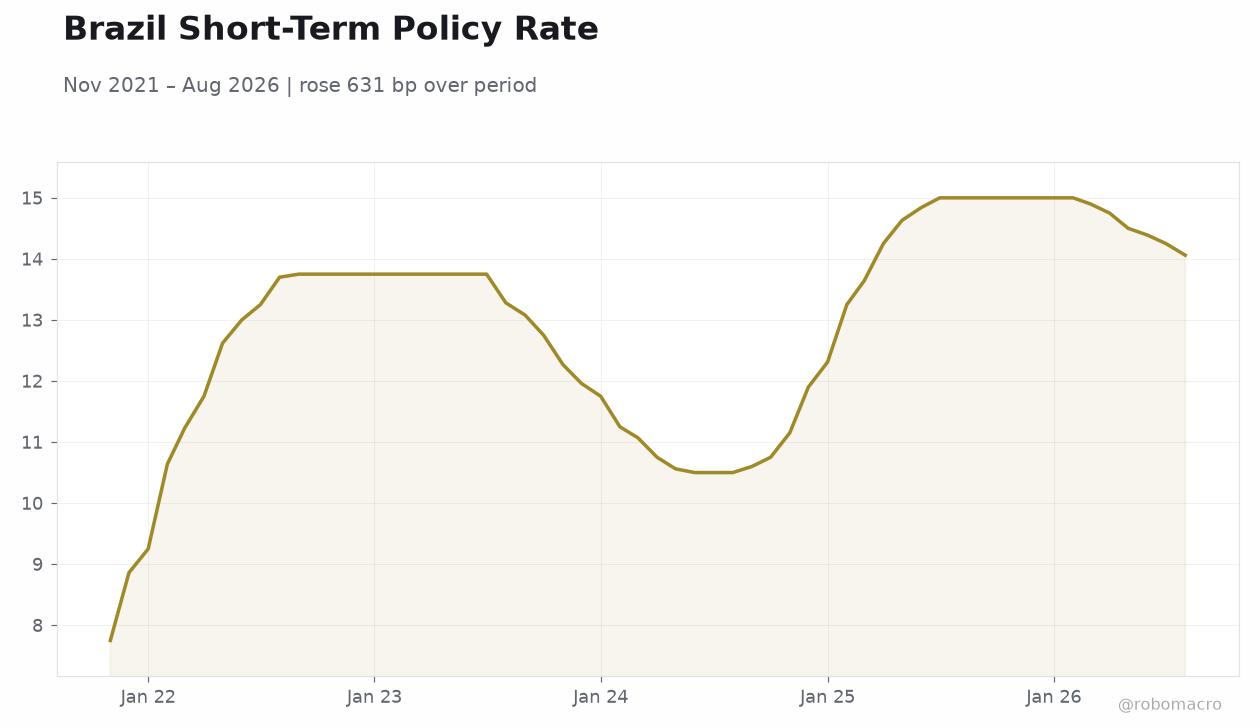
Brazil Short-Term Policy Rate | Type: macro_line | Policy Rate %: 14.06 (2026-08-01) | Range: 7.75–15 | Trend(6pt): 7.75,13.75,11.07,14.63,14.25,14.06
| Data | Prior | Cons | Time |
|---|---|---|---|
| Wednesday (2026-10-14) | |||
| Business Confidence Index | 44.90 | - | 10:00 |
| Thursday (2026-10-15) | |||
| Retail Sales Month-over-Month | -0.80 | - | 08:00 |
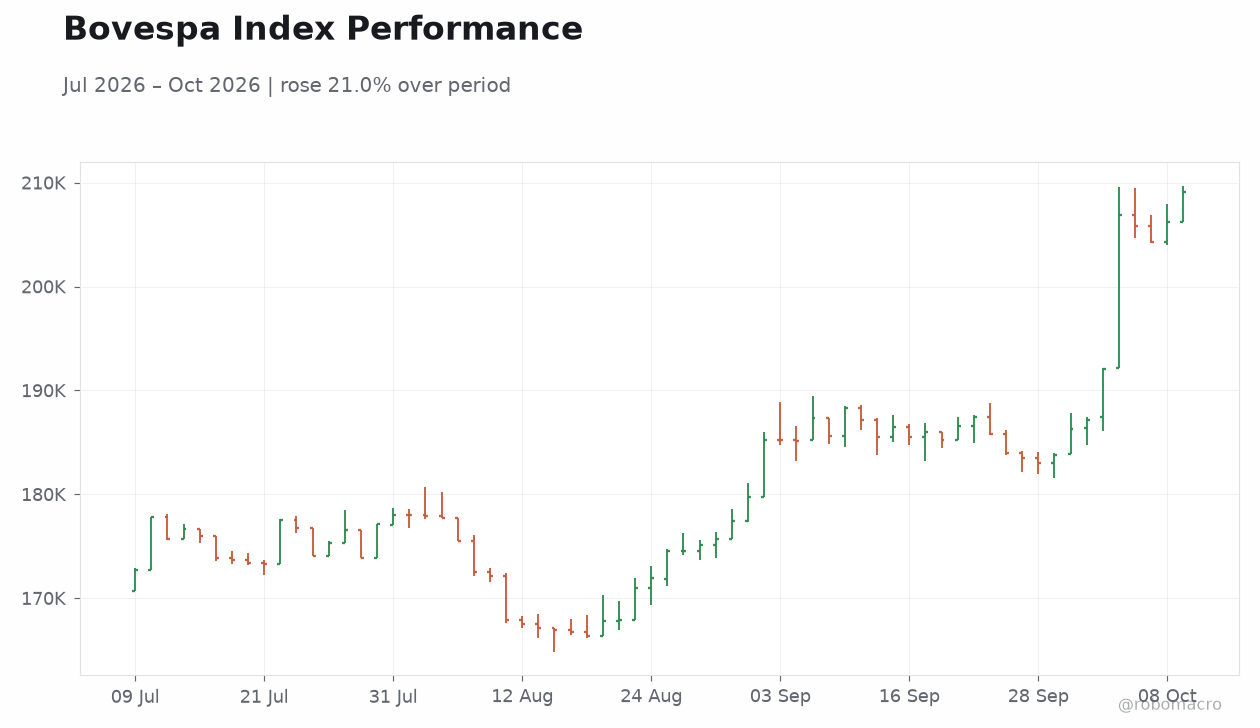
Friday's session delivered a broad risk-on rally across Brazilian assets. The Bovespa advanced 1.38% to close at 209,067, with Petrobras surging 2.47% to 25.30 and Vale gaining 1.49% to 13.62, tracking firm crude prices as WTI rose 0.60% to 92.40. Fixed income markets outperformed equities in conviction terms: the 10-year government yield dropped 34 bp to 12.57% and the 5-year fell 26 bp to 12.48%, a steep rally signaling renewed confidence in Brazil's fiscal and monetary trajectory.
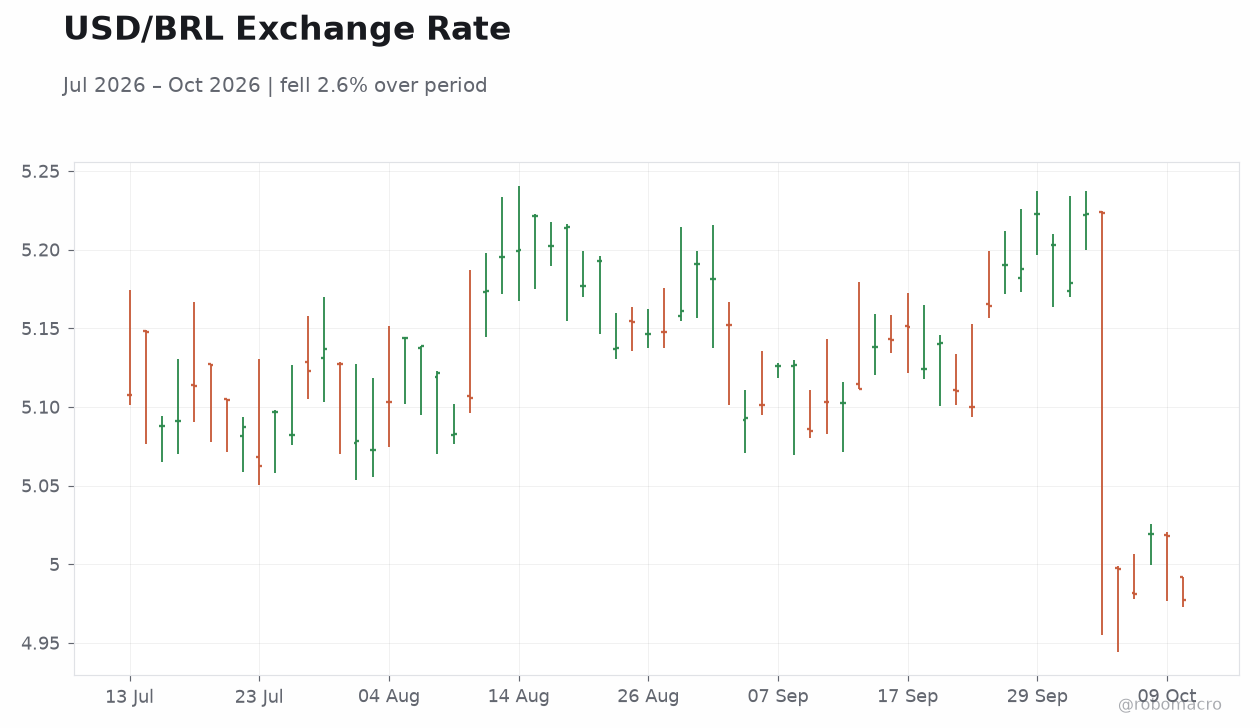
The real appreciated 0.81% against the dollar to 4.98, with EUR/BRL easing similarly to 5.58. Equity strength was reinforced by domestic commentary from asset managers noting a rare alignment of falling Selic rates and attractive equity valuations, drawing fixed-income capital into equities alongside renewed foreign inflows. Political catalysts centered on Flávio Bolsonaro's proposal to cut up to BRL 200bn in public spending, which investors received enthusiastically despite skepticism about implementation.
Gold slipped 0.44% to 4,197.90 and Bitcoin was marginally lower at 83,484.86, reflecting modest rotation away from safe havens.
The calendar is light early in the week, with no releases scheduled Monday or Tuesday. Wednesday brings the Business Confidence Index at 10:00 local time, with the prior reading at 44.9 — a figure still signaling contractionary sentiment below the 50 threshold, making any improvement noteworthy for the growth outlook. Thursday features Retail Sales Month-over-Month at 08:00, following a prior decline of 0.8%; consensus is not yet published, but the print will test whether household consumption is stabilizing after recent softness.
Both releases fall into the medium-impact category but carry outsized signaling value given the sparse calendar. With no major data until midweek, expect political developments around the presidential campaign and fiscal debate to drive price action. Traders will also watch global crude trends given Petrobras's index weight and the real's sensitivity to terms of trade.
Subscribe to Brazil Macro Daily and get each new issue delivered to your inbox.
Already a member? Visit robomacro.com to log in and manage subscriptions, or use Forgot Password to set a password.
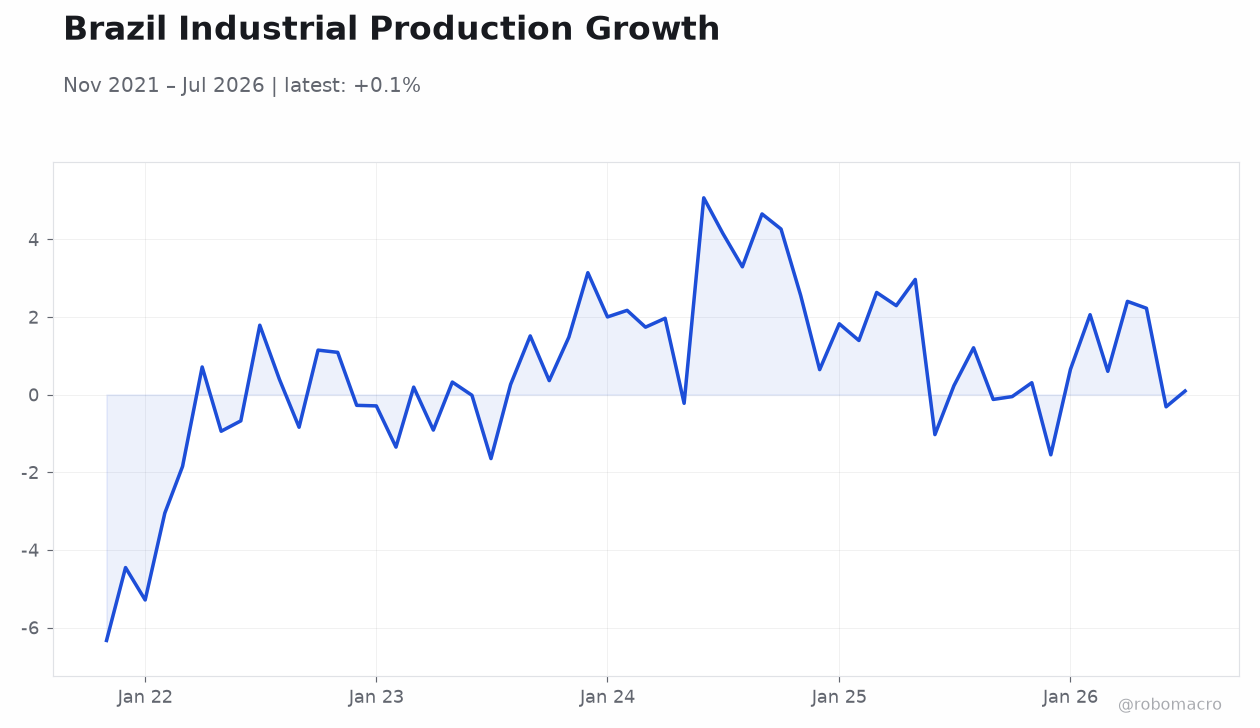
Brazil Industrial Production Growth | Type: macro_line | Ind. Production YoY %: 0.09432 (2026-07-01) | Range: -6.332–5.071 | Trend(5pt): -6.332,-0.2891,1.739,2.968,0.09432
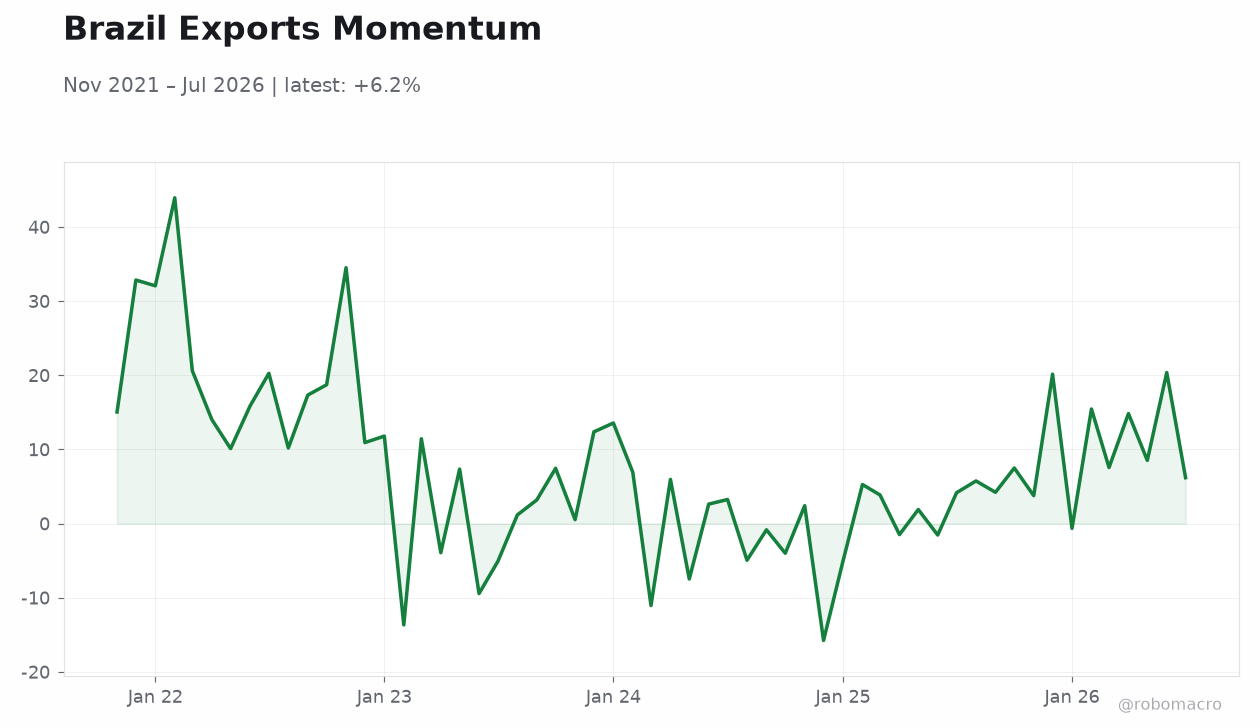
Brazil Exports Momentum | Type: macro_line | Exports USD mn: 6.195 (2026-07-01) | Range: -15.76–43.94 | Trend(5pt): 15.05,11.81,-11.04,1.904,6.195
USD/BRL Exchange Rate | Type: market_hloc | USD/BRL: 4.977 (2026-10-12) | Range: 4.977–5.223 | Trend(6pt): 5.108,5.103,5.146,5.151,5.018,4.977
Bovespa Index Performance | Type: market_hloc | Index Level: 2.091e+05 (2026-10-09) | Range: 1.663e+05–2.091e+05 | Trend(6pt): 1.727e+05,1.78e+05,1.719e+05,1.855e+05,2.062e+05,2.091e+05
Small and medium enterprises account for 26.5% of Brazil's GDP according to recent TV BRICS reporting, underscoring the economy's fragmented productive base and the sensitivity of employment to credit conditions at current Selic levels. The World Bank's regional projections now show Colombia outpacing both Brazil and Mexico in 2026 growth, a relative-growth narrative that could influence portfolio allocation within LatAm. The fiscal debate remains the dominant structural theme: while Bolsonaro's BRL 200bn cut proposal cheered markets, analysts at Intellinews note the plan may fall short of stabilizing the debt trajectory without complementary structural reforms.
Marina Silva's warning that a Bolsonaro presidency could intensify Amazon degradation adds an environmental-policy dimension relevant to agricultural and mining exporters facing EU deforestation rules.
Global risk sentiment provided a supportive backdrop, with Wall Street gains spilling into Brazilian equities per InfoMoney's attribution of the Ibovespa rally to NY strength and election trades. Crude's advance to 92.40 benefits Petrobras and Brazil's trade balance, though it raises imported-inflation questions for the BCB. Currency markets elsewhere saw intervention themes: India's RBI implemented measures against speculative currency bets, Japan's authorities monitored yen weakness, and Norway's rate-hike prospects supported the krone — a reminder that EM central banks remain active in FX management.
Gold's pullback from record territory suggests modest profit-taking in haven assets as risk appetite builds. ↓ p.3
Bitcoin's stability near 83,500 indicates crypto markets are not diverting EM flows. The World Bank's LatAm growth rankings add a competitive dimension to the regional allocation story. Meanwhile, Netanyahu's invitation to Flávio Bolsonaro signals potential geopolitical realignment should the right win, with implications for BRICS cohesion and trade policy.
The Selic stands at 13.75% following the October 6 decision, and the latest CPI reading of 4.58% year-over-year suggests disinflation is progressing but remains above the target continuum's midpoint. The 34 bp drop in 10-year yields to 12.57% implies markets are pricing a faster easing cycle than the BCB's cautious guidance has confirmed. The negative term-structure — 5-year yields at 12.48% below the policy rate — reflects conviction that cuts are imminent and cumulative.
InfoMoney's reporting on asset managers describing a "rare moment" for equities on Selic declines confirms the rate-cut trade has become consensus positioning. However, the recent IPCA print of 0.82% monthly, cited in market commentary, bears watching for stickiness in services inflation that could temper the pace of the cutting cycle. The BCB's communications will need to balance growth-supportive easing against fiscal-policy uncertainty, particularly as campaign promises on spending lack detailed implementation paths.
Watch for COPOM minutes to clarify whether the committee shares the market's conviction on the easing trajectory or retains optionality on the pace. The real's appreciation to 4.98 provides a helpful pass-through tailwind, giving the bank room to deliver without inflation credibility costs.