| Asset | Level | Change |
|---|---|---|
| Bovespa | 206,888.00 | -1.04% |
| USD/BRL | 5.01 | +0.58% |
| EUR/BRL | 5.62 | +1.06% |
| Vale | 13.37 | -1.11% |
| Petrobras | 25.50 | +0.31% |
| WTI Crude | 94.38 | +0.25% |
| Gold | 4,165.90 | -0.27% |
| Bitcoin | 83,396.12 | +0.36% |
| Brazil 5Y Govt Yield | 12.48% | -26 bp |
| Brazil 10Y Govt Yield | 12.57% | -34 bp |
| Data | Prior | Cons | Actual |
|---|---|---|---|
| No events available | |||
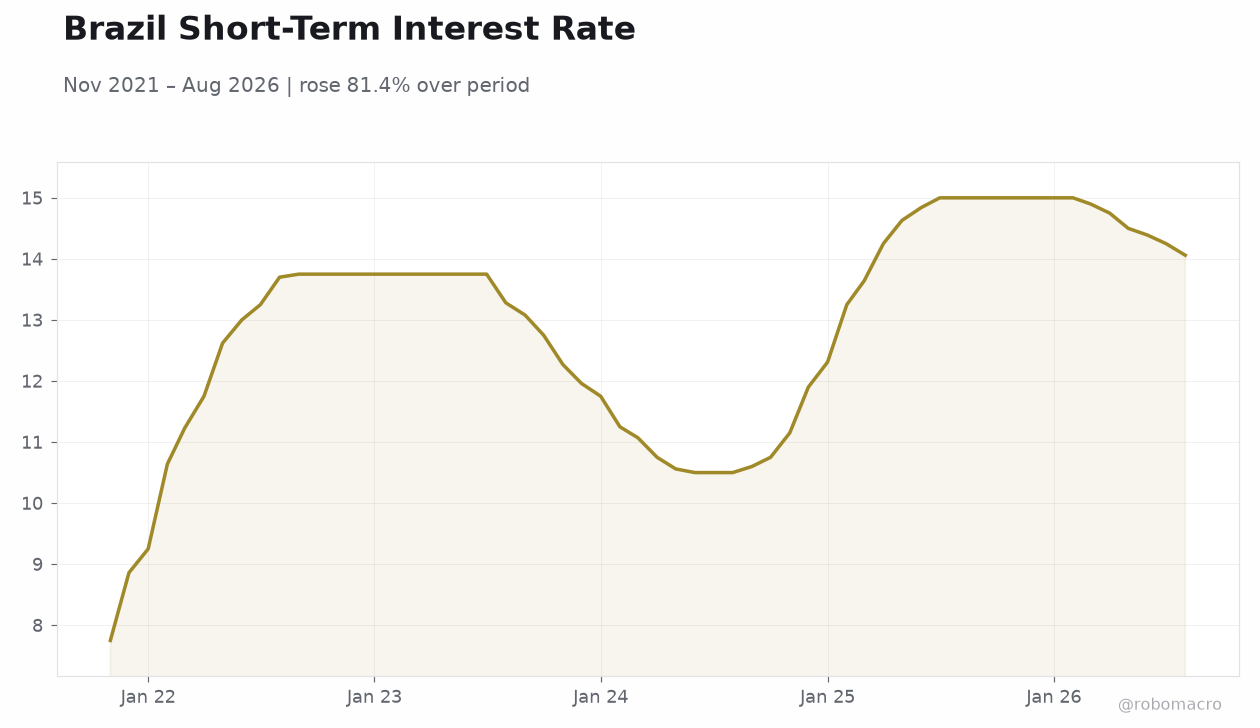
Brazil Short-Term Interest Rate | Type: macro_line | Selic / Short Rate (%): 14.06 (2026-08-01) | Range: 7.75–15 | Trend(6pt): 7.75,13.75,11.07,14.63,14.25,14.06
| Data | Prior | Cons | Time |
|---|---|---|---|
| Business Confidence Index | 44.90 | - | 10:00 |
| Thursday (2026-10-15) | |||
| Retail Sales Month-over-Month | -0.80 | - | 08:00 |
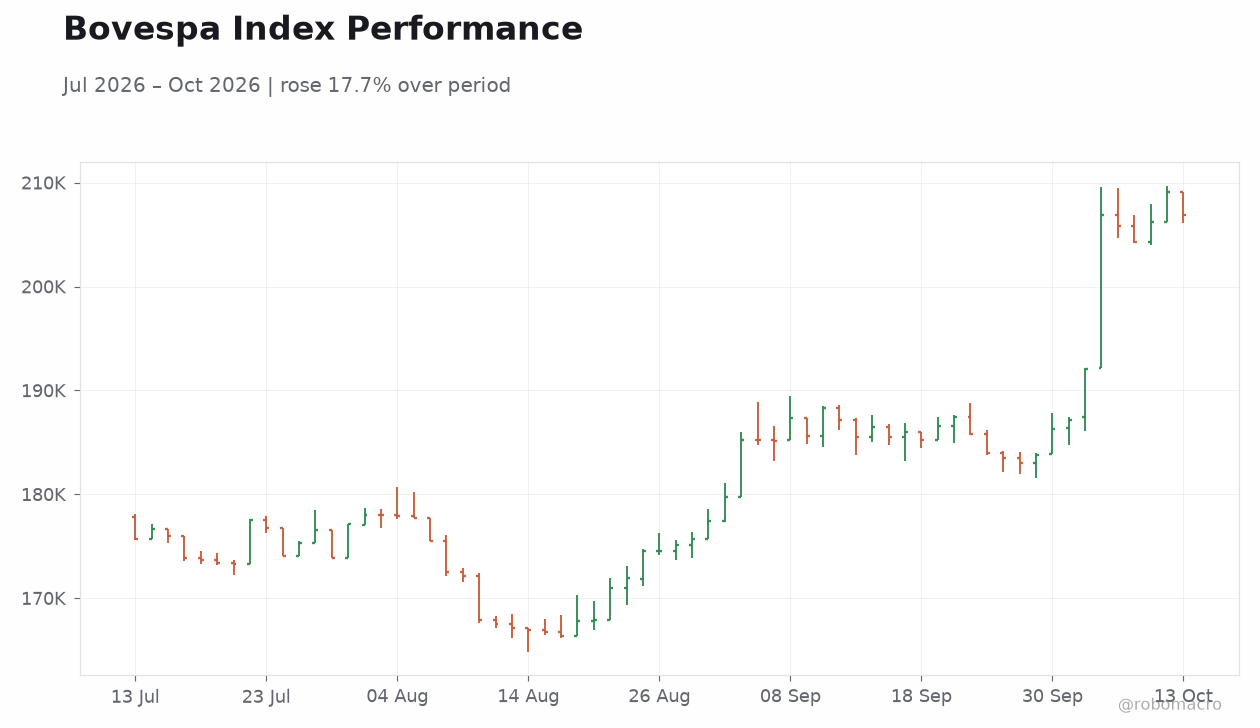
Brazilian fixed income led the charge higher, with the 10-year government yield falling 34 bp to 12.57% and the 5-year easing 26 bp to 12.48%, extending a rally that has gathered pace since the early-October policy meeting. The move reflects growing conviction that the central bank's easing cycle from the 13.75% Selic has further to run, with the local Focus survey now anchoring the rate at 12% by end-2027. Equities lagged the bond rally: the Bovespa shed 1.04% to close at 206,888, with Vale down 1.11% at 13.37 as iron ore sentiment remained fragile.
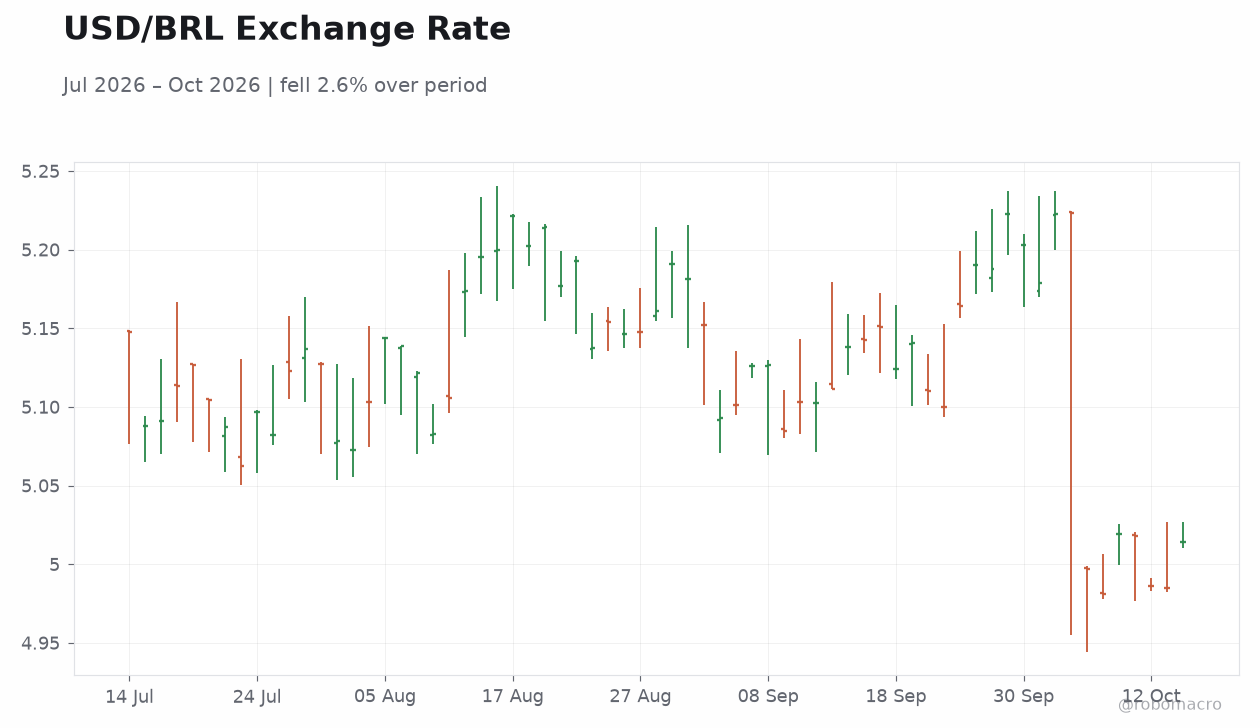
Petrobras bucked the trend, adding 0.31% to 25.50 as WTI crude held near $94. The currency market told a more nuanced story: the real weakened 0.58% to 5.01 per dollar even as Goldman Sachs slashed its three-month USD/BRL forecast to 4.70, citing fiscal adjustment expectations, more favorable governability, and the rate-cutting differential. The euro strengthened 1.06% against the real to 5.62.
Gold slipped 0.27% to $4,165.90 and Bitcoin edged up 0.36% to $83,396. BTG Pactual's latest note on winners and losers from falling rates circulated widely, reinforcing the narrative that carry trades are rotating back into duration.
Today's calendar is light but not empty: the Business Confidence Index prints at 10:00 local time, with the prior reading at 44.9 — a level still deep in contraction territory below the 50 boom-bust line. Any upside surprise would bolster the narrative that Brazil's industrial and services sectors are stabilizing as inflation cools and the Selic easing cycle lowers financing costs. Thursday brings Retail Sales Month-over-Month, where the previous print of -0.8% sets a low bar; a rebound would signal that real wage gains and easier credit conditions are filtering through to consumption.
Markets will also parse the IMF's regional outlook for Brazil-specific revisions, following the fund's downgrade of LatAm growth. With no COPOM decision this week, focus stays on the data flow into the next meeting and the shape of the Focus survey revisions.
Subscribe to Brazil Macro Daily and get each new issue delivered to your inbox.
Already a member? Visit robomacro.com to log in and manage subscriptions, or use Forgot Password to set a password.
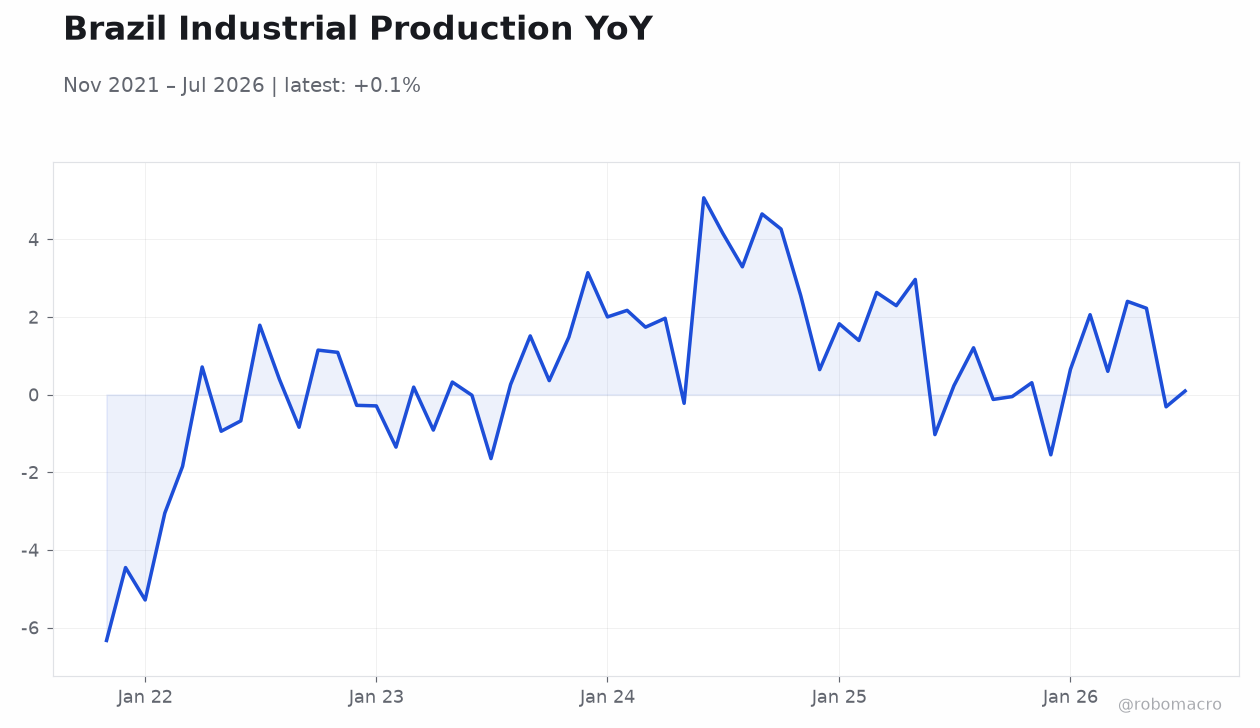
Brazil Industrial Production YoY | Type: macro_line | Industrial Production (%): 0.09432 (2026-07-01) | Range: -6.332–5.071 | Trend(5pt): -6.332,-0.2891,1.739,2.968,0.09432
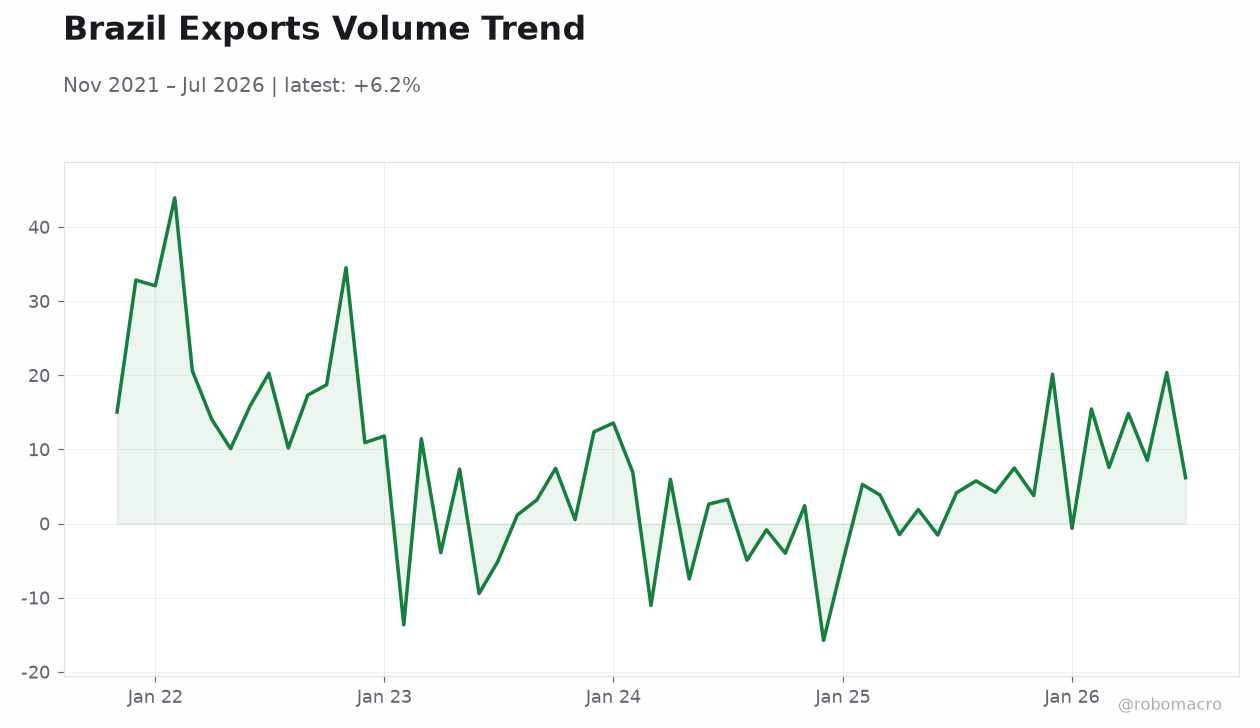
Brazil Exports Volume Trend | Type: macro_line | Exports Index: 6.195 (2026-07-01) | Range: -15.76–43.94 | Trend(5pt): 15.05,11.81,-11.04,1.904,6.195
USD/BRL Exchange Rate | Type: market_hloc | USD/BRL: 5.014 (2026-10-14) | Range: 4.981–5.223 | Trend(6pt): 5.148,5.144,5.147,5.124,4.986,5.014
Bovespa Index Performance | Type: market_hloc | Index Level: 2.069e+05 (2026-10-13) | Range: 1.663e+05–2.091e+05 | Trend(5pt): 1.757e+05,1.779e+05,1.746e+05,1.852e+05,2.069e+05
The IMF's downward revision for Latin America and the Caribbean explicitly cites Brazil's slowdown, a reminder that the region's largest economy remains the swing factor for regional growth. Fiscal dynamics are back in focus: Goldman's more constructive real view hinges on credible adjustment and governability improving, a thesis the bond rally partially validates. On the trade front, China's imposition of tariffs on 28 chemical product categories exported to Brazil adds friction to a bilateral relationship that remains dominated by iron ore, soybeans, and oil.
Meanwhile, the political backdrop is noisy, with a scandal engulfing the supreme court raising questions about institutional stability — a variable that could cut either way for the Bolsonaro-Lula contest.
Global risk sentiment was mixed, with crude firming 0.25% to $94.38 as Mirae Asset warns Brent could test $120 amid Middle East volatility into the US midterms — a tailwind for Petrobras but a headwind for Brazil's fuel inflation. The dollar's strength against emerging currencies was not universal: India's rupee rallied to a one-month high on RBI intervention, a template for how aggressive central bank action can stabilize EM FX. Gold's pullback to $4,165.90 suggests profit-taking after a strong run, while Bitcoin's grind higher to $83,396 reflects steady risk appetite.
Binance's November 10 shutdown of its mining pool is a minor operational note for crypto miners. For Brazil, the key transmission channels remain the oil price, the Fed's path, and China's industrial demand.
The Selic stands at 13.75% following the October 6 decision, and the bond market's message is unambiguous: the 10-year at 12.57% implies markets expect the easing cycle to deliver substantially more than the cautious pace implied by earlier guidance. The Focus survey's 12% end-2027 projection aligns with that view, though it sits well below where terminal rate expectations stood mid-year. With September CPI at 4.58% year-over-year — above the 3% target — the central bank has room to continue cutting without abandoning its inflation-targeting credibility.
The key tension for the COPOM is the pace: cutting too fast risks reigniting inflation expectations just as fiscal questions remain unresolved; moving too slowly invites a stronger real and unnecessary output losses. Goldman's 4.70 dollar forecast implicitly assumes the BCB stays ahead of the curve on disinflation while fiscal anchors hold. Watch the next COPOM minutes for language on the neutral rate and the committee's assessment of fiscal dominance risks — the latter being the principal threat to the rally.
Any signal that the board sees the real's appreciation as disinflationary would cement expectations for continued cuts at upcoming meetings.