Brazil Macro Daily(Beta Mode)
Real Slips, Yields Jump as Risk-Off Hits BRL
Market Snapshot
| Asset | Level | Change |
|---|---|---|
| Bovespa | 204,324.00 | -1.06% |
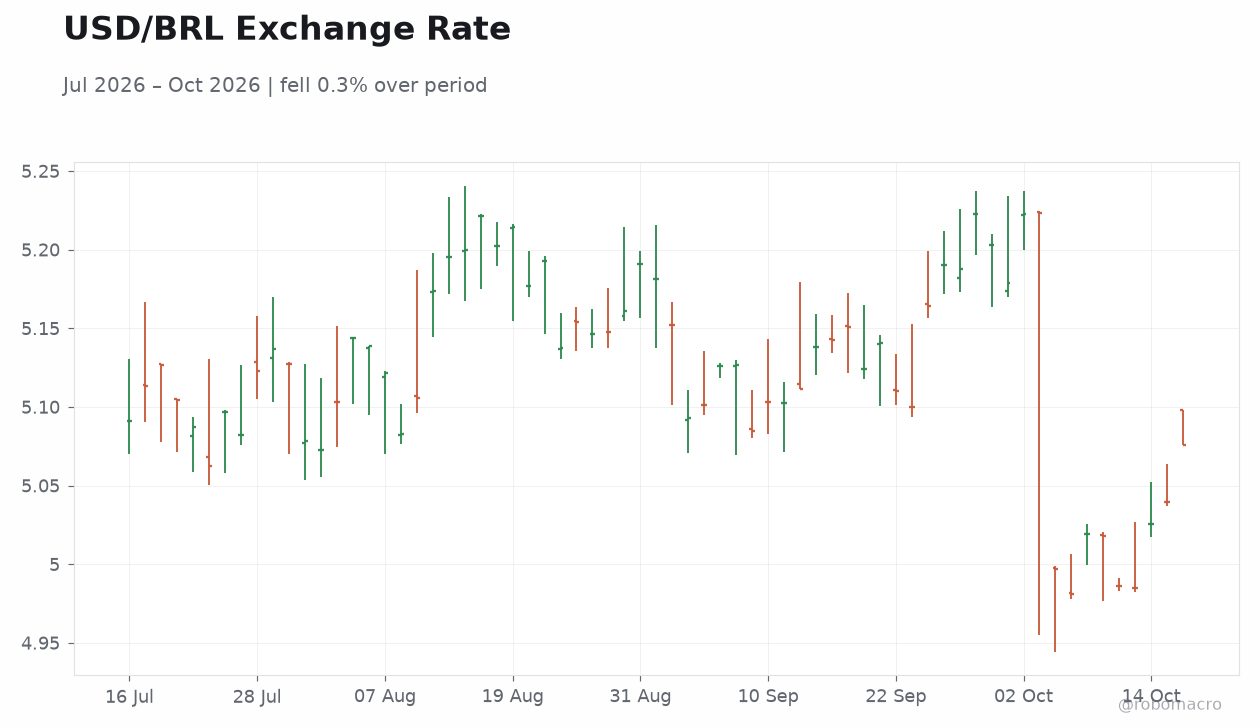
| USD/BRL | 5.08 | +0.72% |
| EUR/BRL | 5.71 | +1.28% |
| Vale | 13.02 | -1.44% |
| Petrobras | 25.30 | -2.47% |
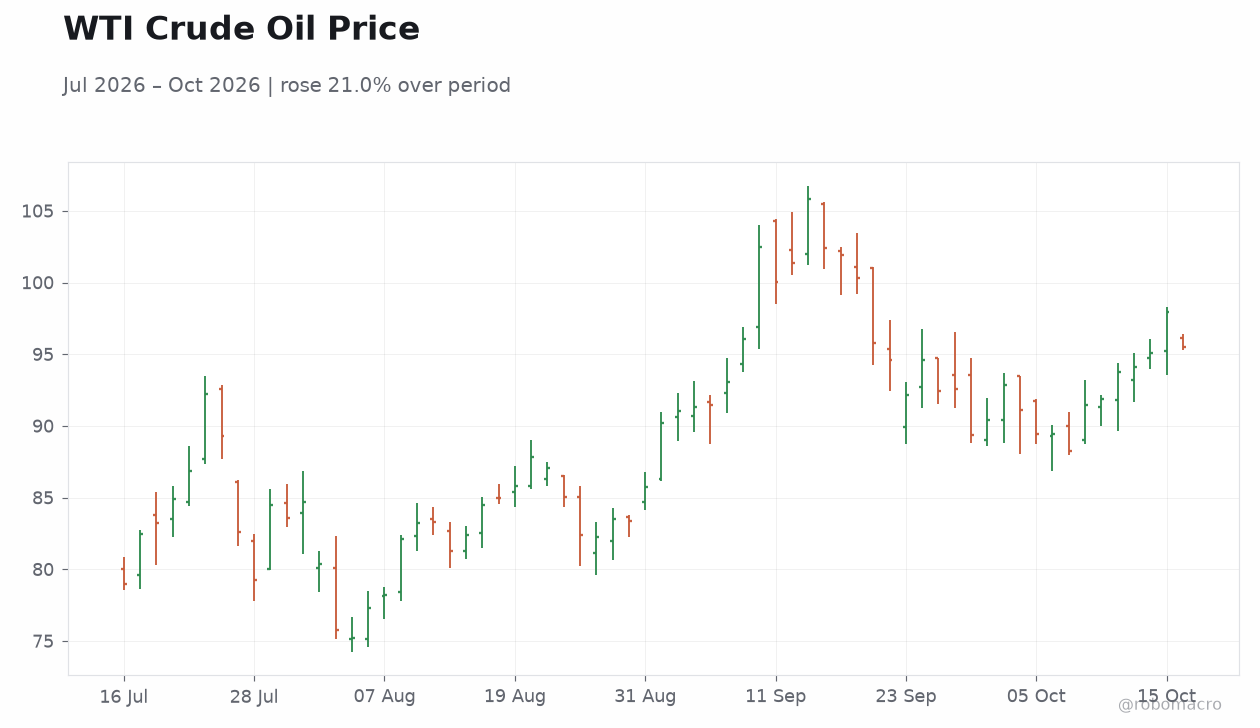
| WTI Crude | 95.49 | -2.53% |
| Gold | 4,208.00 | +0.91% |
| Bitcoin | 82,111.19 | -0.04% |
| Brazil 5Y Govt Yield | 12.65% | +19 bp |
| Brazil 10Y Govt Yield | 12.71% | +21 bp |
Prior Economic Events
| Data | Prior | Cons | Actual |
|---|---|---|---|
| Business Confidence Index | 44.90 | - | 46.20 |
| Retail Sales Month-over-Month | -0.80 | 0.70 | 0.10 |
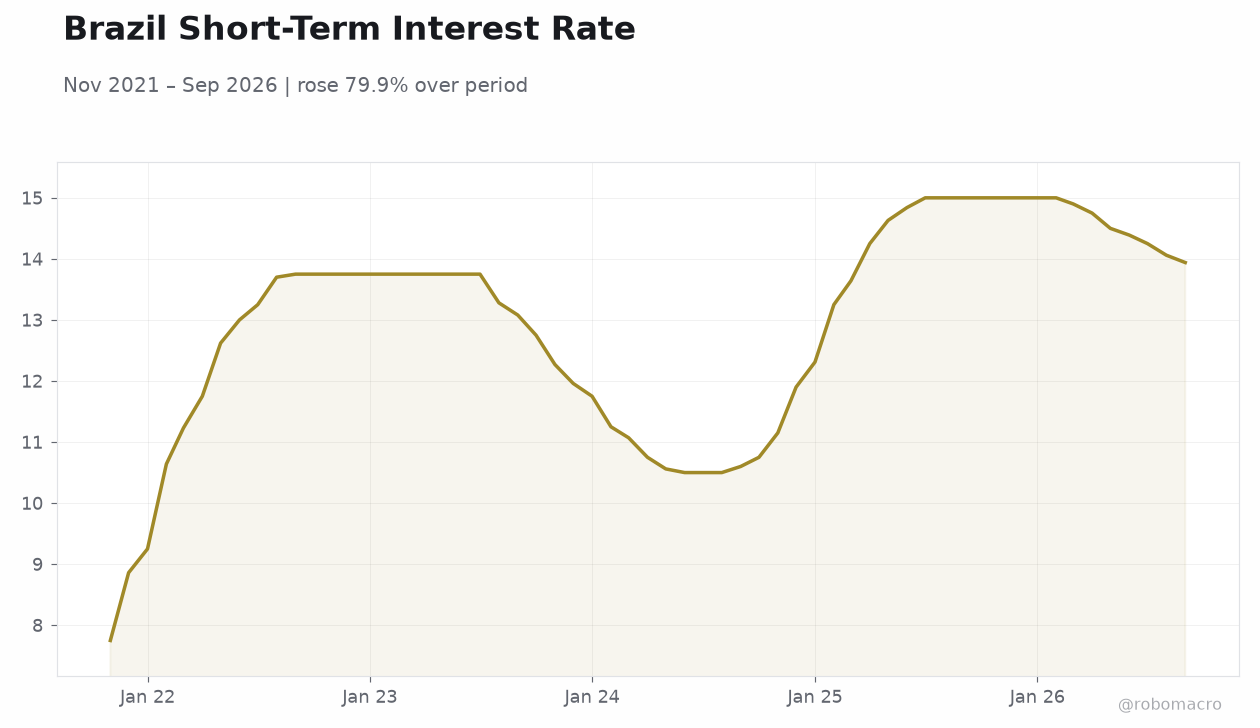 Brazil Short-Term Interest Rate | Type: macro_line | Policy Rate (%): 13.94 (2026-09-01) | Range: 7.75–15 | Trend(6pt): 7.75,13.75,11.07,14.63,14.25,13.94
Today's Economic Events
| Data | Prior | Cons | Time |
|---|---|---|---|
| No events available | |||
- Brazil 10Y yield jumped 21 bp to 12.71% and the 5Y rose 19 bp to 12.65% as risk-off sentiment swept local fixed income.
- USD/BRL weakened 0.72% to 5.08 while the Bovespa fell 1.06% to 204,324, with Petrobras down 2.47% on a 2.53% slide in WTI crude.
- Retail sales rose just 0.1% m/m in September, well below the 0.7% consensus, while business confidence improved to 46.2 from 44.9.
Yesterday's Recap
Brazilian assets traded under pressure through the session, with the Bovespa closing down 1.06% at 204,324 as Petrobras dropped 2.47% and Vale lost 1.44% alongside a 2.53% decline in WTI crude. The real weakened against both major crosses, with USD/BRL rising 0.72% to 5.08 and EUR/BRL climbing 1.28% to 5.71. Local rates sold off sharply, with the 10-year government yield rising 21 bp to 12.71% and the 5-year up 19 bp to 12.65%, signaling renewed concern about the fiscal and inflation outlook.
On the data front, September retail sales rose a mere 0.1% m/m, disappointing against the 0.7% consensus and following August's 0.8% contraction, underscoring the drag from tight monetary conditions on household demand. Business confidence, however, offered a brighter note, climbing to 46.2 in October from 44.9 previously, suggesting sentiment among firms is stabilizing even as consumption softens. Gold's 0.91% gain to 4,208 reflected the broader defensive tone across global markets, while Bitcoin was essentially flat at 82,111, offering little direction for risk appetite.
The Day Ahead
The calendar is quiet today with no scheduled Brazilian data releases, leaving markets to digest yesterday's soft retail print and position ahead of the presidential runoff in ten days. Attention shifts to campaign developments after Congress approved the constitutional amendment cutting the work week to 40 hours, a political win for President Lula that could influence the race's final stretch. Traders will also watch regional currency markets and commodity prices for direction, with iron ore and oil flows to China remaining key drivers of the real.
External catalysts, including US Treasury commentary on currency policy and global rate expectations, may dominate price action in the absence of domestic data. Next week's calendar is expected to fill with mid-October inflation readings and current account figures. With the BCB in its quiet period, focus turns to how incoming data shapes expectations for the December Copom meeting.
Other Economic Notes
Brazil's structural story gained a boost from projections that the economy could become the world's eighth-largest by 2027, though near-term momentum remains uneven. ↓ p.2