Brazil Macro Daily(Beta Mode)
Fiscal Anxiety Grips Brazilian Assets
Market Snapshot
| Asset | Level | Change |
|---|---|---|
| Bovespa | 169,186.00 | -1.06% |
| USD/BRL | 5.38 | +0.67% |
| EUR/BRL | 6.02 | +0.97% |
| Vale | 11.18 | -2.53% |
| Petrobras | 21.90 | -0.59% |
| WTI Crude | 103.84 | +1.80% |
| Gold | 3,982.10 | -1.22% |
| Bitcoin | 77,968.39 | +0.25% |
| Brazil 5Y Govt Yield | 15.03% | +1 bp |
| Brazil 10Y Govt Yield | 14.87% | -6 bp |
Prior Economic Events
| Data | Prior | Cons | Actual |
|---|---|---|---|
| BCB Focus Market Readout | - | - | "" |
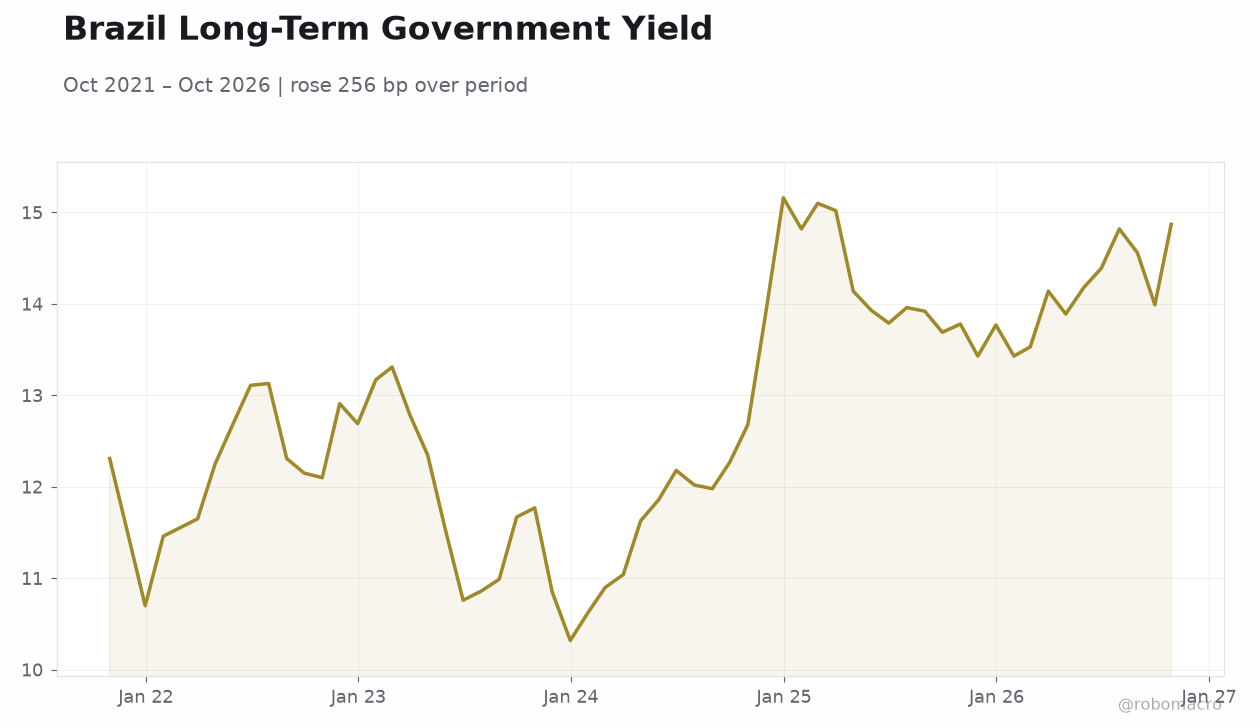 Brazil Long-Term Government Yield | Type: macro_line | 10Y Govt Yield (%): 14.87 (2026-10-28) | Range: 10.32–15.16 | Trend(5pt): 12.31,13.17,11.63,13.96,14.87
Today's Economic Events
| Data | Prior | Cons | Time |
|---|---|---|---|
| Headline Unemployment Rate | 5.30 | 5.20 | 08:00 |
- Bovespa slides 1.06% to 169,186 as fiscal concerns weigh on sentiment
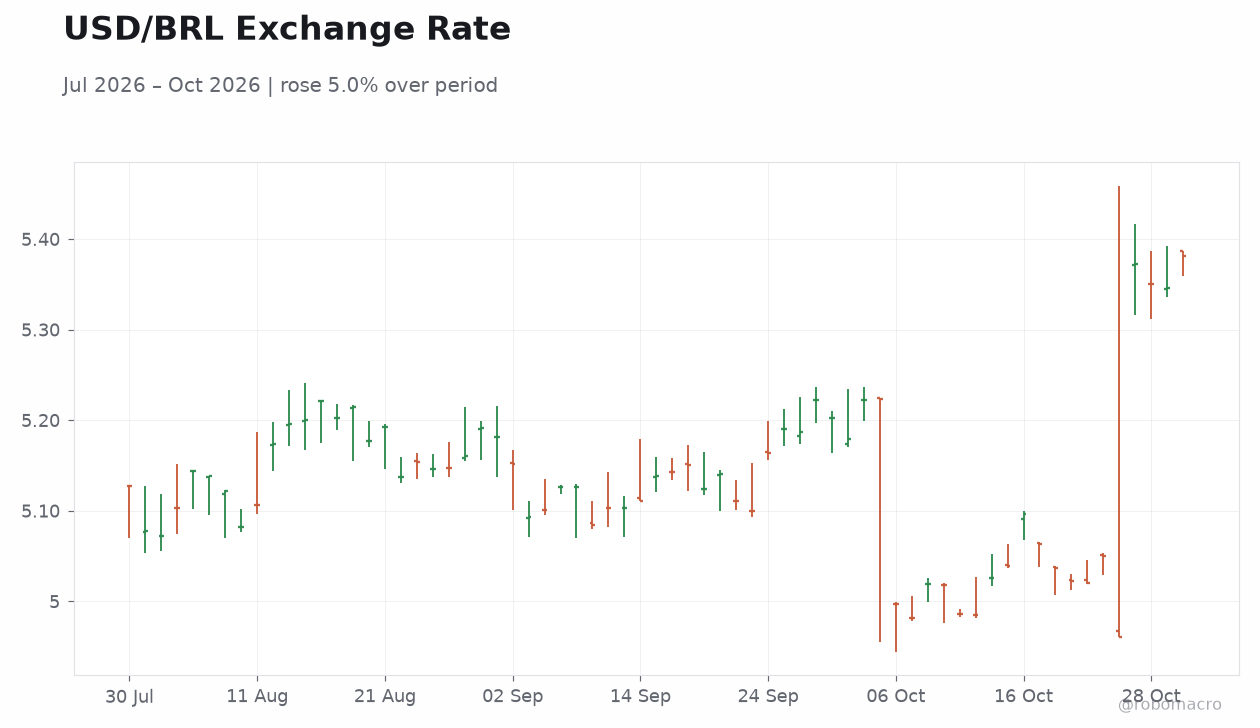
- USD/BRL weakens 0.67% to 5.38 amid elevated risk premium
- Unemployment expected at 5.2%, down from prior 5.3%
Yesterday's Recap
Brazilian markets faced renewed selling pressure on October 29 as fiscal anxiety dominated sentiment. The Bovespa declined 1.06% to close at 169,186, with Vale leading losses at -2.53% while Petrobras slipped 0.59%. Currency markets reflected the risk-off tone, with USD/BRL depreciating 0.67% to 5.38 and EUR/BRL falling 0.97% to 6.02.
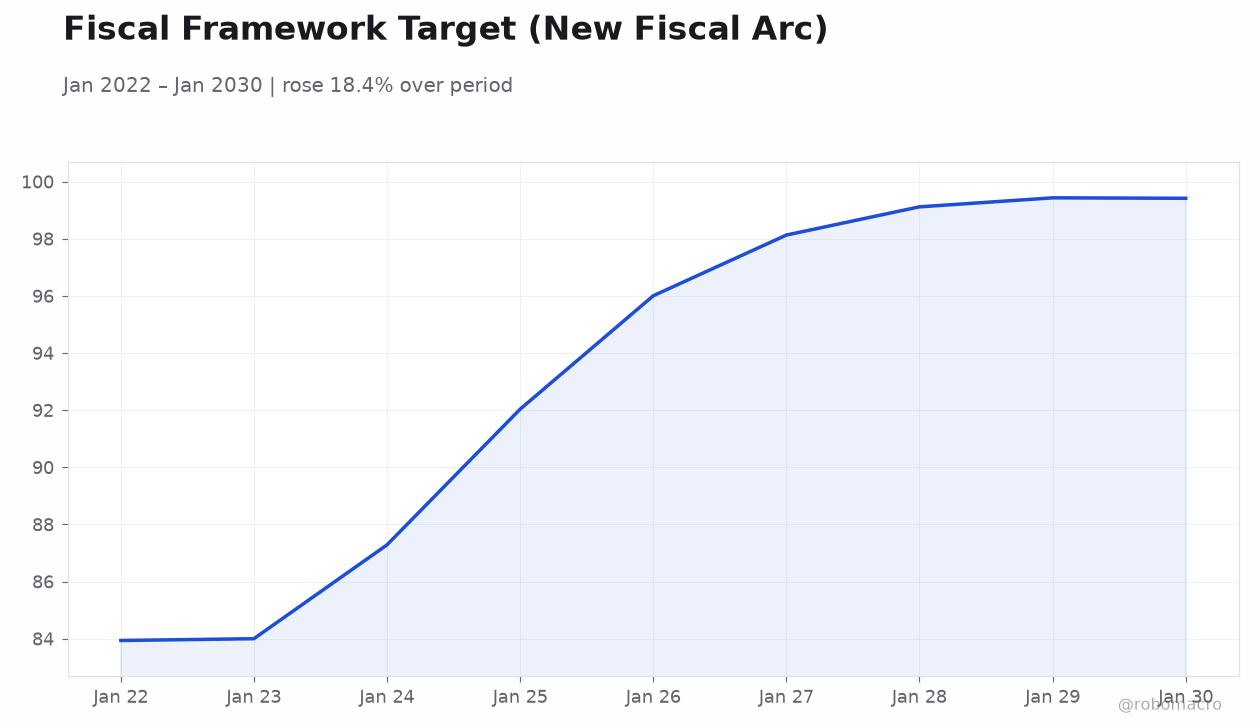
The yield curve showed mixed signals—the 10-year government yield eased 6 basis points to 14.87%, while the 5-year yield edged up 1 basis point to 15.03%. The BCB Focus Market Readout released Monday provided little fresh direction, with market participants continuing to digest the elevated interest burden now representing 9% of GDP, the highest since 2016. Commodity markets offered partial support, with WTI crude advancing 1.80% to $103.84, though gold declined 1.22% to $3,982.10.
The Day Ahead
The headline unemployment rate for September prints at 08:00 ET today, with consensus expecting 5.2% versus the prior 5.3% reading. A print at or below consensus would reinforce the view that Brazil's labor market remains resilient despite restrictive monetary policy, potentially reducing pressure on the BCB to accelerate easing. Conversely, an upside surprise could complicate the disinflation narrative as the committee approaches its November 4 decision.
With no other Brazilian releases scheduled for today or tomorrow, market attention will shift toward positioning ahead of next week's COPOM meeting and the accompanying statement language.
Other Economic Notes
The IMF projects Brazil will become the world's 8th largest economy by 2027, reflecting the country's expanding role in global trade and investment flows. However, the rising interest burden—now at 9% of GDP—poses a structural challenge to fiscal sustainability, crowding out productive investment and limiting countercyclical policy space. China's green technology exports are reportedly sufficient to offset Brazil's annual fossil fuel emissions, highlighting deepening commercial ties between the two economies and potential opportunities in the renewable energy supply chain.
Petrobras confirmed a third oil discovery in the Equatorial Margin at the Morpho well offshore Amapá, signaling upside potential for the state-controlled producer's reserve base.