| Asset | Level | Change |
|---|---|---|
| S&P/TSX | 36,176.60 | +0.11% |
| USD/CAD | 1.41 | -0.83% |
| EUR/CAD | 1.58 | -0.74% |
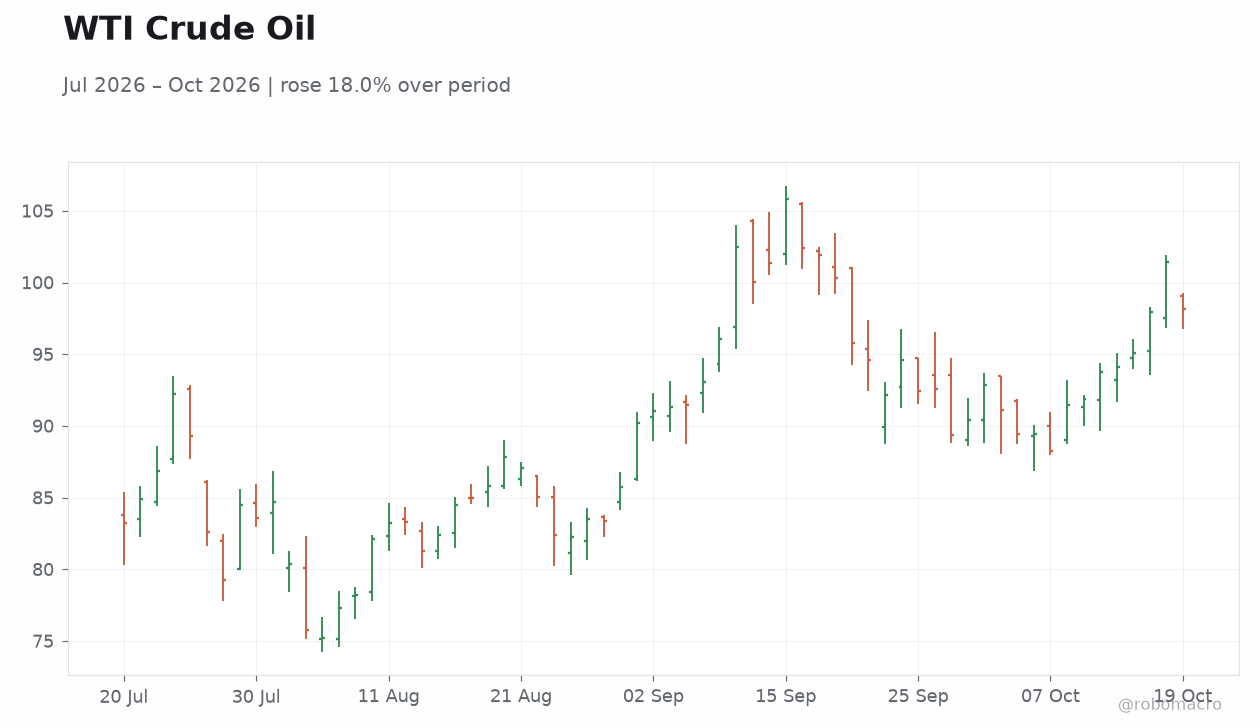
| WTI Crude | 98.14 | -3.22% |
| Natural Gas | 3.14 | +0.74% |
| Gold | 4,191.50 | +0.25% |
| Brent Crude | 108.42 | -1.31% |
| Bitcoin | 82,126.79 | +0.13% |
| Canada 2Y Govt Yield | 3.20% | -1 bp |
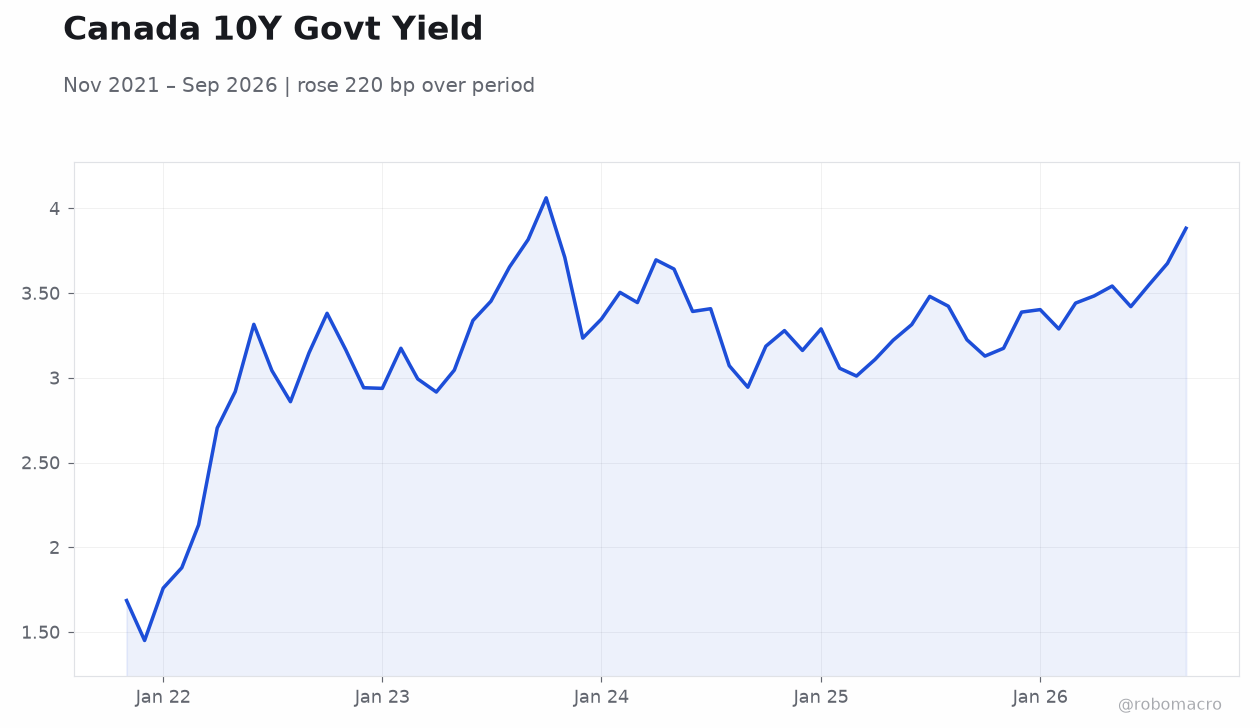
| Canada 10Y Govt Yield | 3.83% | -2 bp |
| Data | Prior | Cons | Actual |
|---|---|---|---|
| No events available | |||
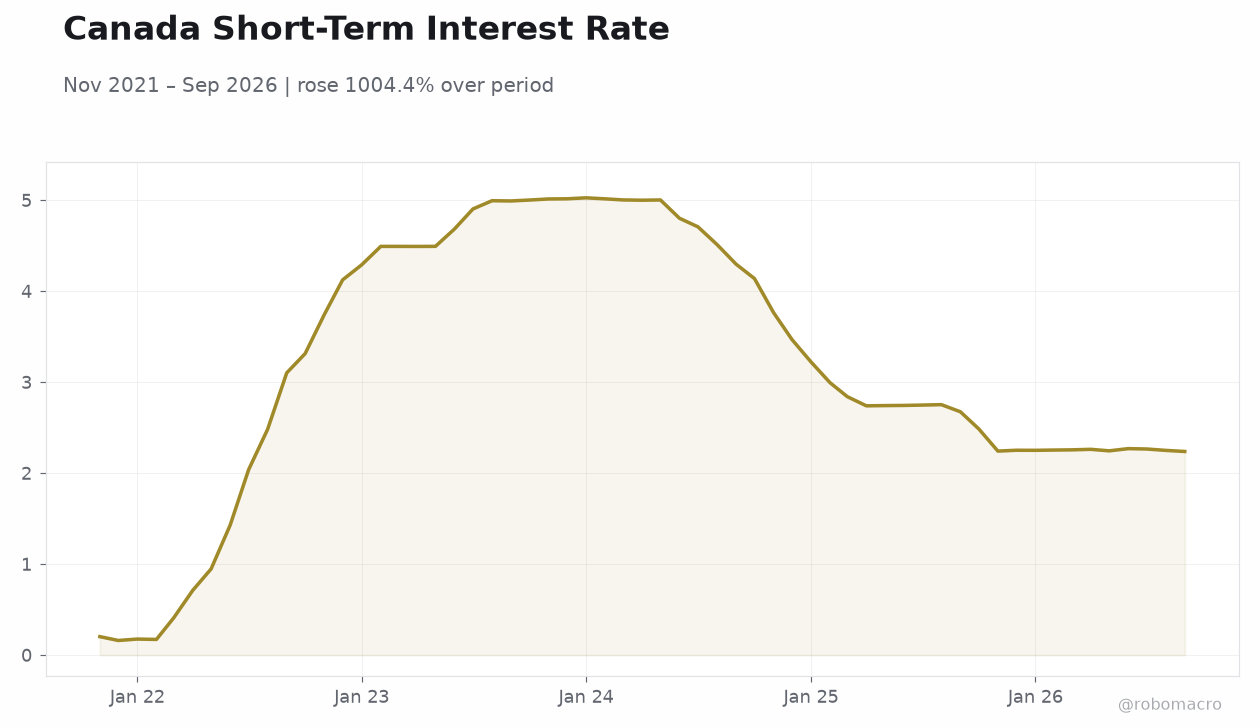
Canada Short-Term Interest Rate | Type: macro_line | Short Rate %: 2.238 (2026-09-01) | Range: 0.1604–5.026 | Trend(6pt): 0.2027,4.29,5.003,2.742,2.265,2.238
| Data | Prior | Cons | Time |
|---|---|---|---|
| No events available | |||
Canadian markets ended the week on a mixed but constructive note. The S&P/TSX Composite added 0.11% to close at 36,176.60, extending its grind higher even as energy-heavy indices absorbed a sharp pullback in crude. WTI fell 3.22% to $98.14 and Brent shed 1.31% to $108.42, though natural gas bucked the trend, gaining 0.74% to $3.14.
The loonie was the standout performer, with USD/CAD sliding 0.83% to 1.41 as the currency rode bullish oil dynamics and rising Fed pause expectations to a two-week high versus the greenback. Fixed income was quiet but bid: the 2-year Government of Canada yield eased 1 bp to 3.20% and the 10-year slipped 2 bp to 3.83%, a modest bull-flattening that suggests markets are leaning toward a less restrictive policy path. Gold advanced 0.25% to $4,191.50, finding support from the oil decline and rate-outlook reassessment.
Bitcoin was essentially flat at $82,126.79, up just 0.13%. The session's undertone was risk-neutral-to-positive for Canada, with commodity strength in gas and a firming currency offsetting crude's late-week stumble.
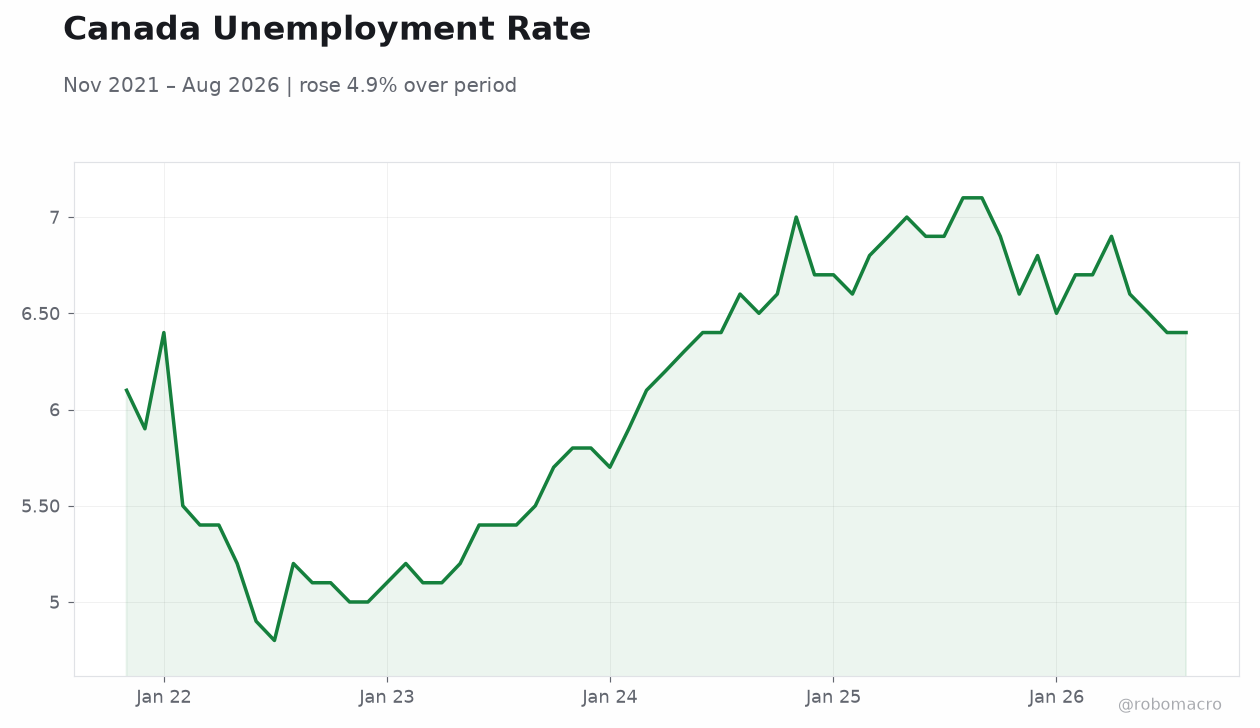
The week opens quietly on the domestic calendar, but attention quickly turns to Statistics Canada's September consumer price index release, which headlines the data docket and will shape expectations for the Bank of Canada's next move. Markets are treating the upcoming decision as "live," and officials have flagged the CPI print and labour data as the pair of releases that will determine its direction. With headline inflation last measured at 3.00% year-over-year and the BoC explicitly warning that higher oil prices will lift its inflation projections, the September figures carry outsized significance for the rate path.
Currency desks will also watch how the loonie consolidates its recent gains, with sterling-cross forecasts pointing to continued oil-supported strength. Housing data continues to trickle out, with sales forecasts having been downgraded for a third time as mortgage rates climb. Any commentary from BoC officials ahead of the decision window will be parsed closely for hints on whether the committee leans hold or tighten.
Subscribe to Canada Macro Daily and get each new issue delivered to your inbox.
Already a member? Visit robomacro.com to log in and manage subscriptions, or use Forgot Password to set a password.
Canada 10Y Govt Yield | Type: macro_line | 10Y Yield %: 3.882 (2026-09-01) | Range: 1.45–4.062 | Trend(6pt): 1.686,2.938,3.444,3.221,3.547,3.882
Canada Unemployment Rate | Type: macro_line | Unemployment %: 6.4 (2026-08-01) | Range: 4.8–7.1 | Trend(5pt): 6.1,5.1,6.1,7,6.4
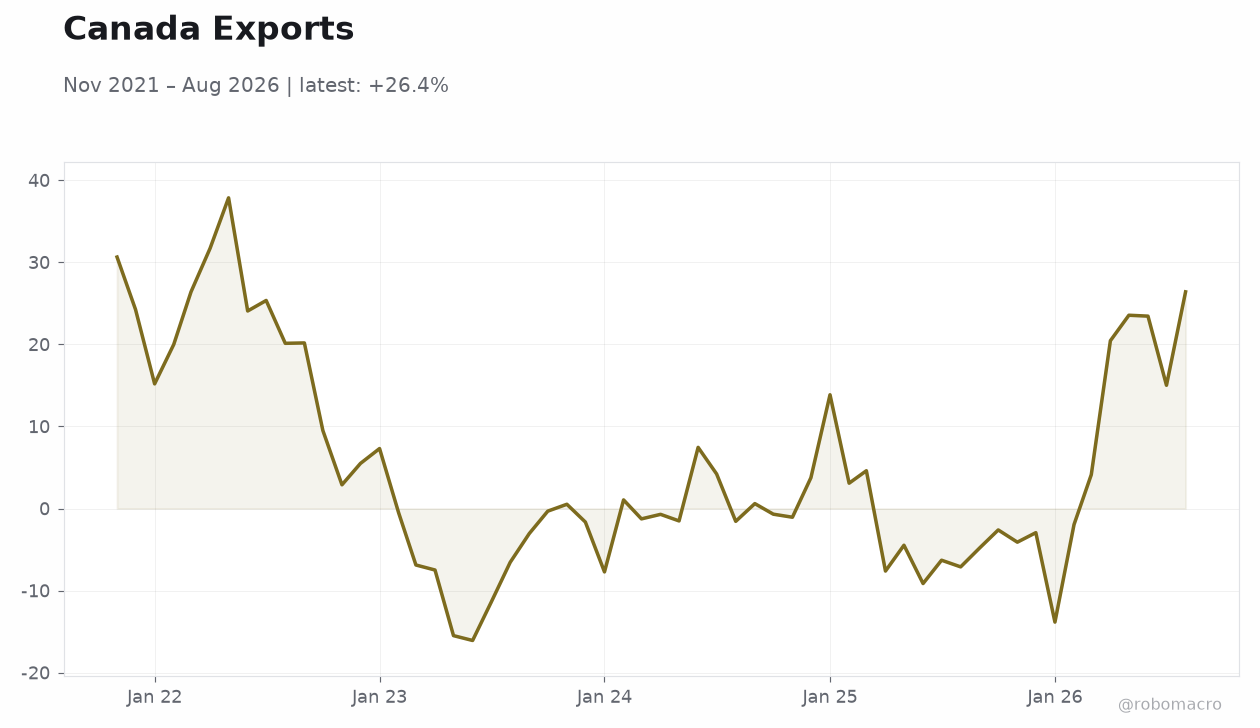
Canada Exports | Type: macro_line | Exports Value: 26.4 (2026-08-01) | Range: -16.08–37.85 | Trend(6pt): 30.64,7.305,-1.263,-4.475,15.01,26.4
WTI Crude Oil | Type: market_hloc | WTI $/bbl: 98.17 (2026-10-19) | Range: 75.22–105.8 | Trend(5pt): 83.23,83.2,91.01,92.41,98.17
Canada's housing market is deteriorating on two fronts simultaneously: rising mortgage rates are deepening what analysts describe as a recession in sales, now downgraded for the third consecutive forecast cycle, while trade-war escalation compounds the pressure. RBC characterizes the retreat as a collision between rate hikes and protectionist trade policy, a combination that is freezing transaction volumes. The oil price surge, however, is a partial offset — it supports national income, energy-sector capex, and provincial royalties in Alberta and Saskatchewan.
The tension between an energy-led growth impulse and a rate-sensitive domestic sector is now the defining macro split in the Canadian economy, and it is exactly the trade-off the Bank of Canada must navigate in coming decisions.
Globally, the theme is fragility meeting inflation. Macklem's warning that global resilience is "under strain" echoes broader concerns about trade fragmentation and geopolitical risk. In the US, Fed Chair Kevin Warsh declined to offer fresh signals on the rate path less than two weeks before the next meeting, keeping pause expectations alive — a dynamic that has weakened the dollar and lifted the CAD.
Gold's rise amid falling oil reflects a classic hedge bid as investors assess the US rate outlook. Vietnam's central bank cut rates to support growth, underscoring the divergent global policy landscape. For Canada, the key transmission channels are the Fed's trajectory (via USD/CAD), crude prices (via terms of trade), and global trade tensions (via export exposure), each pulling in different directions.
The Bank of Canada's communications have turned notably more hawkish in tone. Macklem stated Canada has "not raised rates yet" as energy prices pose challenges, and the bank is set to revise its inflation forecast sharply higher when the Monetary Policy Report is updated, explicitly citing the oil shock. The policy rate stands at 2.25%, and the governing council's recent framing — that the next decision is "live" and contingent on incoming CPI and labour data — signals genuine two-sided risk rather than a pre-committed path.
The oil-driven growth and inflation upgrade complicates the picture: stronger nominal activity argues for less accommodation, yet Macklem's global-resilience warning counsels caution. Markets read the combination as tilt-to-tighten, consistent with the loonie's strength and the modest bull-flattening in the curve. Quantitative tightening continues in the background but is no longer the marginal driver; the marginal driver is whether September CPI confirms the oil pass-through.
A hot print likely brings forward hike expectations; an in-line result keeps the hold-versus-hike debate alive into the decision.