Eurozone Macro Daily(Beta Mode)
Bund Yields Ease as UniCredit-Commerzbank Clears ECB
Market Snapshot
| Asset | Level | Change |
|---|---|---|
| Euro Stoxx 50 | 6,168.26 | -0.36% |
| DAX | 25,382.62 | +0.33% |
| CAC 40 | 7,934.70 | +0.78% |
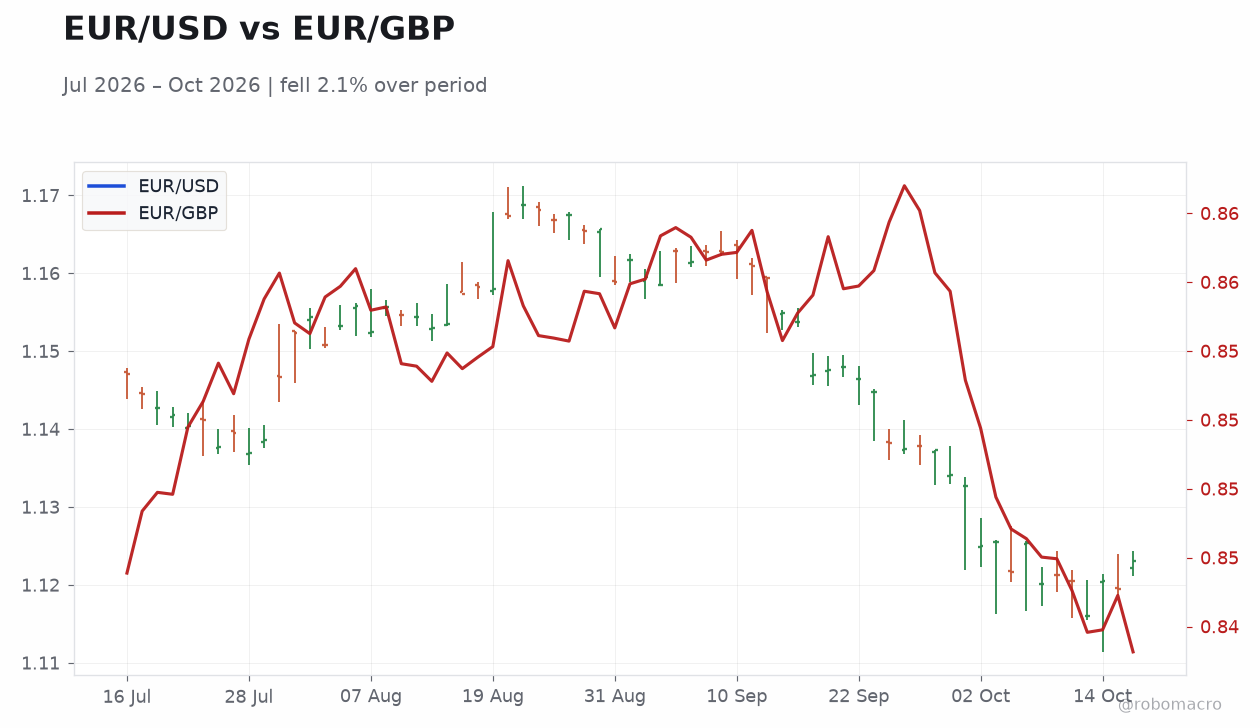
| EUR/USD | 1.12 | +0.33% |
| EUR/GBP | 0.84 | -0.24% |
| EUR/JPY | 177.22 | +0.22% |
| Gold | 4,195.00 | +0.60% |
| Brent Crude | 105.43 | -0.46% |
| Bitcoin | 82,193.29 | +0.77% |
| German 2Y Bund | 3.07% | -4 bp |
| German 10Y Bund | 3.42% | -6 bp |
Prior Economic Events
| Data | Prior | Cons | Actual |
|---|---|---|---|
| Wholesale Prices Month-over-Month | 0.90 | 0.70 | 1.90 |
| Wholesale Prices Year-over-Year | 6.80 | - | 8.70 |
| Headline Unemployment Rate | 4 | - | 4 |
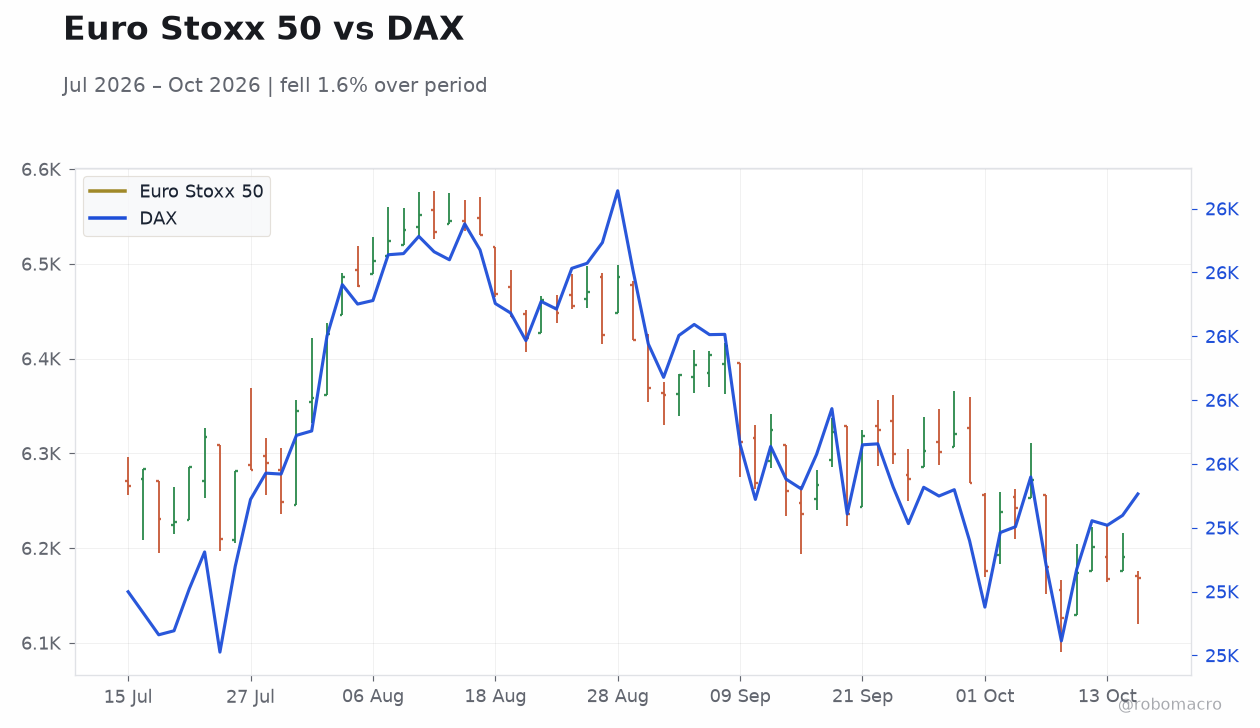 Euro Stoxx 50 vs DAX | Type: market_hloc | Euro Stoxx 50: 6168 (2026-10-15) | Range: 6127–6551 | Trend(6pt): 6266,6503,6486,6318,6167,6168 | DAX: 2.538e+04 (2026-10-15) | Range: 2.476e+04–2.657e+04 | Trend(6pt): 2.5e+04,2.614e+04,2.657e+04,2.558e+04,2.526e+04,2.538e+04
Today's Economic Events
| Data | Prior | Cons | Time |
|---|---|---|---|
| Trade Balance | 8,240m | 7,500m | 06:00 |
- German Bunds rallied, with the 10-year yield easing 6 bp to 3.42% and the 2-year down 4 bp to 3.07%, as risk sentiment steadied.
- German wholesale prices surged 1.9% m/m and 8.7% y/y, far above consensus, keeping pipeline inflation pressures alive.
- The ECB approved UniCredit's takeover of Commerzbank; Italy's trade balance is the sole data point today.
Yesterday's Recap
Eurozone markets ended Wednesday mixed but constructive, with the DAX gaining 0.33% to 25,382.62 and the CAC 40 outperforming at +0.78% to 7,934.70, while the Euro Stoxx 50 slipped 0.36% to 6,168.26. Fixed income was the standout story: German Bunds rallied across the curve, the 10-year yield easing 6 bp to 3.42% and the 2-year falling 4 bp to 3.07%, signaling a modest flight to quality even as equities held up. On the data front, German wholesale prices rose 1.9% month-over-month, well ahead of the 0.7% consensus, with the year-over-year rate accelerating to 8.7% from 6.8% previously — a sharp pipeline signal for goods inflation.
The Netherlands reported an unchanged headline unemployment rate of 4.0%, underscoring continued labor market resilience. In corporate news, the ECB granted regulatory approval for UniCredit's takeover of Commerzbank, a milestone for European banking consolidation that lifted sentiment around German financials. The euro firmed 0.33% against the dollar to 1.12, while easing 0.24% against sterling to 0.84 and gaining 0.22% versus the yen at 177.22.
Brent crude slipped 0.46% to $105.43, offering marginal relief on the energy front, though European officials remain wary of winter supply tightness.
The Day Ahead
Today's calendar is thin, with Italy's trade balance the sole scheduled release at 06:00 ET, where the consensus looks for a surplus of roughly €7.5 billion versus €8.24 billion previously. With no tier-one prints, attention will stay on the bond market's follow-through after Wednesday's rally and on French fiscal developments. German Chancellor Merz's reform agenda remains in focus after his defiant pledge to press ahead with unpopular changes.
Markets will also watch for any color from ECB speakers following the UniCredit-Commerzbank clearance. Tomorrow's calendar currently shows no scheduled releases, leaving the data lull to extend into the weekend.
Other Economic Notes
France's fiscal trajectory continues to dominate the periphery of the euro story, with Banque de France chief Moulin suggesting a 3%-of-GDP deficit is achievable by 2029 — a target that would require sustained consolidation. ↓ p.2