| Asset | Level | Change |
|---|---|---|
| Saudi Aramco | 25.74 | -0.39% |
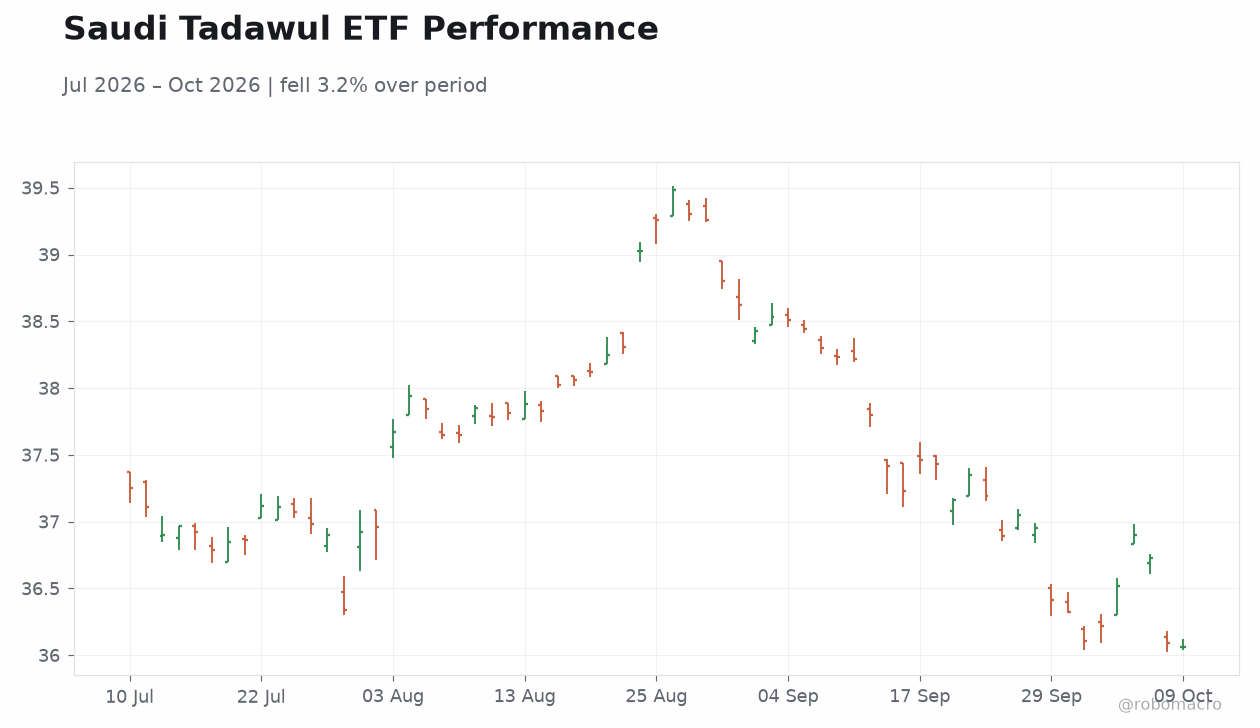
| MSCI Saudi | 36.06 | -0.08% |
| MSCI UAE | 19.32 | +0.10% |
| MSCI Qatar | 15.99 | -0.28% |
| MSCI Kuwait | 36.02 | +0.67% |
| Brent Crude | 104.72 | +0.42% |
| WTI Crude | 91.85 | +0.39% |
| Gold | 4,216.30 | +1.43% |
| USD/SAR | 3.76 | +3.20% |
| USD/AED | 3.67 | +0.04% |
| USD/KWD | 0.31 | +0.04% |
| Bitcoin | 83,012.01 | +0.56% |
| Data | Prior | Cons | Actual |
|---|---|---|---|
| No events available | |||
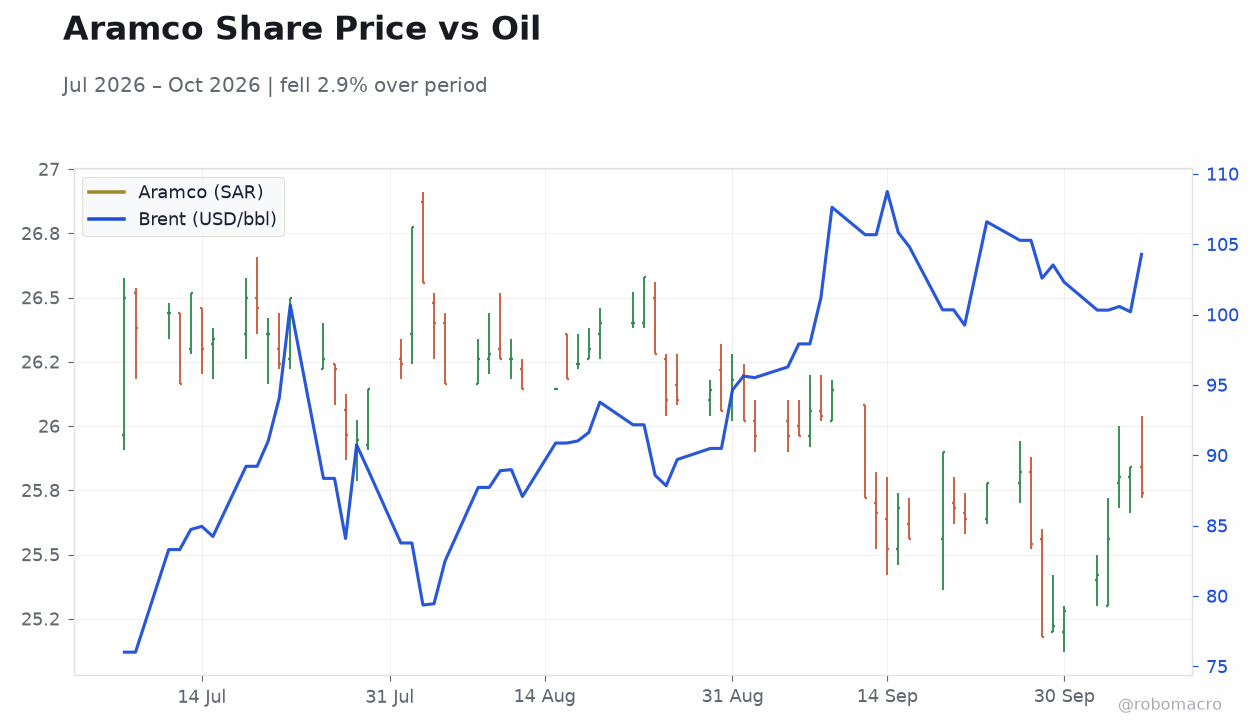
Aramco Share Price vs Oil | Type: market_hloc | Aramco (SAR): 25.74 (2026-10-08) | Range: 25.18–26.77 | Trend(6pt): 26.5,26.14,26.4,25.66,25.84,25.74 | Brent (USD/bbl): 104.7 (2026-10-09) | Range: 76.01–108.8 | Trend(5pt): 76.01,83.77,88.58,104.8,104.7
| Data | Prior | Cons | Time |
|---|---|---|---|
| No events available | |||
The dominant story across the Gulf was the security incident at Riyadh's King Khalid International Airport, which temporarily halted operations and forced Emirates, Etihad, flydubai and Air Arabia to cancel Riyadh services, snarling weekend air links between the UAE and Saudi Arabia. The EU subsequently warned that Houthi capabilities now extend deeper inside Saudi territory, a development that keeps regional supply-chain and infrastructure risk squarely on the radar for investors pricing GCC sovereign risk. On the diplomatic front, Saudi Arabia and the UAE both endorsed Japan's proposal to strengthen coordinated oil reserve arrangements across Asia, underscoring the Gulf's central role in Asian energy security architecture.
In corporate news, Qatar National Bank reported a 4.9% rise in profit, with management flagging a strategic push into digital infrastructure and real-estate financing to capture cross-border trade flows. Aramco separately confirmed it will supply full requested crude volumes to European refiners in November, a reassuring signal for physical market tightness. Equity performance was mixed: MSCI Kuwait led gainers at +0.67%, MSCI UAE edged up 0.10%, while MSCI Qatar slipped 0.28% and MSCI Saudi was broadly flat at -0.08%.
Aramco shares closed at 25.74, down 0.39%, lagging the broader Saudi tape.
The calendar is light into the weekend, with no major scheduled macro releases across the six member states. Attention shifts to follow-through on the Iraqi prime minister's planned visits to Saudi Arabia and Kuwait, which could yield bilateral energy and investment announcements. Markets will also watch for further updates on Riyadh airport operations and the resumption of UAE–Saudi flight schedules, a practical barometer of how quickly the security situation normalizes.
In energy markets, traders will track physical crude differentials and freight rates through the Strait of Hormuz and Red Sea corridors as Houthi risk keeps tanker insurance costs elevated. The UAE's investigation into the flydubai incident may produce additional findings that inform aviation-risk assessments. With regional bourses open Sunday through Thursday, positioning into the weekend will reflect hedging demand around any escalation headlines.
Subscribe to GCC Macro Daily and get each new issue delivered to your inbox.
Already a member? Visit robomacro.com to log in and manage subscriptions, or use Forgot Password to set a password.
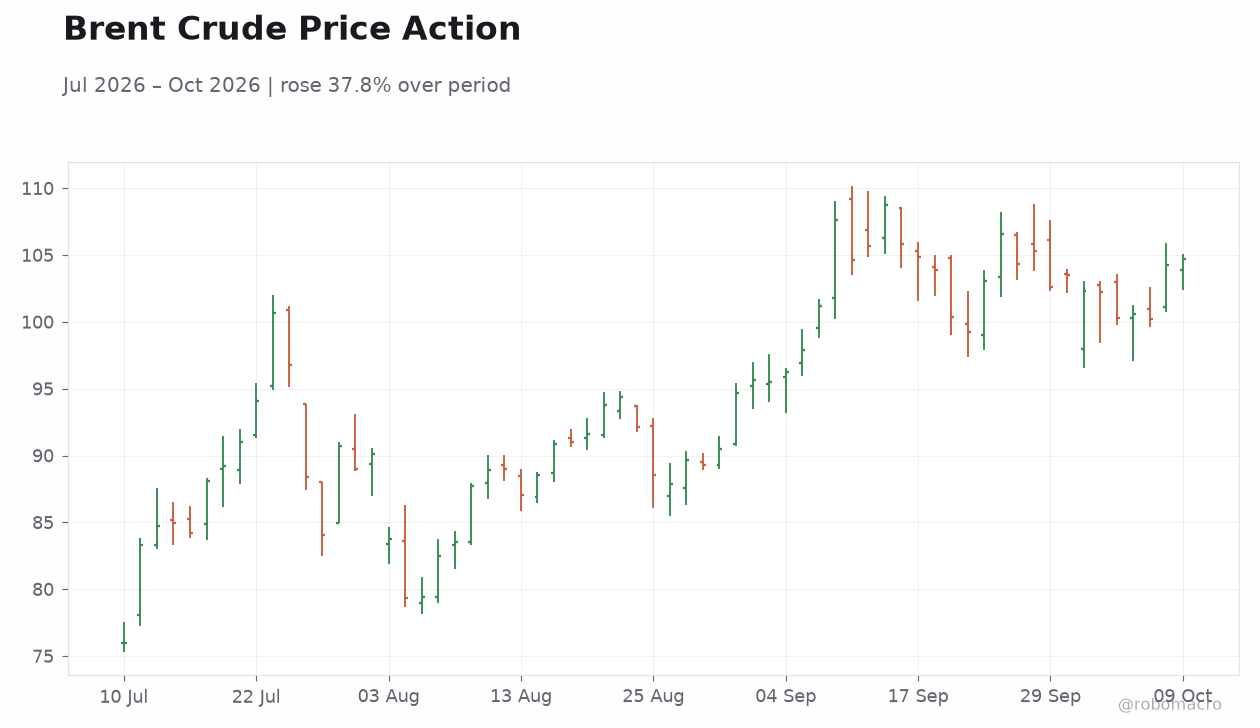
Brent Crude Price Action | Type: market_hloc | Brent (USD/bbl): 104.7 (2026-10-09) | Range: 76.01–108.8 | Trend(5pt): 76.01,83.77,88.58,104.8,104.7
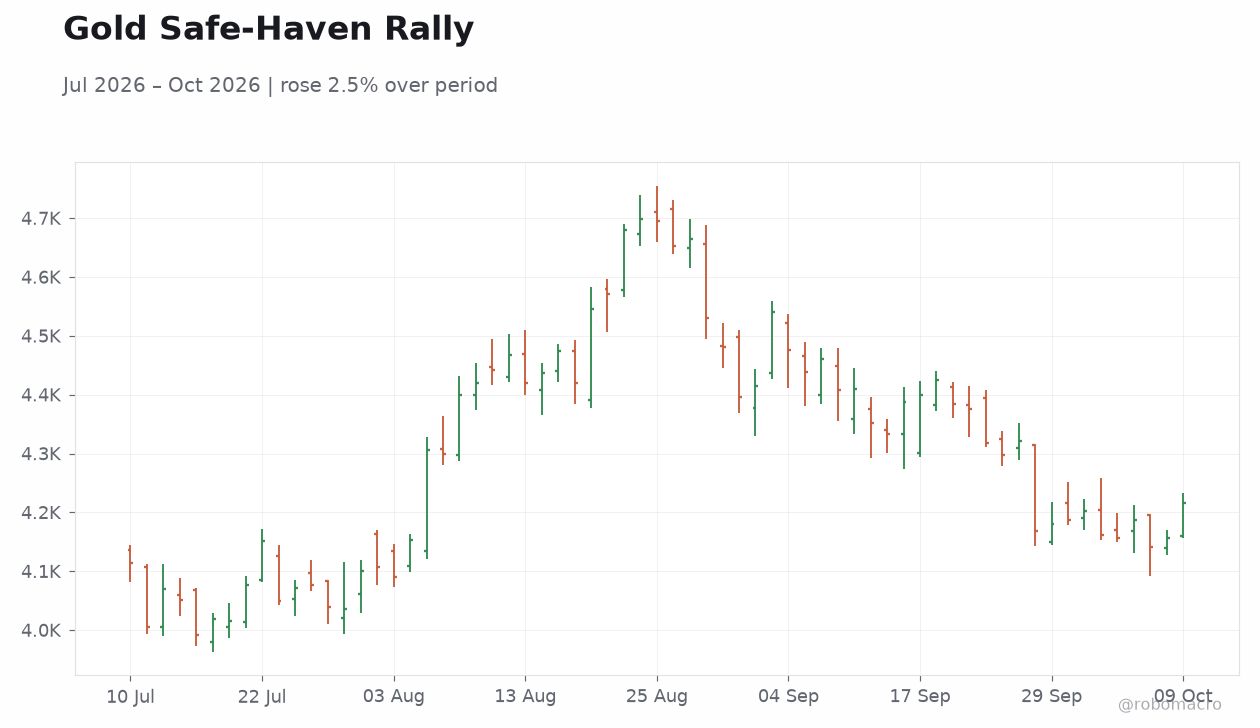
Gold Safe-Haven Rally | Type: market_hloc | Gold (USD/oz): 4216 (2026-10-09) | Range: 3992–4698 | Trend(5pt): 4114,4090,4694,4400,4216
Saudi Tadawul ETF Performance | Type: market_hloc | iShares Saudi ETF (USD): 36.06 (2026-10-09) | Range: 36.06–39.48 | Trend(5pt): 37.25,37.67,39.26,37.46,36.06
SAMA Governor commentary emphasized that Saudi Arabia maintains considerable economic resilience despite regional tensions, a message echoed by the Council of Economic and Development Affairs, which stressed the kingdom's structural durability. These coordinated reassurances from Riyadh's economic policymaking establishment appear designed to anchor investor expectations amid the security noise. The UAE Coast Guard's rescue of 22 crew members from a burning tanker in the Arabian Gulf highlights the operational fragility of Gulf maritime infrastructure at a time of heightened attack frequency.
Meanwhile, Australia's plan to reserve up to a fifth of LNG output for domestic use and persistent Asian LNG demand softness are reshoring dynamics that could indirectly support Gulf LNG exporters' market share in Asia.
Gold's 1.43% surge to $4,216.30 and Brent's grind higher to $104.72 reflect a classic risk-off, inflation-hedging configuration, with the Financial Times noting that the Iran conflict has snarled usually free-flowing energy markets. Bank of Spain raised its inflation forecasts on higher energy prices, a reminder that the oil shock is now feeding into European core inflation prints and complicating the ECB's easing path. In LNG markets, two US cargoes diverted to Europe as Asian demand eased, while China continues to shun US LNG entirely, reshuffling trade flows in ways that benefit Qatar's long-term contract portfolio.
↓ p.3
Australia's domestic reservation scheme, if finalized aggressively, could tighten Pacific basin supply and support QatarEnergy's pricing power in spot markets. Bitcoin's 0.56% gain to roughly $83,000 suggests crypto is trading as a modest risk asset rather than a haven. The broader implication for the Gulf is constructive: sustained triple-digit Brent materially improves fiscal breakeven math for all six sovereigns, with Saudi Arabia and the UAE best positioned to rebuild buffers at current levels.
SAMA Governor Ahmed Al-Kholify's public emphasis on economic resilience doubles as a signal that Saudi monetary conditions remain comfortably anchored; the riyal's print at 3.76 against the dollar — a 3.20% move on the day — is worth monitoring for any drift from the typical 3.75 peg level, though the move likely reflects fixing mechanics rather than genuine pressure. The CBUAE's dirham held steady at 3.67, and the Kuwaiti dinar at 0.31 against the dollar, with the CBK continuing to manage the basket peg that gives Kuwait modest flexibility relative to its pure-USD peers. With the Fed's easing cycle paused and regional inflation contained, all six central banks — SAMA, CBUAE, QCB, CBK, CBO and CBB — face little pressure to deviate from Fed-linked rate paths, keeping repo and interbank rates, including SAIBOR and EIBOR, in familiar ranges.
QCB's alignment remains mechanical given the riyal peg, while Oman's CBO and Bahrain's CBB benefit from the same stability, though Bahrain's narrower fiscal buffers make its peg the most sensitive to a sustained oil drawdown. The gold rally and elevated Brent provide a comfortable external backdrop for reserve accumulation across the region. Any Fed repricing at upcoming meetings would transmit immediately through the six currency boards, making the November FOMC the key external event for GCC rate watchers.
For now, the peg architecture is performing exactly as designed, with no visible stress in forward markets or sovereign CDS.