RoboMacro ResearchAlso todaySee the Commodities Daily

GCC Macro Daily(Beta Mode)

October 13, 2026 robomacro.com

Houthis Hit Aramco; Oil Holds Near $107

Saudi Aramco25.78+0.31%
MSCI Saudi35.83+0.49%
MSCI UAE19.37+0.31%
MSCI Qatar15.81-0.03%

Market Snapshot

AssetLevelChange
Saudi Aramco25.78+0.31%
MSCI Saudi35.83+0.49%
MSCI UAE19.37+0.31%
MSCI Qatar15.81-0.03%
MSCI Kuwait36.03+0.00%
Brent Crude106.63-0.02%
WTI Crude95.03+1.38%
Gold4,187.10-0.08%
USD/SAR3.76+3.18%
USD/AED3.67+0.03%
USD/KWD0.31+0.14%
Bitcoin83,629.45+2.28%

Prior Economic Events

Data Prior Cons Actual
No events available
Chart of the Day

Today's Economic Events

Data Prior Cons Time
No events available
  • Houthi missile and drone strikes on Riyadh and Aramco infrastructure extend into a second phase, with Saudi officials confirming four wounded and an extended closure at Riyadh airport; Qatar Airways and UAE carriers suspend Saudi routes, raising regional logistics costs.
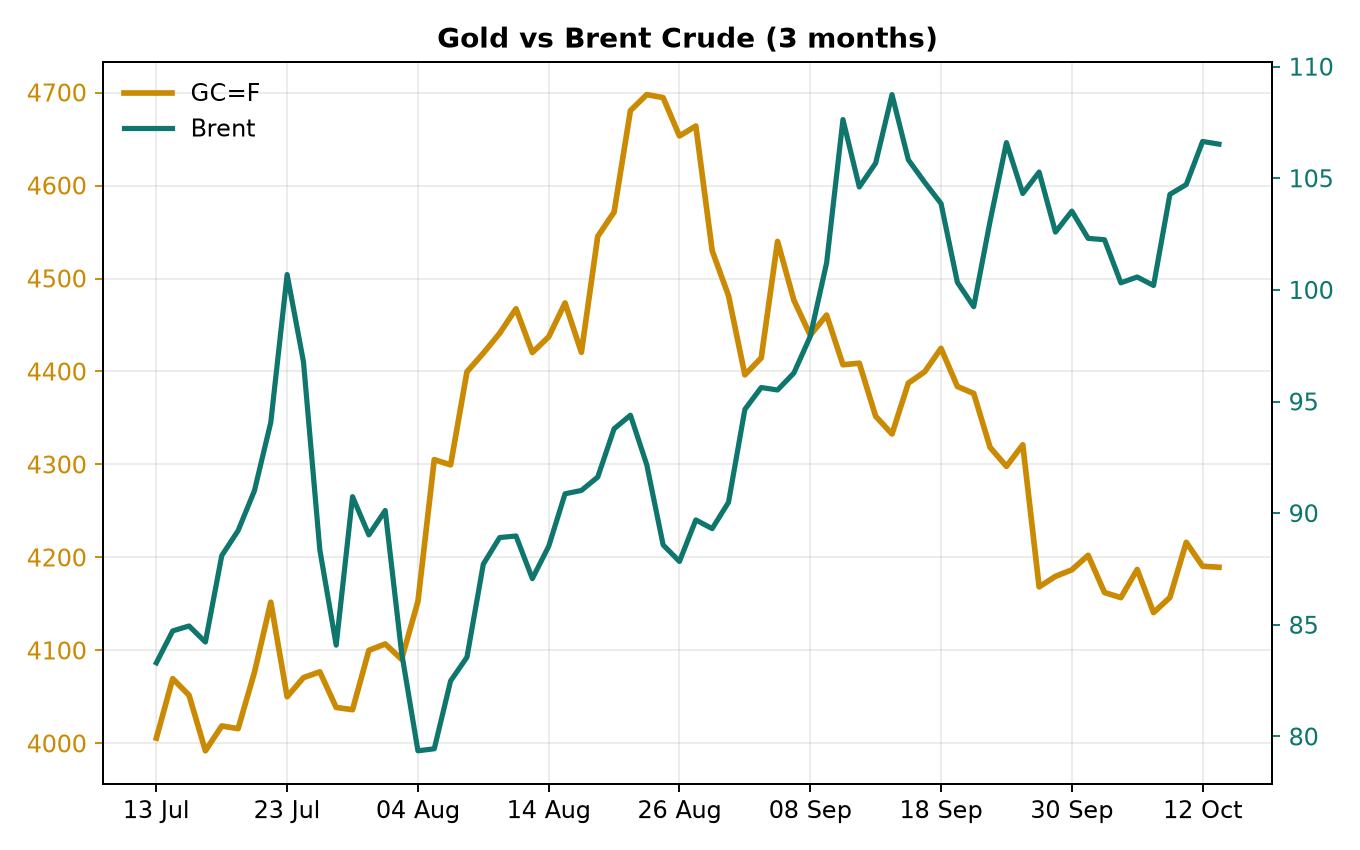
  • Brent eased 0.02% to $106.63 while WTI gained 1.38% to $95.03, with the WTI-Brent spread narrowing as US supply data and Hormuz transit risk dominate positioning.
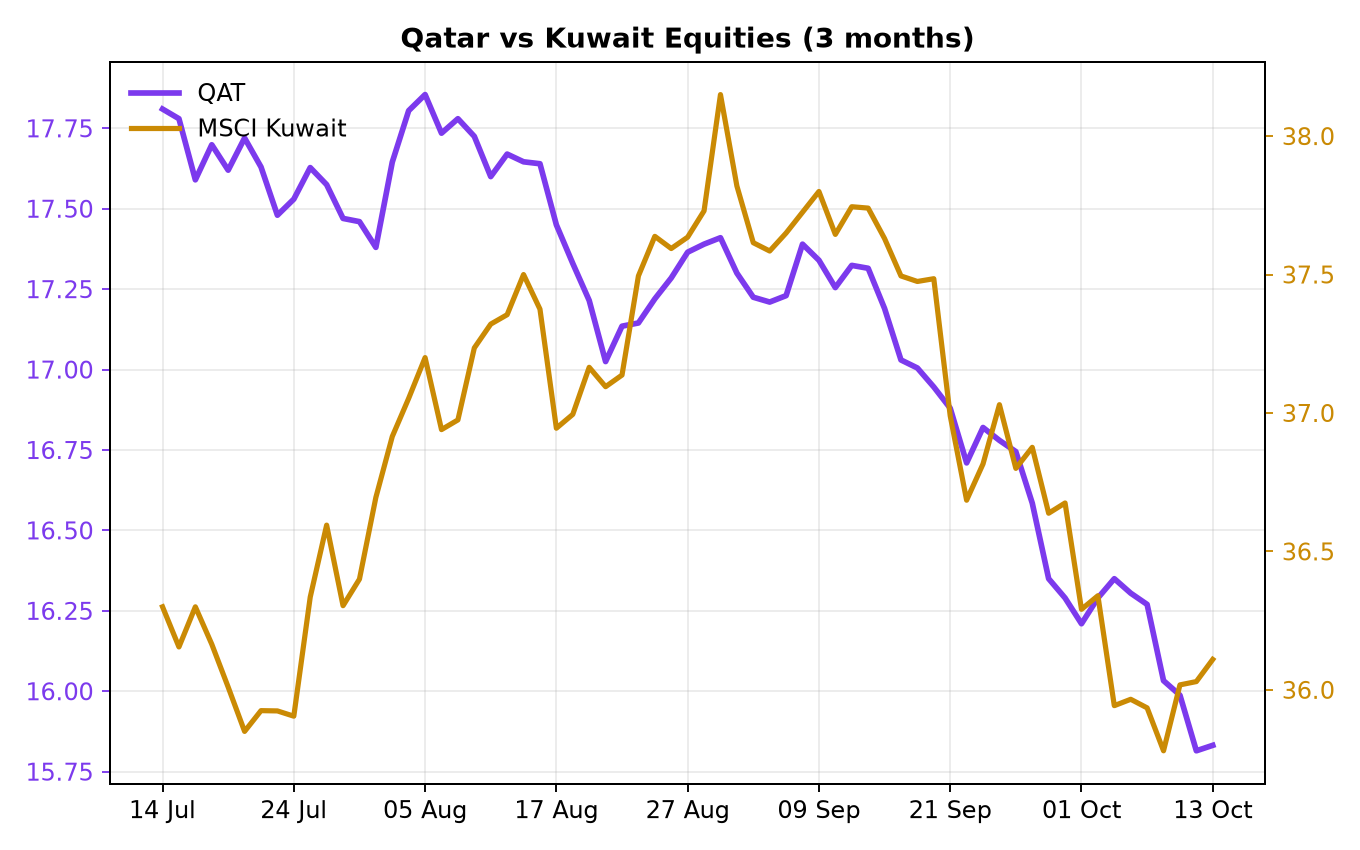
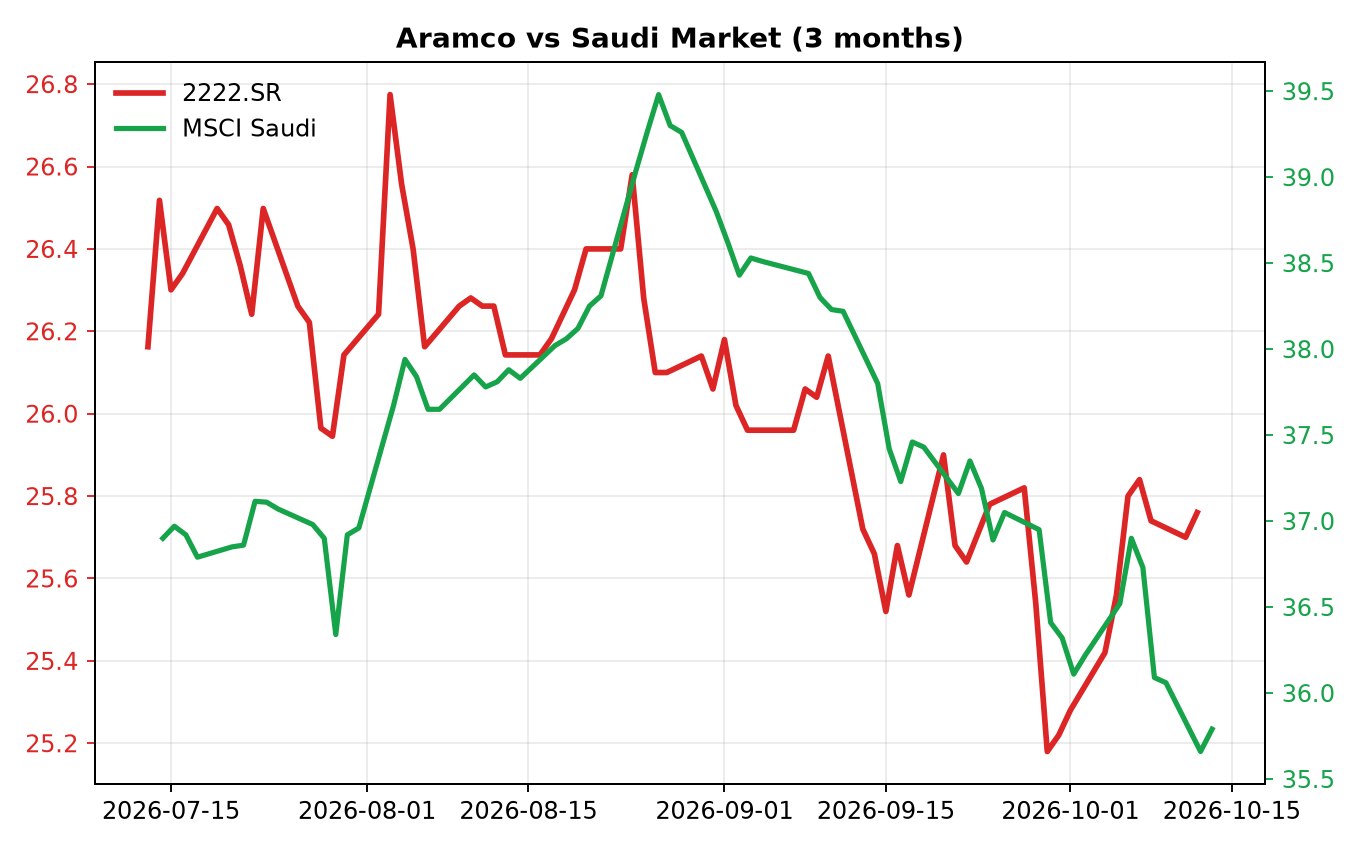
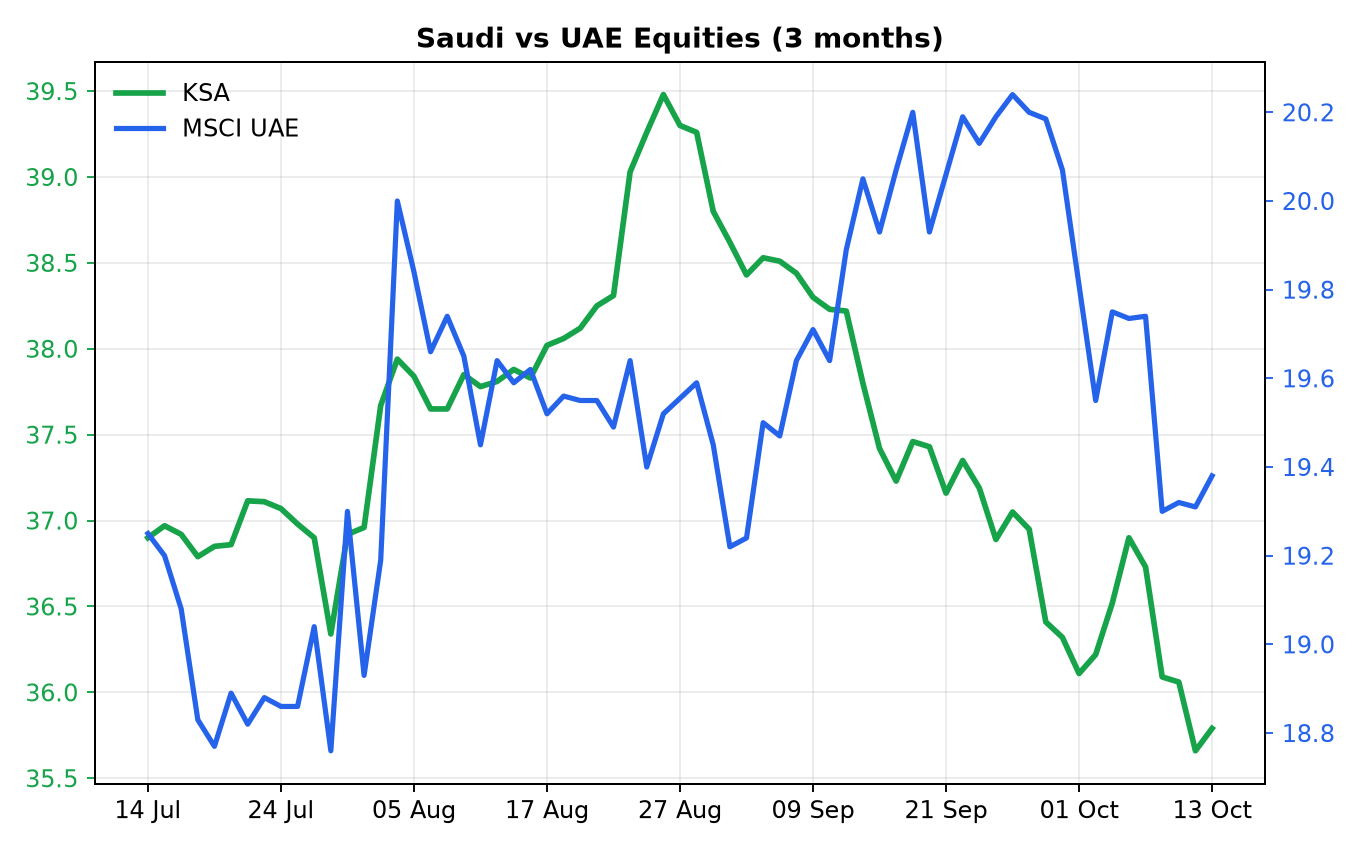
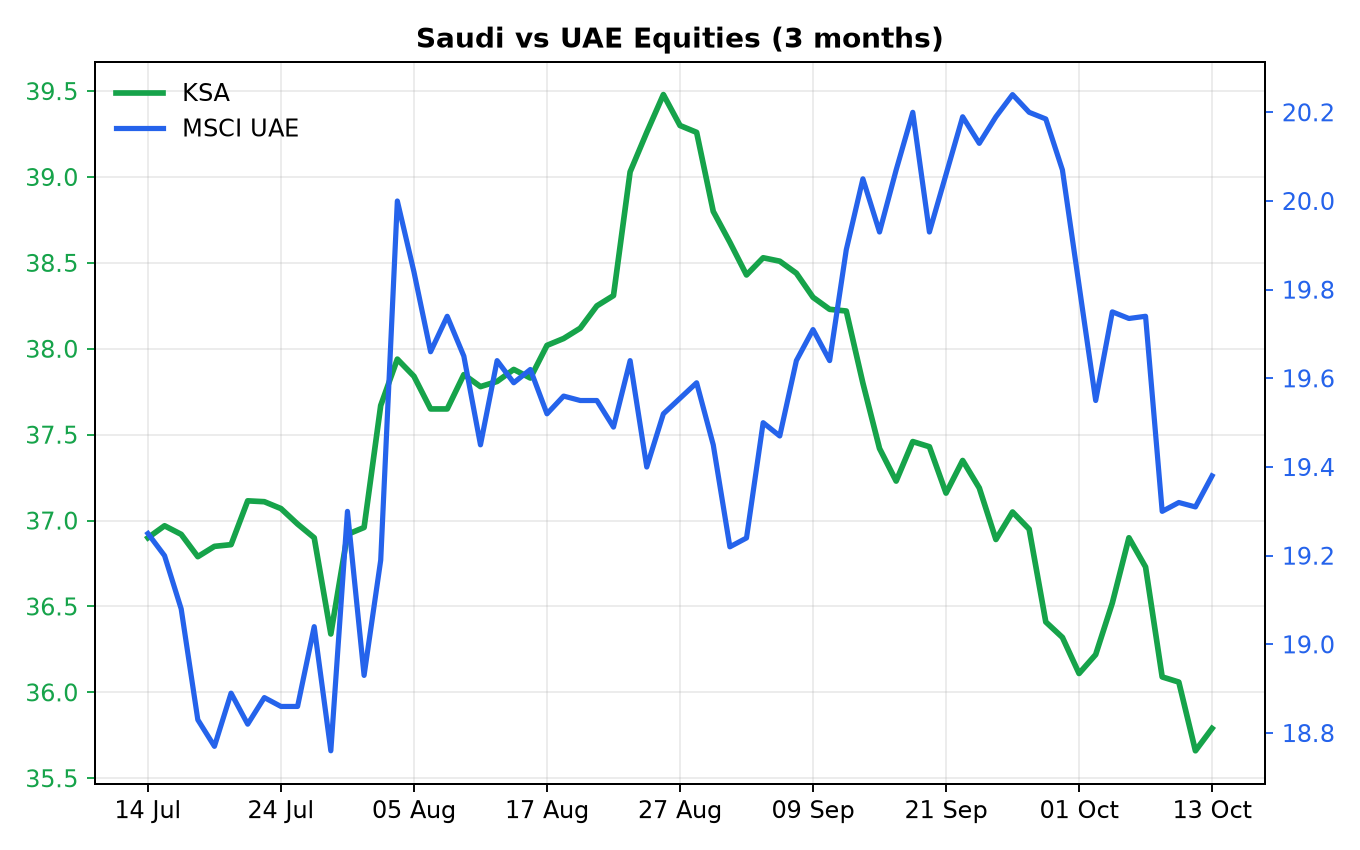
  • Gulf equities ground higher despite the security backdrop: Saudi Aramco rose 0.31% to 25.78, MSCI Saudi added 0.49%, and MSCI UAE gained 0.31%, while MSCI Qatar slipped 0.03% and MSCI Kuwait was flat.

Yesterday's Recap

The dominant story across the Gulf remained the escalation of Houthi attacks on Saudi territory, with strikes on an Aramco building in Riyadh wounding four and prompting an extended closure of Riyadh airport. The security deterioration is now visibly feeding into the real economy: commentary citing IMF projections points to a 3.3% GDP contraction for Saudi Arabia, while reports highlight the kingdom drawing down interceptor missile inventories as air-defense tempo persists. Aviation disruption spread across the GCC, with Emirates, Etihad, and flydubai cancelling Riyadh, Dammam, and Jeddah services and Qatar Airways suspending Riyadh and Dammam flights — a tangible hit to regional trade and travel corridors.

Qatar and Kuwait issued coordinated statements condemning the attacks, signaling a diplomatic push for joint Gulf security action that the UAE has publicly championed. On markets, the damage was contained: Saudi Aramco shares climbed 0.31% to 25.78 and MSCI Saudi outperformed at +0.49%, suggesting investors view the fiscal buffer and Aramco's scale as resilient to the disruption. Brent crude was essentially flat at $106.63, though WTI's 1.38% jump to $95.03 narrowed the transatlantic spread, and gold was little changed at 4,187.10.

USD/SAR printed 3.76, a 3.18% move on the day that bears watching for peg mechanics, while USD/AED held at 3.67 and USD/KWD at 0.31.

The Day Ahead

The calendar is thin on scheduled macro prints for Tuesday, leaving market attention on the geopolitical tape and any follow-through from the Riyadh strikes. Watch for further updates on Saudi airport reopening timelines, as extended closures would compound the logistics drag on non-oil activity. Saudi energy diplomacy continues with the energy minister's MoUs with Mongolia, Tanzania, Cyprus, and Mauritius, which may yield incremental supply or investment headlines.

Bangladesh's push for long-term LNG commitments from Saudi Arabia and Qatar underscores intensifying competition for Gulf molecules into South Asia. Any formalization of joint GCC air-defense coordination, following the UAE's call for collective action, would be a positive for regional risk sentiment and sovereign spreads. Later in the week, attention shifts to whether the Houthi campaign forces curtailments in Saudi loading schedules, which would be the first hard supply data point from the escalation.
Page 1

GCC Macro Daily(Beta Mode)

October 13, 2026 robomacro.com
Chart 1
Chart 2
Chart 3
Chart 4

Other Economic Notes

The war's economic transmission channels are multiplying: remittance flows from the large expatriate workforce in Saudi Arabia — a critical pillar for Bangladesh and other South Asian economies — face disruption risk as employers retrench. EFG Hermes launched market making and liquidity provision on the Dubai Financial Market, a structural positive for UAE market depth and institutional participation. Tanzania's progress toward a $42bn Equinor-Shell LNG final investment decision, after years of delay, adds a marginal competitor to Gulf LNG in the late-2020s supply wave.

India's gas demand calculus is being reshaped by Hormuz transit risk, reinforcing the premium on secure, long-tenor Gulf supply contracts. The UAE's business activity data showing slowdown from war disruption confirms the conflict is no longer a Saudi-only story — it is a GCC-wide growth drag.

Global Macro News

Oil's resilience near $106-107 reflects a market pricing sustained Middle East supply risk, with the Houthi campaign now striking inside Saudi Arabia and attention turning to potential US intervention. The WTI outperformance at +1.38% versus flat Brent suggests US crude is catching a bid from refinery demand and narrowing arbitrage economics. China's continued absence from US LNG purchases, despite maintaining contract exposure, keeps the global LNG market bifurcated and supports Gulf suppliers' pricing power into Asia.

Gold's stability near 4,187 signals neither a risk-off surge nor a dollar rally — a neutral macro backdrop that has allowed Gulf equities to grind higher. ↓ p.3

Sponsored by Arbitrage Search
Page 2

GCC Macro Daily(Beta Mode)

October 13, 2026 robomacro.com

Continuation

Global Macro News (continued)

Bitcoin's 2.28% gain to 83,629 reflects broad risk appetite in digital assets, consistent with the equity tone. The dollar's mixed performance — SAR's sharp 3.18% move against a stable AED — suggests idiosyncratic flows rather than a broad dollar trend, keeping GCC peg pressure contained for now.

GCC Central Banks Watch

The USD/SAR print of 3.76, up 3.18% on the day, is the standout FX move and warrants scrutiny of forward market pricing around the SAMA peg — a move of that magnitude in a pegged regime typically reflects month-end fixing dynamics or hedging flows rather than peg stress, but it merits monitoring against Saudi foreign reserve levels. SAMA's rate path remains mechanically tied to the Fed, and with the security escalation raising Saudi fiscal needs, any divergence between Fed cuts and SAMA's response would pressure the riyal swap curve. CBUAE faces a milder task: USD/AED at 3.67 is anchored, and UAE's stronger external position gives the central bank more latitude, though the war-driven activity slowdown argues for following the Fed lower at the next meeting.

QCB's coordination is straightforward with USD/QAR stability, though Qatar Airways' Saudi suspensions add a marginal current-account drag. CBK's basket peg gives Kuwait flexibility — USD/KWD at 0.31 was stable, and the dinar's multi-currency anchor cushions imported volatility from dollar swings. CBO and CBB, with smaller reserve buffers, will simply shadow the Fed, with Oman's fiscal position aided by elevated crude and Bahrain's narrower buffer the persistent watch-item.

Across the region, SAIBOR and EIBOR fixings should drift lower in sympathy with Fed expectations, supporting bank net interest margins only if deposit repricing lags.

Sponsored by Arbitrage Search
Page 3