RoboMacro ResearchAlso todaySee the FX Daily

GCC Macro Daily(Beta Mode)

October 14, 2026 robomacro.com

Houthis Hit Aramco; GCC Equities Slip

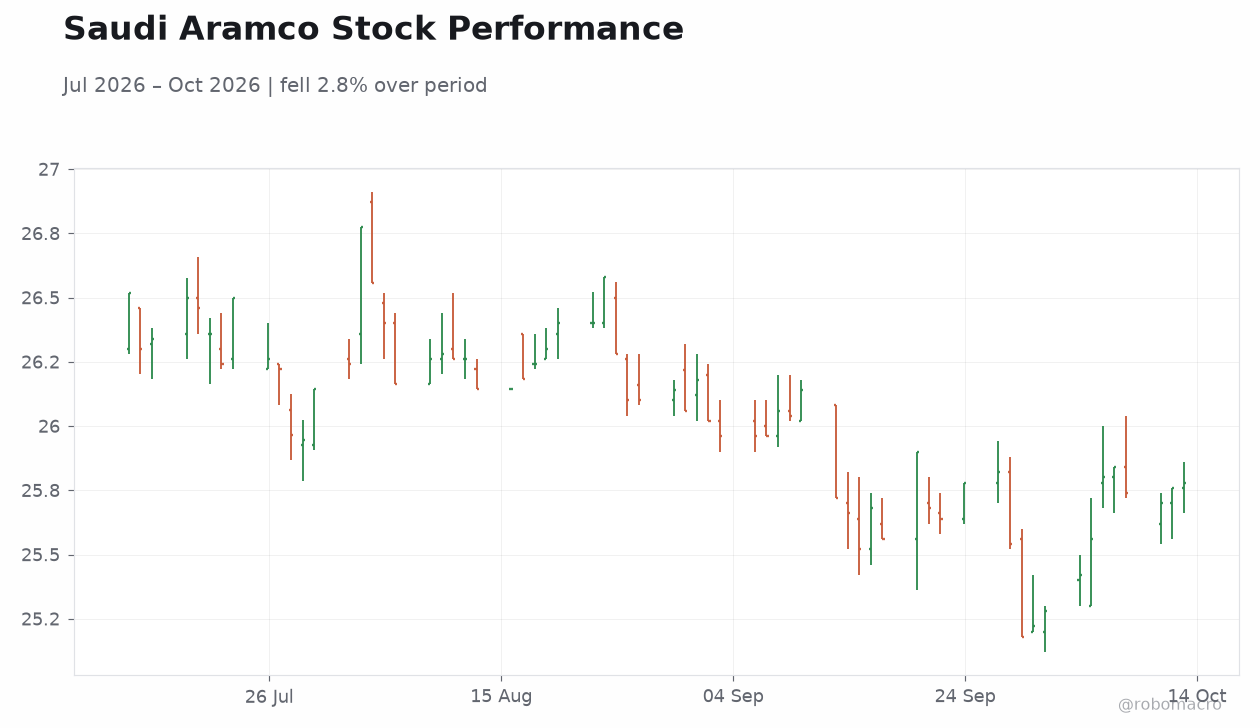
Saudi Aramco25.38-1.55%
MSCI Saudi35.15-1.79%
MSCI UAE19.56+0.93%
MSCI Qatar15.76-0.49%

Market Snapshot

AssetLevelChange
Saudi Aramco25.38-1.55%
MSCI Saudi35.15-1.79%
MSCI UAE19.56+0.93%
MSCI Qatar15.76-0.49%
MSCI Kuwait35.38-2.02%
Brent Crude104.26-1.35%
WTI Crude93.79-0.37%
Gold4,176.00-0.03%
USD/SAR3.75+3.06%
USD/AED3.67+0.00%
USD/KWD0.31+0.14%
Bitcoin81,208.18-2.27%

Prior Economic Events

Data Prior Cons Actual
No events available
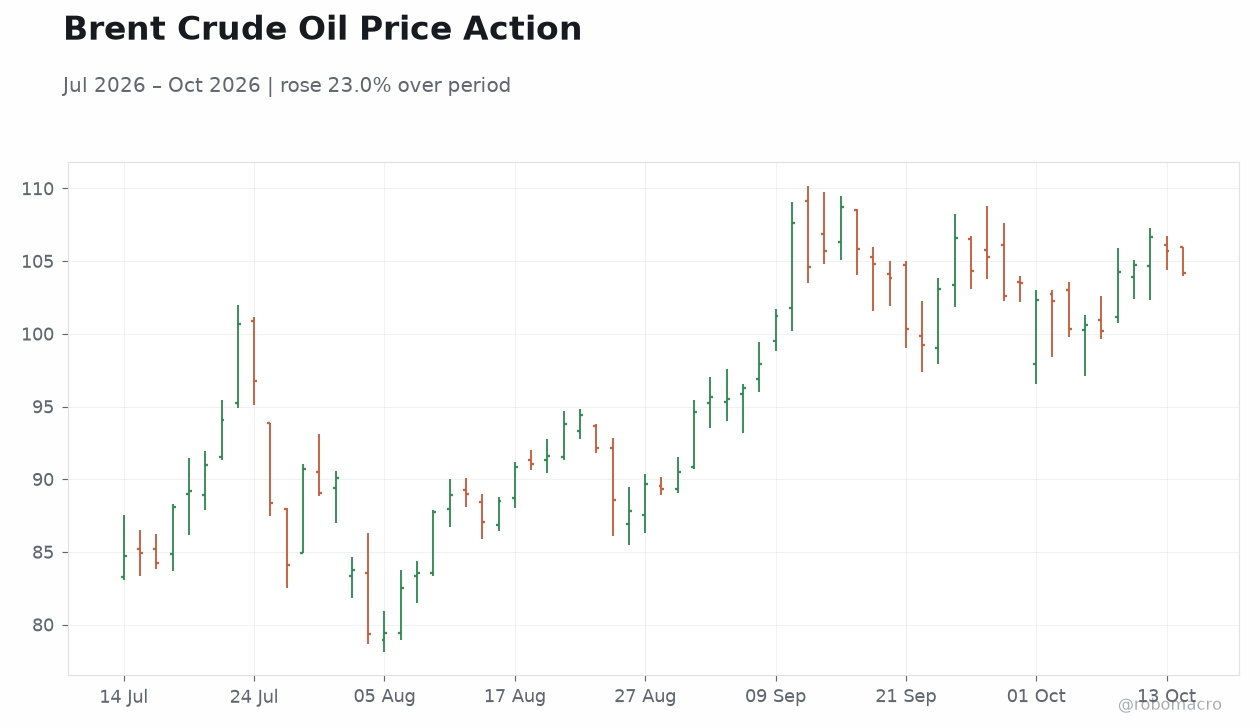
Brent Crude Oil Price ActionBrent Crude Oil Price Action | Type: market_hloc | USD/bbl: 104.2 (2026-10-14) | Range: 79.36–108.8 | Trend(6pt): 84.73,79.45,89.7,100.3,105.7,104.2

Today's Economic Events

Data Prior Cons Time
No events available
  • Houthi strikes on Aramco facilities wounded four in Riyadh and extended airport closures, lifting supply-risk premia as Brent eased 1.35% to $104.26.
  • IMF projects a 3.3% Saudi GDP contraction this year on war disruption, while lifting the 2027 growth forecast to 7.9%.
  • GCC equities diverged: MSCI UAE +0.93% vs Saudi -1.79%, Kuwait -2.02%, Qatar -0.49%; the riyal peg held at 3.75.

Yesterday's Recap

Geopolitics dominated the Gulf tape as Yemen's Houthis pressed their campaign against Saudi energy infrastructure, sparking a fire at an Aramco building in Riyadh that wounded four and prompting renewed vows to target the kingdom's facilities. The IMF warned the attacks carry global economic consequences, projecting a 3.3% contraction for Saudi GDP this year as war disruption squeezes output — a sharp downgrade from prior expectations — while separately raising the kingdom's 2027 growth forecast to 7.9% on the assumption of normalization and investment-led recovery. The security situation disrupted regional logistics: Saudi airport closures extended, forcing Qatar Airways to suspend Riyadh and Dammam routes and triggering Emirates, Etihad, flydubai and Air Arabia cancellations on Saudi routes, a tangible hit to Gulf aviation and trade flows.

Qatar's public finances are also feeling the pinch, with revenue dropping sharply as the regional conflict weighs on activity. Markets reflected the risk-off tone: Saudi Aramco shares fell 1.55% to 25.38, MSCI Saudi dropped 1.79%, and MSCI Kuwait slid 2.02%, though MSCI UAE bucked the trend, up 0.93%. Brent crude eased 1.35% to $104.26 and WTI slipped 0.37% to $93.79, the modest pullback suggesting markets view supply-disruption risk as partially priced.

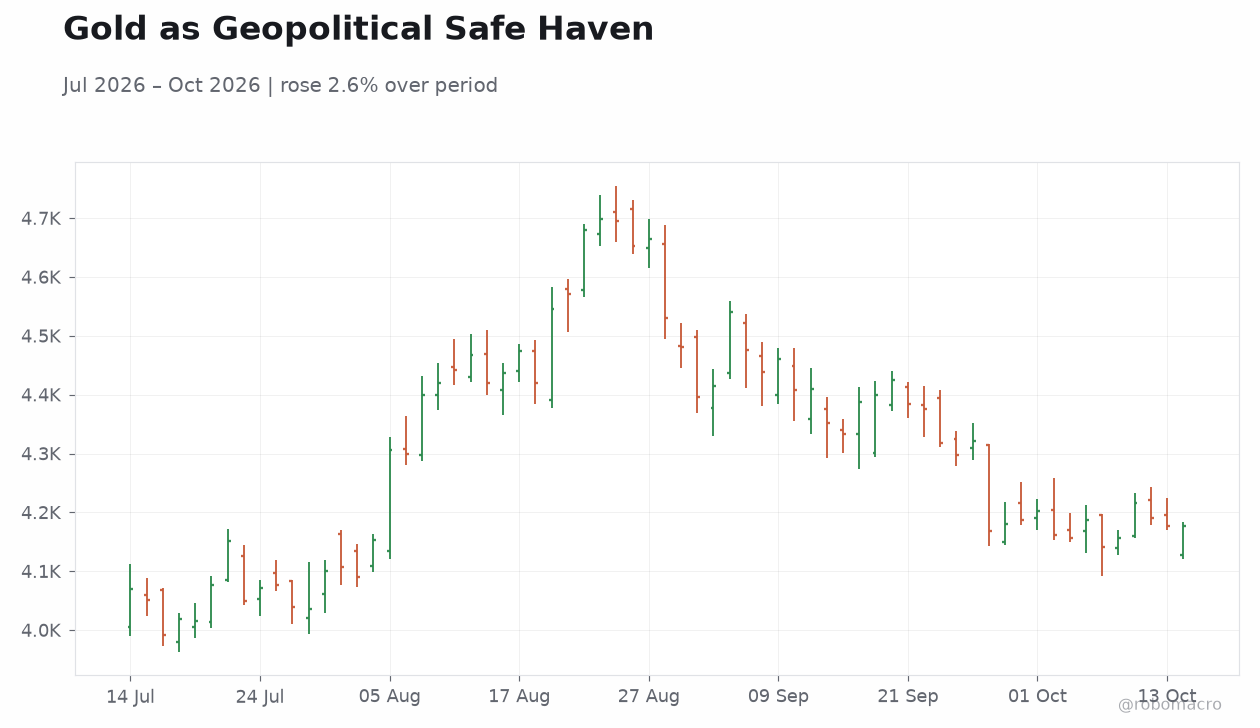
Gold was flat at $4,176, while Bitcoin fell 2.27% to $81,208 in a broader risk retrenchment.

The Day Ahead

The calendar is light on scheduled GCC data releases over the next session, leaving market attention squarely on the evolving security situation and its fiscal implications. Watch for further updates on Saudi airport operations and the pace of restoration at Aramco facilities, as prolonged disruption would feed directly into the kingdom's production and export volumes. Any formal IMF or regional-body commentary quantifying the war's fiscal cost for Riyadh would move sovereign CDS.

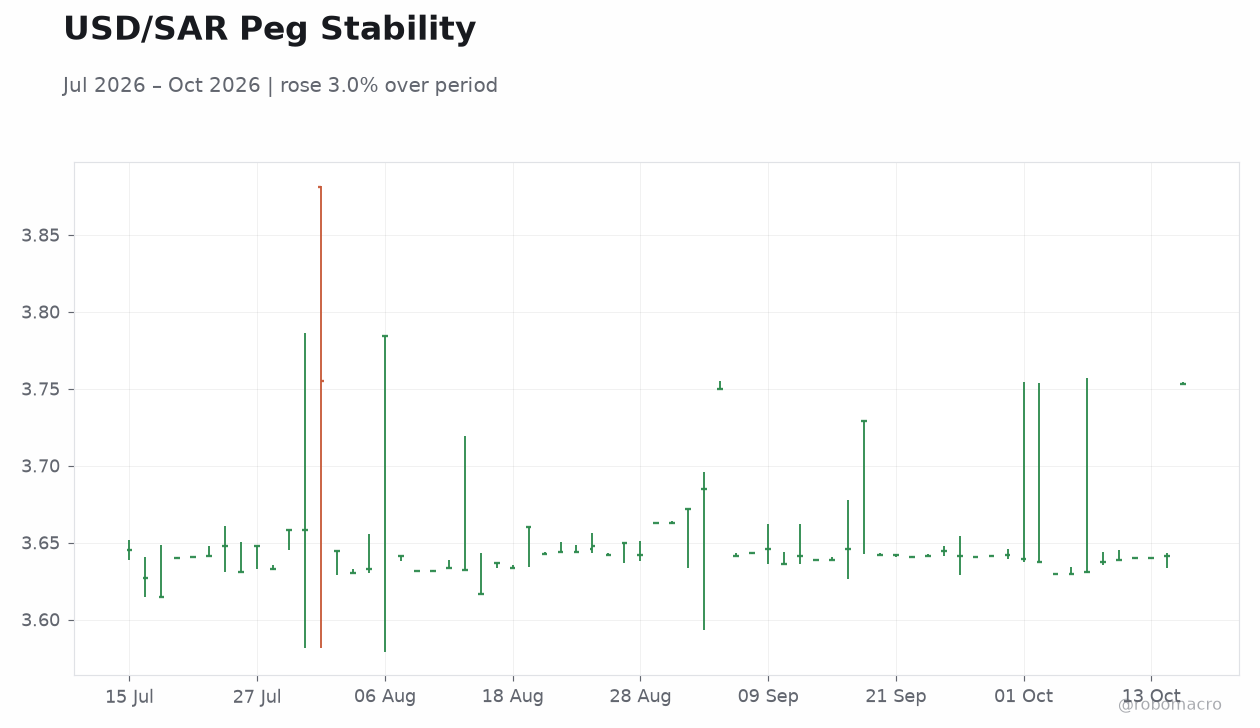
Qatar's revenue trajectory bears monitoring after the sharp drop flagged this week, with the emirate's budget arithmetic sensitive to both volumes and the Brent price. Energy markets will look to OPEC+ messaging for signals on whether the kingdom seeks compensation barrels or defends the higher price environment that conflict risk has created. On the currency front, the pegs remain the anchor: USD/SAR printed 3.75 and USD/AED held 3.67, and any deviation would signal stress.
Page 1

GCC Macro Daily(Beta Mode)

October 14, 2026 robomacro.com
Saudi Aramco Stock Performance Saudi Aramco Stock Performance | Type: market_hloc | SAR: 25.78 (2026-10-13) | Range: 25.18–26.77 | Trend(5pt): 26.52,26.4,26.1,25.9,25.78
USD/SAR Peg Stability USD/SAR Peg Stability | Type: market_hloc | USD/SAR: 3.753 (2026-10-15) | Range: 3.615–3.784 | Trend(6pt): 3.645,3.784,3.642,3.642,3.64,3.753
Gold as Geopolitical Safe Haven Gold as Geopolitical Safe Haven | Type: market_hloc | USD/oz: 4177 (2026-10-14) | Range: 3992–4698 | Trend(6pt): 4070,4305,4664,4384,4177,4177

Other Economic Notes

The war's economic footprint is widening beyond the Gulf's borders — Bangladesh's remittance, energy-import and export channels face fresh risk given their deep dependence on the Saudi economy, underscoring how GCC disruption transmits to labor-exporting economies. The IMF's bifurcated Saudi outlook — contraction now, 7.9% growth in 2027 — captures the consensus view that the hit is a timing shock rather than a structural break, contingent on Vision 2030 giga-project pipelines regaining full speed. Qatar's revenue slump highlights the second-order channel: even hydrocarbon-rich states with strong external positions feel conflict through logistics, insurance and confidence.

Meanwhile, Tanzania's progress toward a $42bn Equinor-Shell LNG final investment decision signals intensifying competition for the LNG market share Qatar has long dominated, a medium-term consideration for Doha's expansion strategy.

Global Macro News

Global energy markets are in a regime of elevated volatility, with coal prices up 40% this year as LNG-replacement demand and supply uncertainty persist — a dynamic that indirectly supports Gulf LNG producers' pricing power even as physical disruption clouds the outlook. China's emergence as an importer of American coal underscores how the energy-security scramble is redrawing trade flows, with implications for Gulf producers' Asian market share. The risk-off tone in crypto and equities — Bitcoin down 2.27% — reflects broader macro caution that keeps dollar funding conditions, and hence GCC monetary policy, in focus.

↓ p.3

Sponsored by Arbitrage Search
Page 2

GCC Macro Daily(Beta Mode)

October 14, 2026 robomacro.com

Continuation

Global Macro News (continued)

Nigeria's push to attract UAE funding for its power grid illustrates how Gulf sovereign wealth is increasingly the swing financier for emerging-market infrastructure. For the GCC, the dominant global variables remain the Brent price — still above $100, comfortably above regional fiscal breakevens — and the Fed's policy path, which mechanically sets the region's rate structure given the dollar pegs.

GCC Central Banks Watch

The dollar-peg architecture held firm through the week's volatility: USD/SAR printed at 3.75 and USD/AED was unchanged at 3.67, while USD/KWD edged up 0.14% to 0.31, a reminder that the dinar's basket peg gives Kuwait's central bank modest flexibility its GCC peers lack. SAMA's task is complicated by the war shock — with the IMF projecting a 3.3% Saudi contraction, the kingdom faces the unusual combination of a growth downgrade and an inflationary supply impulse, constraining how far Riyadh would welcome any Fed divergence from its needs. CBUAE enters the period from a position of strength, with UAE equities outperforming and the dirham peg untested; EIBOR dynamics remain anchored to Fed expectations.

QCB faces the more delicate balance, as Qatar's revenue slump coincides with the need to maintain rate coordination for the riyal peg — fiscal softness argues for accommodation the peg may not permit. CBK's basket arrangement continues to provide a small buffer, allowing the dinar to absorb the 0.14% move against the dollar without policy action. CBO and CBB remain pure takers of Fed policy, with Omani and Bahraini sovereigns watching reserve adequacy as higher-for-longer global rates raise the carry on defending the pegs.

The dominant near-term question for all six: whether the Fed's next move aligns with what Gulf growth conditions — softening in Saudi, resilient in the UAE — actually require, or whether peg discipline overrides domestic cyclical needs as it has historically. SAIBOR and interbank fixings across the region will be the first place any stress shows.

Sponsored by Arbitrage Search
Page 3