| Asset | Level | Change |
|---|---|---|
| KOSPI | 6,384.24 | -3.65% |
| KOSDAQ | 849.19 | -4.83% |
| USD/KRW | 1,340.13 | -0.05% |
| Samsung | 232,000.00 | -11.45% |
| SK Hynix | 1,443,000.00 | -14.16% |
| Brent Crude | 106.37 | -0.26% |
| Gold | 4,183.70 | -0.16% |
| Bitcoin | 83,340.55 | +1.93% |
| Korea 3Y Govt Yield | 3.86% | -6 bp |
| Korea 10Y Govt Yield | 4.31% | -8 bp |
| Data | Prior | Cons | Actual |
|---|---|---|---|
| No events available | |||
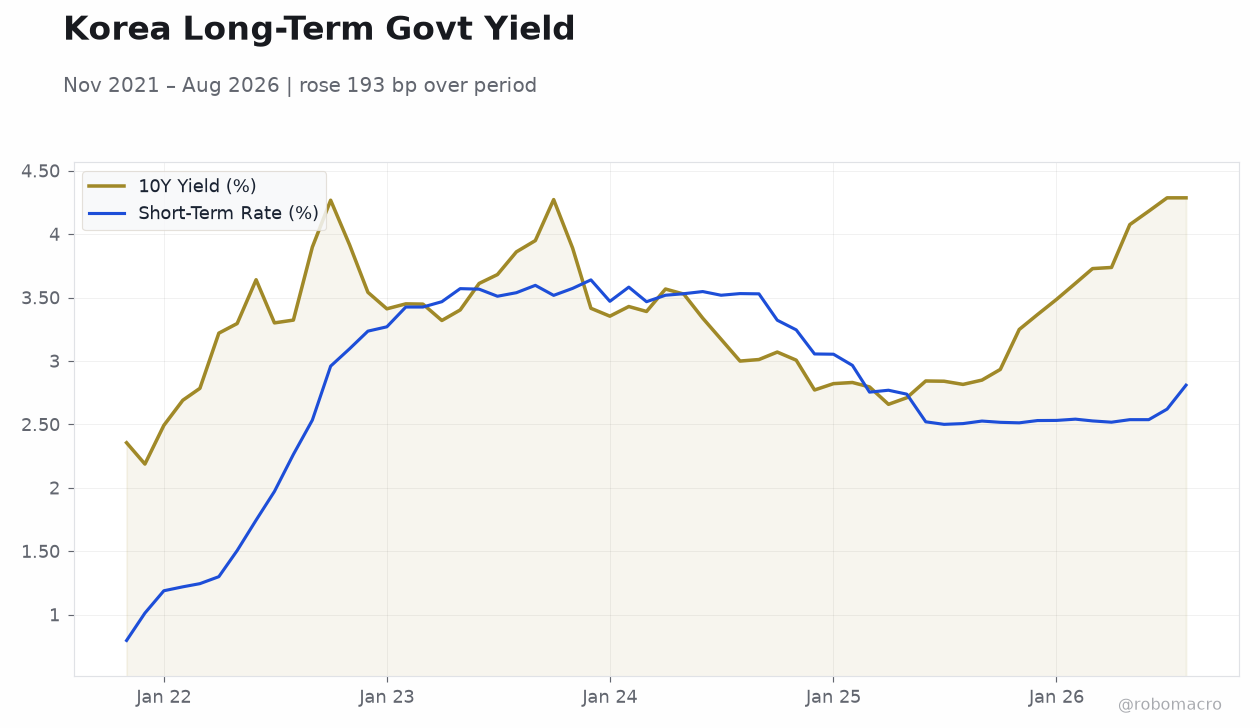
Korea Long-Term Govt Yield | Type: macro_line | 10Y Yield (%): 4.286 (2026-08-01) | Range: 2.187–4.286 | Trend(5pt): 2.355,3.411,3.39,2.71,4.286 | Short-Term Rate (%): 2.809 (2026-08-01) | Range: 0.796–3.639 | Trend(6pt): 0.796,3.269,3.467,2.738,2.62,2.809
| Data | Prior | Cons | Time |
|---|---|---|---|
| Thursday (2026-10-15) | |||
| Headline Unemployment Rate | 2.70 | - | 19:00 |
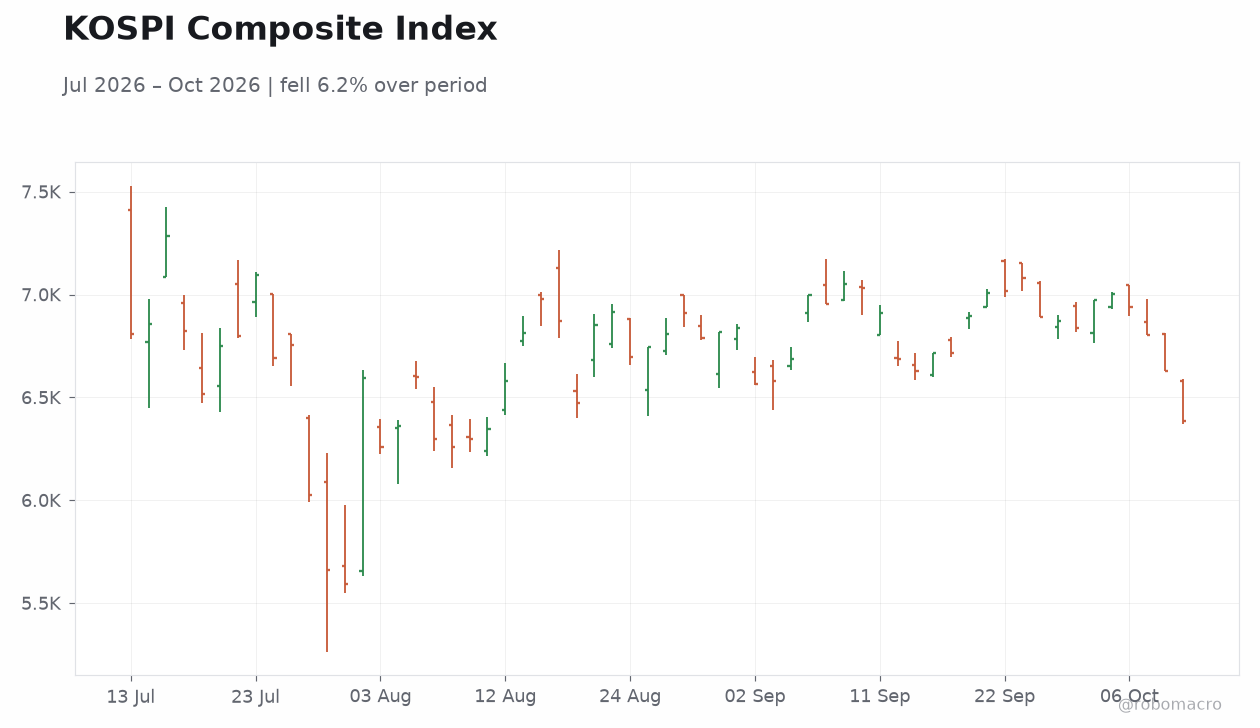
Korean equities suffered a bruising session as the KOSPI dropped 3.65% to 6,384.24 and the KOSDAQ slid 4.83% to 849.19, with the exchange activating its sell-side sidecar mechanism on the sharp opening fall. The damage was concentrated in memory chips: Samsung Electronics collapsed 11.45% to 232,000 won and SK Hynix plunged 14.16% to 1,443,000 won, as investors reassessed the durability of AI-driven semiconductor demand. The selloff took the benchmark to its lowest level since August, according to regional press, and spilled into global chip sentiment during the New York session.
Fixed income told a different story, with the 3-year yield easing 6 bp to 3.86% and the 10-year down 8 bp to 4.31%, as the flight from equities revived demand for duration. The won proved remarkably resilient, with USD/KRW slipping 0.05% to 1,340.13, a divergence analysts attributed to the chip sector's structural current-account surplus shielding the currency. Commentary highlighted that stronger equities usually accompany a weaker won, yet the opposite has held recently, with foreign-currency deposits surging by ₩30 trillion over five months as corporates and households bought dollar and yen dips.
Brent crude eased 0.26% to $106.37 and gold slipped 0.16% to $4,183.70, while bitcoin bucked the trend, gaining 1.93% to $83,340.
The calendar is light until Thursday, when Korea releases its headline unemployment rate at 19:00 ET, with the prior print at 2.7% and no consensus yet published. Until then, attention stays on the secondary effects of the equity rout: whether sidecar-triggered volatility persists, how quickly leveraged positions in chip names are unwound, and whether foreign investors extend net selling of KOSPI heavyweights. Officials' commentary will matter too, with the Bank of Korea governor travelling to Bangkok this week for G20 and IMF-World Bank meetings, offering a platform for policy signaling.
FX-rule changes announced by Seoul, designed to boost won usage and raise reporting thresholds, will be parsed for implications on onshore liquidity. Any follow-through weakness in Samsung and SK Hynix shares will shape regional chip sentiment into the US earnings season.
Subscribe to Korea Macro Daily and get each new issue delivered to your inbox.
Already a member? Visit robomacro.com to log in and manage subscriptions, or use Forgot Password to set a password.
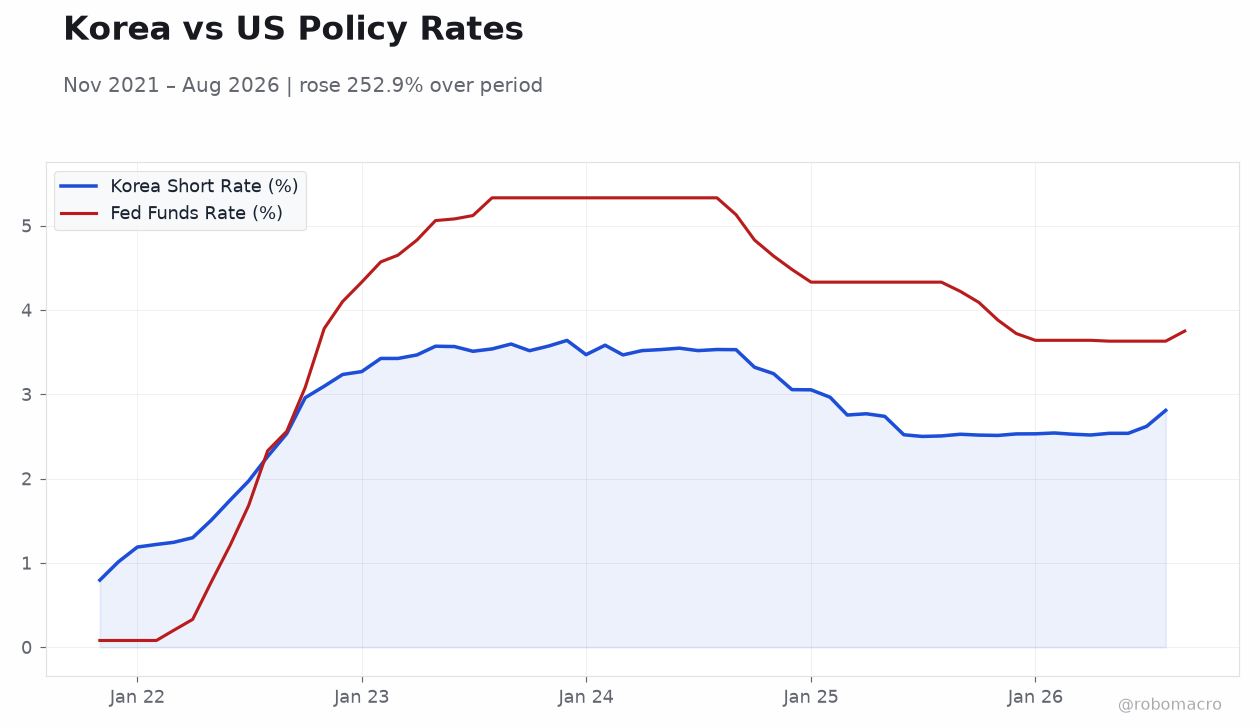
Korea vs US Policy Rates | Type: macro_line | Korea Short Rate (%): 2.809 (2026-08-01) | Range: 0.796–3.639 | Trend(6pt): 0.796,3.269,3.467,2.738,2.62,2.809 | Fed Funds Rate (%): 3.75 (2026-09-01) | Range: 0.08–5.33 | Trend(6pt): 0.08,4.33,5.33,4.33,3.63,3.75
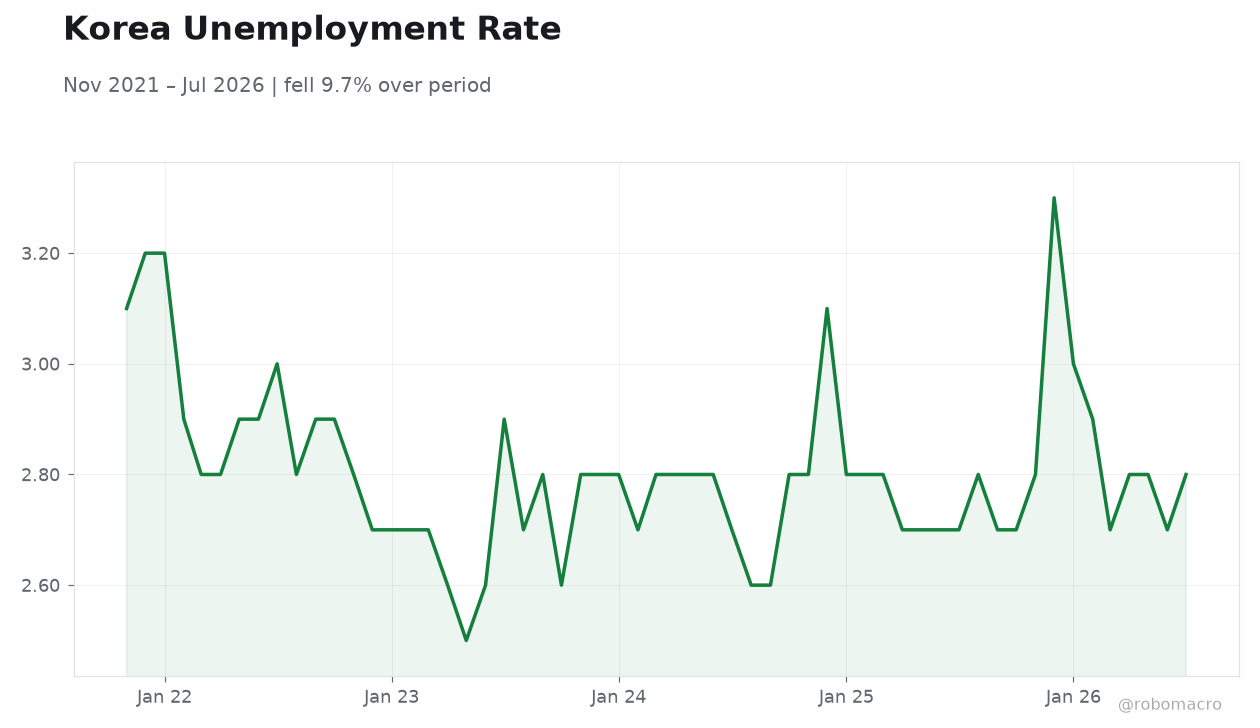
Korea Unemployment Rate | Type: macro_line | Unemployment Rate (%): 2.8 (2026-07-01) | Range: 2.5–3.3 | Trend(5pt): 3.1,2.7,2.8,2.7,2.8
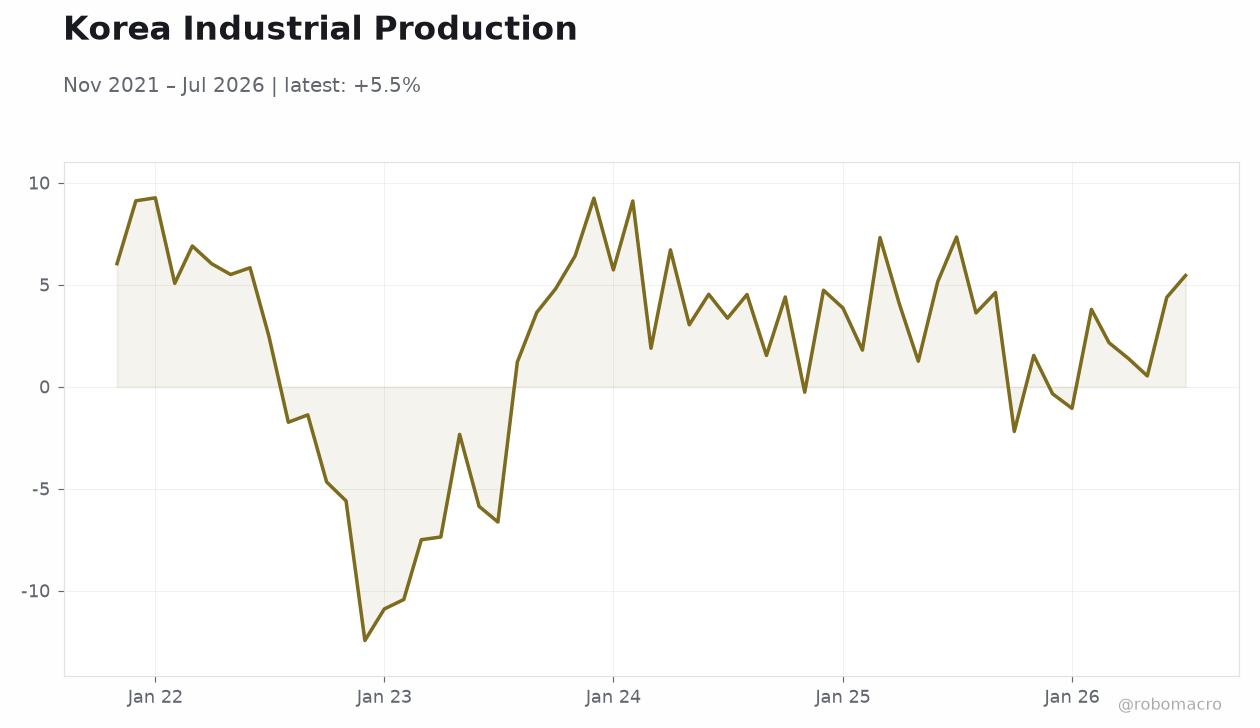
Korea Industrial Production | Type: macro_line | Industrial Production (Index): 5.455 (2026-07-01) | Range: -12.45–9.263 | Trend(5pt): 6.034,-10.9,1.887,1.251,5.455
KOSPI Composite Index | Type: market_hloc | KOSPI: 6384 (2026-10-12) | Range: 5594–7284 | Trend(5pt): 6807,6359,6808,6718,6384
Seoul's decision to ease FX rules, including higher reporting thresholds and measures to promote won invoicing, marks an incremental liberalization of the capital account aimed at deepening the won's international role. The banking sector is innovating in parallel: Jeonbuk Bank launched Korea's first bitcoin-backed won loan for corporates, a small but symbolic step in crypto-collateralized credit. Foreign-currency deposits have swollen by ₩30 trillion in five months, reflecting corporate hedging behavior and dip-buying in dollars and yen, a reservoir of liquidity that could amplify won moves if sentiment turns.
The persistent strength of the won against equity-market logic remains a puzzle for strategists, with the chip trade surplus cited as the key buffer.
The Korea selloff rippled through global markets, with New York futures mixed as memory-chip weakness and earnings jitters weighed on sentiment, and Asian equities logging their lowest levels since August. Oil eased modestly, with Brent at $106.37, while gold's slight dip to $4,183.70 suggests the safe-haven bid is cooling even as equities wobble. Bitcoin's 1.93% gain to $83,340.55 stands out against the risk-off tone in traditional assets.
The AI-infrastructure trade, which has powered Korean chipmakers' run, is now the focal point of a global reassessment, with investors scrutinizing whether hyperscaler capex can justify current valuations. Mideast tensions and inflation concerns were cited in Seoul's weak open, adding geopolitical texture to the risk backdrop. ↓ p.3
For Korea, the interplay between US chip earnings, Chinese demand, and Fed expectations will dominate the external environment this week.
The Bank of Korea remains hawkish on inflation, with headline CPI at 2.88% year-on-year in September, above the 2% target, and Governor Rhee Chang-yong signaling that further tightening cannot be ruled out. The base rate stands at 2.81%, and the President's remark that a rate hike is "unavoidable" has sparked debate about political pressure on central-bank independence, a sensitive topic given the BoK's institutional standing. Rhee's apology over ETF risks, tied to leveraged retail exposure in the equity selloff, underscores the financial-stability channel now competing with the inflation mandate.
The governor has also championed won stablecoin innovation as part of a broader internationalization agenda, aligning with Seoul's FX-rule liberalization. With the 10-year yield at 4.31% after an 8 bp rally, markets are pricing a pause-and-assess stance rather than an imminent hike, but the hawkish rhetoric keeps upside risks alive. Watch for any BoK commentary from the Bangkok meetings for clues on the timing of the next move.