Korea Macro Daily(Beta Mode)
KOSPI Tumbles 3.6% as AI Selloff Deepens
Market Snapshot
| Asset | Level | Change |
|---|---|---|
| KOSPI | 5,648.79 | -3.59% |
| KOSDAQ | 704.39 | -4.08% |
| USD/KRW | 1,340.83 | -0.30% |
| Samsung | 212,000.00 | -3.42% |
| SK Hynix | 1,339,000.00 | -4.22% |
| Brent Crude | 95.08 | -8.22% |
| Gold | 4,073.10 | +3.37% |
| Bitcoin | 80,222.83 | +3.72% |
| Korea 3Y Govt Yield | 3.74% | 0 bp |
| Korea 10Y Govt Yield | 4.00% | -3 bp |
Prior Economic Events
| Data | Prior | Cons | Actual |
|---|---|---|---|
| Inflation Rate Year-over-Year | 2.90 | 2.90 | 2.80 |
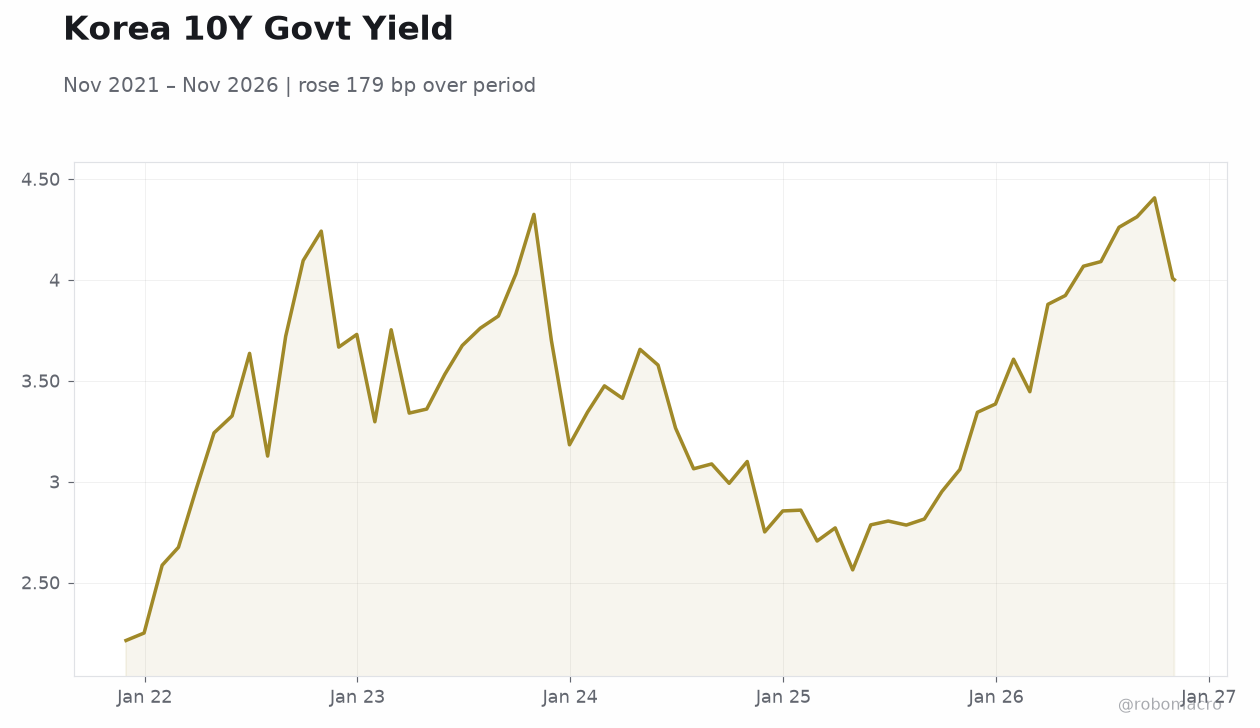 Korea 10Y Govt Yield | Type: macro_line | 10Y Yield (%): 4.001 (2026-11-03) | Range: 2.213–4.407 | Trend(5pt): 2.213,3.753,3.578,2.815,4.001
Today's Economic Events
| Data | Prior | Cons | Time |
|---|---|---|---|
| No events available | |||
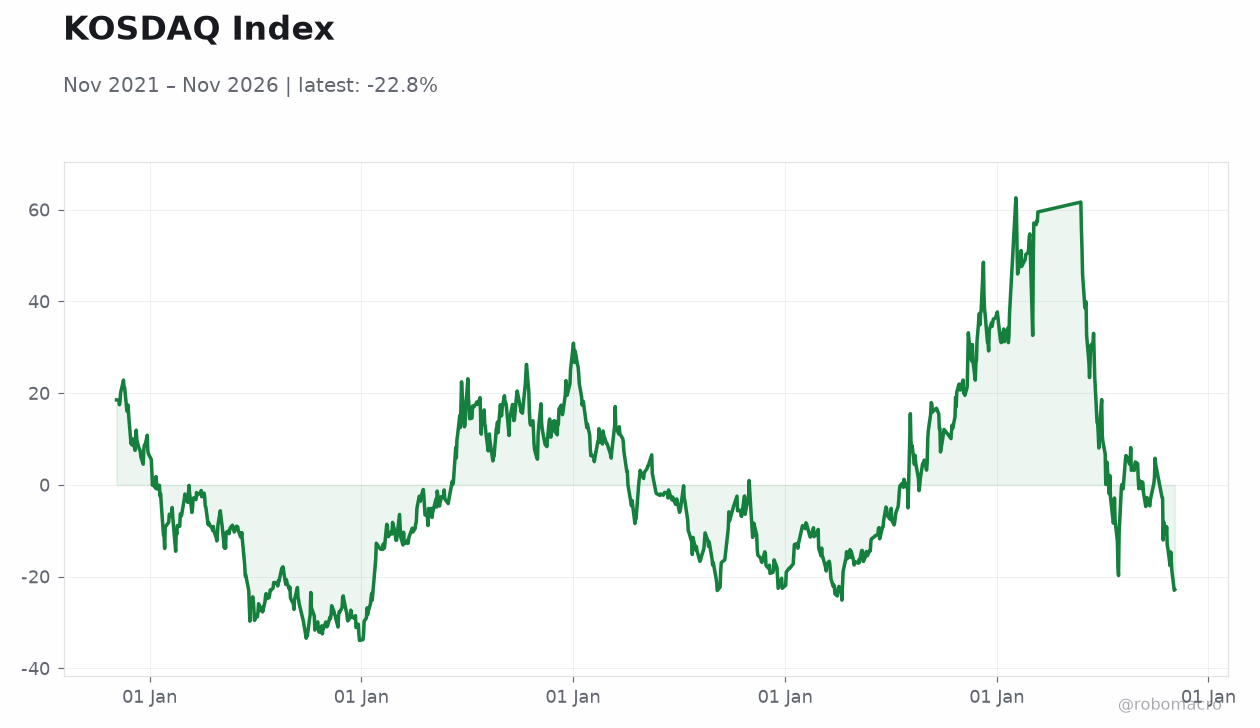
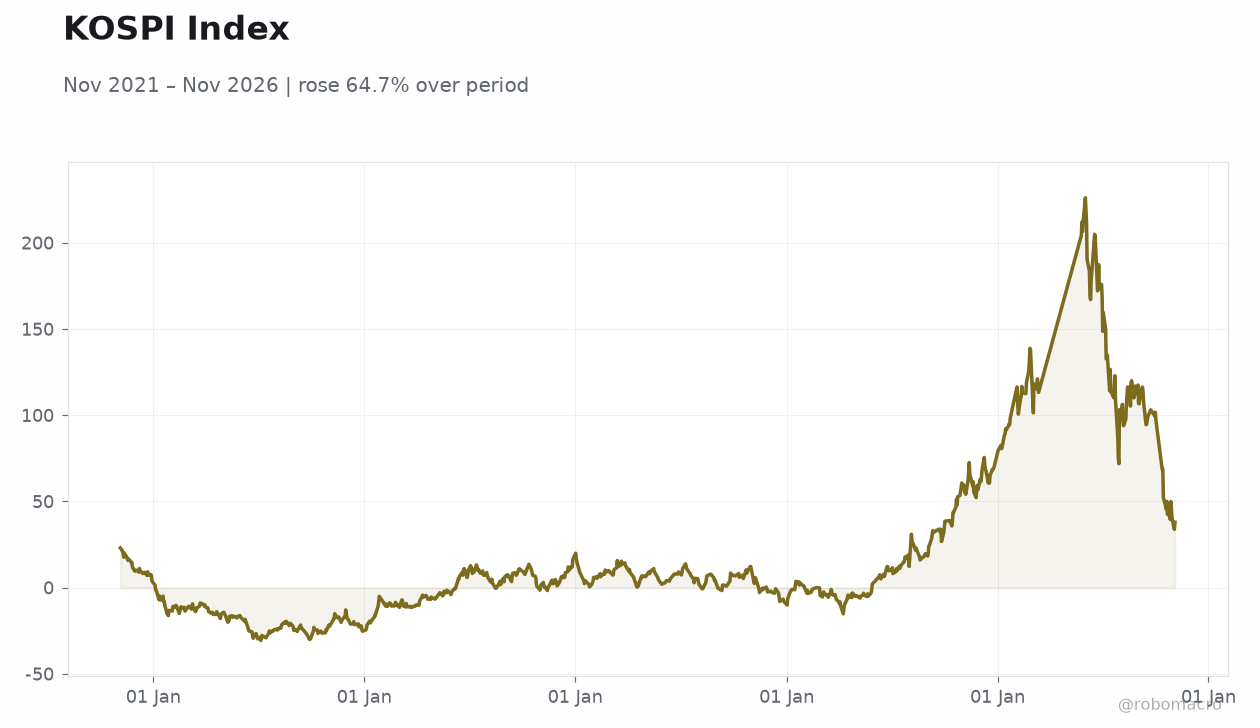
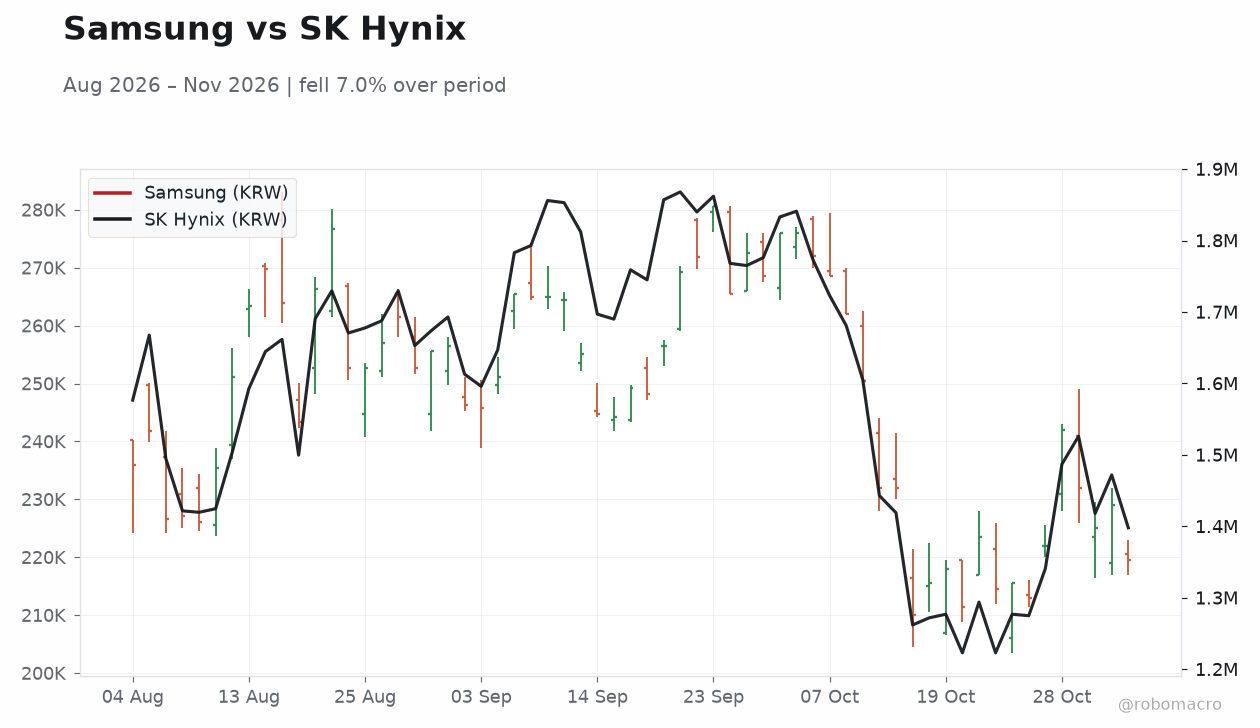
- KOSPI plunged 3.59% to 5,648.79 and KOSDAQ fell 4.08% as a global AI-related selloff hammered semiconductor heavyweights Samsung (-3.42%) and SK Hynix (-4.22%).
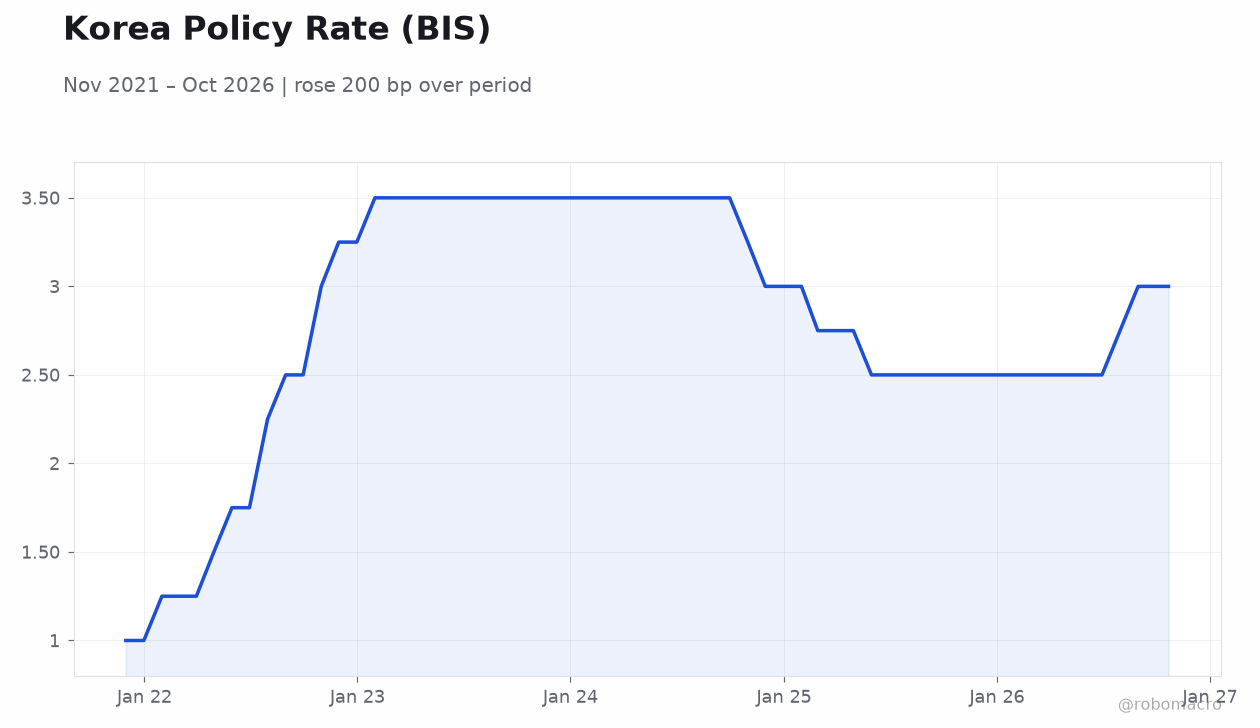
- October CPI eased to 2.80% y/y from 2.9%, but inflation remains above the BoK's 2% target, keeping the case for further tightening alive ahead of the November 26 MPC.
- Korea 10Y yield eased 3 bp to 4.00% while the 3Y held at 3.74%, a modest safe-haven bid contrasting sharply with the equity rout; USD/KRW slipped 0.30% to 1,340.83.
Yesterday's Recap
South Korea's October inflation printed at 2.80% y/y, a touch below both the prior 2.9% and consensus of 2.9%, yet still comfortably above the Bank of Korea's 2% target. The modest cooling did little to alter the policy narrative, with WSJ and Bloomberg both framing the print as consistent with "above-target" inflation and a live case for additional hikes. Equities told a very different story: the KOSPI dropped 3.59% to 5,648.79 and the KOSDAQ shed 4.08% to 704.39, with Samsung falling 3.42% to 212,000 and SK Hynix down 4.22% to 1,339,000 as escalating AI concerns triggered a broad tech de-rating.
The won firmed modestly, with USD/KRW down 0.30% to 1,340.83, aided by expectations of dollar weakness following the Democrats' midterm sweep. Rates were mixed but orderly: the 10-year yield eased 3 bp to 4.00% while the 3-year held at 3.74%, a flattening bias consistent with growth concerns offsetting hawkish inflation optics. Household loans rebounded by 2.8 trillion won in October, underscoring that credit demand and household leverage remain key financial-stability watch items for the BoK.
The Day Ahead
The domestic calendar is empty for November 4, leaving Korean markets to trade on offshore cues and the prior session's momentum. With no scheduled data, focus shifts to the AI-driven global tech selloff and whether Samsung and SK Hynix can stabilize after Tuesday's sharp declines. Traders will also monitor USD/KRW for follow-through on the midterm-driven dollar narrative and watch for any BoK commentary on inflation persistence in services and durable goods.
Bond investors will eye whether the 10-year's 3 bp rally extends, with the 3Y–10Y spread at 26 bp offering limited room for further flattening. Attention increasingly pivots toward the November 26 MPC, the next scheduled policy event.
Other Economic Notes
The rebound in household loans by 2.8 trillion won in October signals that credit growth is re-accelerating even as the policy rate sits at 3.00%, complicating the BoK's financial-stability calculus. ↓ p.2