| Asset | Level | Change |
|---|---|---|
| KOSPI | 5,067.44 | +1.99% |
| KOSDAQ | 662.81 | +1.96% |
| USD/KRW | 1,334.20 | +0.09% |
| Samsung | 192,900.00 | -0.92% |
| SK Hynix | 1,154,000.00 | +0.87% |
| Brent Crude | 90.07 | -2.04% |
| Gold | 3,663.30 | -2.10% |
| Bitcoin | 61,616.60 | -2.18% |
| Korea 3Y Govt Yield | 3.72% | -2 bp |
| Korea 10Y Govt Yield | 3.94% | -4 bp |
| Data | Prior | Cons | Actual |
|---|---|---|---|
| No events available | |||
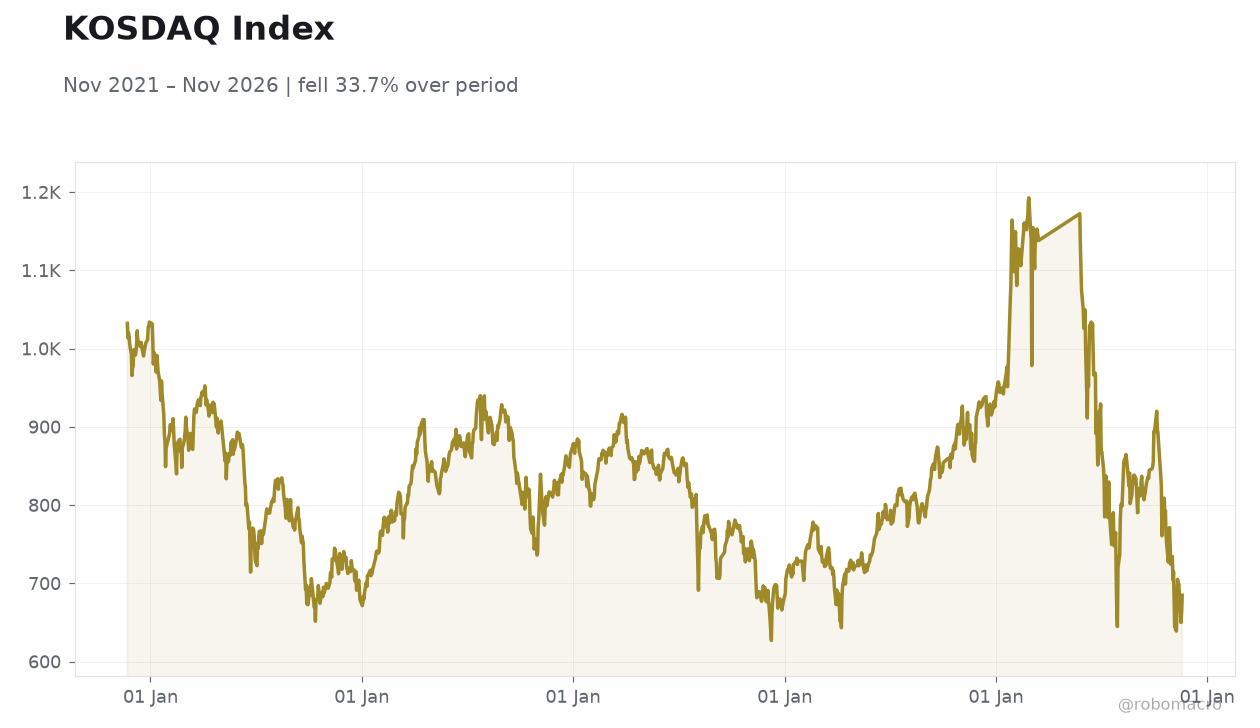
KOSDAQ Index | Type: macro_line | KOSDAQ Index: 684.8 (2026-11-19) | Range: 627–1193 | Trend(5pt): 1032,764.6,860.5,783.7,684.8
| Data | Prior | Cons | Time |
|---|---|---|---|
| No events available | |||
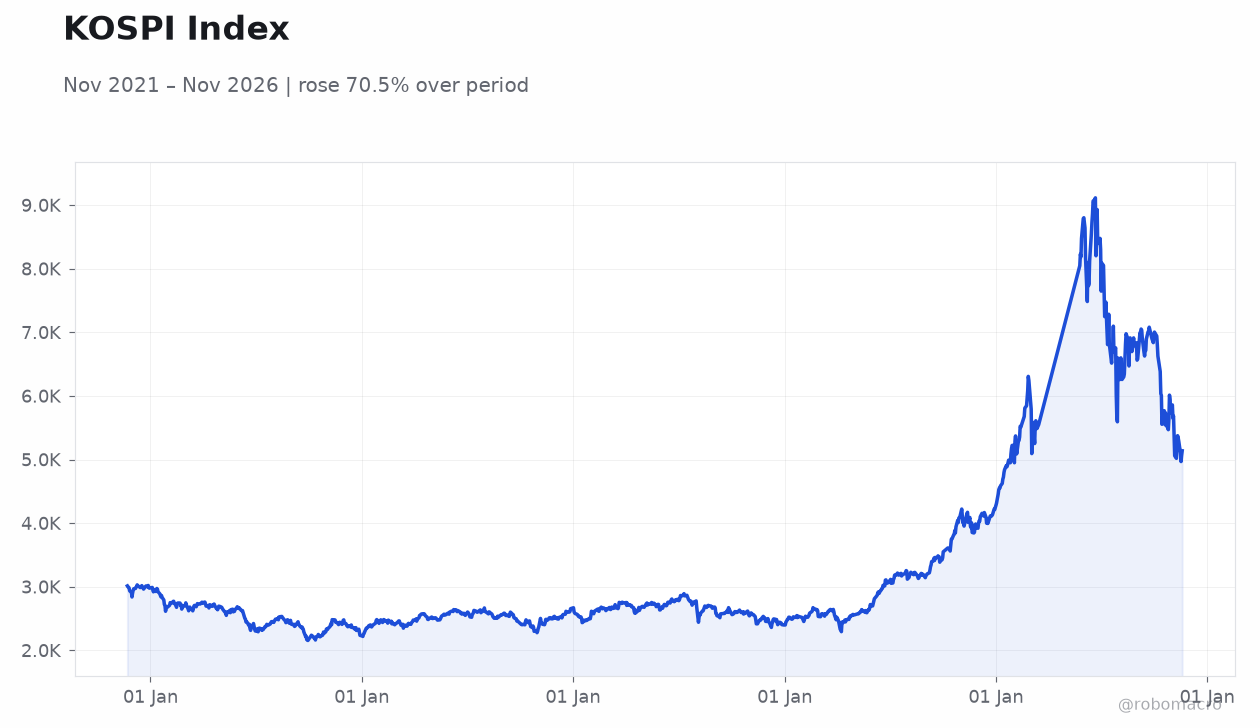
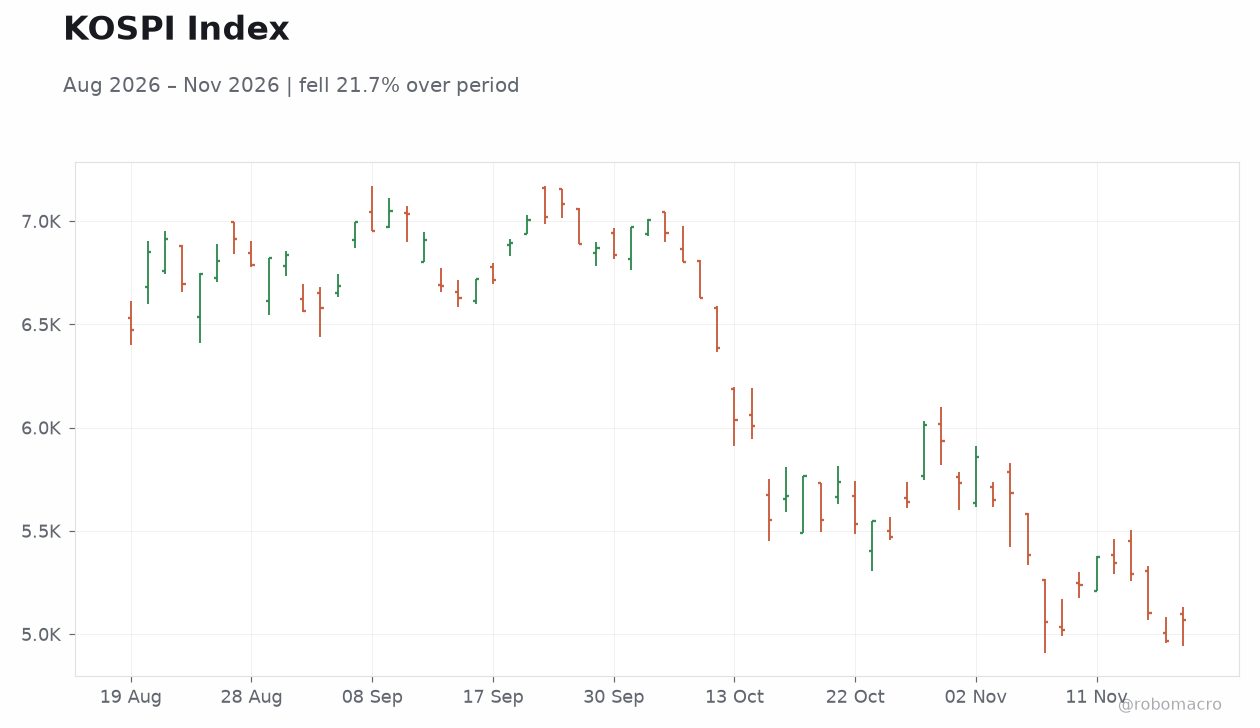
Korean equities staged a broad risk-on rally Wednesday, with the KOSPI climbing 1.99% to 5,067.44 and the KOSDAQ adding 1.96% to 662.81, as chip and tourism names jumped on Anthropic IPO buzz and Korea-China FTA optimism. The move followed Nvidia earnings that spurred a global semiconductor rally, lifting SK Hynix 0.87% to 1,154,000 won even as Samsung slipped 0.92% to 192,900 won. Rates moved lower in sympathy with global duration demand, the 10-year government yield easing 4 bp to 3.94% and the 3-year down 2 bp to 3.72%.
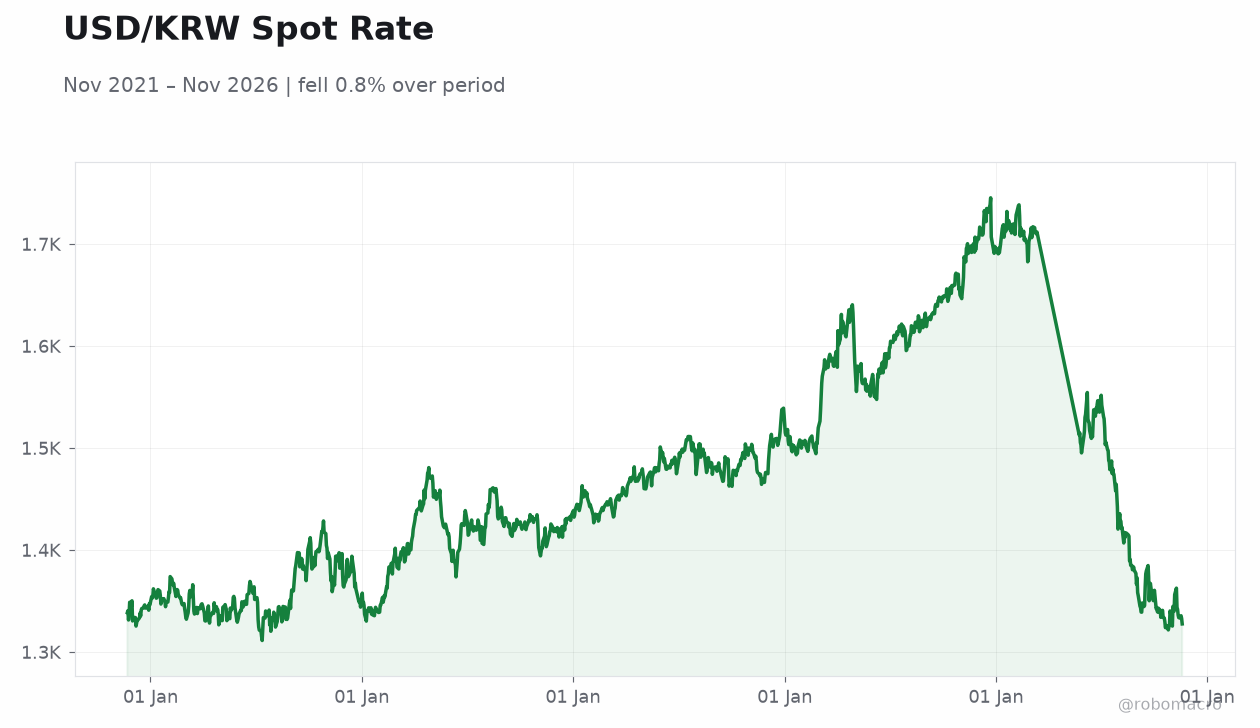
The won held near 1,330-1,334, with USD/KRW at 1,334.20 (+0.09%), as Korean chip exporters flooded the market with dollar proceeds, capping appreciation pressure. Macro releases were sparse, but household credit data showed growth slowing in Q3 amid high market rates, even as total household debt topped a record 2,030 trillion won. Bank loan delinquency rebounded to 0.59% in September, a 10-year September high, with SME and sole-proprietor stress persisting.
Net external financial assets hit a record $344.8 billion, underscoring Korea's resilient external buffer despite equity volatility.
No scheduled Korean data releases appear on the calendar for Thursday, leaving markets to trade off the chip-led momentum and positioning ahead of next week's Bank of Korea decision. Attention turns to the November 26 Monetary Policy Board meeting, where the committee is widely expected to weigh the August hike's transmission against record household leverage and softening credit growth. Traders will monitor USD/KRW for exporter conversion flows and any shift in the won's near-1,330 equilibrium, which the BoK has flagged as a disinflationary channel.
Bond markets will watch whether the 10-year yield's slide below 3.95% extends, with the 3Y-10Y spread at roughly 22 bp. Equity flows into Samsung and SK Hynix remain the swing factor for the KOSPI's hold above 5,000, particularly as Anthropic's debut reshapes AI-linked positioning. Regional banks' youth-startup financing programs (BNK Busan and BNK Gyeongnam, 100 billion won) add marginal credit-supply color.
Subscribe to Korea Macro Daily and get each new issue delivered to your inbox.
Already a member? Visit robomacro.com to log in and manage subscriptions, or use Forgot Password to set a password.
KOSPI Index | Type: macro_line | KOSPI Index: 5138 (2026-11-19) | Range: 2155–9115 | Trend(5pt): 3013,2450,2707,3072,5138
USD/KRW Spot Rate | Type: macro_line | USD/KRW Spot Rate: 1328 (2026-11-19) | Range: 1311–1745 | Trend(6pt): 1339,1339,1472,1599,1336,1328
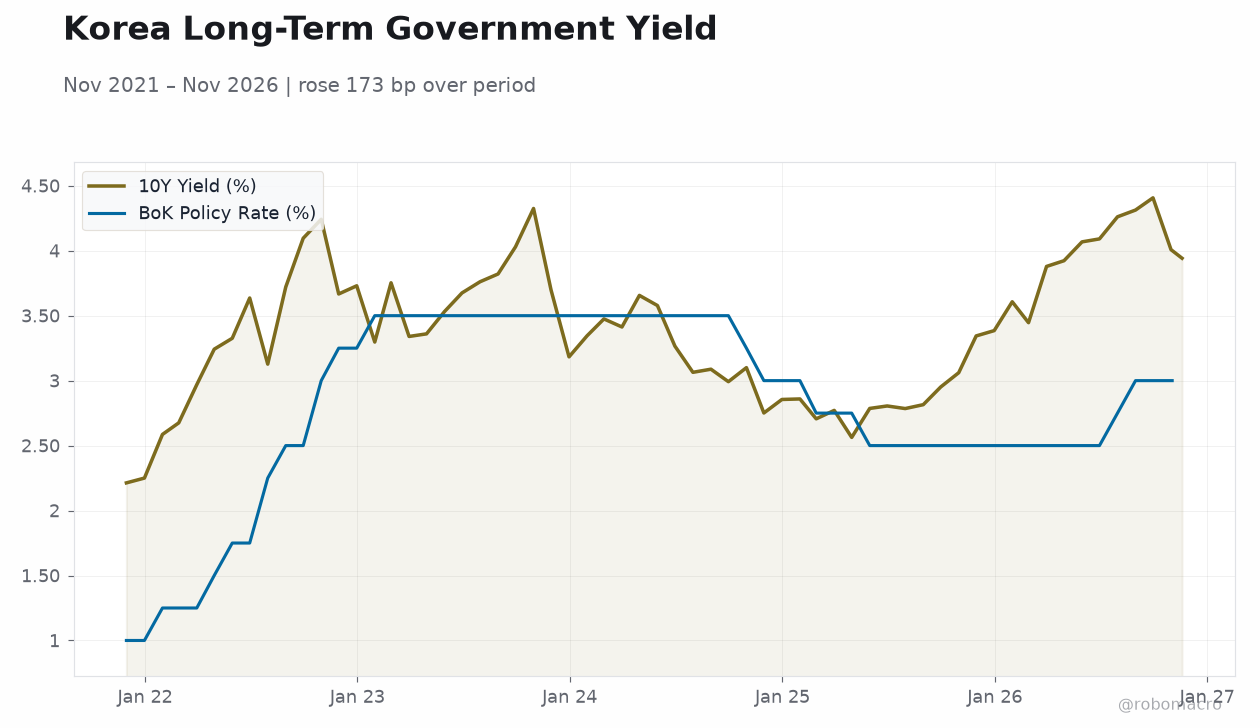
Korea Long-Term Government Yield | Type: macro_line | 10Y Yield (%): 3.942 (2026-11-19) | Range: 2.213–4.407 | Trend(5pt): 2.213,3.753,3.578,2.815,3.942 | BoK Policy Rate (%): 3 (2026-11-02) | Range: 1–3.5 | Trend(5pt): 1,3.5,3.5,2.5,3
KOSPI Index | Type: market_hloc | KOSPI: 5067 (2026-11-18) | Range: 4968–7081 | Trend(6pt): 6471,7052,7004,5638,4968,5067
Household debt crossing 2,030 trillion won sets a record even as Q3 credit growth decelerated on high market rates, a combination that complicates the BoK's policy path. The September delinquency rebound to 0.59% — a decade high for that month — signals creeping asset-quality deterioration concentrated in SMEs and sole proprietors, which could constrain banks' risk appetite into 2027. A BoK study estimating that a 10% won appreciation would cut household living costs by roughly 165,000 won annually highlights the currency's distributional role, easing income polarization.
Meanwhile, banks' credit to Samsung and SK fell 1.6 trillion won as corporate cash piles grew, reflecting weak capex demand despite the chip rally. Net external assets at a record $344.8 billion provide a meaningful cushion against external shocks.
Nvidia's earnings beat reignited the global AI-semiconductor trade, directly transmitting into Korean chip names and the KOSPI's 5,000 reclaim. Brent crude fell 2.04% to $90.07, easing imported inflation pressure for Korea's energy-intensive economy, while gold dropped 2.10% to $3,663.30 and Bitcoin slid 2.18% to $61,616.60, signaling a rotation out of defensive and speculative assets into equities. The Anthropic IPO is drawing global attention to AI infrastructure demand, with Korean chip and tourism shares positioned as derivative beneficiaries.
Korea-China FTA progress adds a trade-normalization tailwind for export-driven growth. ↓ p.3
Global duration demand pushed Korean yields lower in sympathy, though the BoK's August hike keeps the domestic curve anchored at elevated levels. External financial strength — record net assets — buffers Korea against a still-restrictive global rate backdrop.
The Bank of Korea has held the base rate at 3.00% since its October 22 decision, following a +25 bp hike at the August 27 meeting from 2.75%. The committee voted to hold in October, and with the next meeting set for November 26, markets are parsing whether the hike's transmission — visible in slowing Q3 household credit growth — argues for an extended pause. Record household debt above 2,030 trillion won and the September delinquency rebound to 0.59% sharpen the financial-stability trade-off the Board has emphasized, limiting scope for any near-term reversal of the August hike.
CPI at 2.82% YoY remains above target, reinforcing the BoK's cautious stance and keeping real rates restrictive. The won near 1,330 is a live disinflationary channel the BoK has quantified, with 10% appreciation cutting household costs by roughly 165,000 won annually. For markets, the hold bias supports front-end yields near 3.72% while the 10-year at 3.94% prices a slow, data-dependent path; any dovish tilt on November 26 would steepen the curve, but the burden of proof rests on softer credit and inflation prints.