Mexico Macro Daily(Beta Mode)
Peso Slips as Trade Gap Widens
Market Snapshot
| Asset | Level | Change |
|---|---|---|
| IPC Bolsa | 69,711.87 | +0.35% |
| USD/MXN | 18.63 | +0.43% |
| EUR/MXN | 20.74 | +0.06% |
| WTI Crude | 101.68 | +1.78% |
| Silver | 54.20 | -0.17% |
| Gold | 4,069.40 | -0.13% |
| Brent Crude | 111.13 | -2.41% |
| Bitcoin | 80,668.03 | -0.17% |
| Mexico 10Y Govt Yield | 9.25% | -10 bp |
Prior Economic Events
| Data | Prior | Cons | Actual |
|---|---|---|---|
| Trade Balance | 605m | - | -606m |
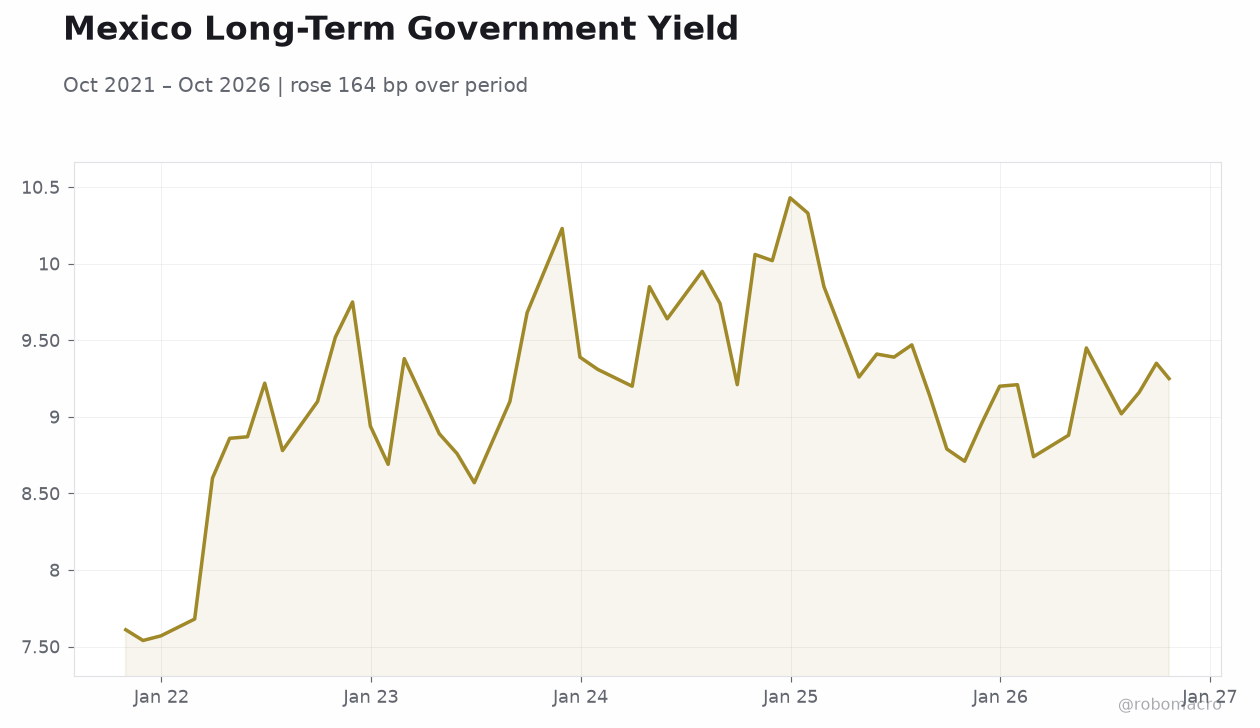 Mexico Long-Term Government Yield | Type: macro_line | 10Y govt yield (%): 9.25 (2026-10-22) | Range: 7.54–10.43 | Trend(6pt): 7.61,8.94,9.85,9.39,9.16,9.25
Today's Economic Events
| Data | Prior | Cons | Time |
|---|---|---|---|
| Friday (2026-10-30) | |||
| GDP Growth Quarter-over-Quarter Preliminary | 1.40 | 0.50 | 08:00 |
| GDP Growth Year-over-Year Preliminary | 2.10 | 2.40 | 08:00 |
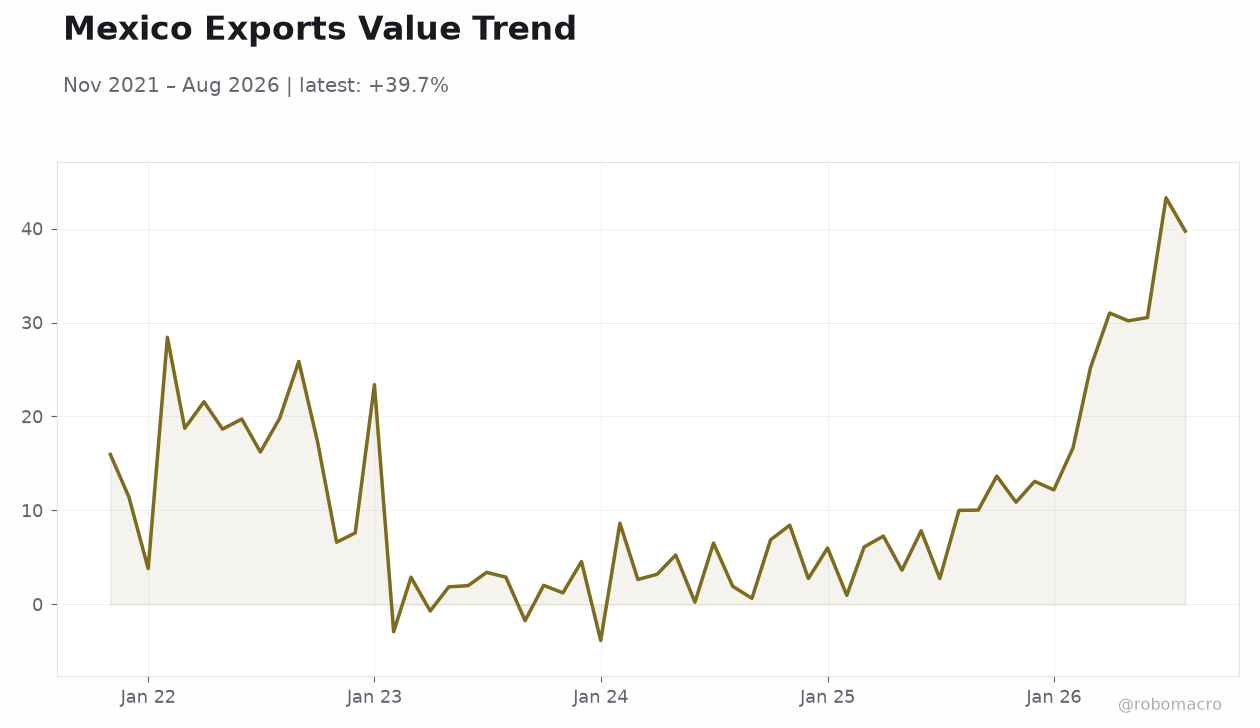
- Mexico's trade balance printed a deficit of MXN 606 million, reversing the prior MXN 605 million surplus and signaling softening export momentum.
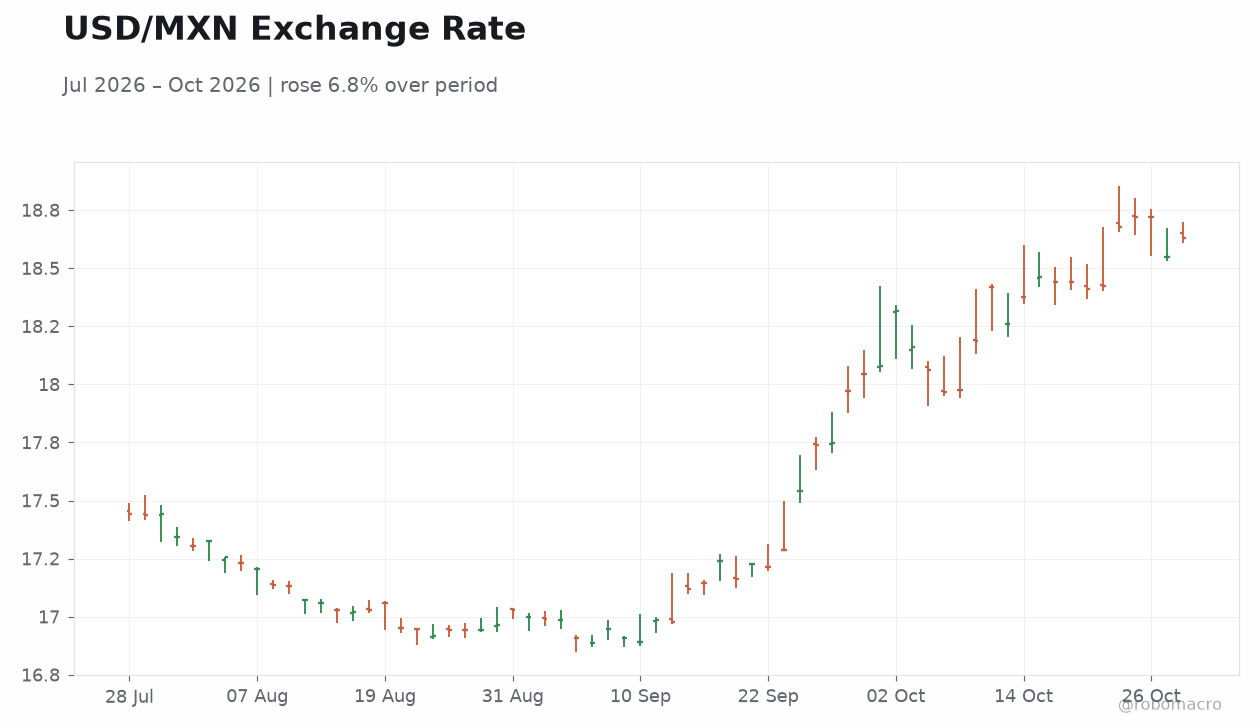
- USD/MXN rose 0.43% to 18.63 as the peso underperformed despite a 10 bp decline in the 10-year yield to 9.25%.
- All eyes turn to Friday's preliminary Q3 GDP, with consensus at 0.5% QoQ versus 1.4% prior, a sharp deceleration.
Yesterday's Recap
Mexico's trade balance printed a deficit of MXN 606 million, a reversal from the prior MXN 605 million surplus and a clear negative for the external accounts. The IPC Bolsa managed a modest 0.35% gain to 69,711.87, though the move lagged the broader risk-on tone implied by falling local yields. The Mexico 10-year government yield eased 10 bp to 9.25%, reflecting duration demand even as the currency weakened.
USD/MXN climbed 0.43% to 18.63, with the peso underperforming most EM peers on the session. EUR/MXN edged up 0.06% to 20.74, suggesting the peso's weakness was broad rather than euro-specific. The combination of a trade deficit print and peso depreciation points to deteriorating near-term external balance dynamics.
The Day Ahead
The calendar is empty for Wednesday, leaving markets to position ahead of Friday's pivotal Q3 GDP release. Preliminary quarter-over-quarter growth is expected at 0.5%, a steep slowdown from the prior 1.4% pace, while year-over-year consensus sits at 2.4% versus 2.1% previously. The divergence between the QoQ and YoY expectations implies base effects and a possible statistical carryover from earlier strength.
Traders will likely keep USD/MXN ranges tight into the print, with positioning skewed toward peso vulnerability given the weak trade data. A sub-consensus QoQ figure would reinforce the case for continued Banxico easing and pressure the currency further.
Other Economic Notes
India and Mexico have launched negotiations toward a trade pact aimed at expanding market access and investment flows, a diversification signal worth monitoring for Mexican export composition. Honda executives warned that higher US auto tariffs would be "catastrophic," underscoring the stakes for Mexico's integrated automotive supply chain under USMCA. The Washington Post's reporting on cheap Chinese EVs available in Mexico but not the US highlights Mexico's role as a competitive import gateway.
These threads collectively point to Mexico's deepening entanglement in global trade realignment, with nearshoring benefits contingent on tariff stability.