Mexico Macro Daily(Beta Mode)
Peso Firms as Banxico Cut Cycle Faces Inflation Test
Market Snapshot
| Asset | Level | Change |
|---|---|---|
| IPC Bolsa | 71,204.98 | -0.84% |
| USD/MXN | 18.47 | -0.28% |
| EUR/MXN | 20.30 | -0.60% |
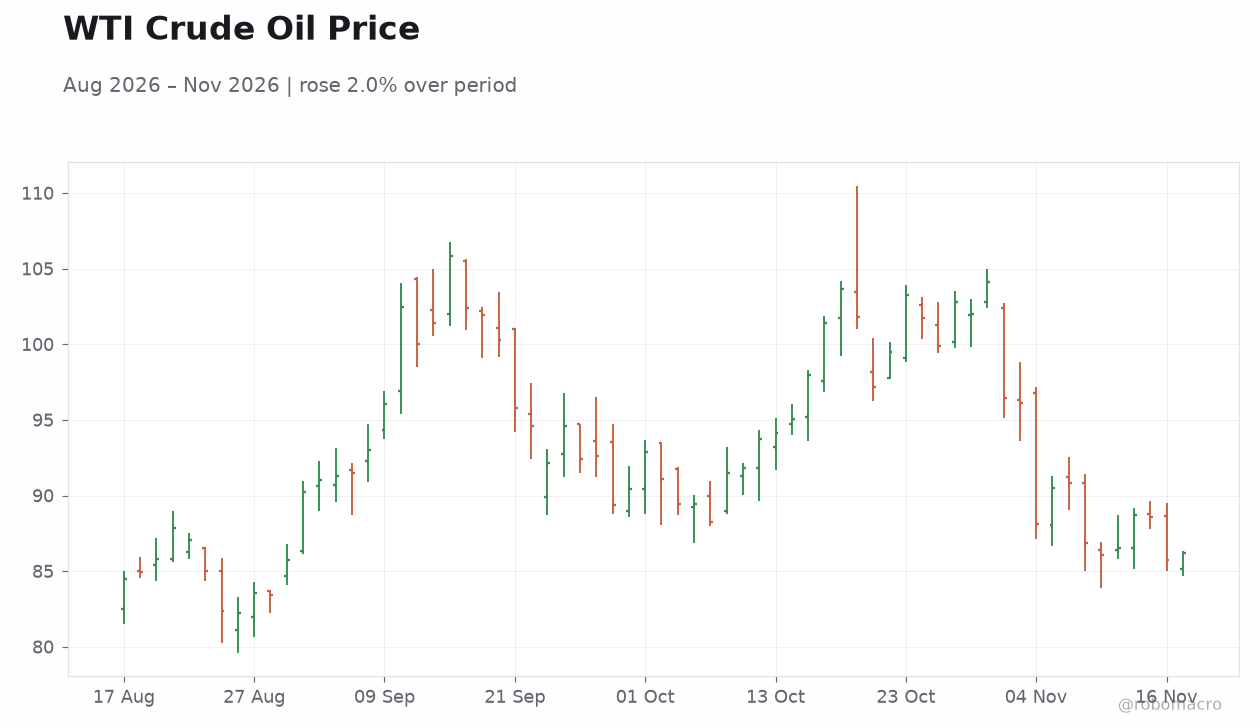
| WTI Crude | 86.22 | +0.58% |
| Silver | 47.56 | +1.66% |
| Gold | 3,867.80 | +0.38% |
| Brent Crude | 92.85 | +0.44% |
| Bitcoin | 64,819.92 | -0.06% |
| Mexico 10Y Govt Yield | 9.28% | -1 bp |
Prior Economic Events
| Data | Prior | Cons | Actual |
|---|---|---|---|
| No events available | |||
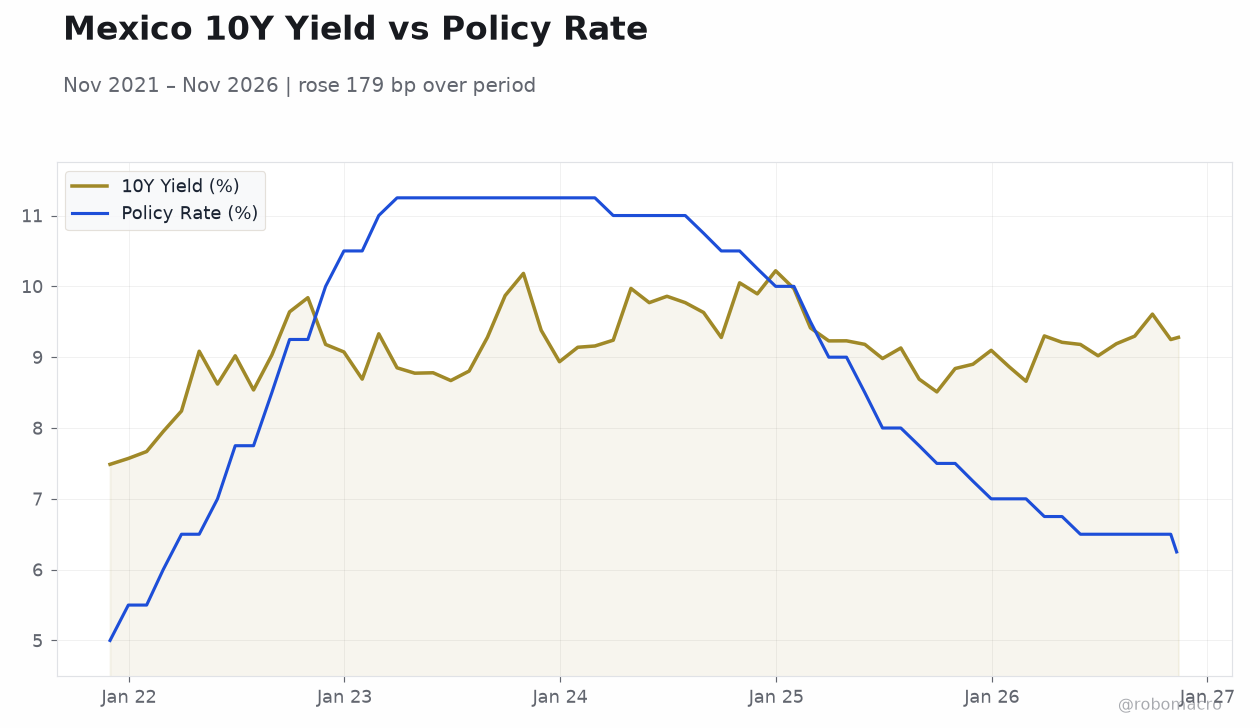 Mexico 10Y Yield vs Policy Rate | Type: macro_line | 10Y Yield (%): 9.28 (2026-11-13) | Range: 7.487–10.22 | Trend(5pt): 7.487,9.33,9.77,8.69,9.28 | Policy Rate (%): 6.25 (2026-11-10) | Range: 5–11.25 | Trend(5pt): 5,11,11,7.75,6.25
Today's Economic Events
| Data | Prior | Cons | Time |
|---|---|---|---|
| No events available | |||
- USD/MXN slipped 0.28% to 18.47 as the peso outperformed despite a 0.84% drop in the IPC Bolsa to 71,204.98, signaling divergent risk pricing between FX and equities.
- Mexico's 10-year government yield eased 1 bp to 9.28%, a marginal move that keeps the long end elevated relative to the 6.25% policy rate.
- With no Mexican data releases on the calendar for Nov 16-18, markets are trading on positioning and external cues ahead of Banxico's Dec 17 decision.
Yesterday's Recap
Mexico's Nov 16 session offered no scheduled data releases, leaving markets to trade on positioning and external flows. The peso strengthened, with USD/MXN falling 0.28% to 18.47, while EUR/MXN dropped 0.60% to 20.30, suggesting broad dollar softness rather than Mexico-specific catalysts. Equities moved the other way: the IPC Bolsa declined 0.84% to 71,204.98, a divergence that points to profit-taking in large caps rather than a uniform risk-off impulse.
In fixed income, the Mexico 10-year government yield eased just 1 bp to 9.28% as of the Nov 13 observation, a negligible move that leaves the long end near recent highs. Commodities provided a supportive backdrop for Mexico's export complex, with WTI up 0.58% at $86.22 and Brent up 0.44% at $92.85, while silver jumped 1.66% to $47.56 and gold added 0.38% to $3,867.80. Bitcoin was essentially flat at $64,819.92, down 0.06%, offering no signal on global risk appetite.
The Day Ahead
The Mexican calendar is empty for Nov 17, with no statistical agency or Banxico releases scheduled, so direction will come from external markets and carry positioning. Traders will watch the peso's reaction to U.S. session flows, particularly whether USD/MXN can hold below the 18.50 handle that has capped recent rallies.
With the 10-year yield anchored near 9.28%, there is little domestic duration catalyst until the next inflation print or Banxico communication. Attention increasingly shifts toward the Dec 17 Banxico decision, the final meeting of the year, where the market will test whether the easing cycle continues. Absent local data, IPC Bolsa moves will likely track U.S.
equity sentiment and commodity prices rather than domestic fundamentals.
Other Economic Notes
Mexico's macro backdrop remains defined by the tension between disinflation and a still-restrictive real rate. CPI running at 3.45% year-on-year as of Sept 30 sits close to Banxico's target range, yet the 6.25% policy rate implies a real ex-ante rate of roughly 280 bp, leaving room for further normalization if inflation stays contained. ↓ p.2