Riksbank's Bunge Flags Upturn; SEK Firming
OMX Stockholm 303,269.79+0.36%
Oslo Bors2,071.11+0.13%
OMX Copenhagen 251,837.27+0.68%
OMX Helsinki 256,404.74+0.41%
Market Snapshot
| Asset | Level | Change |
|---|
| OMX Stockholm 30 | 3,269.79 | +0.36% |
| Oslo Bors | 2,071.11 | +0.13% |
| OMX Copenhagen 25 | 1,837.27 | +0.68% |
| OMX Helsinki 25 | 6,404.74 | +0.41% |
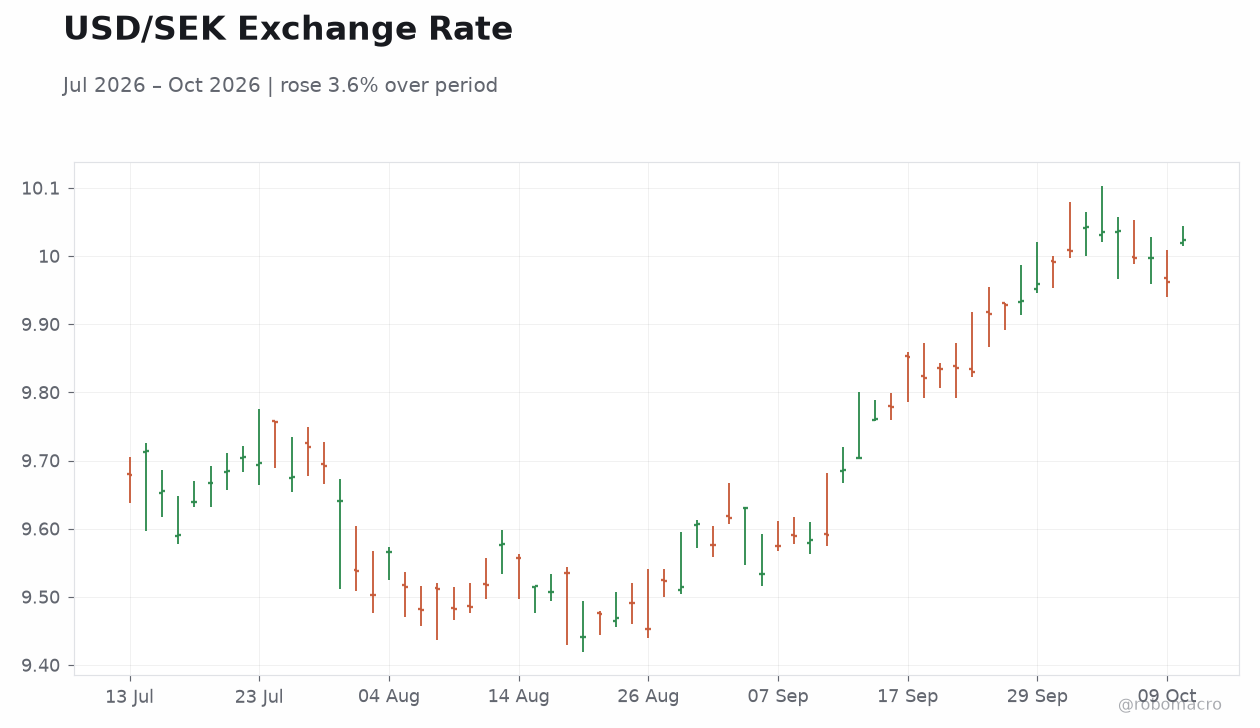
| USD/SEK | 10.02 | +0.60% |
| USD/NOK | 9.57 | +0.04% |
| EUR/SEK | 11.20 | +0.20% |
| EUR/NOK | 10.69 | -0.31% |
| Brent Crude | 105.59 | -0.99% |
| Gold | 4,220.40 | +0.71% |
| Bitcoin | 83,412.25 | -0.32% |
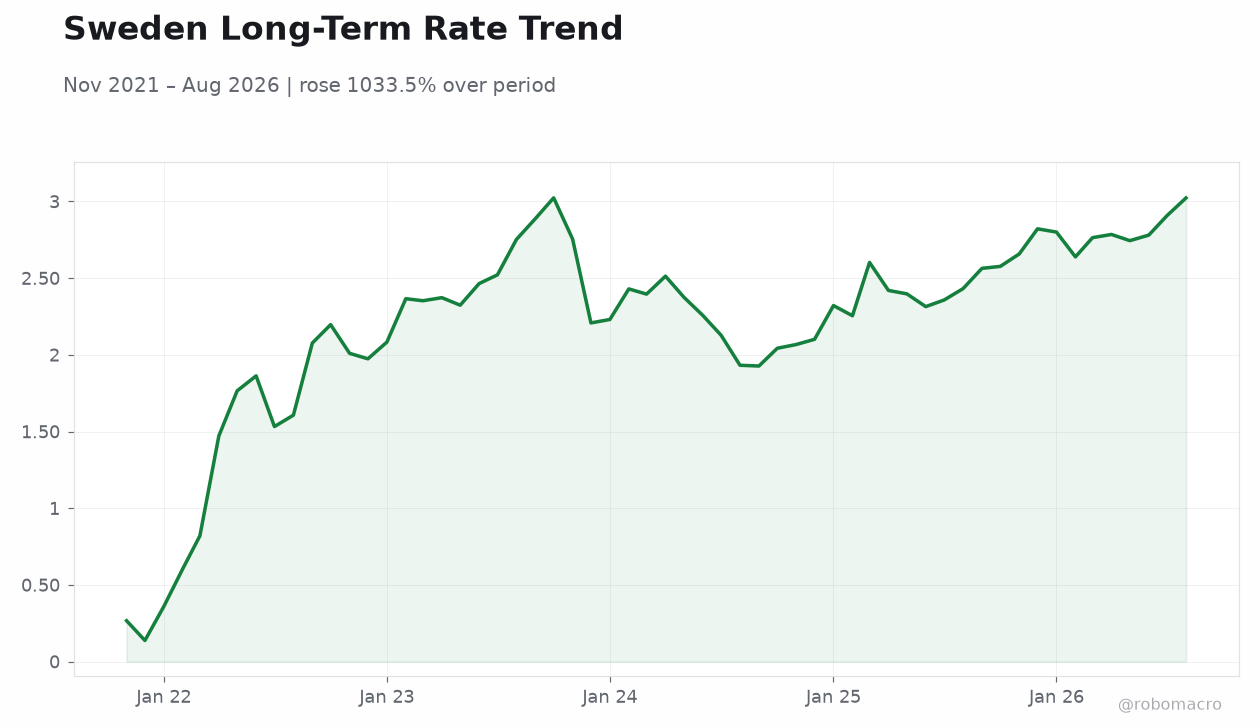
| Sweden 10Y Govt Yield | 3.20% | -3 bp |
| Norway 10Y Govt Yield | - | - |
Prior Economic Events
| Data |
Prior |
Cons |
Actual |
| No events available |
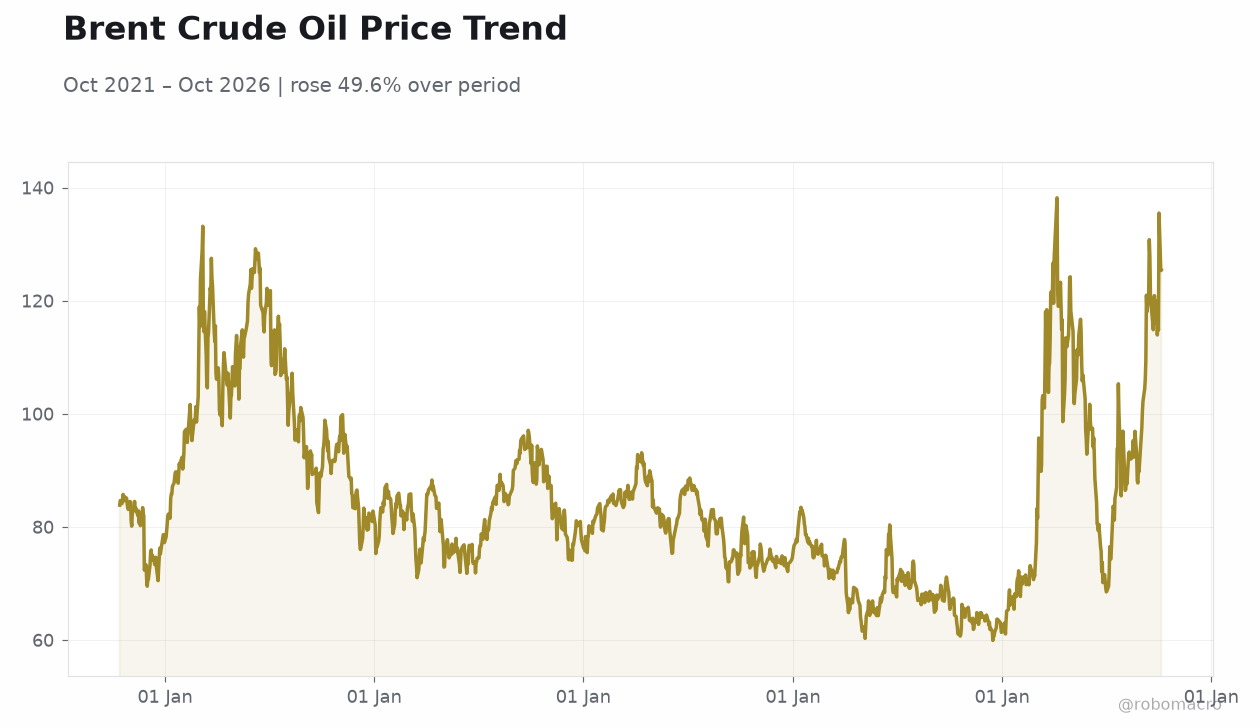 Brent Crude Oil Price Trend | Type: macro_line | Brent Crude ($/bbl): 125.4 (2026-10-06) | Range: 59.93–138.2 | Trend(6pt): 83.86,82.59,91.49,71.98,125.5,125.4
Today's Economic Events
| Data |
Prior |
Cons |
Time |
| No events available |
- Riksbank First Deputy Governor Bunge said Sweden's economy is showing a "long-awaited upturn" with signs of labour-market improvement, reinforcing a constructive krona backdrop.
- Rabobank argues the Riksbank's outlook supports SEK against the euro, with EUR/SEK slipping 0.20% to 11.20.
- Brent eased 0.99% to $105.59 as Houthi strikes on Saudi Arabia kept energy markets volatile, a key swing factor for Norway's fiscal and krone outlook.
Yesterday's Recap
Nordic equity markets closed higher on Monday, with the OMX Copenhagen 25 leading the advance at +0.68% to 1,837.27, followed by the OMX Helsinki 25 at +0.41% to 6,404.74. Stockholm's OMX 30 gained 0.36% to 3,269.79, while Oslo Børs lagged slightly at +0.13% to 2,071.11 as Brent crude retreated. In FX, the dollar strengthened broadly against the krona, with USD/SEK up 0.60% to 10.02 and USD/NOK edging 0.04% higher to 9.57.
Against the euro, the krona firmed — EUR/SEK fell 0.20% to 11.20 and EUR/NOK weakened 0.31% to 10.69 — a divergence Rabobank attributes to the Riksbank's policy outlook. Sweden's 10-year government yield eased 3 bp to 3.20%, extending the prior session's decline. On the policy front, Riksbank First Deputy Governor Anna Breman Bunge delivered the day's most consequential remarks, stating the Swedish economy is showing a "long-awaited upturn" with early signs of labour-market improvement.
In Copenhagen, Jyske Bank raised its earnings expectations, citing healthy activity levels — a modest but positive signal for Danish credit conditions. Norway's data protection authority fined Microsoft subsidiary Xandr 92 million kroner (€8.6 million) over Grindr user-data sharing, a regulatory rather than macro story but one that underscores the compliance costs facing foreign tech firms in the Nordic market.
The Day Ahead
Tuesday's calendar is light across the Nordics, with no tier-one data releases scheduled in Sweden, Norway, Denmark, or Finland. Attention will instead focus on the start of US bank earnings season, which MarketWatch notes will offer a first read on how higher yields are transmitting through the real economy — a relevant signal for Nordic banks with US exposure. Swedish investors will watch for any follow-up commentary from Riksbank officials after Bunge's constructive remarks, particularly on the timing of policy adjustments given the nascent labour-market recovery.
In Norway, oil-market direction remains the dominant swing factor for the krone and the government pension fund's fiscal stance. Danish markets will track the euro peg dynamics, with EUR/DKK stability underpinning Nationalbank's passive approach. Equity desks will monitor whether Monday's broad-based Nordic gains extend, with Copenhagen's outperformance a trend worth watching.
Page 1
Never miss an issue
Subscribe to Nordics Macro Daily and get each new issue delivered to your inbox.
Already a member? Visit robomacro.com
to log in and manage subscriptions, or use Forgot Password to set a password.