South Africa Macro Daily(Beta Mode)
ANC Setback, Unemployment Edges Higher
Market Snapshot
| Asset | Level | Change |
|---|---|---|
| JSE Top 40 | 106,738.00 | -0.33% |
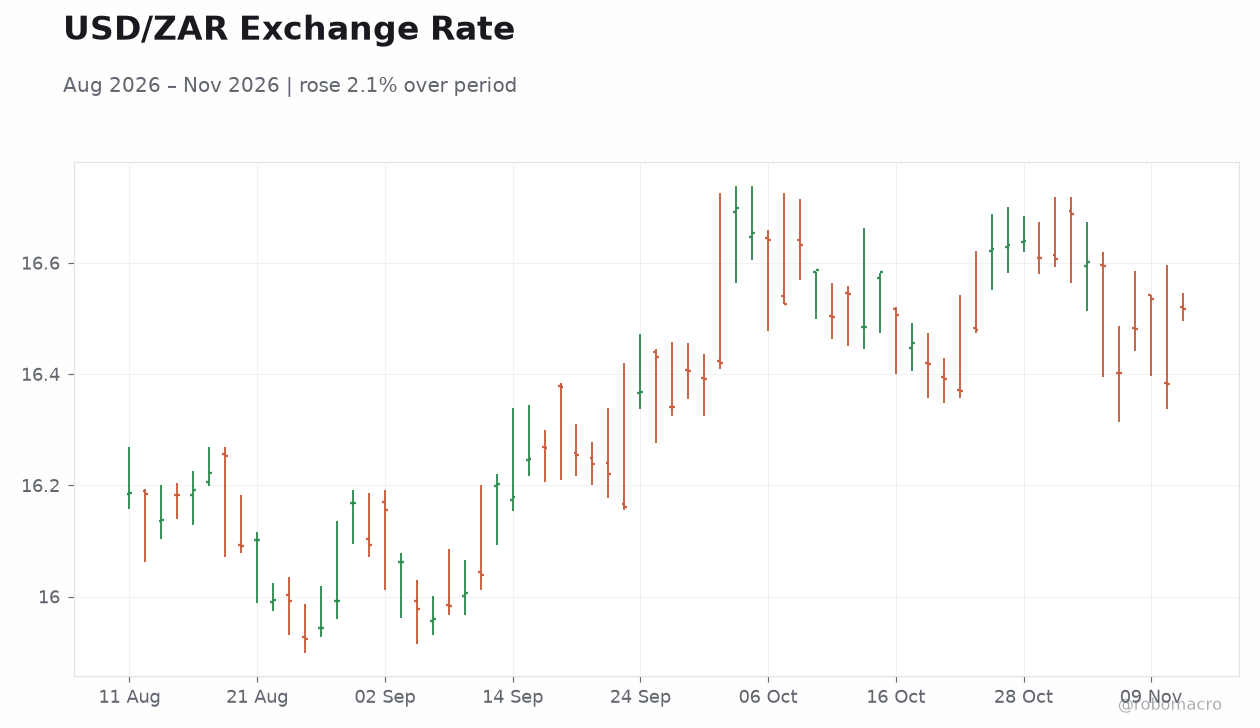
| USD/ZAR | 16.52 | +0.84% |
| EUR/ZAR | 18.44 | +0.32% |
| Platinum | 1,565.70 | +0.29% |
| Gold | 4,056.40 | -1.41% |
| Brent Crude | 92.39 | -0.19% |
| Naspers | 77,800.00 | +1.43% |
| Bitcoin | 73,483.71 | -2.31% |
| South Africa 5Y Govt Yield | 8.30% | -1 bp |
| South Africa 10Y Govt Yield | 8.51% | -3 bp |
Prior Economic Events
| Data | Prior | Cons | Actual |
|---|---|---|---|
| Headline Unemployment Rate | 33.60 | - | 33.70 |
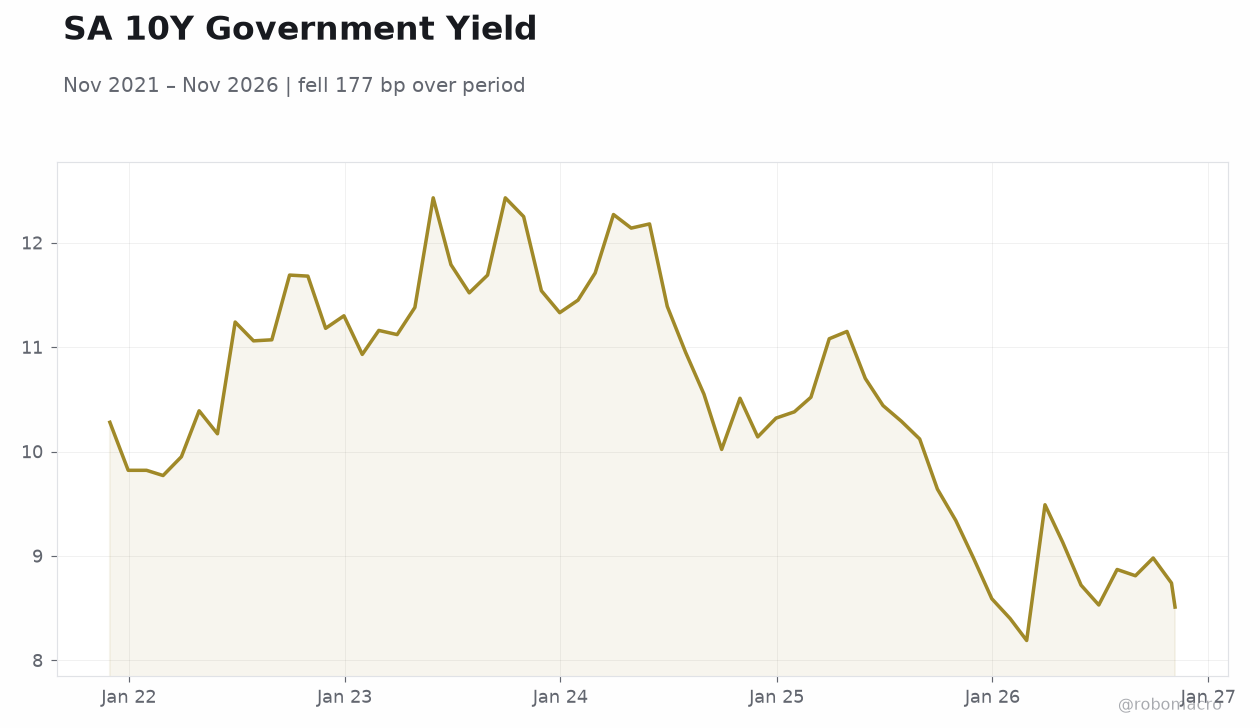 SA 10Y Government Yield | Type: macro_line | 10Y Yield (%): 8.51 (2026-11-06) | Range: 8.19–12.43 | Trend(5pt): 10.28,11.16,12.18,10.12,8.51
Today's Economic Events
| Data | Prior | Cons | Time |
|---|---|---|---|
| No events available | |||
- ANC wins most seats but suffers worst-ever electoral setback; coalition talks now centre stage, injecting policy uncertainty into the local-government landscape.
- Headline unemployment rate rose to 33.7% from 33.6% previously, underscoring persistent labour-market slack.
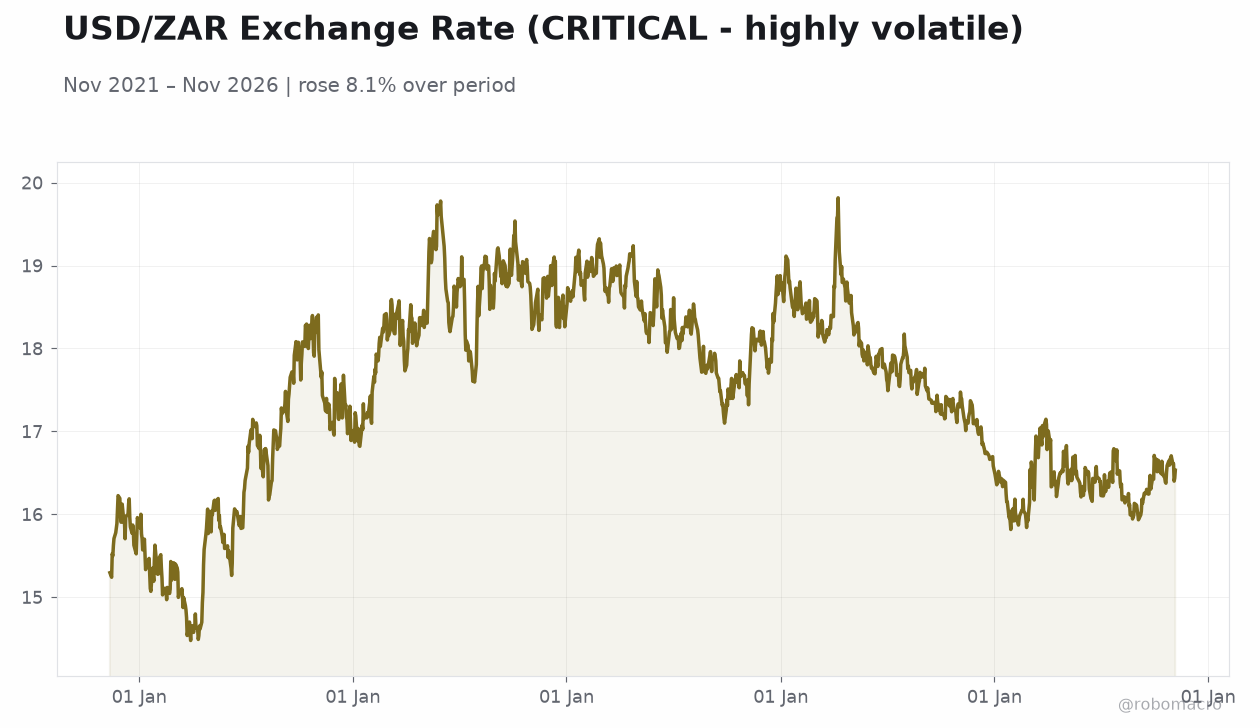
- Rand weakened 0.84% to 16.52/USD while the JSE Top 40 slipped 0.33%; bonds firmed with the 10-year yield easing 3 bp to 8.51%.
Yesterday's Recap
South Africa's headline unemployment rate printed at 33.7%, marginally above the prior 33.6% reading, confirming that labour-market conditions remain deeply stressed despite modest growth. Markets delivered a mixed picture: the JSE Top 40 fell 0.33% to 106,738, with Naspers bucking the trend to gain 1.43% at R77,800. The rand bore the brunt of risk aversion, depreciating 0.84% to 16.52/USD, while EUR/ZAR edged 0.32% higher to 18.44.
Fixed income told a more constructive story, with the 10-year government yield easing 3 bp to 8.51% and the 5-year down 1 bp to 8.30%. Precious metals diverged sharply — platinum added 0.29% to $1,565.70/oz while gold dropped 1.41% to $4,056.40/oz. Brent crude slipped 0.19% to $92.39/bbl, and Bitcoin fell 2.31% to $73,483.71, reflecting broader risk-off sentiment.
The Day Ahead
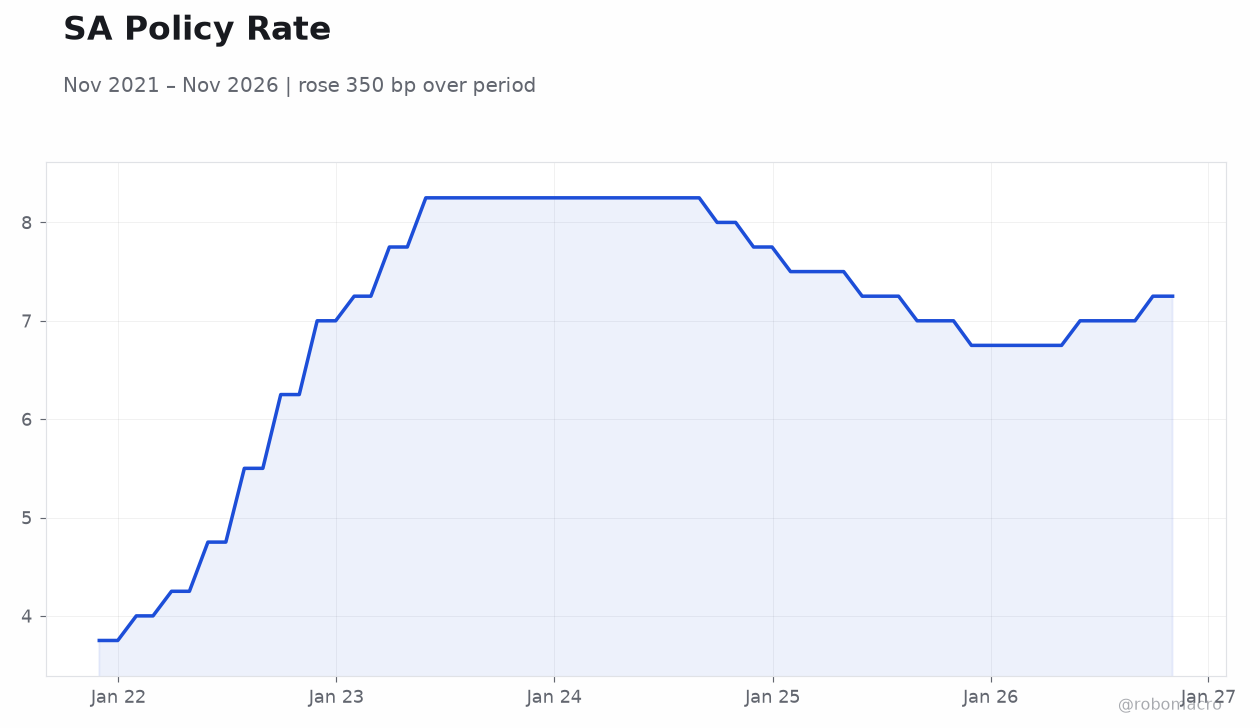
The domestic data calendar is empty for today and tomorrow, leaving markets to trade off political developments and global risk appetite. Coalition negotiations following the ANC's electoral setback will be the dominant domestic narrative, with investors watching for signals on municipal policy continuity and fiscal discipline. With no scheduled SARB events until the 19 November MPC meeting, rate expectations will be shaped by incoming global data and rand dynamics.
Liquidity should remain adequate, though the absence of fresh catalysts may keep the JSE range-bound. Traders will likely position cautiously ahead of next week's policy decision.
Other Economic Notes
The ANC's worst-ever electoral showing has shifted coalition talks to centre stage, raising questions about local-government stability and service delivery — a key constraint on growth. Encouragingly, South Africa's trade with China has surged following a zero-tariff deal, offering a meaningful export tailwind for mining and agricultural sectors. The unemployment print at 33.7% reinforces structural labour-market rigidities that limit consumption and tax revenue.
With CPI at 4.55%, real rates remain restrictive, weighing on credit-sensitive sectors. Energy supply remains a persistent risk, though load-shedding intensity has been manageable in recent weeks.