RoboMacro AI Economic Research

Global Macro Watch

Also todaySee the FX Daily Week of November 9–13, 2026 robomacro.com
Global Macro Watch
Week of November 9–13, 2026
  • Policy divergence metric at 5.38 leads weekly signals as central banks diverge on December decisions.
  • October nonfarm payrolls and CPI both exceeded consensus, lifting the 10-year Treasury yield 20bp.
  • Waller backs December 25bp hike while BoJ October 30 minutes show debate on faster normalization at 1.25%.
  • Brent rose 3.53% to 95.84 and WTI advanced 1.97% to 88.56, supporting Nordic and Turkish equities amid yield repricing.
Policy Divergence Holds Rate Paths Apart

Policy Divergence Defines Mid-Cycle Setting

Central-bank divergence now sets the dominant tone across G10 and emerging markets. The policy metric printed 5.38 this week, ahead of risk-appetite readings and confirming that rate-path differences transmit the clearest information about the cycle. October nonfarm payrolls rose more than expected while October CPI also exceeded consensus, pushing the 10-year Treasury yield 20bp higher. Fed Governor Waller stated support for a 25bp December hike and openness to a larger move if inflation fails to slow. These prints arrive against a backdrop in which the Bank of Japan’s October 30 Summary of Opinions revealed members debating faster rate hikes at the unchanged 1.25% policy rate. The configuration places the global cycle in its mid-phase, where domestic data releases move individual central banks at different speeds rather than producing coordinated shifts.

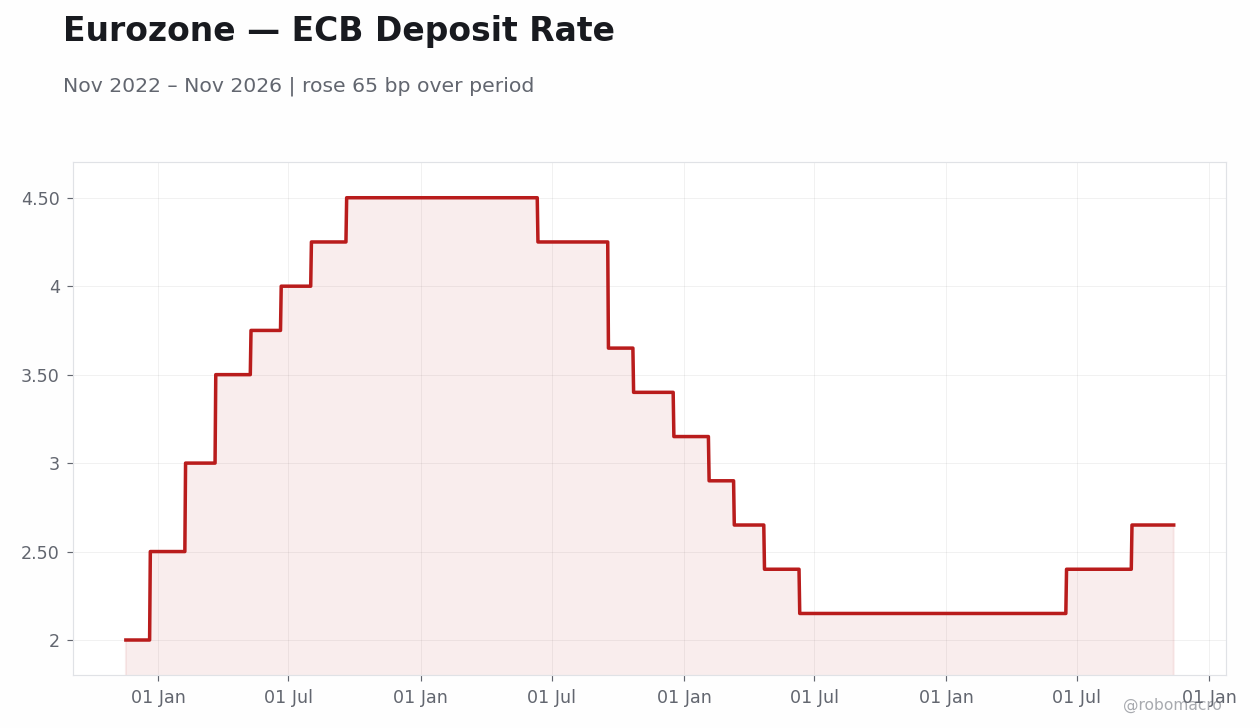
The absence of convergence is reinforced by explicit statements. The Bank of Canada reinforced a data-dependent stance after October labour data showed a surprise contraction in jobs and a rise in the unemployment rate. Headline CPI remained above target, driven by a gasoline price rebound. In the euro area the ECB deposit facility rate stayed on hold while succession talks between Germany and France intensified ahead of the December meeting. Forward guidance remains tied to incoming prints rather than any common reaction function. The data therefore suggest that investors must price separate trajectories for the Federal Reserve, the ECB, the Bank of Japan and the Bank of Canada rather than a single global impulse.

DM Central Banks Transmit Uneven Signals
Join the AIeconomist.app Waitlist

Published every Sunday afternoon Not financial advice.
RoboMacro AI Economic Research

Global Macro Watch

Week of November 9–13, 2026 robomacro.com

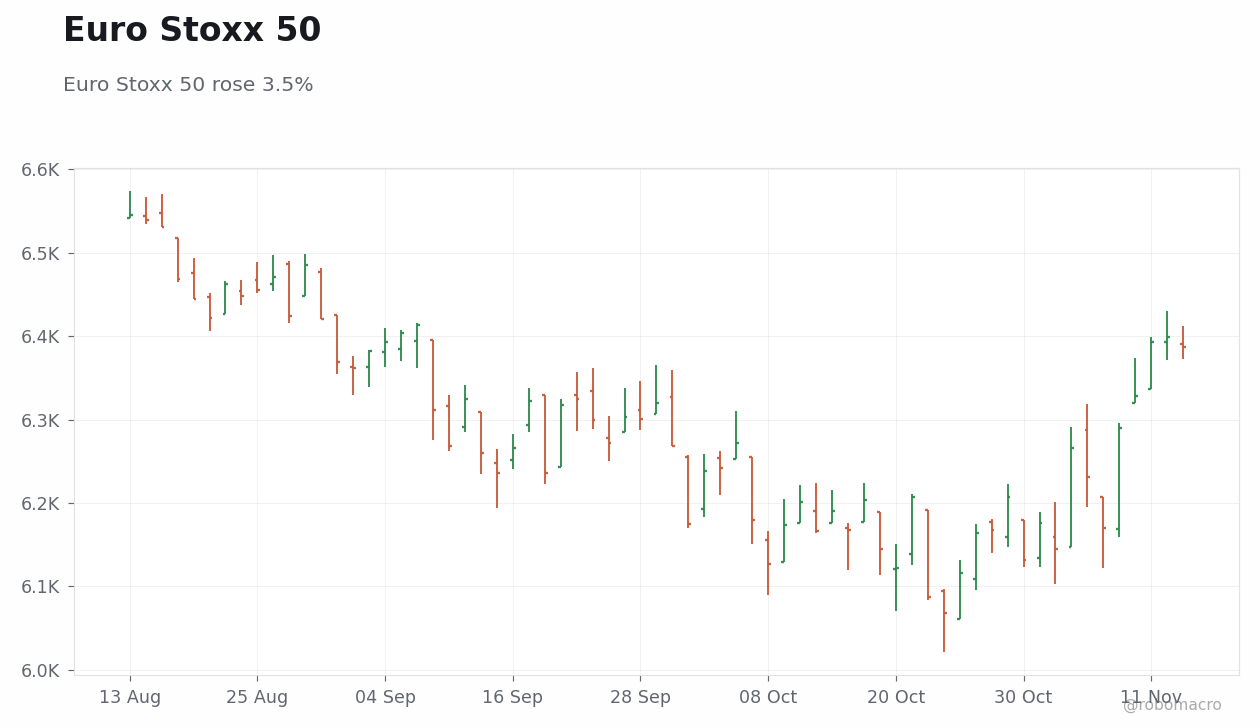
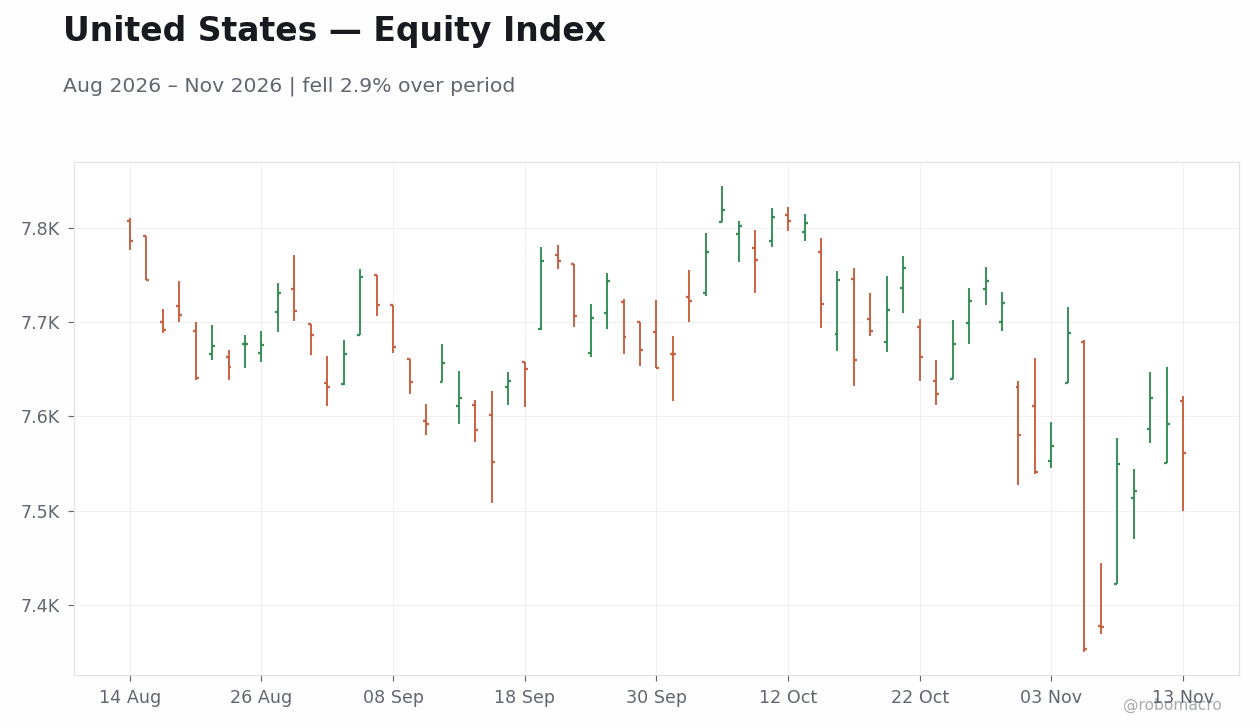
Developed-market outcomes cluster around selective resilience rather than uniform policy responses. In the United States the S&P 500 closed at 7561.67, up 0.16% week-over-week, even as the 10-year yield climbed. In the euro area German 10-year Bund yields rose while the Euro Stoxx 50 advanced 1.53% to 6386.86, reflecting divergent equity-bond responses to sticky inflation. French unemployment declined and Italian industrial production rose, yet German trade balance missed expectations. The ECB kept settings unchanged, allowing real-rate differentials inside the bloc to persist.

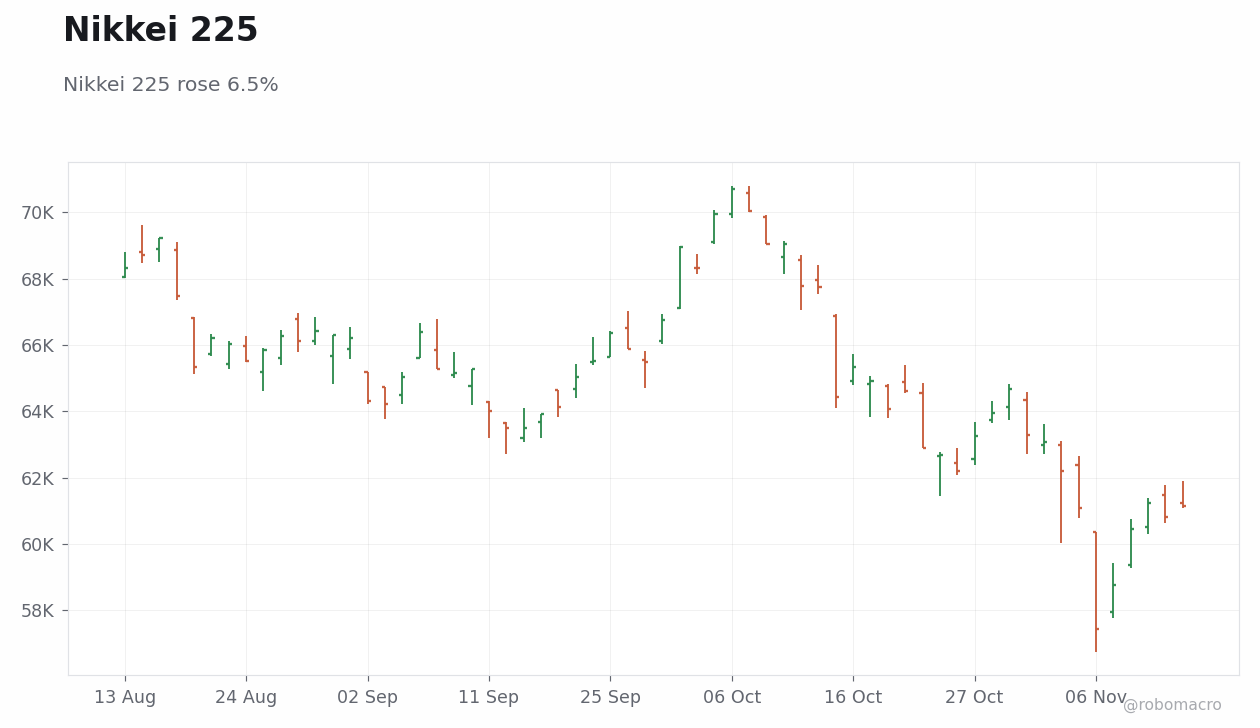
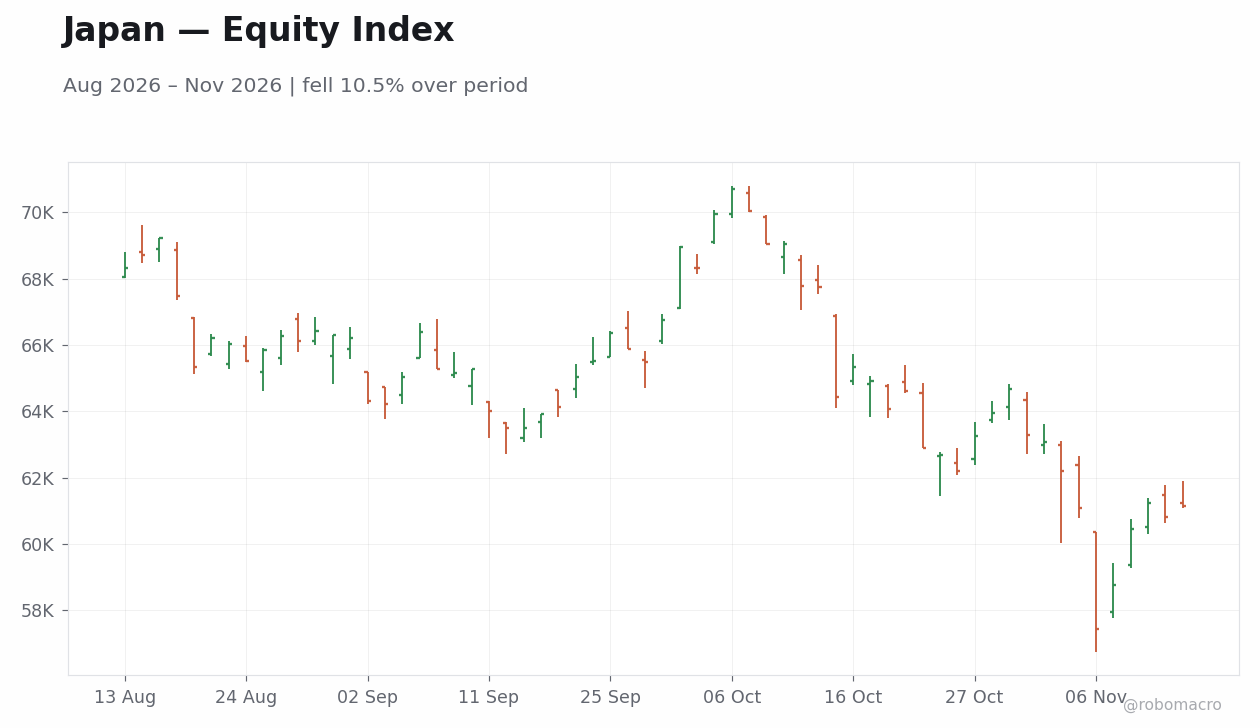
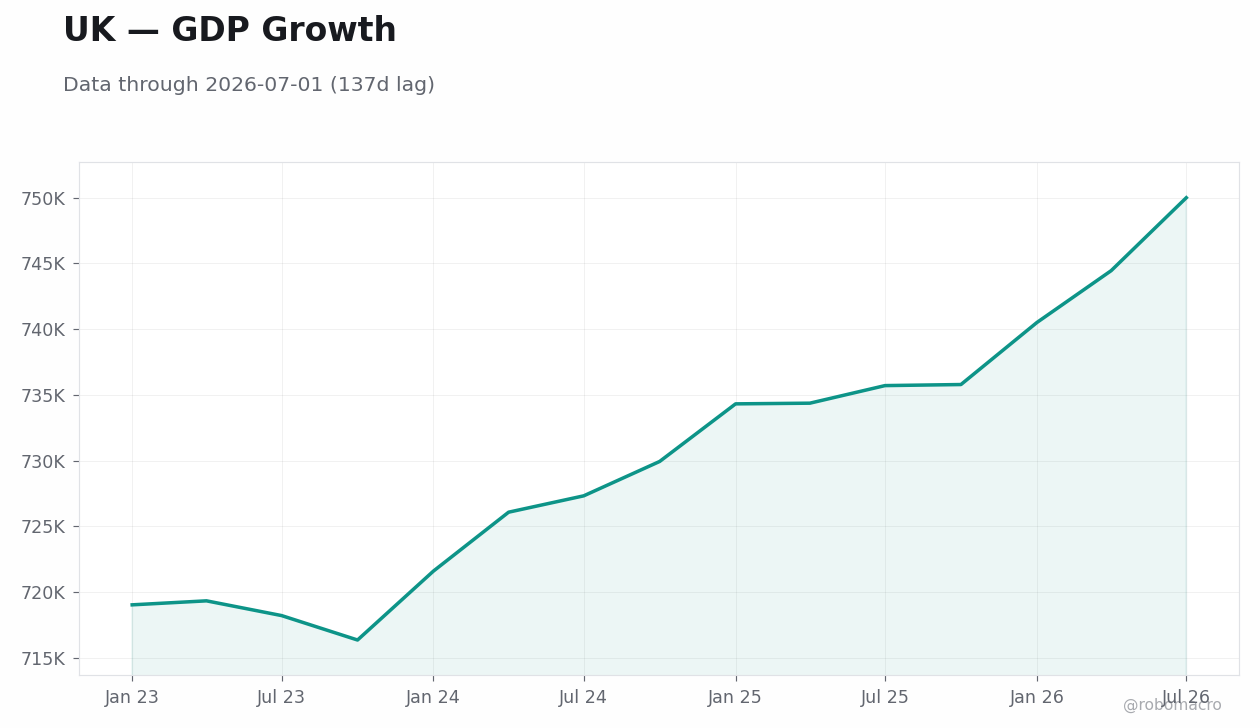
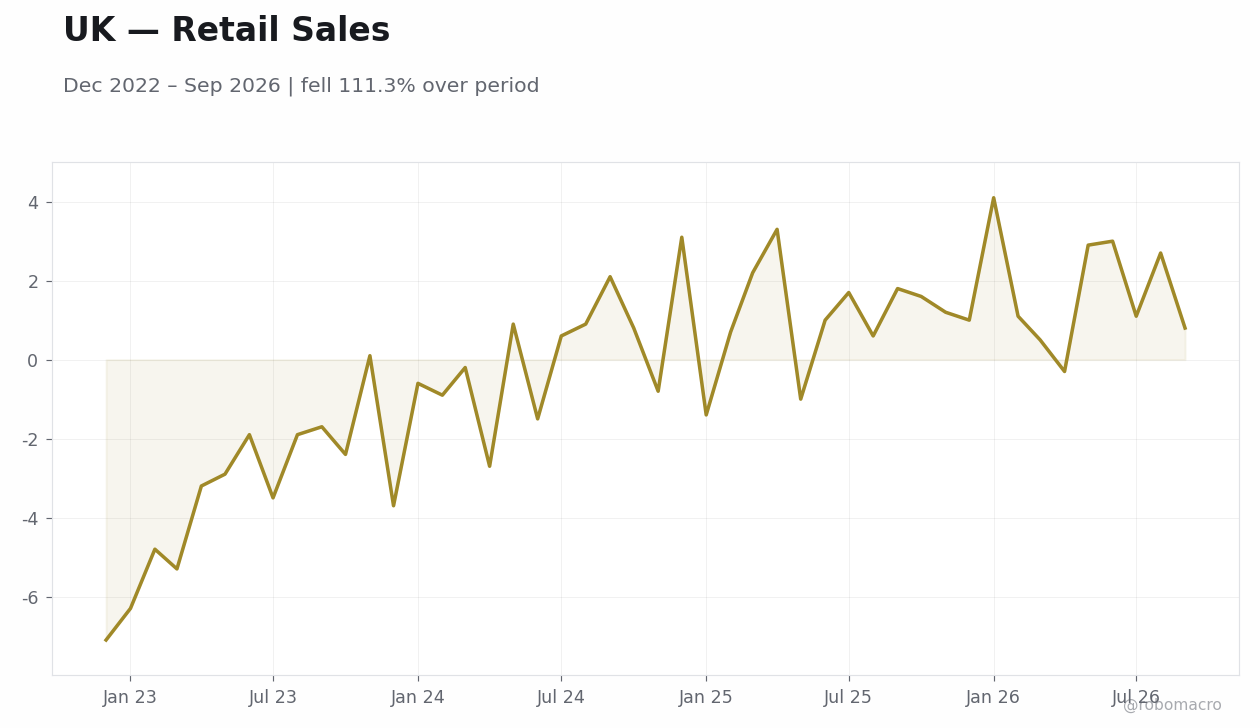
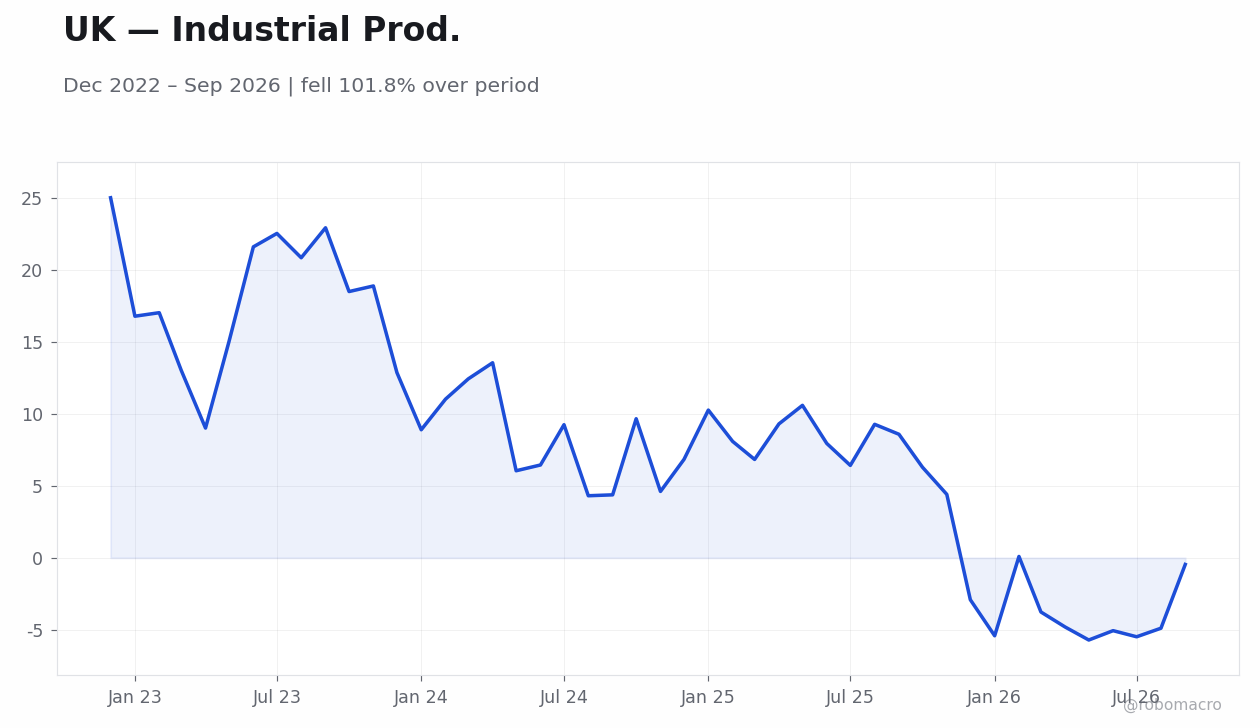
Japan recorded household spending declines that missed consensus while inflation stayed above target. The Nikkei 225 recovered to 61142.35, up 4.03% week-over-week, as risk appetite overrode the consumption data. Bank of Japan members reinforced the 2% target achievement and the normalization path. In the United Kingdom monthly GDP and industrial production exceeded expectations while retail sales and housing metrics softened. The BoE highlighted a data-dependent path with a December move still possible, supporting a modest rise in shorter-dated yields. These contrasting signals leave DM rate paths apart and transmit uneven price signals into equity and fixed-income markets.

EM Policy Settings Split Along Domestic Prints

Emerging-market central banks delivered mixed actions that widened rather than narrowed dispersion. Banco de Mexico cut the policy rate on November 5, reopening the easing cycle, yet October CPI rose more than expected on both a month-over-month and year-over-year basis. The inflation overshoot arrived directly after the decision, shifting the data backdrop for the December 17 meeting. In contrast, Peru’s central bank raised its policy rate, marking the first hike in the current cycle. Chile’s October CPI rose while the finance minister confirmed recession, sending MSCI Chile lower and USD/CLP higher. Colombia’s October CPI rose below consensus yet the policy rate kept USD/COP under pressure.

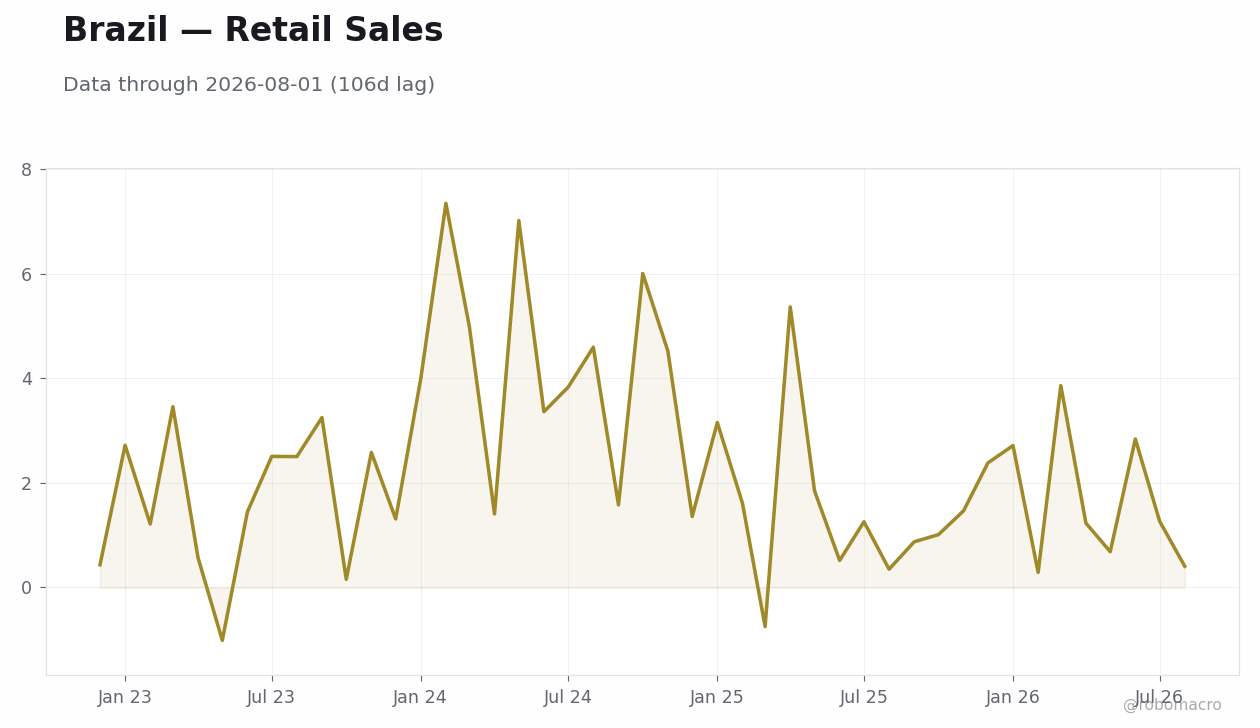
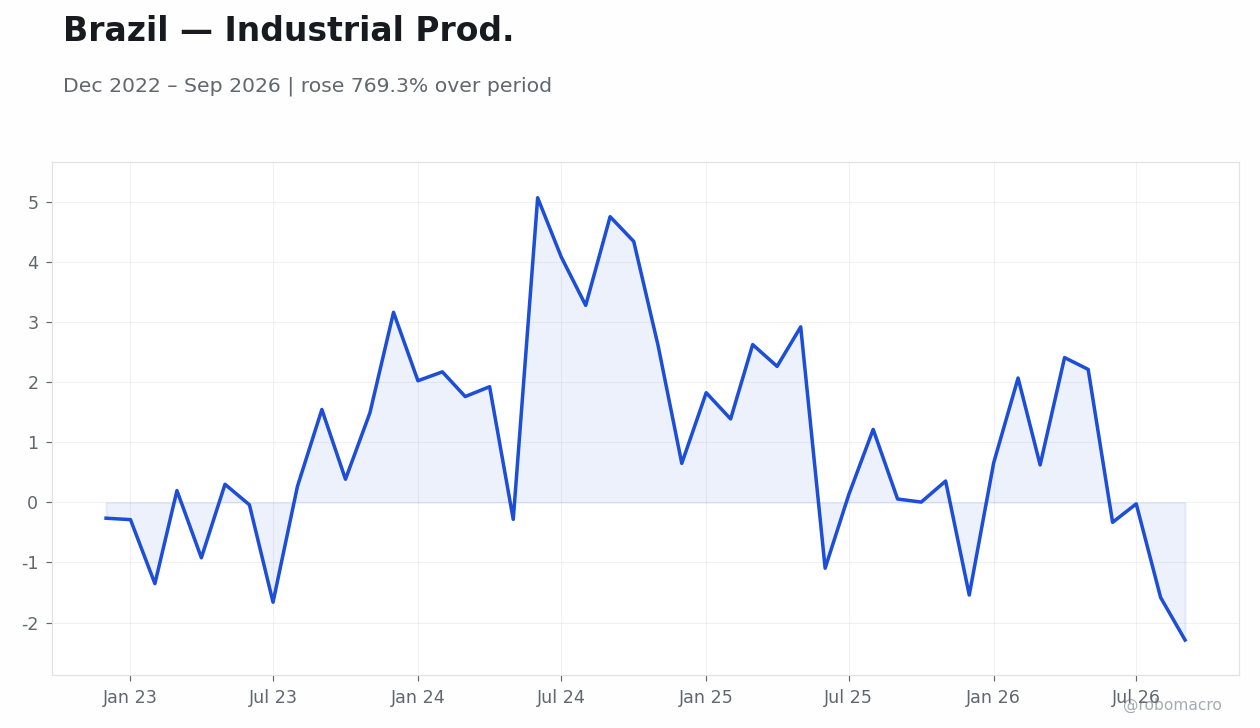
Brazil’s IPCA showed softer momentum while the BCB Copom minutes from the November 4 hold highlighted persistent price pressures alongside slowing activity. South Africa’s labour-market data confirmed ongoing slack ahead of the SARB decision, with the JSE Top 40 declining 2.43% and USD/ZAR rising 2.4%. The RBA raised the cash rate in its most recent decision while New Zealand employment contracted quarter-over-quarter. These outcomes preserve real-rate buffers in some jurisdictions and erode them in others, sustaining the dispersion already visible in currency markets.

RoboMacro AI Economic Research

Global Macro Watch

Week of November 9–13, 2026 robomacro.com

Cross-Asset Moves Reflect Yield Repricing

Rates, FX and equities moved in patterns consistent with divergent policy expectations. The 10-year Treasury yield rose 20bp, Canada 10-year yields climbed 20bp and Mexico 10-year yields advanced 19bp. Turkey 10-year yields jumped 52bp while South Africa 10-year yields rose 24bp. Equity performance split along domestic resilience: KOSPI rose 5.41% to 5290.53 and the Nikkei 225 gained 4.03%, while the JSE Top 40 fell 2.43%. Brent crude rose 3.53% to 95.84 and WTI advanced 1.97% to 88.56, supporting Norwegian and Turkish equity indices. Gold declined 5.55% to 3886.30 amid the yield surge. USD/ZAR rose 2.4% and USD/BRL rose 2.5%, illustrating external pressure on commodity-sensitive currencies. These moves show that fixed-income repricing transmits faster than equity or commodity adjustments when central banks remain on separate schedules.

Policy Outlook Points to Persistent Dispersion

The global central-bank landscape now features three distinct clusters. The Federal Reserve and Bank of Canada remain on data-dependent tightening paths. The ECB and Bank of England sit on hold with December decisions still possible. The Bank of Japan continues gradual normalization at 1.25%. Emerging-market institutions range from Mexico’s November 5 cut to Peru’s first hike and the RBA’s recent increase. Real-rate differentials therefore stay intact. No institution altered its stated reaction function this week; each tied its next decision explicitly to domestic releases scheduled after November 13. The configuration sustains the dispersion already priced into FX and fixed-income markets.

Forward Look

Next week’s focus falls on the December 17 Banco de Mexico meeting, fresh US CPI and retail-sales prints, and any additional Bank of Japan communications. Labour data from Canada and activity releases from the euro area will test whether the current divergence in rate expectations narrows or widens. Markets will continue to differentiate on the basis of local prints rather than a uniform global impulse.

RoboMacro AI Economic Research

Global Macro Watch

Week of November 9–13, 2026 robomacro.com
Global Economic Outlook Summary
IMF World Economic Outlook projections, % change year-on-year. Real GDP and average consumer prices. Retrieved November 15, 2026.
Economy Real GDP (% y/y) Consumer Prices (% y/y)
2026E2027E2028E 2026E 2027E2028E
Americas
United States2.32.32.13.62.82.1
Canada1.11.71.72.82.42.0
Mexico1.51.82.23.83.63.1
Brazil2.21.92.44.44.13.1
Argentina2.13.54.232.521.214.8
Colombia2.22.32.46.05.73.9
Chile0.62.62.43.73.53.0
Peru3.02.93.23.82.62.1
Asia / Pacific
Japan0.70.70.62.02.62.0
China4.54.04.01.01.41.6
India7.07.06.95.04.43.9
Australia1.91.61.83.93.12.5
New Zealand2.02.62.74.12.82.0
South Korea3.32.82.32.72.32.0
Indonesia5.15.15.23.32.82.5
Malaysia5.24.64.32.21.92.0
Philippines3.45.15.55.64.13.2
Singapore5.03.02.52.32.22.0
Thailand2.12.12.32.11.71.5
Taiwan10.74.33.22.01.81.6
Vietnam8.47.55.94.74.94.7
Western Europe
Euro area1.11.21.33.12.82.2
Germany1.31.11.12.73.12.0
France0.40.71.22.42.21.9
Italy0.80.60.73.32.82.3
Spain2.51.81.83.72.72.5
United Kingdom1.31.21.63.32.82.0
Sweden2.52.22.11.11.92.7
Norway1.51.31.13.22.82.3
Denmark3.72.01.81.82.52.0
Switzerland1.91.21.90.70.80.8
Netherlands1.51.31.42.92.82.6
Poland3.42.52.53.22.83.9
Czech Republic1.81.92.22.12.82.7
Hungary1.92.12.31.92.83.0
Romania-0.52.22.58.24.14.3
EMEA Emerging
Turkey2.73.64.031.226.520.6
South Africa1.01.31.54.43.93.3
Israel4.54.43.61.82.02.0
Saudi Arabia-3.37.94.81.92.22.0
UAE-3.97.77.04.52.52.0
Egypt5.14.75.013.314.88.9
Nigeria4.24.34.115.614.713.3
Kenya4.54.74.96.05.05.3
Global Aggregates
Global3.13.43.34.74.13.5
Developed markets2.11.81.73.12.72.1
Emerging markets3.74.44.35.75.14.4
E = IMF projection. Source: IMF World Economic Outlook, retrieved via the IMF DataMapper. Aggregates (Global, Developed markets, Emerging markets, Euro area) are the IMF's own groupings. A blank cell means the IMF does not publish a projection for that economy and year.
RoboMacro AI Economic Research

Global Macro Watch

Week of November 9–13, 2026 robomacro.com
Global Central Bank Watch
Policy rates as of November 15, 2026. Current rates, last changes and meeting dates are verified against central bank publications and BIS policy-rate data. Quarter columns show realized quarter-end rates for quarters that have completed.
Central Bank Instrument Current
Rate
Last
Change
bp Next
Meeting
Q1
2026
Q2
2026
Q3
2026
Q4
2026
The Americas
Federal ReserveFed funds upper4.00%Sep 2026+25Dec 93.753.754.00—
Bank of CanadaO/N rate2.50%Oct 2026+25Dec 92.252.252.25—
BCB (Brazil)SELIC13.75%Sep 2026-25Dec 914.7514.2513.75—
BanxicoO/N rate6.25%Nov 2026-25Dec 176.756.506.50—
BCRA (Argentina)Aggregates regime—Jun 2025——————
BanRep (Colombia)Repo12.25%Sep 2026+25Dec 1810.2511.2512.00—
BCCh (Chile)MPR4.50%Dec 2025-25—4.504.504.50—
Europe / Africa
ECBDepo rate2.50%Sep 2026+25Dec 172.002.252.50—
Bank of EnglandBank rate4.00%Nov 2026+25Dec 173.753.753.75—
RiksbankRepo rate1.75%Oct 2025-25Dec 161.751.751.75—
Norges BankDep rate4.50%Sep 2026+25Dec 174.004.254.50—
SNBPolicy rate0.00%Jun 2025-25Dec 100.000.000.00—
CNB (Czech)2-wk repo4.00%Nov 2026+25Dec 173.503.753.75—
NBH (Hungary)Base rate5.50%Aug 2026-25Nov 176.256.255.50—
NBP (Poland)Ref rate3.75%Mar 2026-25—3.753.753.75—
SARBRepo rate7.25%Sep 2026+25Nov 196.757.007.25—
CBRT (Turkey)1-wk repo36.00%Oct 2026-100Dec 1037.0037.0037.00—
Asia / Pacific
RBACash rate4.85%Nov 2026+25Dec 84.104.354.60—
RBNZOCR2.75%Sep 2026+25Dec 92.252.252.75—
BoJPol rate1.25%Sep 2026+25Dec 180.751.001.25—
PBoC1-yr LPR3.00%———3.003.003.00—
RBI (India)Repo rate5.50%Oct 2026+25—5.255.255.25—
BoK (Korea)Base rate3.00%Aug 2026+25—2.502.503.00—
BI (Indonesia)BI-Rate5.75%Jun 2026+25Nov 184.755.755.75—
BSP (Philippines)Rev repo5.50%Oct 2026+50—4.254.755.00—
BoT (Thailand)1-day repo1.00%Feb 2026-25Dec 231.001.001.00—
CBC (Taiwan)Disc rate2.00%Mar 2024+12.5—————
MAS (Singapore)SGD NEERMild appr.Jul 2026slope+—————
Changes to Consensus Rate Views This Week vs Nov 8
Banxico current rate: 6.50→6.25 ▼ -25bp  ·  Bank of England current rate: 3.75→4.00 ▲ +25bp  ·  CNB (Czech) current rate: 3.75→4.00 ▲ +25bp  ·  RBA current rate: 4.60→4.85 ▲ +25bp  ·  RBI (India) current rate: 5.25→5.50 ▲ +25bp
Every figure on this page is verified against official central bank publications or BIS policy-rate data; a cell we cannot verify is left blank ("n/v") rather than estimated. Quarter columns show realized quarter-end rates only — no forward rate path is published, because market-implied pricing is not sourced for these banks. Shaded rows denote regional groupings. Data as of Week of November 9–13, 2026.
RoboMacro AI Economic Research

Global Macro Watch

Week of November 9–13, 2026 robomacro.com
Activity Tracking & NowcastReal-time growth pulse
RoboMacro US Labor Nowcast — Oct 2026 NFP
Nonfarm Payrolls (m/m)+76k  80% CI +16k…+299k
Unemployment Rate4.2%
Avg Hourly Earnings (y/y)3.3%
Point estimate = median of a 10-model ensemble (ElasticNet, LightGBM, MIDAS, SARIMAX, XGBoost, VAR, UC stochastic-trend, RF, MLP, naive-AR). Bands are model dispersion, not a forecast of revisions.
RoboMacro High-Frequency Activity Nowcast
Composite weekly activity index, diffusion-style (50 = neutral; >50 expansion), seasonally adjusted. Each economy combines 2–7 weekly public indicators — among them electricity and gas demand, flights, port calls, road traffic, card and payment volumes, job postings and tax deposits. A week is published only when indicators covering at least 70% of the index weight have reported and the week has closed; the as-of date and the share of indicators reporting are shown per row. Source: RoboMacro High-Speed Macro engine.
Economy Activity Index4-wk Δ13-wk Δ Week endingIndicators Signal
Brazil80.3+20.3+12.02026-11-133/4Expanding · Advancing
Germany61.8+7.7+7.52026-11-135/6Expanding · Advancing
Spain60.9+7.4-2.12026-11-065/5Expanding · Advancing
Canada58.9-0.3+8.62026-11-066/8Expanding · Flat
Italy57.8+3.6-12.62026-11-065/5Expanding · Advancing
Poland56.4+2.6-12.62026-11-133/4Expanding · Advancing
Japan55.2-3.3-9.22026-11-063/5Expanding · Retreating
France55.1+20.0+5.12026-11-064/5Expanding · Advancing
Euro Area53.9+7.0+0.42026-11-065/5Expanding · Advancing
United States52.3-0.9+2.82026-11-067/7Expanding · Retreating
Australia50.7-7.8+1.62026-11-063/3Expanding · Retreating
New Zealand37.5-10.7-17.22026-11-063/5Contracting · Retreating

Activity remains in expansion in United States, Euro Area, Germany, France, Italy, Spain, Japan, Canada, Brazil, Australia, Poland; while high-frequency trackers point to sub-trend activity in New Zealand. On a 4-week basis, momentum is improving in Euro Area, Germany, France, Italy, Spain, Brazil, Poland and cooling in United States, Japan, Australia, New Zealand. RoboMacro's labor ensemble nowcasts the next US payrolls print at +76k.

Nowcasts are model-derived from high-frequency public data and update weekly as new releases arrive. Activity-index country coverage is expanding. A cross-country PMI matrix is planned pending a verified PMI data source.
RoboMacro AI Economic Research

Global Macro Watch

Week of November 9–13, 2026 robomacro.com
Markets in ReviewRates & Fixed Income
Rates & Fixed Income Chart 1
Rates & Fixed Income Chart 2
Rates & Fixed Income Chart 3
Rates & Fixed Income Chart 4

Week in Review

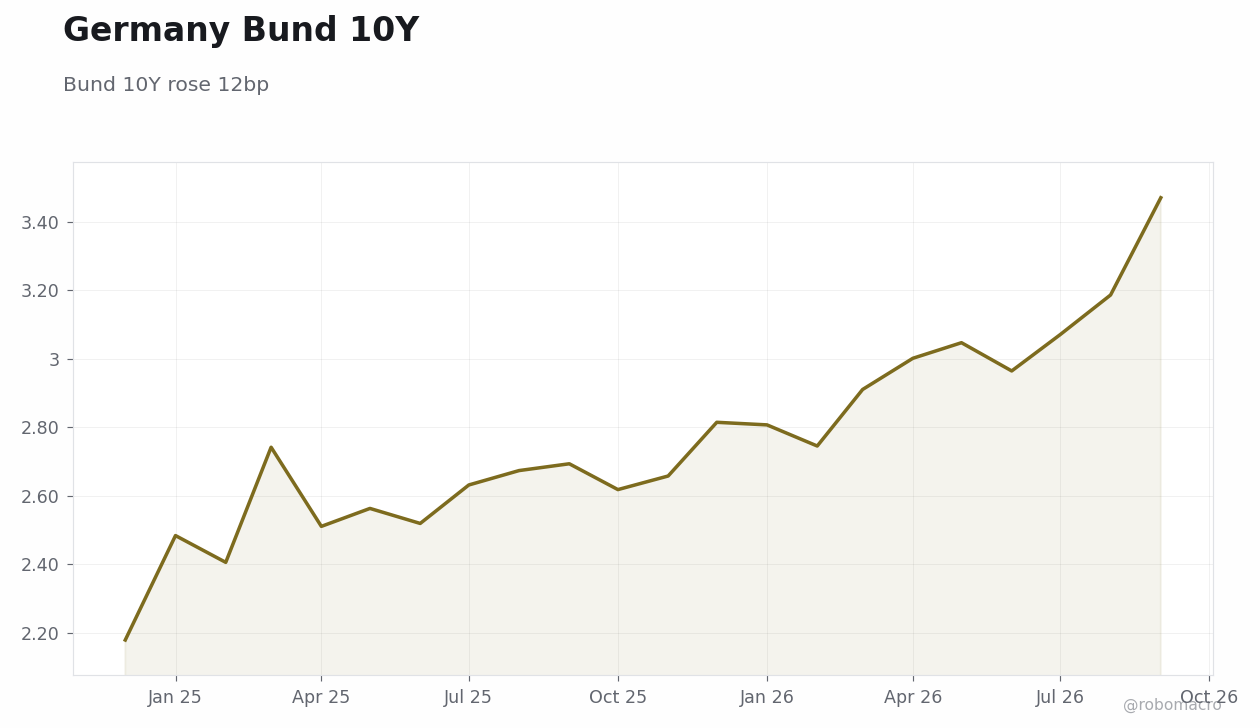
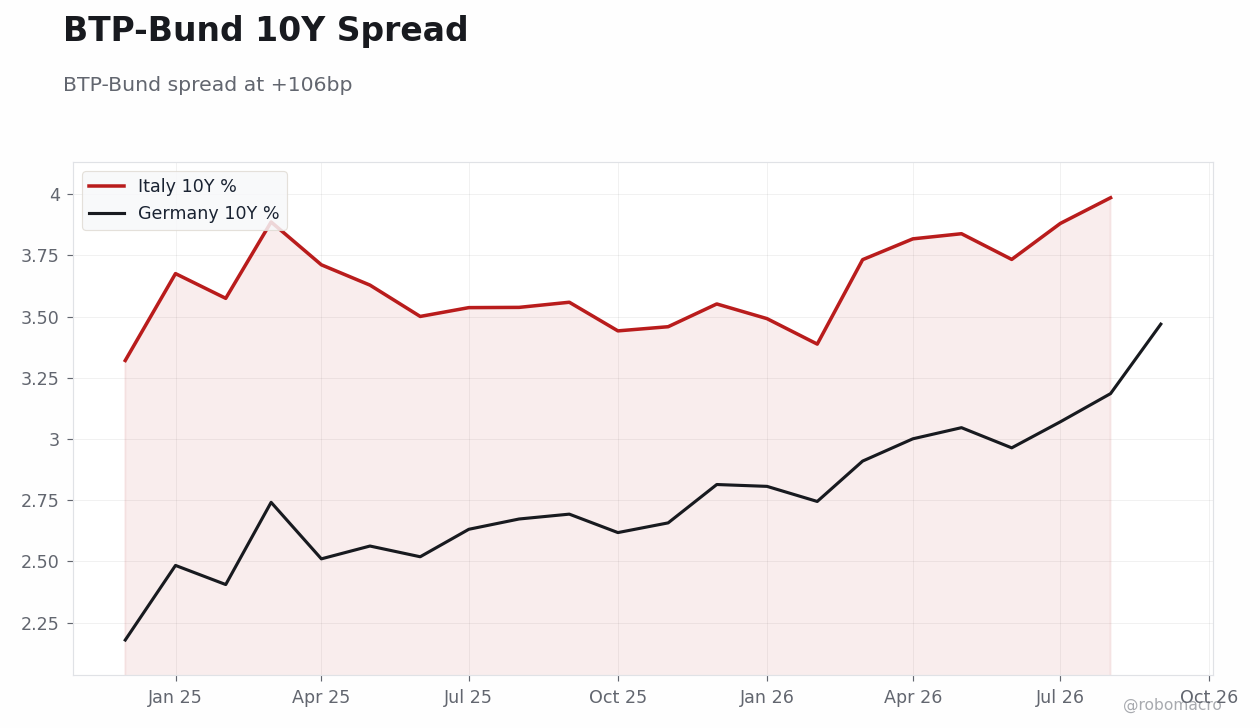
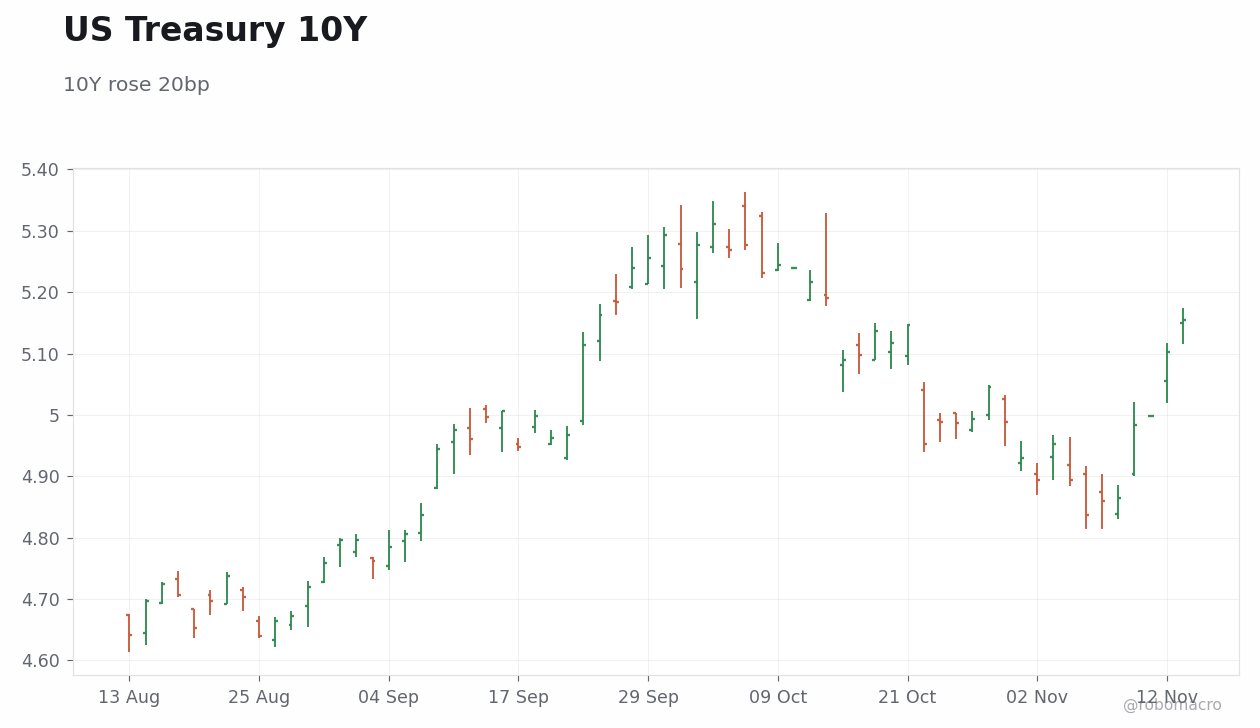
U.S. 10-year yields rose 20bp to 5.10% as the most important DM yield move of the week. This increase was accompanied by a 28bp rise in the 2-year to 4.86%. The yield climbed steadily from 4.8640 on Monday, to 4.9830 on Tuesday, 4.9980 on Wednesday, 5.1030 on Thursday and 5.1540 on Friday. German 10-year yields rose 12bp to 3.38%, while UK 10-year gilt yields increased 18bp to 5.34%. Japanese 10-year yields rose 22bp to 2.86%. The moves left the 30-year U.S. yield at 5.43% after a 15bp increase.

Curve & Spreads

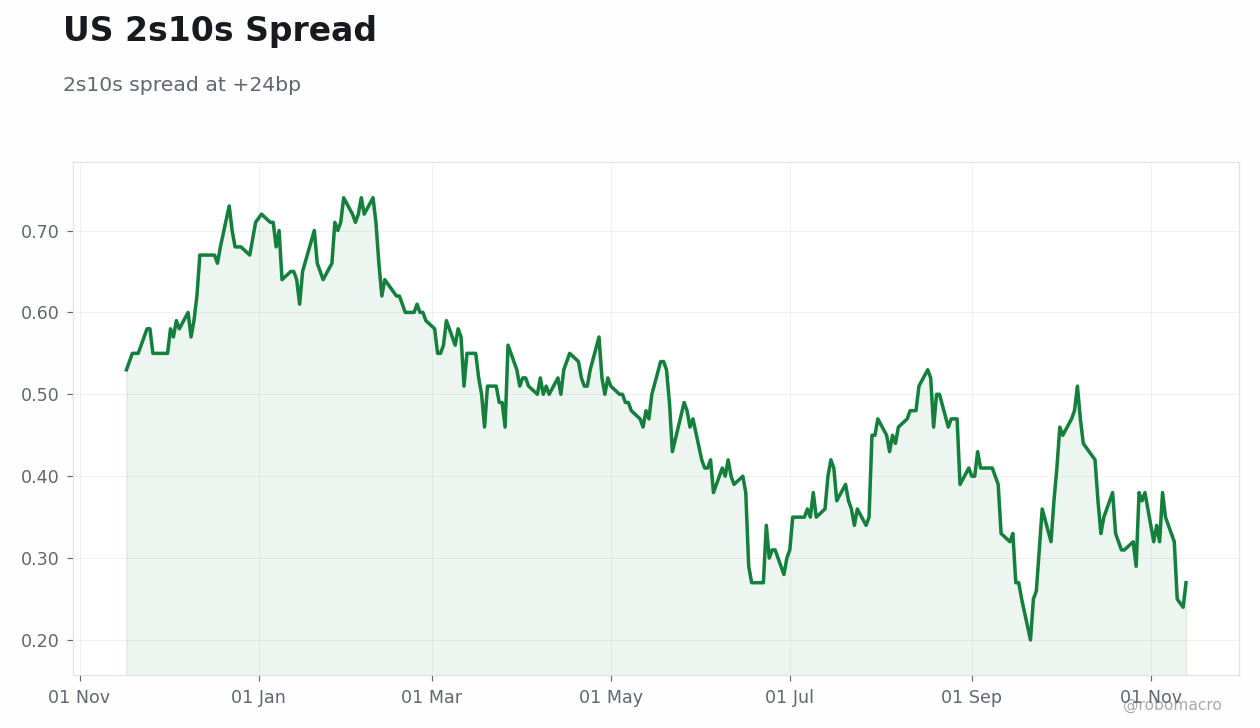
The U.S. 2s10s spread stood at +24bp, the German 2s10s at +26bp and the UK 2s10s at +35bp. These narrow positive spreads across the US, Germany and UK indicate tempered growth expectations. The flat curve shape suggests markets are anticipating slower economic activity ahead. Compared to the US and Germany, the UK curve is slightly steeper, implying relatively better growth prospects.

EM Bonds

Turkish 10-year yields stood at 36.44% after rising 52bp while Brazil 10-year yields reached 15.34%. South Africa 10-year yields increased to 8.68% and Indonesia 10-year yields fell 8bp to 7.61%. EM yields remain dramatically higher than DM levels, with Turkey's 36.44% and Brazil's 15.34% comparing to the U.S. 5.10% and Germany 3.38%, resulting in wide spread differentials. Turkey's 2s10s spread was -323bp, highlighting an inverted curve unlike the positive spreads in most DM markets.

Central Bank Read

The narrow U.S. 2s10s spread of +24bp implies an easing bias as markets price in eventual policy accommodation. Front-end rates rose faster than back-end with the 2-year yield up 28bp compared to 20bp for the 10-year. Similar dynamics were seen in Germany where the 2-year rose 14bp versus 12bp for the 10-year. The curve shape in the UK and Japan also implies an easing bias over time. Central bank communications remained data-dependent, consistent with the signals from the yield curves.

Week Ahead

Several key CPI/inflation prints, payrolls/jobs data, CB meetings for the Fed, ECB, BoE, and BoJ, as well as GDP releases and Treasury auctions are on the calendar next week. These data points will be critical for assessing duration risk. Inflation prints and labor market data from the US will matter most as they could influence the policy outlook significantly. Stronger than expected figures would likely lead to further pressure on bond prices.

RoboMacro AI Economic Research

Global Macro Watch

Week of November 9–13, 2026 robomacro.com
Markets in ReviewFixed Income
Global Government Bond Yields
Yields in %. WoW change in basis points, over the five trading sessions to the latest close. US tenors are Treasury constant-maturity yields (Federal Reserve); international tenors are benchmark government yields from public market data.
Country2Y2Y WoW10Y10Y WoW30Y30Y WoW2s10s
United States4.86%+28bp5.10%+20bp5.43%+15bp+24bp
United Kingdom4.98%+22bp5.34%+18bp5.79%+17bp+35bp
Germany3.12%+14bp3.38%+12bp3.74%+11bp+26bp
France3.63%+13bp4.92%+15bp5.47%+15bp+129bp
Italy3.54%+10bp4.44%+10bp5.02%+7bp+90bp
Spain3.23%+14bp3.94%+9bp4.45%+10bp+71bp
Japan1.88%+15bp2.86%+22bp4.01%+17bp+98bp
Canada3.36%+21bp3.86%+20bp4.16%+16bp+50bp
Australia4.92%+9bp5.14%+12bp5.59%+13bp+22bp
China1.23%+2bp1.62%+2bp2.07%+4bp+39bp
India6.91%+21bp7.31%+14bp7.75%+7bp+40bp
Brazil14.68%+3bp15.34%+16bp——+65bp
Mexico——9.31%+19bp———
South Korea3.76%+15bp4.00%+16bp4.07%+12bp+25bp
Indonesia——7.61%-8bp7.76%0bp—
Turkey39.67%+5bp36.44%+52bp——-323bp
South Africa——8.68%+24bp8.96%+22bp—
Poland——6.33%+16bp———

US Treasury yields surged, with the 2Y rising 28bp to 4.86% and the 10Y climbing 20bp to 5.10%. Turkey’s 10Y led advances with a 52bp jump to 36.44%. Indonesia’s 10Y eased 8bp to 7.61%, the sole notable decline. Steepening was pronounced in France where 2s10s widened 129bp, while Turkey’s curve flattened sharply by 323bp. UK and Canadian 2Y yields advanced 22bp and 21bp respectively, outpacing Germany’s 14bp gain. Divergences emerged as DM curves steepened broadly versus mixed EM moves. Japan 10Y rose 22bp to 2.86%, narrowing the gap with peers. Attention turns to next week’s inflation prints and supply for further direction.

RoboMacro AI Economic Research

Global Macro Watch

Week of November 9–13, 2026 robomacro.com
Markets in ReviewGlobal Equities
Global Equities Chart 1
Global Equities Chart 2
Global Equities Chart 3
Global Equities Chart 4

Week in Review

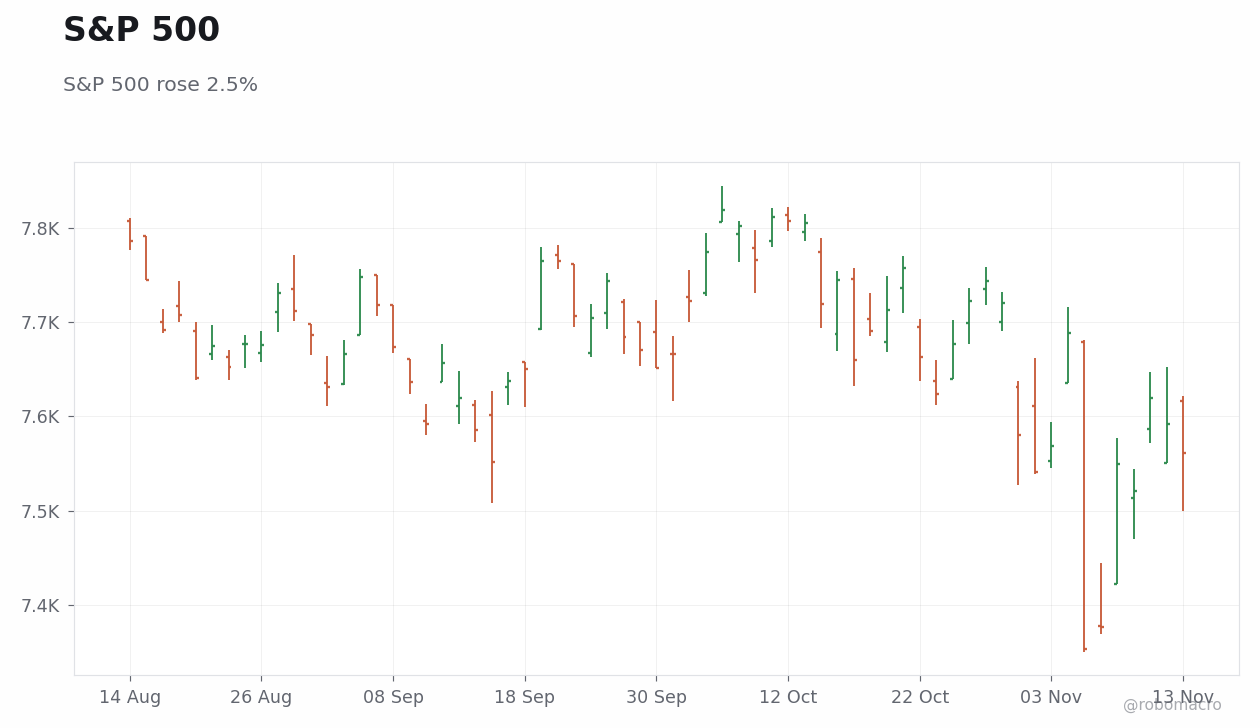
The S&P 500 rose 2.5% week-over-week to close at 7,562. The index opened the week at 7,550 on Monday, fell to 7,521 on Tuesday, then rebounded sharply to an intra-week high of 7,619 on Wednesday before closing at 7,562 on Friday. In Europe the Euro Stoxx 50 gained 3.5% to finish at 6,387, advancing steadily from 6,290 on Monday through 6,399 on Thursday. Asian markets diverged sharply, with the Nikkei 225 surging 6.5% to close at 61,142 after climbing from 58,776 on Monday. Emerging market equities were mixed, as the KOSPI rose 4.6% while the Hang Seng fell 3.5%, the Russell 2000 gained 1.3% to 2,790, and the Ibovespa advanced 2.4% to 172,458.

Regional Divergences

European benchmarks generally outpaced the United States, with the Euro Stoxx 50 up 3.5% versus the S&P 500’s 2.5% and the DAX leading regional gains at 3.6%. Japanese equities posted the strongest performance among major regions as the Nikkei 225 surged 6.5%, while Chinese markets lagged with the Hang Seng declining 3.5%. Within EM, the KOSPI’s 4.6% advance contrasted with more modest gains in the Nifty 50 at 0.5% and small declines in the JSE Top 40. These divergences aligned with macro catalysts including resilient labor and manufacturing data in Europe, domestic demand weakness in Japan that was overshadowed by risk appetite, stronger-than-expected US economic prints, and varied inflation and policy signals across Latin America.

Volatility & Risk Appetite

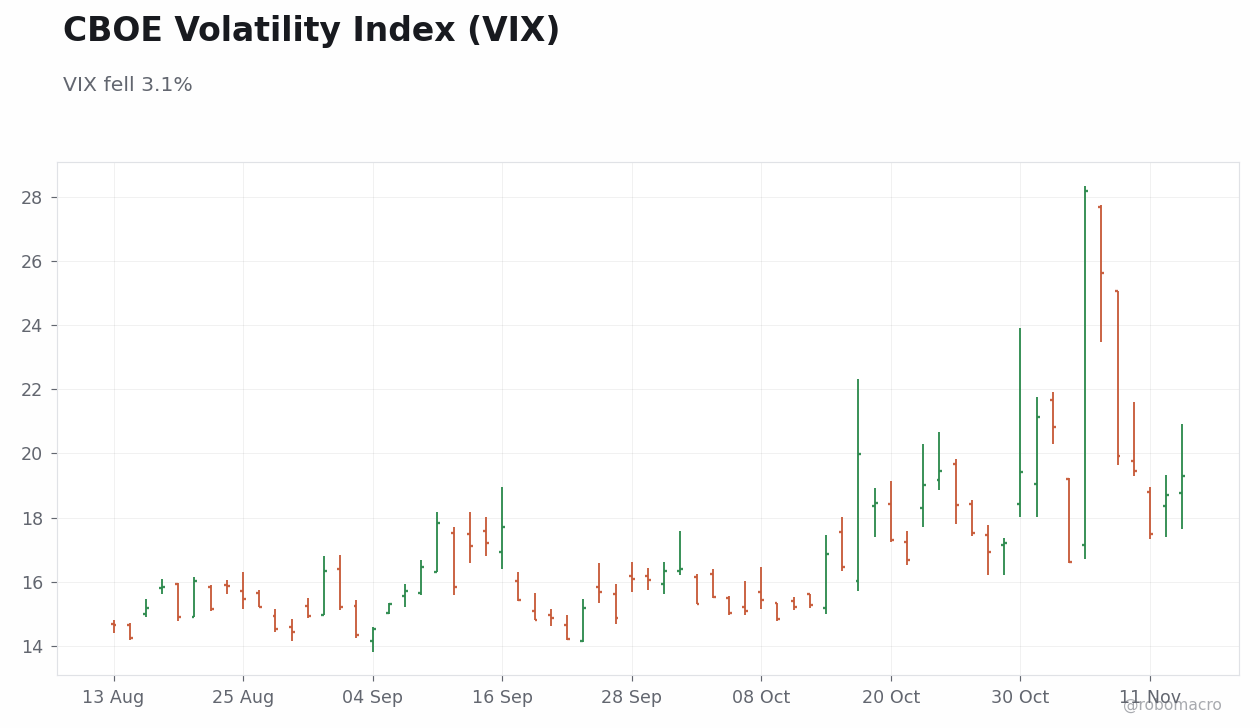
The VIX closed the week at 19.3 after moving from 19.9 on Monday to a low of 17.5 on Wednesday. Growth outperformed value, with the Nasdaq 100 rising 3.5% compared with the Dow Jones gain of 2.1%. Small caps lagged large caps as the Russell 2000 advanced 1.3% against the S&P 500’s 2.5% rise. Falling commodity prices, including WTI Crude declining 2.5% and gold falling 4.6%, pointed to selective pressure on resource-sensitive sectors even as broader equity indices advanced. Rising bond yields across major markets reinforced a backdrop of policy caution, yet risk appetite held as curves steepened directionally, implying expectations of differentiated growth and inflation paths ahead.

Week Ahead

The economic calendar next week is relatively light. Focus will center on earnings reports from major technology and financial names midweek. PMI releases in Europe and services data in the United States are scheduled, along with select central bank speakers. These events represent the biggest risk to equity markets, as hotter-than-expected inflation or softer activity prints could tilt sentiment toward risk-off, while resilient corporate results and steady PMIs would favor continued risk-on momentum.

RoboMacro AI Economic Research

Global Macro Watch

Week of November 9–13, 2026 robomacro.com
Markets in ReviewGlobal Equities
Global Equity Indices
Week-on-week, month-to-date, year-to-date. WoW is the change over the seven calendar days to the latest close. Source: public market data.
IndexLevelWoWMTDYTD
S&P 5007,562+2.5%+0.3%+10.2%
Nasdaq 10027,944+3.5%-0.2%+10.9%
Dow Jones52,348+2.1%+0.7%+8.2%
Russell 20002,790+1.3%-0.6%+11.2%
S&P/TSX36,106+0.9%+0.8%+13.2%
FTSE 10010,903+2.1%+1.3%+9.6%
Euro Stoxx 506,387+3.5%+3.4%+7.8%
DAX26,750+3.6%+3.0%+9.0%
CAC 408,369+2.8%+4.0%+2.1%
FTSE MIB51,859+3.6%+3.8%+14.3%
IBEX 3520,020+3.4%+5.6%+14.4%
Nikkei 22561,142+6.5%-3.1%+18.0%
Hang Seng23,638-3.5%+1.0%-10.2%
S&P/ASX 2009,082+0.7%+2.5%+4.1%
KOSPI5,291+4.6%-9.7%+22.8%
Nifty 5025,144+0.5%+7.3%-3.8%
Ibovespa172,458+2.4%+4.2%+7.4%
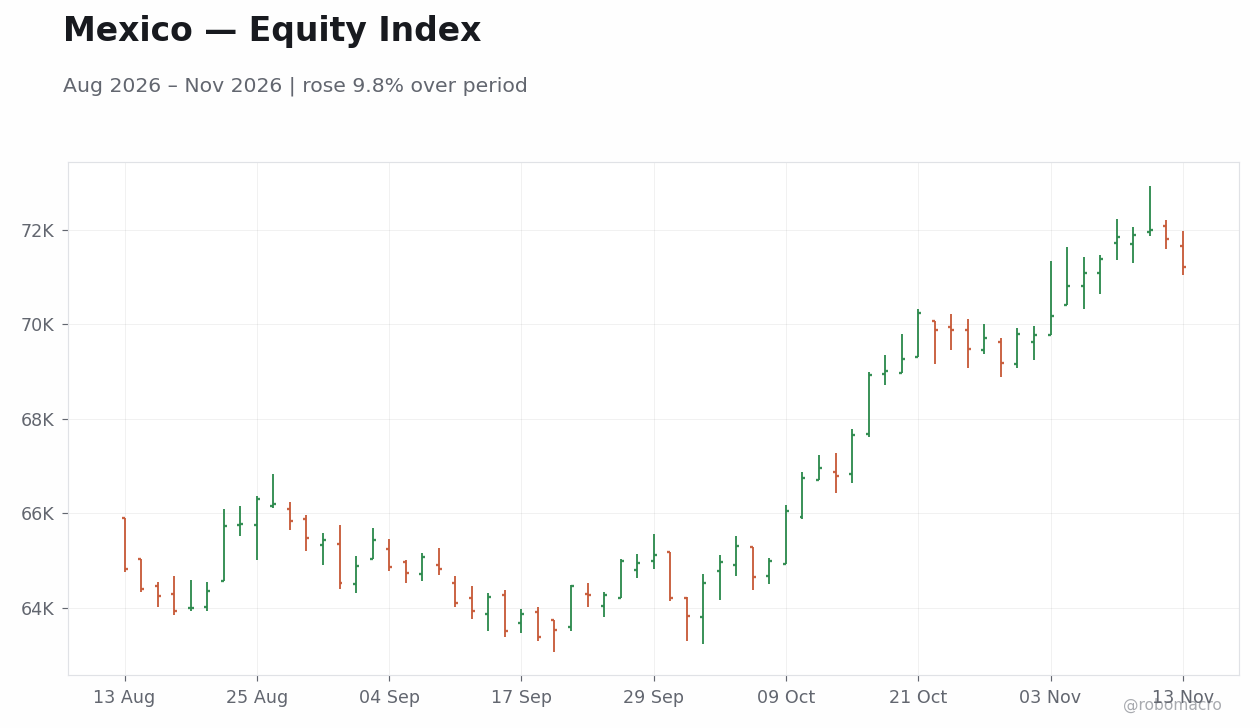
IPC Mexico71,205-0.3%+1.4%+11.0%
JSE Top 40104,487-0.2%+3.0%-3.5%

Global equities rose across most major markets, with the Nikkei 225 surging 6.5% and the KOSPI advancing 4.6%. The Nasdaq 100 gained 3.5% to 27,944 while the S&P 500 added 2.5% to 7,562. European indices outperformed, as the DAX and FTSE MIB each climbed 3.6% and the Euro Stoxx 50 rose 3.5%. The Hang Seng fell 3.5%, marking the week’s largest decline. The FTSE 100 and Dow Jones both advanced 2.1%, while the Russell 2000 lagged with a 1.3% gain. The CAC 40 and IBEX 35 posted respective increases of 2.8% and 3.4%. Next week, attention centers on fresh inflation data and central-bank speeches for further direction.

Equity Performance Heat Map
IndexWoWMTDYTD
S&P 500+2.5%+0.3%+10.2%
Nasdaq 100+3.5%-0.2%+10.9%
Dow Jones+2.1%+0.7%+8.2%
Russell 2000+1.3%-0.6%+11.2%
S&P/TSX+0.9%+0.8%+13.2%
FTSE 100+2.1%+1.3%+9.6%
Euro Stoxx 50+3.5%+3.4%+7.8%
DAX+3.6%+3.0%+9.0%
CAC 40+2.8%+4.0%+2.1%
FTSE MIB+3.6%+3.8%+14.3%
IBEX 35+3.4%+5.6%+14.4%
Nikkei 225+6.5%-3.1%+18.0%
Hang Seng-3.5%+1.0%-10.2%
S&P/ASX 200+0.7%+2.5%+4.1%
KOSPI+4.6%-9.7%+22.8%
Nifty 50+0.5%+7.3%-3.8%
Ibovespa+2.4%+4.2%+7.4%
IPC Mexico-0.3%+1.4%+11.0%
JSE Top 40-0.2%+3.0%-3.5%
RoboMacro AI Economic Research

Global Macro Watch

Week of November 9–13, 2026 robomacro.com
Markets in ReviewFX & Digital Assets
FX & Digital Assets Chart 1
FX & Digital Assets Chart 2
FX & Digital Assets Chart 3
FX & Digital Assets Chart 4

Week in Review

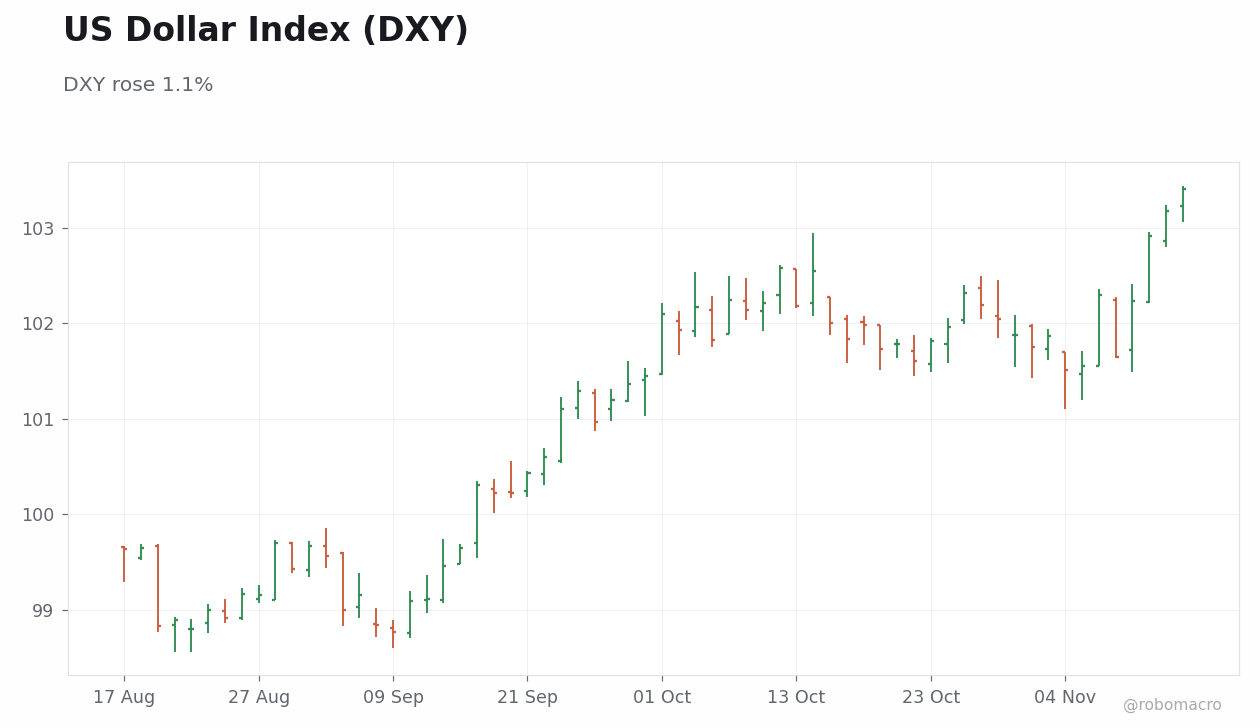
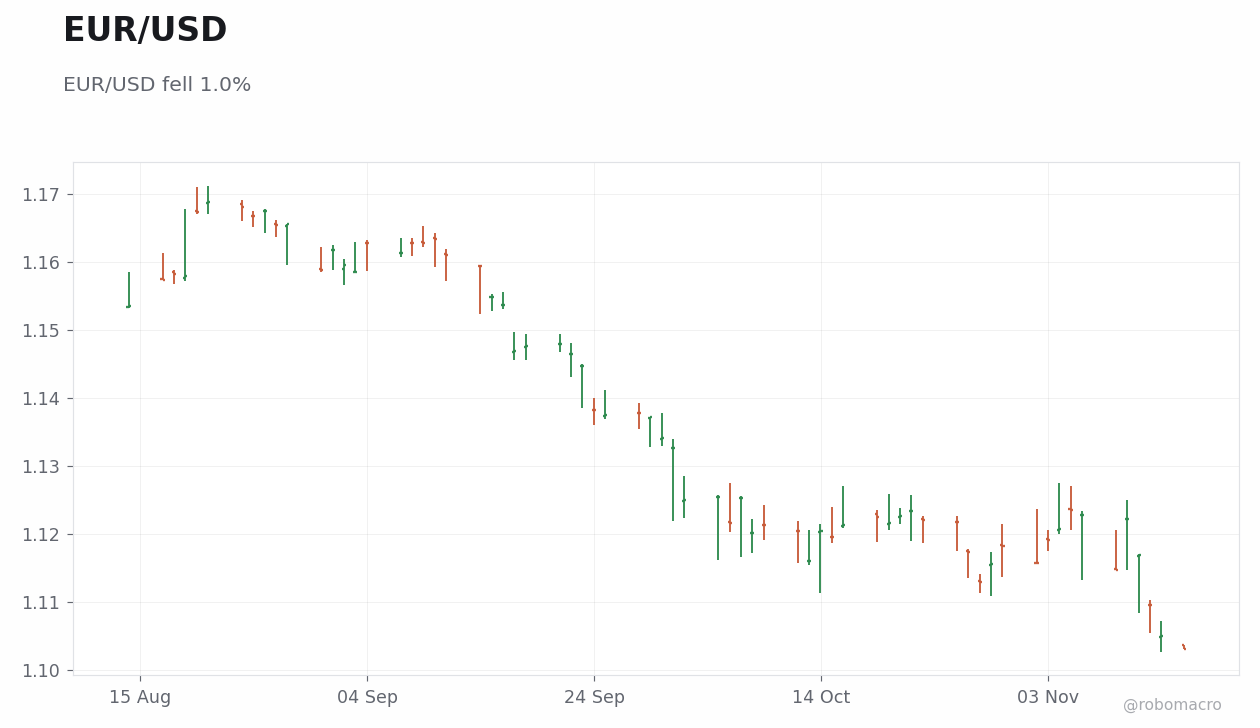
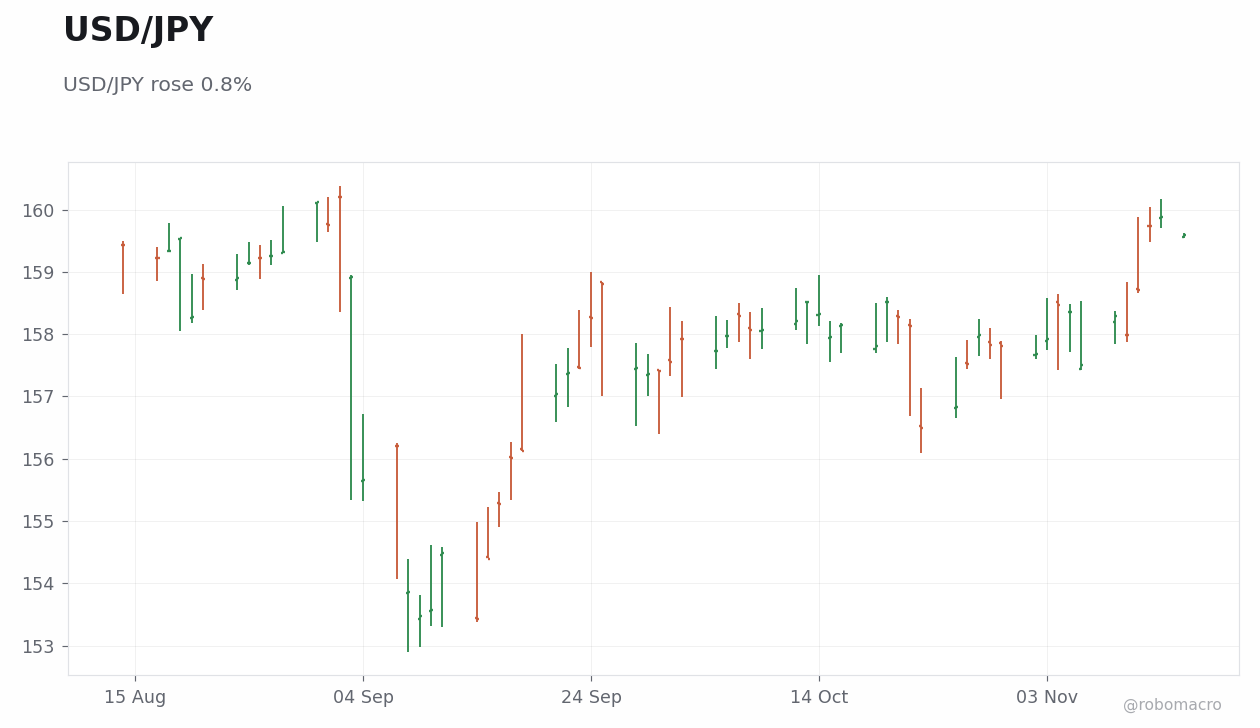
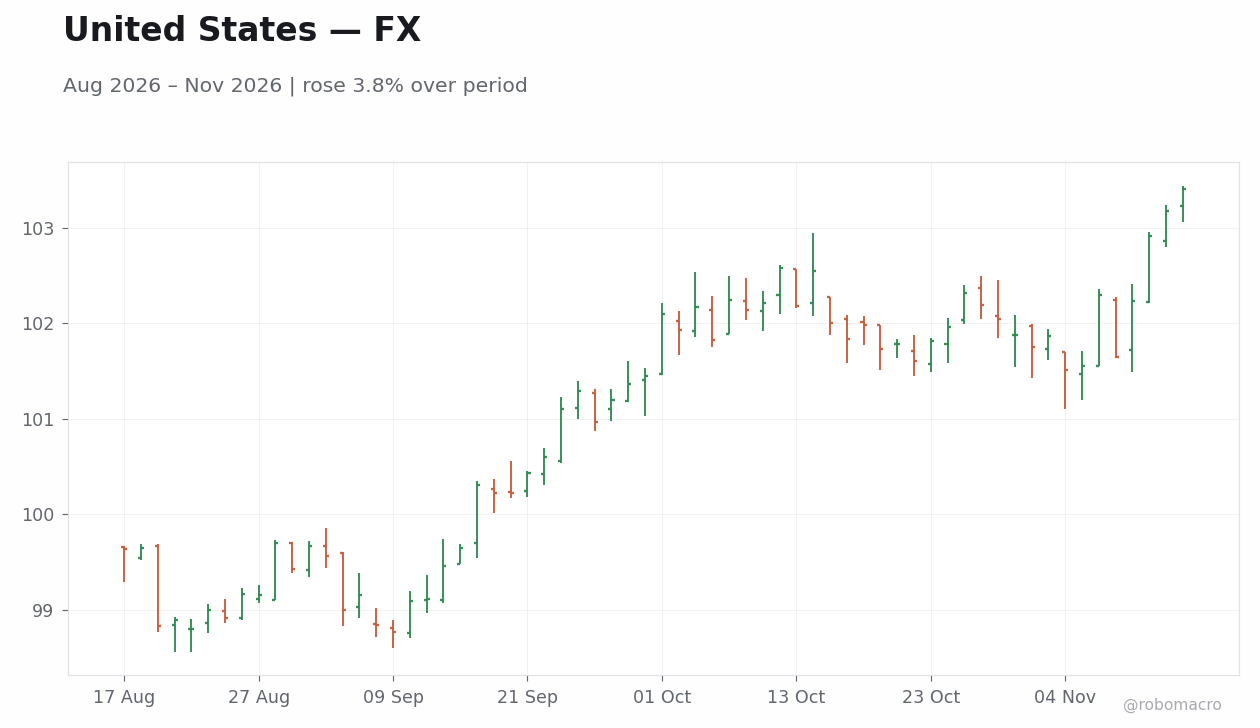
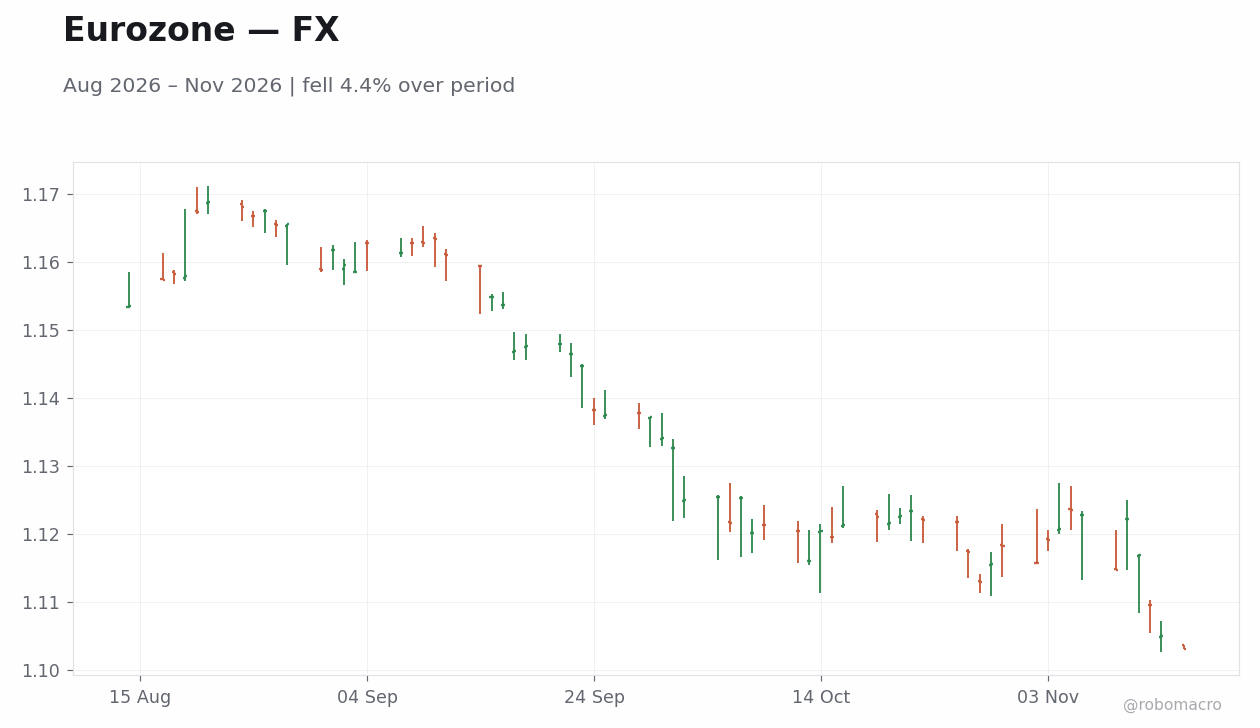
The DXY rose 1.1% week-over-week to 103.41. The index climbed from 102 on Tuesday to 103 on Wednesday and remained at 103 through Friday. EUR/USD fell 1.0% to 1.1031 after climbing to 1.1222 on Tuesday before sliding through closes of 1.1169, 1.1095 and 1.1050. GBP/USD declined 1.0% to 1.3223 while USD/JPY gained 0.8% to 159.59. In EM currencies, USD/BRL surged 2.5% to 5.6408, USD/ZAR rose 2.4% to 16.93, USD/MXN eased 0.6% to 18.52, USD/TRY edged 0.4% higher to 50.35 and USD/CNY was nearly unchanged at 6.6705.

Dollar & G10

Stronger-than-expected US data widened rate differentials in favor of the dollar, lifting shorter-dated yields more than peers in Europe and Japan and reinforcing dollar strength. EUR/USD closed the week at 1.1031 after its 1.0% decline. GBP/USD ended at 1.3223, likewise down 1.0% week-over-week. USD/JPY advanced to 159.59, posting an 0.8% gain as the yen underperformed amid divergent yield moves.

EM FX

EM currencies were mixed against the dollar. USD/BRL jumped 2.5% to 5.6408 and USD/ZAR climbed 2.4% to 16.93, reflecting commodity price weakness and yield differential pressure. USD/MXN fell 0.6% to 18.52 despite local inflation surprises, while USD/TRY rose 0.4% to 50.35. USD/CNY ticked 0.1% lower to 6.6705 as selective EM yield widening failed to generate uniform dollar buying.

Bitcoin & Crypto

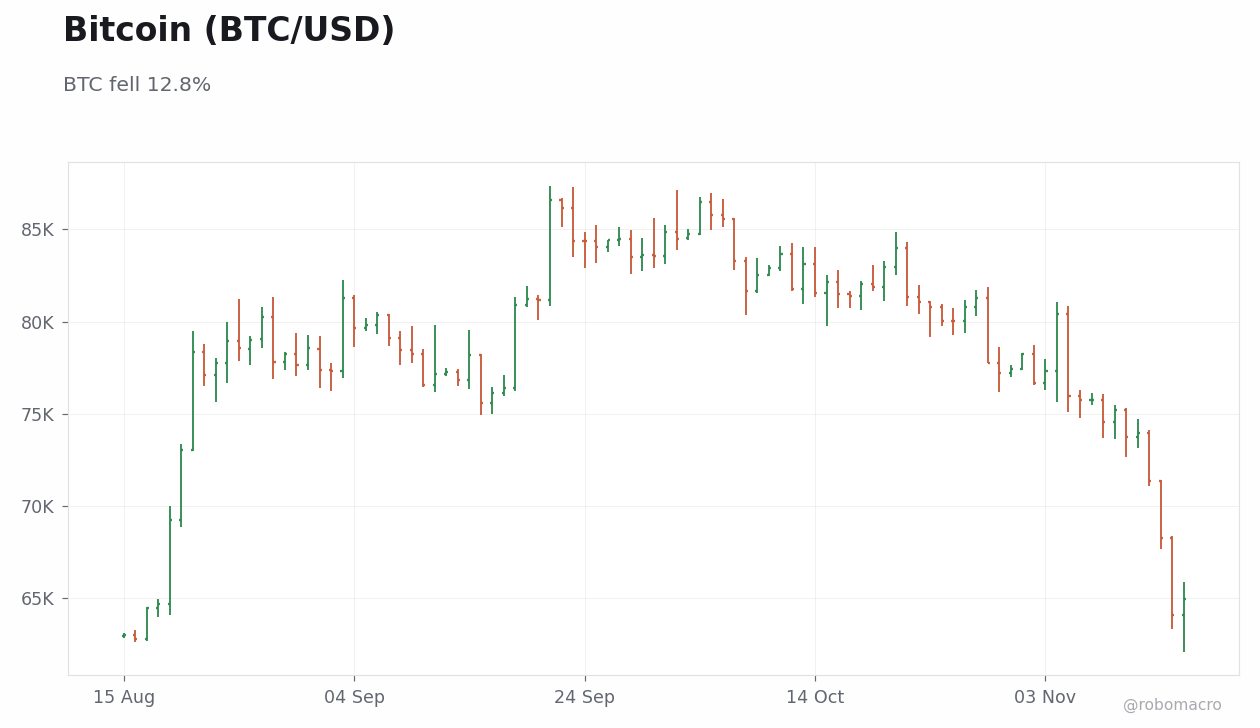
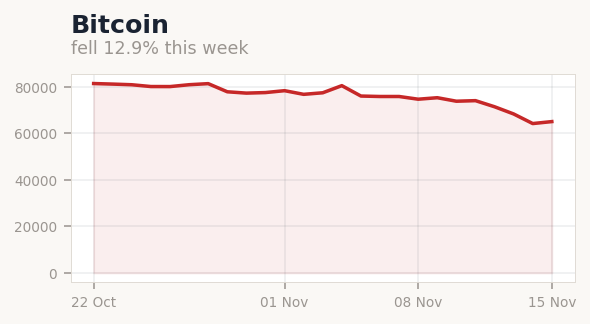
Bitcoin fell 12.8% on the week to $65,002. Prices dropped steadily from 73,964 on Wednesday to 71,343 on Thursday, 68,249 on Friday and 64,128 on Saturday. Ethereum declined 14.2% to $1,821. Solana posted a 16.6% drop to $72 while XRP fell 13.4% to $0.9619, underscoring broad risk aversion across digital assets as equity and crypto markets decoupled from dollar strength.

Week Ahead

Next week offers a light economic calendar with no major central bank rate decisions or high-impact CPI and payrolls releases listed. Trade balance data for select EM economies could influence FX positioning, though specific country releases are limited. Markets will remain focused on data-dependent central bank communications. No crypto regulatory events, ETF deadlines or protocol upgrades appear in the provided calendar.

RoboMacro AI Economic Research

Global Macro Watch

Week of November 9–13, 2026 robomacro.com
Markets in ReviewCommodities
Commodities Chart 1
Commodities Chart 2
Commodities Chart 3
Commodities Chart 4

Week in Review

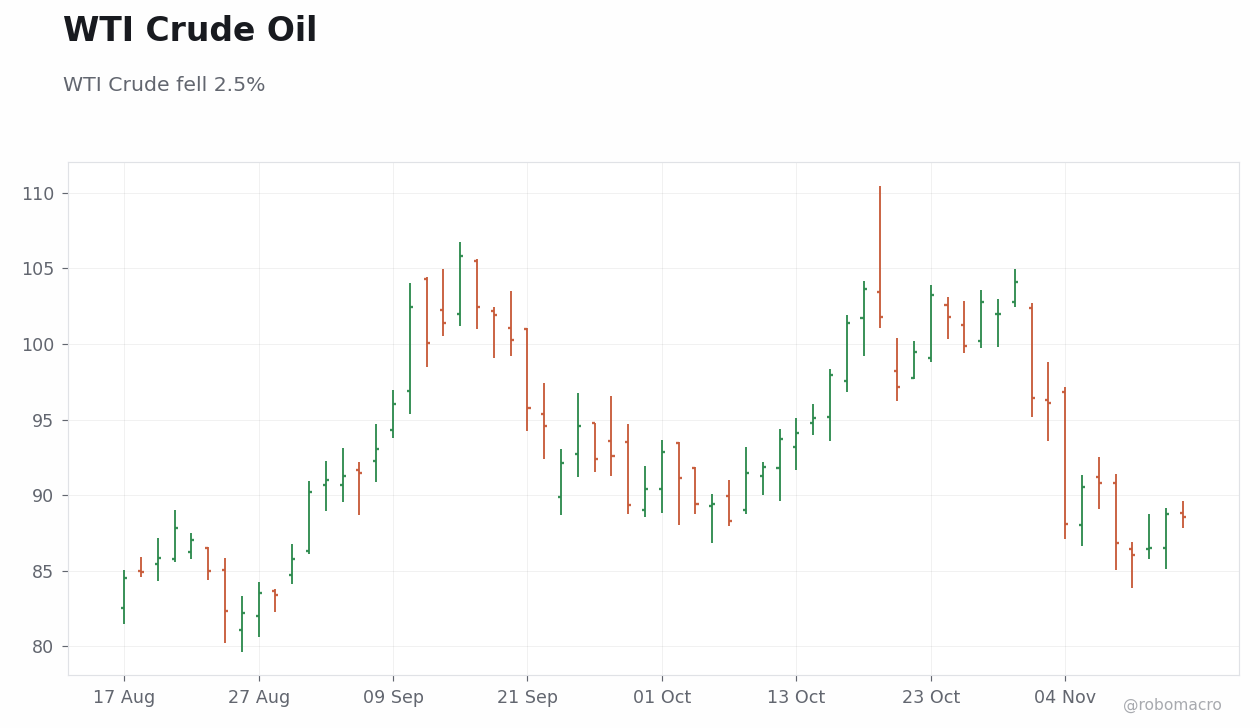
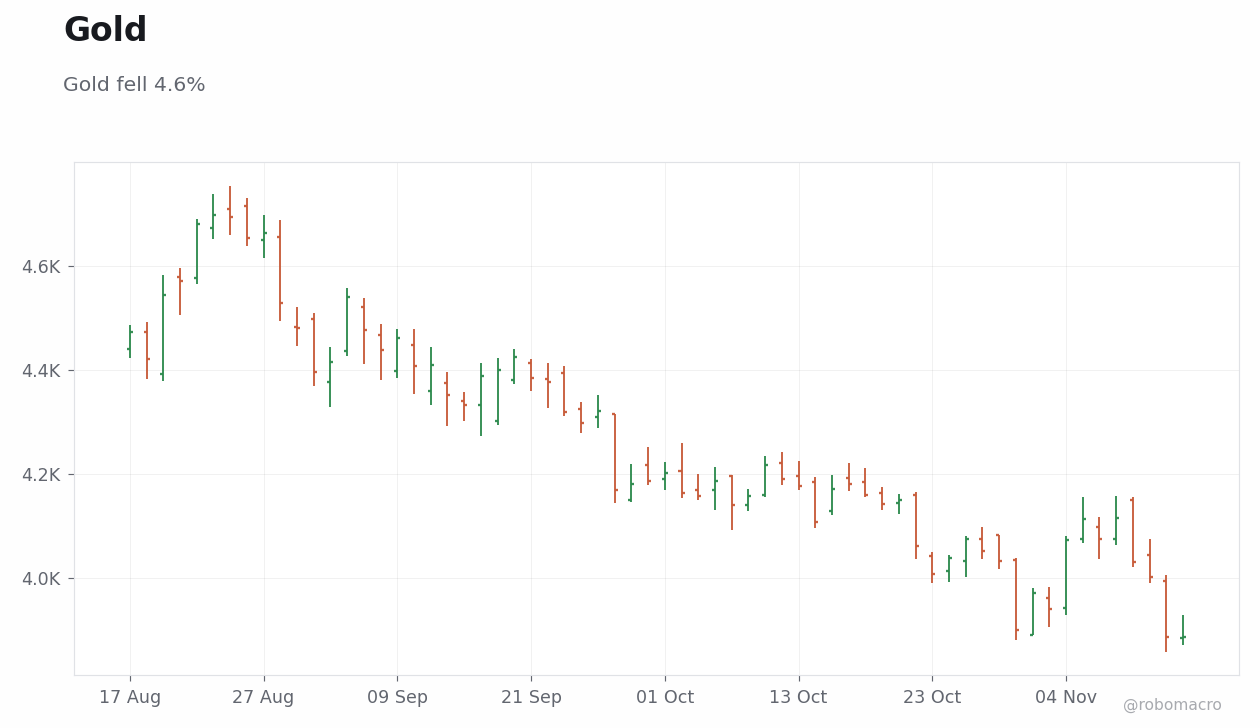
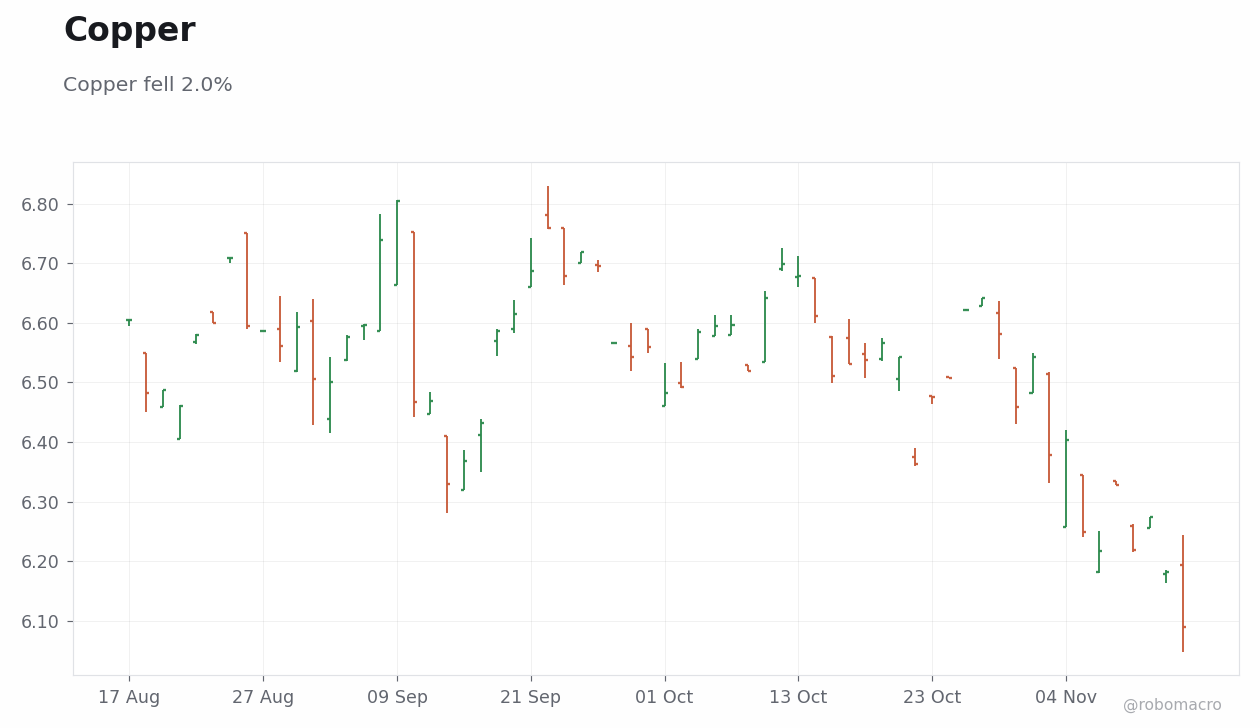
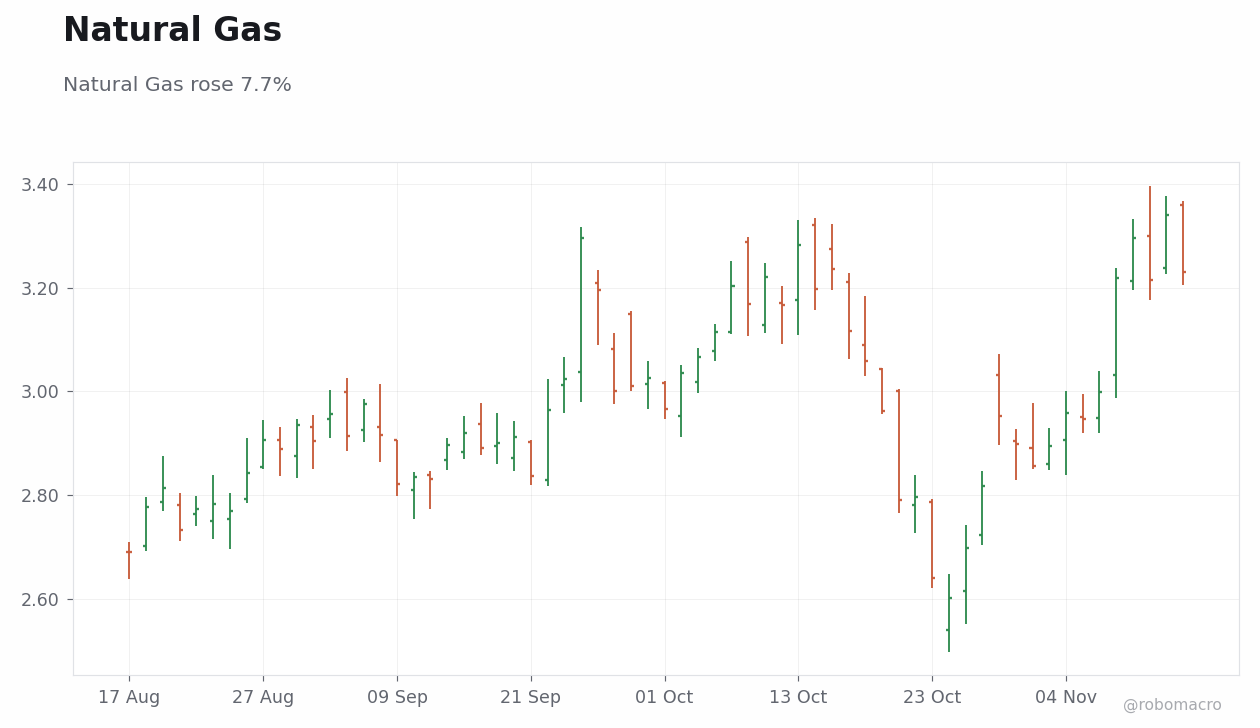
Natural Gas was the biggest mover, rising 7.7% week-over-week to 3.23. Energy markets otherwise retreated, with WTI Crude falling 2.5% to 88.56 and Brent Crude declining 2.5% to 95.84. Daily closes showed WTI Crude rising from 86.0 on Tuesday to 86.5 on Wednesday and 88.7 on Thursday before closing at 88.6 on Friday. In metals, Gold fell 4.6% to 3886.30 while Silver dropped 5.2% to 49.12, with daily closes for Gold moving from 4,030 on Tuesday to 4,000 on Wednesday, 3,885 on Thursday and 3,886 on Friday. Copper declined 2.0% to 6.09, signaling softer industrial demand, while Wheat advanced 0.3% to 593.25. The commodities complex ended the week mixed, with precious metals under pressure and natural gas diverging higher.

Energy Complex

WTI Crude settled at 88.56, down 2.5% on the week, while Brent Crude ended at 95.84, also down 2.5%. Natural Gas rose 7.7% to 3.23, with daily closes reflecting swings from 3.2960 on Tuesday to 3.2150 on Wednesday, 3.3400 on Thursday and 3.2300 on Friday. Oil prices edged higher at points but were set for a second weekly decline in a row as Washington’s focus on blockading Iran and ramping up other economic pressures allayed fears of renewed direct conflict. Geopolitical narratives around West Asia remained central to sentiment even as supply concerns eased modestly. The energy complex thus closed with divergent performance between crude and natural gas.

Metals & Ags

Gold closed at 3886.30 after falling 4.6% while Silver finished at 49.12, down 5.2%. Silver’s larger decline pushed the gold-silver ratio higher as the two metals responded to tightening expectations. Daily closes for Silver showed movement from 51.1 on Tuesday to 51.9 on Wednesday before falling to 50.0 on Thursday and 49.1 on Friday. Copper, a key growth signal, fell 2.0% to 6.09 and 6.9% month-to-date, pointing to softening industrial momentum. Wheat proved resilient by comparison, rising 0.3% to 593.25. Inflation data and West Asia tensions are expected to keep bullion markets volatile in coming sessions.

Week Ahead

The economic calendar for the coming week contains no commodity-relevant events. There are no EIA crude or gas inventories, OPEC meetings, China PMI or industrial production releases, US CPI prints, or central bank meetings affecting commodity currencies such as CAD, AUD or BRL listed. In the absence of scheduled data, non-calendar risks will dominate, including geopolitical developments in West Asia, potential weather impacts on natural gas demand, and any OPEC diplomacy. Market participants will therefore monitor these factors for directional cues across the complex.

RoboMacro AI Economic Research

Global Macro Watch

Week of November 9–13, 2026 robomacro.com
Markets in ReviewFX, Commodities & Crypto
Foreign Exchange
Week-on-week, month-to-date, year-to-date. WoW is the change over the seven calendar days to the latest close. Source: public market data.
PairLevelWoWMTDYTD
DXY103.41+1.1%+1.6%+5.1%
EUR/USD1.1031-1.0%-1.1%-6.1%
GBP/USD1.3223-1.0%-1.2%-1.9%
USD/JPY159.59+0.8%+1.2%+1.8%
AUD/USD0.6781-1.3%-3.5%+1.5%
NZD/USD0.5535-0.4%-1.6%-3.9%
USD/CAD1.4267+1.1%+2.1%+4.0%
USD/CHF0.8381+2.3%+1.6%+5.8%
USD/CNY6.6705-0.1%+0.1%-4.7%
USD/BRL5.6408+2.5%+3.8%+2.2%
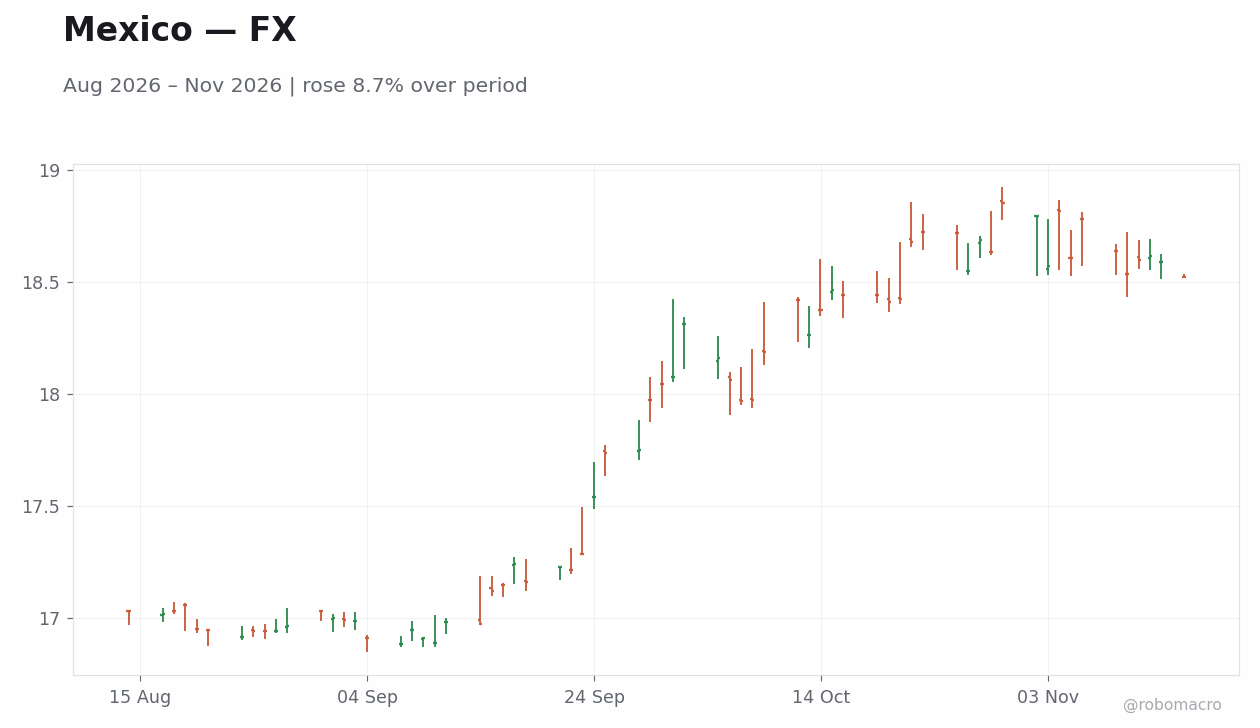
USD/MXN18.52-0.6%-1.5%+3.0%
USD/INR94.23+0.3%-0.7%+4.7%
USD/ZAR16.93+2.4%+1.5%+2.3%
USD/TRY50.35+0.4%+0.8%+17.1%
Commodities
Week-on-week, month-to-date, year-to-date. WoW is the change over the seven calendar days to the latest close. Source: public market data.
CommodityLevelWoWMTDYTD
WTI Crude88.56-2.5%-8.2%+54.5%
Brent Crude95.84-2.5%-8.5%+57.8%
Gold3886.30-4.6%-2.1%-10.2%
Silver49.12-5.2%-3.1%-30.4%
Copper6.09-2.0%-6.9%+8.0%
Natural Gas3.23+7.7%+13.1%-10.7%
Wheat593.25+0.3%-2.2%+17.1%
Iron Ore91.48-1.3%+0.2%-14.6%
Crypto Assets
Week-on-week, month-to-date, year-to-date. WoW is the change over the seven calendar days to the latest close. Source: public market data.
AssetLevelWoWMTDYTD
Bitcoin$65,002-12.8%-16.9%-26.7%
Ethereum$1,821-14.2%-19.9%-39.3%
Solana$72-16.6%-23.9%-43.3%
XRP$0.9619-13.4%-23.0%-48.8%

The dollar index climbed 1.1% to 103.41, extending its YTD gain to 5.1%. USD/CHF surged 2.3%, while USD/BRL and USD/ZAR rose 2.5% and 2.4%. EUR/USD and GBP/USD each declined 1.0% to 1.1031 and 1.3223, with AUD/USD falling 1.3% to 0.6781. USD/JPY added 0.8% to 159.59, while USD/MXN eased 0.6% to 18.52 and USD/CNY slipped 0.1%. USD/CAD gained 1.1% to 1.4267, contrasting with more contained moves in USD/TRY and USD/INR. The broad USD bid highlighted divergences across G10 and EM crosses. Next week, attention turns to fresh inflation data and central-bank speeches for signs of policy divergence.

RoboMacro AI Economic Research

Global Macro Watch

Week of November 9–13, 2026 robomacro.com
United States
Market Scorecard
AssetLevelWoW
S&P 5007561.67+0.2%
Nasdaq 10027943.74+0.1%
Dow Jones52347.55-0.1%
Russell 20002790.49-1.8%
USD/JPY159.54+0.8%
EUR/USD1.1-1.0%
GBP/USD1.32-1.0%
Gold3886.3-5.5%
WTI Crude88.56+2.0%
Bitcoin65051.02-12.8%
Chart 1
Chart 2
Chart 3
Chart 4
  • October nonfarm payrolls rose more than expected, lifting the 2-year Treasury yield on November 9.
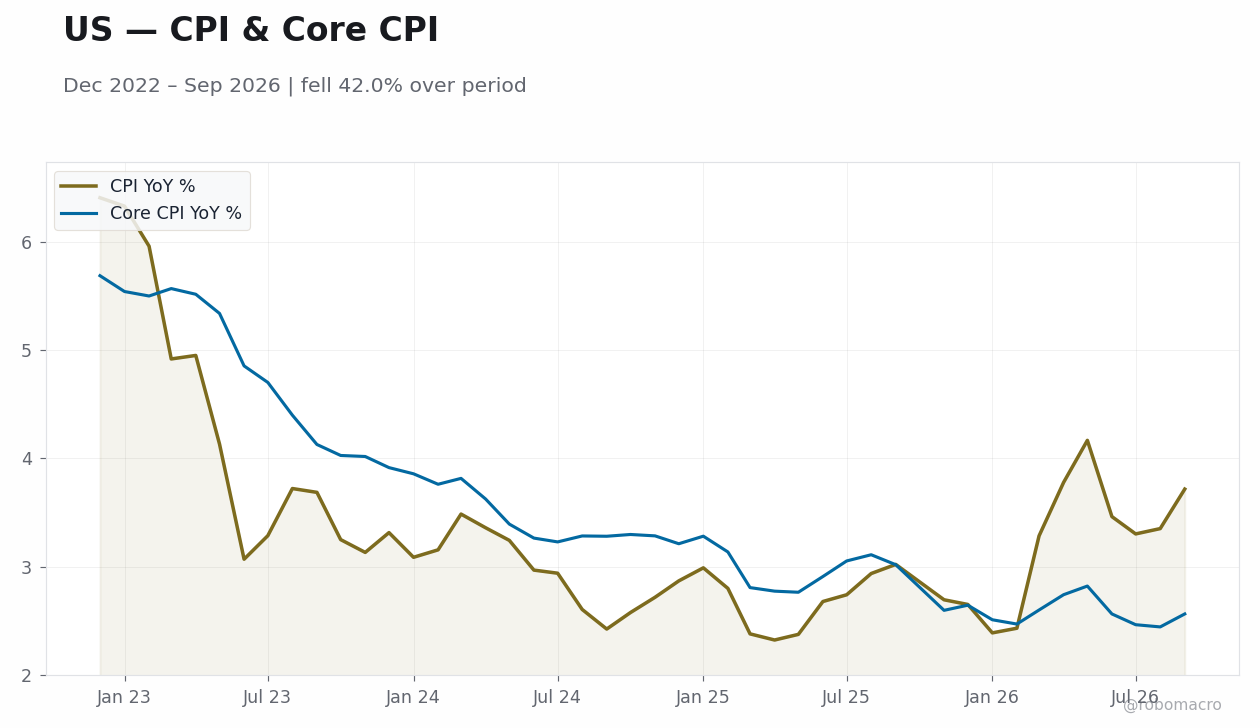
  • October CPI printed higher than consensus, with core also exceeding expectations and pushing the 10-year yield higher midweek.
  • Fed Governor Waller stated support for a 25 bp hike in December and openness to a larger move if inflation fails to slow.
  • The S&P 500 ended the week at 7561.67, up 0.16% week-over-week, while gold fell 5.55% to 3886.30 amid the yield surge.

Week in Review

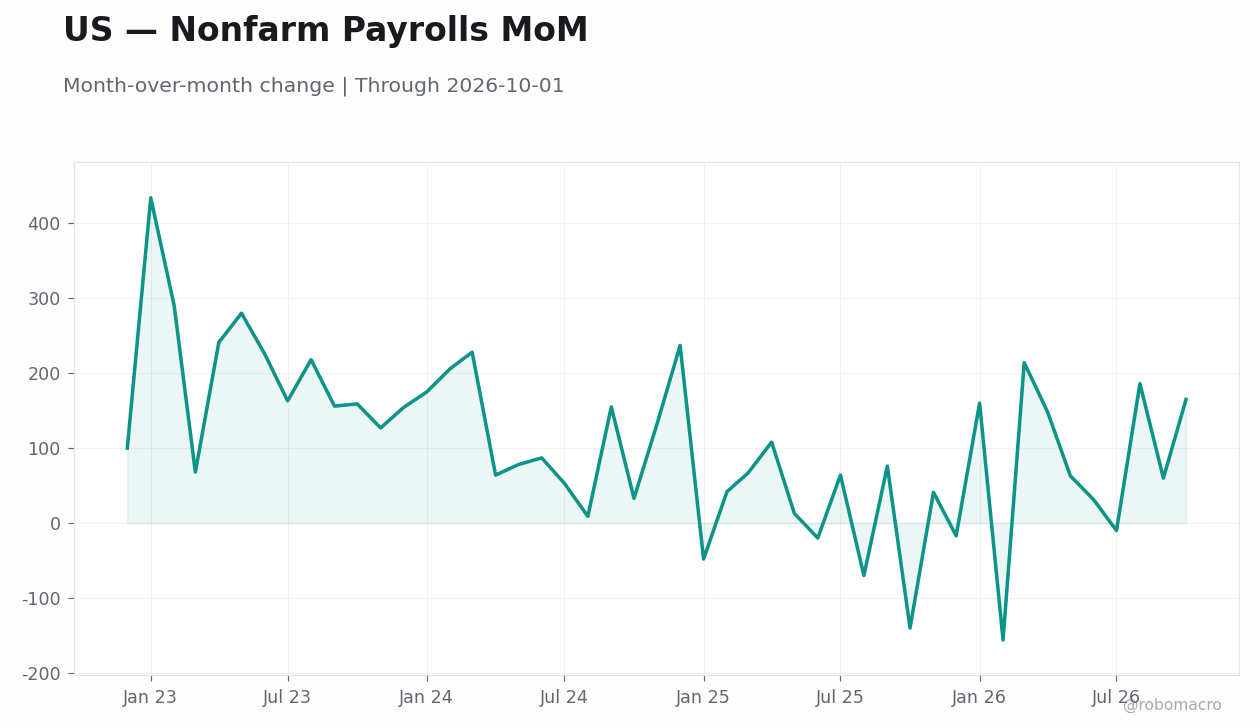
Labor Market Shows Resilience October nonfarm payrolls rose more than expected. ADP employment change increased from the prior reading. Initial jobless claims came in below consensus on November 12. These prints reinforced the view of sustained hiring momentum into mid-November.

Inflation Data Surprises Higher October CPI rose more than consensus. Core CPI advanced more than expected. Producer prices followed with a smaller gain than forecast on November 13. The sequence kept inflation on a firm trajectory after the prior month’s headline increase.

Fed Communications Turn Hawkish Governor Waller explicitly flagged the possibility of a larger move if price pressures persist. Chicago Fed President Goolsbee warned that AI data-center buildout is overheating the economy. Richmond Fed President Barkin and Governor Bowman also spoke during the week, maintaining data-dependent language without softening prior guidance.

Cross-Asset Reaction Remains Contained Equities absorbed the CPI surprise with limited net downside, while the 2-year yield climbed on November 11. The configuration left the policy rate path tethered to incoming prints rather than immediate repricing.

Fed Watch

Governor Waller stated he would support a 25 bp hike in December and argued policymakers should weigh a larger move if inflation fails to slow. Chicago Fed President Goolsbee described the AI data-center buildout as overheating the economy, a notably hawkish framing from a typically dovish voice. Governor Bowman and Richmond Fed President Barkin delivered multiple speeches that kept the committee’s reaction function explicitly data-dependent. The October CPI upside surprise reinforced the case for maintaining the current policy rate setting into year-end. No shift in forward guidance emerged from the week’s communications. The combination of resilient payrolls and sticky core inflation keeps the medium-term rate path biased toward further tightening rather than easing. Markets therefore price a higher terminal rate than the path signaled after the September decision.

Data Review

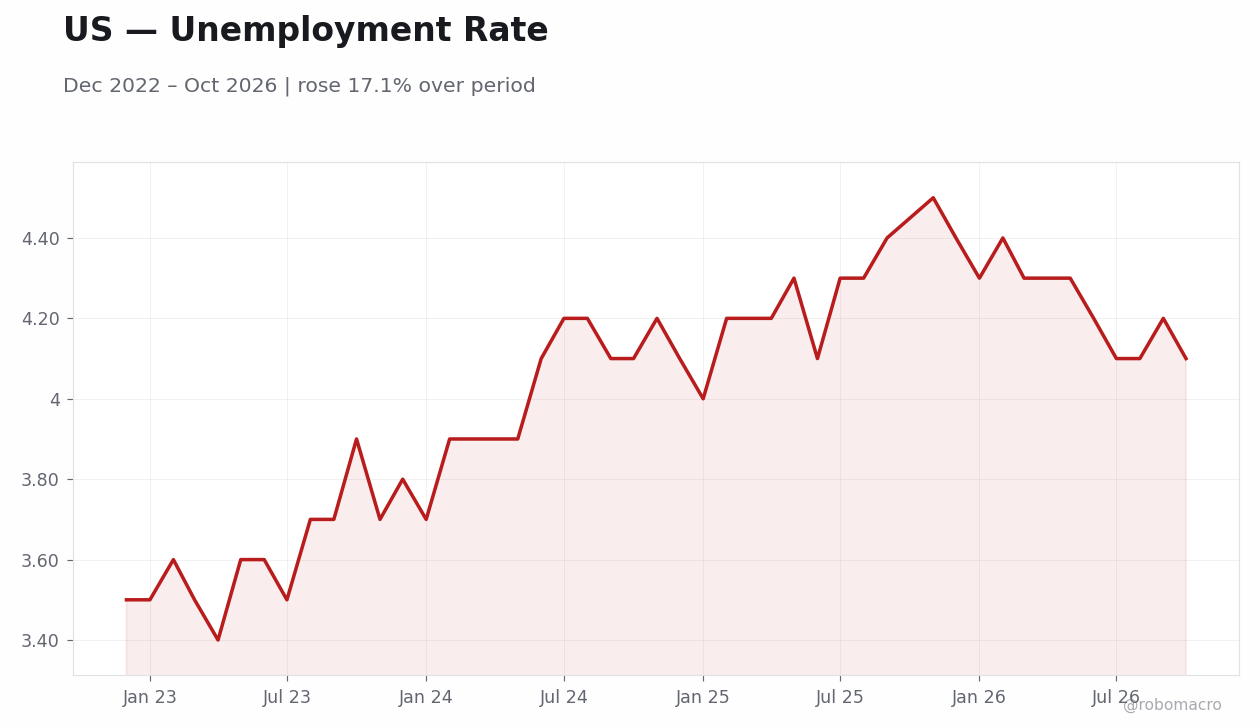
October nonfarm payrolls beat consensus and coincided with a drop in the unemployment rate. ADP weekly employment change rose from the prior reading, confirming labor demand resilience. October CPI delivered a clear upside surprise on both headline and core measures, exceeding forecasts. The seasonally adjusted CPI level advanced from the prior reading. Producer prices printed below consensus, while core PPI matched expectations. Existing home sales printed below consensus. Weekly jobless claims came in below forecast. These releases collectively point to a mid-cycle environment where growth remains above stall speed and inflation stays sticky, keeping the Federal Reserve on a restrictive footing. The data flow supports a slower descent in the policy rate than markets had previously embedded after the September move.

RoboMacro AI Economic Research

Global Macro Watch

Week of November 9–13, 2026 robomacro.com
Data Review: Actual vs Consensus
DateCtryEventPrior Cons.Actual
Mon 9USSpeech by Fed's Bowman---
Mon 9USFed Goolsbee Speech---
Mon 9USCb Employment Trends Index108-108
Mon 9USWholesale Inventories Mont0.600.600.70
Mon 9USWholesale Sales Month-over2.0-2.8
Mon 9USNy Fed Bill Purchases 1 To---
Mon 9USConsumer Inflation Expecta3.9-3.9
Mon 9US3-Month Treasury Bill Auct4.04.14.1
Mon 9US6-Month Treasury Bill Auct4.2-4.1
Mon 9USAtlanta Fed GDPNow3.4-3.5
Mon 9USSpeech by Fed's Barkin---
Mon 9USSpeech by Fed's Bowman---
Mon 9USAtlanta Fed GDPNow3.4-3.5
Mon 9US3-Year Treasury Note Aucti4.9-4.6
Week Ahead: Key Releases
DateReleasePriorCons.
2026-11-16Speech by Fed's Barr--
2026-11-16NY Empire State Manufacturing Index25.5-
2026-11-16Speech by Fed's Williams--
2026-11-16Fed Chair Warsh Speech--
2026-11-16Speech by Fed's Barkin--
2026-11-17Speech by Fed's Musalem--
2026-11-17ADP Employment Change Weekly20K-
2026-11-17Retail Sales Month-over-Month0.800
2026-11-17Export Prices Month-over-Month2.2-
2026-11-17Import Prices Month-over-Month1.1-
Chart 5
Chart 6
Chart 7
Chart 8

The Week Ahead

Monday brings the Swiss GDP flash estimate and Turkish budget balance, both of which will color global risk sentiment ahead of U.S. data. Tuesday features the Indian WPI inflation release, which often influences commodity-linked flows into U.S. assets. Wednesday includes the U.S. EIA crude inventory update and additional Fed speakers including Collins and Logan. Thursday carries the U.S. initial jobless claims print and existing-home-sales revision, both of which will test whether labor-market cooling has resumed. Friday rounds out the week with the University of Michigan sentiment reading and further Fed commentary from Daly and Williams. These releases will directly inform the December 9 FOMC reaction function. Any further upside surprise in inflation proxies would widen the gap between current policy and market expectations. Central-bank speakers remain the dominant flow driver given the light Tier-1 calendar.

Risks & Themes

The week’s data shift the outlook toward a higher-for-longer policy rate, reducing the probability of near-term cuts. Upside inflation scenarios now carry greater weight after the CPI print. Positioning appears crowded in the rates-up direction, with the 2-year yield having risen sharply in a single session. Volatility remains elevated as equity dispersion across regions persists from the prior week. Flow considerations favor selective domestic resilience over broad risk-on exposure. Market mispricing signals are most visible in the gold market, which fell sharply despite geopolitical tensions. The configuration leaves room for a sharp reversal if subsequent data soften.

Cross-Asset

The S&P 500 rose 0.16% week-over-week to close at 7561.67, while the Nasdaq 100 gained 0.13% to 27943.74. The Dow Jones slipped 0.08% to 52347.55 and the Russell 2000 fell 1.77% to 2790.49. The 2-year Treasury yield ended higher after rising as much as 17 bp intraday on November 11, and the 10-year yield rose on the week. USD/JPY advanced 0.79% to 159.54, while EUR/USD declined 1.04% to 1.10 and GBP/USD fell 1.03% to 1.32. Gold dropped 5.55% to 3886.30 and WTI crude rose 1.97% to 88.56. Bitcoin fell 12.78% to 65051.02. The moves reflected a classic rates-up, risk-on mix after the hot CPI print, with the curve bear-flattening as shorter-dated yields led the advance.

Global Context

Equity markets outside the United States continued to fragment, with KOSPI down sharply in the prior week while the Nifty 50 advanced. DM central banks delivered mixed signals, including the Bank of England’s November 5 rate hike and the Riksbank’s concurrent move. The euro area showed further fragmentation, with German retail sales contracting while Spanish manufacturing PMI rose. Japan noted that its 2% price-stability target has been generally achieved yet left policy unchanged. These cross-border developments transmit uneven price signals into U.S. fixed-income and currency markets, sustaining the observed dispersion in risk appetite.

RoboMacro AI Economic Research

Global Macro Watch

Week of November 9–13, 2026 robomacro.com
Eurozone
Market Scorecard
AssetLevelWoW
Euro Stoxx 506386.86+1.5%
DAX26749.95+1.8%
CAC 408368.91+1.6%
EUR/USD1.1-1.0%
EUR/GBP0.83-0.1%
EUR/JPY176.07-0.2%
Gold3886.3-5.5%
Brent Crude95.84+3.5%
Bitcoin65028.85-12.8%
Chart 1
Chart 2
Chart 3
Chart 4
  • German trade balance missed expectations while exports rebounded, underscoring import-led weakness in the bloc’s largest economy.
  • French unemployment declined and Italian industrial production rose, delivering labor and manufacturing resilience.
  • ECB deposit facility rate held steady with succession talks between Germany and France intensifying ahead of the December meeting, keeping forward guidance data-dependent.
  • Euro Stoxx 50 rose 1.53% to 6386.86 while German 10-year Bund yields climbed, reflecting divergent equity-bond responses to sticky euro-area inflation.

Week in Review

Trade data highlights external vulnerability. German trade balance printed below consensus even as exports rose after a prior contraction. Import growth outpaced shipments, trimming the surplus and signaling softer net trade contribution to Q4 GDP.

Labor and manufacturing prints surprise positively. French headline unemployment eased while Italian industrial production jumped against consensus and after a prior contraction. These outcomes contrasted with the German shortfall and pointed to uneven but non-collapsing domestic demand.

Rates markets price persistent inflation pressure. German 2-year yields rose on the final session and 10-year yields added to the week’s sell-off after earlier safe-haven buying. Euro-area inflation kept the ECB deposit rate unchanged and limited scope for near-term easing.

Equity dispersion reflects sector and country differences. The Euro Stoxx 50 advanced 1.53% to 6386.86, the DAX gained 1.84% to 26749.95, and the CAC 40 rose 1.65% to 8368.91, while EUR/USD fell 1.04% to 1.10. Succession headlines for the ECB chief economist role added volatility without altering the policy stance.

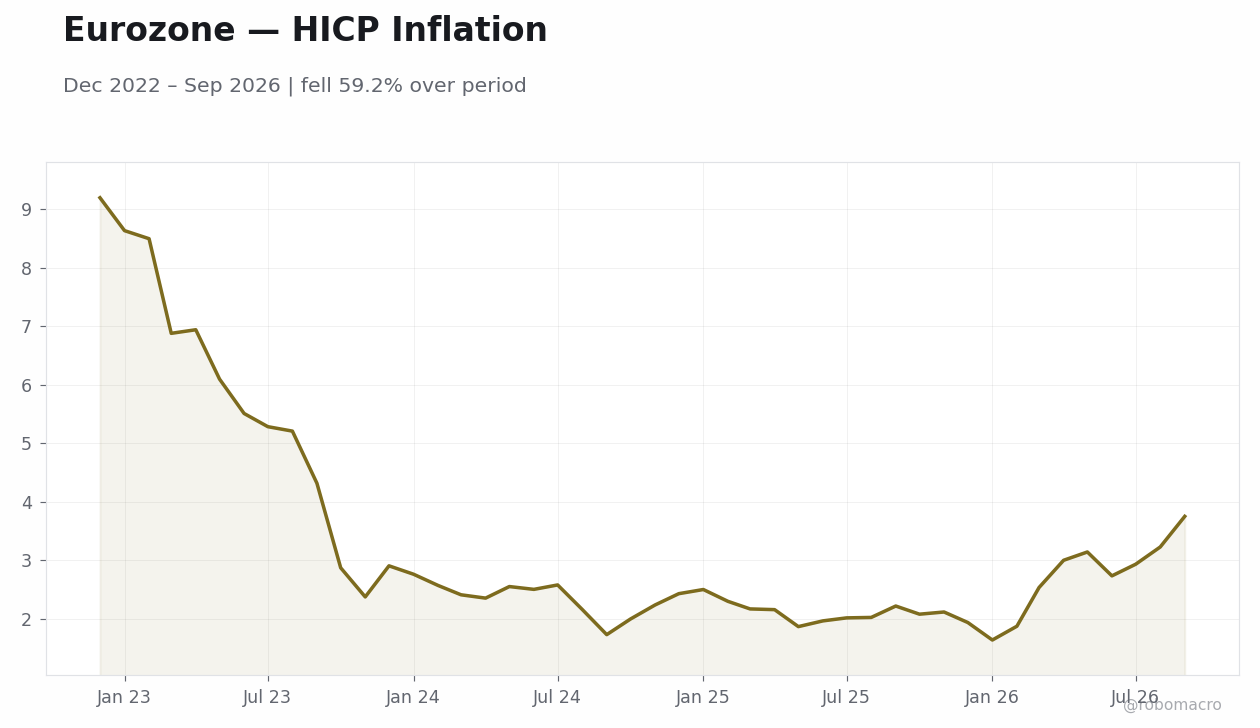
Investor confidence and wholesale prices round out the picture. Eurozone investor confidence slipped in November, and German wholesale prices rose in line with consensus yet remained elevated year-over-year, reinforcing the inflation backdrop that anchors the ECB’s holding pattern.

ECB Watch

The ECB held the deposit facility rate steady through the week, maintaining its data-dependent stance without fresh forward guidance. Succession discussions intensified, with Germany and France in intensive talks over top posts and Germany set to propose candidates next week, including potential support for De Cos. Minutes and speeches continued to tie the next policy move explicitly to incoming inflation and activity prints rather than calendar-based easing. Euro-area CPI and German wholesale prices keep the medium-term rate path anchored near current levels. The prior hike remains the last adjustment, and officials have signaled tolerance for equity volatility provided domestic prints stay within recent ranges. Markets therefore price limited near-term change ahead of the December meeting, with the succession race adding political overlay but not altering the reaction function. Data releases this week, particularly the German trade miss and French labor beat, reinforce the case for continued patience on rate adjustments.

Data Review

German trade balance came in below consensus and prior, a clear miss driven by import strength that outstripped the export rebound. This print points to weaker external demand and a smaller positive contribution from net trade to fourth-quarter growth. French unemployment fell versus expected and prior, an upside surprise that suggests labor-market resilience in the bloc’s second-largest economy. Italian industrial production rose against consensus and after a prior contraction, reversing the earlier decline and offering a positive signal for euro-area manufacturing momentum. German wholesale prices rose in line with consensus while the year-over-year rate remained elevated, keeping inflation pressure visible even as the ECB maintains its deposit facility rate. These releases together indicate the euro area remains in a mid-cycle phase with sticky prices above target and uneven growth momentum. The data support a data-dependent ECB path that tolerates dispersion across member states rather than coordinated easing. Wholesale price stability at the monthly level alongside the headline CPI reading limits the scope for near-term policy shifts.

RoboMacro AI Economic Research

Global Macro Watch

Week of November 9–13, 2026 robomacro.com
Data Review: Actual vs Consensus
DateCtryEventPrior Cons.Actual
Mon 9FITrade Balance-1.1bn--1.2bn
Mon 9DETrade Balance17.8bn19.2bn15.6bn
Mon 9DEExports Month-over-Month-0.40-2.0
Mon 9DEImports Month-over-Month0.60-4.2
Mon 9ATTrade Balance268.0mn--1.3bn
Mon 9DE11-Month Bubill Auction2.9-2.9
Mon 9DE5-Month Bubill Auction2.7-2.7
Mon 9EUECB Buch Speech---
Mon 9FR12-Month BTF Auction3.4-3.2
Mon 9FR3-Month BTF Auction2.8-2.8
Mon 9FR6-Month BTF Auction3.1-3.0
Mon 9EUEurogroup Meeting--""
Mon 9IEConstruction PMI Index---
Tue 10NLInflation Rate Month-over---0.70
Week Ahead: Key Releases
DateReleasePriorCons.
2026-11-16Industrial Production Month-over-Mo-0.50-
2026-11-17Trade Balance-6.0bn-
2026-11-17ZEW Economic Sentiment Index18.5-
2026-11-17ZEW Economic Sentiment Index28.1-
2026-11-18ECB Financial Stability Review--
2026-11-19Headline Unemployment Rate4.0-
2026-11-20Consumer Confidence Index-34.0-
2026-11-20Producer Price Index Year-over-Year6.7-
2026-11-20Business Confidence Index105-
2026-11-20Negotiated Wage Growth2.4-

The Week Ahead

Monday brings Swiss GDP flash estimate and Turkish budget balance, providing early external context for euro-area sentiment. Tuesday features German wholesale price follow-ups and potential Italian data revisions that could color manufacturing momentum. Wednesday includes French and Italian consumer confidence prints that will test whether recent labor resilience extends to households. Thursday highlights German Ifo business climate and euro-area flash PMI releases, key inputs for the ECB’s December assessment. Friday rounds out the week with euro-area current account and final HICP details, alongside any late central-bank speaker commentary. Consensus expectations center on modest PMI rebounds consistent with the mid-cycle stabilization seen in Italian production. These releases matter because they will shape the final data set before the December ECB meeting and influence positioning in Bunds and EUR crosses. Speakers from the Governing Council are likely to reiterate data dependence while succession talks continue to generate headlines.

Risks & Themes

The German trade miss raises downside risks to Q4 GDP while French and Italian beats limit the breadth of any slowdown narrative. Positioning in Bunds has shifted toward higher yields as inflation keeps the ECB on hold, yet equity flows remain supportive of selective euro-area indices. Volatility in EUR crosses could rise if succession headlines intensify without clarity on the next policy move. Upside scenario centers on further labor-market resilience feeding into stronger domestic demand, while downside centers on import-driven trade weakness spreading to broader activity. Market mispricing appears limited given the alignment between actual prints and the unchanged rate path. Flows into German debt have moderated after the week’s sell-off, suggesting reduced safe-haven demand unless global risk appetite deteriorates further.

Cross-Asset

Euro Stoxx 50 closed the week at 6386.86 for a 1.53% gain while the DAX rose 1.84% to 26749.95 and the CAC 40 advanced 1.65% to 8368.91, reflecting selective equity resilience amid mixed data. German 2-year Bund yields ended higher after a rise on the final session and 10-year yields reached higher after an increase, extending the week’s net sell-off from earlier safe-haven demand. EUR/USD fell 1.04% to 1.10, pressured by the German trade miss and firmer dollar backdrop, while EUR/GBP slipped 0.05% to 0.83 and EUR/JPY declined 0.21% to 176.07. Gold dropped 5.55% to 3886.30 and Brent crude rose 3.53% to 95.84, illustrating commodity rotation away from safe-haven flows. Daily equity moves showed dispersion, with the Euro Stoxx 50 adding ground mid-week before closing flat to lower later in the week. Bond yields steepened modestly across the sessions as markets digested the CPI reading and the unchanged ECB deposit rate.

Global Context

Global risk appetite remained the dominant signal, with equity dispersion across regions transmitting uneven price action into euro-area assets. DM central banks continued to tolerate volatility provided domestic prints stayed within recent ranges, as seen in the Bank of England’s earlier hike and the Federal Reserve’s data-dependent stance. Trade dynamics showed import strength in Germany coinciding with Brent crude rising, adding external price pressure. Geopolitical risks stayed contained within the last seven days, yet selective EM resilience in India and South Africa highlighted differentiation that could affect euro-area export demand. Cross-border spillovers from U.S. nonfarm payrolls and ISM beats earlier in the period supported a firmer dollar, contributing to the EUR/USD decline.

RoboMacro AI Economic Research

Global Macro Watch

Week of November 9–13, 2026 robomacro.com
Japan
Market Scorecard
AssetLevelWoW
Nikkei 22561142.35+4.0%
USD/JPY159.54+0.8%
EUR/JPY176.07-0.2%
GBP/JPY210.84-0.3%
Gold3886.3-5.5%
Brent Crude95.84+3.5%
Bitcoin65028.85-12.8%
Chart 1
Chart 2
Chart 3
Chart 4
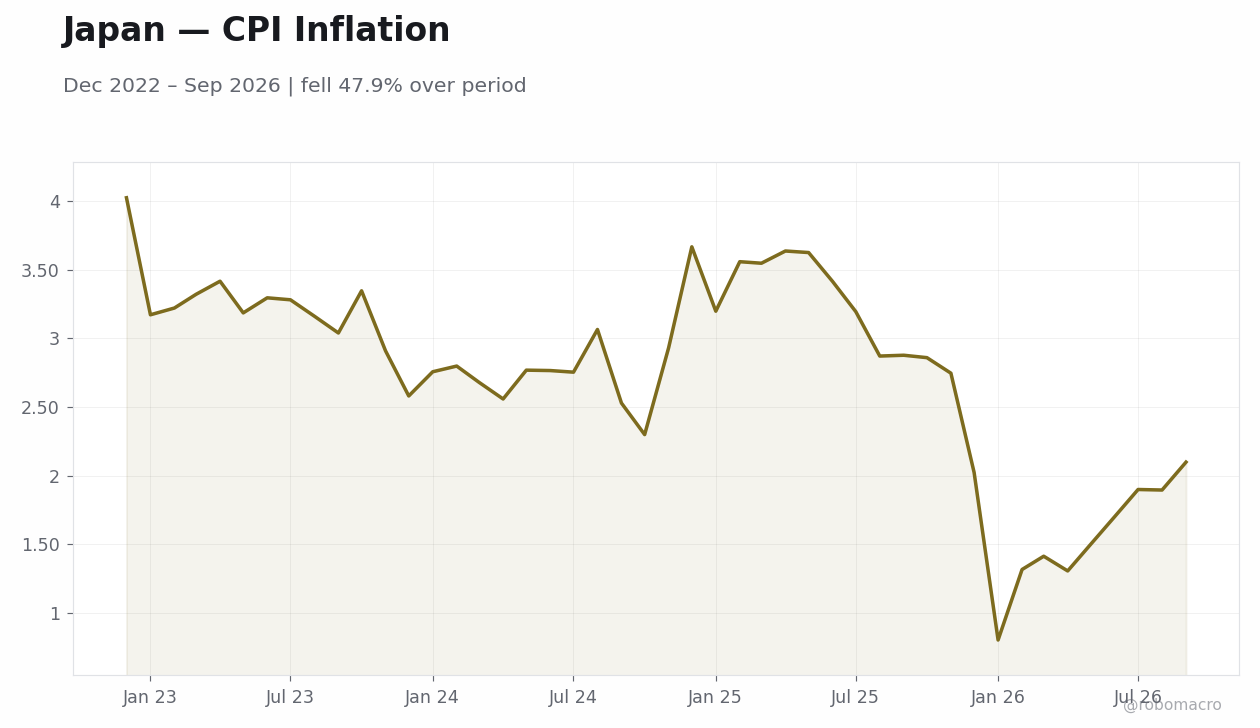
  • Household Spending declined sharply year-over-year and month-over-month, missing consensus and exposing weakness in domestic demand while inflation remained above target.
  • Nikkei 225 recovered to close the week at 61,142.35, up 4.03% week-over-week, as risk appetite overrode the consumption data.
  • Bank of Japan Summary of Opinions from the October 30 meeting showed members debating faster rate hikes, with Governor Ueda and board member Asada reinforcing the 2% target achievement and normalization path at the unchanged 1.25% policy rate.

Week in Review

Equity Rebound Over Weak Consumption The Nikkei 225 declined early in the week after BoJ minutes and Ueda remarks highlighted potential policy tightening, then rose on subsequent sessions to finish at 61,142.35.

Household Spending Shock Household Spending missed consensus on both a month-over-month and year-over-year basis on November 9, while the Current Account Balance also came in below forecast.

Policy Communications Drive Positioning The BoJ October Summary of Opinions released November 10 revealed explicit debate on accelerating hikes from the 1.25% policy rate, echoed in Asada’s November 11 speech.

Yen and Intervention Dynamics USD/JPY rose during the week despite intervention, closing at 159.54.

JGB Yield Path The 10-year JGB yield eased early in the week before rising modestly by November 15, while the 2-year yield fluctuated around prior levels.

Data-Price Divergence Markets absorbed the consumption miss and lower current-account print without derailing the equity recovery, consistent with the prior week’s pattern of selective domestic resilience amid global risk dispersion.

Inflation Context Wholesale inflation acceleration kept the CPI reading above target and supported the BoJ’s stated view that the price-stability goal has been generally achieved.

Cross-Asset Flows Brent Crude and Gold both declined, illustrating that domestic policy signals rather than commodity prices dominated Japan price action.

Week Arc Summary The five-day period therefore showed a clear through-line of fragile demand data coexisting with firming BoJ communication and equity resilience.

BoJ Watch

The Bank of Japan left the policy rate at 1.25% after the October 30 meeting while the Summary of Opinions released November 10 documented several members calling for an earlier or faster pace of adjustment. Governor Ueda stated that overseas investment income now dominates the current account and that labor shortages are supporting domestic investment, though he noted uncertainty over the duration of 2% inflation. Board member Asada’s November 11 remarks reinforced the same normalization message without altering forward guidance. The household spending decline and current-account undershoot did not shift the committee’s published focus on achieving the price-stability target, leaving the data-dependent path to the next decision intact. Officials’ repeated emphasis on wage growth and persistent inflation above target supplied the clearest policy signal of the week.

RoboMacro AI Economic Research

Global Macro Watch

Week of November 9–13, 2026 robomacro.com
Data Review: Actual vs Consensus
DateCtryEventPrior Cons.Actual
Mon 9JPCoincident Index Prelimina119-120
Mon 9JPLeading Economic Index Pre118117116
Mon 9JPHousehold Spending Month-o0.100.30-2.8
Mon 9JPHousehold Spending Year-ov-3.1-3.1-6.8
Mon 9JPBoJ Summary of Opinions---
Mon 9JPCurrent Account Balance3993.0bn3354.4bn2372.0bn
Mon 9JPBank Lending Year-over-Yea5.25.45.2
Mon 9JP30-Year JGB Auction4.1-3.8
Tue 10JPEco Watchers Survey Curren47.046.846.1
Tue 10JPEco Watchers Survey Outloo47.4-46.5
Tue 10JPReuters Tankan Index22.0-27.0
Tue 10JPBoj Jgb Purchase---
Wed 11JPMachine Tool Orders Year-o60.4-42.5
Wed 11JPForeign Bond Investment Le1312.0bn--537.6bn
Week Ahead: Key Releases
DateReleasePriorCons.
2026-11-17Trade Balance-536.6bn-
2026-11-17Exports Year-over-Year16.7-
2026-11-18Machinery Orders Month-over-Month5.2-
2026-11-18Machinery Orders Year-over-Year18.6-
2026-11-19Inflation Rate Year-over-Year2.1-
2026-11-19Core Inflation Rate Year-over-Year2.1-
Chart 5
Chart 7

The Week Ahead

Preliminary GDP Growth Quarter-over-Quarter and Annualized prints scheduled for November 15 will provide the first hard read on third-quarter activity after the household-spending data. Trade Balance and inflation-related releases expected early in the following week will test whether the CPI level is broadening or moderating. Wholesale inflation data due mid-week will feed directly into the Bank of Japan’s assessment of underlying price pressures ahead of the next policy meeting. Any further Ministry of Finance commentary on the yen near current levels will be watched for signals on intervention tolerance. The combination of growth and price prints will clarify whether the fragile domestic-demand picture challenges or supports the committee’s stated preference for gradual normalization. Markets will also monitor any updates to the Quarterly Outlook Report language on the persistence of 2% inflation. These releases matter because they will shape the Bank of Japan’s assessment of the balance between activity weakness and inflation persistence in coming quarters.

Risks & Themes

The sharp consumption miss raises downside risk to the growth outlook even as the Bank of Japan maintains its inflation-target achievement narrative. Equity resilience despite the data suggests markets continue to price policy normalization on schedule, yet any further yen weakness could prompt renewed intervention that complicates the rate path. Upside inflation surprises in next week’s prints would reinforce the hawkish tilt visible in the Summary of Opinions, while downside growth surprises could widen the gap between domestic fundamentals and policy expectations. The week’s pattern of intervention failing to cap USD/JPY at current levels points to a potential mispricing of the balance between external pressure and domestic policy resolve.

RoboMacro AI Economic Research

Global Macro Watch

Week of November 9–13, 2026 robomacro.com
Canada
Market Scorecard
AssetLevelWoW
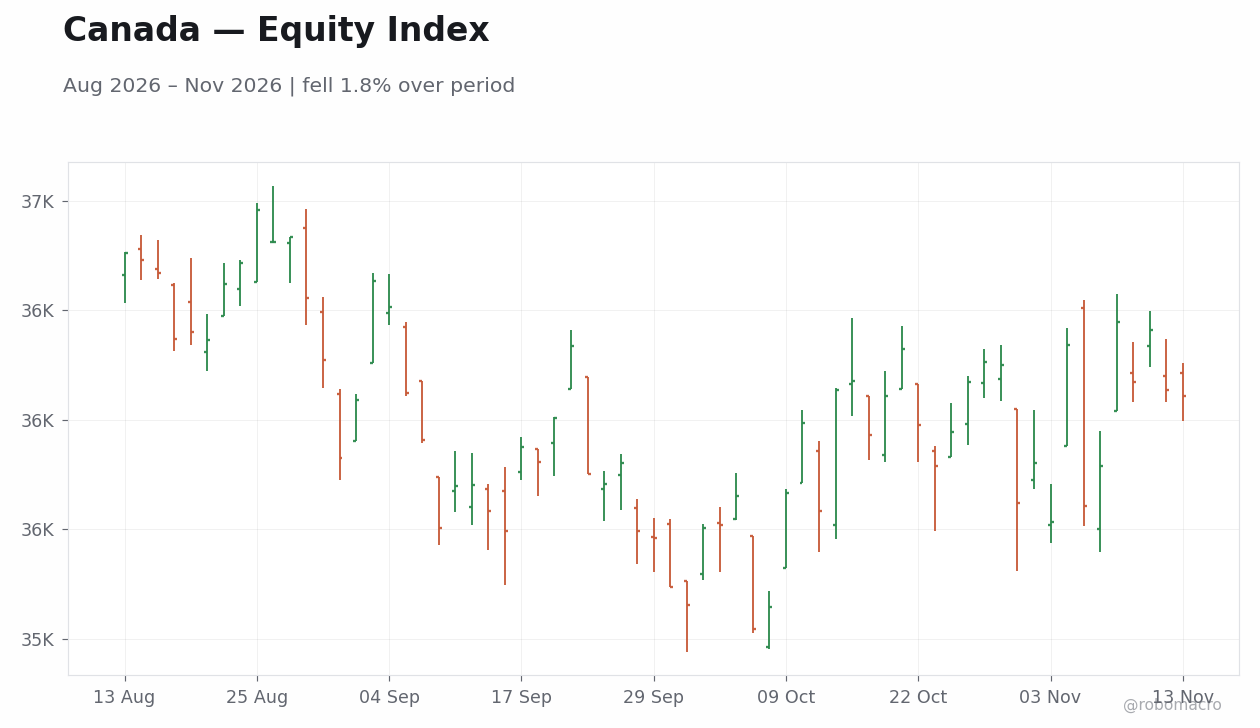
S&P/TSX36105.9-0.9%
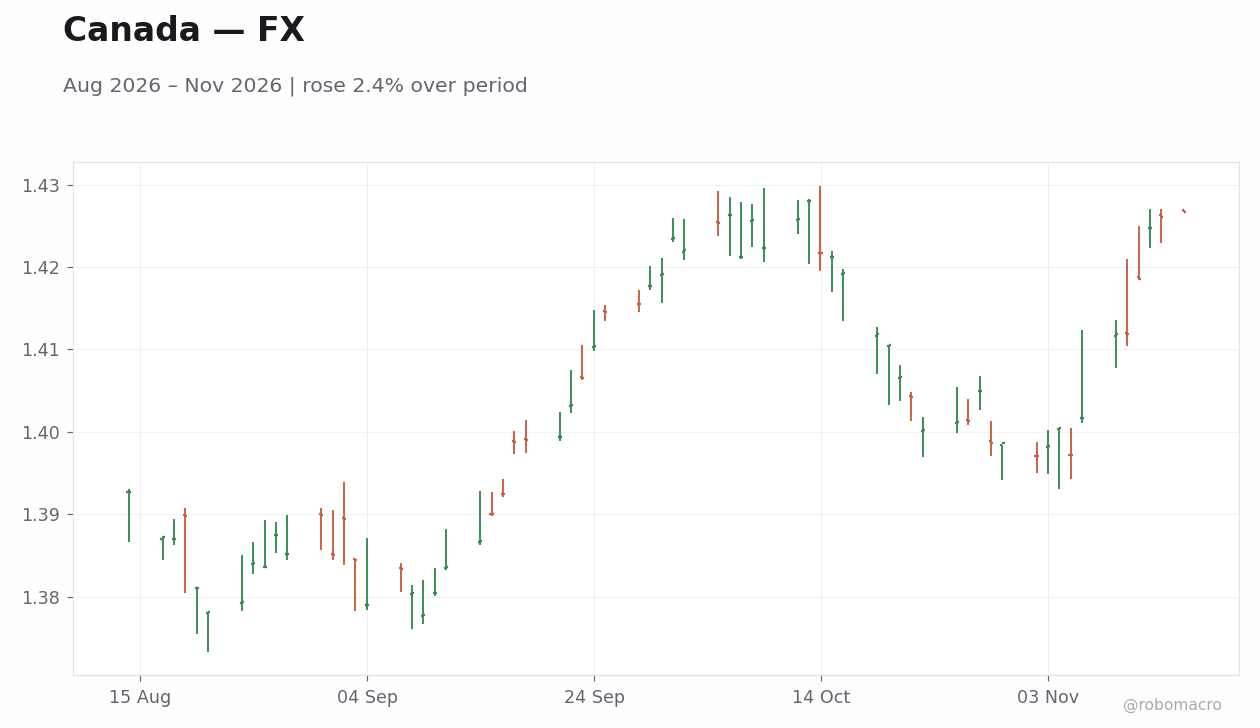
USD/CAD1.43+1.1%
EUR/CAD1.57+0.0%
WTI Crude88.56+2.0%
Natural Gas3.23+0.4%
Gold3886.3-5.5%
Brent Crude95.84+3.5%
Bitcoin65019.94-12.8%
Chart 1
Chart 2
Chart 3
Chart 4
  • Canada's October labour report delivered a surprise contraction in jobs, lifting the unemployment rate and marking the clearest domestic signal of the week.
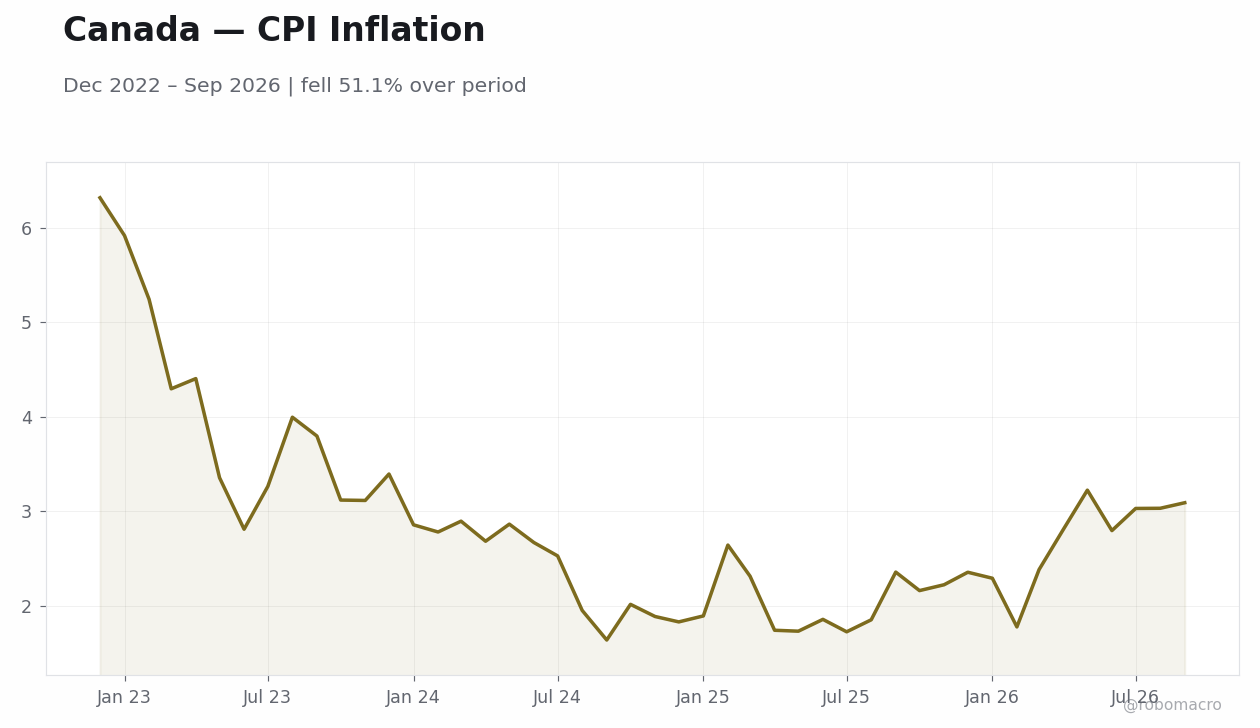
  • Headline CPI remained above the Bank of Canada's target, driven by a gasoline price rebound.
  • Bank of Canada communications reinforced a data-dependent stance ahead of the next decision.

Week in Review

Labour Market Deterioration Canada's October employment report released on November 9 showed a loss of jobs and an unemployment rate increase, a clear downside surprise relative to prior prints. The S&P/TSX closed the period at 36105.9, a net decline of 0.93 percent from the prior Friday. USD/CAD rose to 1.43 over the same interval as the loonie absorbed the domestic data shock.

Inflation Persistence Canada CPI stayed above the 2 percent target, with the gasoline component providing the main upward impulse. WTI crude traded in a range across the five sessions, ending at 88.56.

Policy Signal Transmission Bank of Canada officials maintained an explicit data-dependent stance in public remarks. The TSX posted gains early in the week before giving back ground later. Gold declined 5.55 percent over the week to 3886.3, consistent with the broader commodity price softening.

Cross-Border Rate Context No tier-one Canadian data releases occurred after the jobs print, leaving markets to trade primarily on the October employment outcome and imported U.S. inflation signals. The data arc therefore showed a clear growth downside alongside inflation that remained above target through the gasoline channel.

BoC Watch

Bank of Canada communications during the week emphasized a continued restrictive stance. Officials stated that they would proceed carefully on any additional increases, while the meeting minutes highlighted the need to address inflation risks. The October jobs contraction and recent CPI print arrived after the most recent decision, leaving the forward path explicitly tied to subsequent domestic releases. Deputy Governor Gravelle's scheduled remarks later in the month will provide the next direct channel for guidance. The data therefore sustain a hawkish tilt in official language even as activity prints weakened.

RoboMacro AI Economic Research

Global Macro Watch

Week of November 9–13, 2026 robomacro.com
Data Review: Actual vs Consensus
DateCtryEventPrior Cons.Actual
Mon 9CA10-Year Bond Auction--3.7
Thu 12CABuilding Permits Month-ove---4.1
Thu 12CA2-Year Bond Auction--3.4
Fri 13CACapacity Utilization Rate--81.5
Fri 13CAManufacturing Sales Month---0
Fri 13CAWholesale Sales Month-over--0.70
Week Ahead: Key Releases
DateReleasePriorCons.
2026-11-16Inflation Rate Year-over-Year3.1-
2026-11-16Core Inflation Rate Year-over-Year2.2-
2026-11-16Inflation Rate Month-over-Month0.10-
2026-11-17Housing Starts Level250K-
2026-11-18New Housing Price Index Month-over--0.20-
2026-11-20Retail Sales Excluding Autos Month-1.2-
2026-11-20Retail Sales Month-over-Month Final1.20.70
2026-11-20Retail Sales Month-over-Month Prel--
Chart 6
Chart 7
Chart 8

The Week Ahead

Canada October CPI is scheduled for release on November 16 and will be the first major domestic inflation read since the jobs shock. The print will directly inform the Bank of Canada's assessment of whether the recent rate is broadening or remains gasoline-driven. Deputy Governor Gravelle is set to speak on November 18, offering the first senior official comments after the employment and inflation data. Markets will parse both releases for any shift in the data-dependent language that has anchored recent statements. The absence of other high-impact Canadian events leaves the CPI outcome as the dominant input for the upcoming decision. Broader global risk sentiment and oil price moves will continue to influence CAD and front-end yields in the interim.

Risks & Themes

The October jobs contraction introduces downside risk to growth while CPI keeps inflation concerns elevated, creating a narrow path for policy. A hotter-than-expected CPI release next week would reinforce the Bank of Canada's hike bias and could pressure the front end of the curve higher. Conversely, confirmation of further labour market softening would widen the gap between activity and prices, testing the durability of the current restrictive setting. The dispersion between equity sector performance and the loonie's move to 1.43 highlights that commodity and rate differentials remain the primary transmission channels.

RoboMacro AI Economic Research

Global Macro Watch

Week of November 9–13, 2026 robomacro.com
Mexico
Market Scorecard
AssetLevelWoW
IPC Bolsa71204.98-0.9%
USD/MXN18.52-0.6%
EUR/MXN20.46-1.5%
WTI Crude88.56+2.0%
Silver49.12-6.5%
Gold3886.3-5.5%
Brent Crude95.84+3.5%
Bitcoin65056.1-12.8%
Chart 1
Chart 2
Chart 3
  • October CPI rose more than expected on both a month-over-month and year-over-year basis, marking the clearest upside surprise of the week.
  • Banco de Mexico cut the policy rate on November 5, reopening the easing cycle and triggering an initial rise in USD/MXN.
  • The inflation overshoot arrived directly after the November 5 decision, shifting the data backdrop for the next policy meeting on December 17.

Week in Review

Inflation reacceleration dominates the data flow. October headline CPI rose more than expected month-over-month and year-over-year, exceeding both consensus and prior readings. The prints placed headline inflation above Banco de Mexico’s 3% target and above the upper edge of its tolerance band.

Policy easing collides with the hotter print. Banco de Mexico delivered a rate cut on November 5, effective November 6, before the October data arrived. The sequence left the central bank with fresh evidence of reaccelerating prices just as the easing cycle reopened.

Equity and currency responses diverged. The IPC Bolsa posted a net decline over the five trading days. USD/MXN finished lower on the week despite the initial post-cut spike.

Commodity crosscurrents provided partial offset. WTI Crude ended the week higher after a weekly gain, while Brent Crude settled higher following a larger advance. These moves eased some imported inflation pressure even as domestic price data surprised higher.

Prior-quarter growth context remains supportive. Q3 GDP expanded more than expected, supplying a counterweight to the inflation miss and keeping the growth backdrop from deteriorating in tandem with prices. The combination of resilient activity and hotter inflation framed the week’s central tension for policy.

Market positioning reflected the mixed signals. Equities absorbed the inflation data with only modest net losses while the peso recovered from its initial post-cut weakness, consistent with broad dollar softness rather than Mexico-specific selling. The absence of further domestic releases after November 9 left the October CPI as the dominant domestic input for the remainder of the period.

Banxico Watch

Banco de Mexico cut the policy rate on November 5, reopening the easing cycle ahead of the October inflation release. The subsequent month-over-month and year-over-year prints exceeded both consensus and prior readings, placing headline inflation above the 3% target. Officials had already tied the November decision to incoming data, and the hotter outturn supplies new evidence on price momentum ahead of the next meeting. The sequence leaves the post-cut communication focused on whether the reacceleration alters the pace of further adjustments. Data dependence remains the explicit framework, with the October figures now the most recent domestic input available to the committee.

RoboMacro AI Economic Research

Global Macro Watch

Week of November 9–13, 2026 robomacro.com
Data Review: Actual vs Consensus
DateCtryEventPrior Cons.Actual
Mon 9MXInflation Rate Month-over-0.420.550.65
Mon 9MXInflation Rate Year-over-Y3.53.63.8
Mon 9MXAuto Exports Year-over-Yea-11.9--17.9
Mon 9MXAuto Production Year-over--15.1--17.7
Mon 9MXCore Inflation Rate Month-0.200.310.34
Mon 9MXCore Inflation Rate Year-o3.83.83.8
Mon 9MXProducer Price Index Month1.4-1.9
Mon 9MXProducer Price Index Year-4.0-5.6
Wed 11MXIndustrial Production Mont0.69--1.4
Wed 11MXIndustrial Production Year3.53.51.3
Chart 5
Chart 7

The Week Ahead

No Mexico-specific releases are scheduled for the coming five trading days. Attention therefore centers on any additional communication from Banco de Mexico officials ahead of the next policy meeting. Global data prints, particularly US activity and inflation figures, will shape dollar direction and cross-border flows into the peso. Commodity price moves in oil and precious metals remain relevant given Mexico’s fiscal and terms-of-trade exposure. The October CPI overshoot supplies the latest domestic evidence for assessing whether price pressures are reaccelerating into coming quarters. Market participants will parse any speeches for signals on how the central bank weighs the recent inflation data against the growth backdrop when setting the path for the policy rate.

Risks & Themes

The inflation overshoot raises the possibility that price pressures prove stickier than the November 5 cut assumed, tilting the balance toward a slower pace of easing. Conversely, continued resilience in Q3 GDP and supportive commodity prices could limit downside risks to activity even if further cuts are delayed. The peso’s recovery from the initial post-cut spike suggests markets are not yet pricing sustained FX weakness, leaving room for repricing if subsequent data reinforce the October print. External risk appetite remains the dominant transmission channel, with any renewed equity volatility capable of overriding domestic data signals in the near term. The configuration leaves the outlook sensitive to whether the October figures mark a one-off reacceleration or the start of a broader inflation trend.

RoboMacro AI Economic Research

Global Macro Watch

Week of November 9–13, 2026 robomacro.com
Brazil
Market Scorecard
AssetLevelWoW
Bovespa172458.0+0.1%
USD/BRL5.64+2.5%
EUR/BRL6.23+1.6%
Vale11.22-6.3%
Petrobras18.34-0.1%
WTI Crude88.56+2.0%
Gold3886.3-5.5%
Bitcoin65056.1-12.8%
Chart 1
Chart 2
  • The latest IPCA reading showed softer inflation momentum than the prior month.
  • BCB Copom minutes from the November 4 hold highlighted persistent price pressures alongside slowing activity, keeping the policy stance explicitly data-dependent.
  • Retail sales rose modestly while the Business Confidence Index declined, underscoring household weakness under restrictive rates.

Week in Review

Inflation trajectory softens. The October IPCA print missed consensus and marked a clear deceleration from the prior month. The release followed the BCB’s November 4 decision to hold the policy rate and reinforced the view that headline pressures are not re-accelerating sharply. Markets responded with modest curve flattening.

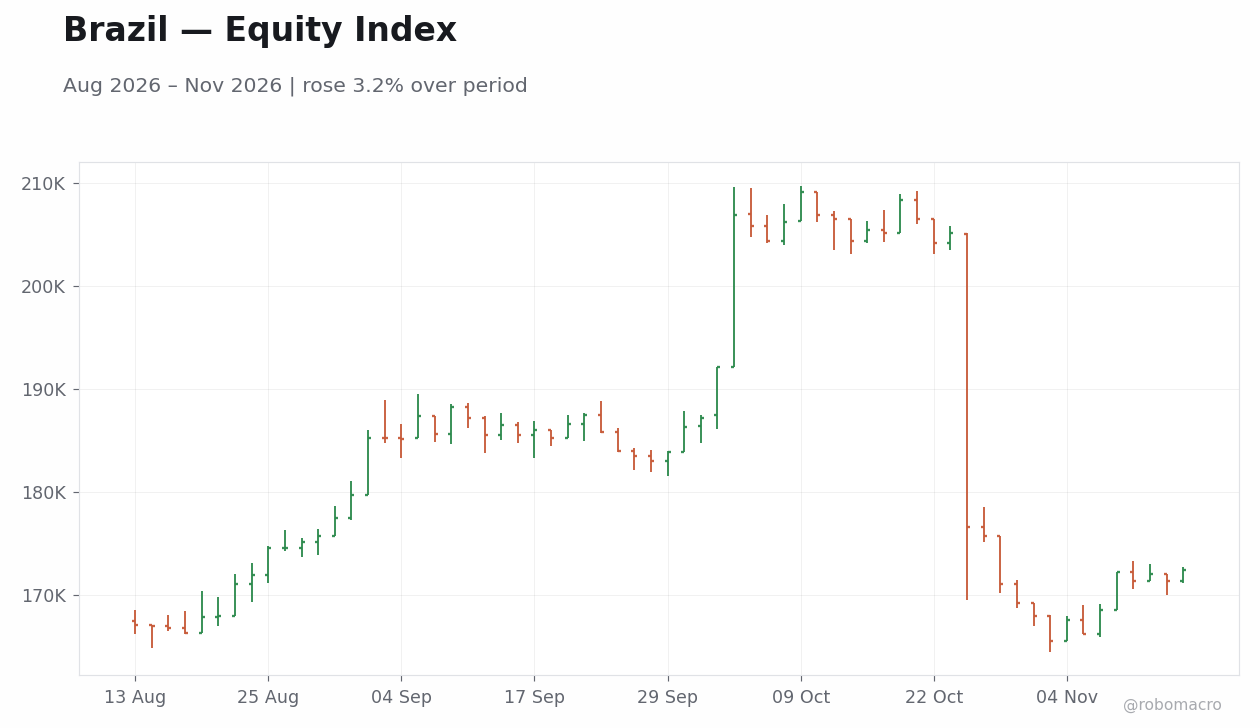
Activity and confidence data diverge. Retail sales beat consensus while the Business Confidence Index declined. The combination pointed to resilient nominal spending but sharply weaker forward expectations under the current policy rate. Bovespa closed the week at 172458, up 0.13% week-over-week. Vale declined while Petrobras was little changed.

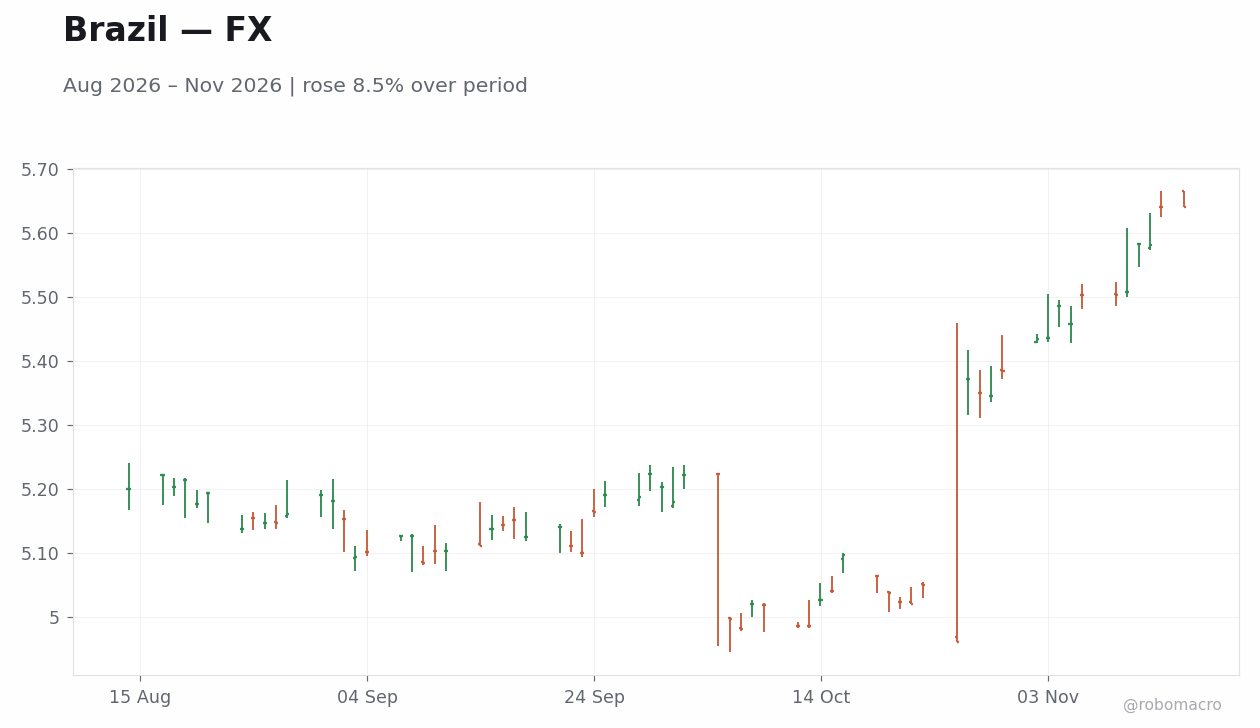
Fiscal announcement arrives amid external pressure. The government unveiled a fiscal package for the coming year, providing a headline-positive signal on the fiscal trajectory even as detail remained limited. USD/BRL rose 2.5% week-over-week to 5.64. EUR/BRL ended at 6.23, up 1.62% over the five sessions.

Policy signal remains unchanged. The minutes stressed inflation caution and activity slowdown without altering the data-dependent language. The BCB Focus Market Readout added no material surprise. Overall price action showed equities holding gains while the real weakened, consistent with domestic data prints taking precedence over global commodity moves such as WTI crude ending at 88.56.

BCB Watch

The Copom minutes released November 10 reiterated the committee’s focus on inflation persistence and the activity slowdown after the November 4 hold. Officials tied the next decision explicitly to incoming prints, noting that the October IPCA outcome would factor directly into the assessment of price dynamics. The data-dependent stance leaves the rate path open to either further holds or measured adjustments depending on whether subsequent releases confirm the recent softening or show re-acceleration. Retail sales and the drop in Business Confidence supplied additional evidence of demand restraint under current settings. The BCB therefore signaled no shift in reaction function, anchoring expectations to the sequence of releases ahead of the next meeting.

RoboMacro AI Economic Research

Global Macro Watch

Week of November 9–13, 2026 robomacro.com
Data Review: Actual vs Consensus
DateCtryEventPrior Cons.Actual
Mon 9BRBCB Focus Market Readout--""
Tue 10BRBCB Copom Meeting Minutes---
Wed 11BRServices Output Month-over0-0.30-0.10
Wed 11BRServices Output Year-over-0.60-0.50-0.10
Wed 11BRCar Production Month-over--1.1--5.1
Wed 11BRNew Car Registrations Mont2.3--5.6
Thu 12BRInflation Rate Month-over-0.820.260.14
Thu 12BRInflation Rate Year-over-Y4.64.74.6
Fri 13BRRetail Sales Month-over-Mo0.20-0.200.20
Fri 13BRRetail Sales Year-over-Yea0.501.01.7
Fri 13BRBusiness Confidence Index46.2-40.2
Week Ahead: Key Releases
DateReleasePriorCons.
2026-11-16BCB Focus Market Readout--
Chart 6
Chart 7

The Week Ahead

Attention turns to the absence of high-impact Brazilian releases in the immediate sessions, leaving markets to digest the October IPCA and retail sales prints already in hand. The next meeting remains the key focal point, with participants watching for any follow-through in inflation or activity data that could alter the balance of risks around the policy rate. Global cross-currents, including commodity price movements and external risk sentiment, will continue to influence USD/BRL and local yields. A soft patch in confidence readings raises the possibility that future activity releases could reinforce the case for patience at the central bank. Conversely, any re-acceleration in subsequent inflation prints would test the committee’s tolerance for above-target readings. The fiscal package details will also be monitored for their potential to affect risk premia embedded in the curve. Overall, the data-dependent framework implies that the coming releases will set the tone for whether the BCB maintains the current stance or signals a change in coming quarters.

Risks & Themes

The softer October IPCA print shifts the near-term inflation outlook lower and reduces the probability of an early policy reversal, yet the y/y level still sits above the tolerance band midpoint and keeps upside risks alive. Weak business confidence highlights downside growth scenarios that could pressure the BCB to extend the hold if activity data deteriorate further. Fiscal slippage remains a latent concern despite the announced package, particularly if implementation details disappoint and widen sovereign spreads. The real’s 2.5% week-over-week rise to 5.64 suggests markets may be under-pricing the persistence of external funding pressures relative to domestic resilience signals. A sequence of stronger-than-expected activity prints could challenge the current stagflation-lite narrative priced into the flat-to-inverted curve, while continued disinflation would support the case for eventual easing in coming quarters.

RoboMacro AI Economic Research

Global Macro Watch

Week of November 9–13, 2026 robomacro.com
Argentina
Market Scorecard
AssetLevelWoW
USD/ARS1543.5-0.1%
EUR/ARS1702.87-1.1%
Gold3886.3-5.5%
Brent Crude95.84+3.5%
Soybean1231.5+4.2%
Bitcoin65075.5-12.8%
Chart 2
Chart 3
  • Political criticism of austerity added headline risk but left the currency and equity market with limited movement.
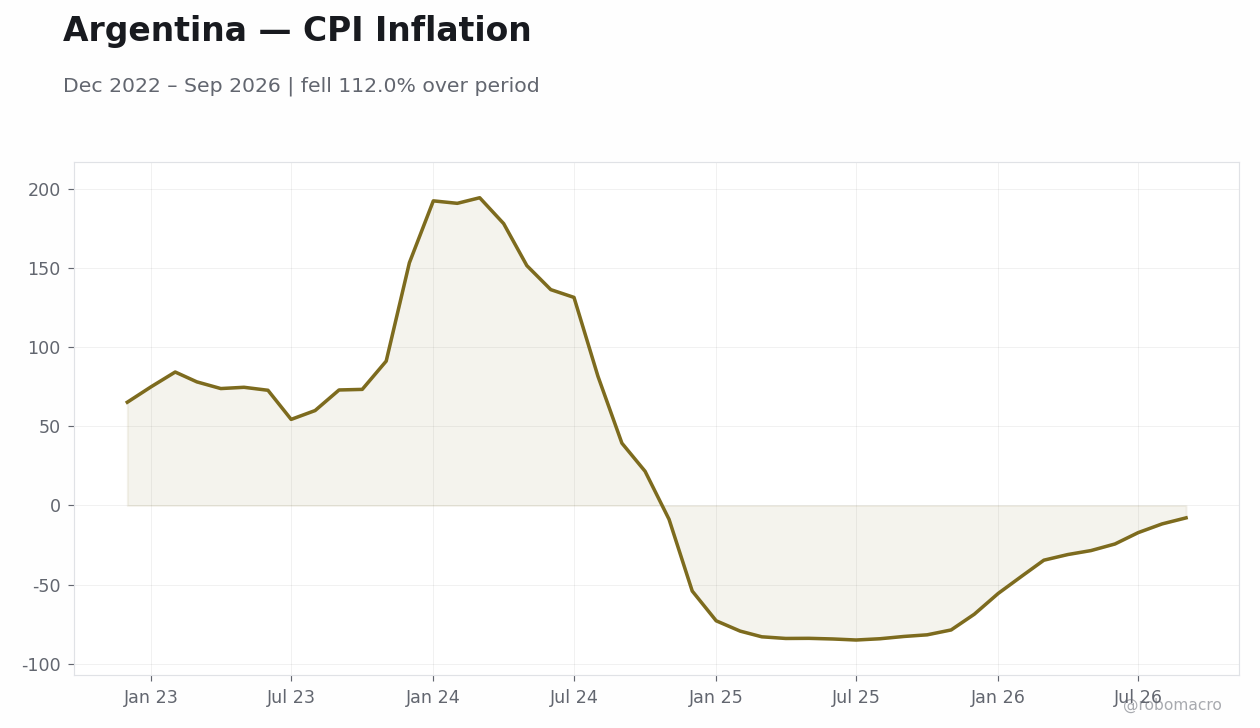
  • The absence of fresh inflation data left the disinflation narrative unchanged while the BCRA maintained its data-dependent stance.
  • No domestic releases or central-bank communications occurred, keeping the policy signal and crawling-peg framework stable.

Week in Review

Political Noise Overshadows Thin Calendar No Argentine economic releases were published, so price action responded to external political commentary on the austerity program. Equity turnover stayed light with no domestic catalysts to shift sentiment.

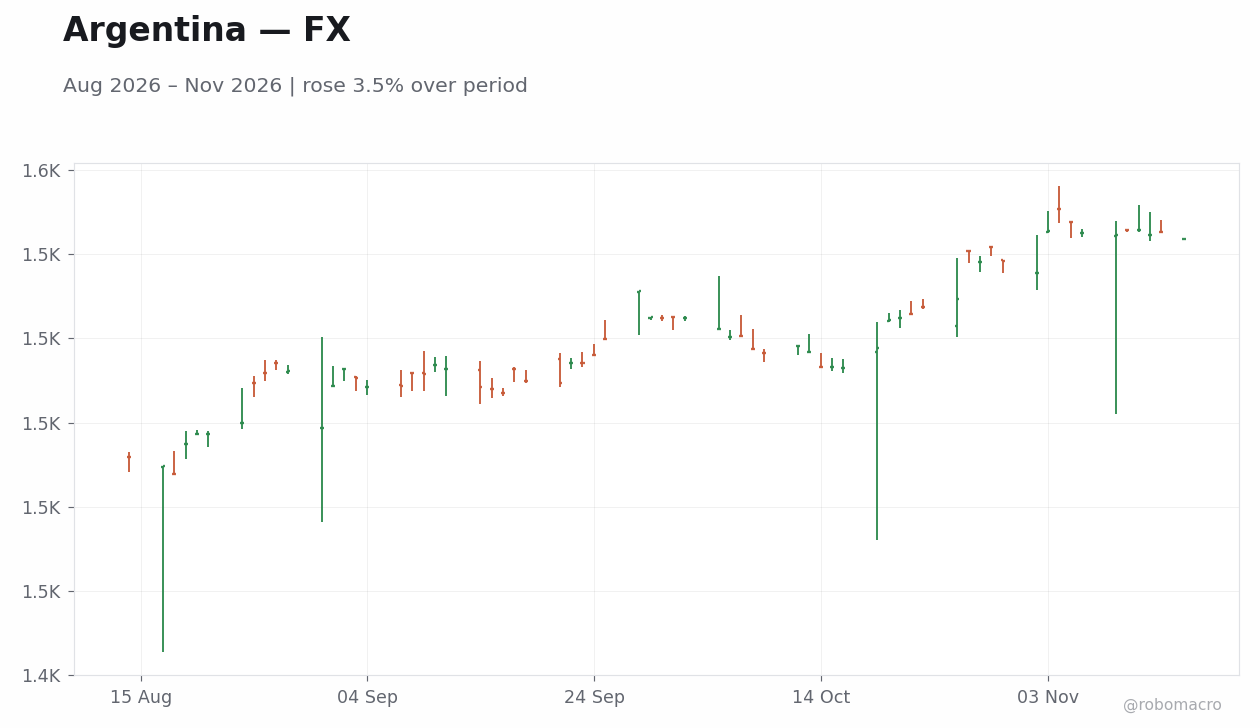
FX Peg Remains Anchored USD/ARS eased 0.07 percent to 1543.5. EUR/ARS declined 1.09 percent to 1702.87, reflecting broader dollar strength rather than local pressures. The managed float absorbed flows without widening the crawl.

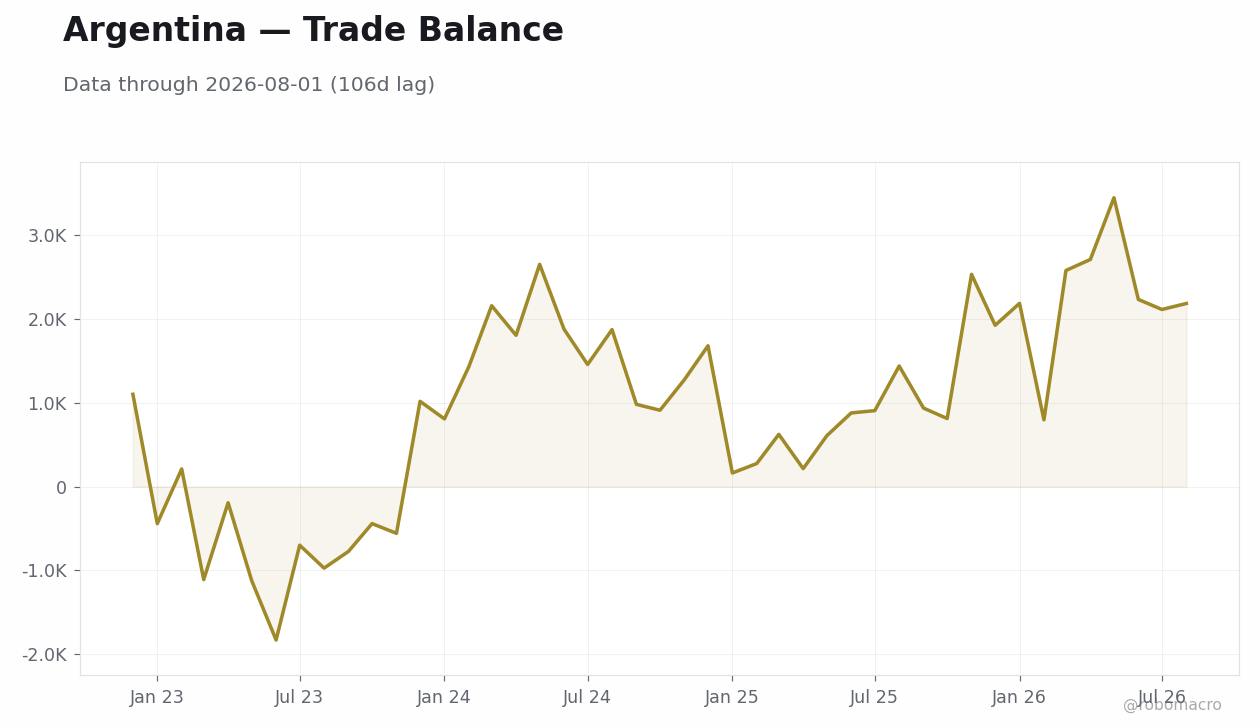
Commodity Tailwinds Support Reserves Soybean futures rose 4.17 percent to 1231.5, supporting the outlook for export inflows that aid BCRA accumulation. Brent crude advanced 3.53 percent to 95.84, trimming the energy import bill and providing modest trade-balance relief.

Equity Consolidation Continues Daily equity turnover remained subdued with no fresh domestic drivers. Bitcoin fell 12.75 percent to 65075.5, producing limited spillover into local risk assets.

Disinflation Path Unchanged The lack of new monthly inflation data left the disinflation trajectory unchanged and kept the policy anchor in place.

BCRA Watch

The Central Bank of Argentina kept policy settings unchanged with no speakers, minutes, or decisions released. The absence of communication reinforced the data-dependent stance, as officials continued to tie upcoming decisions to incoming inflation and activity prints. The lack of new CPI data left the disinflation trajectory as the latest domestic reference point. The policy signal remained one of steady monitoring rather than active adjustment, with the crawling peg managed without fresh intervention signals.

RoboMacro AI Economic Research

Global Macro Watch

Week of November 9–13, 2026 robomacro.com
Data Review: Actual vs Consensus
DateCtryEventPrior Cons.Actual
Mon 9ARIndustrial Production Year-3.2--
Thu 12ARInflation Rate Month-over----
Thu 12ARInflation Rate Year-over-Y---
Thu 12ARLeading Indicator Month-ov---
Chart 6

The Week Ahead

The domestic calendar for November 16–22 contains no scheduled Argentine data releases or BCRA events. Attention will focus on secondary-market flows and any official commentary. Traders will monitor the USD/ARS fix for signs of accumulation ahead of month-end export liquidation and watch parallel-market spreads for stress. Soybean and Brent pricing remain the key swing factors for the trade balance and fiscal revenue outlook. Any later reserve or deposit prints will be scrutinized for signals on accumulation capacity. The next policy decision will continue to be framed around incoming inflation and activity prints. Global risk appetite and commodity moves will likely set the tone for local assets.

Risks & Themes

Political criticism highlighted downside risk to the fiscal-consolidation narrative, yet market data showed no immediate reaction in the form of currency pressure. Upside scenarios rest on sustained soybean strength supporting reserve accumulation and keeping the peg stable. Downside scenarios center on any acceleration in the crawl or widening parallel spreads if political noise intensifies without offsetting commodity gains. The market continues to price limited near-term stress given contained FX moves, though the absence of fresh inflation or activity data leaves the disinflation path open to later revisions.

RoboMacro AI Economic Research

Global Macro Watch

Week of November 9–13, 2026 robomacro.com
Colombia, Chile and Peru
Market Scorecard
AssetLevelWoW
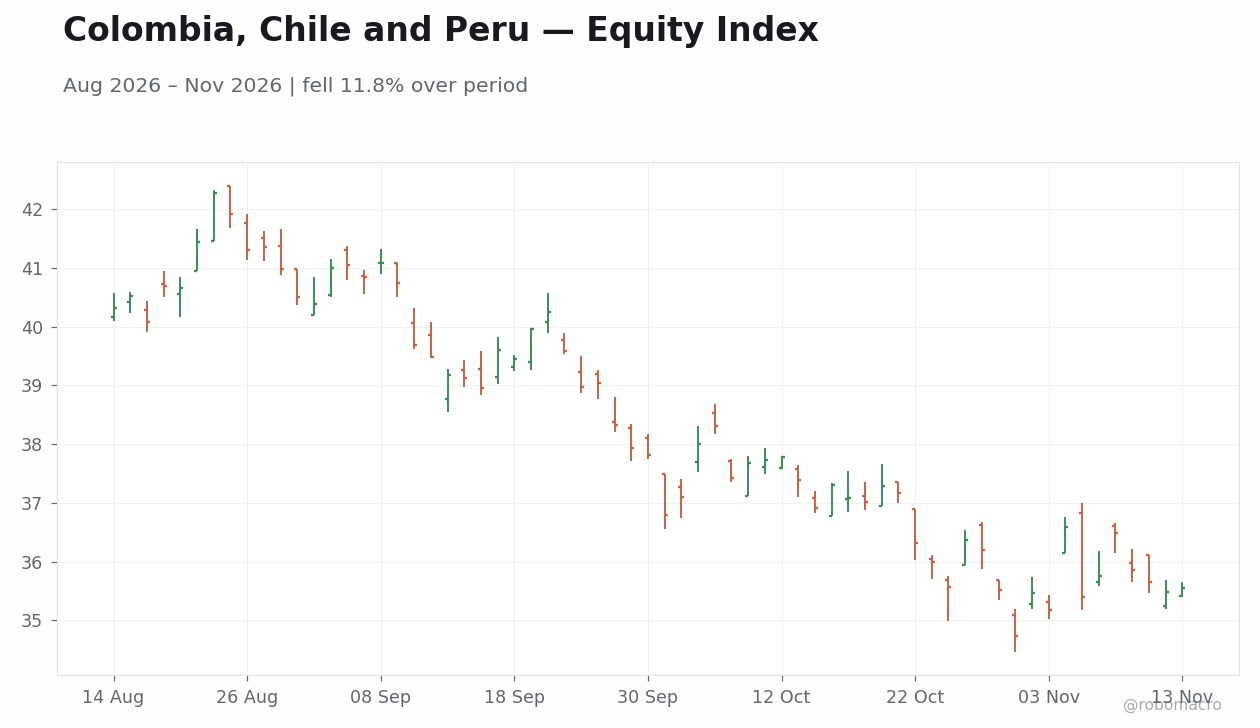
MSCI Chile35.55-2.5%
MSCI Peru80.8-2.6%
USD/COP3302.5+5.8%
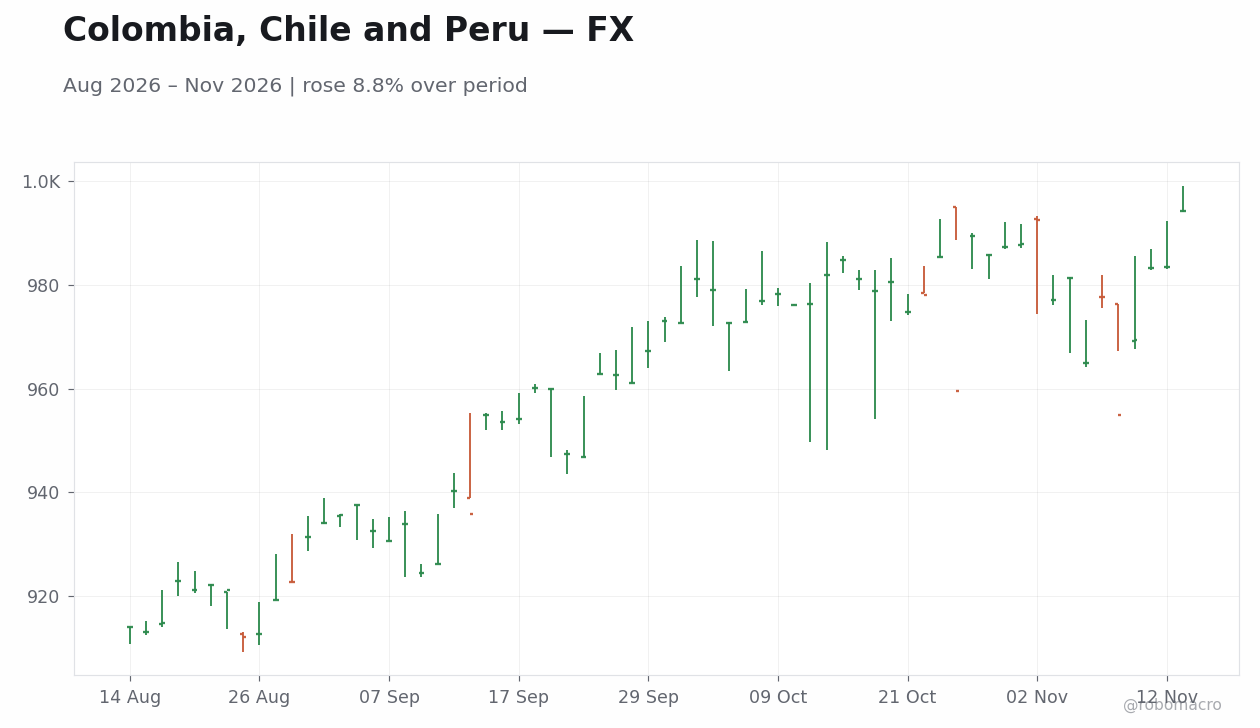
USD/CLP994.21+4.1%
USD/PEN3.4+1.6%
Copper6.09-3.8%
Gold3886.3-5.5%
Brent Crude95.84+3.5%
Bitcoin65087.17-12.7%
Chart 1
Chart 2
  • Peru’s central bank raised its policy rate, marking the first hike in the current cycle and diverging from the regional easing bias.
  • Chile’s October CPI rose while the finance minister confirmed recession, sending MSCI Chile lower week-over-week and USD/CLP higher.
  • Colombia’s October CPI rose below consensus, yet the policy rate kept USD/COP under pressure with a week-over-week advance.

Week in Review

Inflation prints split the policy outlook. Colombia’s October CPI rose below consensus, easing immediate pressure on the central bank after its recent hike. Chile’s October CPI remained elevated relative to target, reinforcing the case for caution ahead of the next decision. Peru’s inflation trajectory set the stage for the central bank’s move.

Activity data confirmed Chile’s downturn. The finance minister stated that the economy is in recession, driving MSCI Chile lower and USD/CLP higher. No comparable GDP or activity releases appeared for Colombia or Peru during the week.

FX markets reflected commodity and carry divergence. USD/COP rose week-over-week while USD/CLP and USD/PEN advanced. Copper declined and gold dropped, weighing on Chile and Peru export revenues, while Brent crude rose, offering limited offset for Colombia.

Equity performance tracked external risk and local headlines. MSCI Chile declined week-over-week and MSCI Peru fell; MSCI Colombia was unchanged. Daily moves showed MSCI Peru advancing before reversing.

Commodity cross-currents shaped fiscal narratives. Brent’s advance supported Colombia’s oil-linked revenues while copper’s decline pressured Chile and Peru mining accounts. No tier-one releases occurred across the three countries.

Policy signals turned tighter only in Peru. The central bank’s decision to raise the policy rate contrasted with unchanged settings elsewhere. The data arc showed Colombia’s softer inflation print, Chile’s confirmed contraction, and Peru’s inflation-driven tightening.

Andean Central Banks Watch

The central bank in Peru raised its policy rate, citing the inflation trajectory and delivering the first adjustment from the prior level. The central bank in Chile faced upward pressure from the October CPI print and the recession admission, leaving the policy rate on hold but with reduced room for near-term easing. The central bank in Colombia kept its rate unchanged after the October CPI came in below consensus, preserving the widest real-rate buffer in the region. Officials in all three central banks tied future decisions explicitly to incoming inflation and activity prints without altering stated reaction functions. The week’s data therefore point to a widening gap between Peru’s tightening path and the more cautious stances elsewhere.

RoboMacro AI Economic Research

Global Macro Watch

Week of November 9–13, 2026 robomacro.com
Data Review: Actual vs Consensus
DateCtryEventPrior Cons.Actual
Mon 9CLExports Level10.6bn-10.3bn
Mon 9CLImports Level8.5bn-7.7bn
Mon 9CLTrade Balance2.0bn-2.5bn
Mon 9COInflation Rate Month-over-0.37-0.20
Mon 9COInflation Rate Year-over-Y6.3-6.3
Wed 11CLMonetary Policy Meeting Mi---
Thu 12COConsumer Confidence Index--8.5
Thu 12PECentral Bank Interest Rate4.24.54.5
Fri 13COIndustrial Production Year--1.5
Fri 13CORetail Sales Year-over-Yea--9.7
Fri 13PETrade Balance4.7bn--
Chart 5
Chart 7

The Week Ahead

Peru’s next inflation release will test whether the recent hike is viewed as a one-off or the start of a sequence. Chile will publish activity indicators that could confirm or soften the recession signal already acknowledged by the finance minister. Colombia’s upcoming data prints will inform whether the policy rate remains on hold or faces renewed pressure. Copper and Brent price action will continue to shape external accounts for all three economies ahead of the next policy meetings. Markets will watch for any official commentary on FX volatility. The absence of scheduled central-bank decisions next week shifts focus to data releases and their implications for the rate paths over coming quarters.

Risks & Themes

Chile’s recession confirmation and persistent CPI elevation raise downside growth risks while limiting easing capacity. Colombia’s below-consensus inflation print reduces the probability of further hikes but leaves the policy rate exposed if subsequent prints re-accelerate. Peru’s hike introduces upside policy-surprise risk if inflation continues to exceed target. Commodity weakness could widen fiscal gaps in Chile and Peru faster than current projections allow. The data shift the regional outlook toward greater policy divergence, with Peru tightening while Chile and Colombia remain on hold, a configuration that may not yet be fully reflected in cross-border flows.

RoboMacro AI Economic Research

Global Macro Watch

Week of November 9–13, 2026 robomacro.com
United Kingdom
Market Scorecard
AssetLevelWoW
FTSE 10010902.6+1.1%
FTSE 25024805.4+0.4%
GBP/USD1.32-1.0%
GBP/EUR1.20.0%
GBP/JPY210.84-0.3%
Brent Crude95.84+3.5%
Gold3886.3-5.5%
UK Nat Gas3.23+0.4%
Bitcoin65093.58-12.7%
Chart 1
Chart 2
Chart 3
  • UK activity data showed modest expansion with monthly GDP and industrial production exceeding expectations, while consumer-facing indicators remained subdued.
  • BoE communications highlighted a data-dependent path with a December move still possible, supporting a modest rise in shorter-dated yields.
  • Retail sales and housing metrics continued to soften, pointing to persistent weakness in domestic demand.
  • FTSE 100 advanced while GBP/USD declined, reflecting domestic resilience set against softer external sentiment.

Week in Review

GDP rebound meets expectations but breadth remains narrow. UK preliminary Q3 GDP rose in line with consensus while the three-month average improved. Monthly GDP surprised higher. Industrial production and manufacturing output both exceeded forecasts, indicating stabilisation in the goods sector.

Consumer and housing data continue to lag. Retail sales missed expectations and the house-price balance deteriorated further. Business investment contracted and the goods trade deficit widened.

Policy communication turned incrementally hawkish. Deputy Governor Lombardelli’s remarks that a December move remains in play contrasted with Governor Bailey’s focus on financial-stability risks. Markets adjusted pricing toward a higher probability of further tightening.

Cross-asset price action reflected the mixed signals. Equities posted net gains while sterling weakened and the gilt curve bear-flattened, consistent with domestic policy expectations outweighing softer consumer prints.

BoE Watch

Bank of England Governor Bailey reiterated the importance of central-bank independence and flagged AI valuation risks to financial stability. Deputy Governor Lombardelli explicitly stated that a December rate rise remains in play given the low-gear economy and youth-hiring weakness. Chief Economist Huw Pill’s remarks focused on inflation persistence versus emerging slack without altering the data-dependent guidance.

The November 5 unanimous 25 bp hike to a 4.00% Bank Rate continues to anchor expectations. NIESR’s forecast that inflation will exceed 2% for four additional years reinforces the case for a higher terminal rate. Markets responded by lifting the 2-year yield on 12 November while the 10-year eased modestly.

The medium-term rate path therefore remains biased toward further tightening provided incoming prints do not show faster disinflation or sharper growth deterioration.

Data Review

The GDP bundle delivered a clean beat on monthly activity and matched consensus on the headline quarterly and annual readings. Growth together with the three-month average points to a modest mid-cycle expansion. Industrial production and manufacturing output both exceeded forecasts, suggesting the goods sector is stabilising after earlier weakness.

Retail sales fell short of consensus, extending the run of subdued consumer spending. The house-price balance reinforced the picture of housing-market softness. Business investment contracted and the goods trade deficit widened, adding a further drag on the external account.

Taken together, the data indicate the UK economy is expanding at a below-trend pace that still leaves room for the Bank of England to maintain a restrictive policy stance. Inflation-persistence signals align with the observed activity prints and support a higher medium-term rate path.

RoboMacro AI Economic Research

Global Macro Watch

Week of November 9–13, 2026 robomacro.com
Data Review: Actual vs Consensus
DateCtryEventPrior Cons.Actual
Mon 9GBBoE Gov Bailey Speech---
Mon 9GBBRC Retail Sales Monitor Y1.01.21.1
Tue 10GBTreasury Gilt 2056 Auction5.8-5.5
Tue 10GBBoE Lombardelli Speech---
Tue 10GBBoE Pill Speech---
Wed 11GBRICS House Price Balance-34.0-32.0-36.0
Thu 12GBGDP Growth Quarter-over-Qu0.500.700.70
Thu 12GBGDP Growth Year-over-Year 1.41.91.9
Thu 12GBGDP Month-over-Month000.20
Thu 12GBBusiness Investment Quarte1.8-0.40
Thu 12GBGDP 3-Month Avg0.600.700.70
Thu 12GBGoods Trade Balance-19.6bn-19.2bn-22.3bn
Thu 12GBGoods Trade Balance Non-EU-6.8bn--9.0bn
Thu 12GBIndustrial Production Mont0.70-0.300.30
Week Ahead: Key Releases
DateReleasePriorCons.
2026-11-17Headline Unemployment Rate4.7-
2026-11-17Average Earnings incl. Bonus (3Mo/Y3.7-
2026-11-17Employment Change102K-
2026-11-18Inflation Rate Year-over-Year3.5-
2026-11-18Core Inflation Rate Year-over-Year2.8-
2026-11-18Inflation Rate Month-over-Month0.40-
2026-11-19GFK Consumer Confidence Index-24.0-
2026-11-20Retail Sales Month-over-Month-0.40-
2026-11-20Retail Sales Year-over-Year0.80-
2026-11-20CBI Industrial Trends Orders-32.0-
Chart 5
Chart 6
Chart 7

The Week Ahead

Monday brings Indian WPI inflation prints and Swiss Q3 GDP flash, offering indirect read-throughs for UK external demand. Tuesday features no high-impact UK releases but includes potential BoE speaker follow-ups. Wednesday’s calendar is light domestically, allowing markets to digest the prior GDP bundle.

Thursday could see additional BoE commentary ahead of the December decision. Friday’s focus shifts to any late-week data revisions or housing indicators. Consensus for next week’s UK prints remains sparse, but any surprise in retail sales or inflation will directly influence the December policy call.

The absence of tier-one releases early in the week leaves sterling and gilts sensitive to global risk sentiment and cross-Atlantic yield differentials.

Risks & Themes

Positioning remains skewed toward further BoE tightening after Lombardelli’s hawkish tone, yet softer consumer and housing data create scope for downside surprises. A sharper contraction in business investment could shift the growth outlook lower and cap gilt yields.

Volatility in Brent crude adds an inflation upside risk that could reinforce the restrictive stance. Sterling’s decline suggests markets are already pricing some policy divergence versus the euro area.

Upside scenarios hinge on sustained industrial production gains; downside risks centre on continued retail-sales weakness and widening trade deficits. Flow data show limited rotation out of mid-caps, implying domestic resilience is still selectively supported.

Cross-Asset

The FTSE 100 rose while the FTSE 250 gained less. UK 2-year gilts moved higher and the 10-year rose, with the 2-year spiking intraday after Lombardelli’s comments.

GBP/USD declined, with daily losses recorded mid-week. GBP/EUR held flat while GBP/JPY fell. Brent crude advanced, reversing earlier weekly losses, while gold dropped. UK natural gas edged up.

The configuration shows equities outperforming fixed income and sterling on domestic growth resilience, while the gilt curve’s bear-flattening move priced incremental policy tightening.

Global Context

Global equity dispersion persisted, with the S&P 500 declining while selective EM indices posted gains. DM central banks continued to tolerate volatility provided domestic prints stayed within recent ranges.

Oil-price volatility transmitted directly into UK inflation expectations, while gold’s drop reflected broad risk-off flows. Trade-balance deterioration in the UK mirrored wider global goods-demand softness observed in the prior week’s data.

RoboMacro AI Economic Research

Global Macro Watch

Week of November 9–13, 2026 robomacro.com
Sweden, Norway, Denmark and Finland
Market Scorecard
AssetLevelWoW
OMX Stockholm 303356.87+1.4%
Oslo Bors2111.77+1.6%
OMX Copenhagen 252017.1-0.1%
OMX Helsinki 256332.69+0.9%
USD/SEK10.05+1.6%
USD/NOK9.57+1.2%
EUR/SEK11.1+0.7%
EUR/NOK10.56+0.1%
Brent Crude95.84+3.5%
Gold3886.3-5.5%
Bitcoin65099.69-12.7%
Chart 1
Chart 2
Chart 4
  • Nordic equities posted gains with OMX Stockholm 30 and Oslo Bors both advancing while USD/SEK and USD/NOK moved higher. Brent crude rose, supporting the Norwegian market.
  • Sweden and Norway 10-year yields moved higher amid broader fixed-income repricing, with no scheduled high-impact Nordic data releases leaving rate expectations anchored to prior central bank signals.
  • OMX Copenhagen 25 ended essentially flat while OMX Helsinki 25 advanced; EUR/SEK and EUR/NOK posted modest gains.

Week in Review

Riksbank policy signal shapes Swedish markets. The Riksbank raised its policy rate and released minutes indicating further gradual increases ahead. October CPI remained below target. OMX Stockholm 30 advanced while the 10-year government yield moved higher.

Norges Bank hold and softer inflation. Norges Bank kept its policy rate unchanged after October core inflation printed softer. Headline CPI stayed steady year-over-year. Oslo Bors rose while Brent crude climbed, providing fiscal support. USD/NOK finished higher.

Equity and currency moves across the region. OMX Copenhagen 25 ended essentially flat while OMX Helsinki 25 gained ground. EUR/SEK rose and EUR/NOK advanced amid broader dollar strength. The absence of top-tier Nordic releases left markets focused on prior central bank signals from Sweden and Norway.

Cross-border flows and political backdrop. Swedish political developments removed near-term government formation risk but left policy direction unclear. Nordic equities absorbed the latest policy signals without broad sell-off. Domestic policy actions continued to influence regional price action more than external risk appetite.

Nordic Central Banks Watch

Riksbank minutes reinforced the recent decision to hike, with governors backing further gradual increases. Norges Bank held its policy rate and offered no fresh forward guidance, citing the cooling October core inflation print as reducing near-term upside risks. Danmarks Nationalbank and Bank of Finland maintained alignment with ECB settings, with no domestic deviations or speeches altering the path. Sweden’s CPI reading underscored the Riksbank’s focus on ensuring inflation durability before pausing, while Norway’s softer core data supported the hold decision. The combined signals point to continued divergence, with Sweden tightening and Norway on hold into the next meetings.

RoboMacro AI Economic Research

Global Macro Watch

Week of November 9–13, 2026 robomacro.com
Data Review: Actual vs Consensus
DateCtryEventPrior Cons.Actual
Mon 9DKCurrent Account Balance34.5bn-39.1bn
Mon 9DKTrade Balance31.2bn-33.8bn
Mon 9FITrade Balance-1.1bn--1.2bn
Mon 9NOProducer Price Index Year-48.8-59.0
Tue 10NOConsumer Confidence Index-16.6--
Tue 10FIIndustrial Production Year0.80-4.5
Tue 10NOCore Inflation Rate Month-0.20-0.30
Tue 10NOCore Inflation Rate Year-o3.0-2.7
Tue 10NOInflation Rate Month-over-0.50-0.30
Tue 10NOInflation Rate Year-over-Y3.4-3.6
Tue 10SEConstruction Output Year-o3.9-3.1
Tue 10SEIndustrial Production Mont5.4--3.2
Tue 10SEIndustrial Production Year5.8--3.7
Tue 10SENew Orders Year-over-Year5.1-8.4
Chart 6
Chart 7
Chart 8

The Week Ahead

Nordic calendars remain light next week with no high-impact releases scheduled for Sweden, Norway, Denmark or Finland. Markets will monitor any follow-through from recent central bank communications. Attention turns to how Swedish mortgage rates adjust after the latest policy rate change. Norway’s krone trajectory will depend on Brent crude stability and any updates on fiscal revenue. Denmark and Finland data are absent, leaving ECB speakers and euro-area prints as the main external inputs for Bank of Finland and Danmarks Nationalbank. The lack of domestic prints keeps rate-path expectations tied to the Riksbank’s signal and Norges Bank’s inflation watch.

Risks & Themes

Riksbank hawkishness risks faster transmission into household spending via higher mortgage rates, potentially challenging the recent CPI outcome if demand weakens faster than expected. Norway faces upside oil-price volatility that could strengthen the krone and ease imported inflation further. Equity gains in Sweden and Norway may overstate resilience if global risk appetite narrows again. Yield moves in Sweden and Norway suggest markets are beginning to price sustained divergence, yet political uncertainty in Sweden could still inject volatility. Data absence next week leaves the outlook exposed to external euro-area or US prints that could alter relative rate paths for all four central banks.

RoboMacro AI Economic Research

Global Macro Watch

Week of November 9–13, 2026 robomacro.com
Poland, Czech Republic, Hungary, Romania and Turkey
Market Scorecard
AssetLevelWoW
BIST 10011842.8+1.1%
iShares Poland44.13+0.8%
EUR/PLN4.4+0.3%
EUR/HUF364.66+0.7%
EUR/CZK24.39+0.3%
USD/TRY50.35+0.5%
Brent Crude95.84+3.5%
Gold3886.3-5.5%
Bitcoin65120.85-12.7%
Chart 2
Chart 4
  • Turkey’s industrial production rebounded in September, delivering the clearest positive regional data surprise and supporting the CBRT’s restrictive stance.
  • Poland’s preliminary GDP slowed, missing consensus and confirming a moderation from the prior print.
  • Romania’s BNR held the policy rate as expected, preserving the widest real-rate premium in the EU bloc while peers such as the MNB sit lower.
  • Regional FX posted modest net losses versus the euro while BIST 100 advanced amid Brent crude gains.

Week in Review

Turkey manufacturing stabilizes Turkey industrial production printed a positive year-over-year reading on November 11, reversing the prior contraction and marking the first positive reading since August. The swing occurred even as USD/TRY moved higher, indicating the rebound reflected domestic output resilience rather than currency effects.

Poland growth moderates Poland’s preliminary GDP figures released November 13 showed slower year-over-year growth against consensus and the prior print, with the quarter-over-quarter rate also declining. The miss aligned with earlier NBP deposit data showing households shifting toward term deposits ahead of potential policy adjustments.

CEE FX and equity dispersion EUR/HUF rose while EUR/PLN added ground over the five sessions, reflecting positioning ahead of the MNB meeting. In contrast, the BIST 100 gained and iShares Poland rose, supported by the Turkish IP print and limited regional equity inflows.

Policy chatter remains contained NBP Governor Glapiński confirmed gold holdings while analysts noted the CPN programme could reduce future CPI. Hungary’s MNB leadership referred headquarters renovation questions to investigators, adding minor institutional noise but no immediate market reaction.

Commodity backdrop adds pressure Brent crude advanced, raising input costs for energy-importing economies, while gold declined, reducing safe-haven support for regional currencies.

Emerging Europe Central Banks Watch

Romania’s BNR held the policy rate on November 12, with the statement expected to emphasize sticky core inflation and the need to maintain the real-rate premium. No other central-bank decisions occurred in the region.

NBP communications focused on gold accumulation and the CPN programme’s disinflationary impact on future CPI. MNB leadership referred the headquarters renovation case to investigators, adding governance scrutiny without altering rate guidance.

CBRT received supportive data from the IP print, which may temper expectations for near-term easing even as USD/TRY moved higher. CNB and MNB remained silent on forward guidance, leaving rate paths anchored to domestic inflation trajectories that continue to diverge from euro-area peers.

Data Review

Turkey’s September industrial production rose year-over-year versus the prior print, delivering the week’s clearest beat in the absence of a published consensus. The rebound points to manufacturing stabilization after summer weakness and supports the CBRT’s current restrictive stance without immediate easing pressure.

Poland’s preliminary GDP printed slower year-over-year growth against consensus and the prior print, while the quarter-over-quarter rate also declined. The sequential slowdown signals the Polish cycle has passed its peak and aligns with NBP expectations of contained inflation pressures into 2027.

Romania’s BNR left the policy rate unchanged on November 12, matching the consensus and prior level. The hold preserves Romania’s real-rate advantage relative to Hungary and the Czech Republic, where policy rates sit lower.

No high-impact releases emerged from the Czech Republic or Hungary, leaving the regional data picture dominated by the Turkish IP upside and Polish GDP downside. The combination suggests divergent growth trajectories within CEEMEA, with Turkey showing early stabilization and Poland confirming moderation.

RoboMacro AI Economic Research

Global Macro Watch

Week of November 9–13, 2026 robomacro.com
Data Review: Actual vs Consensus
DateCtryEventPrior Cons.Actual
Mon 9ROTrade Balance-3.1bn--3.1bn
Mon 9CZForeign Exchange Reserves 180.1bn-179.1bn
Mon 9HUGovernment Budget Balance-92.8bn--
Tue 10HUCore Inflation Rate Year-o1.9-2.1
Tue 10HUInflation Rate Month-over-0.20-0.40
Tue 10HUInflation Rate Year-over-Y1.6-2.0
Tue 10CZInflation Rate Month-over---0.40
Tue 10CZInflation Rate Year-over-Y--2.4
Tue 10CZHeadline Unemployment Rate5.0--
Tue 10HU3-Month Dtb Auction--5.2
Thu 12ROInflation Rate Month-over-0.77-0.82
Thu 12ROInflation Rate Year-over-Y6.66.96.9
Thu 12HU5-Year Bond Auction---
Thu 12HU10-Year Bond Auction--5.4
Chart 5
Chart 7

The Week Ahead

Turkey’s government budget balance release on November 16 will provide the first fiscal update since the IP rebound and will be watched for signs of spending restraint ahead of year-end.

Switzerland’s GDP flash estimate on the same day offers an external benchmark for regional growth comparisons. India WPI inflation components due November 16 may influence global commodity sentiment relevant to Turkish and Hungarian producers.

No central-bank meetings are scheduled for the CEEMEA group next week, shifting focus to data prints and any follow-up commentary from the BNR statement. Polish markets will digest the GDP slowdown while Hungarian and Czech investors monitor forint and koruna positioning ahead of the MNB decision later in the month.

Risks & Themes

Poland’s GDP miss raises the possibility that NBP may delay any 2027 tightening, a scenario markets appear to underprice given the outcome. Turkey’s IP rebound reduces downside risks to growth but leaves the CBRT exposed if Brent crude sustains elevated levels.

FX positioning shows modest euro strength, with EUR/HUF up on the week, suggesting crowded long-HUF trades could unwind quickly on any MNB hawkish surprise. Regional equity outperformance in Turkey versus Poland highlights differentiation that could reverse if global risk appetite narrows further.

Volatility remains elevated in Bitcoin, which may spill into EM currency flows if sentiment deteriorates.

Cross-Asset

BIST 100 rose on the week, with daily gains on November 10 and November 12 offsetting the decline on November 11. iShares Poland advanced, posting gains on November 12 and November 13.

EUR/PLN climbed while EUR/HUF increased; EUR/CZK added ground. USD/TRY rose, extending the lira’s measured depreciation.

Brent crude gained, providing a headwind for regional importers, while gold declined. Bitcoin fell, amplifying broader risk-off flows into the final sessions.

Global Context

DM central-bank divergence continued to transmit uneven signals, with the Bank of England’s November 5 hike contrasting the ECB’s steady stance. Equity market fragmentation persisted, as the S&P 500 fell while selective EM indices posted gains.

Brent crude’s advance added cost pressure to energy importers across CEEMEA. Gold’s decline reduced safe-haven demand that had previously supported regional currencies during risk-off episodes.

RoboMacro AI Economic Research

Global Macro Watch

Week of November 9–13, 2026 robomacro.com
South Africa
Market Scorecard
AssetLevelWoW
JSE Top 40104486.6-2.4%
USD/ZAR16.93+2.4%
EUR/ZAR18.67+1.3%
Platinum1489.7-4.6%
Gold3886.3-5.5%
Brent Crude95.84+3.5%
Naspers72537.0-5.4%
Bitcoin65059.86-12.8%
Chart 1
Chart 2
  • South Africa’s labour-market data confirmed ongoing slack ahead of the South African Reserve Bank’s next policy decision.
  • Foreign exchange reserves declined during the week.
  • The JSE Top 40 declined 2.43 percent while USD/ZAR rose 2.4 percent; 10-year government yields moved lower as fixed-income markets positioned ahead of the upcoming SARB meeting.

Week in Review

Political Developments and Market Reaction South African markets reacted to domestic political developments that raised questions over municipal spending and service delivery. Equity and currency moves reflected selective positioning early in the week before reversing. The JSE Top 40 closed the week lower. USD/ZAR rose over the week.

Labour Market and Reserves Data Foreign exchange reserves declined to 74.51 billion from 75.43 billion. No other high-impact domestic data releases occurred during the week, leaving political developments and global risk sentiment as the dominant drivers.

Fixed Income and Commodity Moves Bond yields moved lower across the curve. Precious metals declined, with platinum and gold both lower. Brent crude rose, providing a partial offset to the fuel import bill. The data suggest that domestic activity remains the binding constraint on consumer demand and tax revenue.

SARB Watch

The South African Reserve Bank maintained its policy rate through the week, with the next decision scheduled for November 19. Officials have tied forward guidance explicitly to incoming inflation and activity prints. Foreign exchange reserve data showed a modest decline, but the central bank has not altered its communication on reserve management or liquidity operations.

RoboMacro AI Economic Research

Global Macro Watch

Week of November 9–13, 2026 robomacro.com
Data Review: Actual vs Consensus
DateCtryEventPrior Cons.Actual
Mon 9ZAForeign Exchange Reserves 75.4bn-74.5bn
Mon 9ZA182-Day T-Bill Auction7.7-7.6
Mon 9ZA273-Day T-Bill Auction7.9-7.8
Mon 9ZA364-Day T-Bill Auction8.0-7.9
Mon 9ZA91-Day T-Bill Auction7.4-7.3
Tue 10ZAHeadline Unemployment Rate33.6-33.7
Tue 10ZAUnemployed Persons Level8.5mn-8.6mn
Tue 10ZA2033 Bond Auction8.3-8.1
Tue 10ZA2039 Bond Auction8.9-8.6
Tue 10ZA2042 Bond Auction9.1-8.8
Tue 10ZAManufacturing Production M-3.1-0
Tue 10ZAManufacturing Production Y-4.3-2.0-3.5
Thu 12ZAGold Production Year-over--5.7--7.5
Thu 12ZAMining Production Month-ov-5.4-2.8
Chart 6
Chart 7
Chart 8

The Week Ahead

The South African Reserve Bank’s November 19 policy decision will be the dominant domestic event. No other high-impact South African data releases are scheduled for November 16-20. Global risk sentiment and commodity price moves will likely influence rand flows and positioning into the meeting. Traders will also monitor coalition negotiation headlines for any signals on municipal fiscal discipline. The absence of fresh domestic catalysts suggests liquidity may remain range-bound ahead of the decision.

Risks & Themes

Political fragmentation raises downside risks to infrastructure execution and municipal revenue collection, which could further constrain growth in coming quarters. Persistent labour-market slack continues to limit the scope for stronger consumer demand. Upside scenarios would require clearer coalition outcomes that preserve spending momentum. Markets have yet to fully price the interaction between political developments and the South African Reserve Bank’s data-dependent reaction function. Domestic resilience rather than broad risk appetite will determine cross-border flows.

RoboMacro AI Economic Research

Global Macro Watch

Week of November 9–13, 2026 robomacro.com
Australia and New Zealand
Market Scorecard
AssetLevelWoW
ASX 2009082.2+0.6%
NZX 5014173.68+1.3%
AUD/USD0.68-1.3%
NZD/USD0.55-0.4%
AUD/NZD1.22-0.9%
BHP58.86-0.6%
Gold3886.3-5.5%
Brent Crude95.84+3.5%
Bitcoin65050.49-12.8%
Chart 1
Chart 2
Chart 3
Chart 4
  • The RBA raised the cash rate in its most recent decision, with housing finance data confirming rapid transmission of tighter policy into the domestic sector through sharp contractions in home loans and investment lending.
  • New Zealand labour market data showed employment contracting quarter-over-quarter against consensus and unemployment rising, marking the clearest sign of softening activity in the region this week.
  • RBNZ Governor Conway stated that inflation expectations remain a concern and that market pricing will not dictate upcoming decisions, reinforcing a data-dependent stance alongside the RBA’s post-hike communications.

Week in Review

RBA tightening transmits through housing channel. The RBA lifted the cash rate in its most recent decision, and the subsequent release of Q3 housing finance data showed home loans contracting quarter-over-quarter and investment lending declining sharply, illustrating the speed at which higher borrowing costs are affecting credit demand. Australian consumer confidence readings deteriorated further, with the Westpac index falling in November after a brief rebound, while the NAB Business Confidence Index slipped deeper into negative territory.

New Zealand labour market deterioration stands out. Employment change printed below consensus quarter-over-quarter on November 3, and the unemployment rate climbed above expectations, coinciding with the NZD/USD rate moving lower. The RBNZ Financial Stability Report and Governor Conway’s November 10 press conference highlighted concerns over inflation expectations without altering the policy rate.

Equity and commodity moves remained contained. The ASX 200 closed the week at 9082.2 after a 0.58 percent weekly gain, while the NZX 50 rose 1.34 percent to 14173.68; Brent crude ended at 95.84 after a 3.53 percent weekly advance, and gold fell 5.55 percent to 3886.3. AUD/USD finished at 0.68, down 1.28 percent on the week. Trade balance data released November 9 printed above consensus, providing a partial offset through resilient commodity exports. The Ai Group Industry Index improved but remained in contraction territory. Overall, the week’s data flow showed policy tightening exerting measurable pressure on Australian housing and New Zealand employment without yet producing broad equity-market distress.

ANZ Central Banks Watch

The RBA’s most recent decision to raise the cash rate was accompanied by a monetary policy statement that kept the focus on inflation, with subsequent speeches maintaining the data-dependent language. In New Zealand, the RBNZ Financial Stability Report and Conway’s November 10 press conference explicitly flagged worrying inflation expectations and stated that market pricing would not drive policy, leaving the policy rate unchanged. The sharp contraction in Australian housing finance and the New Zealand labour market miss both reinforce the case for continued vigilance at upcoming decisions. Officials in both countries tied their next moves directly to incoming activity and price prints rather than external market signals. The data therefore point to a policy signal that remains focused on domestic inflation persistence even as growth indicators soften.

RoboMacro AI Economic Research

Global Macro Watch

Week of November 9–13, 2026 robomacro.com
Data Review: Actual vs Consensus
DateCtryEventPrior Cons.Actual
Mon 9AUWestpac Consumer Confidenc-4.7--2.7
Mon 9AUWestpac Consumer Confidenc80.4-78.2
Mon 9AUNAB Business Confidence In-14.0--15.0
Mon 9NZ1-Year Bill Auction3.5-3.4
Mon 9NZ3-Month Treasury Bill Auct3.03.03.0
Mon 9NZ6-Month Treasury Bill Auct3.2-3.2
Tue 10NZRBNZ Financial Stability R---
Tue 10NZRBNZ Press Conference---
Tue 10AUHome Loans Quarter-over-Qu-2.0--5.3
Tue 10AUInvestment Lending for Hom-11.2--32.3
Wed 11NZElectronic Retail Card Spe-0.50--0.70
Wed 11NZElectronic Retail Card Spe0.90-0.30
Wed 11NZVisitor Arrivals Year-over8.0-9.8
Wed 11AURBA Baker Speech---
Week Ahead: Key Releases
DateReleasePriorCons.
2026-11-16RBA Meeting Minutes--
2026-11-18Employment Change-39K-
2026-11-18Full-Time Employment Change34K-
2026-11-18Headline Unemployment Rate4.7-
2026-11-22S&P Global Manufacturing PMI Flash49.6-
2026-11-22S&P Global Services PMI Flash48.5-
Chart 5
Chart 7

The Week Ahead

The coming week contains limited high-impact Australian and New Zealand releases, with attention likely to centre on any follow-up speeches from RBA and RBNZ officials. Business NZ PMI data already released on November 12 will serve as an early read on manufacturing momentum ahead of the next RBNZ decision. Markets will also monitor any updates to Australian retail sales or inflation prints scheduled later in the period for signs of whether the higher cash rate is producing the intended moderation in demand. For the RBNZ, the absence of major data means the focus stays on Governor Conway’s recent comments about inflation expectations and the implications for the rate path in coming quarters. Global commodity moves, including Brent crude at 95.84, may influence terms-of-trade readings but will be secondary to domestic prints. Overall, the sparse calendar leaves both central banks in a holding pattern until the next round of activity and price data arrives.

Risks & Themes

The sharp drop in housing finance and the New Zealand labour market miss raise the possibility that policy tightening is moving faster than officials anticipated, potentially shifting the growth outlook lower in coming quarters. An upside scenario would require stronger-than-expected trade and commodity data to offset the domestic weakness, while a downside scenario centres on further confidence erosion feeding into consumption and investment. The data suggest that the RBA and RBNZ are both prioritising inflation control over near-term growth concerns, yet the speed of housing and employment responses could test that stance if subsequent prints deteriorate. Selective equity resilience in the ASX 200 and NZX 50 indicates that markets are still differentiating between policy-sensitive sectors and commodity-exposed names rather than pricing a uniform regional slowdown.

RoboMacro AI Economic Research

Global Macro Watch

Week of November 9–13, 2026 robomacro.com
China, Hong Kong and Taiwan
Market Scorecard
AssetLevelWoW
Shanghai Composite3634.35-0.7%
Hang Seng23637.6-3.3%
TAIEX43675.12+4.8%
USD/CNY6.67-0.1%
USD/HKD7.84+0.1%
Copper6.09-3.8%
Brent Crude95.84+3.5%
Gold3886.3-5.5%
Bitcoin65036.75-12.8%
Chart 1
Chart 2
  • China’s October trade data delivered the clearest signal of the week, with imports rising sharply against consensus while exports also beat expectations, narrowing the surplus.
  • Taiwan’s TAIEX posted a strong weekly gain even after an initial plunge, outperforming mainland and Hong Kong benchmarks that closed lower.
  • The PBoC pledged stepped-up policy support for the economy following the trade prints and weak services momentum, keeping the medium-term easing path intact.
  • Cross-asset moves showed selective resilience in Greater China equities and the yuan alongside sharp commodity swings, with copper declining and Brent crude advancing.

Week in Review

Trade data reshapes demand narrative. China’s October exports rose more than expected while imports accelerated sharply against consensus. The resulting trade surplus fell short of expectations and the prior print. These figures pointed to firmer domestic absorption than markets had priced.

Equity dispersion widens across Greater China. The TAIEX recovered from an early-week drop to close the week higher overall. In contrast, the Hang Seng and the CSI 300 declined. Shanghai Composite ended lower. Authorities in Taipei activated stabilization measures after the initial selloff.

Policy signals reinforce easing bias. The PBoC stated it would increase support for the economy after the trade release. This followed a services PMI print that missed consensus and the prior reading. Weak domestic demand flagged by the NDRC aligned with the services deceleration.

FX markets show modest yuan firmness. USD/CNY eased over the week. USD/HKD held near the weak side of the band. The PBoC’s daily fixing supported the currency move.

Greater China Central Banks Watch

The PBoC pledged to step up policy support following the October trade data and weak services reading. No rate decision occurred during the week, leaving the policy rate unchanged. The HKMA maintained the USD/HKD peg, with the currency holding at 7.84 near the weak-side convertibility band.

Taiwan’s CBC did not alter settings amid the TAIEX volatility. The PBoC’s forward guidance continues to tie further easing to domestic demand indicators, consistent with the NDRC’s emphasis on weak consumption. The import surge and current account widening suggest room for measured accommodation without immediate inflation pressure. Market participants now focus on the timing of any additional liquidity measures ahead of year-end.

Data Review

China’s October trade release produced the largest surprises of the week. Exports exceeded consensus and remained close to the prior pace. Imports overshot consensus by a wide margin, accelerating sharply from the prior print. The trade surplus narrowed versus the expected and prior levels.

The services PMI missed consensus and fell from the prior reading, confirming softening momentum. The preliminary current account surplus expanded from the previous level. These releases together indicate resilient external demand alongside firmer import volumes that point to underlying domestic activity stronger than earlier services and NDRC warnings suggested. The combination keeps the PBoC on an easing trajectory while inflation remains contained.

RoboMacro AI Economic Research

Global Macro Watch

Week of November 9–13, 2026 robomacro.com
Data Review: Actual vs Consensus
DateCtryEventPrior Cons.Actual
Mon 9TWExports Year-over-Year60.9-58.9
Mon 9TWImports Year-over-Year51.7-75.1
Mon 9TWTrade Balance23.6bn-27.9bn
Mon 9CNExports Year-over-Year36.333.535.2
Mon 9CNImports Year-over-Year31.032.041.6
Mon 9CNTrade Balance133.5bn125.8bn105.3bn
Mon 9CNBalance of Trade Yuan906.0bn859.0bn712.8bn
Wed 11CNVehicle Sales Year-over-Ye-8.4--9.2
Fri 13HKGDP Growth Quarter-over-Qu-0.60-1.9
Fri 13HKGDP Growth Year-over-Year 4.3-5.2
Fri 13CNCurrent Account Prel193.7bn-276.1bn
Fri 13CNM2 Money Supply Year-over-7.27.27.1
Fri 13CNNew Yuan Loans1080.0bn20.0bn-100.0bn
Fri 13CNOutstanding Loan Growth Ye4.84.84.7
Week Ahead: Key Releases
DateReleasePriorCons.
2026-11-19Loan Prime Rate 1Y3.03.0
2026-11-19Loan Prime Rate 5Y3.53.5

The Week Ahead

The Greater China calendar remains light for November 16–20. No tier-one releases are scheduled for mainland China, Hong Kong or Taiwan in the immediate sessions. Attention will center on any follow-up trade council outcomes ahead of the expected Xi-Trump meeting and on secondary credit and financing aggregates due later in the month.

Taiwan’s semiconductor supply chain will continue to drive TAIEX moves, while mainland equity stabilization efforts remain in focus after last week’s National Team ETF purchases. The PBoC is expected to maintain its data-dependent stance without new speakers scheduled. Any incremental policy signals would likely arrive through open-market operations rather than formal announcements.

Risks & Themes

The import acceleration raises the possibility that front-loading ahead of potential tariff changes is inflating the headline, which could reverse in coming months. Equity positioning remains vulnerable to further AI-related swings, as evidenced by the TAIEX’s early drop followed by sharp recovery. Yuan stability at 6.67 masks underlying capital-flow sensitivity to any escalation in US-China trade rhetoric.

Commodity price divergence, with copper declining and Brent advancing, signals uneven demand transmission that could pressure growth forecasts if sustained. Market mispricing appears most evident in the narrow trade-surplus consensus, which underestimated import strength by a wide margin. Volatility in Bitcoin and gold may spill into risk sentiment across Hong Kong and Taiwan listings.

Cross-Asset

Equities showed clear regional divergence. The TAIEX rose to 43675.12 on semiconductor sentiment recovery, while the Hang Seng fell to 23637.6 and the CSI 300 declined to 4016.29. Shanghai Composite closed at 3634.35, down 0.72%.

FX markets recorded modest yuan strength, with USD/CNY ending at 6.67 after a 0.08% weekly decline. USD/HKD finished at 7.84, up 0.07%. Commodities reflected mixed China demand signals: copper fell 3.76% to 6.09 while Brent crude advanced 3.53% to 95.84. Gold declined 5.55% to 3886.30. Bitcoin dropped 12.8% to 65036.75.

Global Context

Global equity fragmentation continued, with selective domestic resilience offsetting broad risk-off moves in other markets. Trade-tension easing measures, including China’s extension of the tariff suspension on US goods, provided a near-term buffer for Greater China flows. Commodity price shifts, particularly the Brent advance to 95.84, reflect external demand impulses that interact with China’s import surge.

Policy divergence across developed markets leaves real-rate differentials intact, transmitting uneven signals into Asian FX and equity markets. The absence of coordinated central-bank action keeps cross-border spillovers contained to trade and sentiment channels rather than synchronized rate expectations.

RoboMacro AI Economic Research

Global Macro Watch

Week of November 9–13, 2026 robomacro.com
South Korea
Market Scorecard
AssetLevelWoW
KOSPI5290.53+5.4%
KOSDAQ699.66+9.5%
USD/KRW1334.98-2.0%
Samsung206000.0+8.5%
SK Hynix1216000.0+7.0%
Brent Crude95.84+3.5%
Gold3886.3-5.5%
Bitcoin65008.99-12.8%
Chart 1
Chart 2
Chart 4
  • KOSPI rose 5.41 percent to close the week at 5,290.53, recovering from an initial sharp decline, with Samsung and SK Hynix posting gains of 8.48 percent and 7.04 percent respectively.
  • USD/KRW fell 2.03 percent to 1,334.98 as the won strengthened alongside the equity rebound.
  • Brent crude rose 3.53 percent to 95.84 dollars per barrel, adding external pressure on import costs.

Week in Review

Equity volatility dominated the session. The KOSPI fell sharply on November 9 before recovering to close the week at 5,290.53 for a net 5.41 percent gain. Samsung Electronics advanced 8.48 percent and SK Hynix rose 7.04 percent, underscoring the sector’s influence on index moves.

Currency and rates moved in tandem with risk sentiment. USD/KRW declined 2.03 percent to 1,334.98 as the won strengthened on improved risk appetite. Brent crude climbed 3.53 percent to 95.84 dollars per barrel.

Policy authorities responded with targeted measures. Regulators eased credit-loan collateral ratios temporarily as the KOSPI approached the 5,000 level, while the Korea Exchange activated buy-side mechanisms during the rebound.

The week’s arc showed differentiation rather than broad risk-off. Despite the initial equity drop, selective gains elsewhere highlighted that domestic resilience continued to drive flows more than uniform sentiment. Korean data therefore reinforced the view that local activity prints remain the primary lens for interpreting near-term capital movements.

BoK Watch

Bank of Korea officials noted that semiconductor-driven gains could add pressure on consumption and inflation even as recent price readings moderated. The Policy Board highlighted that South Korean consumption recovery may lag peers despite the chip boom. Unemployment data reinforced labor-market tightness that could sustain wage pressures into the next policy meeting. Import prices declined on the stronger won and lower oil prices, providing a modest disinflationary offset. These prints leave the rate path dependent on whether incoming activity data confirm or challenge the view that domestic demand remains resilient enough to warrant further tightening at the upcoming decision.

RoboMacro AI Economic Research

Global Macro Watch

Week of November 9–13, 2026 robomacro.com
Data Review: Actual vs Consensus
DateCtryEventPrior Cons.Actual
Tue 10KRHeadline Unemployment Rate2.6-2.5
Thu 12KRExport Prices Year-over-Ye40.9-36.7
Thu 12KRImport Prices Year-over-Ye17.6-13.5
Thu 12KR50-Year KTB Auction4.2--
Thu 12KRMoney Supply M36368.6bn--
Chart 6

The Week Ahead

Monday brings no major Korean releases, allowing markets to assess the prior week’s equity rebound and won strength ahead of the next policy meeting. Tuesday features limited domestic data. Wednesday’s calendar remains light, though global risk appetite will continue to influence won flows. Thursday offers no scheduled Korean indicators, keeping focus on positioning for the Bank of Korea’s upcoming decision. Friday concludes the period with potential updates on money-supply growth. The releases will feed directly into assessments of whether labor resilience and chip-driven growth support holding or adjusting the policy rate at the next meeting. Overall, the data flow will test whether domestic demand remains resilient enough to influence the balance between growth support and inflation control.

Risks & Themes

The equity rebound after the November 9 plunge suggests markets may be underweighting downside risks to consumption if semiconductor-driven gains fail to translate into broad household spending. Upside scenarios center on further labor-market strength sustaining wage growth that could keep inflation above target and support a tighter rate path. Downside risks include renewed global AI selloffs that could again pressure the KOSPI and force additional regulatory interventions. Import-price trends on the stronger won provide a buffer, yet any reversal in oil prices could quickly re-accelerate headline inflation. The data therefore point to a narrow window in which domestic resilience must be confirmed before the next policy decision to avoid mispricing the balance between growth support and inflation control.

RoboMacro AI Economic Research

Global Macro Watch

Week of November 9–13, 2026 robomacro.com
Indonesia, Thailand, Malaysia, Philippines, Singapore and Vietnam
Market Scorecard
AssetLevelWoW
JCI5344.41+5.3%
KLCI1582.59-1.3%
STI5231.84-0.5%
USD/IDR18149.0+0.3%
USD/THB33.84+0.9%
USD/MYR4.09+0.6%
USD/PHP63.75+1.1%
USD/SGD1.29+0.4%
Brent Crude95.84+3.5%
Gold3886.3-5.5%
Bitcoin65018.93-12.8%
Chart 1
Chart 2
Chart 3
  • Indonesia’s Q3 GDP growth beat consensus while the rupiah closed the week at 18,149/USD, prompting Bank Indonesia FX intervention.
  • JCI rose 5.33% week-over-week to 5,344.41 while KLCI fell 1.34% to 1,582.59 and STI declined 0.51% to 5,231.84.
  • Bank Negara Malaysia held the OPR unchanged and Bank of Thailand kept its policy rate steady, with both central banks leaving forward guidance unchanged.

Week in Review

GDP outperformance offset by currency pressure Indonesia’s Q3 GDP expanded ahead of consensus, supported by net exports and household spending. The stronger reading arrived alongside sharp rupiah depreciation that prompted visible Bank Indonesia intervention amid political noise and MSCI review positioning.

Equity markets fragment along domestic lines The JCI advanced 5.33% over the five trading days to close at 5,344.41. In contrast, the KLCI posted a 1.34% weekly decline to 1,582.59 while the STI fell 0.51% to 5,231.84. The divergence occurred alongside Brent crude moves, yet local activity prints rather than commodity swings dictated equity direction.

Inflation and policy-rate stability Philippine October inflation rose above consensus, extending the prior reading and keeping price pressures elevated. Malaysia’s BNM held the OPR unchanged as expected on 5 November, after which the ringgit traded in a narrow range versus the dollar. Thailand’s September activity data showed improvement in exports and private investment, yet the baht still weakened on the week.

Regional FX and external flows USD/IDR recorded volatile daily moves before finishing higher on the week, while USD/PHP rose to 63.75. USD/MYR and USD/SGD posted smaller weekly gains. Gold’s 5.55% weekly decline to 3,886.30 coincided with the period of ASEAN currency volatility.

Data calendar remains light No major ASEAN statistical releases printed between 9 and 13 November beyond the Indonesian GDP and Philippine inflation prints. Markets therefore traded primarily on positioning ahead of Bank Indonesia’s upcoming meeting and external US data cues. The absence of fresh domestic releases left policy-rate expectations anchored to the prior week’s communications from BI, BNM and BoT.

ASEAN Central Banks Watch

Bank Indonesia maintained its policy rate while conducting repeated FX operations as the rupiah tested elevated levels. Bank Negara Malaysia’s 5 November decision to hold the OPR produced no change in forward guidance, with the ringgit subsequently trading in a narrow range. The Bank of Thailand left its rate unchanged at the late-October meeting and continued to signal an easing bias on the view that future inflation could turn briefly negative. Philippine inflation reinforced the case for BSP to remain in tightening mode. MAS and SBV offered no new statements during the week, leaving their policy settings on hold. The combination of Indonesia’s GDP beat and persistent rupiah pressure points to a data-dependent approach at BI’s next meeting, while the other five central banks continue to tie any future adjustments to subsequent domestic prints.

RoboMacro AI Economic Research

Global Macro Watch

Week of November 9–13, 2026 robomacro.com
Data Review: Actual vs Consensus
DateCtryEventPrior Cons.Actual
Mon 9IDMotorbike Sales Year-over-15.4-7.9
Mon 9IDRetail Sales Year-over-Yea1.3--
Mon 9MYIndustrial Production Year5.0--
Tue 10PHForeign Direct Investment ---
Tue 10MYHeadline Unemployment Rate2.9--
Wed 11SGMAS 12-Week Bill Auction--2.0
Wed 11SGMAS 4-Week Bill Auction--1.8
Wed 11SGMas 36-Week Bill Auction--1.9
Wed 11THMonetary Policy Meeting Mi---
Wed 11MYConstruction Output Year-o8.8--
Thu 12MYRetail Sales Year-over-Yea6.5--
Fri 13IDCar Sales Year-over-Year28.1--
Fri 13THConsumer Confidence Index52.1--
Week Ahead: Key Releases
DateReleasePriorCons.
2026-11-18Central Bank Interest Rate Decision5.8-
Chart 6

The Week Ahead

Bank Indonesia’s upcoming meeting will be the dominant event for the region, with recent rupiah volatility and the Q3 GDP print likely to shape the statement. No other major ASEAN data releases are scheduled early in the period, so attention will turn to external inflation and activity prints that could influence dollar sentiment across ASEAN currencies. Malaysia’s ringgit and Singapore’s SGD will take direction from any shifts in US data that alter broad risk appetite. Thailand’s next policy decision remains several weeks away, keeping baht trading focused on external flows rather than domestic guidance. The Philippines will monitor whether the October inflation reading prompts any adjustment in BSP rhetoric ahead of its own meeting. Vietnam’s SBV is expected to maintain its current stance absent new inflation or growth surprises. Overall, the light regional calendar means policy signals will continue to be read from official communications rather than fresh data surprises.

Risks & Themes

Persistent rupiah weakness despite the GDP beat raises the possibility that BI will need to extend intervention or adjust communication at the next meeting if depreciation continues. Equity dispersion between Jakarta’s gains and Kuala Lumpur’s losses highlights the risk that domestic political and index-rebalancing flows could override regional growth signals. Philippine inflation remaining above consensus keeps upside risks to BSP’s rate path alive, while any further softening in Philippine activity data could test policy credibility. A sustained rise in Brent crude would add imported-price pressure across the net-energy-importing ASEAN economies. Conversely, a rapid stabilisation of the rupiah could allow BI to maintain its current setting without further tightening signals. Markets appear to be pricing limited near-term policy divergence, yet the week’s FX volatility suggests that assumption could be tested quickly if external dollar strength persists.

RoboMacro AI Economic Research

Global Macro Watch

Week of November 9–13, 2026 robomacro.com
India
Market Scorecard
AssetLevelWoW
Nifty 5025144.3+0.4%
Sensex81592.45+0.6%
USD/INR94.23+0.3%
EUR/INR103.99-0.5%
Reliance1339.7+1.2%
HDFC Bank804.0+0.7%
Brent Crude95.84+3.5%
Gold3886.3-5.5%
Bitcoin65003.42-12.8%
Chart 1
Chart 2
  • October CPI exceeded consensus expectations, lifting the prior reading and confirming reacceleration in price pressures.
  • The rupee reached a multi-month high before state-bank dollar bids capped gains, with USD/INR closing the week at 94.23 after a 0.35% weekly rise.
  • RBI maintained dollar-sales intervention, preserving the policy-rate setting while liquidity operations tightened cash conditions ahead of the next meeting.

Week in Review

Equity Consolidation Amid Rupee Strength Indian equities closed the week modestly higher, with the Nifty 50 advancing 0.4% to 25,144.30 and the Sensex rising 0.6% to 81,592.45. Momentum faded after an early-week gain, with the Nifty slipping on November 13. HDFC Bank outperformed with a 0.73% weekly gain to 804.00 while Reliance added 1.16% to 1,339.70.

Inflation Reacceleration Confirmed October CPI exceeded the consensus estimate and the September print, marking the second consecutive upside surprise. The release on November 12 shifted focus from external risk appetite to domestic price dynamics, with food components cited as the primary driver.

Rupee Intervention and Reserve Drawdown The rupee touched a multi-month high intraday before RBI dollar sales trimmed the advance, leaving USD/INR at 94.23 after a net 0.35% weekly increase. Forex reserves declined, reflecting sustained intervention that capped further appreciation despite FPI inflows.

Oil and Commodity Backdrop Brent crude rose 3.53% to 95.84, adding imported-inflation pressure, while gold declined 5.55% to 3,886.30 and Bitcoin fell 12.85% to 65,003.42. These moves occurred alongside the rupee’s managed appreciation, illustrating the RBI’s priority on containing imported price volatility.

Policy Signal from Data and Liquidity The inflation overshoot and continued liquidity tightening reinforced the RBI’s data-dependent stance without altering the policy rate. Outbound investment flows increased, narrowing the FDI-ODI ratio and supporting the external account narrative.

Through-Line Across the Week The week’s arc showed domestic resilience in equities and the currency offsetting global equity fragmentation, with the October CPI print serving as the pivotal input that elevated inflation concerns for upcoming decisions.

RBI Watch

The October CPI release supplied the clearest signal for the Reserve Bank of India’s next policy setting, exceeding both the prior reading and consensus. Officials maintained the policy rate and the forward short-dollar book, using dollar sales to defend the rupee near multi-month highs without shifting forward guidance. Liquidity operations tightened cash conditions, indicating continued focus on short-term rates. The data print reinforced the central bank’s emphasis on containing price pressures above the comfort band ahead of the next meeting. No speakers altered the reaction function; instead, the inflation outcome directly informs the balance between growth support and inflation control in coming quarters.

RoboMacro AI Economic Research

Global Macro Watch

Week of November 9–13, 2026 robomacro.com
Data Review: Actual vs Consensus
DateCtryEventPrior Cons.Actual
Thu 12INInflation Rate Year-over-Y5.55.96.1
Thu 12INInflation Rate Month-over-0.69-0.51
Fri 13INBank Loan Growth Year-over18.2-19.5
Fri 13INDeposit Growth Year-over-Y16.7-16.9
Fri 13INForeign Exchange Reserves 717.1bn-719.5bn
Chart 8

The Week Ahead

WPI Food, Fuel, Manufacturing and headline inflation prints on Monday will provide the first post-CPI read on producer prices and their pass-through to consumer inflation. The releases matter because any further acceleration would strengthen the case for sustained tightening through the next meeting and beyond. Mid-week trade and industrial-production data will test whether the October CPI reflected a one-off food spike or broader momentum. RBI liquidity operations and any comments on the forward book will be watched for signals on rupee management. The cumulative data flow will shape expectations for how the central bank balances sticky inflation against external resilience in coming quarters.

Risks & Themes

The October CPI overshoot raises the possibility that inflation remains above the upper band for longer, shifting the balance toward additional tightening in upcoming decisions. A stronger-than-expected WPI print next week could amplify this scenario, while a contained food component would support the view that pressures are peaking. The RBI’s continued dollar intervention shows willingness to absorb appreciation pressure, yet persistent FPI inflows could test intervention thresholds. Global equity dispersion and Brent crude at 95.84 introduce imported-price risks that the data have not yet fully priced into the domestic cycle.

RoboMacro AI Economic Research

Global Macro Watch

Week of November 9–13, 2026 robomacro.com
Turkey
Market Scorecard
AssetLevelWoW
BIST 10011842.8+1.1%
USD/TRY50.35+0.4%
EUR/TRY55.54-0.7%
GBP/TRY66.57-0.7%
Gold (TRY)3886.3-5.5%
Brent Crude95.84+3.5%
EUR/USD1.1-1.0%
Bitcoin65015.94-12.8%
Chart 1
Chart 2
Chart 4
  • Turkey's equity index advanced while the lira posted modest net moves against major currencies.
  • BIST 100 closed the week at 11842.8 after a 1.11 percent advance, while USD/TRY settled at 50.35.
  • Brent Crude rose 3.53 percent to 95.84, offering partial support to external accounts.

Week in Review

Equity index advanced BIST 100 rose 1.11 percent to 11842.8 across the five trading days.

Lira posted modest net moves USD/TRY advanced 0.44 percent to 50.35, EUR/TRY declined 0.70 percent to 55.54, and GBP/TRY fell 0.69 percent to 66.57.

Commodity prices provided support Brent Crude rose 3.53 percent to 95.84 over the week.

Market moves remained contained Daily BIST 100 changes stayed within a narrow range, and USD/TRY daily moves did not exceed 0.18 percent, indicating that markets absorbed external-balance developments without sharp repricing.

Week closes with forward-looking focus With no further Turkish data releases between November 11 and 15, attention shifts to the Government Budget Balance scheduled for November 16 as the next concrete input into the growth and fiscal picture.

CBRT Watch

The Central Bank of the Republic of Turkey received no new policy signals from speakers or minutes during the week. Recent activity data point to a firmer growth trajectory that could ease pressure for additional easing at upcoming decisions. External-balance developments highlight the tension between trade improvement and reserve management, which remains central to policy communication. Officials have tied forward guidance explicitly to incoming activity and inflation prints. The data therefore suggest that the rate path will continue to be calibrated to the balance between growth stabilization and reserve preservation ahead of the next meeting.

RoboMacro AI Economic Research

Global Macro Watch

Week of November 9–13, 2026 robomacro.com
Data Review: Actual vs Consensus
DateCtryEventPrior Cons.Actual
Tue 10TRIndustrial Production Year-1.7-2.6
Tue 10TRIndustrial Production Mont-0.90-2.1
Wed 11TRRetail Sales Month-over-Mo1.4-0.10
Wed 11TRRetail Sales Year-over-Yea10.1-7.7
Thu 12TRInflation Report---
Thu 12TRForeign Exchange Reserves 56.1bn-57.0bn
Fri 13TRCurrent Account Balance4.1bn-2.7bn
Fri 13TREnd Year CPI Forecast29.6-30.0
Week Ahead: Key Releases
DateReleasePriorCons.
2026-11-20Business Confidence Index99.8-
2026-11-20Consumer Confidence Index84.8-
Chart 6
Chart 8

The Week Ahead

The Government Budget Balance release on November 16 will open the period and supply the first fiscal print since the September current-account data. The outcome will inform the fiscal impulse that feeds into inflation and growth projections for coming quarters. No other Turkish indicators are scheduled through November 20, leaving the budget figure as the dominant domestic release. The print matters for the Central Bank of the Republic of Turkey because it directly affects the fiscal backdrop against which upcoming decisions will be made. A larger-than-expected deficit could reinforce the need for tighter policy settings, while a narrower gap would support the current stance. Market participants will therefore watch the November 16 number for any revision to the growth and inflation assumptions that guide the next policy meeting. The absence of additional releases keeps the focus squarely on fiscal data as the key variable for the rate outlook.

Risks & Themes

Capital-flow volatility could intensify if external conditions deteriorate further. An upside scenario would see the recent industrial rebound extend into subsequent prints, supporting a more gradual rate path at upcoming decisions. A downside scenario would feature continued reserve pressure that forces earlier or larger adjustments to maintain external stability. Fiscal outcomes next week could either mitigate or amplify these risks depending on the size of the Government Budget Balance.

RoboMacro AI Economic Research

Global Macro Watch

Week of November 9–13, 2026 robomacro.com
Gulf Cooperation Council
Market Scorecard
AssetLevelWoW
Saudi Aramco26.4+1.2%
MSCI Saudi36.01+1.6%
MSCI UAE20.92+3.1%
MSCI Qatar17.63-1.7%
MSCI Kuwait36.31-0.3%
Brent Crude95.84+3.5%
WTI Crude88.56+2.0%
Gold3886.3-5.5%
USD/SAR3.75+3.0%
USD/AED3.67+0.0%
USD/KWD0.31-0.6%
Bitcoin65034.97-12.8%
Chart 1
Chart 2
  • MSCI UAE rose 3.1% week-over-week to 20.92 alongside advances in MSCI Saudi and Saudi Aramco, while MSCI Qatar and MSCI Kuwait declined.
  • Brent crude rose 3.53% week-over-week to 95.84 and WTI advanced 1.97% to 88.56, with Saudi Aramco closing at 26.4.
  • Gold declined 5.55% to 3,886.3 and Bitcoin fell 12.8% to 65,034.97.

Week in Review

Oil prices moved higher. Brent crude rose 3.53% week-over-week to 95.84 while WTI advanced 1.97% to 88.56.

Equity markets diverged across the GCC. MSCI UAE advanced 3.1% to 20.92 and MSCI Saudi rose 1.55% to 36.01, with Saudi Aramco gaining 1.23% to 26.4. MSCI Qatar declined 1.67% to 17.63 and MSCI Kuwait slipped 0.29% to 36.31.

Commodity prices declined. Gold fell 5.55% to 3,886.3 and Bitcoin declined 12.8% to 65,034.97.

No high-impact GCC data releases occurred. The domestic calendar contained no scheduled releases from Saudi Arabia, the UAE or Qatar.

GCC Central Banks Watch

No statements from GCC central banks altered policy signals during the week. Data on equity resilience and commodity price moves suggest domestic conditions remain supportive of current settings without requiring immediate adjustment.

RoboMacro AI Economic Research

Global Macro Watch

Week of November 9–13, 2026 robomacro.com
Data Review: Actual vs Consensus
DateCtryEventPrior Cons.Actual
Tue 10SAIndustrial Production Year-23.5--10.9
Sun 15SAInflation Rate Month-over---0.10
Sun 15SAInflation Rate Year-over-Y--1.7
Sun 15SAWholesale Prices Year-over--4.5
Chart 8

The Week Ahead

Monday features Indian WPI inflation components and Swiss GDP flash estimates. Tuesday includes Turkish budget data. Midweek releases cover euro-area and UK activity prints. The absence of direct GCC calendar events means markets will focus on external prints affecting oil demand and liquidity conditions ahead of upcoming policy meetings.

Risks & Themes

Equity dispersion persisted, with UAE outperformance contrasting Qatar weakness. Markets will monitor whether oil stabilization supports fiscal positions and whether liquidity conditions in Saudi Arabia remain stable. Local equity resilience suggests domestic fundamentals are transmitting more clearly than external impulses.

RoboMacro AI Economic Research

Global Macro Watch

Week of November 9–13, 2026 robomacro.com
Week Ahead CalendarNovember 16 – November 20, 2026
Time Country Event Our Est. Consensus Prior Impact
MONDAY, NOVEMBER 16
03:00🇨🇭GDP Growth Quarter-over-Quarter Flash Estimate——1.5●●○
05:00EUIndustrial Production Month-over-Month——-0.50●●○
05:00🇺🇸Speech by Fed's Barr———●●○
06:30🇧🇷BCB Focus Market Readout———●●○
08:30🇨🇦Inflation Rate Year-over-Year——3.1●●●
08:30🇨🇦Core Inflation Rate Year-over-Year——2.2●●○
08:30🇨🇦Inflation Rate Month-over-Month——0.10●●○
08:30🇺🇸NY Empire State Manufacturing Index——25.5●●○
09:05🇺🇸Speech by Fed's Williams———●●○
12:00🇺🇸Fed Chair Warsh Speech CB———●●●
18:10🇺🇸Speech by Fed's Barkin———●●○
19:30🇦🇺RBA Meeting Minutes CB———●●●
TUESDAY, NOVEMBER 17
02:00🇬🇧Headline Unemployment Rate——4.7●●●
02:00🇬🇧Average Earnings incl. Bonus (3Mo/Yr)——3.7●●○
02:00🇬🇧Employment Change——102,000●●○
04:00🇪🇸Trade Balance——-6.0B●●○
05:00EUZEW Economic Sentiment Index——18.5●●○
05:00🇩🇪ZEW Economic Sentiment Index——28.1●●●
07:30🇺🇸Speech by Fed's Musalem———●●○
08:15🇨🇦Housing Starts Level——250,000●●○
08:15🇺🇸ADP Employment Change Weekly——19,750●●○
08:30🇺🇸Retail Sales Month-over-Month—00.80●●●
08:30🇺🇸Export Prices Month-over-Month——2.2●●○
08:30🇺🇸Import Prices Month-over-Month——1.1●●○
08:30🇺🇸Retail Sales Control Group Month-over-Month——0.10●●○
08:30🇺🇸Retail Sales Excluding Autos Month-over-Month—0.400.90●●○
09:15🇺🇸Industrial Production Month-over-Month—0.100.70●●○
09:20🇺🇸Speech by Fed's Waller———●●○
09:30🇺🇸Fed Hammack Speech CB———●●●
10:00🇺🇸Business Inventories Month-over-Month——0.40●●○
10:00🇺🇸NAHB Housing Market Index——29●●○
14:25🇺🇸Speech by Fed's Williams———●●○
16:30🇺🇸API Weekly Crude Oil Stocks——9.0M●●○
18:50🇯🇵Trade Balance——-536.6B●●●
18:50🇯🇵Exports Year-over-Year——16.7●●○
WEDNESDAY, NOVEMBER 18
02:00🇬🇧Inflation Rate Year-over-Year——3.5●●●
02:00🇬🇧Core Inflation Rate Year-over-Year——2.8●●○
02:00🇬🇧Inflation Rate Month-over-Month——0.40●●○
02:30🇮🇩Central Bank Interest Rate Decision CB——5.8●●●
02:30🇨🇭Industrial Production Year-over-Year——5.5●●○
04:00EUECB Financial Stability Review———●●○
07:00🇺🇸MBA 30-Year Mortgage Rate——7.2●●○
08:30🇨🇦New Housing Price Index Month-over-Month——-0.20●●○
08:30🇺🇸Building Permits Prel—1.4M1.4M●●○
08:30🇺🇸Housing Starts Level—1.2M1.2M●●○
10:00🇺🇸Pending Home Sales Month-over-Month——-7.3●●○
10:00🇺🇸Pending Home Sales Year-over-Year——-11.3●●○
10:30🇺🇸EIA Weekly Crude Oil Inventory——4.7M●●○
10:30🇺🇸EIA Weekly Gasoline Inventory——1.8M●●○
13:35🇺🇸Speech by Fed's Barr———●●○
14:00🇺🇸FOMC Meeting Minutes———●●●
14:30🇺🇸Speech by Fed's Williams———●●○
16:00🇺🇸Net Long-term TIC Flows——279.2B●●○
18:50🇯🇵Machinery Orders Month-over-Month——5.2●●○
18:50🇯🇵Machinery Orders Year-over-Year——18.6●●○
19:30🇦🇺Employment Change——-39,300●●○
19:30🇦🇺Full-Time Employment Change——34,400●●○
19:30🇦🇺Headline Unemployment Rate——4.7●●○
●●● High impact    ●●○ Medium impact    CB Central bank event    Our Est. = RoboMacro model forecast. Shown only where a model covers the release; a blank means we publish no estimate for it.    Source: RoboMacro Economic Calendar
RoboMacro AI Economic Research

Global Macro Watch

Week of November 9–13, 2026 robomacro.com
Week Ahead CalendarNovember 16 – November 20, 2026
Time Country Event Our Est. Consensus Prior Impact
THURSDAY, NOVEMBER 19
00:30🇳🇱Headline Unemployment Rate——4●●○
02:00🇨🇭Trade Balance——1.4B●●○
08:30🇺🇸Philadelphia Fed Manufacturing Index——20.9●●○
08:30🇺🇸Weekly Jobless Claims—200,000200,000●●○
08:50🇺🇸Fed Hammack Speech CB———●●●
12:30🇺🇸Fed Goolsbee Speech CB———●●●
14:15🇺🇸Speech by Fed's Barr———●●○
16:00🇺🇸Speech by Fed's Barkin———●●○
18:30🇯🇵Inflation Rate Year-over-Year——2.1●●●
18:30🇯🇵Core Inflation Rate Year-over-Year——2.1●●○
18:30🇺🇸Speech by Fed's Paulson———●●○
19:01🇬🇧GFK Consumer Confidence Index——-24●●○
20:15🇨🇳Loan Prime Rate 1Y—33●●○
20:15🇨🇳Loan Prime Rate 5Y—3.53.5●●○
FRIDAY, NOVEMBER 20
00:30🇳🇱Consumer Confidence Index——-34●●○
02:00🇩🇪Producer Price Index Year-over-Year——6.7●●○
02:00🇹🇷Business Confidence Index——99.8●●○
02:00🇹🇷Consumer Confidence Index——84.8●●○
02:00🇬🇧Retail Sales Month-over-Month——-0.40●●●
02:00🇬🇧Retail Sales Year-over-Year——0.80●●○
02:45🇫🇷Business Confidence Index——105●●○
05:00EUNegotiated Wage Growth——2.4●●○
06:00🇬🇧CBI Industrial Trends Orders——-32●●○
08:25🇺🇸Speech by Fed's Waller———●●○
08:30🇨🇦Retail Sales Excluding Autos Month-over-Month——1.2●●○
08:30🇨🇦Retail Sales Month-over-Month Final—0.701.2●●○
08:30🇨🇦Retail Sales Month-over-Month Prel———●●○
10:00EUConsumer Confidence Flash——-17.9●●○
10:00🇺🇸Michigan Consumer Sentiment Final—5148●●○
12:15🇺🇸Fed Cook Speech CB———●●●
SUNDAY, NOVEMBER 22
17:00🇦🇺S&P Global Manufacturing PMI Flash——49.6●●○
17:00🇦🇺S&P Global Services PMI Flash——48.5●●○
●●● High impact    ●●○ Medium impact    CB Central bank event    Our Est. = RoboMacro model forecast. Shown only where a model covers the release; a blank means we publish no estimate for it.    Source: RoboMacro Economic Calendar
RoboMacro AI Economic Research

Global Macro Watch

Week of November 9–13, 2026 robomacro.com

Disclosures & Important Information

AI-Generated Content: This publication is 100% generated by artificial intelligence systems and should not be considered as financial advice, investment recommendation, or professional research. All analysis, forecasts, and commentary are algorithmically produced.

Data Sources: Market data from public exchange and market-data providers. US Treasury yields from the Federal Reserve (FRED constant-maturity series). Macroeconomic data from central banks and national statistics offices. Economic calendar data from RoboMacro Economic Calendar. All data subject to revision and may be delayed.

No Warranty: RoboMacro makes no warranty, express or implied, regarding the accuracy, completeness, or reliability of the information contained in this publication. Data may be delayed, incomplete, or contain errors. Past performance is not indicative of future results.

Not Financial Advice: Nothing in this publication constitutes investment advice, tax advice, legal advice, or any other form of professional advice. Any opinions expressed are AI-generated and do not represent the views of any individual or organisation. Readers should consult qualified professionals before making investment decisions.
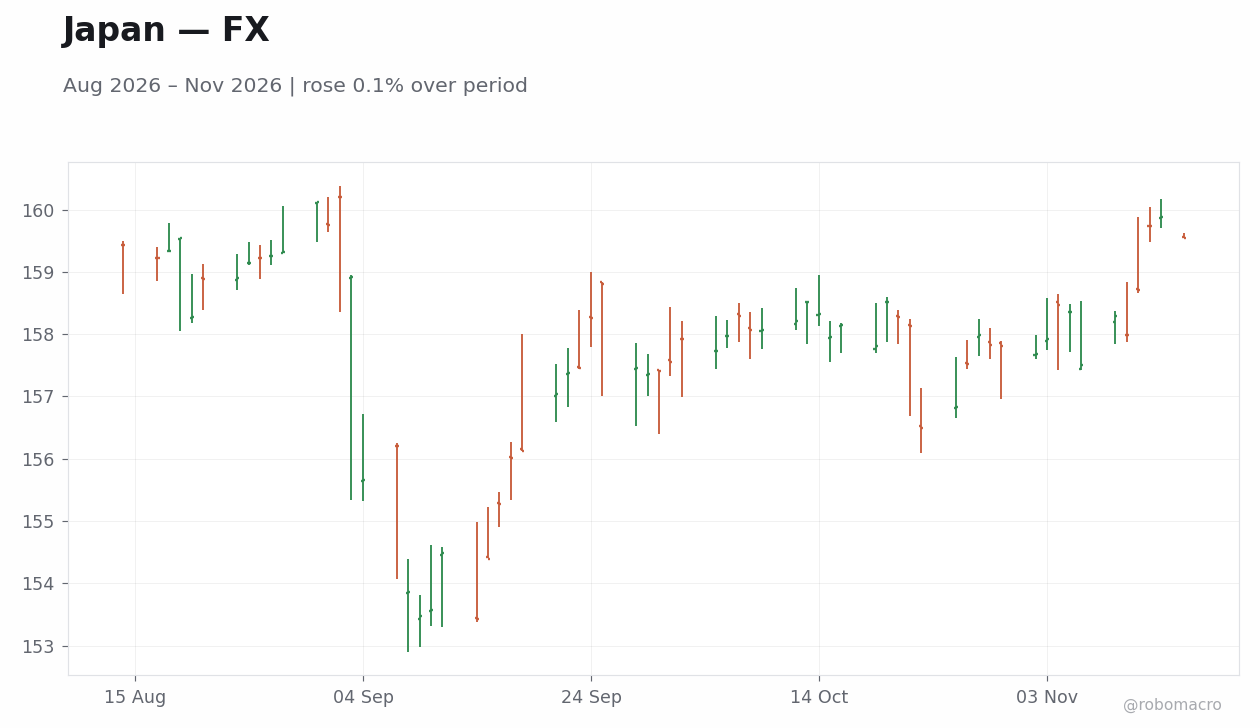
Nowcasts and Model Output: The US labour nowcast is the median of a ten-model ensemble. Activity indices are composite z-scores of weekly public high-frequency indicators, seasonally adjusted, published only for weeks meeting a minimum indicator-coverage threshold; the as-of date and coverage are shown on every row. All model output carries significant uncertainty.
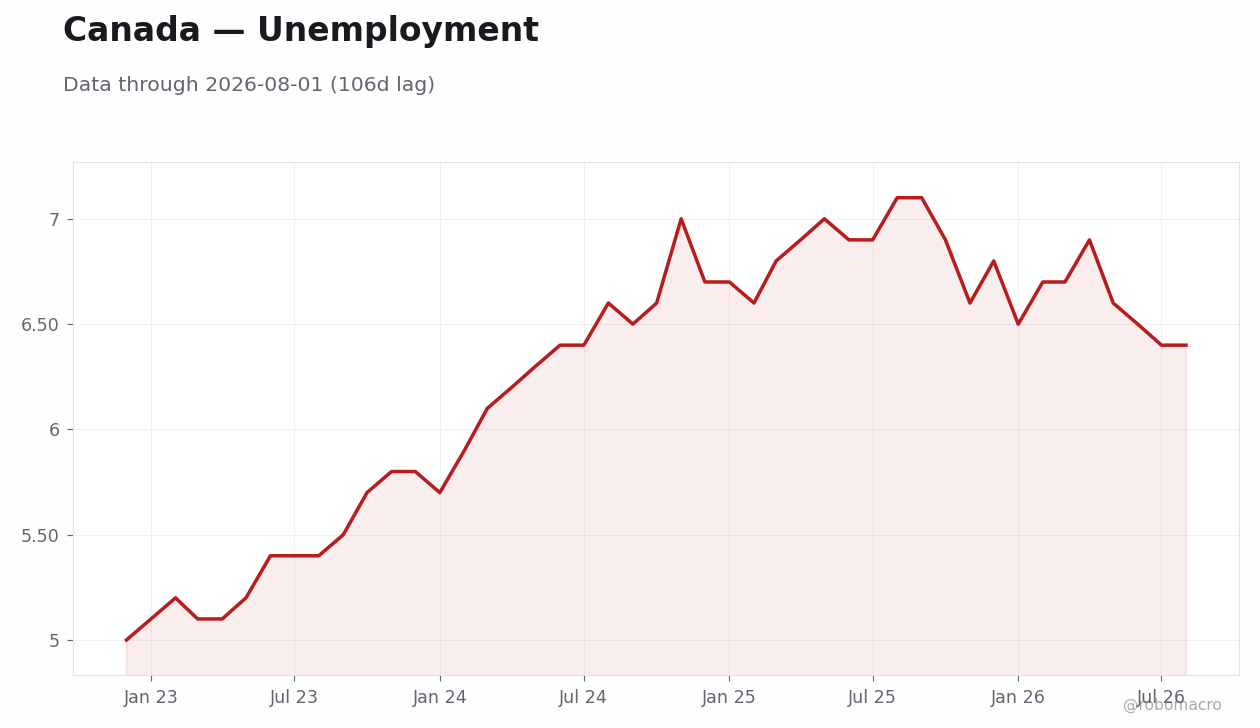
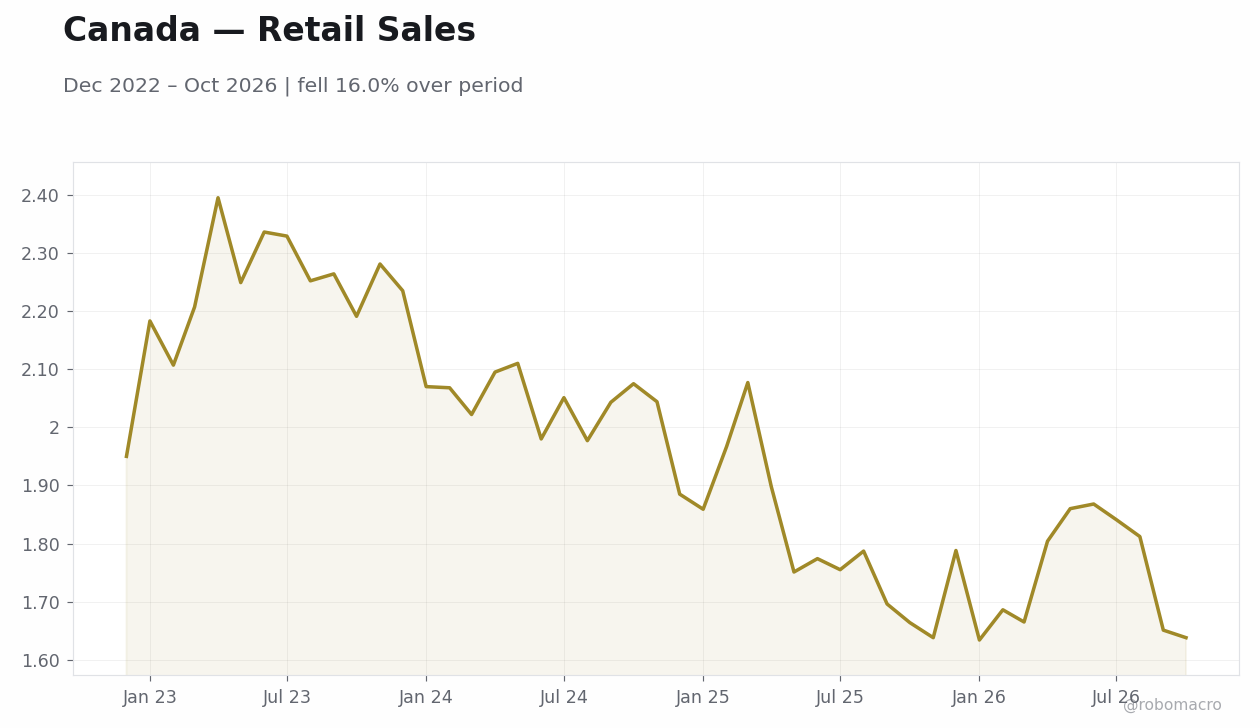
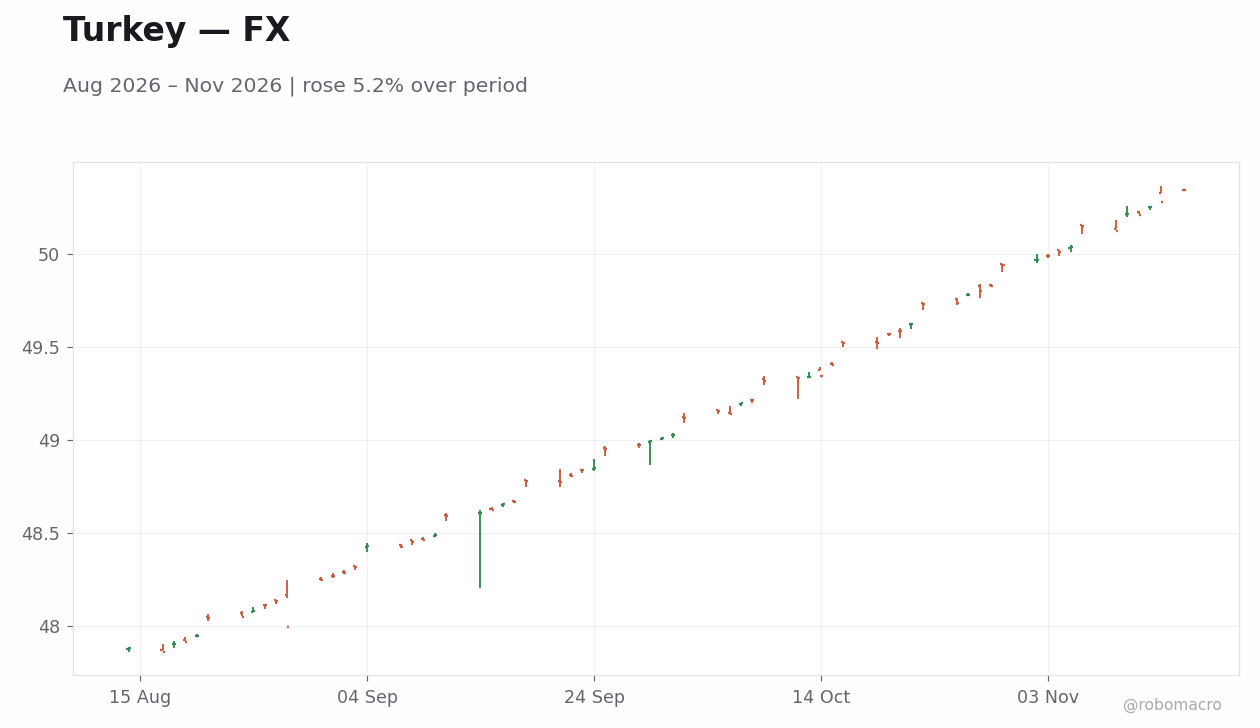
Contact: [email protected] | robomacro.com

Publication: Global Macro Watch is published weekly on Sundays, covering the preceding Monday-to-Friday week. © 2026 RoboMacro. All rights reserved.