RoboMacro AI Economic Research

Global Macro Watch

Also todaySee the FX Daily Week of November 2–6, 2026 robomacro.com
Global Macro Watch
Week of November 2–6, 2026
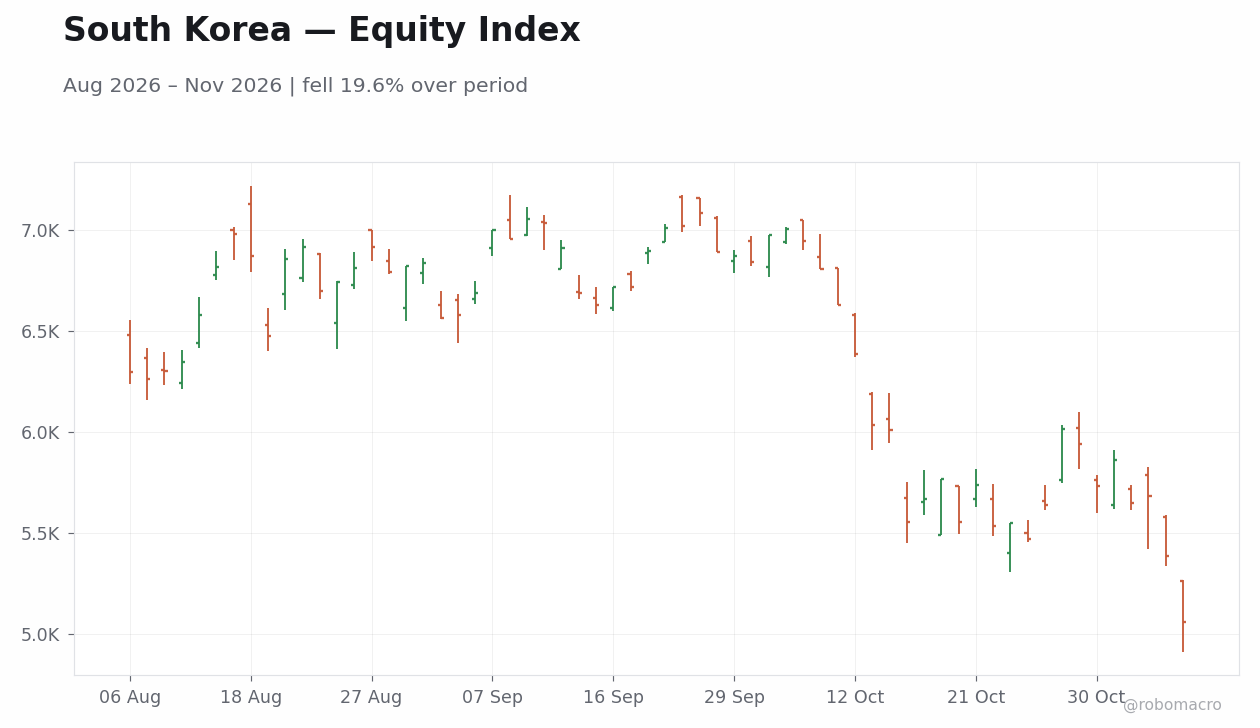
  • Equity dispersion widens with KOSPI declining 11.7 percent week-over-week
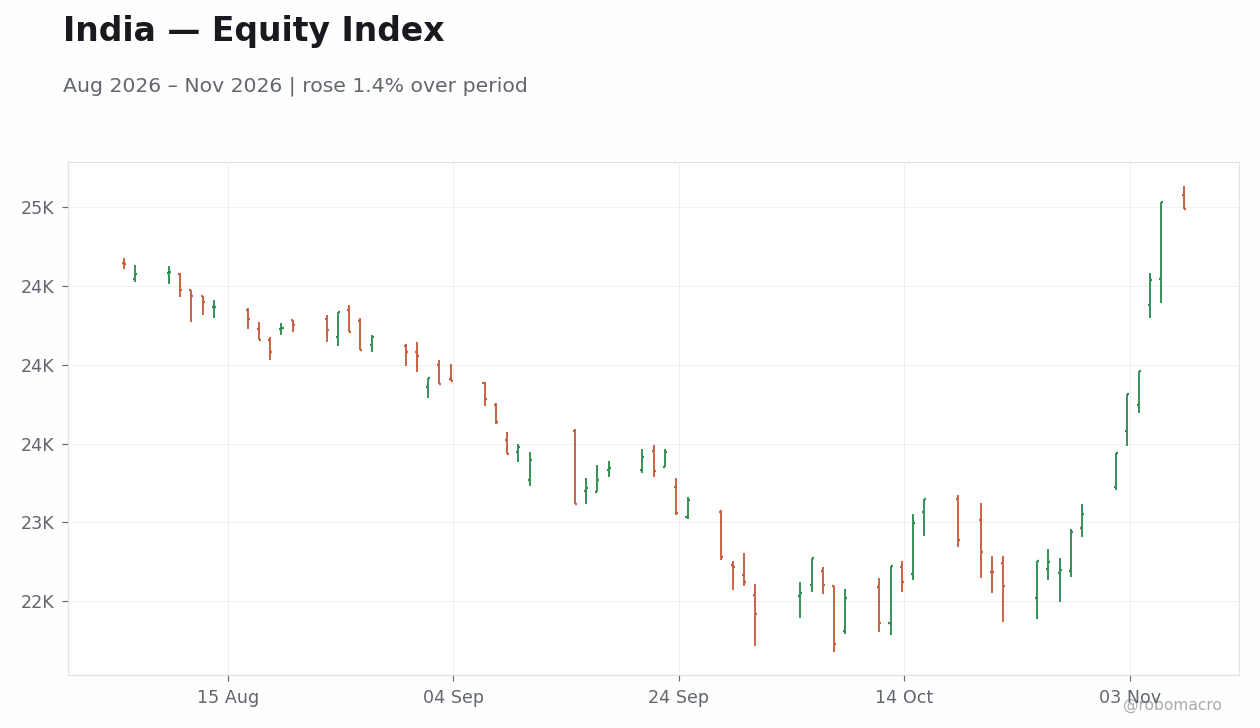
  • Nifty 50 advances 6.6 percent while Nikkei 225 falls 8.95 percent
  • Central banks deliver divergent rate decisions from BoC hike to Banxico cut
  • Cross-asset moves show gold rising to 4,074.90 amid Brent decline to 98.32
Equity Dispersion Tests Risk Appetite

Equity dispersion tests risk appetite

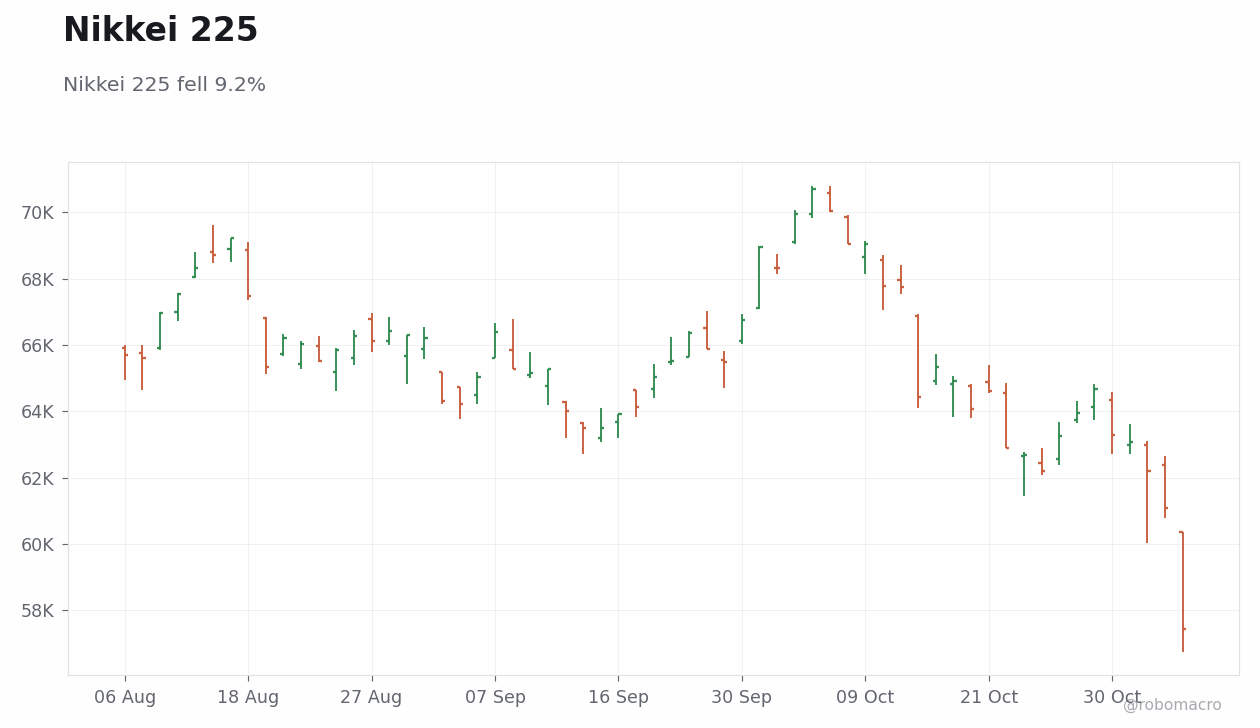
Global equity markets delivered the clearest signal on risk appetite this week. The risk metric reached 8.63, confirming equities remain the dominant driver. KOSPI posted the largest move at minus 11.7 percent to 5,059.69, with AI-related selling hitting Samsung and SK Hynix. Nikkei 225 fell 8.95 percent to 57,434.77 while Nasdaq 100 declined 4.9 percent. These moves occurred against a backdrop of US nonfarm payrolls beating expectations and the unemployment rate declining. The configuration places the global cycle in its mid-phase, where equity price action transmits external signals faster than most central banks can adjust. We note that the breadth of declines extended beyond typical tech exposures, yet selective resilience appeared in Nifty 50, which advanced 6.59 percent to 24,986.40, and JSE Top 40, which rose 3.23 percent to 104,714.00. This dispersion indicates that risk appetite has not collapsed uniformly but has narrowed to markets with clearer domestic activity support.

DM theme
Join the AIeconomist.app Waitlist

Published every Sunday afternoon 100% AI-generated — not financial advice
RoboMacro AI Economic Research

Global Macro Watch

Week of November 2–6, 2026 robomacro.com

Developed-market equity outcomes clustered around domestic data resilience rather than uniform risk-off flows. In the United States, ISM Manufacturing PMI rose above consensus with factory orders advancing more than expected, underscoring labor-market resilience that underpins the Federal Reserve’s data-dependent stance. Equities rotated sharply, with the Dow Jones advancing while the Nasdaq 100 declined and the 10-year Treasury yield eased. In the euro area, German retail sales contracted sharply m/m in September while Spanish manufacturing PMI rose and Italian manufacturing PMI fell. Euro Stoxx 50 closed the week at 6170.49 with a net change of minus 0.09 percent while German 10-year Bund yields fell. The Bank of Japan left the policy rate unchanged and stated the 2 percent price stability target has been generally achieved. Industrial production rebounded while retail sales slowed and the unemployment rate improved. Nikkei 225 fell 8.95 percent week-over-week as USD/JPY rose 0.47 percent to 158.43. In Canada, labour market indicators pointed to softening conditions with the unemployment rate moving higher. The Bank of Canada raised the policy rate and Governor Macklem pledged to proceed carefully on further increases. These contrasting signals leave DM rate paths apart and transmit uneven price signals across equity and fixed-income markets.
EM theme

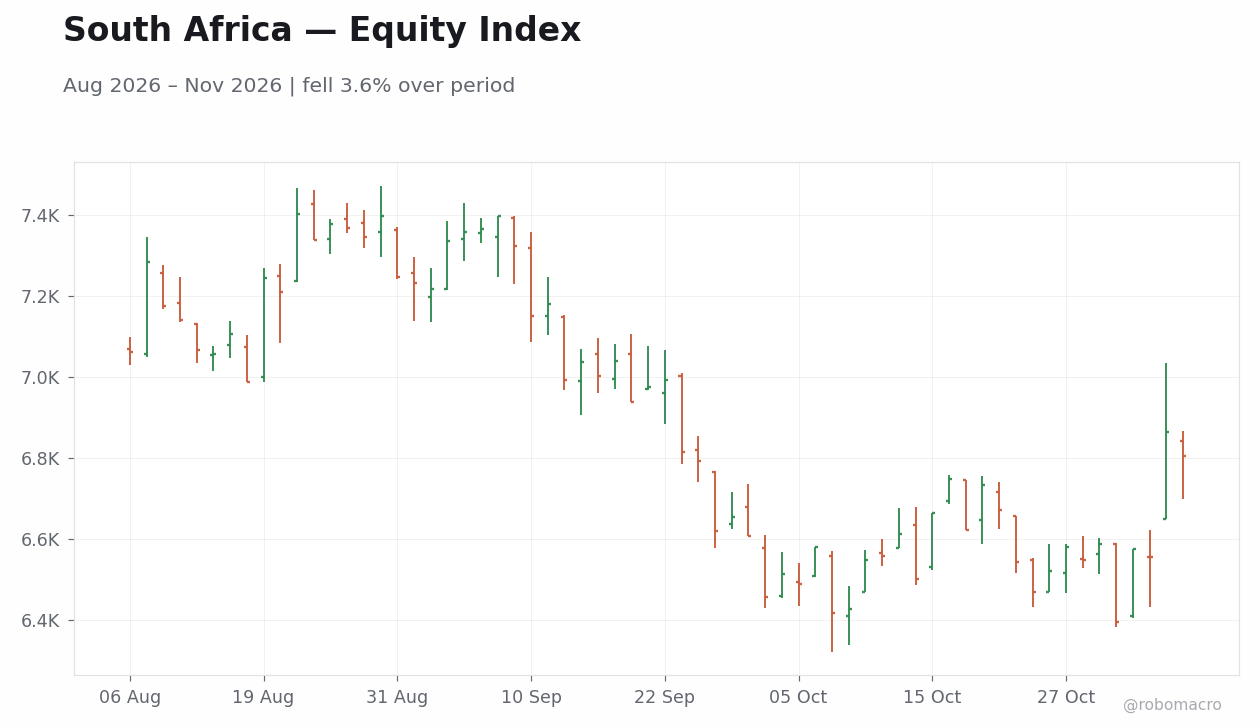
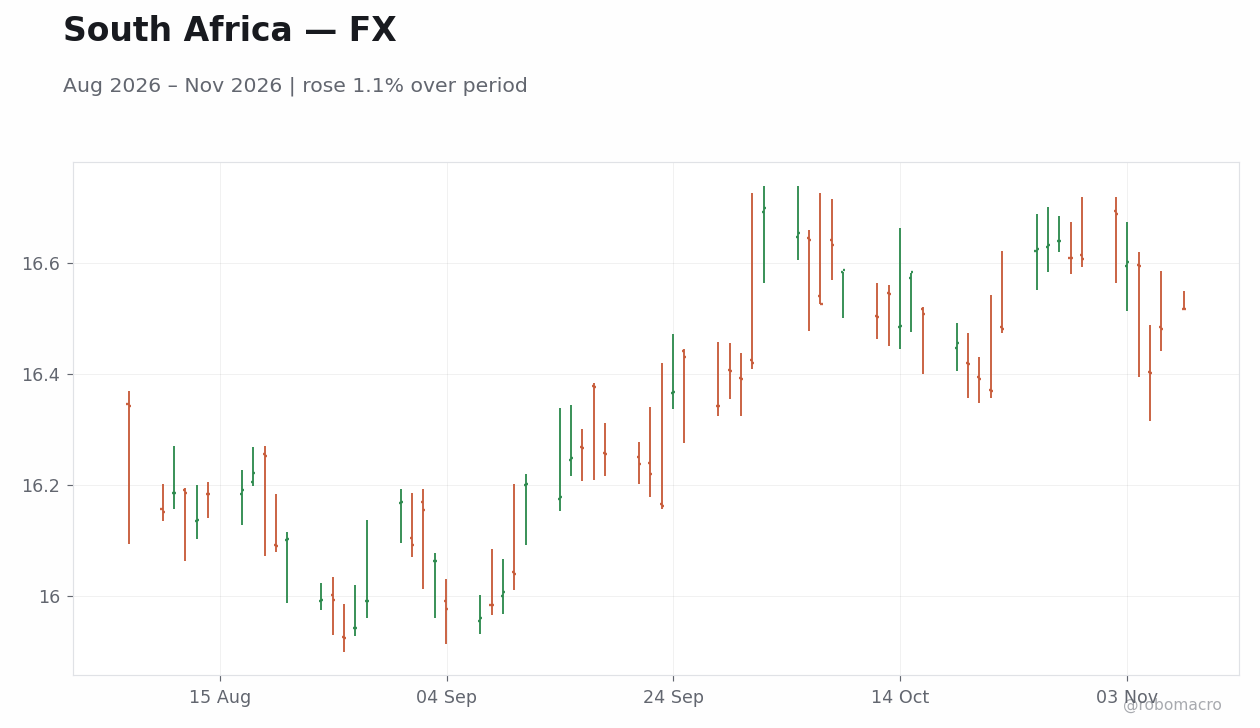
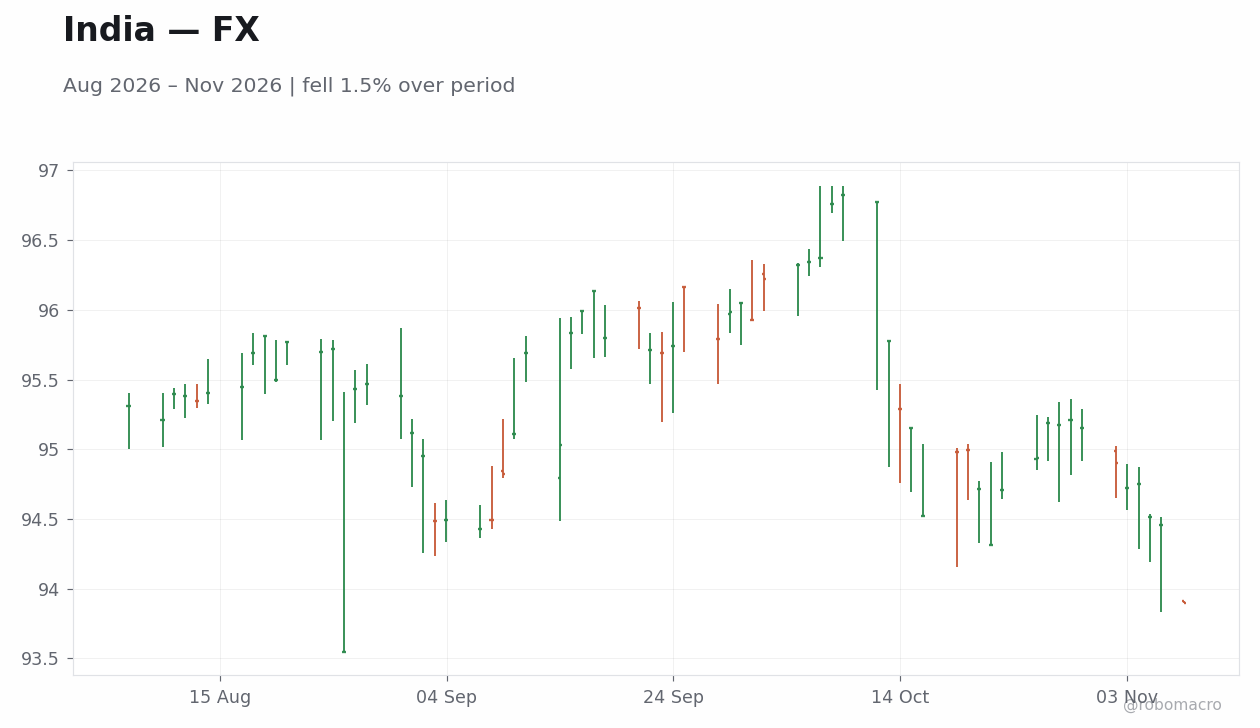
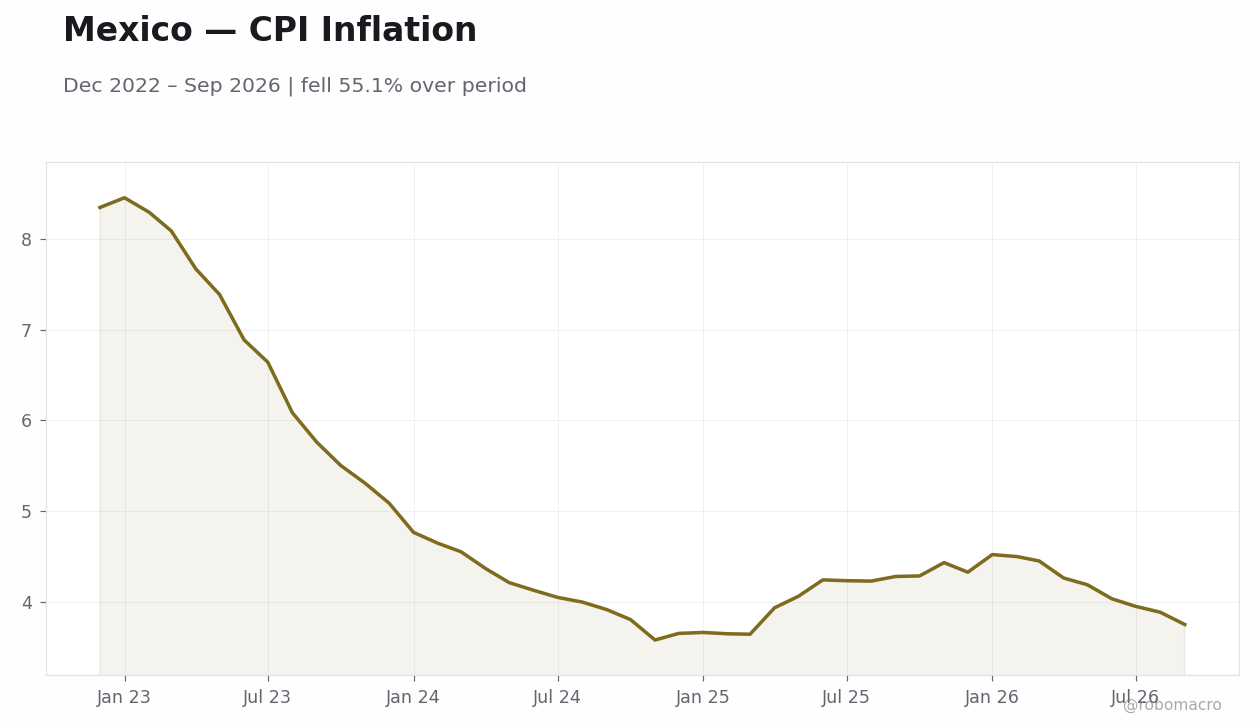
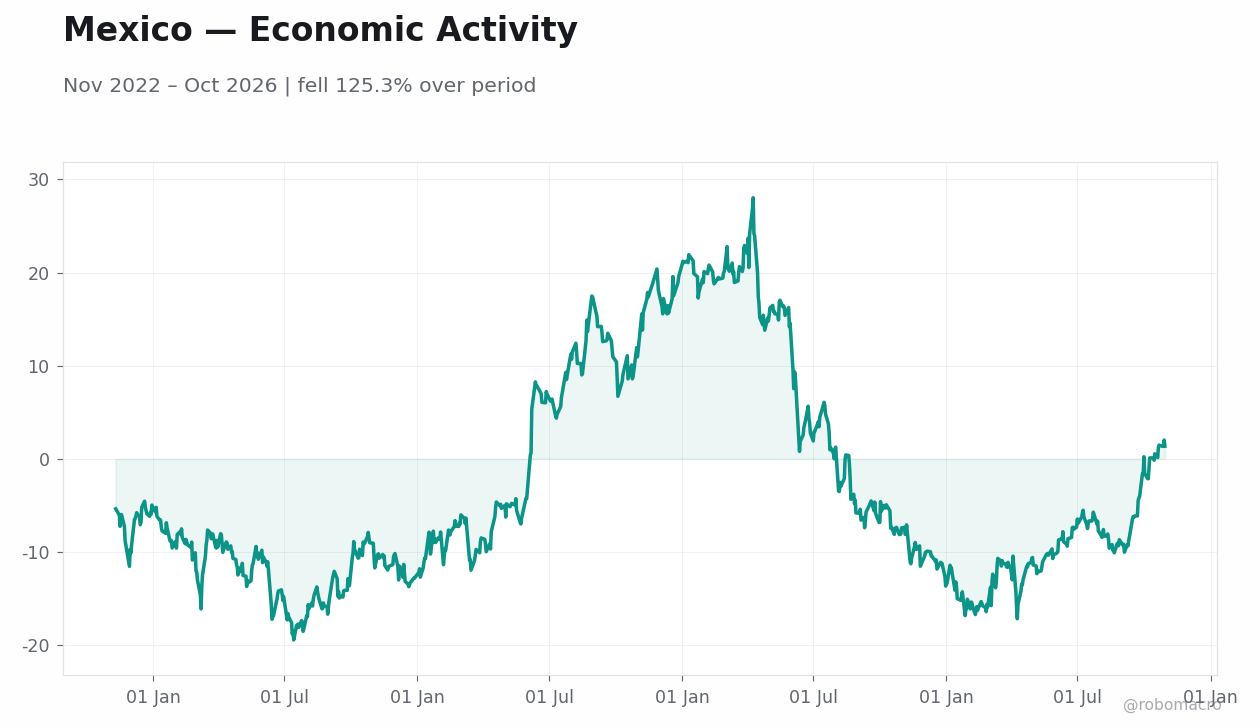
Emerging-market equity and currency moves split along domestic resilience versus external commodity pressure. Mexico’s Q3 GDP expanded, beating expectations and supporting resilient domestic activity into the November decision. Banco de Mexico cut the policy rate on November 5, diverging from consensus. Business Confidence Index rose while Consumer Confidence Index declined. In Brazil, COPOM held the policy rate after inflation projections deteriorated and the currency weakened. Activity indicators pointed to sharper contraction with services PMI moving deeper into contraction territory. The 10-year local yield moved higher and the Bovespa advanced while Petrobras shares declined. South Africa’s JSE Top 40 rose 3.23 percent to 104,714.00 while USD/ZAR fell 1.02 percent to 16.52, driven by platinum advancing 5.43 percent to 1,538.20 and gold rising 2.65 percent to 4,074.90. The South African Reserve Bank held the policy rate at 7.25 percent. India’s Nifty 50 advanced 6.59 percent to 24,986.40 while USD/INR declined 1.06 percent to 93.89 as RBI forex interventions eased. Regional dispersion underscores that EM risk appetite remains tethered to domestic activity prints rather than a single external impulse.

Cross-asset theme

RoboMacro AI Economic Research

Global Macro Watch

Week of November 2–6, 2026 robomacro.com

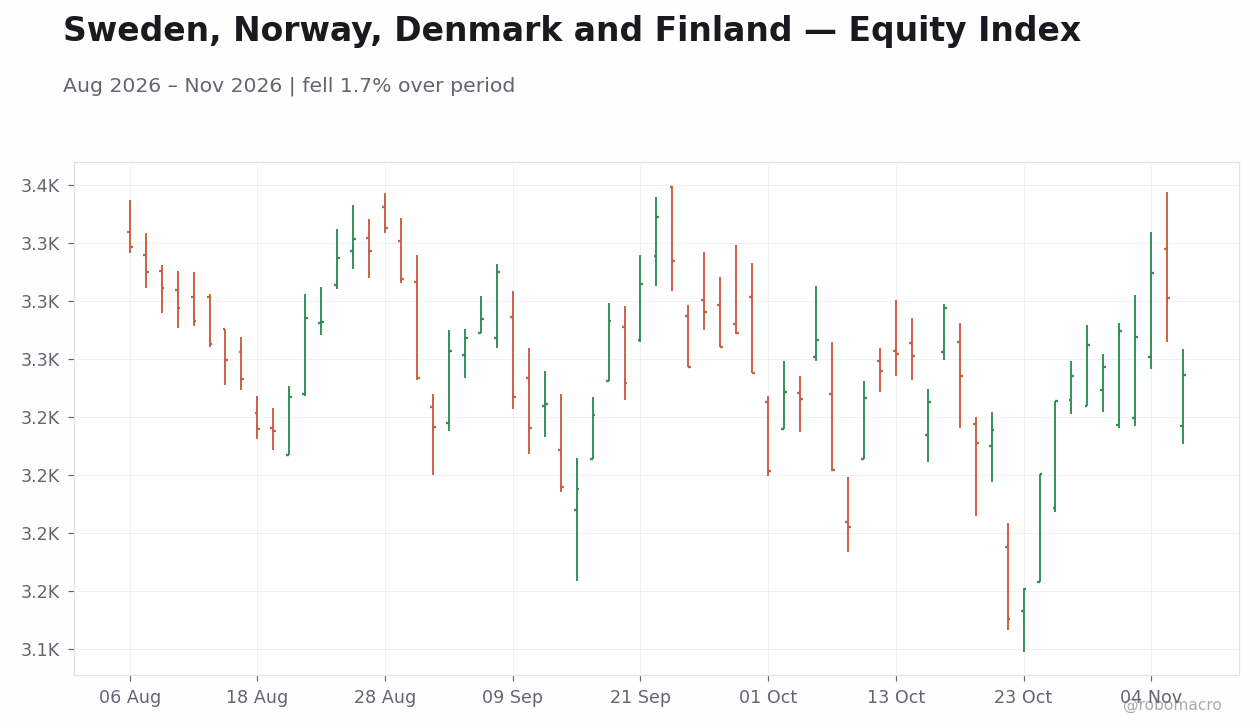
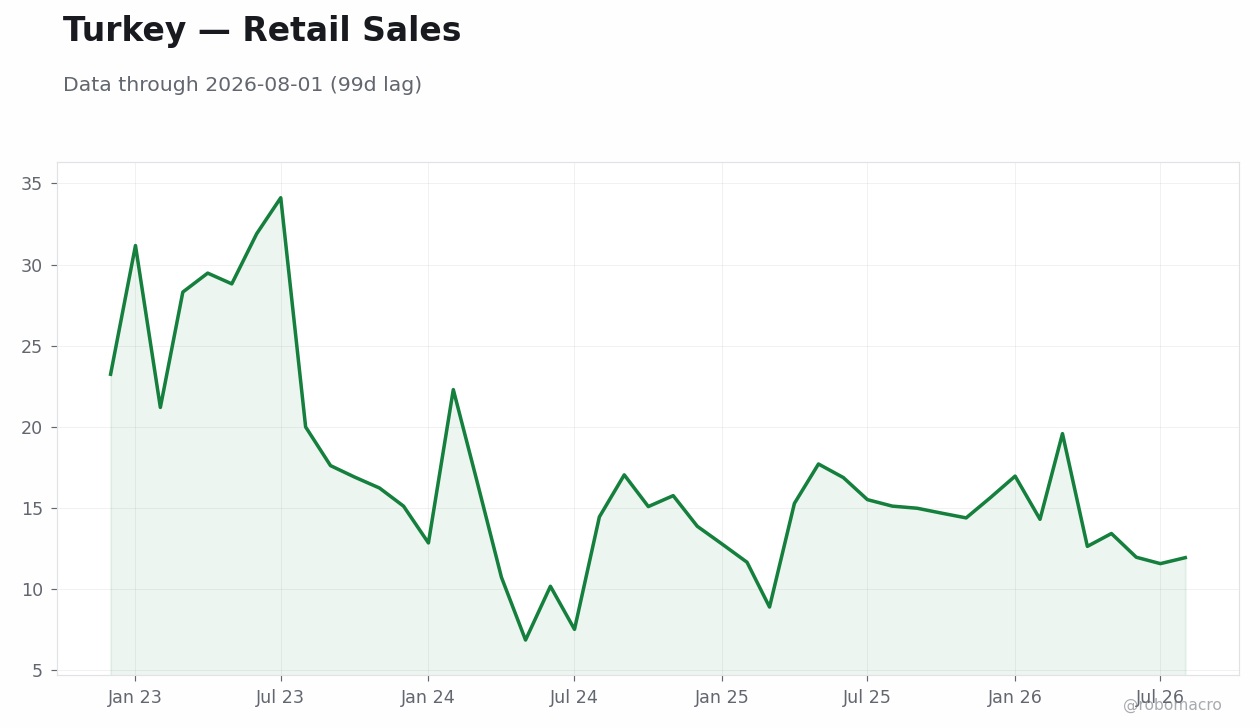
Cross-asset price action reveals safe-haven rotation amid equity volatility and commodity weakness. Brent crude fell 6.16 percent to 98.32 while WTI crude declined 12.8 percent. Gold rose to 4,074.90 on safe-haven demand. In the Nordic region, OMX Stockholm 30 fell 0.58 percent to 3267.88 and Oslo Bors declined 2.97 percent to 2053.36 amid the Brent move, while OMX Copenhagen 25 rose 1.15 percent to 2008.97. South African 10-year yields eased 29.0bp. Indian 10-year yields moved lower by 23.0bp. Australian inflation data prompted the RBA to raise the cash rate on November 3. New Zealand employment contracted and the unemployment rate rose. The configuration shows that commodity price weakness is transmitting unevenly, supporting selective equity resilience in India while pressuring energy-exposed Nordic and Latin American assets. Rates markets priced divergent policy paths without coordinated shifts.
Policy outlook

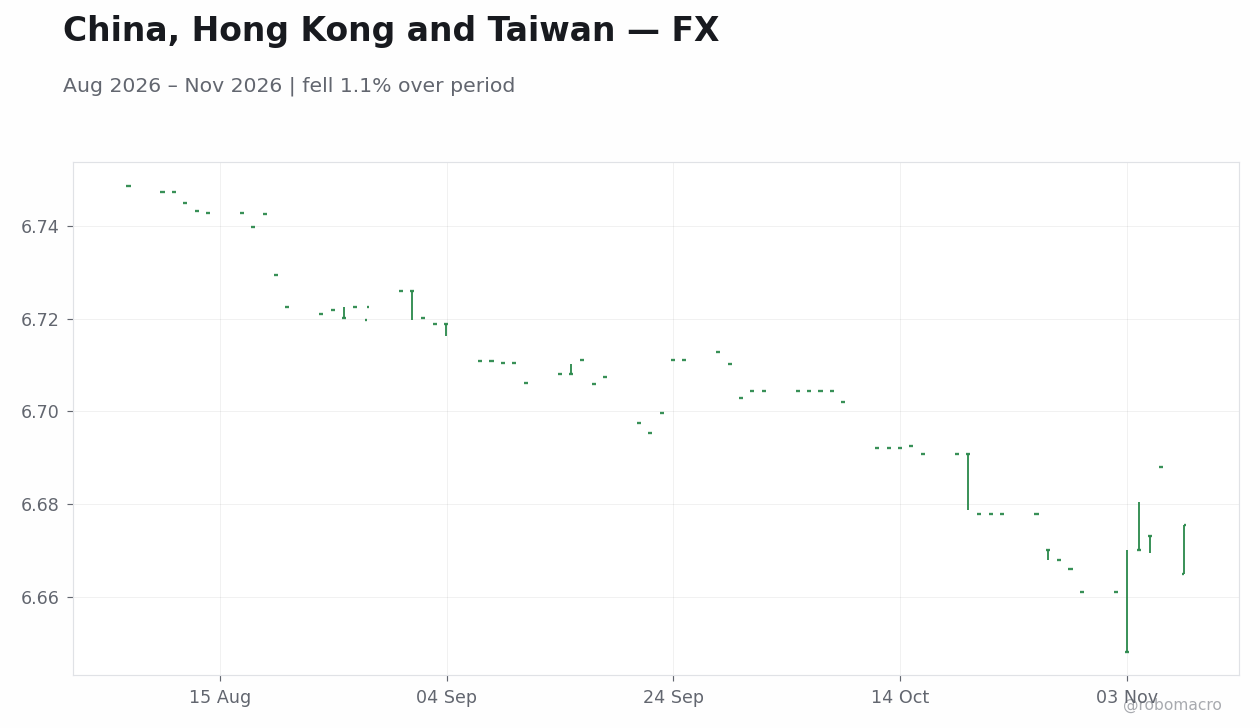
Central-bank divergence now defines the global policy landscape. The Bank of England raised the policy rate in a unanimous vote while Riksbank delivered a hike on November 4 and Norges Bank held its policy rate on November 5. Australian inflation data prompted the RBA to raise the cash rate. In contrast, Banco de Mexico cut the policy rate on November 5. The PBoC raised the FX reserve requirement ratio to cap yuan appreciation, producing the currency’s sharpest daily decline with USD/CNY closing at 6.68. Turkish inflation and trade data showed modest upside surprises, keeping the CBRT on a gradual easing path. The NBP held the policy rate as expected. This configuration leaves real-rate differentials intact and sustains the dispersion already visible in currency and equity markets. The data therefore suggest that investors must price separate policy trajectories rather than a single global impulse.

Forward look

Next week’s calendar features the US CPI release, Eurozone flash GDP prints, and the Bank of Japan’s Quarterly Outlook Report follow-up. Markets will watch whether the equity dispersion narrows or widens further after this week’s 8.63 risk metric reading. Central banks in Mexico, South Africa, and Turkey face domestic data that could alter their stated reaction functions. Commodity price moves, particularly Brent at 98.32, will continue to influence producer and importer fiscal positions. The absence of coordinated policy shifts suggests dispersion across asset classes will persist into mid-November.

RoboMacro AI Economic Research

Global Macro Watch

Week of November 2–6, 2026 robomacro.com
Global Economic Outlook Summary
IMF World Economic Outlook projections, % change year-on-year. Real GDP and average consumer prices. Retrieved November 08, 2026.
Economy Real GDP (% y/y) Consumer Prices (% y/y)
2026E2027E2028E 2026E 2027E2028E
Americas
United States2.32.32.13.62.82.1
Canada1.11.71.72.82.42.0
Mexico1.51.82.23.83.63.1
Brazil2.21.92.44.44.13.1
Argentina2.13.54.232.521.214.8
Colombia2.22.32.46.05.73.9
Chile0.62.62.43.73.53.0
Peru3.02.93.23.82.62.1
Asia / Pacific
Japan0.70.70.62.02.62.0
China4.54.04.01.01.41.6
India7.07.06.95.04.43.9
Australia1.91.61.83.93.12.5
New Zealand2.02.62.74.12.82.0
South Korea3.32.82.32.72.32.0
Indonesia5.15.15.23.32.82.5
Malaysia5.24.64.32.21.92.0
Philippines3.45.15.55.64.13.2
Singapore5.03.02.52.32.22.0
Thailand2.12.12.32.11.71.5
Taiwan10.74.33.22.01.81.6
Vietnam8.47.55.94.74.94.7
Western Europe
Euro area1.11.21.33.12.82.2
Germany1.31.11.12.73.12.0
France0.40.71.22.42.21.9
Italy0.80.60.73.32.82.3
Spain2.51.81.83.72.72.5
United Kingdom1.31.21.63.32.82.0
Sweden2.52.22.11.11.92.7
Norway1.51.31.13.22.82.3
Denmark3.72.01.81.82.52.0
Switzerland1.91.21.90.70.80.8
Netherlands1.51.31.42.92.82.6
Poland3.42.52.53.22.83.9
Czech Republic1.81.92.22.12.82.7
Hungary1.92.12.31.92.83.0
Romania-0.52.22.58.24.14.3
EMEA Emerging
Turkey2.73.64.031.226.520.6
South Africa1.01.31.54.43.93.3
Israel4.54.43.61.82.02.0
Saudi Arabia-3.37.94.81.92.22.0
UAE-3.97.77.04.52.52.0
Egypt5.14.75.013.314.88.9
Nigeria4.24.34.115.614.713.3
Kenya4.54.74.96.05.05.3
Global Aggregates
Global3.13.43.34.74.13.5
Developed markets2.11.81.73.12.72.1
Emerging markets3.74.44.35.75.14.4
E = IMF projection. Source: IMF World Economic Outlook, retrieved via the IMF DataMapper. Aggregates (Global, Developed markets, Emerging markets, Euro area) are the IMF's own groupings. A blank cell means the IMF does not publish a projection for that economy and year.
RoboMacro AI Economic Research

Global Macro Watch

Week of November 2–6, 2026 robomacro.com
Global Central Bank Watch
Policy rates as of November 08, 2026. Current rates, last changes and meeting dates are verified against central bank publications and BIS policy-rate data. Quarter columns show realized quarter-end rates for quarters that have completed.
Central Bank Instrument Current
Rate
Last
Change
bp Next
Meeting
Q1
2026
Q2
2026
Q3
2026
Q4
2026
The Americas
Federal ReserveFed funds upper4.00%Sep 2026+25Dec 93.753.754.00—
Bank of CanadaO/N rate2.50%Oct 2026+25Dec 92.252.252.25—
BCB (Brazil)SELIC13.75%Sep 2026-25Dec 914.7514.2513.75—
BanxicoO/N rate6.50%May 2026-25Dec 176.756.506.50—
BCRA (Argentina)Aggregates regime—Jul 2025——————
BanRep (Colombia)Repo12.25%Sep 2026+25—10.2511.2512.00—
BCCh (Chile)MPR4.50%Dec 2025-25—4.504.504.50—
Europe / Africa
ECBDepo rate2.50%Sep 2026+25Dec 172.002.252.50—
Bank of EnglandBank rate3.75%Dec 2025-25Dec 173.753.753.75—
RiksbankRepo rate1.75%Oct 2025-25Dec 161.751.751.75—
Norges BankDep rate4.50%Sep 2026+25Dec 174.004.254.50—
SNBPolicy rate0.00%Jun 2025-25Dec 100.000.000.00—
CNB (Czech)2-wk repo3.75%Jun 2026+25Dec 173.503.753.75—
NBH (Hungary)Base rate5.50%Aug 2026-25Nov 176.256.255.50—
NBP (Poland)Ref rate3.75%Mar 2026-25—3.753.753.75—
SARBRepo rate7.25%Sep 2026+25Nov 196.757.007.25—
CBRT (Turkey)1-wk repo36.00%Oct 2026-100Dec 1037.0037.0037.00—
Asia / Pacific
RBACash rate4.60%Sep 2026+25Dec 84.104.354.60—
RBNZOCR2.75%Sep 2026+25Dec 92.252.252.75—
BoJPol rate1.25%Sep 2026+25Dec 180.751.001.25—
PBoC1-yr LPR3.00%———3.003.003.00—
RBI (India)Repo rate5.25%Dec 2025-25—5.255.255.25—
BoK (Korea)Base rate3.00%Aug 2026+25—2.502.503.00—
BI (Indonesia)BI-Rate5.75%Jun 2026+25Nov 184.755.755.75—
BSP (Philippines)Rev repo5.50%Oct 2026+50—4.254.755.00—
BoT (Thailand)1-day repo1.00%Feb 2026-25Dec 231.001.001.00—
CBC (Taiwan)Disc rate2.00%Mar 2024+12.5—————
MAS (Singapore)SGD NEERMild appr.Apr 2026slope+—————
Changes to Consensus Rate Views This Week vs Nov 1
Bank of Canada current rate: 2.25→2.50 ▲ +25bp
Every figure on this page is verified against official central bank publications or BIS policy-rate data; a cell we cannot verify is left blank ("n/v") rather than estimated. Quarter columns show realized quarter-end rates only — no forward rate path is published, because market-implied pricing is not sourced for these banks. Shaded rows denote regional groupings. Data as of Week of November 2–6, 2026.
RoboMacro AI Economic Research

Global Macro Watch

Week of November 2–6, 2026 robomacro.com
Activity Tracking & NowcastReal-time growth pulse
RoboMacro US Labor Nowcast — Oct 2026 NFP
Nonfarm Payrolls (m/m)+76k  80% CI +16k…+299k
Unemployment Rate4.2%
Avg Hourly Earnings (y/y)3.3%
Point estimate = median of a 10-model ensemble (ElasticNet, LightGBM, MIDAS, SARIMAX, XGBoost, VAR, UC stochastic-trend, RF, MLP, naive-AR). Bands are model dispersion, not a forecast of revisions.
RoboMacro High-Frequency Activity Nowcast
Composite weekly activity index, diffusion-style (50 = neutral; >50 expansion), seasonally adjusted. Each economy combines 2–7 weekly public indicators — among them electricity and gas demand, flights, port calls, road traffic, card and payment volumes, job postings and tax deposits. A week is published only when indicators covering at least 70% of the index weight have reported and the week has closed; the as-of date and the share of indicators reporting are shown per row. Source: RoboMacro High-Speed Macro engine.
Economy Activity Index4-wk Δ13-wk Δ Week endingIndicators Signal
Germany75.3+26.9+29.12026-11-065/6Expanding · Advancing
Brazil74.0-9.2+7.62026-11-063/4Expanding · Retreating
Spain66.2+8.9+1.02026-10-305/5Expanding · Advancing
Italy65.9+4.3-4.32026-10-305/5Expanding · Advancing
Poland63.5+15.1+9.42026-11-063/4Expanding · Advancing
United States63.0+7.2+10.32026-10-307/7Expanding · Advancing
Japan61.3+3.3-6.52026-10-303/5Expanding · Advancing
Euro Area60.7+9.4+6.22026-10-305/5Expanding · Advancing
Canada60.2+1.0+1.92026-10-304/8Expanding · Advancing
France56.2+17.8+4.62026-10-304/5Expanding · Advancing
Australia52.4-14.9+2.42026-10-303/3Expanding · Retreating
New ZealandInsufficient current data — latest fully-covered week is 23d old; no reading published

Activity remains in expansion in United States, Euro Area, Germany, France, Italy, Spain, Japan, Canada, Brazil, Australia, Poland. On a 4-week basis, momentum is improving in United States, Euro Area, Germany, France, Italy, Spain, Japan, Canada, Poland and cooling in Brazil, Australia. RoboMacro's labor ensemble nowcasts the next US payrolls print at +76k.

Nowcasts are model-derived from high-frequency public data and update weekly as new releases arrive. Activity-index country coverage is expanding. A cross-country PMI matrix is planned pending a verified PMI data source.
RoboMacro AI Economic Research

Global Macro Watch

Week of November 2–6, 2026 robomacro.com
Markets in ReviewRates & Fixed Income
Rates & Fixed Income Chart 1
Rates & Fixed Income Chart 2
Rates & Fixed Income Chart 3
Rates & Fixed Income Chart 4

Week in Review

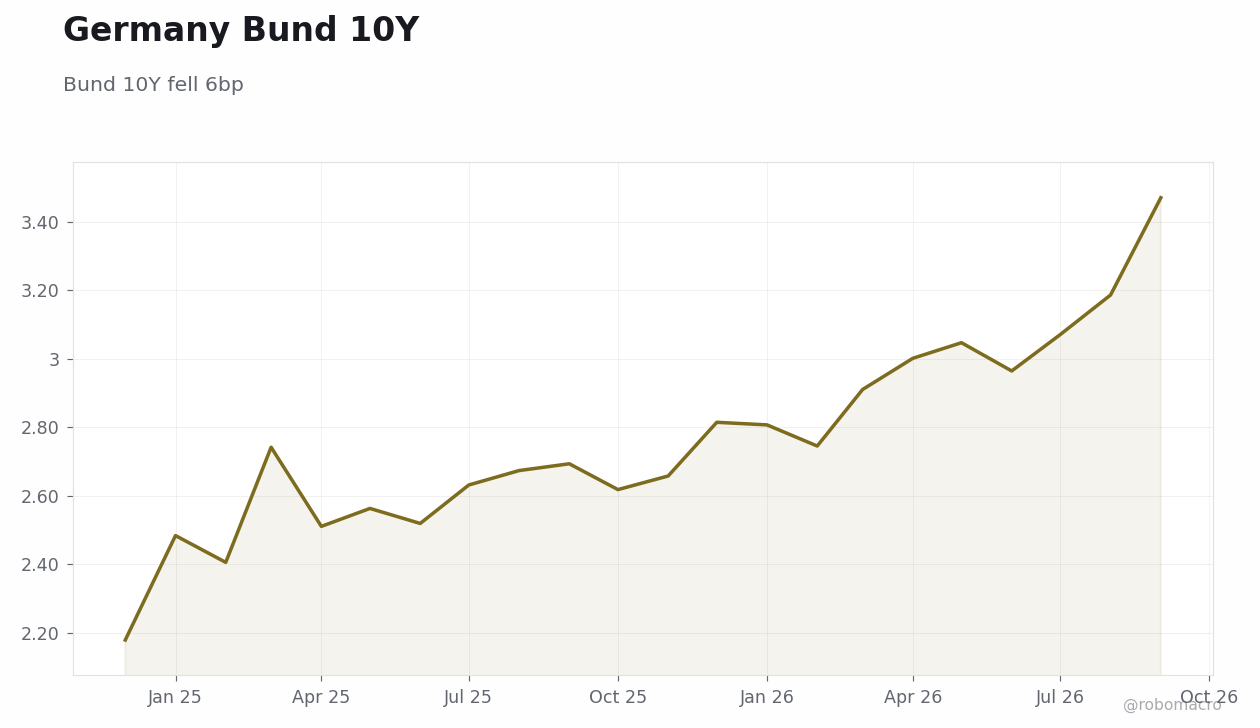
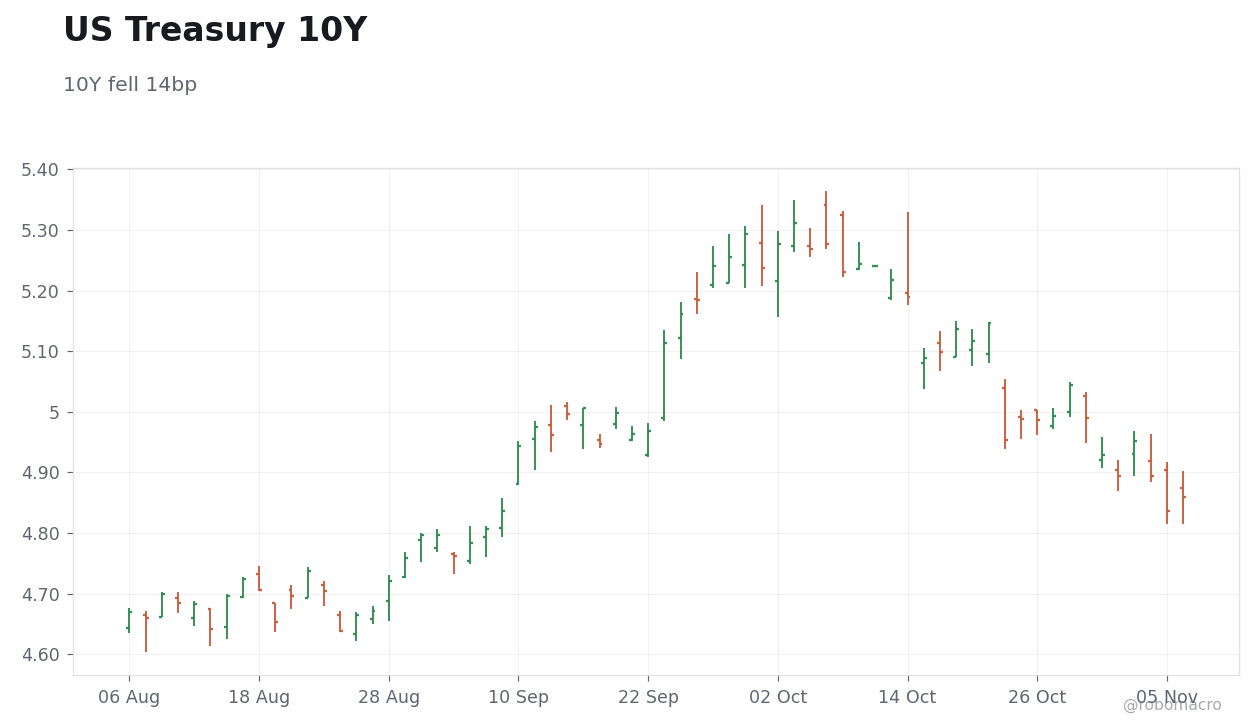
US Treasury yields recorded the largest DM decline, with the 10Y falling 14bp to 4.84%. The intra-week path for US yields showed an early rise, with the 10Y moving from 4.8940 on Monday to 4.9520 on Tuesday before declining to 4.8370 on Thursday and closing at 4.8590 on Friday. German 10Y yields fell 6bp to 3.25%, while UK 10Y gilt yields dropped 14bp to 5.16%. Japanese 10Y yields eased 13bp to 2.64%. These moves occurred amid safe-haven flows and despite resilient US labor data. UK and German curves reflected similar investor positioning toward the long end.

Curve & Spreads

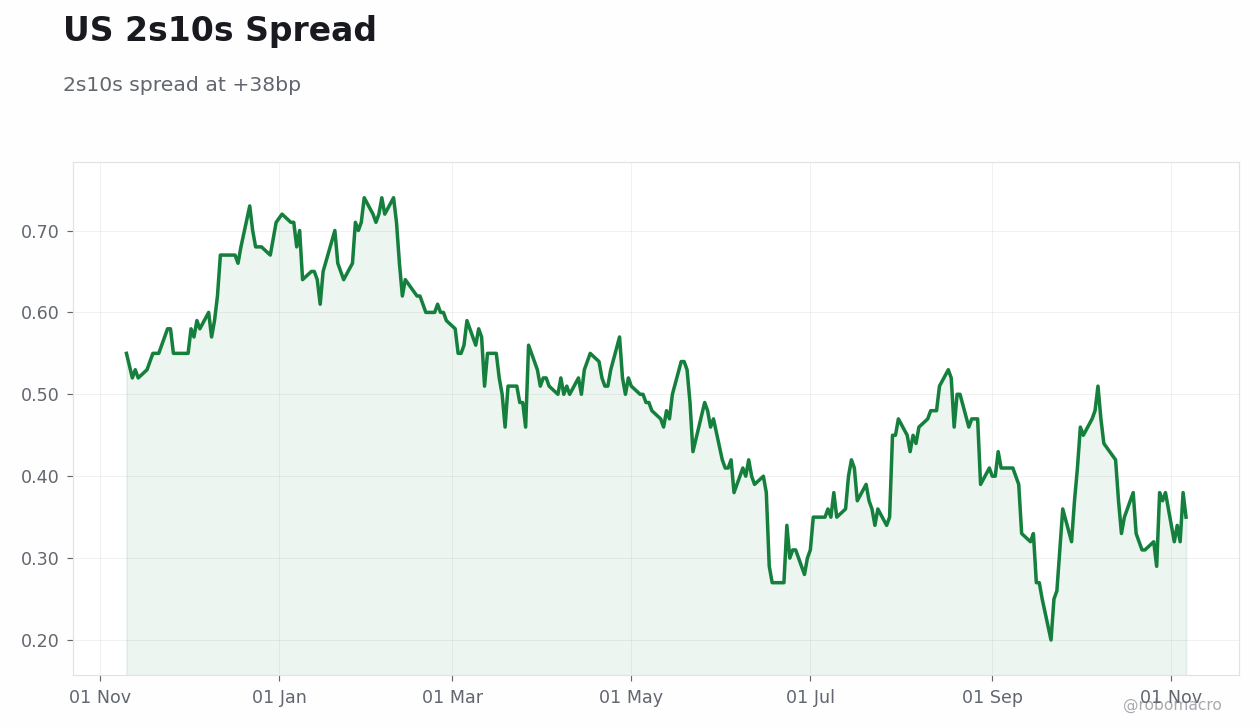
The US 2s10s stands at +38bp, the UK 2s10s at +39bp, and the German 2s10s at +28bp. The similarly positive slopes in the US and UK contrast with Germany’s flatter configuration. This curve shape implies moderately constructive growth expectations, with markets not pricing in either aggressive acceleration or sharp deceleration. The steeper US and UK spreads relative to Germany suggest growth views are marginally more optimistic in the former two markets.

EM Bonds

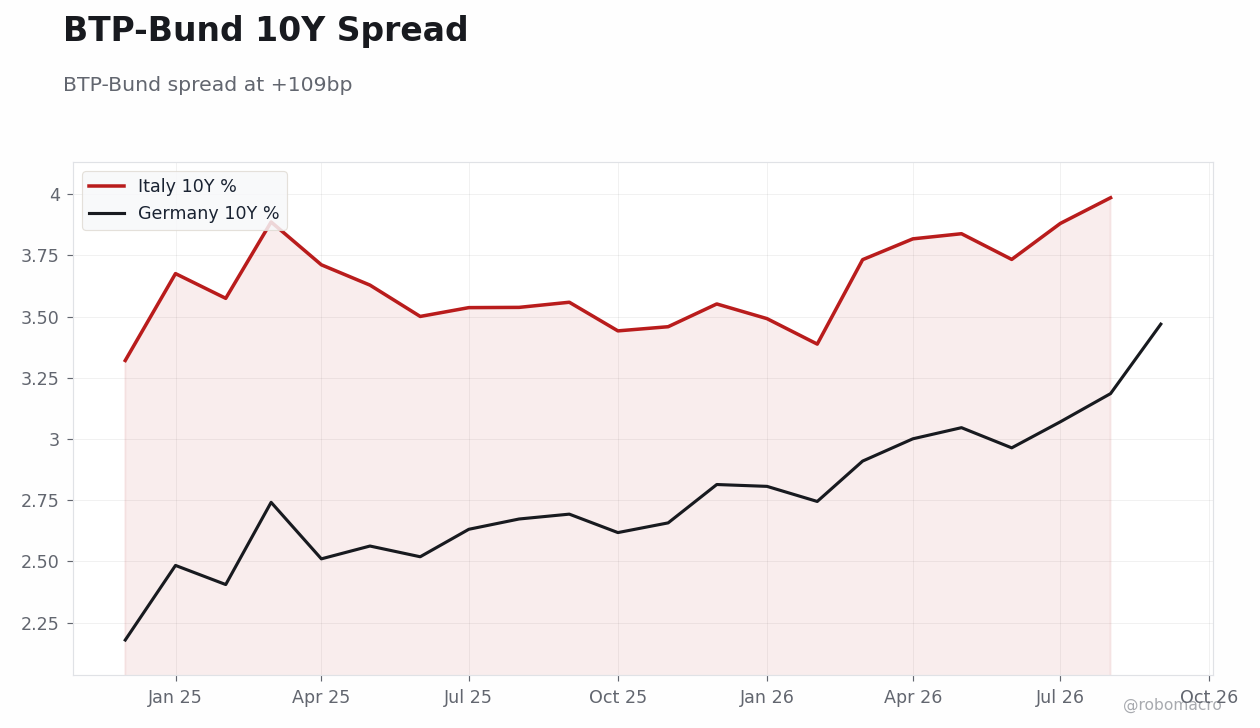
Turkish 10Y yields stand at 35.91% while Brazilian 10Y yields are at 15.18%. South African 10Y yields are at 8.44% and Indonesian 10Y yields are at 7.69%. These EM levels remain substantially elevated versus DM benchmarks such as the US 10Y at 4.84% and German 10Y at 3.25%, resulting in wide spread differentials. Turkey’s 2s10s at -370bp stands in sharp contrast to the positively sloped DM curves, underscoring distinct local dynamics.

Central Bank Read

Front-end versus back-end moves were broadly parallel in the US, with the 2Y falling 15bp against a 14bp decline in the 10Y and a 7bp drop in the 30Y, a configuration where the curve implies an easing bias. UK front-end yields fell 12bp on the 2Y while the 10Y declined 14bp, similarly implying an easing bias. German 2Y yields eased 4bp to 2.98% against a 6bp decline in the 10Y, reinforcing the same directional signal. Japanese 2Y yields fell 14bp to 1.73% while the 30Y was unchanged at 3.83%, a move that also implies an easing bias. Overall DM curve shapes suggest policy expectations have tilted toward gradual adjustment rather than further tightening.

Week Ahead

Next week’s inflation reports will be the primary focus for duration risk, as they will test whether the recent bond rally can be sustained. Central bank commentary from the Fed, ECB, BoE and BoJ will be watched closely for any shift in data-dependent guidance. GDP releases will also matter for gauging growth consistency with the current curve shape. These events are the most significant for rates positioning given the week’s safe-haven flows and mixed EM performance.

RoboMacro AI Economic Research

Global Macro Watch

Week of November 2–6, 2026 robomacro.com
Markets in ReviewFixed Income
Global Government Bond Yields
Yields in %. WoW change in basis points, over the five trading sessions to the latest close. US tenors are Treasury constant-maturity yields (Federal Reserve); international tenors are benchmark government yields from public market data.
Country2Y2Y WoW10Y10Y WoW30Y30Y WoW2s10s
United States4.46%-15bp4.84%-14bp5.25%-7bp+38bp
United Kingdom4.77%-12bp5.16%-14bp5.61%-11bp+39bp
Germany2.98%-4bp3.25%-6bp3.63%-5bp+28bp
France3.49%-17bp4.77%-20bp5.31%-15bp+128bp
Italy3.44%-0bp4.34%-15bp4.95%-14bp+90bp
Spain3.08%-9bp3.85%-10bp4.36%-10bp+76bp
Japan1.73%-14bp2.64%-13bp3.83%-0bp+91bp
Canada3.15%-16bp3.66%-14bp4.00%-12bp+51bp
Australia4.83%-10bp5.02%-13bp5.45%-10bp+19bp
China1.21%-3bp1.59%-6bp2.03%-6bp+38bp
India6.70%-20bp7.17%-23bp7.68%-16bp+47bp
Brazil14.65%-24bp15.18%-23bp——+53bp
Mexico——9.12%-16bp———
South Korea3.60%-11bp3.85%-17bp3.96%-18bp+24bp
Indonesia——7.69%+5bp7.76%-1bp—
Turkey39.62%-15bp35.91%+5bp——-370bp
South Africa——8.44%-29bp8.73%-25bp—
Poland——6.18%-20bp———

Government bond yields fell across most markets, with South Africa’s 10-year down 29bp, India’s 10-year declining 23bp, and Brazil’s 10-year easing 23bp. The United States 2-year yield dropped 15bp to 4.46% and the 10-year fell 14bp to 4.84%, widening the 2s10s curve to +38bp. France recorded the sharpest euro-area declines, with the 10-year yield off 20bp to 4.77% and the 2s10s steepening to +128bp. Japan’s 2-year yield fell 14bp to 1.73% while the 10-year eased 13bp to 2.64%, pushing the 2s10s to +91bp. Turkey’s 10-year rose 5bp to 35.91% and Indonesia’s 10-year added 5bp to 7.69%, the only notable increases. Canada’s 2-year declined 16bp to 3.15% and Australia’s 10-year fell 13bp to 5.02%. Curves steepened broadly, led by France, Japan, and Italy. Next week’s focus will center on inflation releases and central-bank speeches for further direction.

RoboMacro AI Economic Research

Global Macro Watch

Week of November 2–6, 2026 robomacro.com
Markets in ReviewGlobal Equities
Global Equities Chart 1
Global Equities Chart 2
Global Equities Chart 3
Global Equities Chart 4

Week in Review

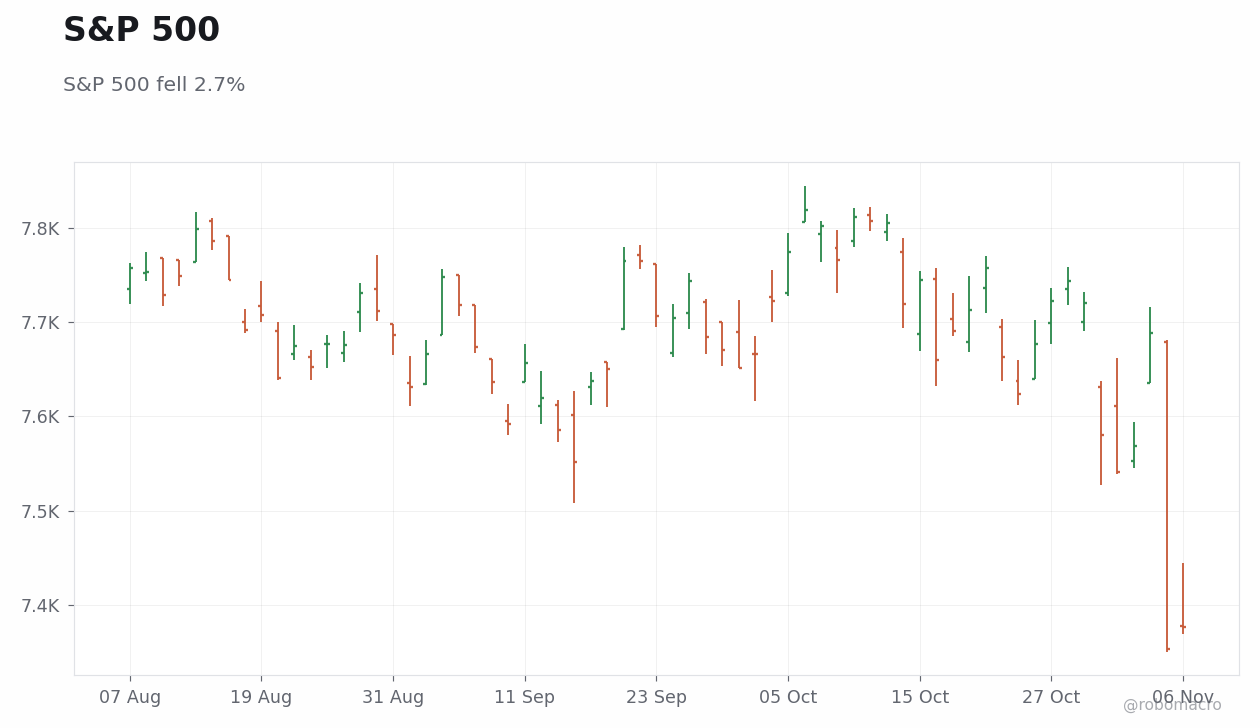
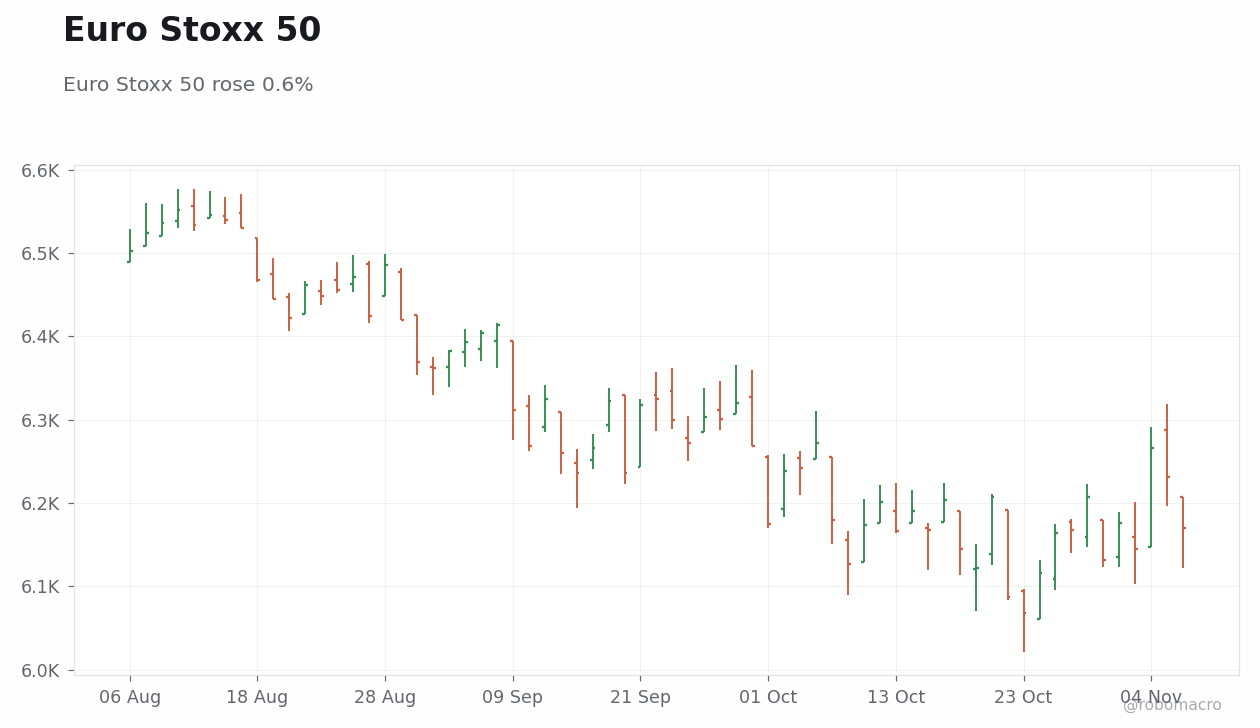
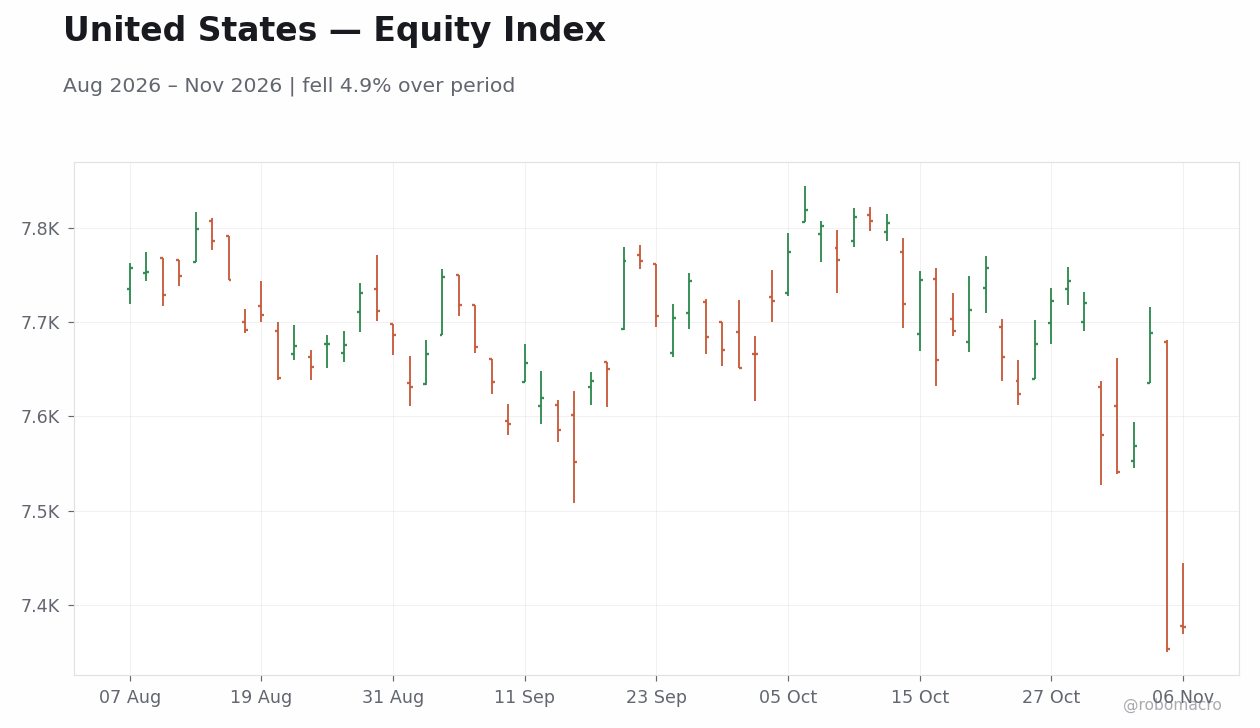
The S&P 500 fell 2.7% week-over-week to 7,377. The index climbed from Monday's close of 7,541 to 7,569 on Tuesday and a mid-week peak of 7,689 on Wednesday before reversing sharply on Thursday to 7,354 amid a tech-led sell-off and closing the week at 7,377 on Friday. In the US, the Nasdaq 100 declined 4.9% to 26,990 while the Dow Jones fell 0.9% to 51,286 and the Russell 2000 lost 2.0% to 2,754. European equities showed resilience with the Euro Stoxx 50 rising 0.6% to 6,170, the CAC 40 gaining 2.1% to 8,139, the FTSE MIB up 1.1% to 50,053 and the IBEX 35 advancing 3.8% to 19,370, although the FTSE 100 slipped 0.5% to 10,674. Asian markets experienced heavy losses as the Nikkei 225 fell 9.2% to 57,435, sliding from 63,290 the prior Friday through 63,082 on Monday, 62,189 on Wednesday and 61,078 on Thursday, while the KOSPI dropped 11.7% to 5,060. EM indices diverged positively with the Hang Seng up 5.1% to 24,482, Nifty 50 rising 6.6% to 24,986, JSE Top 40 gaining 5.3% to 104,714, IPC Mexico up 2.3% to 71,394, S&P/TSX advancing 0.5% to 35,789 and Ibovespa edging 0.3% higher to 168,499.

Regional Divergences

US indices lagged with the S&P 500 down 2.7% and Nasdaq 100 down 4.9% as nonfarm payrolls beat expectations, the unemployment rate declined and ISM Manufacturing PMI rose above consensus, confirming industrial momentum but triggering rotation away from growth stocks. European markets diverged higher with the Euro Stoxx 50 up 0.6%, CAC 40 up 2.1%, FTSE MIB up 1.1% and IBEX 35 up 3.8% despite German retail sales contracting sharply and persistent growth divergence across the euro area. Japanese equities suffered the steepest losses with the Nikkei 225 down 9.2% after the Bank of Japan left the policy rate unchanged while noting that the 2 percent price stability target has been generally achieved. EM performance was mixed but predominantly firmer, with the Nifty 50 up 6.6%, JSE Top 40 up 5.3% and IPC Mexico up 2.3%, reflecting varied reactions to rate decisions including the Bank of Canada hike, Banco de Mexico cut, COPOM pause in Brazil and Bank of England hike.

Volatility & Risk Appetite

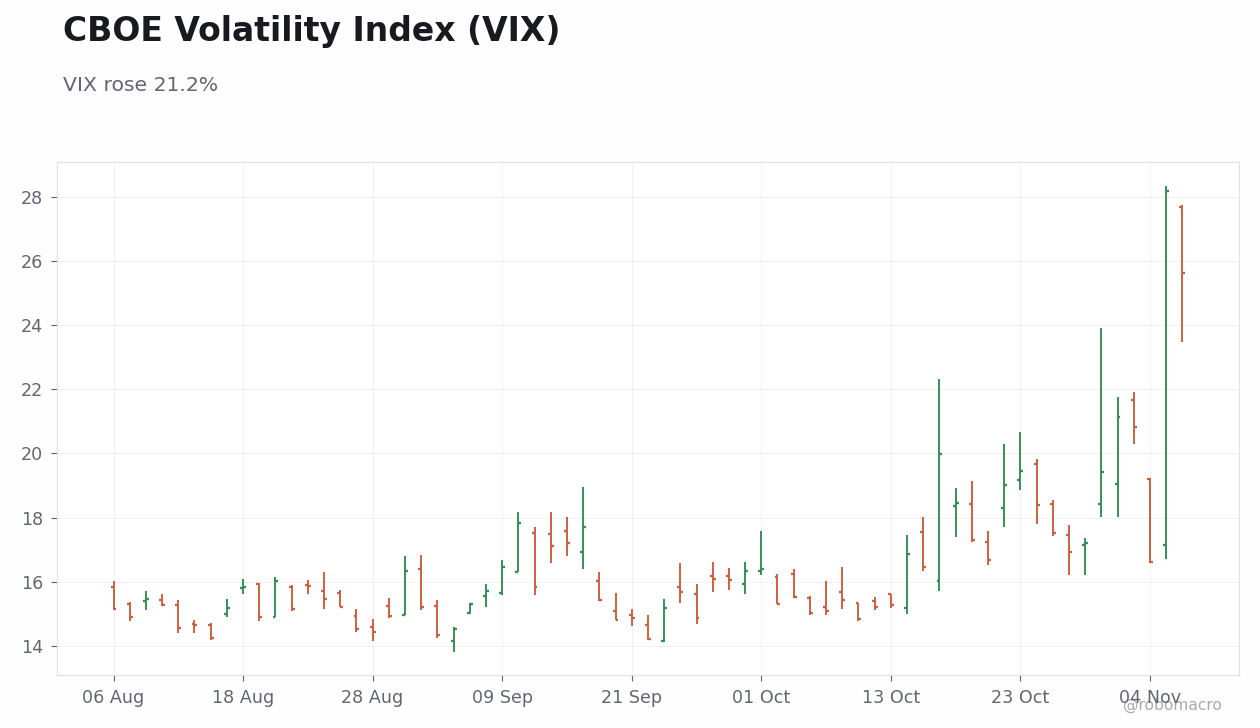
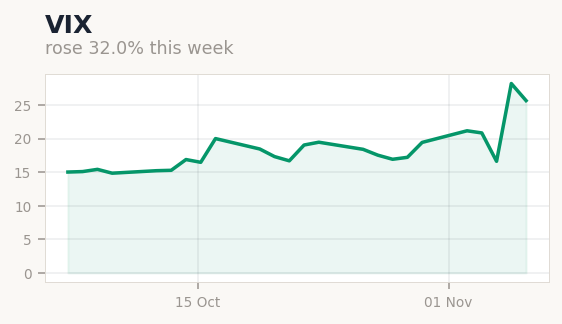
The VIX closed at 25.6 on Friday after spiking to 28.2 on Thursday. Growth significantly underperformed value as the Nasdaq 100 fell 4.9% versus the Dow Jones decline of 0.9%. Small caps displayed relative resilience with the Russell 2000 down 2.0% compared with the S&P 500's 2.7% drop. Commodity moves signaled sector pressure with WTI Crude down 12.8% and Brent Crude down 16.4%, weighing on energy while gold rose 4.5% and silver rose 5.8%, pointing to safe-haven demand. Falling bond yields and a shift toward defensive assets underscored reduced risk appetite amid the global equity rout and semiconductor weakness.

Week Ahead

The economic calendar for next week is light. Upcoming earnings reports, PMI releases and GDP prints will be monitored for confirmation of economic momentum. Central bank speakers may provide further commentary following this week's policy decisions. Hotter-than-expected data would likely favor risk-off moves for equities while softer prints could support risk-on sentiment.

RoboMacro AI Economic Research

Global Macro Watch

Week of November 2–6, 2026 robomacro.com
Markets in ReviewGlobal Equities
Global Equity Indices
Week-on-week, month-to-date, year-to-date. WoW is the change over the seven calendar days to the latest close. Source: public market data.
IndexLevelWoWMTDYTD
S&P 5007,377-2.7%-2.2%+7.6%
Nasdaq 10026,990-4.9%-3.6%+7.1%
Dow Jones51,286-0.9%-1.3%+6.0%
Russell 20002,754-2.0%-1.9%+9.8%
S&P/TSX35,789+0.5%-0.0%+12.2%
FTSE 10010,674-0.5%-0.8%+7.3%
Euro Stoxx 506,170+0.6%-0.1%+4.2%
DAX25,820+0.0%-0.6%+5.2%
CAC 408,139+2.1%+1.1%-0.7%
FTSE MIB50,053+1.1%+0.2%+10.3%
IBEX 3519,370+3.8%+2.2%+10.7%
Nikkei 22557,435-9.2%-8.9%+10.8%
Hang Seng24,482+5.1%+4.7%-7.0%
S&P/ASX 2009,021+1.3%+1.9%+3.4%
KOSPI5,060-11.7%-13.6%+17.4%
Nifty 5024,986+6.6%+6.6%-4.4%
Ibovespa168,499+0.3%+1.8%+5.0%
IPC Mexico71,394+2.3%+1.7%+11.3%
JSE Top 40104,714+5.3%+3.2%-3.2%

Global equities diverged sharply in the week of November 2–6. The KOSPI fell 11.7% and the Nikkei 225 dropped 9.2%, while the Nasdaq 100 declined 4.9% and the S&P 500 lost 2.7%. In contrast, the Nifty 50 rose 6.6%, the JSE Top 40 gained 5.3%, and the Hang Seng advanced 5.1%. European bourses showed resilience, with the IBEX 35 up 3.8% and the CAC 40 adding 2.1%, outpacing the flat DAX and the FTSE 100’s 0.5% decline. The S&P/TSX edged 0.5% higher as U.S. underperformance weighed on broader sentiment. Year-to-date, the KOSPI leads with a 17.4% gain despite the weekly selloff, followed by the IBEX 35 at 10.7%. Next week’s focus will remain on whether the sharp Asia-Pacific and tech-led pullback extends or stabilizes against emerging-market outperformance.

Equity Performance Heat Map
IndexWoWMTDYTD
S&P 500-2.7%-2.2%+7.6%
Nasdaq 100-4.9%-3.6%+7.1%
Dow Jones-0.9%-1.3%+6.0%
Russell 2000-2.0%-1.9%+9.8%
S&P/TSX+0.5%-0.0%+12.2%
FTSE 100-0.5%-0.8%+7.3%
Euro Stoxx 50+0.6%-0.1%+4.2%
DAX+0.0%-0.6%+5.2%
CAC 40+2.1%+1.1%-0.7%
FTSE MIB+1.1%+0.2%+10.3%
IBEX 35+3.8%+2.2%+10.7%
Nikkei 225-9.2%-8.9%+10.8%
Hang Seng+5.1%+4.7%-7.0%
S&P/ASX 200+1.3%+1.9%+3.4%
KOSPI-11.7%-13.6%+17.4%
Nifty 50+6.6%+6.6%-4.4%
Ibovespa+0.3%+1.8%+5.0%
IPC Mexico+2.3%+1.7%+11.3%
JSE Top 40+5.3%+3.2%-3.2%
RoboMacro AI Economic Research

Global Macro Watch

Week of November 2–6, 2026 robomacro.com
Markets in ReviewFX & Digital Assets
FX & Digital Assets Chart 1
FX & Digital Assets Chart 2
FX & Digital Assets Chart 3
FX & Digital Assets Chart 4

Week in Review

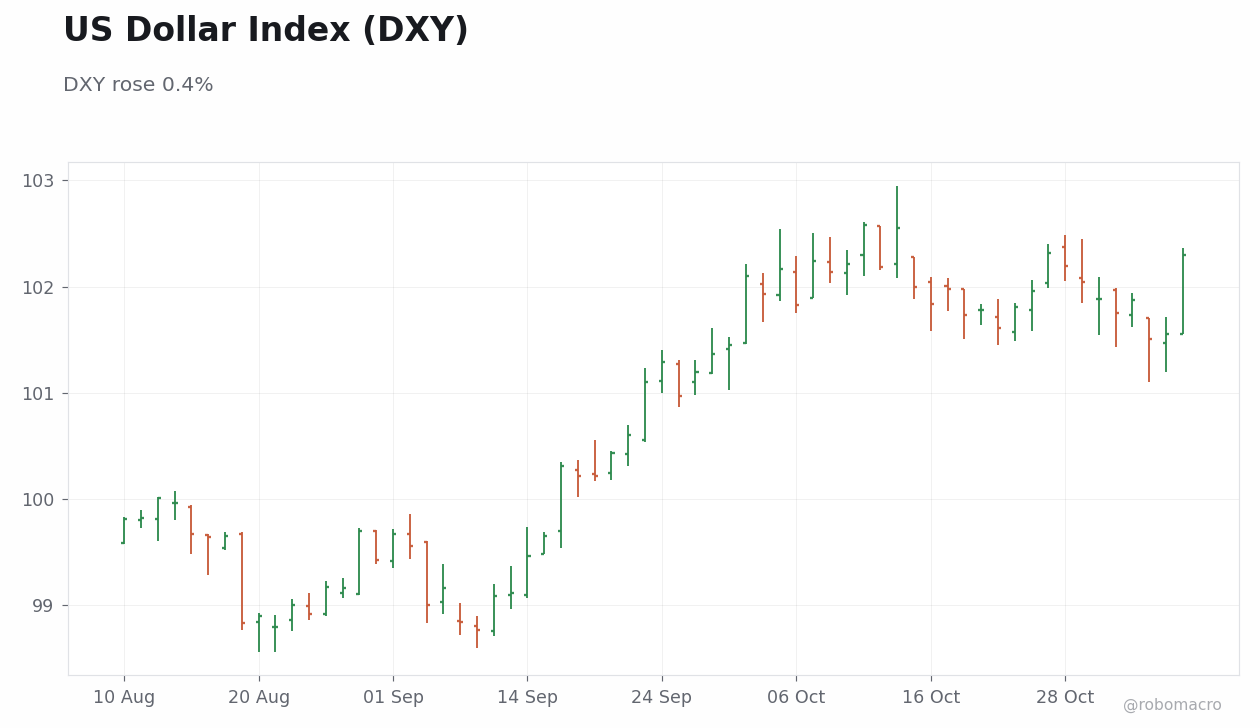
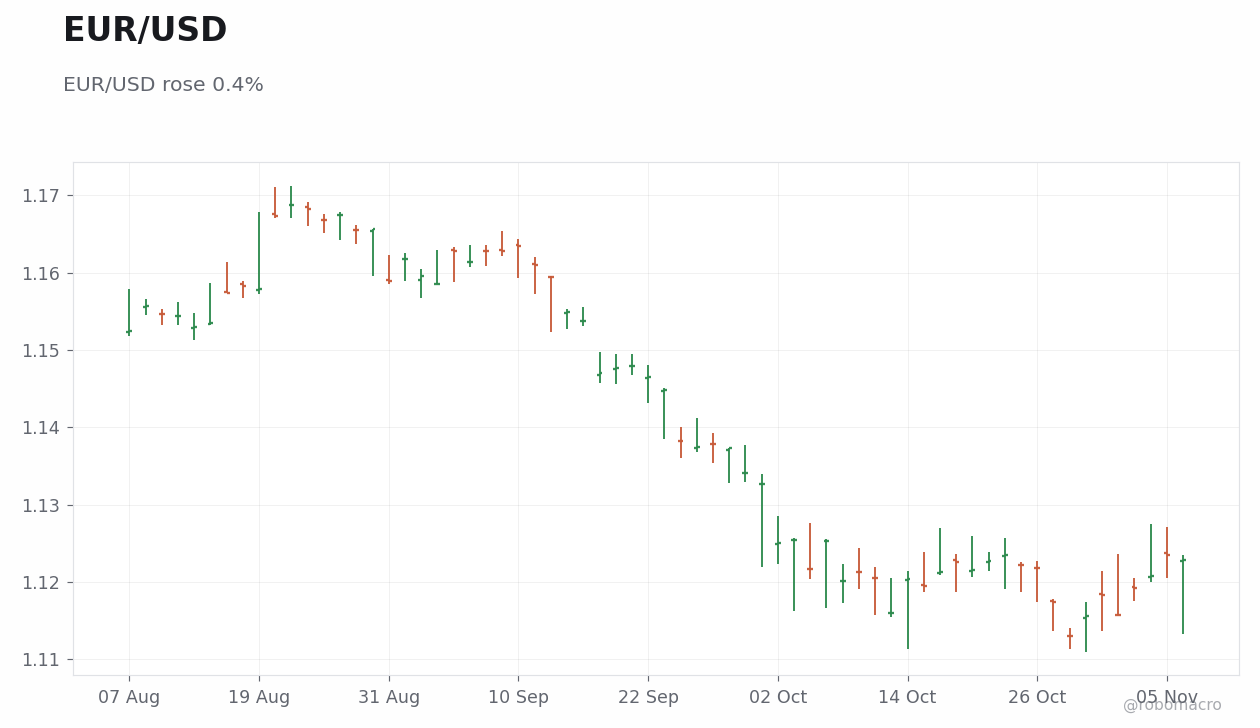
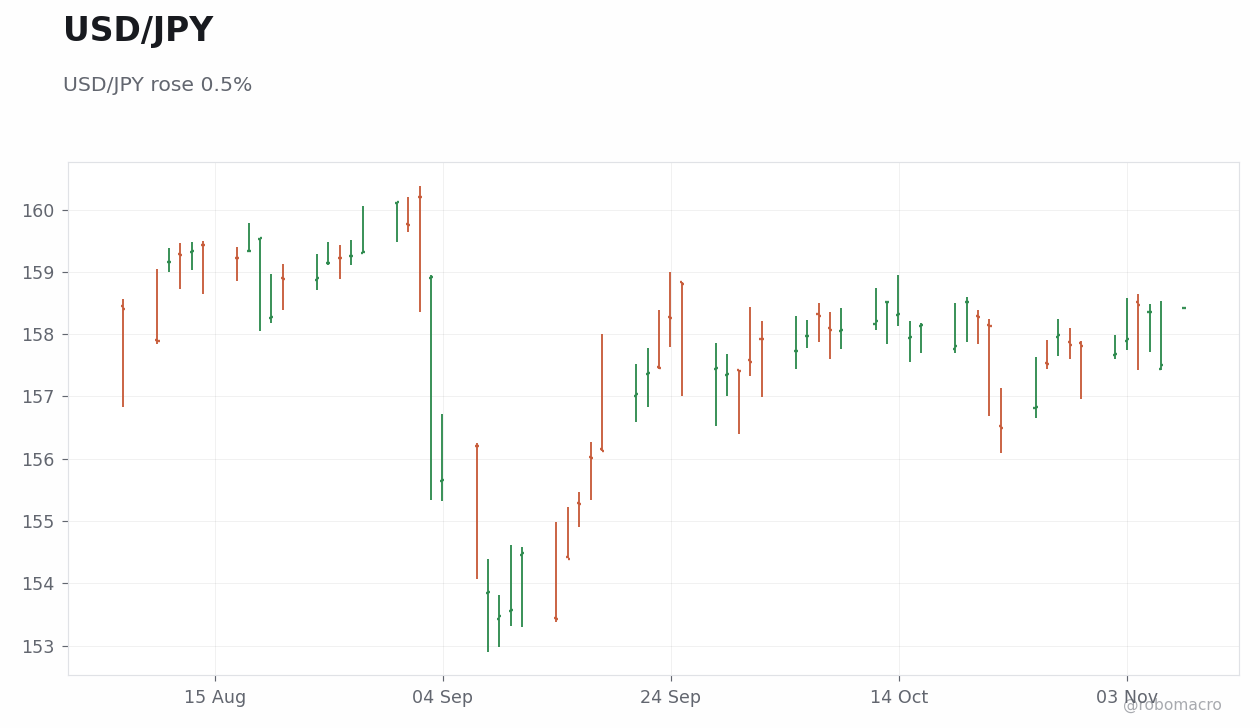
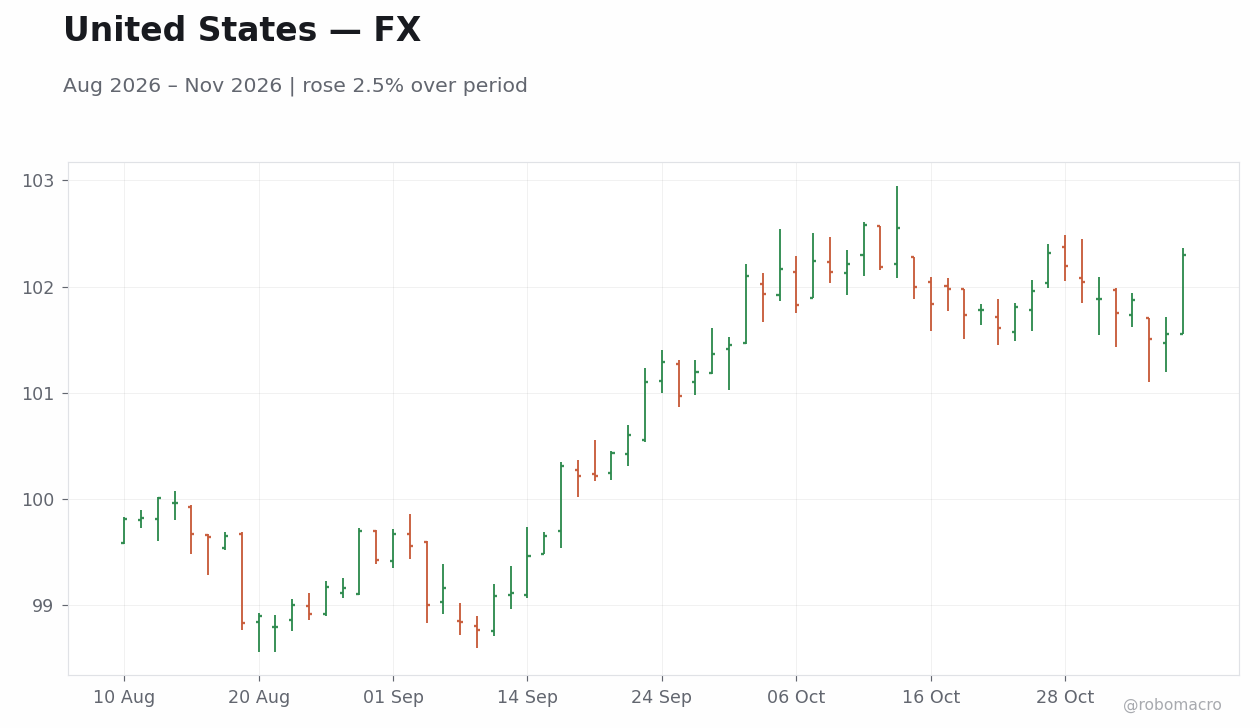
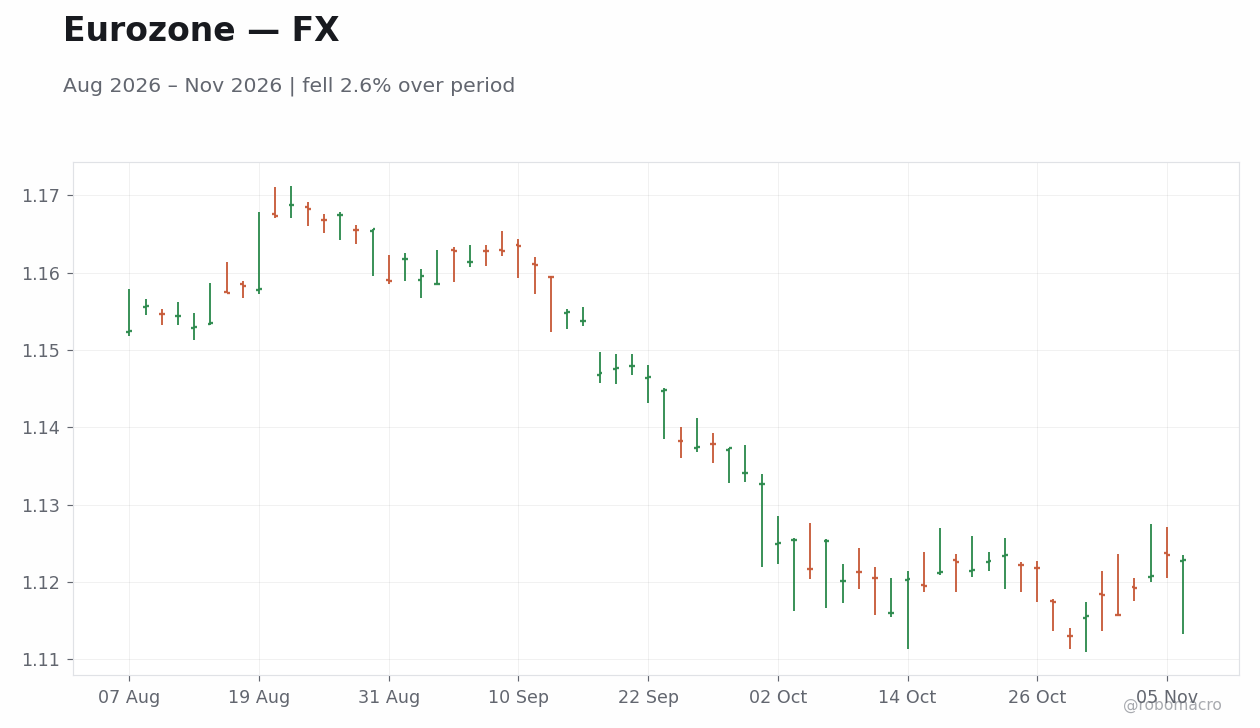
The DXY rose 0.4% week-over-week to 102.30. The index held steady at 102 in daily closes from Tuesday through Friday. In G10 currencies, EUR/USD gained 0.4% to 1.1228, advancing from a Monday close of 1.1157 through 1.1235 on Thursday before finishing at 1.1228. GBP/USD rose 0.6% to 1.3456, moving from 1.3386 on Monday to 1.3477 on Thursday and closing at 1.3456. USD/JPY increased 0.5% to 158.43 while remaining at 158 in daily closes through Thursday before printing 157 on Friday. EM pairs showed dispersion, with USD/BRL up 1.3%, USD/CAD up 1.1%, AUD/USD down 2.3%, and USD/INR down 1.1%.

Dollar & G10

U.S. yields eased across the curve, with the 2-year at 4.46% (-15bp), 10-year at 4.84% (-14bp), and 30-year at 5.25% (-7bp), leaving the 2s10s spread at +38bp. This compared with UK 2s10s at +39bp, German 2s10s at +28bp, and Japanese 2s10s at +91bp, supporting modest dollar resilience. EUR/USD closed at 1.1228 after a 0.4% weekly gain. GBP/USD ended at 1.3456, up 0.6% on the week. USD/JPY finished at 158.43, higher by 0.5%.

EM FX

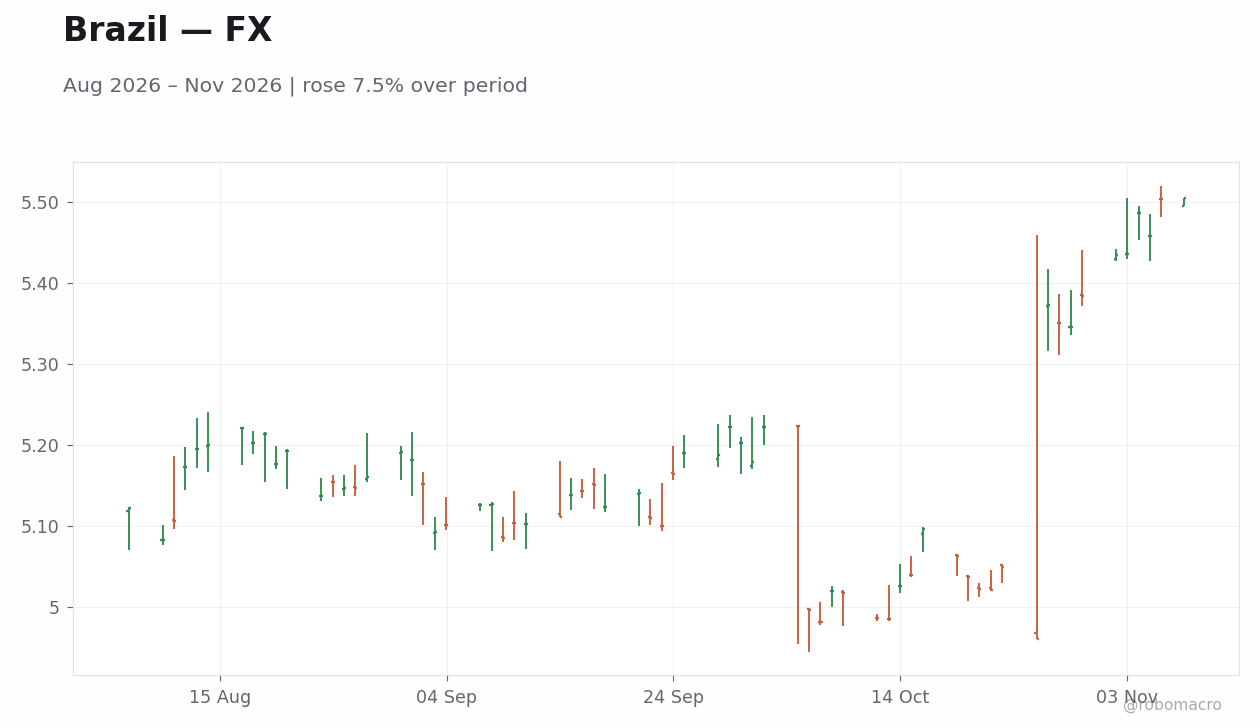
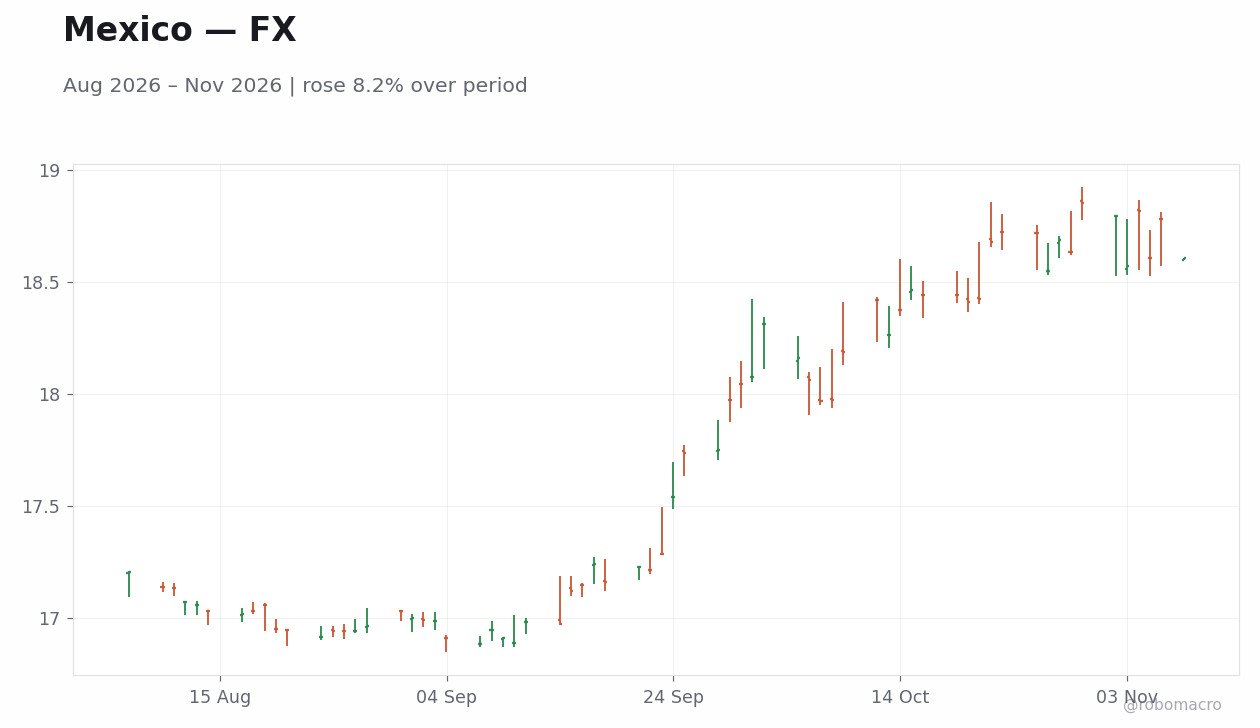
EM FX moves were mixed against the dollar. USD/BRL rose 1.3% to 5.5050 while Brazilian 2-year yields stood at 14.65% and 10-year at 15.18%, with the 2s10s spread at +53bp. USD/MXN fell 1.0% to 18.61 against Mexican 10-year yields at 9.12%. USD/ZAR declined 1.0% to 16.52 and USD/CNY rose 0.2% to 6.6755. USD/TRY gained 0.3% to 50.14 as Turkish 2s10s stood at -370bp. These shifts occurred amid divergent local yield movements and commodity sector pressures highlighted in regional updates.

Bitcoin & Crypto

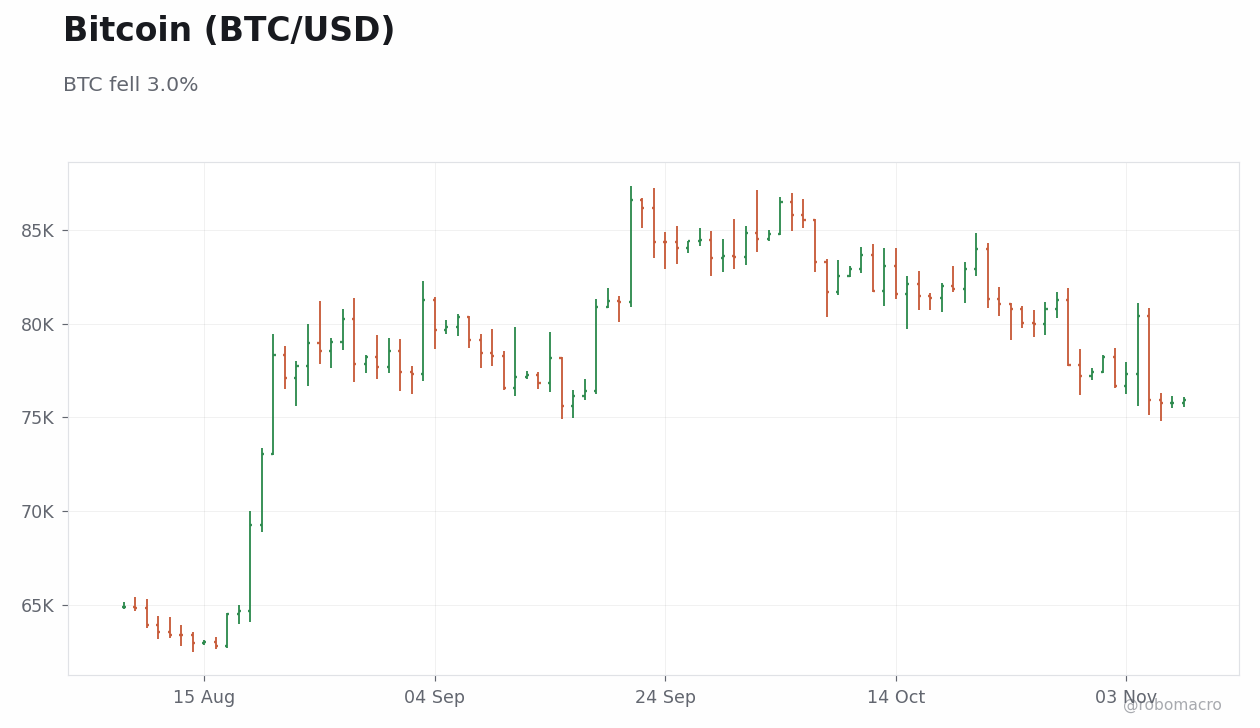
Bitcoin fell 3.0% week-over-week to $75,924. Daily closes showed a sharp drop from 80,405 on Wednesday to 75,942 on Thursday and 75,747 on Friday, with Saturday at 75,748. Ethereum declined 1.6% to $2,237. Solana fell 5.3% to $89 while XRP dropped 7.4% to $1, reflecting broad risk-asset pressure alongside equity rotation and declining technology names.

Week Ahead

The economic calendar is light, with no major central bank rate decisions, CPI releases, or payrolls data scheduled. Trade balance figures that could influence EM FX are also absent from the listed releases. In digital assets, no regulatory events or ETF deadlines appear on the calendar and no on-chain events or protocol upgrades are noted. Rate differentials across U.S., European, and Asian curves are therefore likely to remain the dominant driver for both FX and crypto sentiment in the coming week.

RoboMacro AI Economic Research

Global Macro Watch

Week of November 2–6, 2026 robomacro.com
Markets in ReviewCommodities
Commodities Chart 1
Commodities Chart 2
Commodities Chart 3
Commodities Chart 4

Week in Review

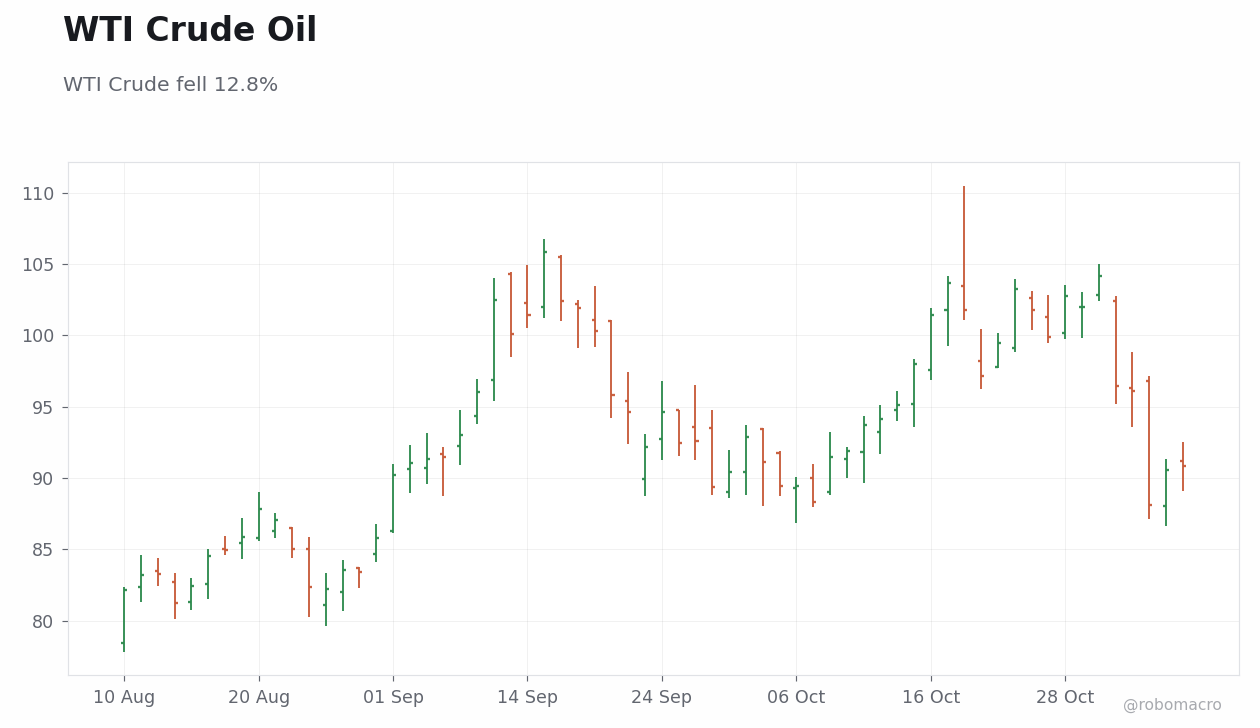
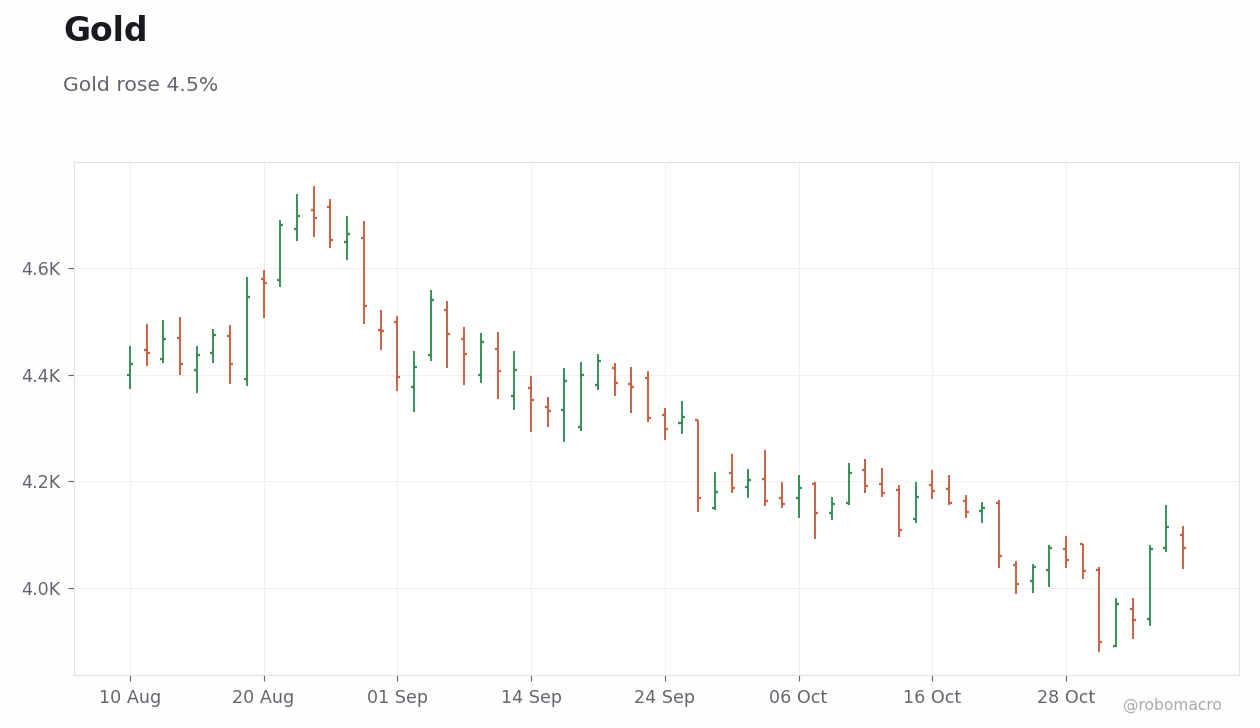
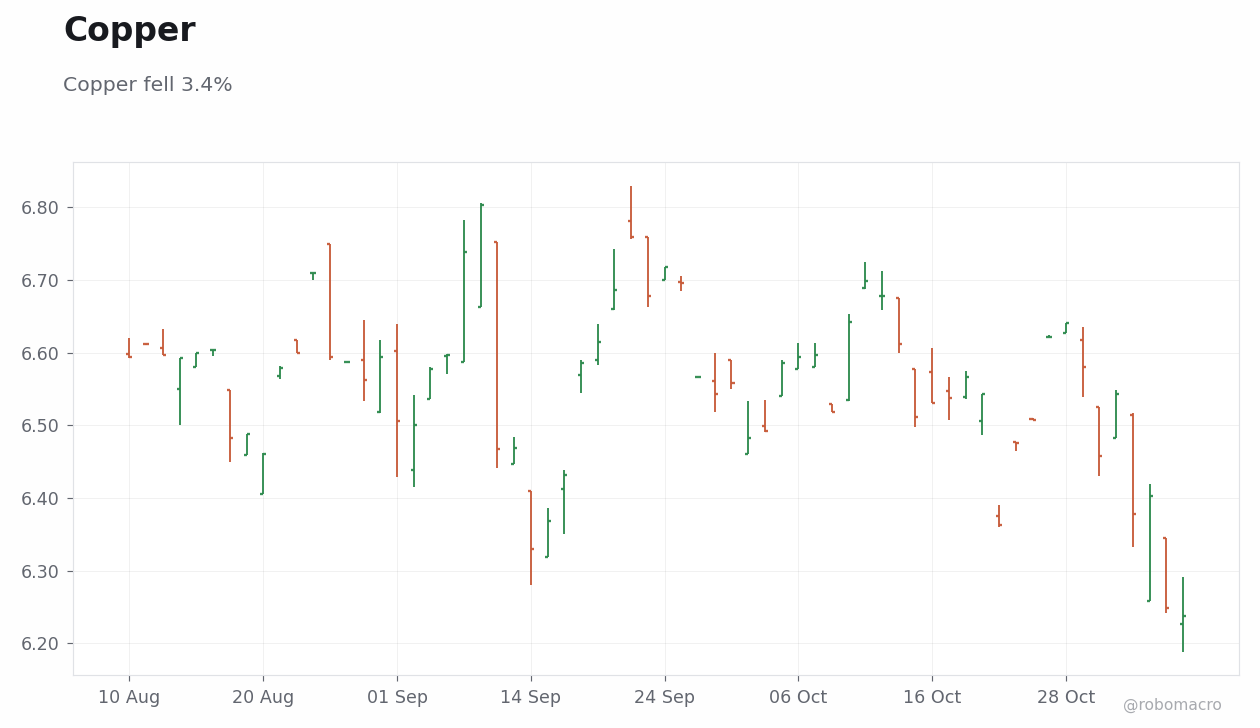
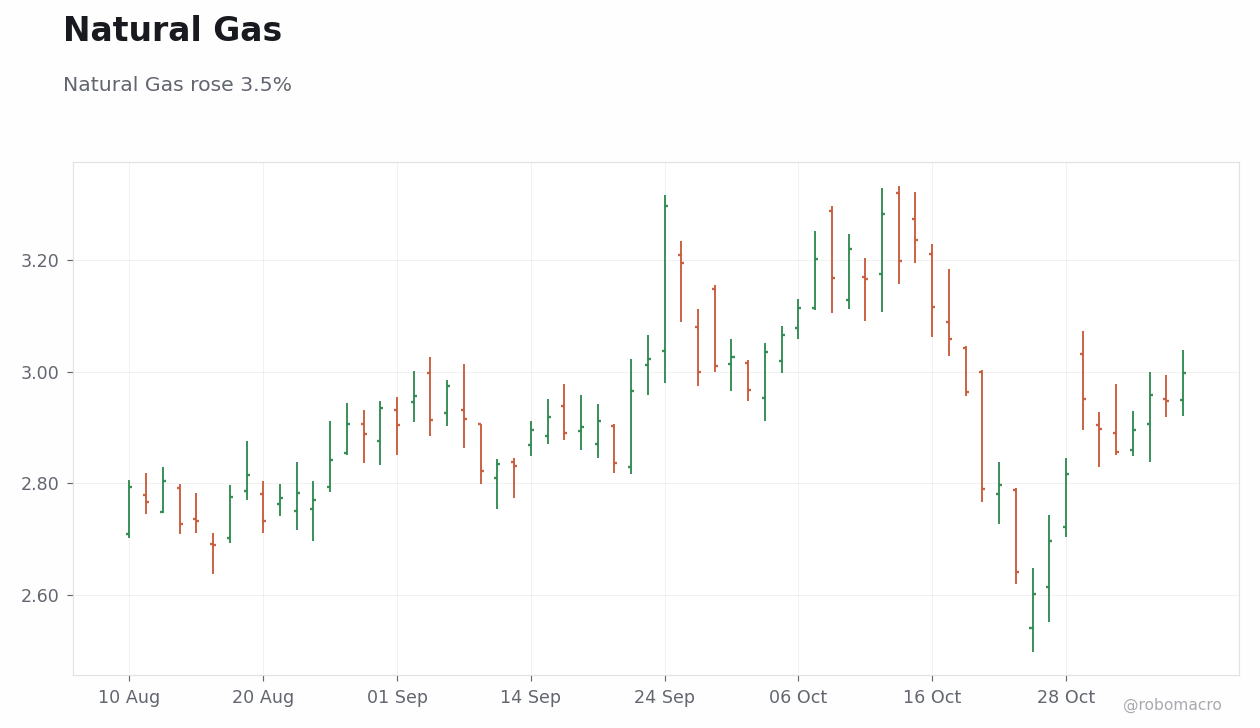
Brent Crude was the biggest mover among commodities, falling 16.4% week-over-week to 98.32. This was followed by a 12.8% decline in WTI Crude to 90.83. The path for WTI Crude showed significant volatility with a Tuesday close of 96.1 giving way to a sharp drop to 88.1 on Wednesday before a partial recovery to 90.5 on Thursday and 90.8 on Friday. Gold prices rose 4.5% on the week to 4074.90, climbing from a Tuesday close of 3,940 to 4,073 on Wednesday, 4,114 on Thursday and settling at 4,075 on Friday. Silver gained 5.8% to 51.94, with closes moving from 49.6 on Tuesday to 52.2 on Thursday before ending at 51.9 on Friday. Copper retreated 3.4% to 6.24 while wheat fell 2.0% to 591.25, reflecting a mixed picture across energy, metals and agriculture.

Energy Complex

WTI Crude settled the week at 90.83 after falling 12.8% while Brent Crude declined 16.4% to 98.32. Natural Gas rose 3.5% to 3.00, closing at 2.9980 on Friday after trading at 2.8950 on Tuesday. The drop in crude oil came as traders unwound bets on conflict escalation. Despite easing oil prices, markets remain concerned that peace is far from certain. OPEC diplomacy and related geopolitical narratives continued to shape the complex even as positions were reduced.

Metals & Ags

Gold rose 4.5% to 4074.90 while silver advanced 5.8% to 51.94. Silver’s outperformance caused the gold-silver ratio to narrow. Copper fell 3.4% to 6.24, signaling softening industrial demand and broader growth concerns. Wheat declined 2.0% to 591.25, adding to the cautious tone in agriculture. Iron ore rose 2.2% to 92.70 but did not offset the overall softening in base metals.

Week Ahead

The economic calendar for the coming week contains no commodity-relevant events including EIA crude or gas inventories, OPEC meetings, China PMI or industrial data, US CPI releases, or central bank meetings affecting commodity currencies such as CAD, AUD or BRL. With the schedule empty of such releases, attention shifts explicitly to non-calendar risks. Geopolitical developments, weather patterns for natural gas and agriculture, and OPEC diplomacy will likely dictate near-term volatility. These factors remain the dominant drivers for crude oil, gold and industrial metals.

RoboMacro AI Economic Research

Global Macro Watch

Week of November 2–6, 2026 robomacro.com
Markets in ReviewFX, Commodities & Crypto
Foreign Exchange
Week-on-week, month-to-date, year-to-date. WoW is the change over the seven calendar days to the latest close. Source: public market data.
PairLevelWoWMTDYTD
DXY102.30+0.4%+0.5%+3.9%
EUR/USD1.1228+0.4%+0.6%-4.4%
GBP/USD1.3456+0.6%+0.5%-0.1%
USD/JPY158.43+0.5%+0.5%+1.1%
AUD/USD0.6868-2.3%-2.3%+2.8%
NZD/USD0.5548-1.4%-1.4%-3.6%
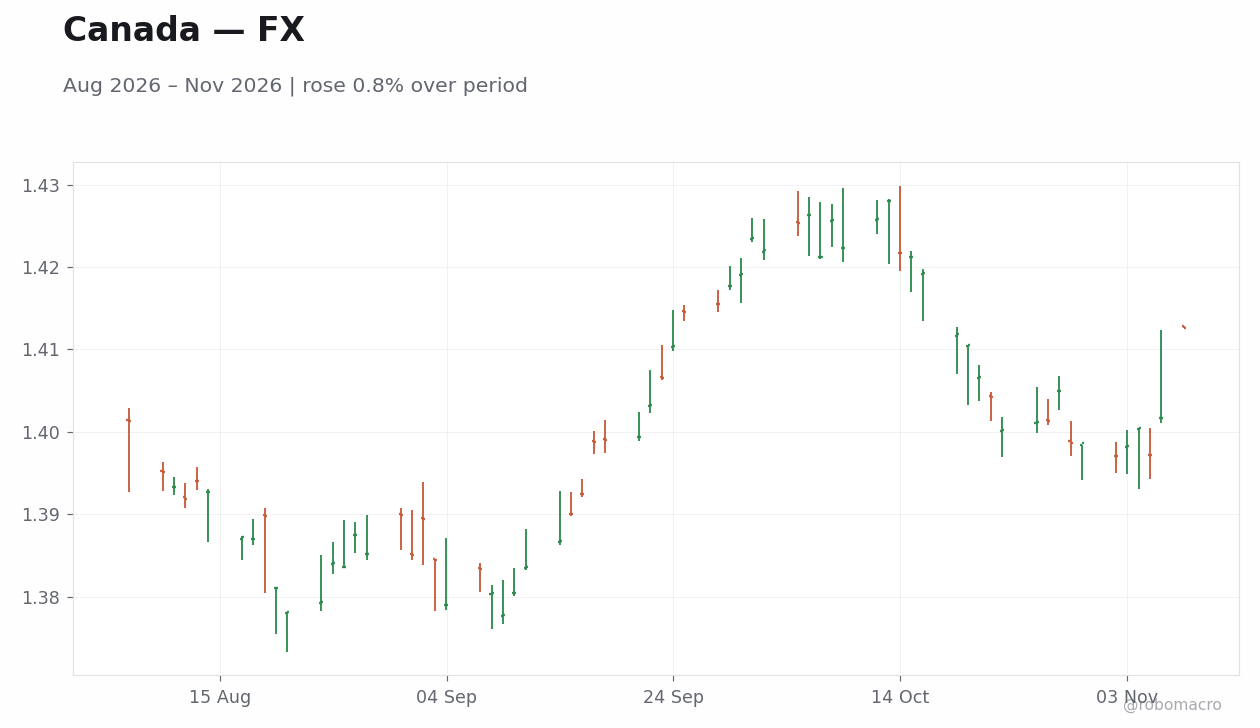
USD/CAD1.4126+1.1%+1.1%+3.0%
USD/CHF0.8154-1.0%-1.1%+3.0%
USD/CNY6.6755+0.2%+0.2%-4.6%
USD/BRL5.5050+1.3%+1.3%-0.2%
USD/MXN18.61-1.0%-1.0%+3.5%
USD/INR93.89-1.1%-1.1%+4.4%
USD/ZAR16.52-1.0%-1.0%-0.2%
USD/TRY50.14+0.3%+0.3%+16.6%
Commodities
Week-on-week, month-to-date, year-to-date. WoW is the change over the seven calendar days to the latest close. Source: public market data.
CommodityLevelWoWMTDYTD
WTI Crude90.83-12.8%-5.8%+58.5%
Brent Crude98.32-16.4%-6.2%+61.8%
Gold4074.90+4.5%+2.6%-5.9%
Silver51.94+5.8%+2.4%-26.4%
Copper6.24-3.4%-4.7%+10.6%
Natural Gas3.00+3.5%+5.0%-17.1%
Wheat591.25-2.0%-2.5%+16.7%
Iron Ore92.70+2.2%+1.6%-13.5%
Crypto Assets
Week-on-week, month-to-date, year-to-date. WoW is the change over the seven calendar days to the latest close. Source: public market data.
AssetLevelWoWMTDYTD
Bitcoin$75,924-3.0%-3.0%-14.4%
Ethereum$2,237-1.6%-1.6%-25.4%
Solana$89-5.3%-5.3%-29.4%
XRP$1-7.4%-7.4%-38.4%

DXY rose 0.4% to 102.30 as USD/CAD gained 1.1% to 1.4126 and USD/BRL climbed 1.3% to 5.5050. AUD/USD led declines, falling 2.3% to 0.6868, while NZD/USD dropped 1.4% to 0.5548. GBP/USD advanced 0.6% to 1.3456, outpacing EUR/USD’s 0.4% gain to 1.1228. USD/JPY added 0.5% to 158.43 even as USD/CHF eased 1.0% to 0.8154. USD/INR fell 1.1% to 93.89 and USD/MXN declined 1.0% to 18.61, highlighting EM divergence from commodity-linked currencies. USD/ZAR also slipped 1.0% to 16.52. MTD moves tracked WoW changes across majors, with YTD gains in DXY at +3.9% contrasting EUR/USD’s -4.4%. Next week’s focus will center on whether AUD and NZD weakness extends against resilient USD/CAD and USD/BRL.

RoboMacro AI Economic Research

Global Macro Watch

Week of November 2–6, 2026 robomacro.com
United States
Market Scorecard
AssetLevelWoW
S&P 5007376.86-2.2%
Nasdaq 10026989.99-3.6%
Dow Jones51285.73-1.3%
Russell 20002754.11-1.9%
USD/JPY158.43+0.5%
EUR/USD1.12+0.6%
GBP/USD1.35+0.5%
Gold4074.9+2.6%
WTI Crude90.83-5.8%
Bitcoin75926.64-3.0%
Chart 1
Chart 2
  • US nonfarm payrolls beat expectations, with the unemployment rate declining, underscoring labor-market resilience that underpins the Federal Reserve’s data-dependent stance.
  • ISM Manufacturing PMI rose above consensus, with factory orders advancing more than expected, confirming accelerating industrial momentum.
  • Federal Reserve speakers reiterated patient, data-dependent policy without altering forward guidance on the policy rate.
  • Equities rotated sharply, with the Dow Jones advancing while the Nasdaq 100 declined; the 10-year Treasury yield eased and gold rose.

Week in Review

US data releases delivered a clear through-line of above-trend growth and labor-market tightness that contrasted with softening services momentum and equity-market rotation. Manufacturing accelerates while labor demand stays firm. The ISM Manufacturing PMI exceeded consensus and lifted the prior reading, while JOLTs job openings climbed above expectations. Factory orders rose more than forecast. These prints reinforced the Atlanta Fed GDPNow revision higher. Payrolls surprise sharply higher. Nonfarm payrolls reached a level above consensus, driving the unemployment rate lower and lifting Michigan Consumer Sentiment. Weekly jobless claims fell below expectations. Services cool and equities rotate. The services PMI slipped below consensus, coinciding with a sharp Nasdaq 100 drop that erased earlier weekly gains. The S&P 500 finished lower for the week. ADP employment change beat expectations. Nonfarm productivity rose more than expected. The configuration leaves the policy-rate path tethered to incoming prints rather than any pre-set easing trajectory.

Fed Watch

Federal Reserve communications remained anchored to incoming data without shifts in forward guidance on the policy rate. Several regional Fed presidents spoke during the week. Speakers emphasized patience and data dependence, tying any future policy-rate adjustments explicitly to inflation and employment prints. The strong payrolls outcome and the drop in the unemployment rate reinforce the case for maintaining the current policy-rate setting until further evidence emerges. JOLTs and ISM beats add to the same narrative of resilient labor demand. No official changed the reaction function or signaled an imminent adjustment. The configuration leaves the medium-term policy-rate path dependent on subsequent releases rather than any pre-committed trajectory.

Data Review

High-impact releases showed consistent beats in activity and labor metrics that point to mid-cycle resilience rather than late-cycle softening. ISM Manufacturing PMI reached a level above consensus, with the employment subindex firm. Factory orders advanced more than expected. JOLTs job openings printed above consensus. ADP employment change came in above expectations. Services PMI eased below consensus. Nonfarm payrolls delivered a beat versus consensus, while the unemployment rate declined. Annual wage growth printed above expectations and monthly wage growth reached a solid pace. Nonfarm productivity rose more than consensus. Weekly jobless claims fell below expectations. Michigan Consumer Sentiment jumped higher. The Atlanta Fed GDPNow estimate held near its prior level. These outcomes collectively signal that growth remains above trend and labor demand stays elevated, keeping the Federal Reserve’s policy-rate path data-dependent without immediate downward pressure.

RoboMacro AI Economic Research

Global Macro Watch

Week of November 2–6, 2026 robomacro.com
Data Review: Actual vs Consensus
DateCtryEventPrior Cons.Actual
Mon 2USS&P Global Manufacturing P55.956.054.9
Mon 2USISM Manufacturing PMI54.554.655.5
Mon 2USISM Manufacturing Employme52.7-52.4
Mon 2USConstruction Spending Mont2.00.40-1.9
Mon 2USISM Manufacturing New Orde55.3-55.5
Mon 2USISM Manufacturing Prices77.977.075.2
Mon 2USFed Goolsbee Speech---
Mon 2US3-Month Treasury Bill Auct4.0-4.0
Mon 2US6-Month Treasury Bill Auct4.2-4.2
Mon 2USAtlanta Fed GDPNow3.2-3.7
Mon 2USLoan Officer Survey--""
Mon 2USTreasury Refunding Financi--""
Tue 3USLogistics Managers Index70.2-70.7
Tue 3USRCM/TIPP Optimism Index46.846.248.5
Week Ahead: Key Releases
DateReleasePriorCons.
2026-11-09Speech by Fed's Bowman--
2026-11-09Fed Goolsbee Speech--
2026-11-09Speech by Fed's Barkin--
2026-11-09Speech by Fed's Bowman--
2026-11-09Fed Goolsbee Speech--
2026-11-10Speech by Fed's Waller--
2026-11-10ADP Employment Change Weekly17K-
2026-11-10Core Inflation Rate Month-over-Mont0.300.20
2026-11-10Core Inflation Rate Year-over-Year2.6-
2026-11-10Inflation Rate Month-over-Month0.600.30

The Week Ahead

Attention turns to the CPI release, expected to show headline inflation near recent levels, followed by PPI. Retail sales data will test consumer resilience after the strong payrolls print. Initial jobless claims and the University of Michigan final sentiment reading arrive mid-week. Federal Reserve speakers scheduled include several regional presidents whose remarks will be parsed for any evolution in data dependence. The FOMC minutes from the prior meeting will provide additional color on the policy-rate outlook. Markets will also monitor the Empire State manufacturing survey and NAHB housing-market index for early signals on housing and factory momentum. These releases matter because they directly inform the Federal Reserve’s assessment of inflation persistence and growth sustainability ahead of the next policy decision. Cross-border spillovers from European and Asian data will influence dollar and Treasury moves.

Risks & Themes

Stronger-than-expected payrolls and manufacturing data shift the balance toward a higher-for-longer policy-rate scenario, reducing the probability of near-term easing priced by some market participants. Upside risks center on continued labor-market tightness that could re-accelerate wage growth. Downside risks include further softening in the services PMI that could foreshadow broader demand weakness. Equity positioning appears crowded in technology after the sharp Nasdaq 100 decline, raising the potential for additional volatility. Gold’s weekly gain signals persistent inflation-hedging flows that could intensify if CPI surprises higher. Treasury-curve steepening observed mid-week may reverse if payroll momentum persists. Flow data show safe-haven demand into duration on risk-off days, yet the overall S&P 500 decline leaves room for further de-risking if subsequent inflation prints disappoint.

Cross-Asset

Equities closed the week lower after sharp daily rotations, with the S&P 500 at 7,376.86 for a 2.18 percent decline and the Nasdaq 100 at 26,989.99 for a 3.57 percent drop. The Dow Jones finished at 51,285.73, down 1.34 percent. The Russell 2000 ended at 2,754.11, off 1.85 percent. Treasury yields eased modestly, with the 10-year lower from the Monday open, while the 2-year closed lower. EUR/USD rose 0.64 percent to 1.12 and GBP/USD gained 0.53 percent to 1.35, while USD/JPY advanced 0.47 percent to 158.43. Gold climbed 2.65 percent to 4,074.90 on safe-haven flows and inflation-hedging demand. WTI crude fell 5.84 percent to 90.83 amid growth concerns. Bitcoin declined 2.97 percent to 75,926.64. The standout daily move occurred when the Nasdaq 100 dropped sharply and WTI crude fell further, reversing earlier gains in both assets.

Global Context

Divergent central-bank signals from the prior week, including the Bank of Canada’s tightening, continue to support real-rate dispersion that favors the US dollar. European data weakness, notably French consumer confidence at its lowest level since 2013, drove safe-haven flows into US Treasuries. Japanese CPI remaining above the 2 percent target without Bank of Japan action kept USD/JPY near 158.43. Emerging-market equity outperformance in Mexico and India contrasted with US tech weakness, illustrating selective resilience outside the United States. Trade-balance narrowing reflected stronger US exports, reducing some external pressure on the current-account outlook. Geopolitical tensions showed limited direct spillovers into US asset prices over the past seven days.

RoboMacro AI Economic Research

Global Macro Watch

Week of November 2–6, 2026 robomacro.com
Eurozone
Market Scorecard
AssetLevelWoW
Euro Stoxx 506170.49-0.1%
DAX25820.36-0.6%
CAC 408139.0+1.1%
EUR/USD1.12+0.6%
EUR/GBP0.83+0.1%
EUR/JPY176.34+0.2%
Gold4074.9+2.6%
Brent Crude98.32-6.2%
Bitcoin75937.78-3.0%
Chart 1
Chart 2
Chart 3
Chart 4
  • German retail sales contracted sharply m/m in September, confirming consumer weakness in the bloc’s largest economy and widening the growth gap with Spain.
  • Spanish manufacturing PMI rose while Italian manufacturing PMI fell, underscoring persistent divergence across euro-area periphery economies.
  • Bundesbank President Nagel joined other ECB officials in backing a December rate hike, keeping the policy rate path data-dependent at the current level amid sticky inflation prints.
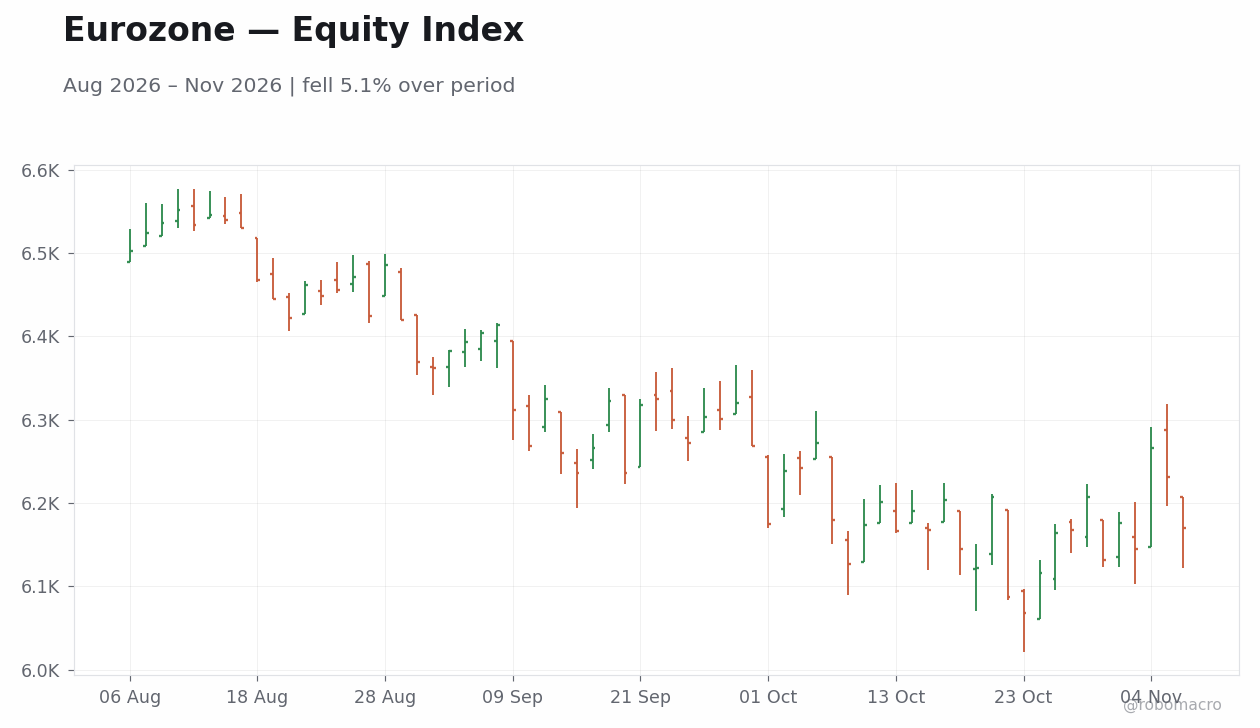
  • Euro Stoxx 50 closed the week at 6170.49 with a net -0.09% change while German 10-year Bund yields fell, reflecting safe-haven flows amid fiscal concerns in France.

Week in Review

German consumer weakness dominates the narrative. German retail sales contracted sharply m/m and y/y in September, well below consensus, after a prior gain. This print arrived alongside German Q3 GDP growth from the prior week, highlighting that state spending rather than household demand drove the expansion. French GDP contracted in the same quarter, deepening the intra-euro-area split already flagged by Fitch’s negative outlook on French debt.

Periphery manufacturing data split sharply. Spanish manufacturing PMI beat consensus, extending the prior reading and signaling continued expansion. Italian manufacturing PMI slipped below 50, moving back into contraction territory from the previous level. These opposing outcomes left the euro-area industrial picture fragmented rather than uniformly soft.

Services and inflation prints added mixed signals. Dutch preliminary inflation accelerated while Spanish services PMI moderated. Italian services PMI improved. Spanish unemployment rose, exceeding consensus and pointing to labor-market softening on the periphery.

Markets priced the divergence through rates and equities. German 10-year Bund yields eased over the week while the 2-year yield fell. Euro Stoxx 50 posted a net -0.09% change to 6170.49, with the DAX down and the CAC 40 up. EUR/USD rose.

ECB Watch

Bundesbank President Nagel stated that further tightening remains appropriate ahead of the December meeting, aligning with other ECB speakers who tied the next policy step to incoming inflation and activity data. The ECB policy rate stayed unchanged with no change to forward guidance during the week. Dutch inflation and sticky Spanish services readings reinforced the case for patience at the current setting. German retail sales weakness highlighted downside risks to growth but did not alter the ECB’s data-dependent stance. French fiscal concerns and the negative Fitch outlook supported Bund outperformance without prompting any ECB intervention signals. The combination of Dutch inflation and divergent periphery PMIs leaves the medium-term rate path anchored to the current level until clearer evidence emerges on both inflation convergence and growth resilience.

Data Review

German retail sales printed below consensus and y/y, marking a clear downside surprise that followed the prior m/m gain. Spanish manufacturing PMI rose against consensus, while Italian manufacturing PMI fell versus consensus. Dutch inflation came in above the prior reading. Spanish unemployment change exceeded consensus. Spanish services PMI printed below consensus. Italian services PMI reached a new level. German factory orders rose versus consensus after a prior decline. French industrial production fell against consensus. Italian retail sales advanced only modestly versus consensus. German industrial production rose versus consensus. French trade balance widened versus consensus. These releases collectively point to a mid-cycle euro-area expansion that remains uneven, with German household demand lagging and periphery inflation remaining elevated, keeping the ECB’s policy rate on a data-dependent path rather than an accelerated easing trajectory.

RoboMacro AI Economic Research

Global Macro Watch

Week of November 2–6, 2026 robomacro.com
Data Review: Actual vs Consensus
DateCtryEventPrior Cons.Actual
Mon 2NLRetail Sales Year-over-Yea3.8-2.7
Mon 2NLNEVI Manufacturing PMI55.6-55.0
Mon 2DERetail Sales Month-over-Mo1.20.40-2.0
Mon 2DERetail Sales Year-over-Yea-0.30--2.3
Mon 2ESS&P Global Manufacturing P51.050.852.2
Mon 2ITS&P Global Manufacturing P50.450.249.4
Mon 2FRS&P Global Manufacturing P50.649.349.5
Mon 2DES&P Global Manufacturing P53.954.254.2
Mon 2EUS&P Global Manufacturing P52.952.452.7
Mon 2DE3-Month Bubill Auction2.6-2.7
Mon 2DE9-Month Bubill Auction2.9-2.9
Mon 2PTIndustrial Production Mont-2.0-2.4
Mon 2PTIndustrial Production Year-3.8--2.7
Mon 2PTRetail Sales Month-over-Mo-0.70--1.0
Week Ahead: Key Releases
DateReleasePriorCons.
2026-11-09Trade Balance19.5bn19.4bn
2026-11-09Exports Month-over-Month-0.80-
2026-11-09ECB Buch Speech--
2026-11-10Headline Unemployment Rate8.3-
2026-11-10ECB Cipollone Speech--
2026-11-10ECB Lane Speech--
2026-11-11ECB Cipollone Speech--
2026-11-11Industrial Production Month-over-Mo-1.31.0
2026-11-11ECB President Lagarde Speech--
2026-11-12ECB Economic Bulletin--
Chart 5

The Week Ahead

Monday brings Japanese coincident and leading indices along with Danish current account and trade balance data. Tuesday features South African foreign exchange reserves and additional Danish figures. Wednesday includes Finnish trade balance and several euro-area flash inflation prints. Thursday highlights German wholesale price index and French CPI. Friday rounds out the week with Italian industrial production and Spanish final HICP. These releases will test whether the recent German consumer weakness persists into October activity data and whether Dutch-style inflation acceleration appears more broadly. ECB speakers are scheduled throughout the week and will likely reiterate the data-dependent approach at the current policy rate. Markets will watch for any revision to the growth outlook stemming from the latest retail sales and industrial production prints.

Risks & Themes

Persistent German retail sales contraction raises downside risks to euro-area consumption in the coming months, particularly if energy prices remain elevated near current Brent levels. French fiscal deterioration and the negative Fitch outlook could widen spreads further and sustain safe-haven flows into German Bunds. Periphery divergence between Spanish expansion and Italian contraction may complicate ECB communication on a uniform rate path. Positioning appears light on euro-area duration given the weekly decline in 10-year yields, leaving room for further flattening if growth data continue to miss. Volatility in Brent crude adds an upside inflation risk that could delay any future easing from the current policy rate. Cross-border flows into gold suggest hedging against both fiscal and geopolitical uncertainty remains elevated.

Cross-Asset

Euro Stoxx 50 closed at 6170.49 for a net -0.09% weekly change, with the DAX at 25820.36 and the CAC 40 at 8139.00. German 10-year Bund yields fell while the 2-year yield declined, flattening the curve on safe-haven demand. EUR/USD rose, EUR/GBP gained, and EUR/JPY advanced. Brent crude fell while gold rose. The equity advance on November 4 coincided with German retail sales data that disappointed, while Bund yields remained steady that session. Brent’s single-day drop on November 4 coincided with the equity advance and an EUR/USD gain.

Global Context

U.S. Treasury yields rose on strong jobs data while safe-haven buying kept German borrowing costs near recent lows. Five European leaders called for closer EU-UK ties on clean energy ahead of the Brussels summit, potentially supporting longer-term trade dynamics. The Iran-related energy disruptions continued to pressure German industrial production despite the m/m gain. Global equity dispersion persisted, with the S&P 500 moving lower even as the CAC 40 posted a weekly gain. These cross-border factors reinforce the ECB’s focus on domestic data rather than coordinated global policy shifts.

RoboMacro AI Economic Research

Global Macro Watch

Week of November 2–6, 2026 robomacro.com
Japan
Market Scorecard
AssetLevelWoW
Nikkei 22557434.77-8.9%
USD/JPY158.43+0.5%
EUR/JPY176.34+0.2%
GBP/JPY211.55+0.2%
Gold4074.9+2.6%
Brent Crude98.32-6.2%
Bitcoin75937.78-3.0%
Chart 1
Chart 2
Chart 3
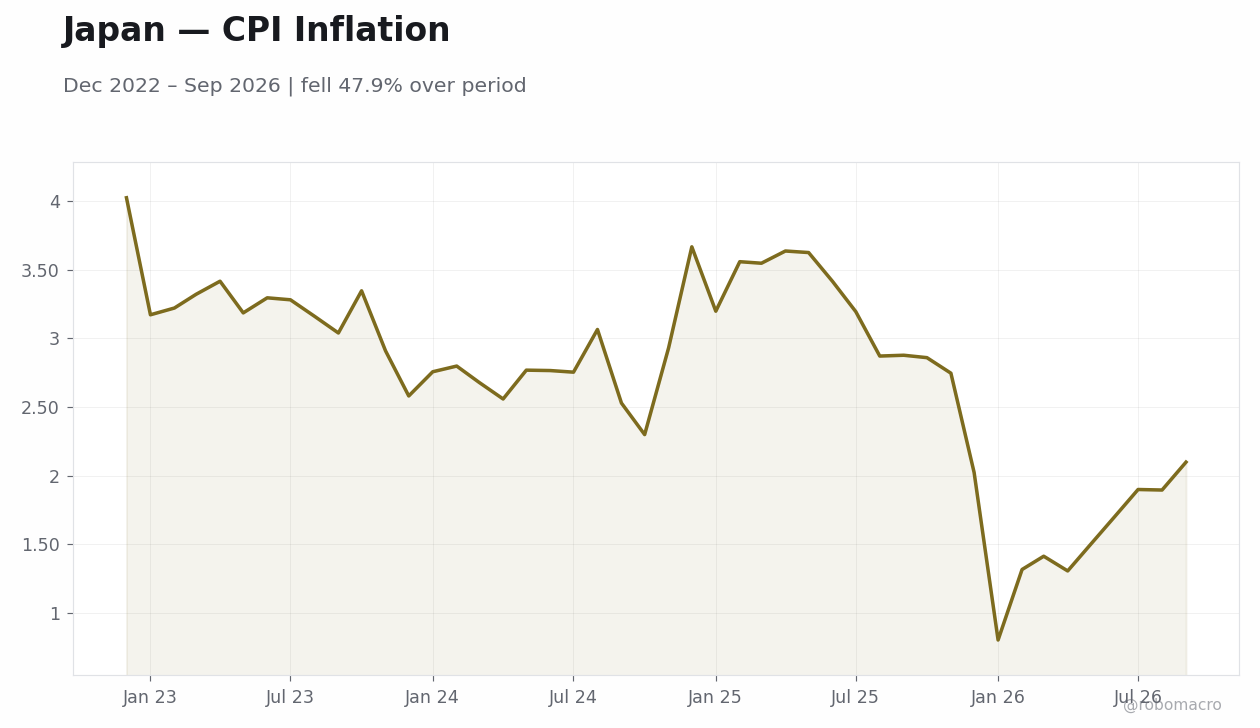
  • Bank of Japan left the policy rate unchanged and stated the 2 percent price stability target has been generally achieved, shifting forward guidance toward sustaining inflation.
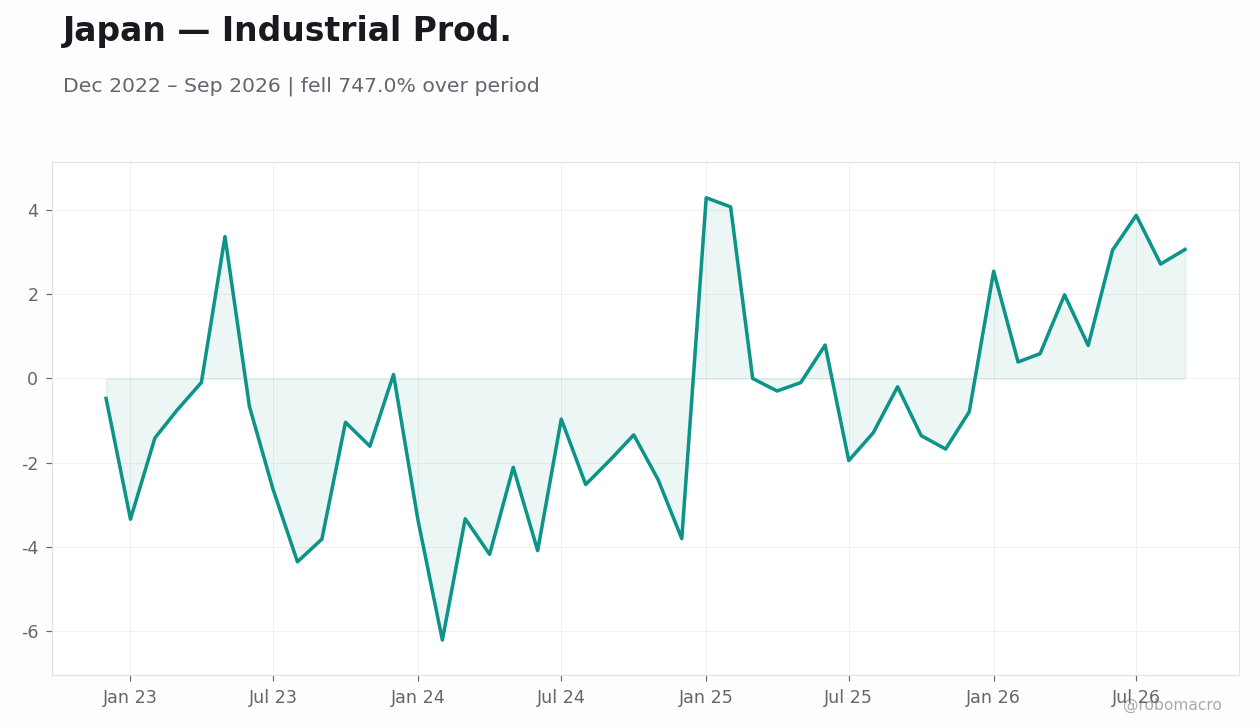
  • Industrial production rebounded while retail sales slowed and the unemployment rate improved.
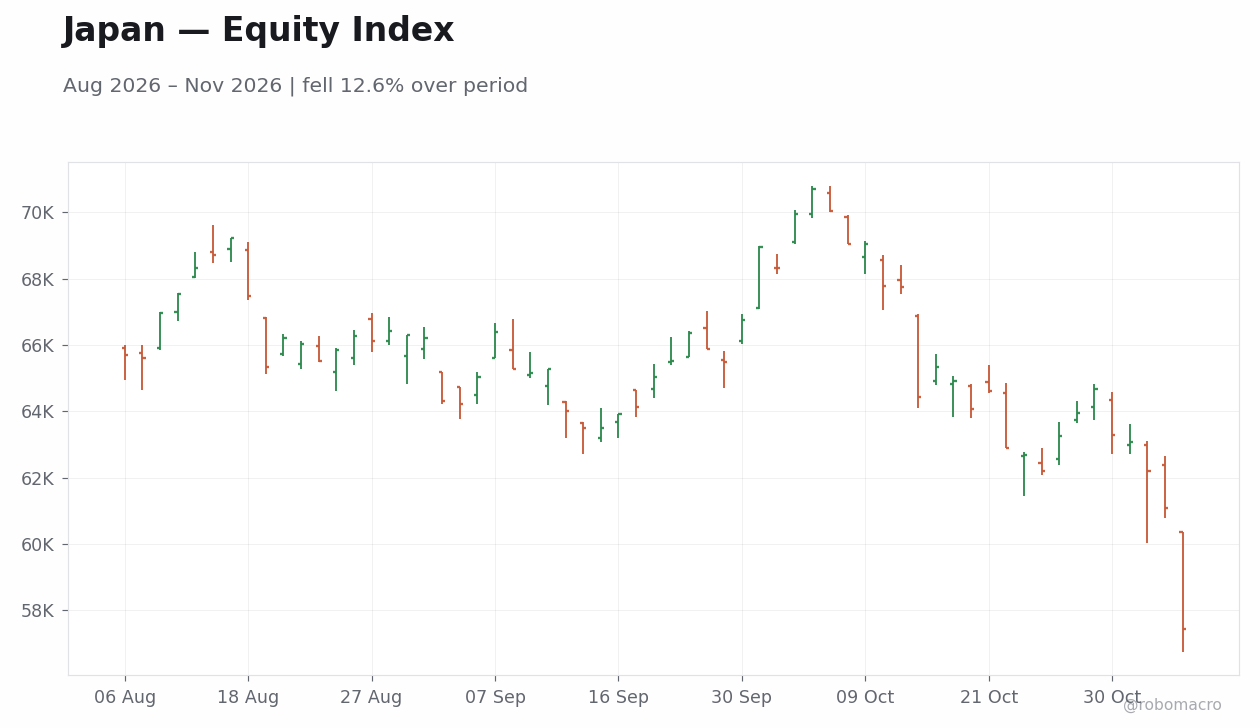
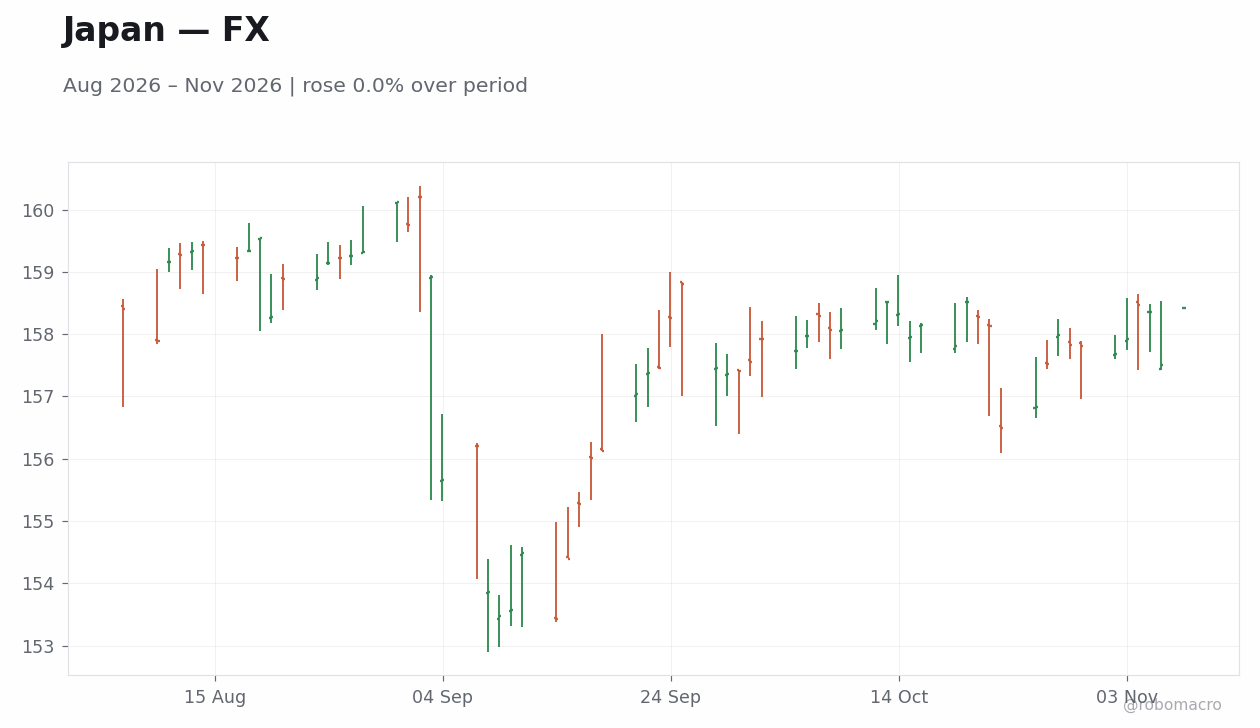
  • Nikkei 225 fell 8.95 percent week-over-week to 57,434.77 as USD/JPY rose 0.47 percent to 158.43 and the 10-year JGB yield moved lower.

Week in Review

BoJ decision reframes the policy debate. The Bank of Japan left the policy rate unchanged and declared the 2 percent target generally achieved in its Quarterly Outlook Report, redirecting attention from reaching the goal to maintaining it. Consumer confidence printed below consensus while the unemployment rate declined. Industrial production rebounded month-over-month, exceeding expectations and reversing the prior contraction. Retail sales rose year-over-year but missed expectations.

Equity and currency moves reflected external pressures. The Nikkei 225 closed the week at 57,434.77 after declining 8.95 percent. USD/JPY advanced to 158.43 while EUR/JPY reached 176.34. The 2-year JGB yield eased and the 10-year yield declined. Brent crude fell 6.16 percent to 98.32, providing some offset to imported inflation concerns.

Data prints showed mixed domestic momentum. Housing starts dropped year-over-year against a consensus gain. No tier-one releases occurred after 2 November, leaving markets to digest the prior decision and the upcoming BoJ Monetary Policy Meeting Minutes released on 4 November. Gold rose 2.65 percent to 4,074.90 while Bitcoin declined 2.95 percent to 75,937.78. The week’s arc confirmed resilient labour-market conditions alongside softening consumption and production signals.

BoJ Watch

The Bank of Japan held the policy rate unchanged on 30 October and explicitly stated that the 2 percent price stability target has been generally achieved. Governor Ueda’s IMF remarks highlighted overseas investment income as the dominant component of the current-account surplus and noted labour shortages supporting domestic investment. The Monetary Policy Meeting Minutes released on 4 November will be examined for the internal balance of views on inflation durability and tolerance for yen weakness at the current settings. The data set, including the unemployment rate and industrial production month-over-month, supports the view that real interest rates have risen recently as stated in post-meeting communications. No changes to forward guidance were issued, keeping the focus on the upcoming decision without altering the stated reaction function.

RoboMacro AI Economic Research

Global Macro Watch

Week of November 2–6, 2026 robomacro.com
Data Review: Actual vs Consensus
DateCtryEventPrior Cons.Actual
Tue 3JPMonetary Base Year-over-Ye-15.2-14.0-13.6
Tue 3JPBoj Jgb Purchase---
Wed 4JPBoJ Monetary Policy Meetin---
Wed 4JPComposite PMI Final52.352.352.1
Wed 4JPServices PMI Final51.352.051.7
Wed 4JP10-Year JGB Auction3.1-2.8
Thu 5JPAverage Cash Earnings Year3.93.84.6
Thu 5JPOvertime Pay Year-over-Yea4.9-3.6
Thu 5JPForeign Bond Investment Le-81.8bn-1312.0bn
Thu 5JPForeign Stock Investment L1182.2bn-1129.3bn
Thu 5JP3-Month Treasury Bill Auct1.3-1.2
Fri 6JPBoJ Gov Ueda Speech---
Sun 8JPForeign Exchange Reserves 1178.4bn--
Week Ahead: Key Releases
DateReleasePriorCons.
2026-11-09Household Spending Month-over-Month0.100.30
2026-11-09Household Spending Year-over-Year-3.1-3.1
2026-11-09BoJ Summary of Opinions--
2026-11-09Current Account Balance4062.0bn3354.4bn
2026-11-11BOJ Asada Speech--
2026-11-15GDP Growth Quarter-over-Quarter Pre0.400.10
2026-11-15GDP Growth Annualized Prel1.40.30
Chart 5
Chart 7

The Week Ahead

Coincident Index Preliminary and Leading Economic Index Preliminary are scheduled for release on 9 November, with the latter carrying a consensus of 116.7. These indicators will provide the first post-decision read on activity momentum ahead of the next Bank of Japan meeting. No other tier-one Japanese data are listed for the following four days. The releases matter because they will test whether labour-market tightness and the industrial production rebound are carrying forward. Officials have tied future adjustments explicitly to domestic prints, so any deviation from recent ranges will inform the pace of normalisation. Market participants will also monitor any additional speeches for language on wage pass-through and inflation sustainability. The absence of high-impact events mid-week leaves room for external factors to influence positioning into the next decision.

Risks & Themes

The week’s data showed a clear split between firm labour-market readings and softer consumption and housing figures, shifting the growth outlook toward selective resilience rather than broad acceleration. Upside risks centre on sustained industrial production gains feeding into wages, while downside risks stem from retail sales missing consensus. Yen softness persisted despite the Bank of Japan’s target-achievement language, illustrating that external rate differentials continue to dominate price action. The equity decline on the Nikkei 225 suggests risk appetite has narrowed, yet JGB yields moved lower, indicating safe-haven demand remains intact. No evidence of coordinated policy shifts emerged, preserving dispersion in rate paths across developed markets.

RoboMacro AI Economic Research

Global Macro Watch

Week of November 2–6, 2026 robomacro.com
Canada
Market Scorecard
AssetLevelWoW
S&P/TSX35789.1-0.0%
USD/CAD1.41+1.1%
EUR/CAD1.57+1.0%
WTI Crude90.83-5.8%
Natural Gas3.0+5.0%
Gold4074.9+2.6%
Brent Crude98.32-6.2%
Bitcoin75937.78-3.0%
Chart 1
Chart 2
Chart 3
Chart 4
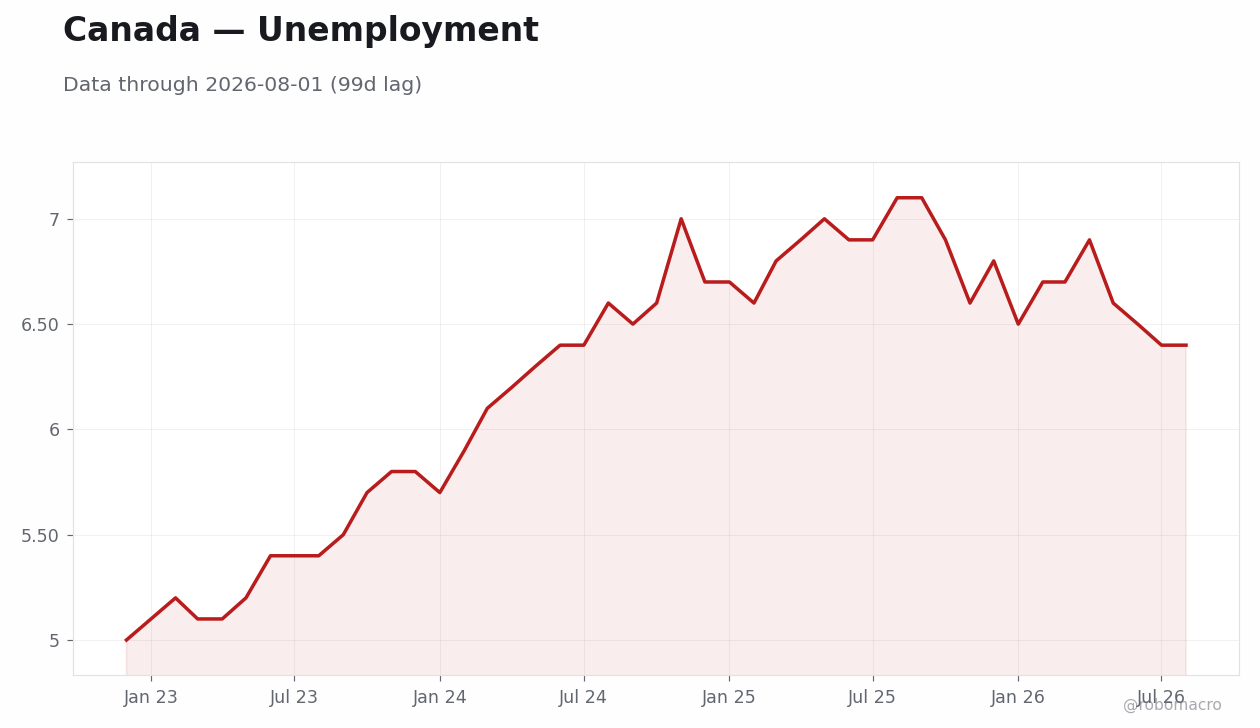
  • Canada’s labour market indicators pointed to softening conditions, with the unemployment rate moving higher and employment declining in the latest reading after the prior month’s drop.
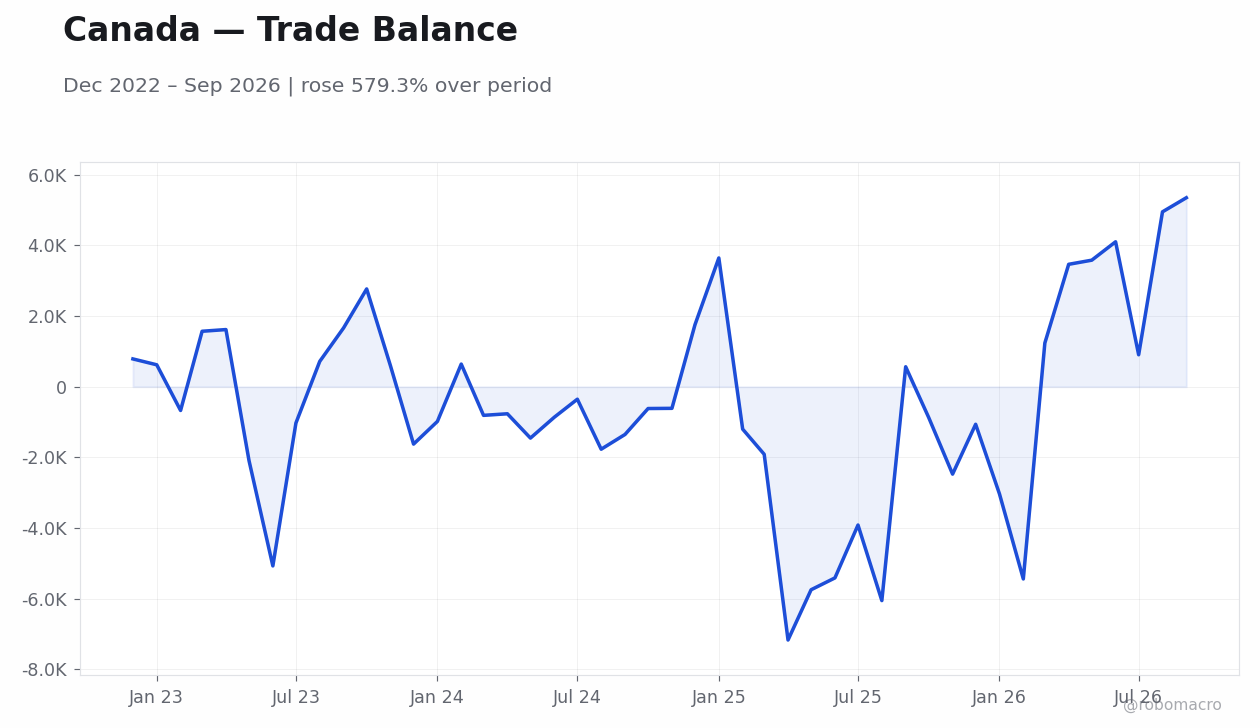
  • S&P Global Manufacturing PMI contracted, confirming goods-sector weakness that aligned with softer export momentum even as the trade surplus widened.
  • Bank of Canada raised the policy rate and Governor Macklem pledged to proceed carefully on further increases, tying the next decision explicitly to incoming domestic data.

Week in Review

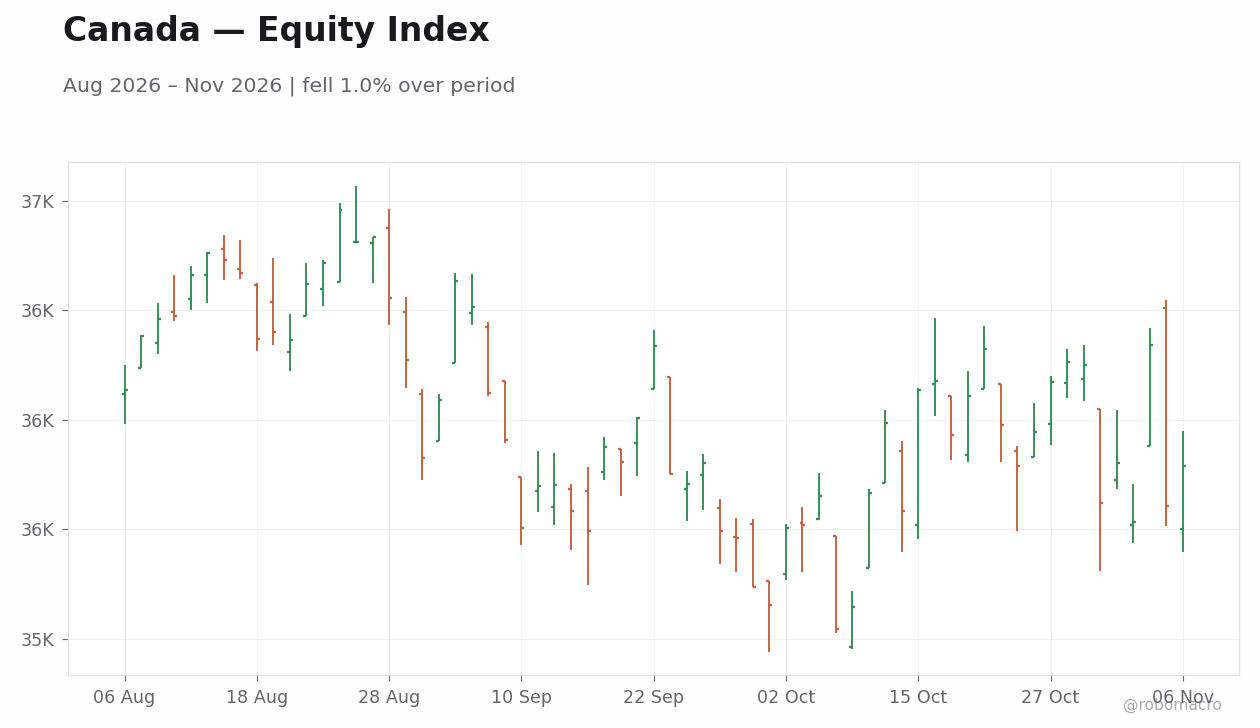
Manufacturing contraction signals broadening weakness. The S&P Global Manufacturing PMI crossed below the 50 threshold, marking the first contraction in several prints. This outcome aligned with softer global demand and elevated borrowing costs weighing on factory activity. Labour market data missed expectations sharply. The unemployment rate climbed while employment declined against a consensus forecast of a gain, extending the prior month’s drop. Full-time employment fell and part-time employment rose only modestly, leaving the participation rate unchanged. Trade balance provided a partial offset. The surplus expanded, exceeding consensus and the prior level, reflecting resilient export flows even as manufacturing indicators softened. Equity and rates markets reflected mixed signals. The S&P/TSX closed the week at 35789.1 after a 0.03 percent decline, while USD/CAD moved to 1.41. The data arc therefore points to softening domestic momentum that challenges earlier resilience assumptions.

BoC Watch

Bank of Canada raised the policy rate, citing an inflation outlook that had deteriorated. Governor Macklem told Parliament that fiscal and monetary policy are not at odds and that officials will proceed carefully on further increases. The manufacturing contraction and the labour-market miss reinforced the data-dependent stance, with Macklem linking upcoming decisions directly to subsequent activity and price prints. The trade surplus beat offered no immediate offset to the growth concerns embedded in the PMI and employment figures. Officials therefore kept forward guidance unchanged, anchoring the next policy move to the flow of domestic releases rather than to any pre-set schedule.

RoboMacro AI Economic Research

Global Macro Watch

Week of November 2–6, 2026 robomacro.com
Data Review: Actual vs Consensus
DateCtryEventPrior Cons.Actual
Mon 2CAS&P Global Manufacturing P51.5-49.6
Wed 4CATrade Balance5.0bn4.1bn5.3bn
Wed 4CAExports Level78.4bn-78.5bn
Wed 4CAImports Level73.5bn-73.2bn
Wed 4CAS&P Global Composite PMI48.7-48.1
Wed 4CAS&P Global Services PMI48.3-48.1
Wed 4CA5-Year Bond Auction3.6-3.5
Fri 6CAHeadline Unemployment Rate6.56.56.7
Fri 6CAEmployment Change-68K14K-4700
Fri 6CAFull-Time Employment Chang-35K--18K
Fri 6CALabor Force Participation64.8-64.8
Fri 6CAPart-Time Employment Chang-33K-13K
Chart 6
Chart 7
Chart 8

The Week Ahead

The Canadian calendar remains light next week, with no tier-one releases scheduled that would directly alter the Bank of Canada’s near-term assessment. Markets will therefore focus on any follow-up commentary from officials that could clarify how the recent labour and manufacturing prints feed into the rate path. Trade-related headlines tied to external tariffs will be monitored for their potential impact on export orders and growth in coming quarters. The absence of fresh domestic data leaves the Bank of Canada’s reaction function unchanged and keeps attention on the cumulative evidence from the prior week’s employment and PMI outcomes. Any speeches will be scrutinized for signals on whether the recent softening warrants a pause or continued tightening at upcoming decisions. Broader North American data releases may still influence CAD and yields through relative growth differentials. Overall, the week is expected to reinforce the data-dependent framework already articulated by Governor Macklem.

Risks & Themes

The jobs miss and manufacturing contraction together shift the growth outlook lower and raise the possibility that the Bank of Canada may need to pause earlier than previously anticipated if subsequent prints remain soft. Upside risks centre on a rebound in the trade surplus that could support exports and limit further downside in activity. Downside scenarios include additional weakness in employment that widens the output gap and keeps inflation pressures contained despite the recent rate hike. Trade uncertainty with the United States adds a separate layer of risk for growth that is not yet captured in the latest domestic releases. The data therefore suggest that markets may be under-weighting the cumulative effect of consecutive soft prints on the Bank of Canada’s reaction function.

RoboMacro AI Economic Research

Global Macro Watch

Week of November 2–6, 2026 robomacro.com
Mexico
Market Scorecard
AssetLevelWoW
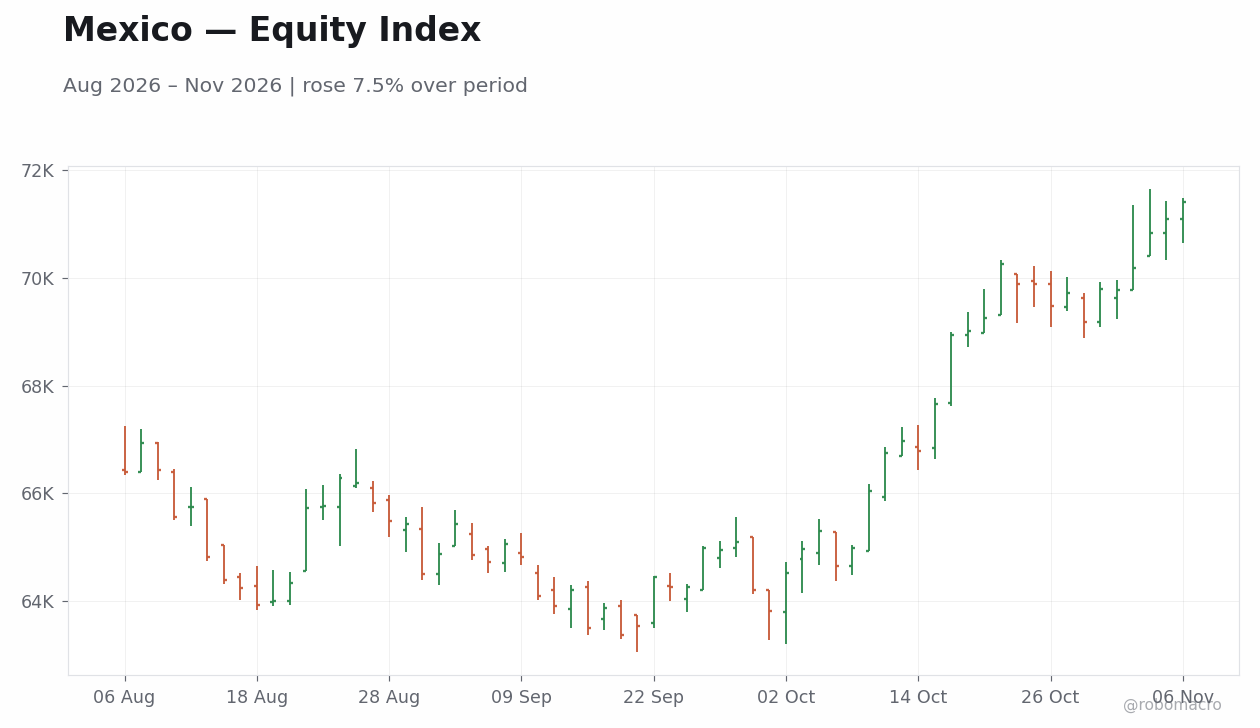
IPC Bolsa71393.57+1.7%
USD/MXN18.61-1.0%
EUR/MXN21.09+0.6%
WTI Crude90.83-5.8%
Silver51.94+2.4%
Gold4074.9+2.6%
Brent Crude98.32-6.2%
Bitcoin75947.48-2.9%
Chart 1
Chart 2
Chart 3
  • Mexico’s Q3 GDP expanded, beating expectations and supporting resilient domestic activity into the November decision.
  • Banco de Mexico cut the policy rate on November 5, diverging from consensus.
  • Business Confidence Index rose while Consumer Confidence Index declined, both remaining below neutral and highlighting uneven sentiment.

Week in Review

GDP surprise alters policy calculus. Mexico’s Q3 GDP expanded, surpassing forecasts and confirming stronger second-half momentum than anticipated after the prior hold. The print immediately tempered expectations for near-term easing ahead of the November meeting.

Survey data remain subdued. Business Confidence Index improved yet stayed below the neutral threshold, while Consumer Confidence Index edged lower, indicating corporate and household caution persisted despite the growth beat.

Policy action surprises. Banco de Mexico lowered the policy rate on November 5, marking an earlier restart of easing than consensus had priced. The decision followed the GDP upside and occurred against a contained inflation backdrop.

Currency and equity moves diverge. USD/MXN declined week-over-week while IPC Bolsa advanced, showing the peso strengthened overall even as the rate cut was delivered. WTI Crude and Brent Crude fell, providing a mixed external backdrop for Mexican assets.

Commodity and risk-asset rotation. Gold and silver gained amid broader haven flows, while Bitcoin declined. The configuration left Mexican equities supported by domestic resilience while external energy weakness weighed on fiscal-linked sentiment.

Through-line across the week. Stronger activity data and the subsequent policy shift produced a cohesive narrative of earlier-than-expected easing, with the peso and local equities absorbing the move without immediate reversal. The data therefore suggest domestic growth buffers allowed the board to adjust settings sooner than prior guidance had implied.

Banxico Watch

Banco de Mexico lowered the policy rate on November 5 after the Q3 GDP print exceeded forecasts. The decision followed unchanged settings through the prior meeting and came alongside subdued readings in Business Confidence Index and Consumer Confidence Index. Officials tied the move to incoming activity data, preserving a still-positive real rate given contained inflation. The statement language will shape expectations for the pace of further adjustments at upcoming decisions, with the board continuing to link future steps to domestic inflation and growth prints.

RoboMacro AI Economic Research

Global Macro Watch

Week of November 2–6, 2026 robomacro.com
Data Review: Actual vs Consensus
DateCtryEventPrior Cons.Actual
Tue 3MXBusiness Confidence Index48.1-48.4
Tue 3MXS&P Global Manufacturing P50.3-49.5
Wed 4MXFiscal Balance-737.3bn--959.6bn
Thu 5MXForeign Exchange Reserves 255.9bn-257.2bn
Thu 5MXConsumer Confidence Index45.1-45.0
Thu 5MXGross Fixed Investment Mon1.4--1.8
Thu 5MXGross Fixed Investment Yea6.66.55.7
Thu 5MXCentral Bank Interest Rate6.56.56.2
Week Ahead: Key Releases
DateReleasePriorCons.
2026-11-09Inflation Rate Month-over-Month0.42-
2026-11-09Inflation Rate Year-over-Year3.5-
Chart 5
Chart 7

The Week Ahead

Monday brings no high-impact Mexican releases, allowing markets to digest the November decision. Mid-week focus will turn to any follow-up commentary from board members that clarifies the reaction function after the latest setting. Later in the week, attention shifts to inflation prints that will inform whether the recent growth beat sustains the case for measured easing at the next meeting. The data will also test whether the peso’s recent strength persists or requires policy recalibration. Releases on external accounts and industrial activity will provide further signals on the trajectory into coming quarters. Overall, the calendar supports a data-dependent stance ahead of subsequent decisions.

Risks & Themes

The rate cut introduces downside risks to the peso if inflation reaccelerates, particularly with business and consumer surveys still below neutral. Upside scenarios hinge on sustained quarterly GDP momentum supporting further gradual easing without currency pressure. The divergence between resilient activity data and soft sentiment readings raises the possibility that the board may need to pause if confidence fails to improve. Markets appear to underweight the credibility signal from moving earlier than the prior path, leaving room for volatility in USD/MXN if subsequent prints challenge the growth narrative.

RoboMacro AI Economic Research

Global Macro Watch

Week of November 2–6, 2026 robomacro.com
Brazil
Market Scorecard
AssetLevelWoW
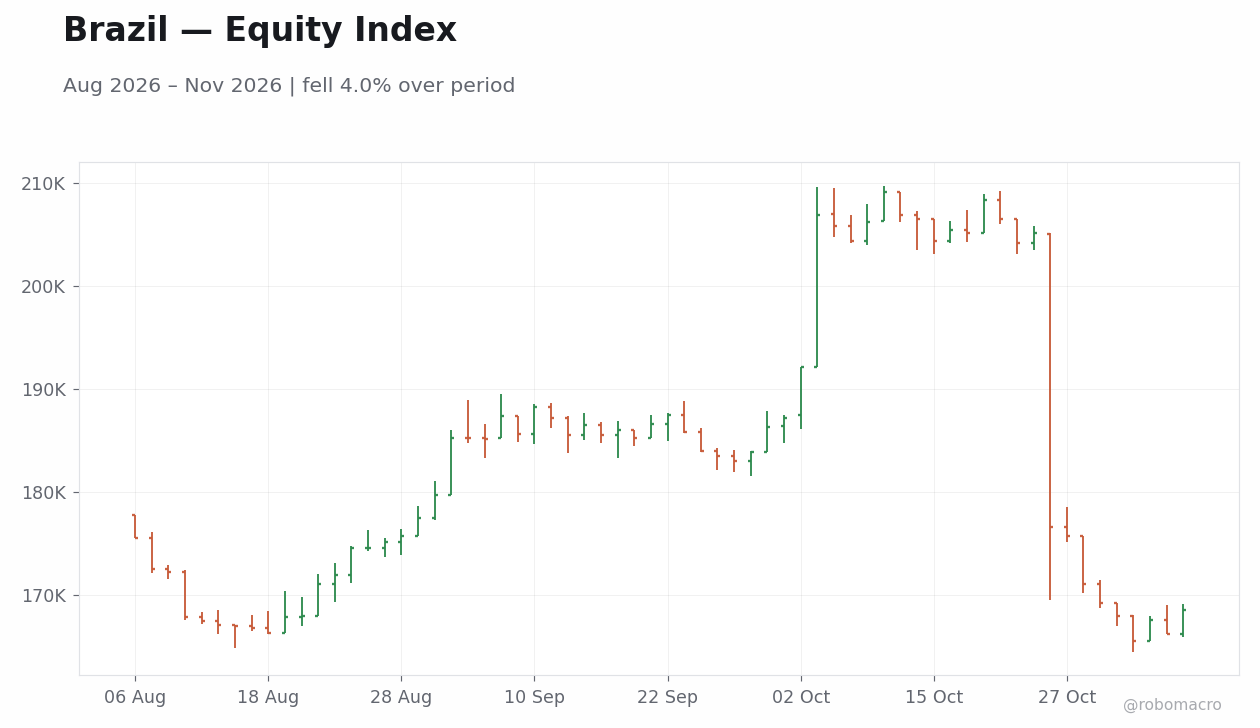
Bovespa168499.0+1.8%
USD/BRL5.51+1.3%
EUR/BRL6.17+1.8%
Vale11.59+2.2%
Petrobras18.53-12.4%
WTI Crude90.83-5.8%
Gold4074.9+2.6%
Bitcoin75950.05-2.9%
Chart 1
Chart 2
  • COPOM held the policy rate, interrupting the easing cycle after inflation projections deteriorated and the currency weakened.
  • Activity indicators pointed to sharper contraction, with services PMI moving deeper into contraction territory.
  • The 10-year local yield moved higher and the Bovespa advanced week-over-week, while Petrobras shares declined sharply over the same period.

Week in Review

Policy hold interrupts easing path. The Banco Central do Brasil held the policy rate, matching expectations and interrupting the prior cutting sequence. The decision coincided with a rise in USD/BRL.

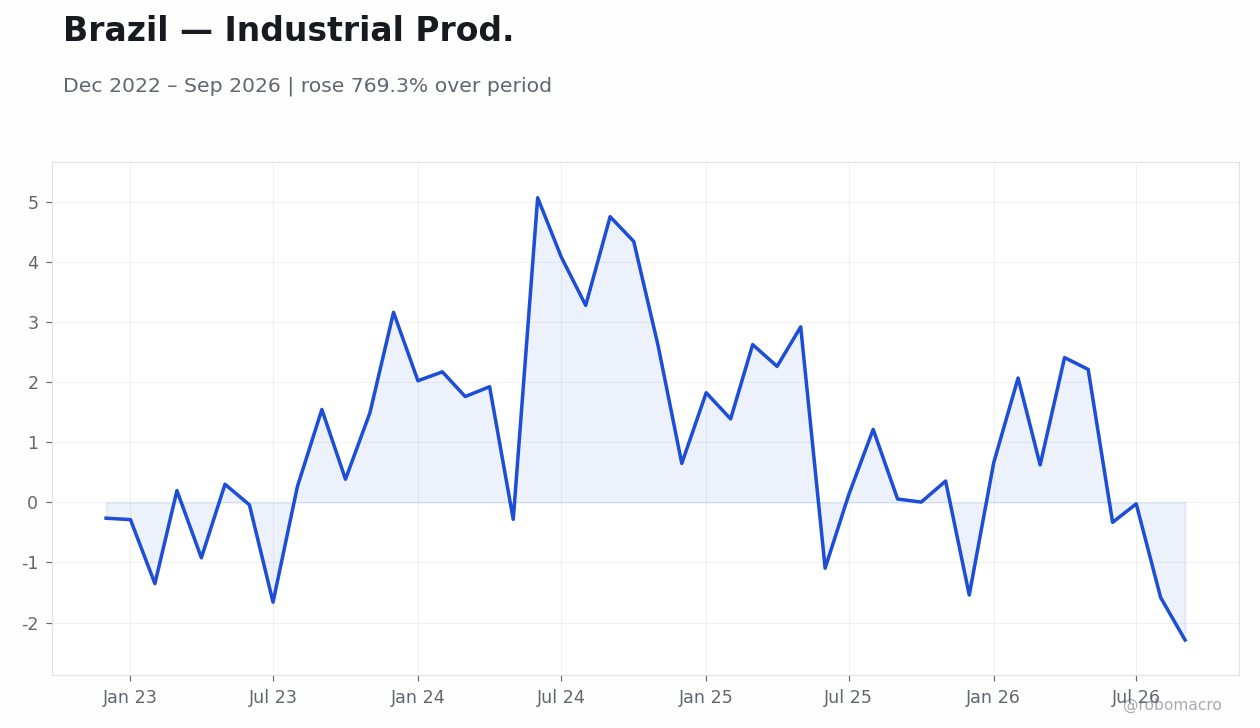
Activity data undershot expectations. Industrial Production contracted month-over-month, worse than consensus, while the S&P Global Services PMI extended contraction territory.

Trade surplus exceeded forecasts. The Trade Balance release showed a larger surplus than consensus and the prior reading. This print arrived after WTI Crude declined week-over-week.

Equity and fixed-income divergence widened. The Bovespa closed the week higher after a gain, while the 10-year government yield increased. Petrobras shares fell over the period, offsetting gains in Vale.

Currency pressure persisted through the week. USD/BRL rose and EUR/BRL advanced, reflecting sustained depreciation pressures. Gold rose amid the broader risk-off tone in local assets.

The data arc shows domestic activity prints challenging prior resilience signals and reinforcing the policy hold, while the trade surplus offered limited offset to the broader selloff in rates and commodity-linked equities.

BCB Watch

The Banco Central do Brasil held the policy rate, ending the easing cycle after consecutive cuts. The decision aligned with the BCB Focus Market Readout released earlier in the week and followed deterioration in local inflation projections. Industrial Production and the S&P Global Services PMI both pointed to weaker momentum entering the next decision window. The committee’s statement tied the pause directly to these incoming prints and the recent currency move. Forward guidance remained data-dependent, with officials signaling that future settings will respond to the path of inflation and activity releases. The hold therefore resets the reaction function around domestic indicators rather than external commodity moves.

RoboMacro AI Economic Research

Global Macro Watch

Week of November 2–6, 2026 robomacro.com
Data Review: Actual vs Consensus
DateCtryEventPrior Cons.Actual
Tue 3BRBCB Focus Market Readout--""
Tue 3BRS&P Global Manufacturing P44.8-46.1
Wed 4BRIPC-Fipe Inflation Month-o0.51-0.44
Wed 4BRNet Payrolls166K171K121K
Wed 4BRCentral Bank Interest Rate13.813.813.8
Thu 5BRIndustrial Production Mont-0.70-0.20-0.80
Thu 5BRIndustrial Production Year-1.2-1.7-2.5
Thu 5BRS&P Global Services PMI49.2-44.5
Thu 5BRS&P Global Composite PMI47.4-44.4
Fri 6BRTrade Balance7.7bn9.0bn9.3bn
Week Ahead: Key Releases
DateReleasePriorCons.
2026-11-09BCB Focus Market Readout--
2026-11-10BCB Copom Meeting Minutes--
2026-11-12Inflation Rate Month-over-Month0.82-
2026-11-12Inflation Rate Year-over-Year4.6-
2026-11-13Retail Sales Month-over-Month0.10-
2026-11-13Business Confidence Index46.2-
Chart 6
Chart 7

The Week Ahead

No major Brazilian data releases are scheduled for November 9–13, shifting focus to the implications of the recent policy hold for the upcoming meeting. The weak Industrial Production and Services PMI prints will feed directly into the next assessment of growth momentum. Trade Balance strength may provide a modest buffer to external accounts but is unlikely to alter the inflation trajectory on its own. Markets will monitor any additional BCB speakers for clarification on the conditions required to resume easing. The absence of fresh prints leaves the committee reliant on subsequent inflation releases to shape the next decision. Officials have already linked the current stance to the observed deterioration in projections, so incoming quarter data will determine whether the pause extends. This setup keeps the rate path tethered to domestic releases rather than global commodity fluctuations.

Risks & Themes

The policy hold and subsequent activity misses raise the possibility that the policy rate remains elevated for longer if growth continues to undershoot. Fiscal concerns already embedded in the yield increase could amplify term-premium volatility if spending debates intensify. Petrobras’s weekly decline highlights sector-specific downside that may spill into broader equity sentiment if iron-ore support for Vale fades. On the upside, a sustained trade surplus could ease external financing needs and reduce pressure on the currency. The data therefore tilt the balance toward a higher-for-longer stance unless subsequent releases show clear stabilization in industrial output and services activity.

RoboMacro AI Economic Research

Global Macro Watch

Week of November 2–6, 2026 robomacro.com
Argentina
Market Scorecard
AssetLevelWoW
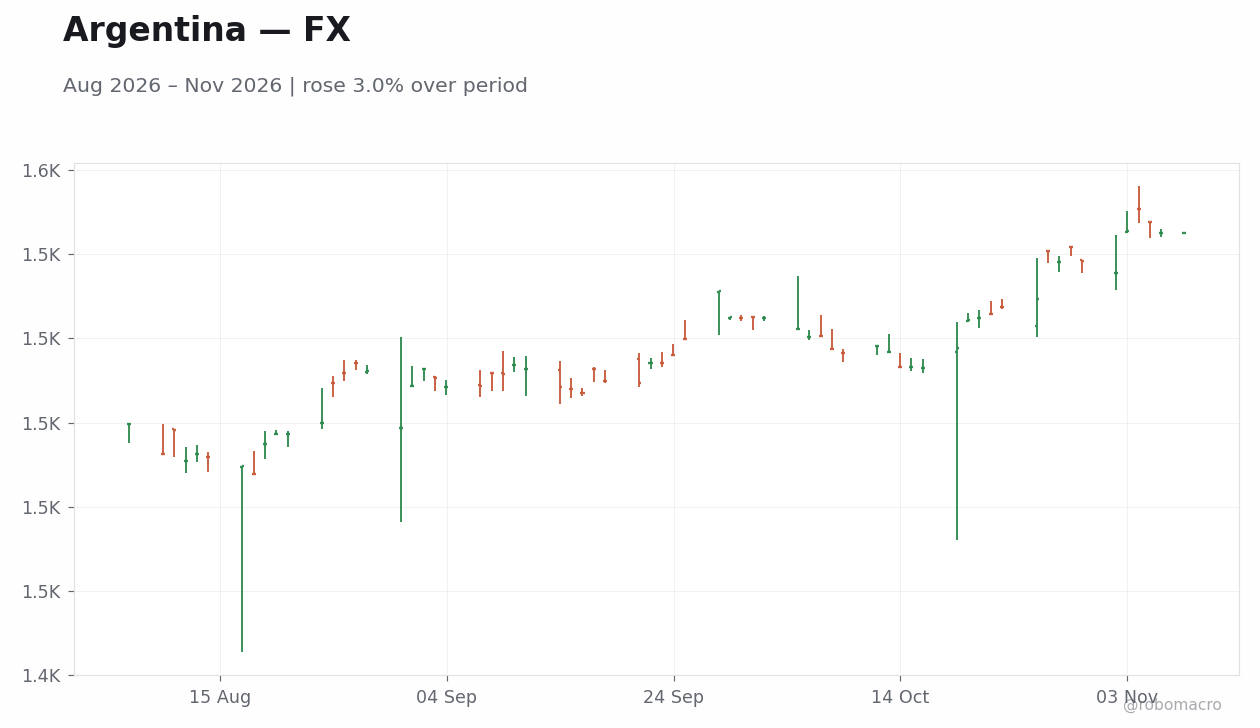
USD/ARS1545.0+0.6%
EUR/ARS1734.72+1.3%
Gold4074.9+2.6%
Brent Crude98.32-6.2%
Soybean1193.75-0.9%
Bitcoin75960.62-2.9%
Chart 2
Chart 3
  • USD/ARS rose 0.61% to 1545 over the week.
  • Brent Crude fell 6.16% to 98.32 while soybean prices declined 0.91% to 1193.75, producing a mixed external backdrop.
  • The Argentine calendar remained empty of domestic releases.

Week in Review

Peso and FX Dynamics USD/ARS rose 0.61% over the week to close at 1545. EUR/ARS advanced 1.26% to 1734.72. The absence of Argentine data releases left the currency to trade on positioning and external commodity signals.

Equity and Commodity Market Moves Brent Crude fell 6.16% to 98.32. Soybean futures declined 0.91% to 1193.75. Gold rose 2.65% to 4074.9. These commodity moves produced offsetting effects on Argentina’s trade balance arithmetic.

Growth and Policy Backdrop No domestic data releases occurred. The lack of BCRA communications or IMF programme updates left reserve accumulation and FX intervention behavior as the observable policy signals.

BCRA Watch

** No Central Bank of Argentina speakers, minutes, or policy decisions were released during the week. The lack of any domestic releases left reserve accumulation and FX intervention behavior as the observable policy signals, with the peso’s moves reflecting positioning rather than shifts in forward guidance. The next policy adjustment will remain tethered to the trajectory of incoming inflation and activity indicators.

RoboMacro AI Economic Research

Global Macro Watch

Week of November 2–6, 2026 robomacro.com
Data Review: Actual vs Consensus
DateCtryEventPrior Cons.Actual
Mon 2ARTax Revenue21359.0bn-21608.0bn
Chart 6

The Week Ahead

The Argentine calendar remains empty for the week beginning November 9. Markets will continue to monitor BCRA reserve and FX-settlement flows for signals on the crawling peg. Commodity price moves in Brent Crude and soybean futures will feed directly into export-tax and balance-of-payments expectations. Global risk appetite and US Treasury yield moves will likely set the tone for the MERVAL and peso in the absence of local catalysts.

Risks & Themes

Brent Crude’s 6.16% weekly decline eased immediate import-bill pressure but left the energy trade balance exposed to further volatility. Soybean price weakness reduced support for the agricultural export complex. The absence of fresh domestic data or central bank communication leaves the market pricing a stable policy path, with room for repricing once the next inflation or activity print arrives.

RoboMacro AI Economic Research

Global Macro Watch

Week of November 2–6, 2026 robomacro.com
Colombia, Chile and Peru
Market Scorecard
AssetLevelWoW
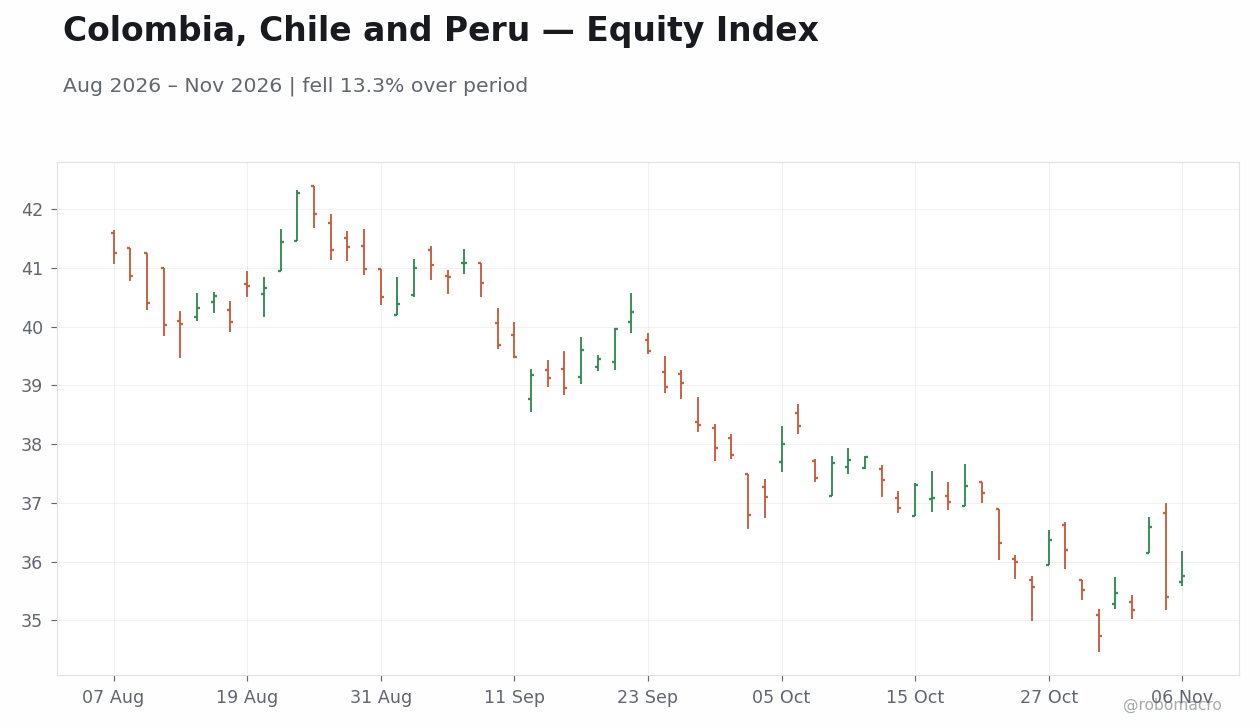
MSCI Chile35.75+0.8%
MSCI Peru80.41-1.1%
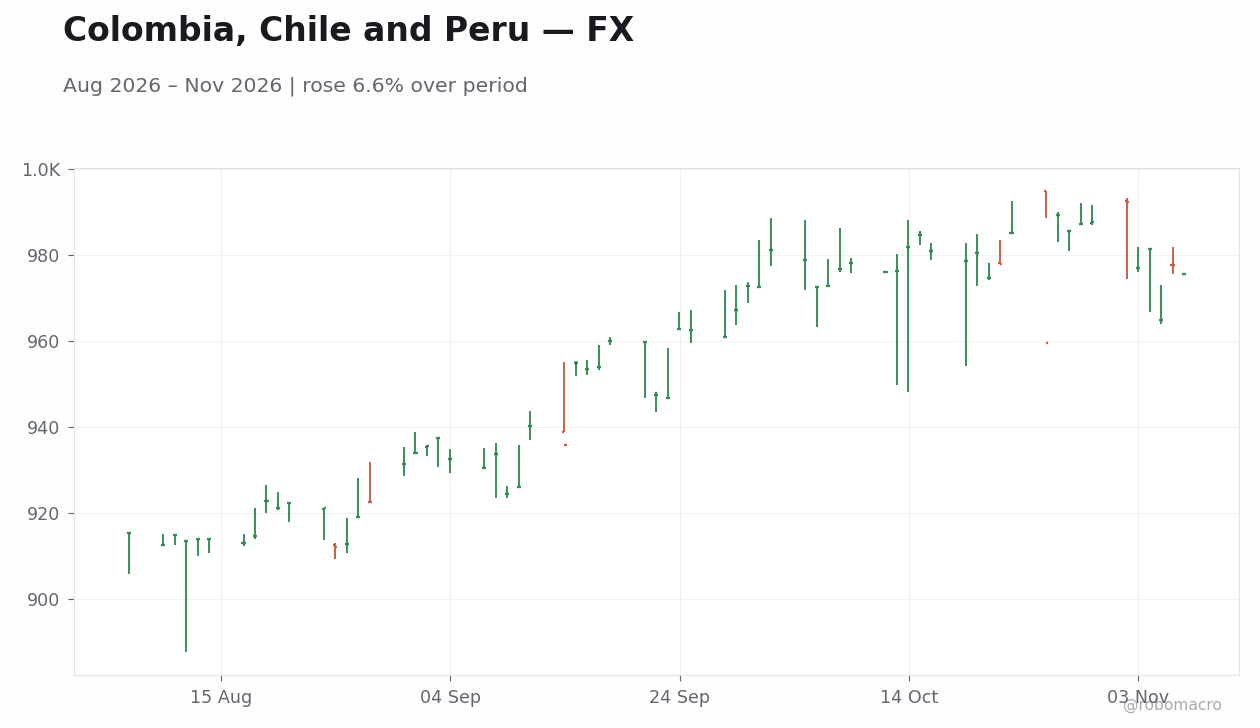
USD/COP3240.49+6.3%
USD/CLP975.74-1.7%
USD/PEN3.44+2.6%
Copper6.24-4.7%
Gold4074.9+2.6%
Brent Crude98.32-6.2%
Bitcoin75962.29-2.9%
Chart 1
Chart 2
  • Equity markets showed dispersion, with MSCI Chile rising while MSCI Peru declined amid commodity price moves.
  • USD/COP posted a large week-over-week gain while USD/CLP eased and USD/PEN advanced.
  • Brent crude declined sharply while gold rose, producing divergent signals for the region's commodity exporters.

Week in Review

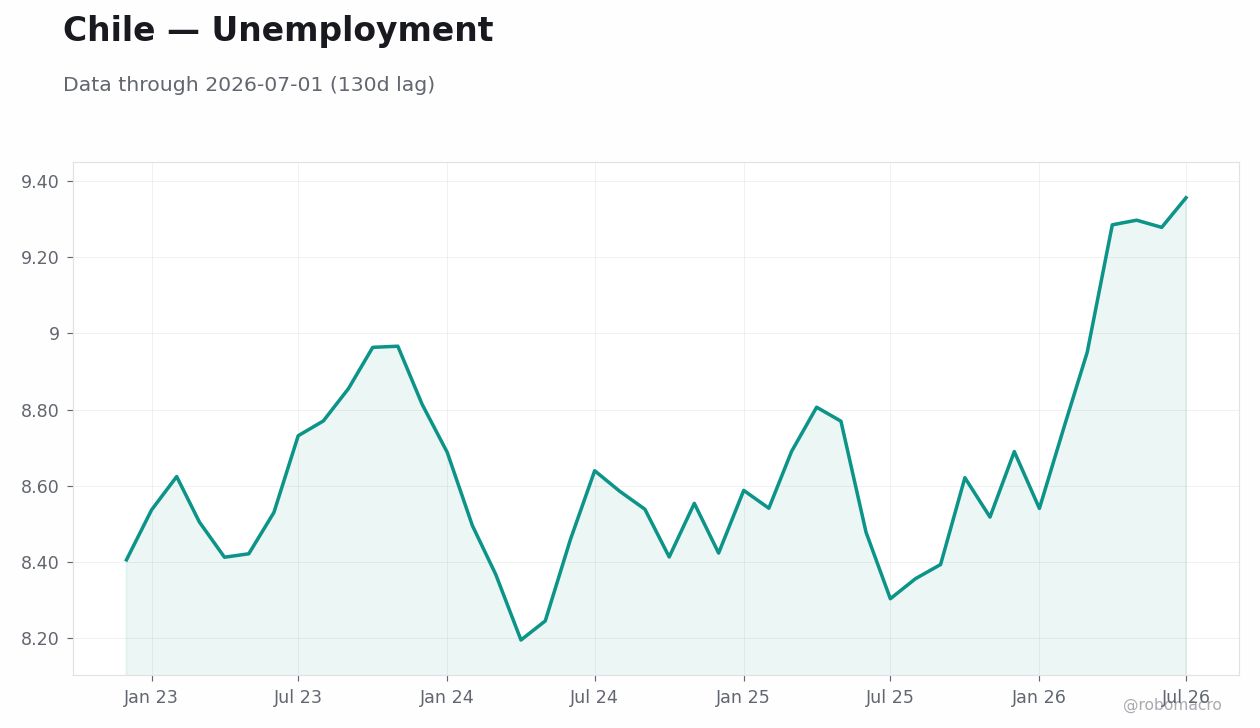
Fiscal and security shocks dominate Colombia. Cooling activity and persistent inflation left the policy stance unchanged. USD/COP rose sharply week-over-week to 3240.49.

Chilean policy signals tighten despite the hold. Minutes from the latest decision indicated discussion of a rate increase before the hold. MSCI Chile rose 0.82% week-over-week to 35.75, supported by pension-fund flows and lower external yields.

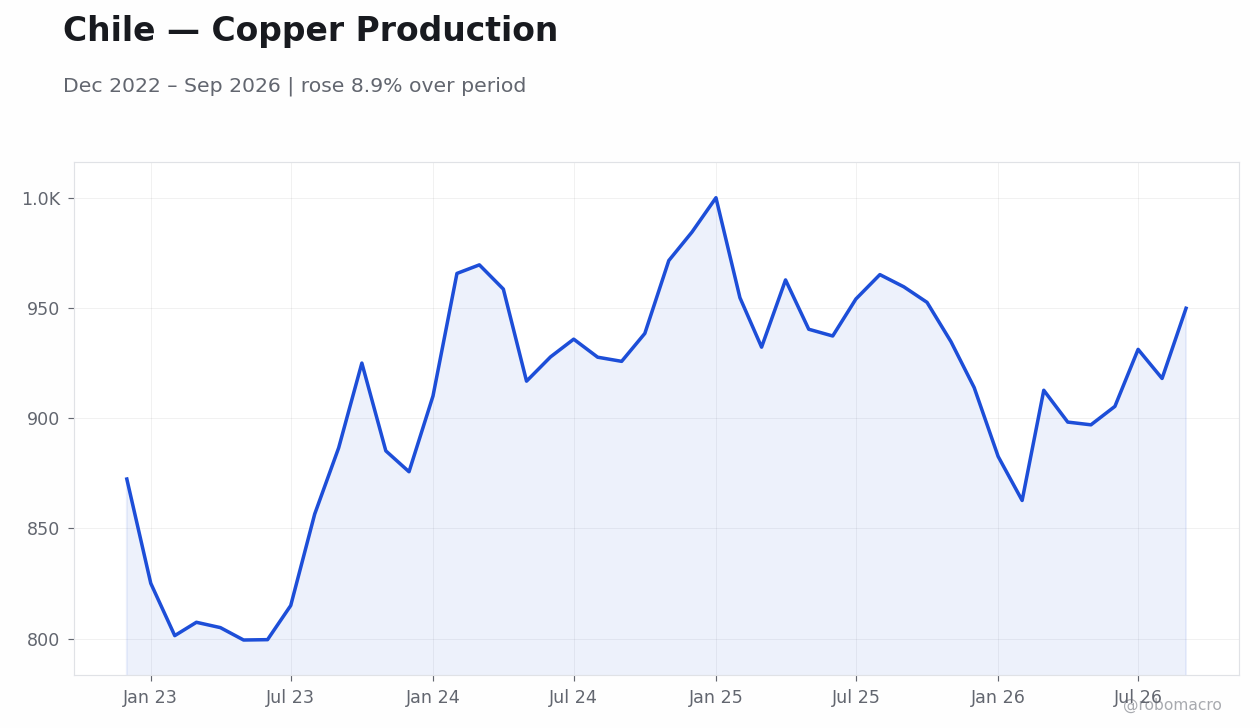
Peru equities lag amid currency swings. MSCI Peru fell 1.05% week-over-week to 80.41 even as gold advanced. USD/PEN rose 2.63% overall to 3.44. Copper declined 4.68% to 6.24, offering little offset to the mining-linked market. The data confirmed expectations of regional dispersion rather than uniform risk-on flows, with the Andean calendar empty of tier-one releases.

Commodity and external flows set the tone. Brent crude fell 6.16% for the week while gold rose, producing divergent export signals for Colombia versus Chile and Peru. Equity and FX moves remained tethered to these prints and dollar direction, with USD/CLP easing 1.68% to 975.74. Policy divergence within the bloc persisted, as Colombia absorbed domestic pressure while Chile and Peru traded on commodity and global risk sentiment.

Andean Central Banks Watch

The latest hold reflected cooling activity offsetting persistent inflation, with fiscal warnings adding downside risk to the outlook ahead of the next decision. Minutes from Chile’s latest decision explicitly noted discussion of a rate increase before the hold, signaling that officials viewed inflation risks from the oil shock as material enough to consider tightening. The BCRP maintained its pre-meeting blackout ahead of its next decision, leaving the latest CPI print and stable sol as the key domestic anchors. The data showed no change in forward guidance from any of the three banks, preserving real-rate buffers amid uneven domestic prints. Officials tied next steps directly to incoming activity and inflation releases rather than external factors.

RoboMacro AI Economic Research

Global Macro Watch

Week of November 2–6, 2026 robomacro.com
Data Review: Actual vs Consensus
DateCtryEventPrior Cons.Actual
Mon 2CLIMACEC Economic Activity Y-1.0-0.20
Mon 2PEInflation Rate Month-over-0.12-0.57
Mon 2PEInflation Rate Year-over-Y4.5-5.2
Tue 3CODavivienda Manufacturing P54.6-51.7
Wed 4COExports Year-over-Year--16.4
Thu 5COMonetary Policy Meeting Mi---
Fri 6CLCore Inflation Rate Month---0
Fri 6CLInflation Rate Month-over---0.50
Fri 6CLInflation Rate Year-over-Y--4.5
Fri 6COProducer Price Index Year---4.5
Week Ahead: Key Releases
DateReleasePriorCons.
2026-11-12Central Bank Interest Rate Decision4.2-
Chart 5
Chart 7

The Week Ahead

The Andean calendar opens quietly with no tier-one releases scheduled for Colombia, Chile or Peru. Attention centers on the BCRP decision, where the board will assess the latest CPI and copper dynamics against the stable sol. Chile’s next BCCh meeting remains further out, so commentary on oil-shock transmission into expectations will shape positioning. Colombia’s BanRep convenes later still, keeping fiscal-bill progress in Congress as the dominant local variable. The releases matter for rate paths because they will test whether cooling activity continues to offset inflation pressures in each jurisdiction. Traders will monitor commodity prints for export-sensitive growth signals that feed into the next decisions. External dollar and risk flows will likely dominate daily moves given the data vacuum.

Risks & Themes

Fiscal and security concerns in Colombia raised downside scenarios for growth and the peso that could keep policy on hold longer. Minutes from Chile’s latest decision revealed upside inflation risks from oil that could prompt a revisit of earlier tightening considerations if volatility persists. Peru’s PEN moves highlighted vulnerability to external flows despite reserve buffers, potentially complicating the stability mandate. The data shifted the outlook toward greater dispersion in rate paths, with Colombia facing domestic headwinds while Chile and Peru remain more exposed to commodity cycles. Markets appear to underweight the fiscal-adjustment risk in Colombia relative to the policy-signal clarity from BCCh minutes.

RoboMacro AI Economic Research

Global Macro Watch

Week of November 2–6, 2026 robomacro.com
United Kingdom
Market Scorecard
AssetLevelWoW
FTSE 10010673.9-0.8%
FTSE 25024504.3-1.2%
GBP/USD1.35+0.5%
GBP/EUR1.2-0.1%
GBP/JPY211.55+0.2%
Brent Crude98.32-6.2%
Gold4074.9+2.6%
UK Nat Gas3.0+5.0%
Bitcoin75962.29-2.9%
Chart 1
Chart 2
Chart 3
  • Bank of England raised the policy rate in a unanimous vote.
  • S&P Global Construction PMI fell in November, marking the sharpest contraction in the series.
  • Lloyds House Price Index declined month-over-month in November, with the year-over-year reading moving lower.
  • FTSE 100 closed the week at 10673.9 for a net decline of 0.81 percent while GBP/USD rose 0.53 percent to 1.35.

Week in Review

Policy shift dominates domestic narrative. The Bank of England raised the policy rate in a unanimous decision that aligned with the pre-meeting consensus. Markets had positioned for the move throughout the prior sessions, yet the accompanying Monetary Policy Report and minutes provided limited additional forward guidance on subsequent steps.

Construction sector contraction deepens. The S&P Global Construction PMI printed below consensus and the prior reading, confirming accelerated weakness in new orders and employment sub-indices. This outcome extended the sector’s contraction streak and contrasted with earlier resilience signals in manufacturing and services.

Housing market data softens further. The Lloyds House Price Index released showed a month-over-month drop, missing consensus and extending the prior decline, while the year-over-year measure moved lower against expectations.

Equity and currency divergence emerges. The FTSE 100 fell 0.81 percent to close at 10673.9 for the week while the domestically oriented FTSE 250 declined 1.18 percent to 24504.3, reflecting caution after the rate decision. Sterling advanced 0.53 percent to 1.35 against the dollar, supported by the policy tightening and relative outperformance versus eurozone peers.

Gilt curve steepens on mixed flows. The UK 10-year gilt yield ended lower on the week while the 2-year yield settled after a modest decline, producing a steepening that priced limited follow-on tightening. Brent crude fell 6.16 percent to 98.32 over the five sessions, easing imported inflation pressures but highlighting demand concerns that weighed on risk assets.

BoE Watch

The Bank of England raised the policy rate in a unanimous vote, marking the first increase since 2023 and aligning with the pre-meeting consensus. The accompanying Monetary Policy Report and MPC minutes offered limited new forward guidance, leaving the path for subsequent adjustments tied explicitly to incoming inflation and activity data. The vote split showed zero preferences for cuts or holds, underscoring committee cohesion around the initial tightening step despite the weak construction PMI release that same morning.

Market pricing had built steadily for the move across the prior sessions, with the 2-year gilt yield declining as investors appeared to discount a one-and-done scenario. The Lloyds House Price Index miss reinforced downside risks to growth, yet the Bank of England’s communication kept emphasis on domestic inflation persistence rather than immediate further action. This configuration leaves the medium-term rate path dependent on the next round of CPI and labor-market prints rather than pre-set calendar guidance.

Data Review

The S&P Global Construction PMI for November came in below consensus and the prior reading by a wide margin and confirming the steepest contraction since early 2023. New orders and employment components both deteriorated sharply, pointing to weaker near-term activity in a sector already sensitive to higher borrowing costs. The Bank of England’s decision to raise the policy rate occurred against this backdrop, with the unanimous vote split indicating broad committee agreement despite the soft print.

The Lloyds House Price Index released printed below consensus and the prior reading, while the year-over-year gauge moved lower against expectations. These figures extend the cooling trend in housing and suggest that higher policy rates are beginning to transmit more visibly into asset prices. Taken together, the data releases reinforce a picture of moderating domestic demand that sits alongside the Bank of England’s decision to begin normalizing policy. The combination points to a growth outlook that is softening faster than inflation pressures are abating, keeping the medium-term rate path data-dependent rather than pre-committed to further moves.

RoboMacro AI Economic Research

Global Macro Watch

Week of November 2–6, 2026 robomacro.com
Data Review: Actual vs Consensus
DateCtryEventPrior Cons.Actual
Mon 2GBS&P Global Manufacturing P51.952.852.8
Tue 3GBGreen Gilt 2037 Auction--5.3
Wed 4GBComposite PMI Final52.053.152.9
Wed 4GBServices PMI Final52.153.152.8
Thu 5GBNew Car Sales Year-over-Ye12.1-5.4
Thu 5GBS&P Global Construction PM46.146.143.6
Thu 5GBBoE Interest Rate Decision3.84.04.0
Thu 5GBBoE MPC Vote Cut0-0
Thu 5GBBoE MPC Vote Hike3.0-9.0
Thu 5GBBoE MPC Vote Unchanged6.0-0
Thu 5GBBoE Monetary Policy Report---
Thu 5GBMPC Meeting Minutes---
Fri 6GBLloyds House Price Index M-0.100.10-0.60
Fri 6GBLloyds House Price Index Y-0.10-0.30-1.2
Week Ahead: Key Releases
DateReleasePriorCons.
2026-11-09BoE Gov Bailey Speech--
2026-11-09BRC Retail Sales Monitor Year-over-1.0-
2026-11-10BoE Lombardelli Speech--
2026-11-10BoE Pill Speech--
2026-11-11RICS House Price Balance-32.0-32.0
2026-11-12GDP Growth Quarter-over-Quarter Pre0.500.70
2026-11-12GDP Growth Year-over-Year Prelimina1.4-
2026-11-12GDP Month-over-Month0.100
2026-11-12Business Investment Quarter-over-Qu1.8-
2026-11-12GDP 3-Month Avg0.70-
Chart 5
Chart 6
Chart 7

The Week Ahead

Attention next week centers on limited UK-specific releases, with markets instead digesting the implications of the policy decision across global calendars. Monday features Japanese coincident and leading indices that may influence sterling cross rates, while Tuesday brings Danish current-account and trade-balance data with limited direct read-through. Wednesday includes South African foreign-exchange reserves and Finnish trade figures that could affect broader European sentiment.

Thursday carries potential for additional European activity prints, and Friday rounds out the period with further global data that will shape relative rate differentials. Bank of England speakers are scheduled for several slots, including follow-up commentary that will be scrutinized for any evolution in the post-hike reaction function. The absence of high-impact domestic releases leaves positioning and external risk factors as the primary drivers until the subsequent week’s inflation and labor data arrive.

Risks & Themes

The rate hike and simultaneous construction PMI miss introduce downside risks to the growth outlook that could pressure sterling and equities if subsequent activity prints disappoint. Housing data weakness signals faster transmission of higher borrowing costs than previously anticipated, raising the possibility that the Bank of England may pause after this initial move. Positioning appears stretched toward further tightening given the unanimous vote, leaving room for volatility if the next CPI release undershoots.

Upside scenarios hinge on resilient services and labor-market data that would support additional policy normalization, while downside cases center on accelerated contraction in construction and housing feeding into weaker GDP prints. Flow considerations favor defensive assets such as gold, which rose 2.65 percent, over cyclical equities that closed lower on the week.

Cross-Asset

The FTSE 100 declined 0.81 percent to close the week at 10673.9 while the FTSE 250 fell 1.18 percent to 24504.3, with the domestically focused index underperforming after the rate decision. The UK 10-year gilt yield ended lower on the week, while the 2-year yield settled after a modest decline, producing a modest steepening.

GBP/USD rose 0.53 percent to 1.35. Brent crude fell 6.16 percent to 98.32. Gold advanced 2.65 percent to 4074.9, reflecting defensive flows amid equity weakness and the policy shift.

Global Context

Global policy divergence remained the dominant theme, with the Bank of England’s hike contrasting with unchanged settings at the ECB and Bank of Japan in the prior week. Brent crude’s 6.16 percent weekly decline to 98.32 eased imported inflation pressures across Europe and supported sterling’s 0.53 percent gain. Equity dispersion continued, with the FTSE 100’s 0.81 percent decline occurring alongside broader risk-off moves in other developed markets.

RoboMacro AI Economic Research

Global Macro Watch

Week of November 2–6, 2026 robomacro.com
Sweden, Norway, Denmark and Finland
Market Scorecard
AssetLevelWoW
OMX Stockholm 303267.88-0.6%
Oslo Bors2053.36-3.0%
OMX Copenhagen 252008.97+1.1%
OMX Helsinki 256221.79+0.1%
USD/SEK9.89+0.7%
USD/NOK9.45+2.6%
EUR/SEK11.03+0.6%
EUR/NOK10.54+2.5%
Brent Crude98.32-6.2%
Gold4074.9+2.6%
Bitcoin75962.31-2.9%
Chart 1
Chart 2
Chart 4
  • Riksbank delivered a hike on November 4 while Norges Bank held its policy rate on November 5.
  • Nordic equities diverged sharply over the week, with OMX Copenhagen 25 rising 1.15% to 2008.97 and OMX Helsinki 25 advancing 0.13% to 6221.79, while OMX Stockholm 30 fell 0.58% to 3267.88 and Oslo Bors declined 2.97% to 2053.36 amid Brent crude’s 6.16% drop to 98.32.
  • Swedish 10-year government yields eased and USD/SEK rose 0.73% to 9.89 while USD/NOK climbed 2.60% to 9.45.

Week in Review

Riksbank delivers hike. The Riksbank raised its policy rate on November 4, matching consensus and framing the move as necessary to close the gap with ECB settings while supporting the krona. Swedish CPI remained well below target-consistent levels, yet the committee proceeded with the step and announced it would finance part of its FX reserves with foreign-currency loans to bolster intervention capacity. Markets responded with USD/SEK falling on the day and the 10-year yield declining.

Norges Bank holds amid krone strength and oil weakness. Norges Bank kept its policy rate unchanged on November 5, consistent with expectations, even as the krone strengthened materially beyond the bank’s own projections. Brent crude fell 6.16% over the week to 98.32, directly pressuring Norway’s fiscal revenue outlook and contributing to Oslo Bors’s 2.97% decline to 2053.36. The central bank left krone sales unchanged, noting the currency’s significant appreciation this year.

Equity and currency dispersion across the bloc. OMX Copenhagen 25 advanced 1.15% to 2008.97 and OMX Helsinki 25 gained 0.13% to 6221.79, supported by broader European sentiment. In contrast, OMX Stockholm 30 slipped 0.58% to 3267.88 and Oslo Bors fell 2.97% to 2053.36. USD/NOK rose 2.60% to 9.45 while EUR/NOK climbed 2.54% to 10.54, reflecting oil-linked pressure on the Norwegian currency.

Data and policy signals remain decoupled. Swedish housing data showed detached-house prices falling sharply in October while apartment prices held resilient, pointing to uneven consumption and credit dynamics. No major macro releases hit the Nordic calendar during the week, leaving positioning driven by the two central-bank decisions and commodity moves. The week’s arc therefore centered on policy divergence within the region rather than uniform data surprises.

Nordic Central Banks Watch

The Riksbank’s November 4 decision to lift the policy rate was accompanied by guidance that further normalization remains possible, with the move explicitly tied to closing the gap versus ECB settings and supporting the krona. Swedish CPI was cited in the statement as running below target-consistent levels, yet the committee still delivered the hike and added technical measures to enhance FX intervention capacity. Norges Bank’s November 5 decision to hold the policy rate came with unchanged forward guidance on krone sales, despite the currency trading stronger than the bank’s projections. The statement noted that the krone’s appreciation this year has already provided a disinflationary impulse, leaving the rate path dependent on incoming domestic activity and inflation prints ahead of the next meeting. Danmarks Nationalbank and Bank of Finland maintained alignment with ECB settings, with no separate policy signals or data releases altering their outlooks during the week.

RoboMacro AI Economic Research

Global Macro Watch

Week of November 2–6, 2026 robomacro.com
Data Review: Actual vs Consensus
DateCtryEventPrior Cons.Actual
Mon 2SESwedbank Manufacturing PMI58.5-60.5
Mon 2NO06/2027 Ntb Auction4.7-4.8
Tue 3DKForeign Exchange Reserves 693.2bn-685.8bn
Wed 4FIHarmonised Inflation Rate --0.60
Wed 4FIHarmonised Inflation Rate --3.4
Wed 4SEServices PMI Index57.3-55.7
Wed 4SERiksbank Rate Decision1.82.02.0
Wed 4DKDgb Auction---
Wed 4NOHouse Price Index Month-ov0.30-0.10
Wed 4NOHouse Price Index Year-ove2.4-1.9
Wed 4SERiksbank Press Conference---
Wed 4SE2028 Sgb Auction2.4-2.7
Wed 4SE2037 Sgb Auction3.1-3.1
Thu 5SECPIF Month-over-Month Prel0.900.300
Chart 6
Chart 7
Chart 8

The Week Ahead

Monday brings Danish Current Account Balance and Trade Balance prints that will inform domestic demand trends and potential pressure on Danmarks Nationalbank’s peg to the euro. Tuesday features Finnish Trade Balance data, which will help assess export momentum and any implications for Bank of Finland growth forecasts ahead of the next ECB decision. Wednesday includes Swedish and Norwegian inflation and activity indicators that will feed directly into Riksbank and Norges Bank assessments of the inflation outlook. Thursday’s calendar highlights additional Nordic labor-market and retail figures that typically influence wage and consumption projections used in rate-path deliberations. Friday wraps with any final revisions to prior prints, providing a clean data slate before the subsequent policy meetings. The releases matter because they will update the domestic inflation and activity inputs that each central bank has tied explicitly to upcoming decisions, with no coordinated regional shift expected.

Risks & Themes

Brent crude’s 6.16% weekly decline to 98.32 introduces downside risk to Norwegian fiscal revenues and Norges Bank’s inflation outlook, potentially requiring softer forward guidance if energy prices remain subdued. Swedish CPI continues to lag the Riksbank’s target path, raising the possibility that further hikes could face internal dissent if activity data soften. Equity dispersion, with Copenhagen and Helsinki outperforming while Stockholm and Oslo lagged, signals uneven risk appetite that could transmit unevenly into credit and housing markets across the region. The data suggest the Riksbank’s credibility-focused hike may have been misread as growth-negative, given the yield decline on the day, while Norges Bank’s hold leaves the krone exposed to further oil-driven volatility.

RoboMacro AI Economic Research

Global Macro Watch

Week of November 2–6, 2026 robomacro.com
Poland, Czech Republic, Hungary, Romania and Turkey
Market Scorecard
AssetLevelWoW
BIST 10011482.6+4.8%
iShares Poland42.79+0.2%
EUR/PLN4.41+0.1%
EUR/HUF362.94-0.5%
EUR/CZK24.27-0.2%
USD/TRY50.14+0.3%
Brent Crude98.32-6.2%
Gold4074.9+2.6%
Bitcoin75962.31-2.9%
Chart 2
Chart 4
  • Turkish inflation and trade data showed modest upside surprises, keeping the CBRT on a gradual easing path.
  • The NBP held the policy rate as expected, supporting a relief rally in Polish assets.
  • BIST 100 posted the strongest regional equity gain while EUR strength against PLN, HUF and CZK remained modest.
  • Brent crude declined sharply, easing cost pressures for energy-importing CEE economies, while gold advanced on safe-haven demand.

Week in Review

Turkish inflation surprise anchors CBRT caution. November CPI exceeded consensus on both a monthly and annual basis, extending the recent pattern of modest upside surprises and leaving the year-over-year rate near 30%. The preliminary trade deficit widened, underscoring the energy import burden even after Brent declined later in the week.

NBP hold delivers policy continuity amid Polish political noise. The National Bank of Poland kept the policy rate unchanged, matching consensus. Markets interpreted the decision as neutral-to-dovish given the inflation backdrop, triggering a relief rally in Polish assets.

Regional FX and equity dispersion reflects local catalysts. EUR/HUF and EUR/CZK moved lower against the euro over the five-day period while USD/TRY edged higher as the lira’s managed path continued. BIST 100 posted the strongest weekly gain, recovering from an early-week dip after the inflation print. iShares Poland finished the week modestly higher despite the constitutional tribunal standoff.

Commodity moves provide tailwinds for importers. Brent crude’s weekly decline reduced near-term cost pressures across the energy-dependent region, while gold’s advance offered a partial hedge for central-bank reserve managers. Bitcoin declined, showing limited spillover into local risk assets.

Emerging Europe Central Banks Watch

The NBP held the policy rate unchanged on November 4, exactly in line with consensus. Governor Glapiński’s subsequent comments on the gold target underscored reserve accumulation without altering forward guidance. The decision leaves the Polish easing cycle on hold amid ongoing political tensions around the Constitutional Tribunal.

The CNB, MNB and BNR held no meetings this week, preserving existing policy settings. CBRT faces continued constraint from the inflation print and the widened trade deficit, pointing to a slower pace of cuts than previously anticipated. Data this week therefore reinforce divergent medium-term rate paths across the five central banks, with the NBP and CBRT both anchored to domestic inflation outcomes rather than external coordination.

Data Review

Turkey’s November inflation release delivered the clearest beat this week, exceeding consensus on both monthly and annual bases. The outcome keeps headline inflation anchored near 30% and reinforces the CBRT’s gradual easing stance. The preliminary trade balance deteriorated, highlighting the persistent external gap tied to energy imports.

Poland’s NBP decision produced no surprise, with the policy rate held in line with consensus. The outcome aligns with the bank’s data-dependent framework and leaves the real-rate buffer intact. No other high-impact releases from the Czech Republic, Hungary or Romania appeared on the calendar, leaving the regional data flow dominated by the Turkish prints and the Polish rate decision.

The Turkish upside surprise points to a mid-cycle inflation plateau, while the Polish hold signals that the NBP sees sufficient room to remain on pause. Both outcomes support the view that CEE central banks are tolerating dispersion in rate paths without coordinated shifts.

RoboMacro AI Economic Research

Global Macro Watch

Week of November 2–6, 2026 robomacro.com
Data Review: Actual vs Consensus
DateCtryEventPrior Cons.Actual
Mon 2HUHALPIM Manufacturing PMI53.2-53.1
Mon 2PLS&P Global Manufacturing P49.049.450.0
Mon 2CZS&P Global Manufacturing P53.5-55.0
Tue 3ROProducer Price Index Year-11.8-13.8
Tue 3HU3-Month Dtb Auction--5.2
Wed 4HUIndustrial Production Year--8.2
Wed 4CZInflation Rate Month-over---0.40
Wed 4CZInflation Rate Year-over-Y--2.4
Wed 4HU6-Month Dtb Auction--5.2
Wed 4HUMonetary Policy Meeting Mi---
Wed 4PLCentral Bank Interest Rate3.83.83.8
Thu 5CZRetail Sales Month-over-Mo--0.10
Thu 5CZRetail Sales Year-over-Yea--4.1
Thu 5HU12-Month Dtb Auction--5.1
Week Ahead: Key Releases
DateReleasePriorCons.
2026-11-12Central Bank Interest Rate Decision6.5-
2026-11-13GDP Growth Quarter-over-Quarter Pre1.0-
2026-11-13GDP Growth Year-over-Year Prelimina3.93.7
Chart 5
Chart 7

The Week Ahead

The calendar for November 9–15 contains limited high-impact releases for the region. Poland, Czech Republic, Hungary, Romania and Turkey have no scheduled central-bank decisions or major inflation prints in the immediate window.

Attention will turn to any follow-up commentary from NBP Governor Glapiński after the hold and to CBRT communications on the inflation trajectory. Global data such as Japanese coincident and leading indices and South African foreign-exchange reserves may influence broader EM sentiment.

Investors will also monitor any updates on the Polish constitutional standoff and its potential implications for Governor Glapiński’s tenure. The absence of domestic prints leaves price action more exposed to external equity and commodity flows.

Risks & Themes

Turkish inflation remaining near 30% raises the risk that CBRT easing expectations become overly optimistic, potentially pressuring the lira further if the trade deficit continues to widen. Polish political tensions around the Constitutional Tribunal could reintroduce volatility in EUR/PLN if the standoff escalates.

Positioning appears light after the week’s equity rally in Turkey and modest FX moves elsewhere, leaving room for profit-taking if Brent stabilizes. The drop in crude provides a near-term buffer for importers but could reverse quickly on any supply disruption. Overall, the data shift this week tilts the balance toward cautious optimism on growth but keeps policy divergence as the dominant theme.

Cross-Asset

Equities posted the largest weekly moves. BIST 100 rose 4.75% while iShares Poland advanced 0.23%, recovering from an early-week decline.

FX markets showed modest regional softening against the euro. EUR/PLN finished higher, EUR/HUF declined and EUR/CZK fell. USD/TRY rose as the lira continued its managed path.

Fixed-income data remained sparse, with no 10-year yield prints released for Poland or Hungary during the period. Commodities delivered mixed signals: Brent crude dropped sharply, easing import costs, while gold climbed on safe-haven demand. Bitcoin declined with limited transmission to local equity or FX markets.

Global Context

Global equity dispersion continued, with the S&P 500 and Nasdaq 100 posting modest weekly declines while selective EM indices such as BIST 100 advanced. Brent’s decline eased cost pressures for the energy-importing CEEMEA region even as gold rose.

Policy divergence across DM central banks remained the backdrop, with no coordinated shifts in forward guidance during the period. Trade and geopolitical spillovers stayed contained, though the Polish institutional clash drew limited external attention. The configuration leaves regional assets more sensitive to domestic data than to broad global impulses over the next week.

RoboMacro AI Economic Research

Global Macro Watch

Week of November 2–6, 2026 robomacro.com
South Africa
Market Scorecard
AssetLevelWoW
JSE Top 40104714.0+3.2%
USD/ZAR16.52-1.0%
EUR/ZAR18.4-1.1%
Platinum1538.2+5.4%
Gold4074.9+2.6%
Brent Crude98.32-6.2%
Naspers75725.0+8.9%
Bitcoin75962.3-2.9%
Chart 1
Chart 2
  • JSE Top 40 rose 3.23 percent to 104,714.00 week-over-week while USD/ZAR fell 1.02 percent to 16.52, driven by platinum advancing 5.43 percent to 1,538.20 and gold rising 2.65 percent to 4,074.90.
  • ANC recorded its weakest local election result at 30-32 percent of the vote after 80 percent counted, pointing to coalition negotiations in Johannesburg, Tshwane and eThekwini.
  • South African Reserve Bank held the policy rate at 7.25 percent with no scheduled speeches or data releases altering the November 19 meeting path.

Week in Review

Commodity rally supports rand and equities. South African markets posted a 3.23 percent net gain in the JSE Top 40. USD/ZAR moved lower while EUR/ZAR eased. Platinum and gold advances provided direct support to mining names on the index.

Brent collapse eases imported inflation pressure. Brent crude declined 6.16 percent, reducing fuel-cost headwinds for the CPI trajectory. Naspers rose 8.95 percent, contributing to the equity advance.

AGOA exclusion registers as structural trade risk. The United States confirmed South Africa’s removal from the duty-free arrangement on November 4, yet USD/ZAR finished the week stronger. The development affects a material share of exports to the United States and adds uncertainty to the growth outlook ahead of the next SARB decision.

Local elections deliver historic ANC setback. Partial results released on November 6 showed the ANC at 30-32 percent, its lowest-ever share. Markets absorbed the news without sharp rand depreciation, suggesting investors viewed coalition formation as the more immediate domestic variable.

Fixed-income yields remain anchored. Government yields showed only marginal moves through the period. No tier-one South African data prints occurred between November 2 and 6, leaving price action driven by global commodity flows and the AGOA headline.

Policy continuity unchanged into mid-November. With the SARB repo rate steady at 7.25 percent and no domestic releases altering the inflation or growth picture, the week reinforced the data-dependent stance ahead of the upcoming meeting. The combination of softer Brent and firmer precious metals points to a mixed but contained inflation impulse for coming quarters.

SARB Watch

The South African Reserve Bank maintained the policy rate at 7.25 percent throughout the week with no speeches or minutes released. Officials have previously stated that current settings can return inflation to 4.55 percent, and the absence of new domestic prints left that assessment intact. The sharp decline in Brent crude reduces imported fuel pressure on the CPI path, while the AGOA exclusion introduces a medium-term growth drag that could weigh on activity prints feeding into the next decision. Foreign exchange reserves data scheduled for November 9 will provide the first post-election gauge of external buffers. The data flow therefore supplies no fresh signal that would shift the Bank’s reaction function before the upcoming meeting.

RoboMacro AI Economic Research

Global Macro Watch

Week of November 2–6, 2026 robomacro.com
Data Review: Actual vs Consensus
DateCtryEventPrior Cons.Actual
Mon 2ZAABSA Manufacturing PMI50.7-49.6
Mon 2ZA182-Day T-Bill Auction---
Mon 2ZA273-Day T-Bill Auction---
Mon 2ZA364-Day T-Bill Auction---
Mon 2ZA91-Day T-Bill Auction---
Mon 2ZATotal New Vehicle Sales62K-62K
Tue 3ZAWeekly Bond Auction---
Wed 4ZAS&P Global PMI Index49.0--
Fri 6ZAForeign Exchange Reserves ---
Week Ahead: Key Releases
DateReleasePriorCons.
2026-11-10Headline Unemployment Rate33.6-
Chart 6
Chart 7
Chart 8

The Week Ahead

Foreign exchange reserves for October print on November 9 and will update the external liquidity position ahead of the November 19 MPC meeting. No other tier-one South African releases appear on the calendar through November 13, leaving markets to monitor global risk appetite and any coalition announcements from the local elections. The reserves figure matters because it directly informs the SARB’s assessment of rand stability and imported inflation risks in coming quarters. With Brent already lower on the week, a stable or higher reserves print would reinforce the disinflationary backdrop. Conversely, any post-election political uncertainty could transmit through the currency and test the Bank’s tolerance for volatility before the next policy setting. The data-dependent guidance therefore keeps attention on external balances rather than domestic activity prints in the near term.

Risks & Themes

The AGOA exclusion raises the prospect of slower export growth that could challenge the anaemic activity trajectory already noted in prior commentary. Election-driven coalition negotiations introduce domestic policy uncertainty that may affect fiscal execution and investor sentiment in key metros. On the upside, sustained precious-metals strength above recent levels would continue to support the current account and rand, partially offsetting the trade shock. The week’s commodity moves already illustrate how external price action can shift the inflation outlook faster than domestic data. Markets appear to have priced the election outcome as contained, yet any prolonged coalition impasse could alter that assessment ahead of the next SARB decision.

RoboMacro AI Economic Research

Global Macro Watch

Week of November 2–6, 2026 robomacro.com
Australia and New Zealand
Market Scorecard
AssetLevelWoW
ASX 2009020.8+1.9%
NZX 5013998.5+2.5%
AUD/USD0.69-2.3%
NZD/USD0.55-1.4%
AUD/NZD1.24-1.0%
BHP57.62+1.6%
Gold4074.9+2.6%
Brent Crude98.32-6.2%
Bitcoin75962.05-2.9%
Chart 1
Chart 2
Chart 3
Chart 4
  • Australian inflation data prompted the RBA to raise the cash rate, reinforcing a data-dependent tightening path.
  • New Zealand employment contracted and the unemployment rate rose, softening the RBNZ's tightening signals.
  • The RBA delivered a rate increase on November 3 while the RBNZ held the OCR unchanged on October 28.

Week in Review

Inflation surprise triggers RBA action. Australian inflation data exceeded expectations and drove the RBA to raise the cash rate at its November 3 meeting. The Monetary Policy Statement and press conference linked the move to persistent excess demand. Australian 2-year and 10-year yields moved higher through the week.

Labour market divergence across the Tasman. New Zealand employment contracted against consensus and prior readings, lifting the unemployment rate. The Ai Group Industry Index improved yet remained in contraction. Australia's trade balance widened, supported by commodity shipments.

Equity and currency moves reflect policy split. The ASX 200 closed the week at 9020.8, up 1.86% from the prior Friday, while the NZX 50 reached 13998.5 for a 2.5% gain. AUD/USD ended at 0.69, down 2.29% week-over-week, and NZD/USD settled at 0.55, down 1.38%. BHP closed at 57.62 after a 1.55% weekly advance. Brent crude fell 6.16% to 98.32 while gold rose 2.65% to 4074.9.

Housing and sentiment backdrop. Mortgage lending rates and producer prices moved higher. ANZ Business Confidence lifted. The data arc shows Australian inflation re-accelerating into the RBA decision while New Zealand activity indicators deteriorated sharply.

ANZ Central Banks Watch

The RBA raised the cash rate on November 3 and released a Monetary Policy Statement that highlighted elevated inflation risks and excess demand. The accompanying press conference maintained a data-dependent stance without altering the reaction function. The RBNZ held the OCR unchanged on October 28 with an unchanged statement and press conference. New Zealand's weak Q3 labour data reduced the likelihood of near-term RBNZ tightening. Australian PPI and CPI reinforced the RBA's focus on returning inflation to target over coming quarters.

RoboMacro AI Economic Research

Global Macro Watch

Week of November 2–6, 2026 robomacro.com
Data Review: Actual vs Consensus
DateCtryEventPrior Cons.Actual
Mon 2AUCommodity Prices Year-over15.9-12.5
Mon 2NZBuilding Permits Month-ove5.3--7.9
Mon 2NZ1-Year Bill Auction3.7-3.5
Mon 2NZ3-Month Treasury Bill Auct3.2-3.0
Mon 2NZ6-Month Treasury Bill Auct3.4-3.2
Mon 2AURBA Interest Rate Decision4.64.84.8
Mon 2AURBA Monetary Policy Statem---
Mon 2AURBA Rate Statement---
Mon 2AURBA Press Conference---
Tue 3NZGlobal Dairy Trade Price I2.5-3.0
Tue 3NZEmployment Change Quarter-0.500.40-0.10
Tue 3NZHeadline Unemployment Rate5.65.55.7
Tue 3NZLabor Force Participation70.770.770.4
Tue 3NZLabour Costs Index Quarter0.70-0.40
Week Ahead: Key Releases
DateReleasePriorCons.
2026-11-09Westpac Consumer Confidence Change-4.7-
2026-11-09Westpac Consumer Confidence Index80.4-
2026-11-09NAB Business Confidence Index-13.0-
2026-11-10RBNZ Financial Stability Report--
2026-11-10RBNZ Press Conference--
2026-11-10Home Loans Quarter-over-Quarter-1.9-
2026-11-10Investment Lending for Homes-10.2-
2026-11-11RBA Baker Speech--
2026-11-12Business NZ PMI56.5-
Chart 5
Chart 7

The Week Ahead

The RBA Hunter speech on November 8 will provide the first post-decision communication on the inflation outlook. Australia releases no major data points on November 9-10, leaving the focus on global prints that could influence commodity revenues. New Zealand has no scheduled releases through November 13, so attention turns to domestic activity follow-through from the weak Q3 employment print. The RBA's next decision will hinge on whether subsequent inflation and demand indicators confirm the November 3 assessment. RBNZ officials will monitor whether the higher unemployment rate persists into the next quarter. Any further Australian trade balance strength would support the growth component of the RBA's reaction function. Markets will parse the Hunter remarks for signals on the pace of additional tightening ahead of upcoming decisions.

Risks & Themes

The RBA's hike and split committee signals introduce upside risk to the terminal rate if subsequent CPI prints remain elevated. New Zealand's labour-market deterioration raises downside risk to growth and could delay RBNZ normalisation. Housing transaction volumes and prices continue to slide under higher borrowing costs, amplifying transmission of the RBA's cumulative tightening. Commodity price volatility, with Brent down 6.16% for the week, could alter Australian export revenues and inflation dynamics. The data suggest the RBA's path remains more front-loaded than the RBNZ's, widening the policy divergence already visible in AUD/NZD at 1.24.

RoboMacro AI Economic Research

Global Macro Watch

Week of November 2–6, 2026 robomacro.com
China, Hong Kong and Taiwan
Market Scorecard
AssetLevelWoW
Shanghai Composite3649.18+0.3%
Hang Seng24481.86+4.7%
TAIEX39701.64-11.6%
USD/CNY6.68+0.2%
USD/HKD7.84-0.1%
Copper6.24-4.7%
Brent Crude98.32-6.2%
Gold4074.9+2.6%
Bitcoin75931.96-3.0%
Chart 1
Chart 2
  • China’s NBS manufacturing PMI contracted while the non-manufacturing gauge also fell, both missing consensus and confirming the sharpest activity slowdown in the region this year.
  • Hong Kong Q3 GDP expanded year-on-year and Taiwan Q3 GDP rose sharply year-on-year, highlighting stark divergence from mainland momentum.
  • The PBoC raised the FX reserve requirement ratio to cap yuan appreciation, producing the currency’s sharpest daily decline in recent sessions with USD/CNY closing at 6.68.
  • Regional equities showed extreme dispersion as the Hang Seng rose 4.65 percent to 24,481.86 while the TAIEX fell 11.62 percent to 39,701.64, underscoring policy and sector-specific drivers.

Week in Review

Mainland activity data signal contraction. China’s NBS manufacturing PMI missed consensus while the non-manufacturing reading also fell short of expectations. The RatingDog services PMI followed with a lower print, marking the first deceleration since July. These prints aligned with copper’s 4.68 percent weekly decline to 6.24 and Brent crude’s 6.16 percent drop to 98.32, both consistent with softer industrial demand.

Hong Kong and Taiwan posted outsized growth surprises. Hong Kong Q3 GDP rose year-on-year, supporting the city’s role as an offshore yuan and fintech hub. Taiwan Q3 GDP expanded sharply year-on-year, a multi-decade high driven by AI chip demand. The contrast with mainland readings reinforced regional policy divergence already visible in prior weeks.

Policy intervention dominated FX markets. The PBoC lifted the FX reserve requirement ratio, triggering USD/CNY’s sharpest daily move and a weekly close at 6.68, up 0.22 percent. Onshore equities still rallied despite the data weakness, with the CSI 300 gaining on November 5.

Equity markets reflected sector rotation rather than uniform risk appetite. The Hang Seng advanced 4.65 percent to 24,481.86 on fintech announcements and Hong Kong GDP strength, while the TAIEX dropped 11.62 percent amid semiconductor profit-taking. Shanghai Composite finished the week at 3,649.18, up only 0.31 percent, showing limited follow-through from the CSI 300 surge.

Greater China Central Banks Watch

The PBoC raised the FX reserve requirement ratio, directly engineering a yuan pullback after sustained appreciation. USD/CNY settled before closing the week at 6.68. No policy-rate decisions emerged from the PBoC, HKMA, or CBC. The soft PMI prints reinforce expectations that the PBoC will maintain its current policy-rate settings while using FX tools to manage capital-flow pressures. HKMA statements during FinTech Week emphasized tokenized settlement infrastructure without altering the linked exchange-rate regime. CBC communications remained focused on domestic semiconductor strength rather than external rate differentials. The week’s data therefore leave all three central banks on hold, with the PBoC’s FX adjustment serving as the primary active lever.

Data Review

China’s October NBS manufacturing PMI missed consensus, the first sub-50 reading since the prior expansion phase. The non-manufacturing gauge also undershot expectations, confirming broad-based weakness across factory and services activity. The RatingDog services PMI extended the deceleration signal into November. Hong Kong Q3 GDP exceeded the prior quarter’s pace and reinforced the city’s recovery narrative. Taiwan Q3 GDP far outpaced regional peers and highlighted semiconductor-driven outperformance. These releases collectively point to a mid-cycle slowdown on the mainland while external demand for high-tech exports remains resilient. The data keep the PBoC on a hold path for the policy rate while supporting HKMA and CBC stability. Growth outlook revisions now tilt toward greater dispersion across Greater China rather than synchronized expansion.

RoboMacro AI Economic Research

Global Macro Watch

Week of November 2–6, 2026 robomacro.com
Data Review: Actual vs Consensus
DateCtryEventPrior Cons.Actual
Tue 3HKGDP Growth Quarter-over-Qu-0.60-1.9
Tue 3HKGDP Growth Year-over-Year 4.3-5.2
Tue 3HKRetail Sales Year-over-Yea2.9-3.9
Tue 3HKS&P Global PMI Index---
Tue 3CNRatingDog Services PMI51.651.550.8
Tue 3CNRatingDog Composite PMI52.4-52.0
Thu 5TWInflation Rate Month-over---0.20
Thu 5TWInflation Rate Year-over-Y--2.3
Thu 5TWForeign Exchange Reserves 600.8bn-596.4bn
Fri 6HKForeign Exchange Reserves --440.5bn
Sat 7CNForeign Exchange Reserves 3400.0bn-3405.0bn
Week Ahead: Key Releases
DateReleasePriorCons.
2026-11-09Exports Year-over-Year36.3-
2026-11-09Imports Year-over-Year31.0-
2026-11-09Trade Balance133.5bn126.5bn
2026-11-13Current Account Prel193.7bn-

The Week Ahead

No top-tier mainland data releases are scheduled for November 9–13. Hong Kong and Taiwan calendars are also light, with attention shifting to regional central-bank speakers. Japan’s coincident and leading indices on November 9 may provide indirect color on Asian supply chains. Market focus will remain on any follow-up PBoC guidance regarding the FX reserve requirement and potential NDRC policy signals on demand support. The absence of high-impact prints leaves positioning sensitive to global risk sentiment and commodity price action. Copper and Brent levels will continue to serve as real-time proxies for mainland demand. Equity flows into Hong Kong are expected to stay supported by the Q3 GDP outperformance while Taiwan semiconductor names face continued volatility.

Risks & Themes

The week’s PMI misses increase downside risks to mainland growth forecasts and raise the probability of additional fiscal or credit easing measures. Taiwan’s equity decline signals potential overextension in the AI trade and raises positioning unwind risks. Hong Kong’s gain and GDP print reduce near-term downside scenarios for the city’s financial-services sector. USD/CNY volatility after the PBoC move highlights flow sensitivity to reserve-requirement adjustments. Commodity price weakness, with copper down 4.68 percent, points to persistent industrial demand concerns that could pressure onshore credit demand. Market mispricing appears most evident in the divergence between mainland equity resilience and the weak activity data, suggesting investors are pricing policy support ahead of concrete measures.

Cross-Asset

Equities delivered the clearest dispersion of the week. The Hang Seng rose 4.65 percent to 24,481.86 while the TAIEX fell 11.62 percent to 39,701.64. The Shanghai Composite gained 0.31 percent to 3,649.18 and the CSI 300 advanced on November 5. Fixed-income markets showed limited movement, with China 10-year yields remaining range-bound amid the PBoC’s FX intervention. USD/CNY closed at 6.68, up 0.22 percent on the week after the reserve-requirement hike capped the prior rally. Copper declined 4.68 percent to 6.24, tracking the weak PMI prints, while Brent crude fell 6.16 percent to 98.32 on demand concerns. Gold rose 2.65 percent to 4,074.90 as a safe-haven bid emerged alongside equity volatility.

Global Context

Global policy divergence continued to shape cross-border flows into Greater China assets. Brent crude’s 6.16 percent weekly decline reflected broader demand concerns that weighed on China-linked commodities. Gold’s 2.65 percent advance to 4,074.90 provided a modest hedge amid regional equity volatility. The PBoC’s FX intervention occurred against a backdrop of stable USD/HKD at 7.84, limiting spillover into the Hong Kong peg. Trade-related headlines on yuan internationalization in Africa offered longer-term context but did not alter near-term capital-flow dynamics.

RoboMacro AI Economic Research

Global Macro Watch

Week of November 2–6, 2026 robomacro.com
South Korea
Market Scorecard
AssetLevelWoW
KOSPI5059.69-13.6%
KOSDAQ644.27-12.3%
USD/KRW1363.65+2.9%
Samsung188700.0-17.6%
SK Hynix1132000.0-23.1%
Brent Crude98.32-6.2%
Gold4074.9+2.6%
Bitcoin75923.52-3.0%
Chart 1
Chart 2
Chart 4
  • KOSPI fell 13.64 percent to 5,059.69 over the week as AI-related selling hammered Samsung and SK Hynix, outweighing stronger Q3 GDP and export prints.
  • October CPI eased year-over-year, remaining above the Bank of Korea’s 2 percent target and leaving the policy rate unchanged.
  • Q3 GDP and October exports both exceeded consensus.

Week in Review

GDP and Export Strength South Korea’s Q3 advance GDP estimate rose quarter-over-quarter and year-over-year, both above consensus. October exports exceeded consensus and the prior reading. These figures confirmed that the semiconductor-led export cycle continued to support activity through the first half of the reporting period.

Inflation Trends Moderating October CPI eased year-over-year from the prior print and consensus. The modest decline left inflation still above the Bank of Korea target, preserving the case for restrictive policy settings. Household loans expanded in October, indicating that credit demand remained resilient despite the higher policy rate.

Equity Market Turmoil KOSPI closed the week at 5,059.69 after a 13.64 percent decline, with KOSDAQ falling 12.27 percent to 644.27. Samsung dropped 17.6 percent to 188,700 won and SK Hynix fell 23.1 percent to 1,132,000 won amid successive daily selloffs tied to AI capex concerns. The equity rout triggered trading halts on multiple sessions and prompted temporary regulatory relief on credit-loan collateral ratios.

Currency and Rates Response USD/KRW rose 2.88 percent to 1,363.65 over the five-day period. The 3-year government yield held near recent levels while the 10-year yield eased, reflecting a modest flattening bias as growth concerns offset the still-elevated inflation print.

BoK Watch

The Bank of Korea left the policy rate unchanged at its most recent meeting. October CPI remained above the 2 percent target and aligned with officials’ prior emphasis on entrenched services and durable-goods pressures. Q3 GDP and export beats reinforced the view that external demand continues to support the economy, yet the sharp equity decline introduced a new financial-stability consideration ahead of the next Monetary Policy Committee meeting. Household-loan growth in October highlighted ongoing leverage risks that the committee has flagged in recent communications. No additional speakers or minutes were released during the week, leaving the data prints as the primary domestic inputs for the upcoming decision.

RoboMacro AI Economic Research

Global Macro Watch

Week of November 2–6, 2026 robomacro.com
Data Review: Actual vs Consensus
DateCtryEventPrior Cons.Actual
Mon 2KRInflation Rate Year-over-Y2.92.92.8
Mon 2KRInflation Rate Month-over-0.300.300.20
Mon 2KR30-Year KTB Auction4.5--
Tue 3KRForeign Exchange Reserves 440.6bn-443.2bn
Wed 4KRCurrent Account Balance46.1bn-61.5bn
Week Ahead: Key Releases
DateReleasePriorCons.
2026-11-10Headline Unemployment Rate2.6-
Chart 6

The Week Ahead

The next week features limited tier-one Korean releases, shifting focus to external data that could influence the Bank of Korea’s assessment of imported inflation and global demand. Japanese coincident and leading indices on Monday will provide an early read on regional manufacturing momentum relevant to Korean exporters. Markets will monitor whether the equity selloff stabilizes before the next Monetary Policy Committee meeting, given the potential impact on household wealth and credit conditions. Any further movement in Brent crude will feed directly into the imported-energy component of the CPI outlook for coming quarters. The absence of domestic data leaves the rate path dependent on the cumulative signal from growth resilience and the persistence of above-target inflation.

Risks & Themes

The sharp equity decline raises the possibility that financial-stability concerns could tilt the Bank of Korea toward a more cautious stance even as growth data remain firm. A sustained drop in chip names could weigh on investment and consumption in coming quarters, creating downside risks to the current activity trajectory. Conversely, continued export strength would support the case for holding rates higher for longer if inflation fails to converge faster toward target. The rise in USD/KRW over the week highlights external dollar pressure as an additional variable that could complicate the inflation outlook. Markets appear to be pricing a relatively contained impact from the equity rout, yet the scale of the semiconductor de-rating suggests the risk of broader spillovers may be under-appreciated.

RoboMacro AI Economic Research

Global Macro Watch

Week of November 2–6, 2026 robomacro.com
Indonesia, Thailand, Malaysia, Philippines, Singapore and Vietnam
Market Scorecard
AssetLevelWoW
JCI5050.43-0.9%
KLCI1616.58-0.2%
STI5179.17-2.4%
USD/IDR18003.5-0.6%
USD/THB33.55-0.4%
USD/MYR4.06+0.0%
USD/PHP63.03-0.8%
USD/SGD1.28+0.3%
Brent Crude98.32-6.2%
Gold4074.9+2.6%
Bitcoin75923.95-3.0%
Chart 1
Chart 2
Chart 3
  • Indonesia equities declined and the rupiah moved lower amid intervention, with the Jakarta Composite Index closing at 5,050.43.
  • Bank Negara Malaysia held the overnight policy rate steady, while the KLCI finished at 1,616.58.
  • Philippine equities and the peso both declined, with the peso closing at 63.03.

Week in Review

Indonesia GDP and FX Pressure Indonesia equities declined, with the Jakarta Composite Index closing at 5,050.43 for a 0.91% weekly drop that included sharp daily swings. The rupiah finished at 18,003.50 after repeated central bank intervention.

Malaysia Policy Hold and Ringgit Stability Bank Negara Malaysia kept the overnight policy rate unchanged. The ringgit closed at 4.06 against the dollar for a 0.01% weekly gain, while the KLCI posted a 0.18% decline to 1,616.58.

Philippine Inflation Acceleration The peso closed at 63.03 for a 0.84% weekly decline.

Regional Equity and Commodity Moves The Straits Times Index fell 2.35% to 5,179.17. Brent crude dropped 6.16% to 98.32 while gold rose 2.65% to 4,074.90. Thailand’s baht closed at 33.55 and Singapore’s SGD finished at 1.28.

Cross-Border Data Context Market moves reflected domestic divergence across ASEAN, with Indonesia and the Philippines seeing currency and equity pressure while Malaysia recorded limited change.

ASEAN Central Banks Watch

Bank Indonesia intervened to defend the rupiah ahead of its next policy meeting. Bank Negara Malaysia’s 5 November decision left the overnight policy rate unchanged. The Bank of Thailand maintained its policy rate, citing a cautious normalisation path. Bangko Sentral ng Pilipinas faces sustained pressure on its policy rate. MAS and Bank Negara Singapore provided no new signals, while State Bank of Vietnam remained on hold. The data releases underscore separate domestic inflation and growth trajectories that each central bank will weigh against its own upcoming decisions.

RoboMacro AI Economic Research

Global Macro Watch

Week of November 2–6, 2026 robomacro.com
Data Review: Actual vs Consensus
DateCtryEventPrior Cons.Actual
Mon 2IDTourist Arrivals Year-over6.3-2.3
Mon 2SGSIPMM Manufacturing PMI51.7-51.4
Mon 2PHS&P Global Manufacturing P49.6-49.1
Mon 2VNForeign Direct Investment 21.1bn--
Mon 2VNIndustrial Production Year16.7--
Mon 2VNInflation Rate Year-over-Y5.1--
Mon 2VNRetail Sales Year-over-Yea14.1--
Mon 2VNTourist Arrivals Year-over16.1--
Mon 2VNTrade Balance1.3bn--
Tue 3SGMAS 12-Week Bill Auction--1.8
Tue 3SGMAS 4-Week Bill Auction--1.7
Tue 3THBusiness Confidence Index48.1-45.2
Tue 3SGS&P Global PMI Index58.1--
Wed 4SG6-Month T-Bill Auction--1.9
Chart 6

The Week Ahead

Monday brings Japan coincident and leading indices that may set the tone for regional risk sentiment. Mid-week attention turns to any Bank Indonesia commentary on foreign flows and the rupiah. Thursday features potential updates on Philippine unemployment trends. The data will inform assessments of growth and inflation trajectories in Indonesia and the Philippines. Singapore and Malaysia releases are expected to remain light, keeping focus on MAS and BNM communications. Vietnam data are unlikely to shift the broader ASEAN narrative. Officials at all six central banks will continue to tie guidance explicitly to incoming domestic prints rather than external benchmarks.

Risks & Themes

Persistent rupiah pressure at 18,003.50 highlights downside risks if outflows accelerate. Equity weakness across the Straits Times Index and Jakarta Composite Index suggests investor caution that could transmit to FX volatility in the coming weeks. The configuration leaves room for further dispersion in policy signals if growth and inflation prints continue to diverge across the six economies.

RoboMacro AI Economic Research

Global Macro Watch

Week of November 2–6, 2026 robomacro.com
India
Market Scorecard
AssetLevelWoW
Nifty 5024986.4+6.6%
Sensex80999.4+7.0%
USD/INR93.89-1.1%
EUR/INR104.63-1.2%
Reliance1324.0+1.9%
HDFC Bank784.1+12.0%
Brent Crude98.32-6.2%
Gold4074.9+2.6%
Bitcoin75923.96-3.0%
Chart 1
Chart 2
Chart 4
  • Nifty 50 advanced 6.59 percent to 24,986.40 over the week while Sensex rose 7.01 percent to 80,999.40, driven by Brent crude falling 6.16 percent to 98.32.
  • USD/INR declined 1.06 percent to 93.89 as RBI forex interventions eased.
  • RBI maintained the policy rate with no change to forward guidance, while forex reserves extended their decline.

Week in Review

Industrial production miss sets cautious tone India’s industrial production grew below consensus and down from the prior pace, while manufacturing output rose. The data confirmed a modest deceleration without triggering immediate policy concerns.

Equity markets stage multi-day advance on crude relief Nifty 50 climbed over the week to 24,986.40, posting successive daily gains. Sensex followed a similar path, rising to 80,999.40 as Brent crude fell to 98.32. The moves marked the strongest weekly equity performance in several months.

Rupee strengthens amid reduced RBI intervention USD/INR moved to 93.89 over the period, with the currency posting its best monthly performance in eight months. Importer hedging activity fell sharply after RBI measures curbed speculative positioning.

Forex reserves extend decline Reserves fell for a seventh consecutive week. The decline occurred even as the rupee traded stronger.

Overseas investment flows remain elevated India Inc’s overseas investments rose, narrowing the FDI-ODI ratio. The data highlighted continued capital outflows alongside domestic equity strength.

Liquidity transmission follows October rate adjustment Lending rates on fresh bank loans eased while deposit rates also declined after the policy rate adjustment. The adjustments reflected gradual pass-through from the October decision.

Earnings season and global risk appetite provide additional support HDFC Bank shares rose 12.01 percent over the week to 784.10 while Reliance gained 1.85 percent. The equity advance occurred against a backdrop of mixed global risk signals and sharply lower crude prices.

RBI Watch

RBI left the policy rate unchanged and maintained its data-dependent stance with no alteration to forward guidance. Officials signaled a hands-off approach to the rupee after interventions moderated, allowing USD/INR to reach 93.89. The central board reviewed the economic outlook and discussed risks to growth and financial stability without indicating near-term adjustments. Forex reserves continued their decline, underscoring the cost of prior stability measures. The October rate decision is now feeding through to deposit rates, tightening liquidity conditions ahead of the next meeting. Incoming inflation and activity prints will shape the path to upcoming decisions, with the data showing no immediate pressure for a shift.

RoboMacro AI Economic Research

Global Macro Watch

Week of November 2–6, 2026 robomacro.com
Data Review: Actual vs Consensus
DateCtryEventPrior Cons.Actual
Mon 2INHSBC Manufacturing PMI Fin55.1-54.7
Wed 4INHSBC Composite PMI Final--56.2
Wed 4INHSBC Services PMI Final--55.8
Fri 6INForeign Exchange Reserves --717.1bn
Week Ahead: Key Releases
DateReleasePriorCons.
2026-11-12Inflation Rate Year-over-Year5.55.9
Chart 8

The Week Ahead

The calendar remains light for India, with no high-impact releases scheduled that would directly alter the Reserve Bank of India’s near-term assessment. Focus will stay on secondary data such as trade and services PMI prints that feed into growth and inflation projections. Traders will monitor rupee flows after the recent easing of forex-reporting thresholds. Any further decline in Brent crude would support the import bill and ease pressure on the current account ahead of upcoming decisions. Equity earnings commentary will provide additional color on corporate margins following the sharp weekly advance. The Reserve Bank of India’s variable-rate reverse repo operations will continue to signal liquidity conditions. Overseas investment trends and rice sales targets under the open-market scheme will be watched for any fiscal or price-stability implications. Overall, the data flow supports a steady policy signal into the next meeting.

Risks & Themes

The week’s sharp equity rally and rupee appreciation occurred against a backdrop of falling forex reserves and persistent food-price concerns, raising questions about sustainability. A rebound in Brent crude would quickly pressure the import bill and test RBI tolerance for further rupee volatility. Continued reserve declines could limit the central bank’s capacity to manage disorderly moves ahead of upcoming decisions. Overseas investment growth signals ongoing capital leakage that may offset domestic equity inflows over coming quarters. The disconnect between resilient GDP and softer corporate earnings remains a latent risk if global risk appetite fades. Markets appear to price a benign path for the rupee and equities, yet the data on reserves and hedging behavior suggest downside scenarios remain plausible if crude or external conditions deteriorate.

RoboMacro AI Economic Research

Global Macro Watch

Week of November 2–6, 2026 robomacro.com
Turkey
Market Scorecard
AssetLevelWoW
BIST 10011482.6+4.8%
USD/TRY50.14+0.3%
EUR/TRY55.93+0.3%
GBP/TRY67.52+0.9%
Gold (TRY)4074.9+2.6%
Brent Crude98.32-6.2%
EUR/USD1.12+0.6%
Bitcoin75923.96-3.0%
Chart 1
Chart 2
Chart 4
  • BIST 100 climbed 4.75 percent week-over-week to close at 11,482.60 amid a 6.16 percent decline in Brent Crude to 98.32.
  • USD/TRY rose 0.34 percent to 50.14 while EUR/TRY gained 0.3 percent to 55.93.
  • Gold (TRY) increased 2.65 percent to 4,074.90.

Week in Review

Inflation Print Surprises to the Upside Inflation rose more than expected on the latest reading. The month-over-month increase exceeded consensus while the year-over-year rate also moved above forecasts. The outcome confirmed that price pressures remained firmer than markets had anticipated.

Trade Balance Deteriorates Sharply The trade balance widened notably on the latest release. The deterioration occurred alongside contained moves in USD/TRY, indicating limited immediate currency pass-through. Market participants therefore focused on the domestic inflation signal.

Equity Market Outperforms Despite Commodity Weakness BIST 100 advanced 4.75 percent from the prior Friday close to finish the week at 11,482.60. The index advance stood in contrast to Brent Crude’s 6.16 percent weekly decline to 98.32, underscoring selective resilience in local risk assets.

Currency and Cross-Market Stability USD/TRY rose only 0.34 percent over the five-day period to 50.14 while EUR/TRY gained 0.3 percent to 55.93. Gold (TRY) increased 2.65 percent to 4,074.90. These contained moves occurred against a backdrop of unchanged policy settings.

CBRT Watch

The latest inflation release showed the year-over-year rate above consensus while the month-over-month figure also exceeded expectations. No Central Bank of the Republic of Turkey speakers or minutes were released during the week, leaving the policy rate path anchored to the latest domestic prints. The widened trade balance adds to the data set the central bank will review ahead of its next decision. Officials have previously tied adjustments to incoming inflation and activity figures, and the overshoot in both inflation components supplies a clear input for that assessment. The absence of new forward guidance leaves the current stance unchanged while the data flow continues to inform the timing of any subsequent moves.

RoboMacro AI Economic Research

Global Macro Watch

Week of November 2–6, 2026 robomacro.com
Data Review: Actual vs Consensus
DateCtryEventPrior Cons.Actual
Mon 2TRIstanbul Chamber of Indust47.9-47.3
Tue 3TRInflation Rate Month-over-1.82.42.6
Tue 3TRInflation Rate Year-over-Y29.729.629.8
Tue 3TRCore Inflation Rate Month-2.1-2.1
Tue 3TRCore Inflation Rate Year-o28.7-28.3
Tue 3TRProducer Price Index Month2.1-1.6
Tue 3TRProducer Price Index Year-27.4-27.4
Tue 3TRBalance of Trade Prel-5.2bn--6.7bn
Tue 3TRExports Prel26.0bn-25.9bn
Tue 3TRImports Prel31.1bn-32.6bn
Thu 5TRForeign Exchange Reserves 59.0bn--
Fri 6TRTreasury Cash Balance-467.2bn--329.9bn
Week Ahead: Key Releases
DateReleasePriorCons.
2026-11-10Industrial Production Year-over-Yea-1.9-
Chart 6
Chart 8

The Week Ahead

No high-impact Turkey-specific releases are scheduled for the coming week. Markets will therefore monitor secondary indicators and external developments for signals ahead of the next Central Bank of the Republic of Turkey decision. With the policy rate path still data-dependent, participants will watch for any revision to the inflation trajectory that could alter the timing of upcoming decisions. Limited domestic calendar content shifts attention to global risk sentiment and its transmission through USD/TRY and BIST 100.

Risks & Themes

The inflation overshoot raises the possibility that price pressures remain more persistent than the prior consensus path implied. A wider trade deficit could compound external-balance concerns if sustained into coming quarters. Equity outperformance on the BIST 100 may reflect optimism around domestic assets, yet any reversal in Brent Crude could test that support. The central bank’s data-dependent stance leaves room for either an extended hold or a later adjustment once the full set of November prints is available. Markets appear to price limited near-term policy change, yet the latest inflation and trade figures introduce modest upside risk to that baseline.

RoboMacro AI Economic Research

Global Macro Watch

Week of November 2–6, 2026 robomacro.com
Gulf Cooperation Council
Market Scorecard
AssetLevelWoW
Saudi Aramco26.08+0.6%
MSCI Saudi35.03+2.2%
MSCI UAE19.86+3.3%
MSCI Qatar17.6+3.6%
MSCI Kuwait36.0+3.7%
Brent Crude98.32-6.2%
WTI Crude90.83-5.8%
Gold4074.9+2.6%
USD/SAR3.75+3.2%
USD/AED3.67+0.0%
USD/KWD0.31-0.9%
Bitcoin75920.26-3.0%
Chart 1
Chart 2
  • Saudi real GDP contracted y/y in Q3 while the kingdom posted a budget deficit, underscoring oil-output cuts and spending pressures.
  • Regional equities advanced despite a sharp Brent decline, with MSCI UAE, MSCI Qatar, and MSCI Kuwait all posting gains.
  • GCC central banks held policy rates steady.

Week in Review

Saudi fiscal and growth data dominate the tape. Saudi real GDP contracted y/y in Q3 as OPEC+ production cuts weighed on oil-sector activity, while the Q3 budget deficit widened amid spending pressures. Non-oil private sector PMI readings for Saudi Arabia and Kuwait remained in expansionary territory, confirming continued diversification momentum even as headline GDP contracted.

Oil-price volatility shaped external balances. Brent crude declined week-over-week while WTI also moved lower; the moves occurred alongside reports of diplomatic efforts and regional security claims.

Equity markets decoupled from crude. MSCI Saudi rose 2.16% week-over-week to 35.03, MSCI UAE advanced 3.33% to 19.86, MSCI Qatar gained 3.65% to 17.60, and MSCI Kuwait climbed 3.67% to 36.00.

Corporate and external metrics provided offsets. Saudi Aramco reported a surge in Q3 profits, sending shares to a weekly close of 26.08 after a 0.62% gain, while FDI inflows into the kingdom rose. The UAE non-oil PMI remained expansionary.

Geopolitical headlines added risk layers. The UAE condemned an attack on a Qatari LNG tanker, and coordinated GCC-Arab League statements followed, while gold rose 2.65% week-over-week to 4074.90 as a hedge. No tier-one GCC data releases appeared on the calendar for November 2–8, leaving markets to price the Saudi prints and oil moves.

GCC Central Banks Watch

GCC central banks maintained existing policy settings with no rate changes or forward-guidance shifts reported during the week. The Saudi policy rate remained unchanged through the period, consistent with the stance observed in recent months. The Saudi GDP contraction and deficit data highlight fiscal sensitivity to oil output levels, yet non-oil PMI expansion suggests domestic demand remains supportive of current real-rate buffers. Officials did not alter stated reaction functions, tying any upcoming decisions explicitly to subsequent domestic prints. The data therefore reinforce a data-dependent approach across the GCC, with no coordinated policy signal emerging from the week's releases.

RoboMacro AI Economic Research

Global Macro Watch

Week of November 2–6, 2026 robomacro.com
Data Review: Actual vs Consensus
DateCtryEventPrior Cons.Actual
Mon 2SARiyad Bank PMI55.3--
Tue 3AES&P Global PMI Index55.3--
Chart 8

The Week Ahead

The calendar for November 9–15 shows no scheduled tier-one releases for Saudi Arabia, the UAE, Qatar, Kuwait, Oman, or Bahrain. Attention will therefore remain on global risk sentiment and any unscheduled official commentary on fiscal trends or OPEC+ baselines. Regional desks will monitor follow-through in equity indices after the prior week's rally and any updates on LNG positioning or energy investment plans. The absence of domestic prints leaves policy-rate expectations anchored to the prior quarter's data dependence. Any de-escalation headlines could further pressure crude and test fiscal breakevens ahead of the next central-bank meetings. Sovereign CDS spreads and interbank rates will serve as the primary intraday indicators for funding conditions.

Risks & Themes

The Saudi deficit widening and GDP contraction shift the near-term outlook toward greater fiscal caution even as equities priced geopolitical optimism. Upside scenarios hinge on sustained non-oil PMI readings above 50 and continued FDI inflows, which could support diversification narratives. Downside risks center on further oil-price weakness or renewed attacks that widen CDS spreads and raise funding costs. Markets appear to be under-weighting the persistence of the quarterly deficit relative to the equity rally, creating potential for repricing if crude remains range-bound near current levels. The data therefore point to a bifurcated outlook in which corporate resilience coexists with macro headwinds.

RoboMacro AI Economic Research

Global Macro Watch

Week of November 2–6, 2026 robomacro.com
Week Ahead CalendarNovember 09 – November 13, 2026
Time Country Event Our Est. Consensus Prior Impact
MONDAY, NOVEMBER 9
02:00🇩🇪Trade Balance—19.4B19.5B●●●
02:00🇩🇪Exports Month-over-Month——-0.80●●○
06:00EUECB Buch Speech CB———●●●
06:30🇧🇷BCB Focus Market Readout———●●○
07:00🇲🇽Inflation Rate Month-over-Month——0.42●●○
07:00🇲🇽Inflation Rate Year-over-Year——3.5●●○
08:40🇺🇸Speech by Fed's Bowman———●●○
10:00🇺🇸Fed Goolsbee Speech CB———●●●
12:15🇺🇸Speech by Fed's Barkin———●●○
12:15🇺🇸Speech by Fed's Bowman———●●○
12:30🇬🇧BoE Gov Bailey Speech CB———●●●
15:00🇺🇸Fed Goolsbee Speech CB———●●●
18:30🇦🇺Westpac Consumer Confidence Change——-4.7●●●
18:30🇦🇺Westpac Consumer Confidence Index——80.4●●○
18:30🇯🇵Household Spending Month-over-Month—0.300.10●●○
18:30🇯🇵Household Spending Year-over-Year—-3.1-3.1●●○
18:50🇯🇵BoJ Summary of Opinions———●●○
18:50🇯🇵Current Account Balance—3354.4B4062.0B●●○
19:01🇬🇧BRC Retail Sales Monitor Year-over-Year——1●●○
19:30🇦🇺NAB Business Confidence Index——-13●●●
22:00🇨🇳Exports Year-over-Year——36.3●●●
22:00🇨🇳Imports Year-over-Year——31●●●
22:00🇨🇳Trade Balance—126.5B133.5B●●●
TUESDAY, NOVEMBER 10
01:30🇫🇷Headline Unemployment Rate——8.3●●○
02:00🇹🇷Industrial Production Year-over-Year——-1.9●●○
04:00🇿🇦Headline Unemployment Rate——33.6●●○
04:00🇺🇸Speech by Fed's Waller———●●○
06:00🇧🇷BCB Copom Meeting Minutes CB———●●●
07:30🇬🇧BoE Lombardelli Speech CB———●●●
08:15🇺🇸ADP Employment Change Weekly——16,750●●○
08:30🇺🇸Core Inflation Rate Month-over-Month—0.200.30●●●
08:30🇺🇸Core Inflation Rate Year-over-Year——2.6●●●
08:30🇺🇸Inflation Rate Month-over-Month—0.300.60●●●
08:30🇺🇸Inflation Rate Year-over-Year——3.7●●●
08:30🇺🇸CPI s.a——336.3●●○
08:30🇺🇸Consumer Price Index——336.9●●○
09:00EUECB Cipollone Speech CB———●●●
09:35🇺🇸Speech by Fed's Logan———●●○
11:45EUECB Lane Speech CB———●●●
12:00🇺🇸Eia Short-Term Energy Outlook———●●○
13:30🇬🇧BoE Pill Speech CB———●●●
13:30🇺🇸Speech by Fed's Bowman———●●○
13:30🇺🇸Speech by Fed's Schmid———●●○
15:00🇳🇿RBNZ Financial Stability Report———●●○
16:30🇺🇸API Weekly Crude Oil Stocks——-5.3M●●○
18:00🇰🇷Headline Unemployment Rate——2.6●●○
18:30🇺🇸Speech by Fed's Bowman———●●○
19:00🇳🇿RBNZ Press Conference CB———●●●
19:30🇦🇺Home Loans Quarter-over-Quarter——-1.9●●○
19:30🇦🇺Investment Lending for Homes——-10.2●●○
WEDNESDAY, NOVEMBER 11
02:50EUECB Cipollone Speech CB———●●●
04:00🇮🇹Industrial Production Month-over-Month—1-1.3●●○
04:45EUECB President Lagarde Speech CB———●●●
07:00🇺🇸MBA 30-Year Mortgage Rate——7.3●●○
18:30🇦🇺RBA Baker Speech CB———●●●
19:01🇬🇧RICS House Price Balance—-32-32●●○
20:30🇯🇵BOJ Asada Speech CB———●●●
●●● High impact    ●●○ Medium impact    CB Central bank event    Our Est. = RoboMacro model forecast. Shown only where a model covers the release; a blank means we publish no estimate for it.    Source: RoboMacro Economic Calendar
RoboMacro AI Economic Research

Global Macro Watch

Week of November 2–6, 2026 robomacro.com
Week Ahead CalendarNovember 09 – November 13, 2026
Time Country Event Our Est. Consensus Prior Impact
THURSDAY, NOVEMBER 12
02:00🇬🇧GDP Growth Quarter-over-Quarter Preliminary—0.700.50●●●
02:00🇬🇧GDP Growth Year-over-Year Preliminary——1.4●●●
02:00🇬🇧GDP Month-over-Month—00.10●●●
02:00🇬🇧Business Investment Quarter-over-Quarter Prel——1.8●●○
02:00🇬🇧GDP 3-Month Avg——0.70●●○
02:00🇬🇧Goods Trade Balance—-19.2B-18.0B●●○
02:00🇬🇧Goods Trade Balance Non-EU——-5.3B●●○
02:00🇬🇧Industrial Production Month-over-Month—-0.400.80●●○
02:00🇬🇧Manufacturing Production Month-over-Month—-0.501.2●●○
04:00EUECB Economic Bulletin———●●○
05:30🇮🇳Inflation Rate Year-over-Year—5.95.5●●○
07:00🇧🇷Inflation Rate Month-over-Month——0.82●●○
07:00🇧🇷Inflation Rate Year-over-Year——4.6●●○
08:00🇷🇴Central Bank Interest Rate Decision CB——6.5●●●
08:30🇺🇸Weekly Jobless Claims—195,000189,000●●○
09:00🇺🇸Fed Hammack Speech CB———●●●
10:00🇺🇸Existing Home Sales—4.0M4.0M●●●
10:00🇺🇸Existing Home Sales Month-over-Month——1.5●●○
10:00🇺🇸Speech by Fed's Barr———●●○
10:30EUECB Vujčić Speech CB———●●●
11:30🇺🇸Fed Goolsbee Speech CB———●●●
12:00🇺🇸EIA Weekly Crude Oil Inventory——-865,000●●○
12:00🇺🇸EIA Weekly Gasoline Inventory——-222,000●●○
13:10🇺🇸Fed Daly Speech CB———●●●
14:00🇺🇸Monthly Budget Statement——-27.0B●●○
14:30EUECB President Lagarde Speech CB———●●●
16:30🇳🇿Business NZ PMI——56.5●●○
18:00🇵🇪Central Bank Interest Rate Decision CB——4.2●●●
18:30🇺🇸Speech by Fed's Williams———●●○
FRIDAY, NOVEMBER 13
01:50EUECB Elderson Speech CB———●●●
02:00🇩🇪Wholesale Prices Month-over-Month—0.401.9●●○
02:00🇩🇪Wholesale Prices Year-over-Year——8.7●●○
02:10EUECB Schnabel Speech CB———●●●
03:30🇵🇱GDP Growth Quarter-over-Quarter Preliminary——1●●○
03:30🇵🇱GDP Growth Year-over-Year Preliminary—3.73.9●●○
04:00🇨🇳Current Account Prel——193.7B●●○
04:00🇮🇹Trade Balance—1.9B1.8B●●○
05:00EUEmployment Change Quarter-over-Quarter Prel—0.200.10●●○
05:00EUEmployment Change Year-over-Year Prel——0.50●●○
05:00EUTrade Balance—-4.5B-16.1B●●○
07:00🇧🇷Retail Sales Month-over-Month——0.10●●○
08:30🇺🇸Producer Price Index Month-over-Month—0.401.3●●●
08:30🇺🇸Core PPI Month-over-Month—0.300.70●●○
09:00🇧🇷Business Confidence Index——46.2●●○
10:50🇺🇸Speech by Fed's Bowman———●●○
11:00🇷🇺GDP Growth Year-over-Year Preliminary——1.3●●○
11:00🇷🇺Inflation Rate Month-over-Month—1.20.30●●○
11:00🇷🇺Inflation Rate Year-over-Year—7.16.3●●○
12:00🇺🇸Fed Daly Speech CB———●●●
19:00🇺🇸Speech by Fed's Jefferson———●●○
SUNDAY, NOVEMBER 15
18:50🇯🇵GDP Growth Quarter-over-Quarter Preliminary—0.100.40●●●
18:50🇯🇵GDP Growth Annualized Prel—0.301.4●●○
●●● High impact    ●●○ Medium impact    CB Central bank event    Our Est. = RoboMacro model forecast. Shown only where a model covers the release; a blank means we publish no estimate for it.    Source: RoboMacro Economic Calendar
RoboMacro AI Economic Research

Global Macro Watch

Week of November 2–6, 2026 robomacro.com

Disclosures & Important Information

AI-Generated Content: This publication is 100% generated by artificial intelligence systems and should not be considered as financial advice, investment recommendation, or professional research. All analysis, forecasts, and commentary are algorithmically produced.

Data Sources: Market data from public exchange and market-data providers. US Treasury yields from the Federal Reserve (FRED constant-maturity series). Macroeconomic data from central banks and national statistics offices. Economic calendar data from RoboMacro Economic Calendar. All data subject to revision and may be delayed.

No Warranty: RoboMacro makes no warranty, express or implied, regarding the accuracy, completeness, or reliability of the information contained in this publication. Data may be delayed, incomplete, or contain errors. Past performance is not indicative of future results.

Not Financial Advice: Nothing in this publication constitutes investment advice, tax advice, legal advice, or any other form of professional advice. Any opinions expressed are AI-generated and do not represent the views of any individual or organisation. Readers should consult qualified professionals before making investment decisions.

Nowcasts and Model Output: The US labour nowcast is the median of a ten-model ensemble. Activity indices are composite z-scores of weekly public high-frequency indicators, seasonally adjusted, published only for weeks meeting a minimum indicator-coverage threshold; the as-of date and coverage are shown on every row. All model output carries significant uncertainty.

Contact: [email protected] | robomacro.com

Publication: Global Macro Watch is published weekly on Sundays, covering the preceding Monday-to-Friday week. © 2026 RoboMacro. All rights reserved.