RoboMacro AI Economic Research

Global Macro Watch

Week of August 17–21, 2026 robomacro.com
Global Macro Watch
Week of August 17–21, 2026
  • Brent crude climbs to 94.39 on supply concerns, lifting commodity-exposed assets across regions while gold advances 5.95 percent to 4680.60.
  • US housing starts decline month-over-month and Australian employment contracts, yet German ZEW sentiment and Japanese machinery orders exceed forecasts.
  • Central banks from the Federal Reserve through the ECB, BoJ, Banco de Mexico and SARB maintain unchanged policy rates with forward guidance locked on incoming data.
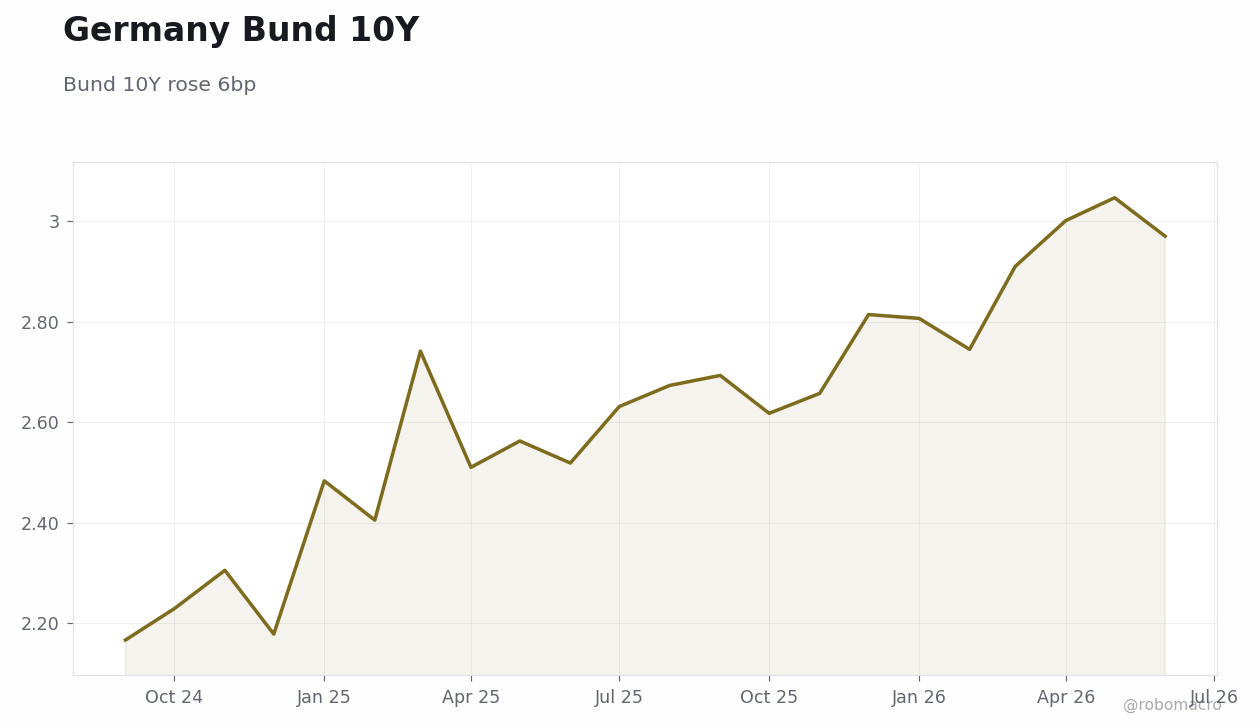
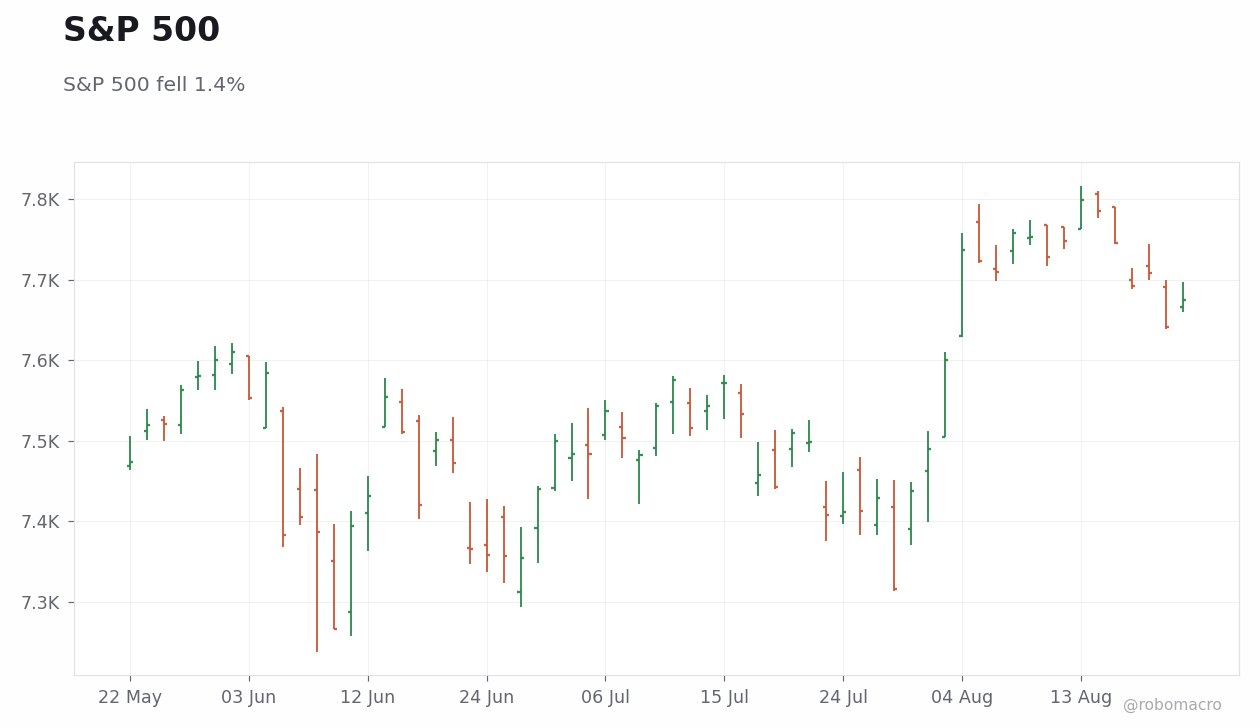
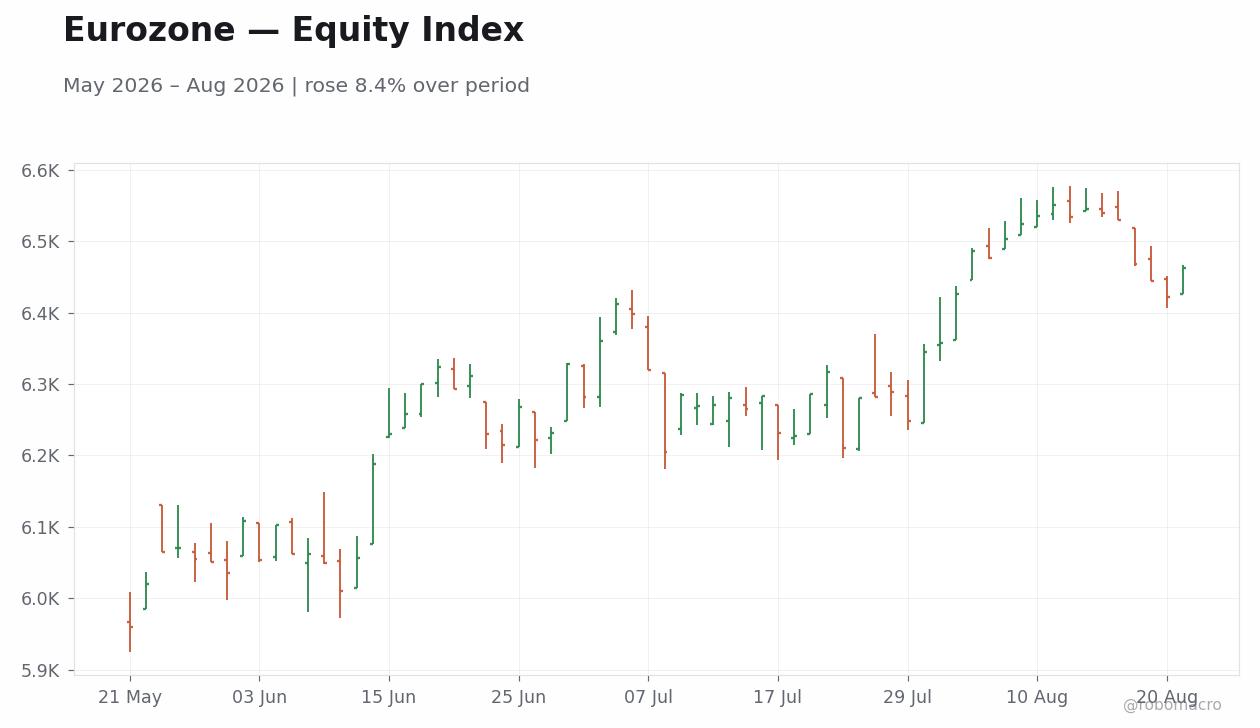
  • S&P 500 falls 1.4 percent to 7,674 while Euro Stoxx 50 settles at 6,462.22; EUR/USD rises to 1.17 and 10-year Bund yields increase 6 basis points.
Commodity Surge Anchors Data-Dependent Hold
Join the AIeconomist.app Waitlist

Published every Sunday afternoon 100% AI-generated — not financial advice

RoboMacro AI Economic Research

Global Macro Watch

Week of August 17–21, 2026 robomacro.com

Global Cycle Remains Mid-Phase Amid Renewed Energy Impulse

The week of August 17–21, 2026 places the global expansion firmly in its mid-phase, where selective activity resilience coexists with a sharp commodity price impulse that re-anchors inflation vigilance. Brent crude settled at 94.39 after a 3.87 percent advance, while gold reached 4680.60, up 5.95 percent. These moves occurred against a backdrop of mixed growth prints that failed to shift any major central bank from its data-dependent posture. The configuration sustains the mid-cycle expansion without injecting fresh tightening or easing impulses, as policymakers absorb the energy-driven price pressure through the second half of 2026.

Activity signals diverged sharply by sector and region. US housing starts declined month-over-month, underscoring rate-sensitive weakness, while the NY Empire State Manufacturing Index and NAHB Housing Market Index both beat expectations. In Australia, July employment contracted against forecasts, lifting the unemployment rate, yet the Westpac Consumer Confidence Index rose. Japan’s preliminary GDP growth missed forecasts, but machinery orders rebounded above expectations. These prints confirm that the expansion continues without synchronized momentum, leaving central banks unwilling to alter parameters on the basis of single-week data.

The dominant narrative therefore centers on commodity-driven inflation risks interacting with uneven real activity. Every major region absorbed the Brent advance without immediate contraction signals, yet the configuration leaves policy expectations anchored for delayed easing across developed markets and continued vigilance in emerging markets through the balance of 2026.

DM Outcomes Cluster Around Selective Resilience and Shared Data Dependence

Developed-market data reinforced a common refusal to recalibrate policy on mixed prints. US housing weakness contrasted with manufacturing and housing-market beats, while FOMC July minutes highlighted upside risks to inflation and reinforced the data-dependent approach. Eurozone headline inflation remained near target, with French July CPI steady year-over-year, allowing the ECB deposit rate to stay unchanged. German ZEW Economic Sentiment rose more than expected, providing the clearest positive surprise of the week.

Japan recorded a sharp GDP miss alongside a pickup in July inflation that reinforced the Bank of Japan’s case for further normalization ahead of its next meeting. UK labor market data showed unemployment holding steady while employment growth slowed and July CPI reached a four-month high. Average earnings growth eased year-over-year, reducing near-term wage pressure signals. Across these economies the common thread is tolerance for divergent prints without immediate policy shifts.

Nordic and other European central banks mirrored the pattern. Riksbank held its policy rate with the tightening option left open despite subdued Swedish inflation. Bank of Canada held steady amid higher-than-expected inflation and declining housing starts. The configuration sustains the mid-cycle stance in which DM policymakers monitor incoming figures through the second half of 2026 without altering forward guidance.

RoboMacro AI Economic Research

Global Macro Watch

Week of August 17–21, 2026 robomacro.com

EM Data Split Along Commodity Support and Domestic Softness

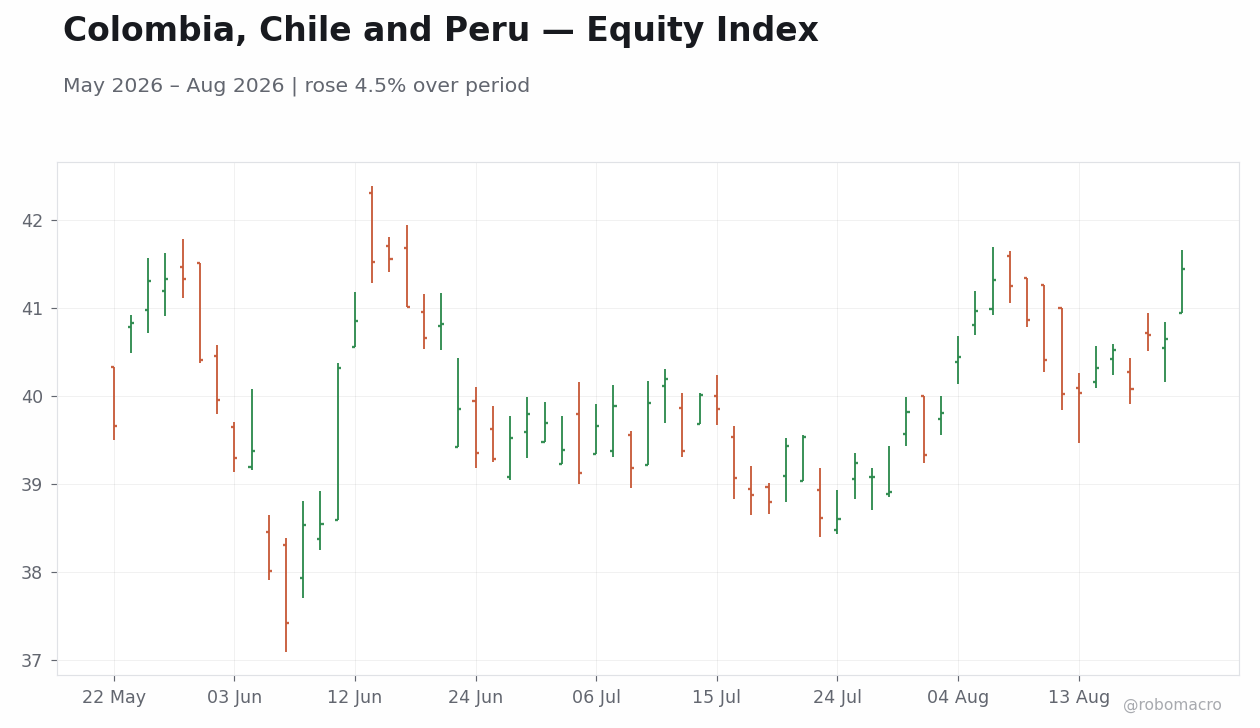
Emerging-market outcomes divided along external price support versus domestic demand indicators. Commodity gains lifted Bovespa and strengthened the real, with Vale and Petrobras advancing, while Mexico’s IPC Bolsa closed at 65,729.18, up 2.29 percent. USD/MXN eased to 16.89. South Africa’s JSE Top 40 rose 3.2 percent as gold and platinum advanced. MSCI Peru climbed 5.39 percent to 94.00 and MSCI Chile gained 2.27 percent to 41.44.

In contrast, China’s industrial production and retail sales both missed expectations, extending the softening trend. Thailand posted the weakest ASEAN growth outcome as external price pressures weighed on momentum. India’s July merchandise trade deficit widened to a six-month high while the current account deficit increased in Q1FY27. Banco Central do Brasil and Banco de Mexico held policy rates with forward guidance remaining data-dependent amid productivity-driven inflation risks. BanRep, BCCh and BCRP left rates unchanged, reinforcing the regional data-dependent stance.

Cross-Asset Pricing Reflects Commodity Impulse and Mixed Growth

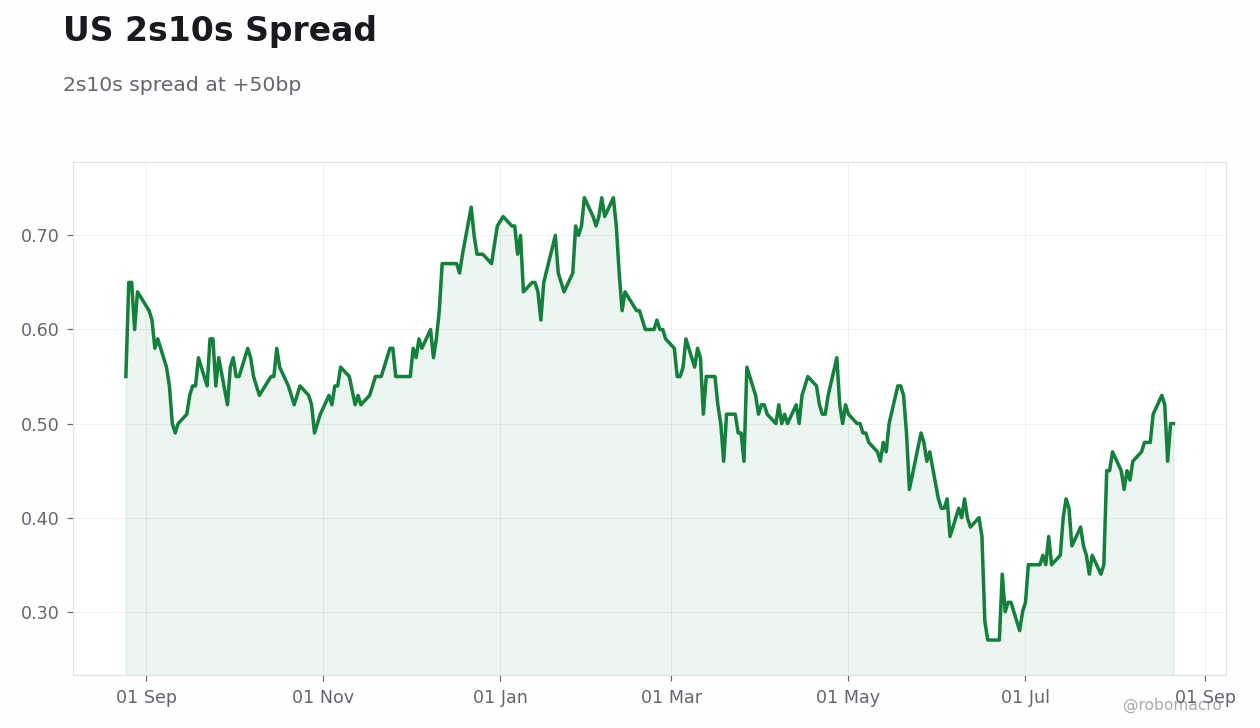
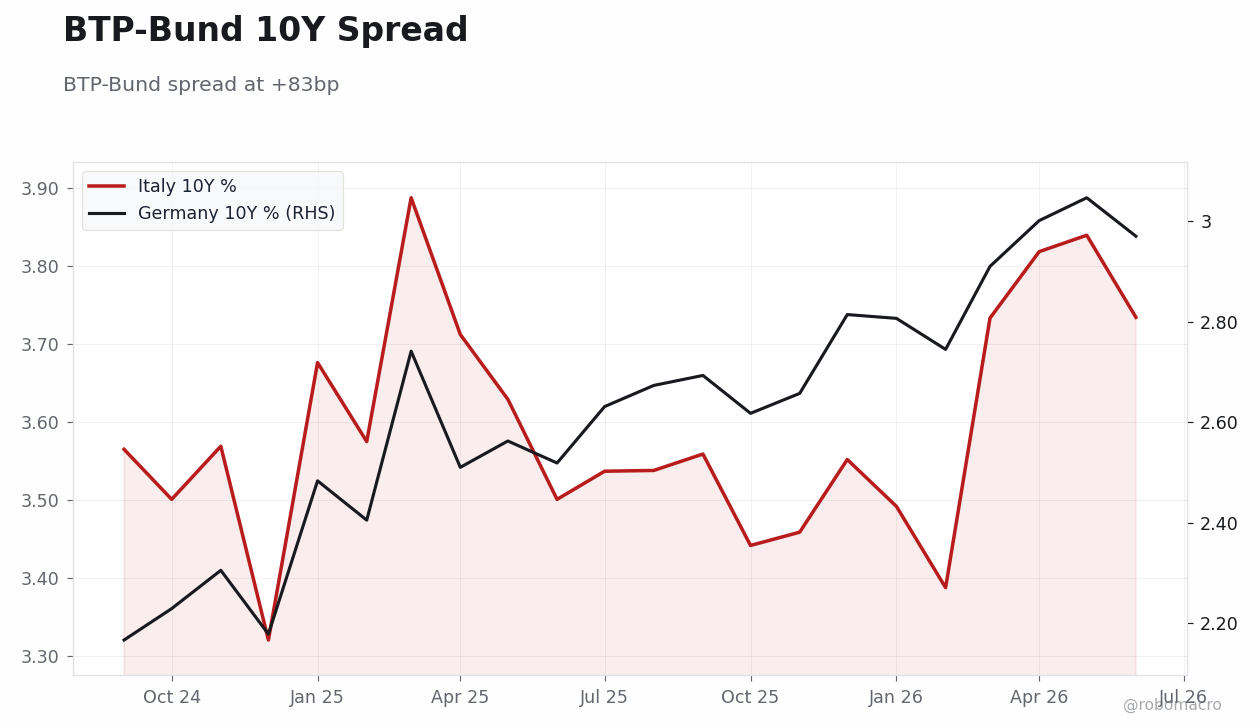
Fixed-income markets showed modest steepening in several curves. US 2s10s widened to +50bp as the 10-year yield rose 6 basis points. German 10-year Bund yields settled higher while Euro Stoxx 50 closed the week down 1.04 percent at 6,462.22. EUR/USD advanced 0.9 percent to 1.17. In Turkey, the 2-year yield fell 393 basis points after CBRT resumed weekly repo auctions at the 37 percent policy rate.

Equity performance split by exposure. KOSPI closed at 6,912.95 after advancing 0.63 percent, with Samsung rising 4.84 percent. Hang Seng advanced 3.5 percent while Shanghai Composite declined. S&P/TSX reached 36,620.2 as energy prices supported CAD at 1.38. Brent and gold advances delivered external support for commodity-exposed assets even as domestic demand indicators softened in several economies.

Policy Landscape Shows Universal Data Dependence

Central banks across both developed and emerging markets maintained unchanged policy parameters with forward guidance locked on incoming data. FOMC minutes, ECB decisions, Bank of Japan normalization signals, Bank of Canada hold, and multiple EM holds from Banco de Mexico through SARB all pointed to the same stance. No institution altered its reaction function on the basis of the week’s prints. The configuration leaves rate paths divergent only to the extent that subsequent inflation and activity releases alter the balance of risks.

Forward Look Centers on Next Week’s Data Releases

Markets will focus on the August 28 Balance of Trade Final in Turkey and subsequent inflation and activity prints that could shift the data-dependent balance. Commodity price stability or reversal will determine whether the current energy impulse persists into September or provides relief that allows selective easing expectations to re-emerge.
RoboMacro AI Economic Research

Global Macro Watch

Week of August 17–21, 2026 robomacro.com
Global Economic Outlook Summary
IMF World Economic Outlook projections, % change year-on-year. Real GDP and average consumer prices. Retrieved August 23, 2026.
Economy Real GDP (% y/y) Consumer Prices (% y/y)
2026E2027E2028E 2026E 2027E2028E
Americas
United States2.32.12.13.22.12.2
Canada1.51.91.72.52.12.0
Mexico1.62.22.13.93.43.0
Brazil1.92.02.44.03.43.0
Argentina3.54.03.830.415.79.6
Colombia2.32.52.65.95.23.4
Chile2.42.62.32.93.33.0
Peru2.82.82.82.51.82.0
Asia / Pacific
Japan0.70.60.62.22.32.0
China4.44.04.01.21.51.8
India6.56.56.54.74.04.0
Australia2.01.71.94.03.22.6
New Zealand2.12.42.43.12.32.1
South Korea1.92.12.22.51.92.0
Indonesia5.05.15.23.02.62.5
Malaysia4.74.34.31.92.02.0
Philippines4.15.86.14.33.23.0
Singapore3.52.72.52.31.92.0
Thailand1.52.12.30.91.01.2
Taiwan5.23.02.41.51.61.6
Vietnam7.16.76.24.94.63.7
Western Europe
Euro area1.11.21.42.62.22.1
Germany0.81.21.22.72.32.0
France0.90.91.21.81.71.9
Italy0.50.50.82.62.42.3
Spain2.11.81.83.02.32.5
United Kingdom0.81.31.63.22.42.0
Sweden2.01.92.11.51.82.6
Norway1.51.31.13.32.62.2
Denmark2.01.61.62.02.22.2
Switzerland1.31.31.80.50.50.6
Netherlands1.21.41.42.72.42.3
Poland3.32.42.63.33.33.9
Czech Republic2.22.22.12.42.22.5
Hungary1.72.02.33.83.53.1
Romania0.72.52.77.83.94.3
EMEA Emerging
Turkey3.43.53.828.621.417.0
South Africa1.01.31.53.93.43.0
Israel3.54.43.72.32.12.0
Saudi Arabia3.14.53.62.32.12.0
UAE3.15.34.62.52.02.0
Egypt4.24.85.513.211.18.1
Nigeria4.14.34.116.015.912.7
Kenya4.54.75.15.95.95.7
Global Aggregates
Global3.13.23.24.43.73.4
Developed markets1.81.71.72.82.22.1
Emerging markets3.94.24.25.54.64.1
E = IMF projection. Source: IMF World Economic Outlook, retrieved via the IMF DataMapper. Aggregates (Global, Developed markets, Emerging markets, Euro area) are the IMF's own groupings. A blank cell means the IMF does not publish a projection for that economy and year.
RoboMacro AI Economic Research

Global Macro Watch

Week of August 17–21, 2026 robomacro.com
Global Central Bank Watch
Policy rates as of August 23, 2026. Current rates, last changes and meeting dates are verified against central bank publications and BIS policy-rate data. Quarter columns show realized quarter-end rates for quarters that have completed.
Central Bank Instrument Current
Rate
Last
Change
bp Next
Meeting
Q1
2026
Q2
2026
Q3
2026
Q4
2026
The Americas
Federal ReserveFed funds upper3.75%Dec 2025-25Sep 163.753.75
Bank of CanadaO/N rate2.25%Oct 2025-25Sep 22.252.25
BCB (Brazil)SELIC14.00%Aug 2026-25Sep 1614.7514.25
BanxicoO/N rate6.50%May 2026-25Sep 246.756.50
BCRA (Argentina)Aggregates regimeJul 2025
BanRep (Colombia)Repo12.00%Jul 2026+7510.2511.25
BCCh (Chile)MPR4.50%Dec 2025-254.504.50
Europe / Africa
ECBDepo rate2.25%Jun 2026+25Sep 102.002.25
Bank of EnglandBank rate3.75%Dec 2025-25Sep 173.753.75
RiksbankRepo rate1.75%Oct 2025-25Sep 241.751.75
Norges BankDep rate4.25%May 2026+25Sep 244.004.25
SNBPolicy rate0.00%Jun 2025-25Sep 240.000.00
CNB (Czech)2-wk repo3.75%Jun 2026+25Sep 173.503.75
NBH (Hungary)Base rate5.75%Jul 2026-25Aug 256.256.25
NBP (Poland)Ref rate3.75%Mar 2026-25Sep 23.753.75
SARBRepo rate7.00%May 2026+25Sep 236.757.00
CBRT (Turkey)1-wk repo37.00%Jan 2026-100Sep 1037.0037.00
Asia / Pacific
RBACash rate4.35%May 2026+25Sep 294.104.35
RBNZOCR2.50%Jul 2026+25Sep 22.252.25
BoJPol rate1.00%Jun 2026+25Sep 180.751.00
PBoC1-yr LPRn/v
RBI (India)Repo rate5.25%Dec 2025-255.255.25
BoK (Korea)Base rate2.75%Jul 2026+25Aug 272.502.50
BI (Indonesia)BI-Rate5.75%Jun 2026+25Sep 234.755.75
BSP (Philippines)Rev repo4.75%Jun 2026+25Aug 274.254.75
BoT (Thailand)1-day repo1.00%Feb 2026-25Aug 261.001.00
CBC (Taiwan)Disc rate2.00%Mar 2024+12.5Sep 17
MAS (Singapore)SGD NEERMild appr.Apr 2026slope+Jul 27
Every figure on this page is verified against official central bank publications or BIS policy-rate data; a cell we cannot verify is left blank ("n/v") rather than estimated. Quarter columns show realized quarter-end rates only — no forward rate path is published, because market-implied pricing is not sourced for these banks. Shaded rows denote regional groupings. Data as of Week of August 17–21, 2026.
RoboMacro AI Economic Research

Global Macro Watch

Week of August 17–21, 2026 robomacro.com
Activity Tracking & NowcastReal-time growth pulse
RoboMacro US Labor Nowcast — Aug 2026 NFP
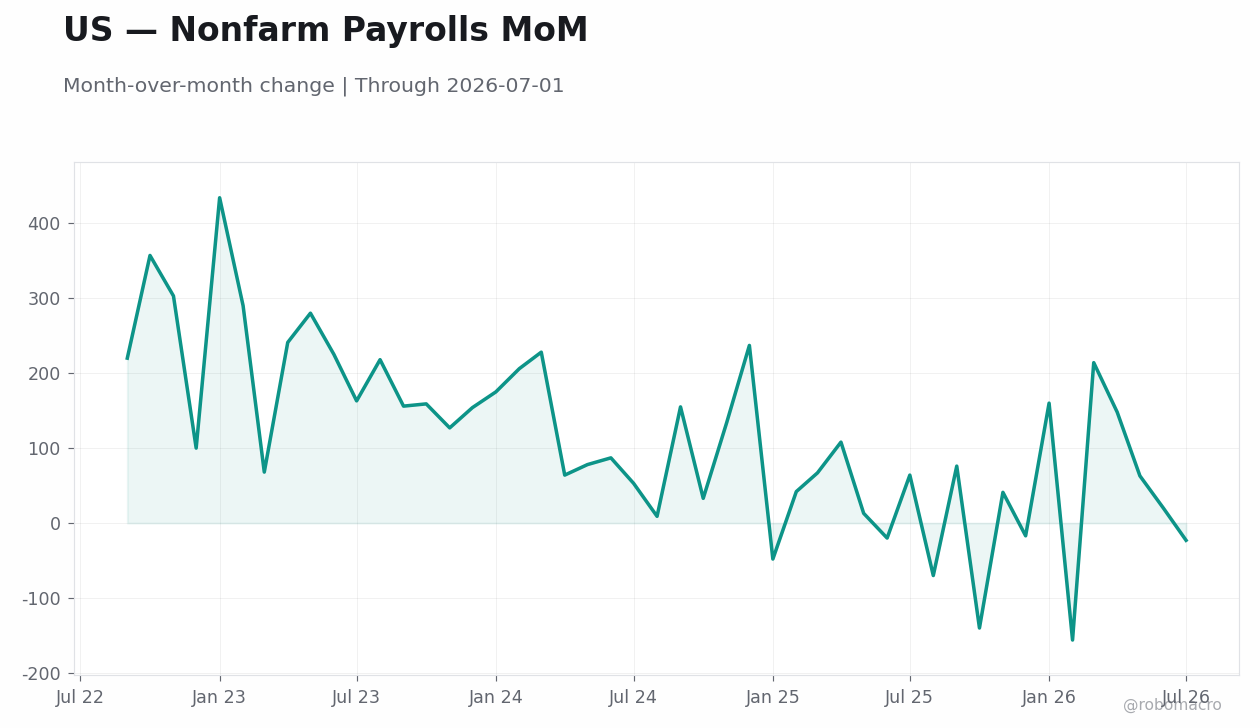
Nonfarm Payrolls (m/m)+52k  80% CI -27k…+347k
Unemployment Rate4.2%
Avg Hourly Earnings (y/y)3.4%
Point estimate = median of a 10-model ensemble (ElasticNet, LightGBM, MIDAS, SARIMAX, XGBoost, VAR, UC stochastic-trend, RF, MLP, naive-AR). Bands are model dispersion, not a forecast of revisions.
RoboMacro High-Frequency Activity Nowcast
Composite weekly activity index, diffusion-style (50 = neutral; >50 expansion), seasonally adjusted. Each economy combines 2–7 weekly public indicators — among them electricity and gas demand, flights, port calls, road traffic, card and payment volumes, job postings and tax deposits. A week is published only when indicators covering at least 70% of the index weight have reported and the week has closed; the as-of date and the share of indicators reporting are shown per row. Source: RoboMacro High-Speed Macro engine.
Economy Activity Index4-wk Δ13-wk Δ Week endingIndicators Signal
Italy62.6+5.7+9.02026-08-145/5Expanding · Advancing
France60.2+12.1+16.22026-08-144/5Expanding · Advancing
Poland58.2+10.5+12.72026-08-213/4Expanding · Advancing
Spain57.4+3.6+4.52026-08-145/5Expanding · Advancing
Euro Area55.9+5.9+9.72026-08-145/5Expanding · Advancing
Germany52.0+6.4+13.42026-08-215/6Expanding · Advancing
United States51.6-0.8-3.02026-08-147/7Expanding · Retreating
New Zealand50.4+1.6-3.82026-08-144/5Expanding · Advancing
Canada49.4-12.0-2.12026-08-146/8Contracting · Retreating
Brazil48.6-8.5+2.12026-08-213/4Contracting · Retreating
Japan47.4-14.2-4.52026-08-145/5Contracting · Retreating
Australia45.7-1.4-2.02026-08-143/3Contracting · Retreating

Activity remains in expansion in United States, Euro Area, Germany, France, Italy, Spain, New Zealand, Poland; while high-frequency trackers point to sub-trend activity in Japan, Canada, Brazil, Australia. On a 4-week basis, momentum is improving in Euro Area, Germany, France, Italy, Spain, New Zealand, Poland and cooling in United States, Japan, Canada, Brazil, Australia. RoboMacro's labor ensemble nowcasts the next US payrolls print at +52k.

Nowcasts are model-derived from high-frequency public data and update weekly as new releases arrive. Activity-index country coverage is expanding. A cross-country PMI matrix is planned pending a verified PMI data source.
RoboMacro AI Economic Research

Global Macro Watch

Week of August 17–21, 2026 robomacro.com
Markets in ReviewRates & Fixed Income
Rates & Fixed Income Chart 1
Rates & Fixed Income Chart 2
Rates & Fixed Income Chart 3
Rates & Fixed Income Chart 4

Week in Review

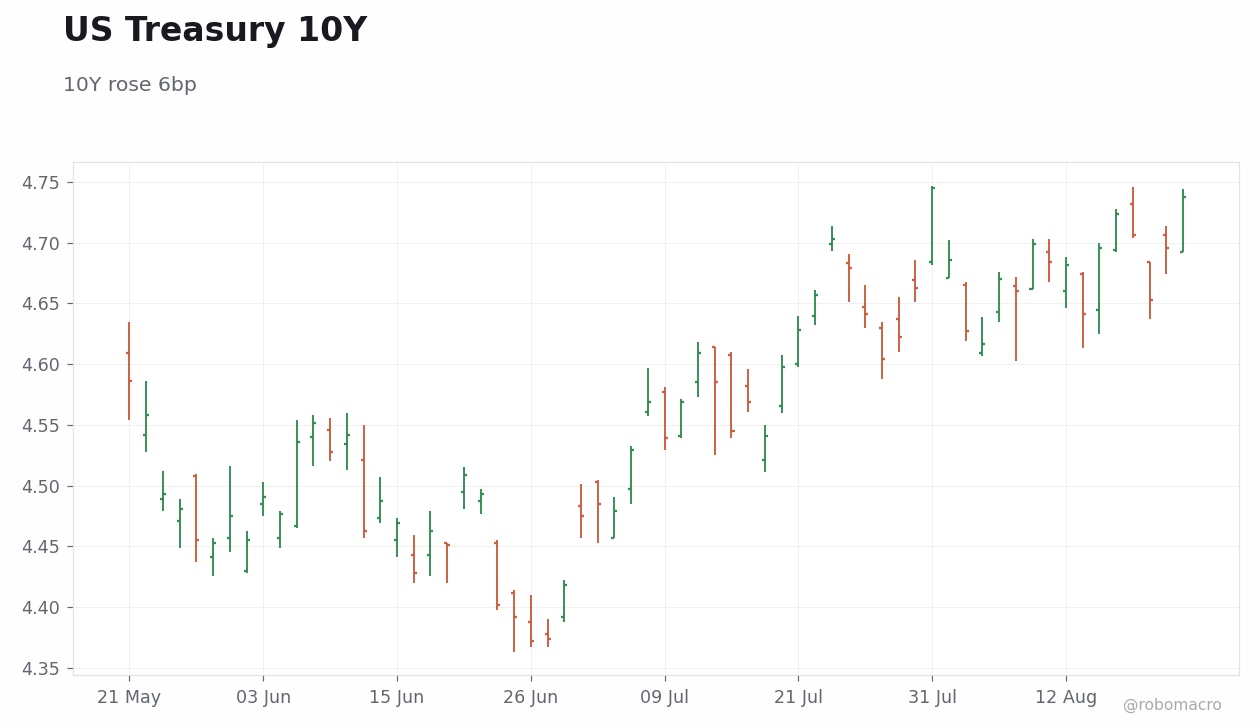
US 10-year yields rose 6 basis points to 4.69%. The daily closes for US yields saw the 10Y move from 4.7240 on Monday down to 4.6530 on Wednesday before rising to 4.7380 on Friday, while the 5Y went from 4.3760 to 4.4240. German 10-year yields rose 6 basis points to 3.26%. UK 10-year yields increased 2 basis points to 5.06%. Japanese 10-year yields eased 1 basis point to 2.87%. This upward drift in DM yields took place amid mixed economic signals, with housing starts declining but manufacturing and sentiment indices beating expectations in several regions.

Curve & Spreads

The US 2s10s spread widened to +50bp, compared to +42bp in Germany and +69bp in the UK. These steep curve shapes imply stronger growth expectations in the medium term as back-end yields remain elevated relative to front-end rates. The variation across regions highlights differing views on the growth and inflation outlook, with the UK curve pricing in the most optimism.

EM Bonds

In EM, Turkey's 10-year yield stood at 34.89% and its 2-year at 37.33% with the 2s10s at -244bp. Brazil's 10-year yield was at 14.64%. South Africa's 10-year yield stood at 8.75% and Mexico's at 9.23%. These EM yield levels are markedly higher than DM benchmarks like the US at 4.69% and Germany at 3.26%, pointing to a substantial spread differential that investors require.

Central Bank Read

The yield curve shapes suggest an easing bias in several major economies. In the US the front end rose 4bp on the 2-year to 4.19% while the back end saw the 30-year rise 2bp to 5.23%. The UK 2-year fell 4bp to 4.37% against a 2bp rise in the 10-year to 5.06%, implying an easing bias through the steepened +69bp 2s10s. Germany's curve steepened slightly to +42bp with the 2-year at 2.84% and 10-year at 3.26%. Central banks continued to emphasize a data-dependent approach with no shifts in forward guidance following recent policy meetings.

Week Ahead

The week ahead has a light economic calendar with few major releases scheduled. Focus will remain on any potential Treasury auctions that could affect supply dynamics and duration risk. Incoming inflation data and labor market indicators will be monitored closely for their impact on yield curves. Any surprises could influence the perceived policy bias from major central banks.

RoboMacro AI Economic Research

Global Macro Watch

Week of August 17–21, 2026 robomacro.com
Markets in ReviewFixed Income
Global Government Bond Yields
Yields in %. WoW change in basis points, over the five trading sessions to the latest close. US tenors are Treasury constant-maturity yields (Federal Reserve); international tenors are benchmark government yields from public market data.
Country2Y2Y WoW10Y10Y WoW30Y30Y WoW2s10s
United States4.19%+4bp4.69%+6bp5.23%+2bp+50bp
United Kingdom4.37%-4bp5.06%+2bp5.82%+2bp+69bp
Germany2.84%+5bp3.26%+6bp3.77%+5bp+42bp
France3.04%+6bp4.13%+8bp4.92%+8bp+109bp
Italy3.08%+7bp4.09%+10bp4.88%+8bp+102bp
Spain2.92%+5bp3.72%+6bp4.42%+4bp+80bp
Japan1.67%+2bp2.87%-1bp4.06%+5bp+120bp
Canada3.04%+8bp3.76%+8bp4.17%+8bp+72bp
Australia4.56%-2bp5.03%+5bp5.60%+6bp+48bp
China1.24%+0bp1.69%+0bp2.17%+1bp+44bp
India6.15%+20bp6.87%+11bp7.47%+12bp+72bp
Brazil14.10%+4bp14.64%-27bp+54bp
Mexico9.23%+7bp
South Korea3.70%+6bp4.37%+7bp4.70%+4bp+67bp
Indonesia6.96%-10bp7.18%-9bp
Turkey37.33%-393bp34.89%-22bp-244bp
South Africa8.75%+15bp9.31%+17bp
Poland5.95%+9bp

US Treasury 10Y yields rose 6bp to 4.69%, with the 2Y adding 4bp. Germany 10Y advanced 6bp to 3.26% while France and Italy posted larger gains of 8bp and 10bp. India 2Y surged 20bp to 6.15%, the largest advance among major markets. Turkey 2Y yields dropped 393bp to 37.33%, the week’s sharpest decline, as Brazil 10Y fell 27bp. The 2s10s curve steepened to +109bp in France and +120bp in Japan. Indonesia 10Y eased 10bp to 6.96%. Cross-market divergence widened between rising core European yields and select EM compression. Focus next week remains on auction supply and inflation prints.

RoboMacro AI Economic Research

Global Macro Watch

Week of August 17–21, 2026 robomacro.com
Markets in ReviewGlobal Equities
Global Equities Chart 1
Global Equities Chart 2
Global Equities Chart 3
Global Equities Chart 4

Week in Review

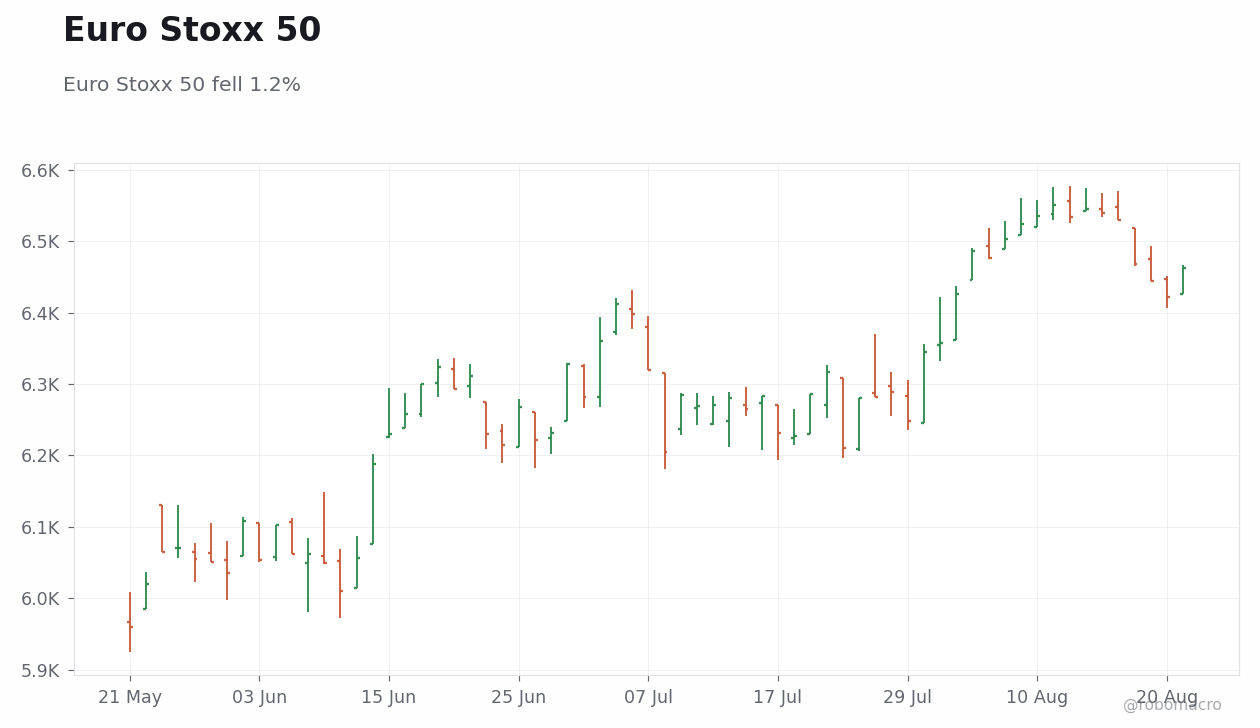
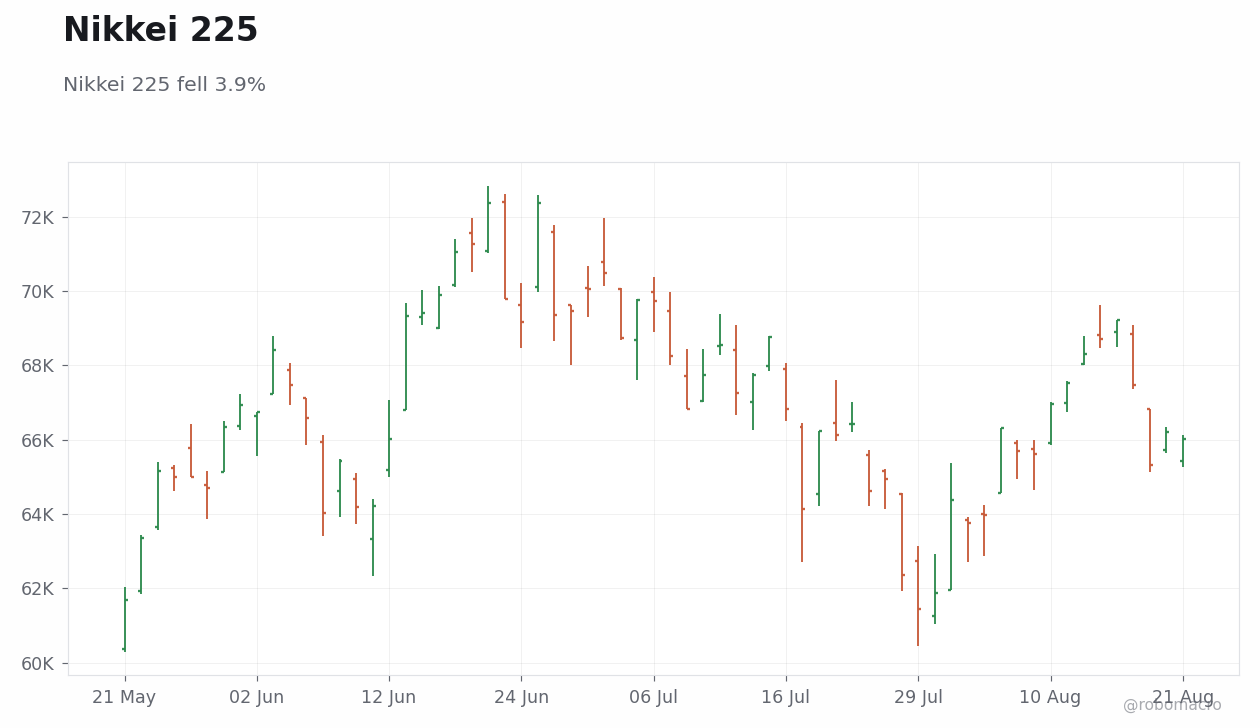
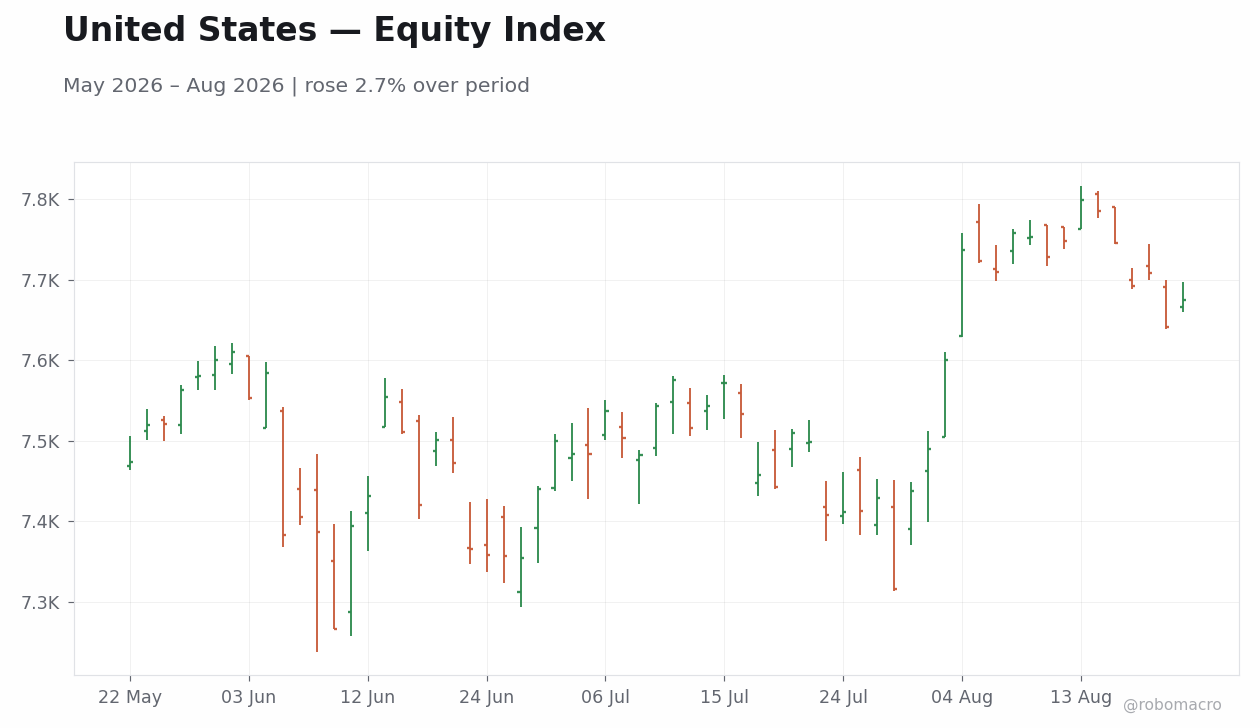
The S&P 500 fell 1.4% on the week to close at 7,674. The index opened at 7,745 on Monday, declined to 7,692 on Tuesday, recovered modestly to 7,708 on Wednesday, sold off to 7,641 on Thursday, and ended at 7,674 on Friday. In Europe the Euro Stoxx 50 fell 1.2% to 6,462, sliding from 6,530 on Monday through 6,422 on Thursday before a late rebound on Friday. The Nikkei 225 dropped 3.9% to 66,016 after falling from 69,220 on Monday to 65,326 on Wednesday amid sharp mid-week pressure. Emerging markets diverged positively with the JSE Top 40 rising 3.9%, Ibovespa gaining 2.1% to 170,449, and IPC Mexico also up 2.1% to 65,729, while the Nifty 50 declined 0.5%. Selective safe-haven flows were evident as gold rose while broader equity indices posted losses.

Regional Divergences

US indices lagged with the S&P 500 down 1.4%, Nasdaq 100 down 2.5%, Dow Jones down 0.8%, and Russell 2000 down 1.6%. European performance was mixed as the FTSE 100 rose 0.6% while the CAC 40 fell 1.8%, DAX declined 1.1%, and Euro Stoxx 50 lost 1.2%. Asia showed the widest spread with the Nikkei 225 down 3.9% contrasting a 3.5% gain in the Hang Seng, while the KOSPI fell 0.9% and S&P/ASX 200 declined 0.6%. EM equities generally outperformed with the JSE Top 40 up 3.9% alongside 2.1% gains in both Ibovespa and IPC Mexico. These divergences aligned with country-specific catalysts including mixed US housing and manufacturing data alongside FOMC emphasis on data dependence, positive German sentiment surprises, Japan’s weak GDP offset by inflation pickup, Canadian inflation overshoot, and commodity-driven support for Brazilian, Mexican, and South African assets.

Volatility & Risk Appetite

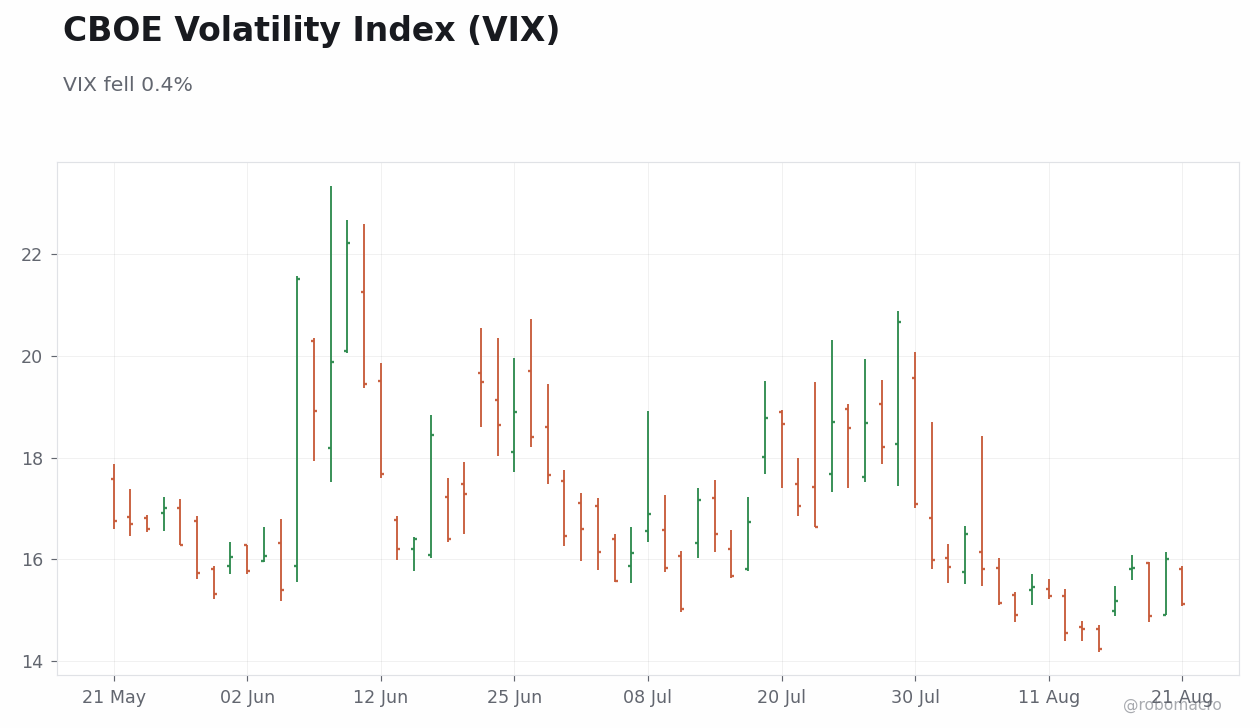
The VIX closed the week at 15.1 after trading between 14.9 and 16.0 during the period. Growth underperformed value as the Nasdaq 100 fell 2.5% compared with the Dow Jones decline of 0.8%. Small caps also lagged with the Russell 2000 down 1.6% versus the S&P 500’s 1.4% drop. Commodity strength signaled selective sector rotation with WTI Crude rising 5.7%, Brent Crude rising 6.6%, and Gold rising 6.8%, supporting resource and materials exposure even as broader risk appetite stayed cautious. Silver rose 7.0% while natural gas rose 2.9%, reinforcing a backdrop where inflation-sensitive and hard-asset themes outperformed pure equity beta.

Week Ahead

The economic calendar next week is light with no major CPI, payrolls, or central bank meetings listed. PMI releases and GDP prints across key regions will be watched for confirmation of growth resilience or further softening. Any earnings reports will be parsed for corporate commentary on margin pressures and demand trends. These developments pose the biggest risk to equity markets if growth signals disappoint, which would favour risk-off flows, while continued resilience in commodity prices and sentiment data could support risk-on positioning.

RoboMacro AI Economic Research

Global Macro Watch

Week of August 17–21, 2026 robomacro.com
Markets in ReviewGlobal Equities
Global Equity Indices
Week-on-week, month-to-date, year-to-date. WoW is the change over the seven calendar days to the latest close. Source: public market data.
IndexLevelWoWMTDYTD
S&P 5007,674-1.4%+1.0%+11.9%
Nasdaq 10029,309-2.5%+1.9%+16.3%
Dow Jones53,277-0.8%+0.2%+10.1%
Russell 20003,018-1.6%+1.2%+20.3%
S&P/TSX36,620-0.3%+2.3%+14.9%
FTSE 10010,817+0.6%-0.4%+8.7%
Euro Stoxx 506,462-1.2%+0.6%+9.1%
DAX26,137-1.1%+0.5%+6.5%
CAC 408,484-1.8%-1.5%+3.5%
FTSE MIB52,668-1.7%-0.4%+16.1%
IBEX 3519,962-1.0%-0.1%+14.1%
Nikkei 22566,016-3.9%+3.5%+27.4%
Hang Seng26,009+3.5%0.0%-1.2%
S&P/ASX 2009,059-0.6%+0.4%+3.8%
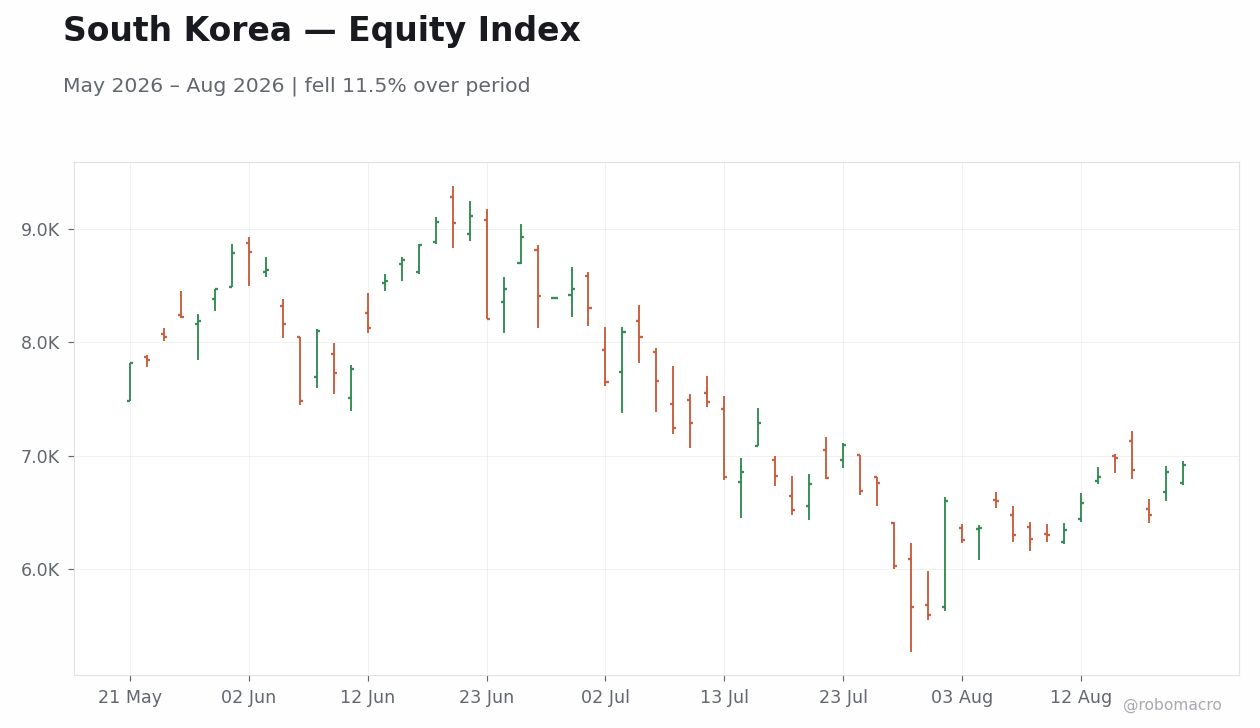
KOSPI6,913-0.9%+10.5%+60.4%
Nifty 5024,252-0.5%-2.1%-7.2%
Ibovespa170,449+2.1%-4.2%+6.2%
IPC Mexico65,729+2.1%-1.4%+2.5%
JSE Top 40110,387+3.9%+5.6%+2.0%

US equities retreated, with the Nasdaq 100 falling 2.5% to 29,309 and the S&P 500 declining 1.4% to 7,674. The Dow Jones and Russell 2000 posted smaller losses of 0.8% and 1.6%, respectively. In Europe, the CAC 40 dropped 1.8% while the FTSE MIB fell 1.7%. Asia showed sharp divergences as the Nikkei 225 slid 3.9% to 66,016, contrasting with the Hang Seng’s 3.5% gain. Emerging markets outperformed, led by the JSE Top 40’s 3.9% advance and 2.1% rises in both the Ibovespa and IPC Mexico. Year-to-date, the KOSPI maintained the strongest performance at +60.4%. Next week, focus will center on US inflation data and any shifts in Fed rhetoric.

Equity Performance Heat Map
IndexWoWMTDYTD
S&P 500-1.4%+1.0%+11.9%
Nasdaq 100-2.5%+1.9%+16.3%
Dow Jones-0.8%+0.2%+10.1%
Russell 2000-1.6%+1.2%+20.3%
S&P/TSX-0.3%+2.3%+14.9%
FTSE 100+0.6%-0.4%+8.7%
Euro Stoxx 50-1.2%+0.6%+9.1%
DAX-1.1%+0.5%+6.5%
CAC 40-1.8%-1.5%+3.5%
FTSE MIB-1.7%-0.4%+16.1%
IBEX 35-1.0%-0.1%+14.1%
Nikkei 225-3.9%+3.5%+27.4%
Hang Seng+3.5%0.0%-1.2%
S&P/ASX 200-0.6%+0.4%+3.8%
KOSPI-0.9%+10.5%+60.4%
Nifty 50-0.5%-2.1%-7.2%
Ibovespa+2.1%-4.2%+6.2%
IPC Mexico+2.1%-1.4%+2.5%
JSE Top 40+3.9%+5.6%+2.0%
RoboMacro AI Economic Research

Global Macro Watch

Week of August 17–21, 2026 robomacro.com
Markets in ReviewFX & Digital Assets
FX & Digital Assets Chart 1
FX & Digital Assets Chart 2
FX & Digital Assets Chart 3
FX & Digital Assets Chart 4

Week in Review

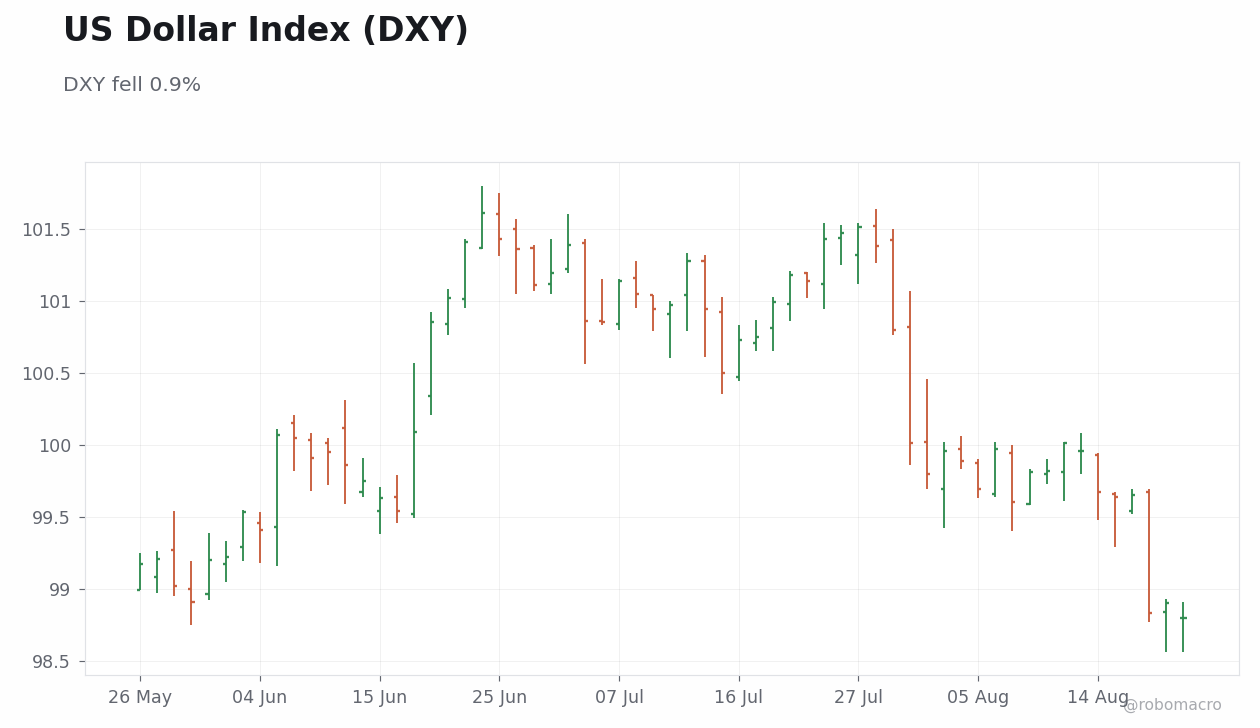
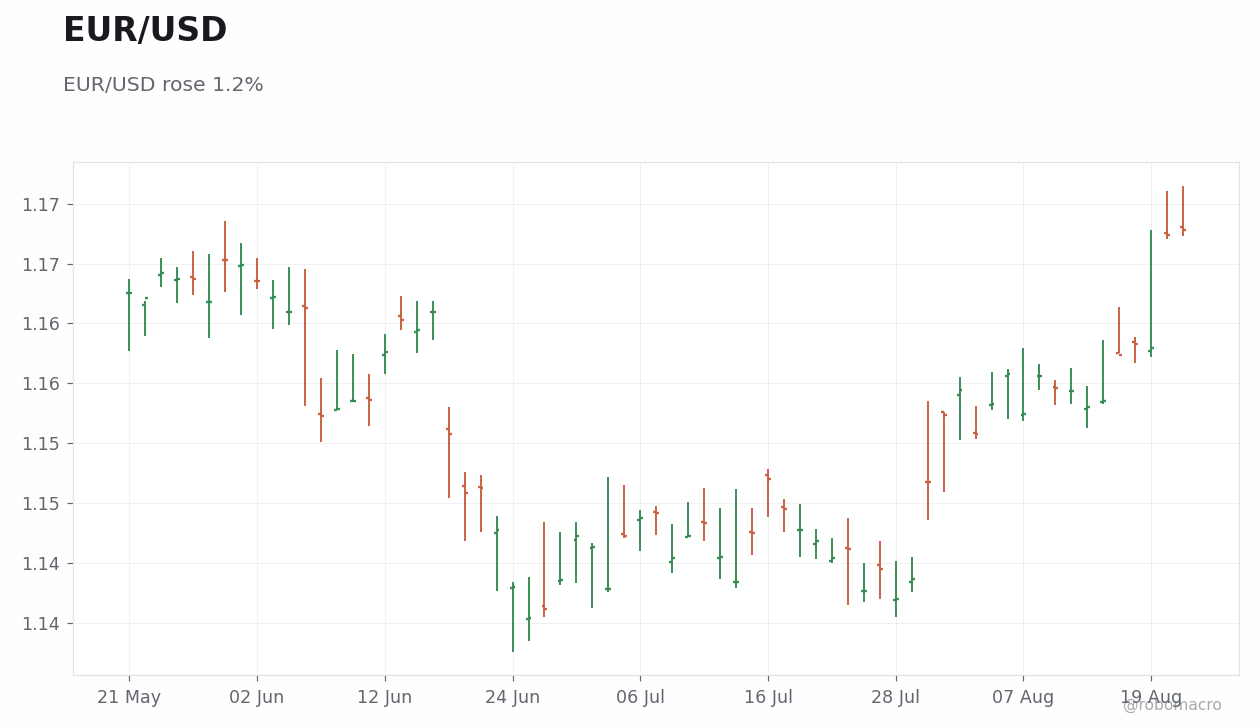
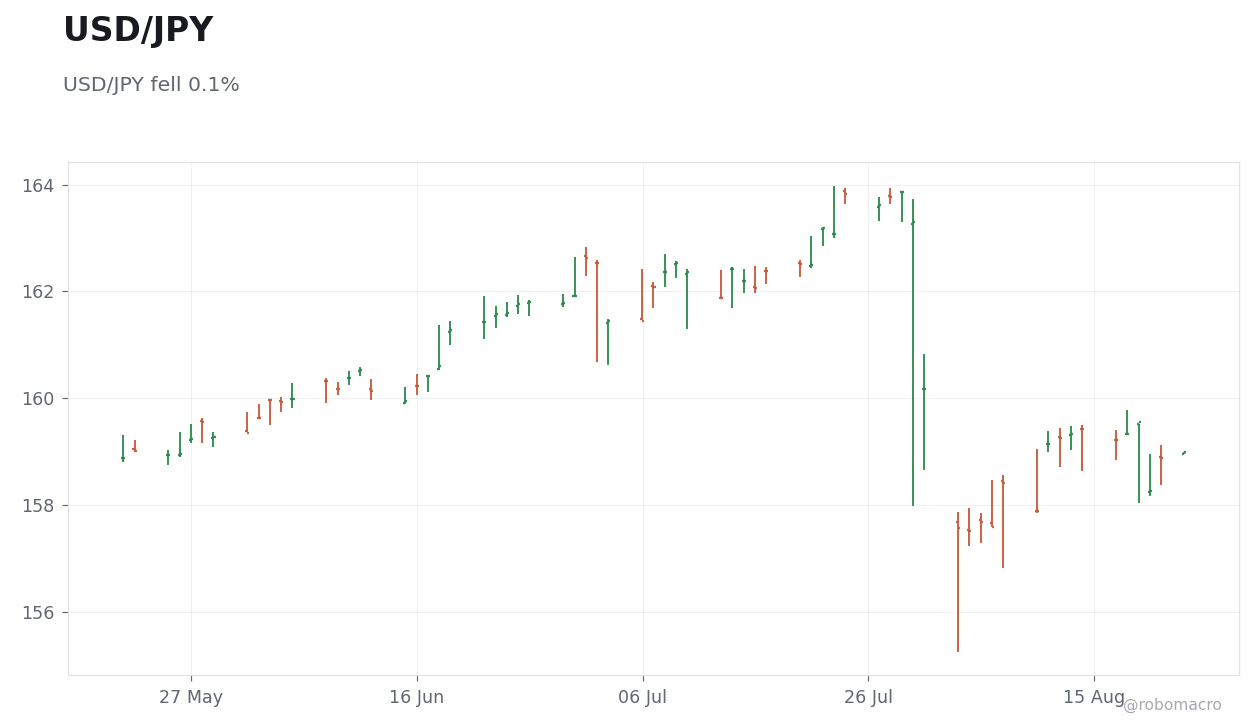
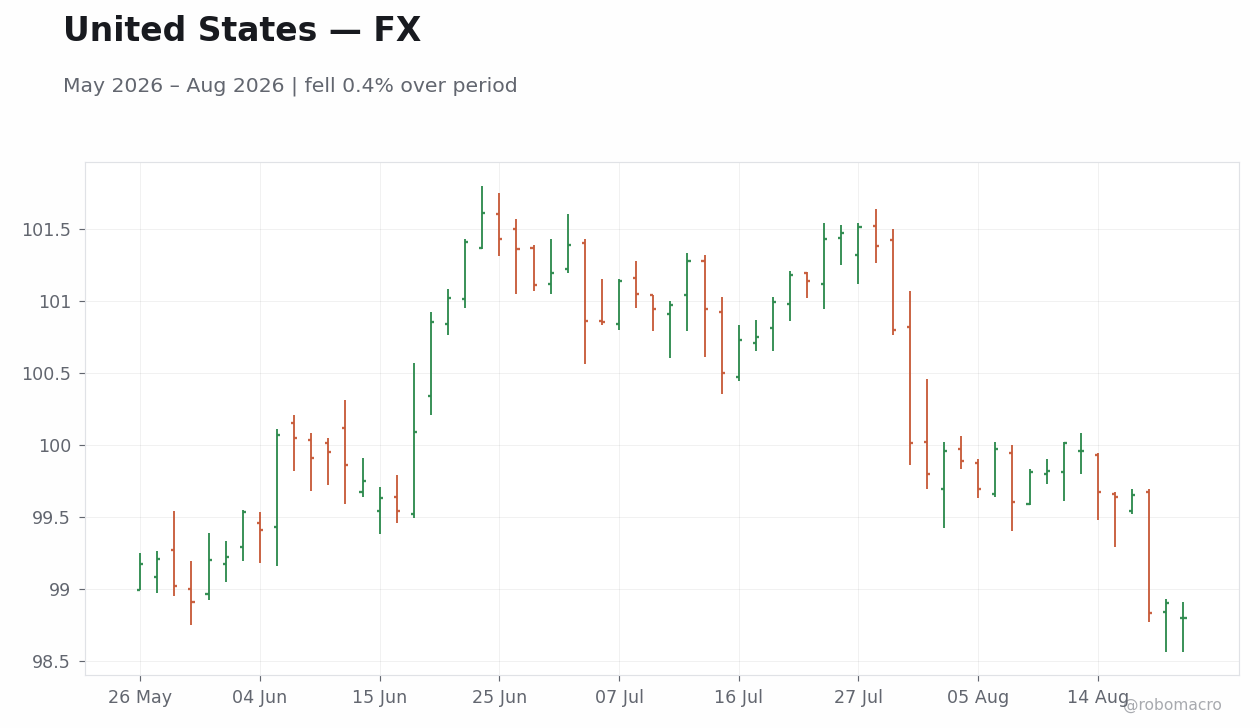
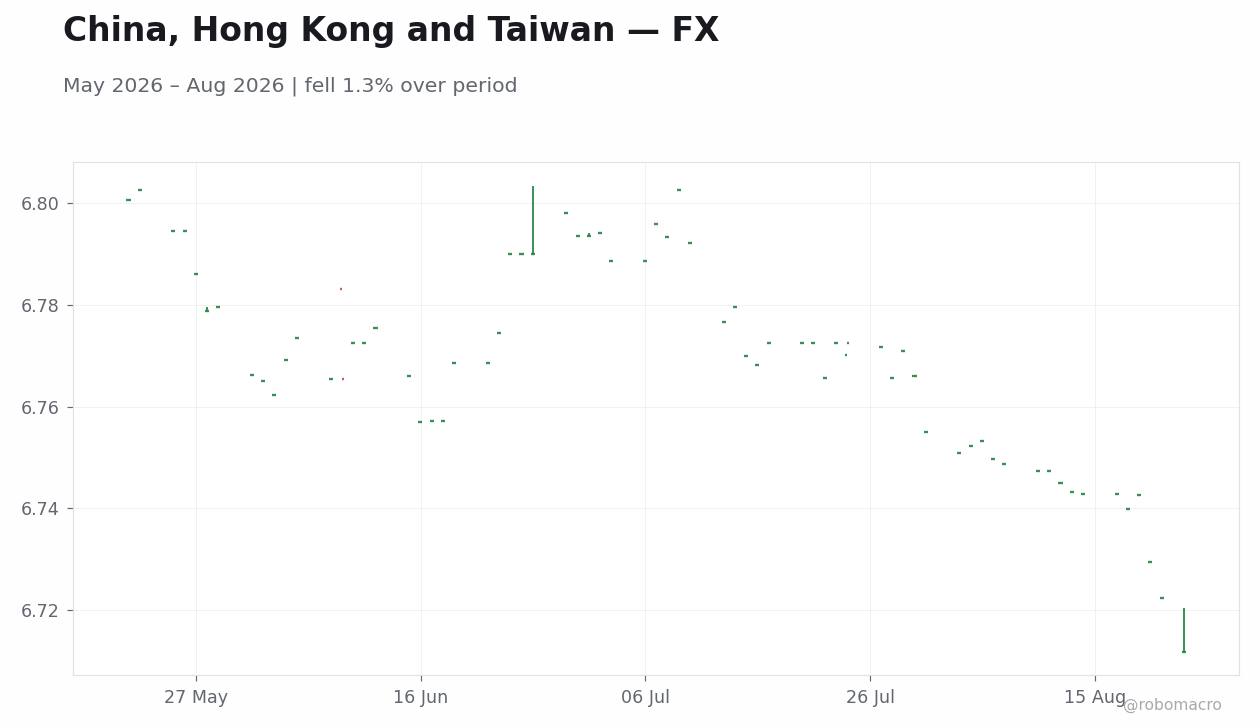
The DXY fell 0.9% to 98.80. It moved from 99.7 on Tuesday down to 98.8 on Wednesday, rose modestly to 98.9 on Thursday and closed at 98.8 on Friday. G10 currencies strengthened with EUR/USD rising 1.2% to 1.1678, GBP/USD gaining 0.6% to 1.3628, AUD/USD up 1.2% to 0.7167 and NZD/USD advancing 1.6% to 0.5983 while USD/JPY declined 0.1% to 158.99, USD/CAD fell 0.4% to 1.3817 and USD/CHF dropped 1.5% to 0.8004. EM FX was mixed but mostly firmer with USD/BRL down 1.6% to 5.1366, USD/MXN easing 0.8% to 16.89, USD/ZAR falling 1.1% to 16.01, USD/CNY declining 0.5% to 6.7118, USD/INR rising 0.2% to 95.68 and USD/TRY gaining 0.4% to 48.05.

Dollar & G10

Rate differentials weighed on the dollar with the US 2s10s at +50bp against wider spreads in Japan at +120bp and the UK at +69bp. EUR/USD rose 1.2% to 1.1678, holding near 1.1574 on Monday through 1.1583 on Tuesday and 1.1579 on Wednesday before advancing sharply to 1.1674 on Thursday and closing at 1.1678 on Friday. GBP/USD gained 0.6% to 1.3628 after trading between 1.3537 and 1.3643 in daily closes. USD/JPY declined 0.1% to close at 158.99 after fluctuating from 159 on Monday to 160 on Wednesday, 158 on Thursday and 159 on Friday.

EM FX

Commodity strength supported selective EM outperformance with USD/BRL falling 1.6% to 5.1366 alongside Brazil 2s10s at +54bp. USD/MXN declined 0.8% to 16.89 as the curve steepened while USD/ZAR fell 1.1% to 16.01. USD/CNY eased 0.5% to 6.7118 with steady local yields and USD/TRY rose 0.4% to 48.05 as the Turkish curve remained inverted at -244bp. These moves reflected divergent yield differentials and commodity tailwinds across EM.

Bitcoin & Crypto

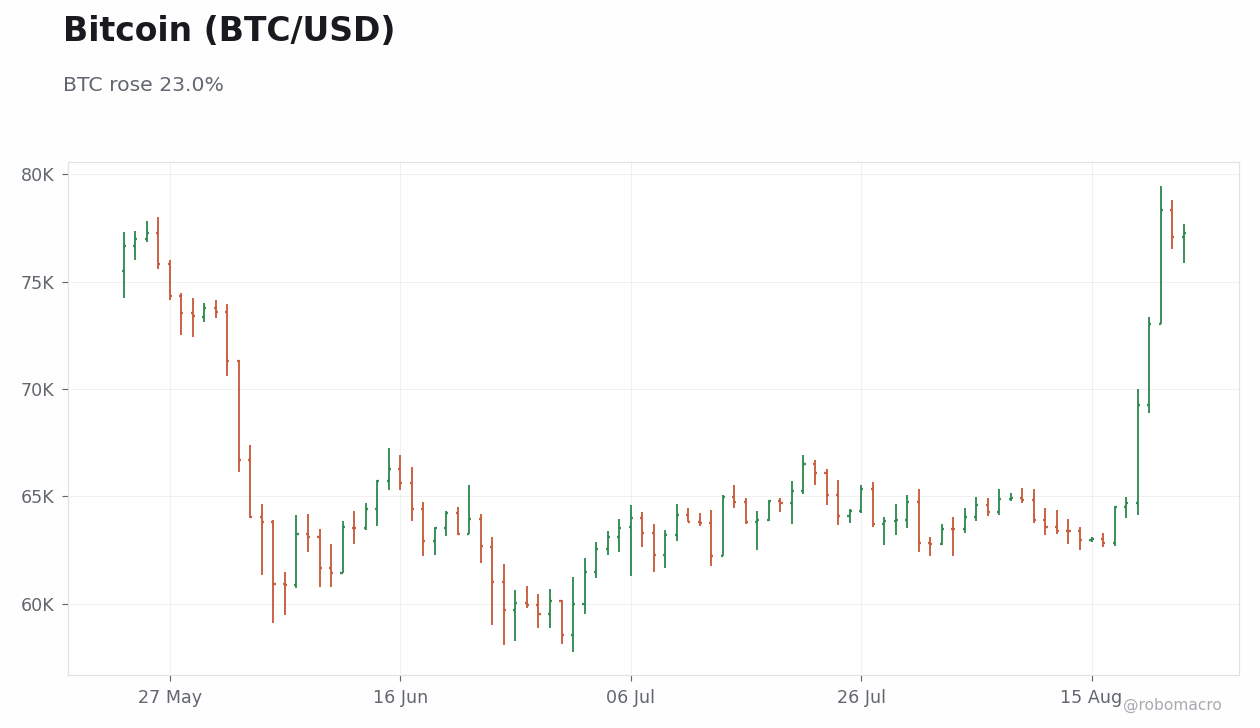
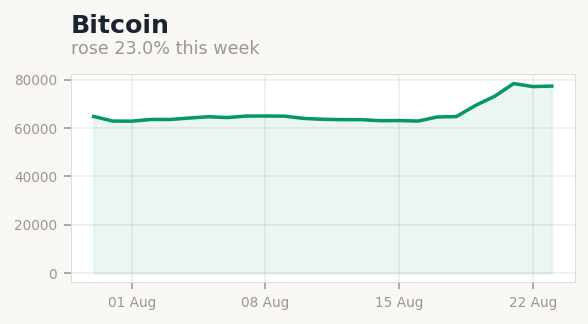
Bitcoin surged 23.0% to $77,246 while Ethereum rose 30.2% to $2,440. Bitcoin climbed from 69,266 on Wednesday to 73,033 on Thursday and 78,335 on Friday before settling at 77,083 on Saturday. Solana gained 27.5% to 95 and XRP jumped 51.0% to 1, leading broader crypto strength. The sharp mid-week acceleration in Bitcoin underscored selective safe-haven and risk appetite flows amid equity weakness.

Week Ahead

The next week features a light economic calendar with central bank communications likely to shape rate differential expectations. Trade balance data from key EM countries could influence local currency moves while CPI releases will be watched for curve shape implications. In Japan focus remains on signals around policy normalization as USD/JPY trades near 159. Crypto markets will track Bitcoin and Ethereum momentum absent specific regulatory events or protocol upgrades in available context.

RoboMacro AI Economic Research

Global Macro Watch

Week of August 17–21, 2026 robomacro.com
Markets in ReviewCommodities
Commodities Chart 1
Commodities Chart 2
Commodities Chart 3
Commodities Chart 4

Week in Review

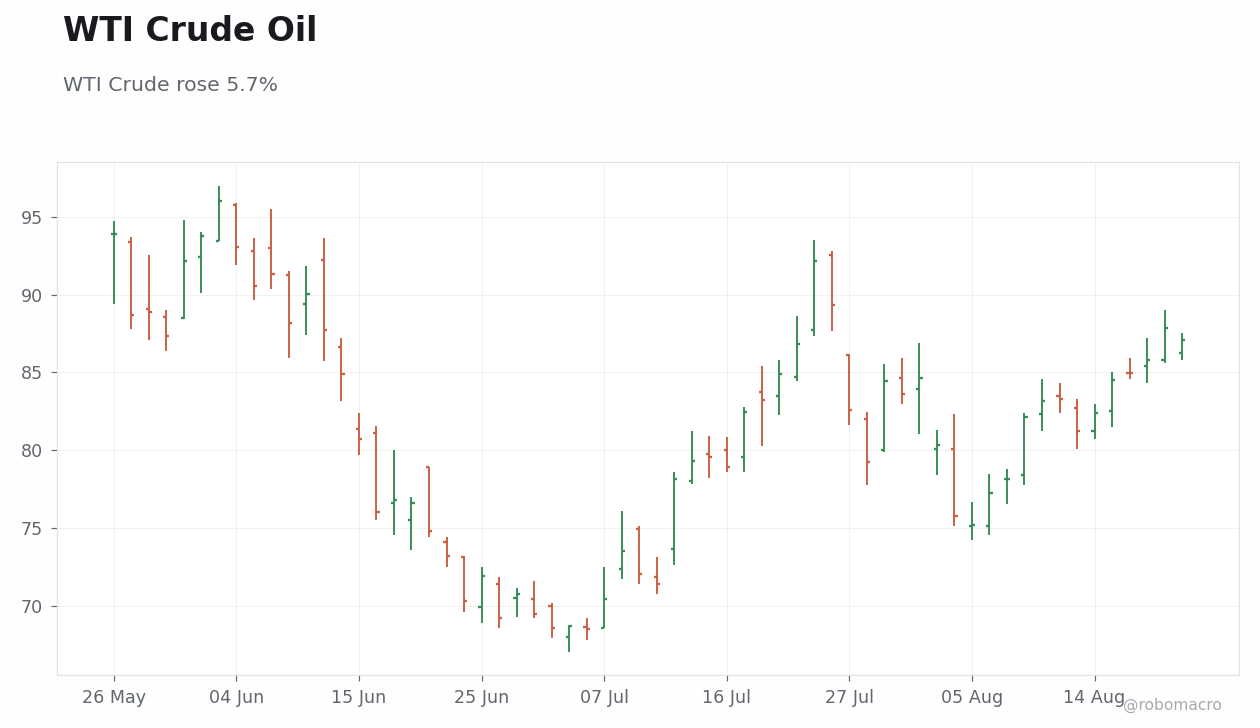
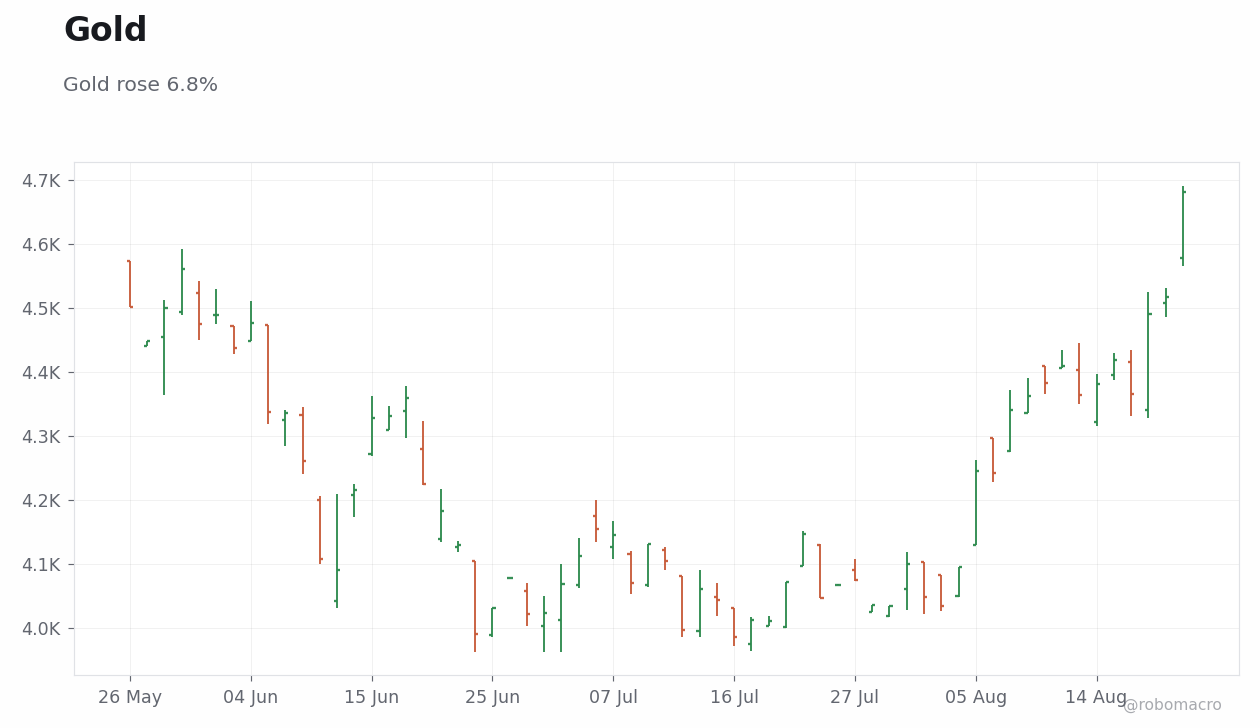
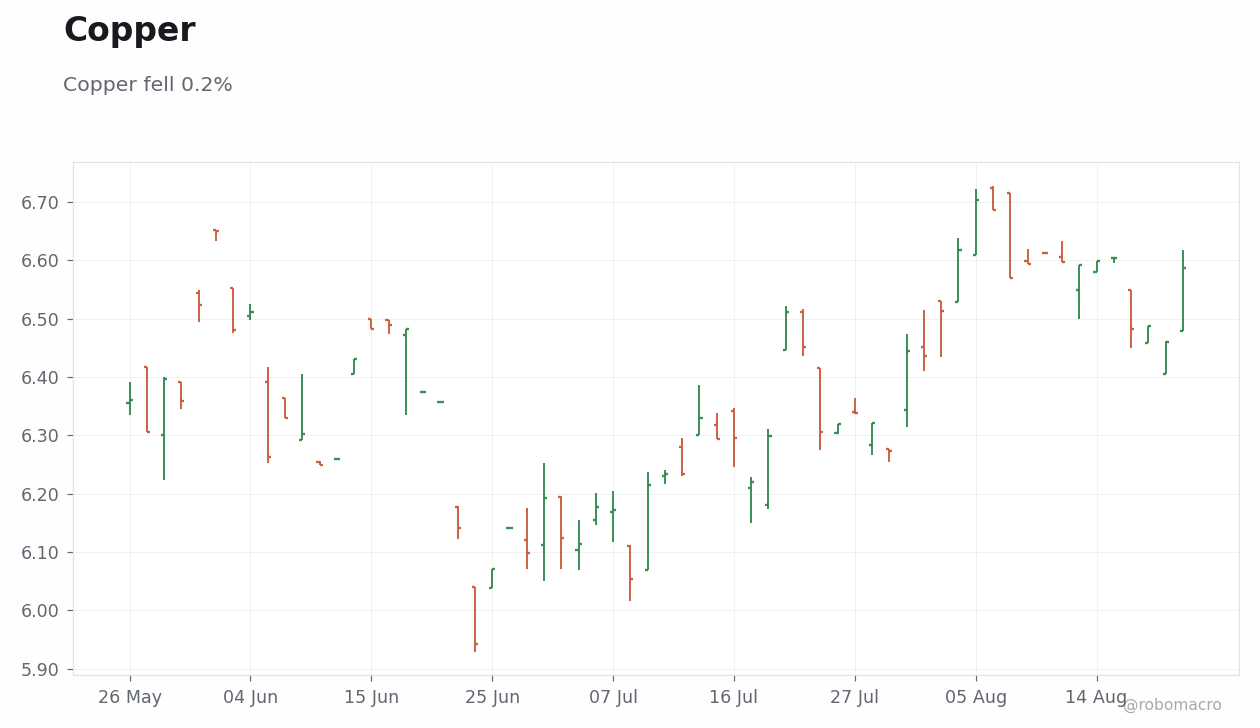
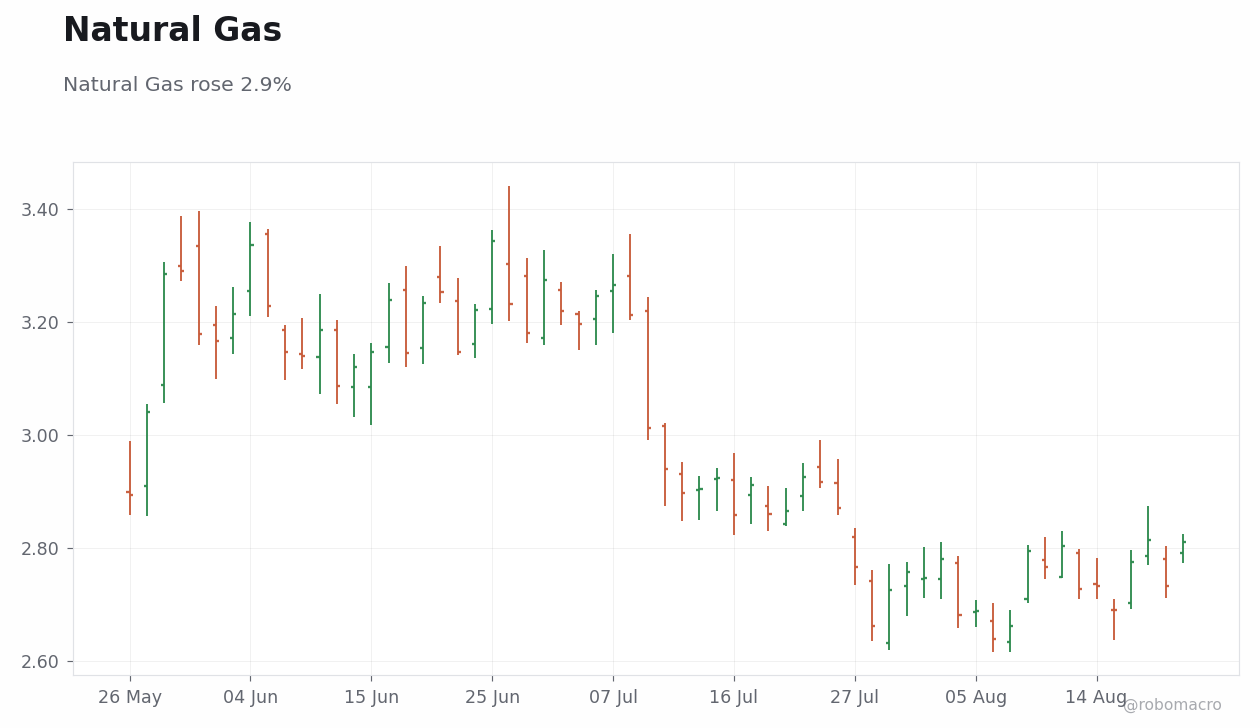
Silver led commodity gains, rising 7.0% week-over-week to 69.53. Precious metals rallied broadly with gold advancing 6.8% to 4680.60. In the energy complex, WTI Crude increased 5.7% to 87.06 while Brent Crude gained 6.6% to 94.39. Daily price action showed WTI Crude closing at 84.9 on Tuesday, 85.8 on Wednesday, 87.8 on Thursday and 87.1 on Friday. Natural Gas rose 2.9% to 2.81, while copper was little changed, declining 0.2% to 6.59. Agricultural commodities also advanced, as wheat rose 3.6% to 699.25.

Energy Complex

WTI Crude settled at 87.06 after a 5.7% weekly gain, while Brent Crude reached 94.39, up 6.6%. The energy complex benefited from simmering Middle East tensions as the US moved to further isolate Iran’s economy, supporting oil’s second weekly gain in a row amid ongoing supply risks. Natural Gas ended the week at 2.81 after gaining 2.9%, with daily closes moving from 2.7760 on Tuesday to 2.8140 on Wednesday, 2.7330 on Thursday and 2.8110 on Friday. Despite modest late-week fluctuation, both crude and natural gas posted gains on geopolitical developments and tighter supply expectations. The complex remains supported by these persistent supply-side concerns.

Metals & Ags

Gold surged 6.8% to 4680.60, climbing steadily from 4,366 on Tuesday to 4,489 on Wednesday, 4,516 on Thursday and 4,681 on Friday. Silver outperformed, rising 7.0% to 69.53 with closes progressing from 63.9 on Tuesday to 65.7 on Wednesday, 68.0 on Thursday and 69.5 on Friday. Copper traded mixed, ending at 6.59 after a 0.2% decline on the week despite a recovery to 6.5870 on Friday, signaling selective industrial demand amid mixed growth signals. Wheat gained 3.6% to 699.25, adding to positive performance across agriculture. Precious metals notably outperformed industrial metals, reflecting safe-haven demand in an environment of geopolitical uncertainty and selective risk appetite.

Week Ahead

The economic calendar for next week contains no major commodity-relevant events such as EIA crude or gas inventories reports, OPEC meetings, China PMI or industrial production data, US CPI releases, or central bank meetings impacting commodity currencies. Market focus will therefore remain on non-calendar risks including geopolitical tensions surrounding Iran and the Middle East, potential shifts in OPEC production diplomacy, and weather developments that could influence natural gas demand and agricultural yields. Participants will also monitor any escalation in Middle East supply risks or changes in diplomatic efforts that could affect crude flows. Overall, the week is expected to be driven by these thematic factors rather than scheduled data releases.

RoboMacro AI Economic Research

Global Macro Watch

Week of August 17–21, 2026 robomacro.com
Markets in ReviewFX, Commodities & Crypto
Foreign Exchange
Week-on-week, month-to-date, year-to-date. WoW is the change over the seven calendar days to the latest close. Source: public market data.
PairLevelWoWMTDYTD
DXY98.80-0.9%-1.2%+0.4%
EUR/USD1.1678+1.2%+1.2%-0.6%
GBP/USD1.3628+0.6%+1.0%+1.1%
USD/JPY158.99-0.1%+0.9%+1.4%
AUD/USD0.7167+1.2%+1.7%+7.3%
NZD/USD0.5983+1.6%+1.4%+3.9%
USD/CAD1.3817-0.4%-1.4%+0.7%
USD/CHF0.8004-1.5%-0.8%+1.1%
USD/CNY6.7118-0.5%-0.6%-4.1%
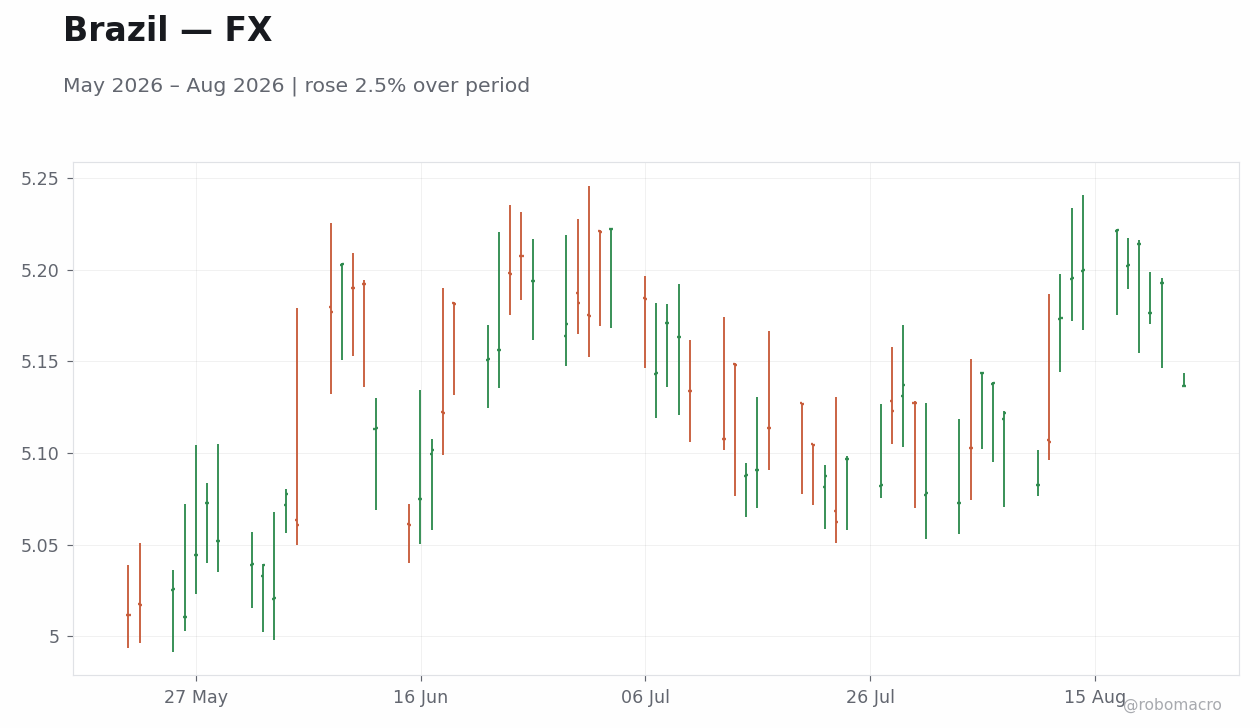
USD/BRL5.1366-1.6%+1.3%-6.9%
USD/MXN16.89-0.8%-2.4%-6.1%
USD/INR95.68+0.2%+0.3%+6.4%
USD/ZAR16.01-1.1%-2.7%-3.2%
USD/TRY48.05+0.4%+1.1%+11.8%
Commodities
Week-on-week, month-to-date, year-to-date. WoW is the change over the seven calendar days to the latest close. Source: public market data.
CommodityLevelWoWMTDYTD
WTI Crude87.06+5.7%+8.4%+51.9%
Brent Crude94.39+6.6%+12.7%+55.4%
Gold4680.60+6.8%+16.0%+8.5%
Silver69.53+7.0%+20.6%-1.4%
Copper6.59-0.2%+1.1%+16.8%
Natural Gas2.81+2.9%+1.1%-22.3%
Wheat699.25+3.6%+7.4%+38.1%
Iron Ore95.21+0.0%+1.6%-11.2%
Crypto Assets
Week-on-week, month-to-date, year-to-date. WoW is the change over the seven calendar days to the latest close. Source: public market data.
AssetLevelWoWMTDYTD
Bitcoin$77,246+23.0%+23.1%-12.9%
Ethereum$2,440+30.2%+32.4%-18.7%
Solana$95+27.5%+32.2%-25.0%
XRP$1+51.0%+41.3%-20.2%

DXY declined 0.9% to 98.80 as EUR/USD rose 1.2% to 1.1678 and AUD/USD gained 1.2% to 0.7167. NZD/USD led gains, climbing 1.6% to 0.5983. USD/CHF fell 1.5% to 0.8004 while USD/BRL dropped 1.6% to 5.1366, underscoring broad USD weakness. GBP/USD advanced 0.6% to 1.3628 and USD/CAD eased 0.4% to 1.3817. USD/JPY was little changed, down 0.1% at 158.99. Among EM currencies, USD/MXN fell 0.8% to 16.89 and USD/ZAR declined 1.1% to 16.01, contrasting with USD/INR’s 0.2% rise to 95.68. USD/TRY added 0.4% to 48.05. Next week, markets will track whether MTD gains in AUD/USD (+1.7%) and NZD/USD extend.

RoboMacro AI Economic Research

Global Macro Watch

Week of August 17–21, 2026 robomacro.com
United States
Market Scorecard
AssetLevelWoW
S&P 5007674.37-0.9%
Nasdaq 10029308.86-2.3%
Dow Jones53277.01-0.3%
Russell 20003017.87-1.3%
USD/JPY158.99-0.1%
EUR/USD1.17+0.9%
GBP/USD1.36+0.6%
Gold4680.6+6.0%
WTI Crude87.06+3.0%
Bitcoin77307.65+23.1%
Chart 1
Chart 2
Chart 3
Chart 4
  • Housing starts declined month-over-month, missing consensus and underscoring rate-sensitive sector weakness.
  • NY Empire State Manufacturing Index and NAHB Housing Market Index both exceeded expectations.
  • FOMC July minutes reinforced a data-dependent approach with officials highlighting upside risks to inflation.
  • Gold rose while the S&P 500 declined, reflecting selective safe-haven demand amid mixed growth signals.
  • We forecast +52k nonfarm payrolls for the Aug 2026 report (due Sep 4; 80% band -27k to +347k), unemployment at 4.2% — RoboMacro model ensemble.

Week in Review

Housing sector delivers clear downside surprise. US housing starts contracted sharply month-over-month, missing consensus, while building permits rose. This divergence underscored persistent pressure on rate-sensitive activity even as broader manufacturing indicators held firmer.

Manufacturing resilience offsets some activity softness. The NY Empire State Manufacturing Index and NAHB Housing Market Index both beat expectations. Industrial production rose modestly month-over-month.

Policy signals reinforce data dependence. FOMC July minutes released during the week highlighted officials' willingness to keep the policy rate on hold until incoming figures alter the balance. Treasury yields moved higher intraday before closing the week lower.

Cross-asset pricing reflected selective caution. Equities closed lower on net while gold posted its strongest weekly gain of the period. The configuration leaves the mid-cycle expansion intact but with clearer evidence that housing weakness will interact with manufacturing stability to keep the Federal Reserve on a data-dependent path.

Fed Watch

FOMC July minutes released during the week showed officials increasingly focused on upside risks to inflation, with several participants noting that the policy rate may need to remain higher for longer if data do not moderate. The minutes reinforced the Committee's data-dependent stance without altering forward guidance on the policy rate. Multiple speakers reiterated that decisions rest solely on incoming figures rather than preset calendars. The housing starts miss and Empire State beat together leave the medium-term rate path unchanged, with markets continuing to price a hold through the balance of 2026 absent further inflation or labor surprises. No new quantitative signals emerged on balance sheet policy or forward guidance language. The configuration sustains the Federal Reserve's current policy rate setting while elevating the bar for any near-term easing.

Data Review

Housing starts missed expectations with a sharp month-over-month decline that reversed the prior gain and confirmed contraction in residential construction. Building permits, by contrast, beat consensus, rising month-over-month and suggesting some forward momentum in permitting activity. The NY Empire State Manufacturing Index delivered the largest positive surprise of the week, lifting the diffusion index well above the prior reading. The NAHB Housing Market Index also exceeded expectations, indicating modest improvement in builder sentiment. Industrial production rose modestly month-over-month, below consensus, while export and import prices declined. Pending home sales fell against expectations. These releases collectively point to a mid-cycle expansion where housing remains the clearest area of softening while manufacturing and sentiment indicators continue to support above-trend growth. The data leave the Federal Reserve's policy rate path anchored to subsequent inflation and labor prints rather than any immediate recalibration.

RoboMacro AI Economic Research

Global Macro Watch

Week of August 17–21, 2026 robomacro.com

Calendar data unavailable

Week Ahead: Key Releases
DateReleasePriorCons.
2026-08-24Chicago Fed National Activity Index-0.02-
2026-08-25Speech by Fed's Barkin--
2026-08-25ADP Employment Change Weekly9500-
2026-08-25S&P/Case-Shiller Home Price Year-ov1.61.7
2026-08-25CB Consumer Confidence90.8-
2026-08-25New Home Sales Level628K620K
2026-08-25New Home Sales Month-over-Month1.6-
2026-08-25Speech by Fed's Barkin--
2026-08-25API Weekly Crude Oil Stocks-3.3mn-
2026-08-26MBA 30-Year Mortgage Rate6.8-
Chart 5
Chart 6
Chart 7
Chart 8

The Week Ahead

Core PCE price index month-over-month is scheduled with consensus at 0.2 percent after a 0.1 percent prior, representing the Federal Reserve's preferred inflation gauge. GDP growth quarter-over-quarter second estimate is also due, with expectations at 1.5 percent versus 2.1 percent prior. Durable goods orders are forecast to rise month-over-month. S&P/Case-Shiller home price index year-over-year is expected on August 25. CB Consumer Confidence and new home sales round out Tuesday's releases. Fed's Barkin is scheduled to speak twice on August 25. Chicago Fed National Activity Index prints on August 24. These releases will provide fresh inputs on inflation momentum, growth revisions, and housing prices that directly inform the policy rate outlook.

Risks & Themes

The housing starts contraction raises downside risks to residential investment and related consumption in coming quarters, potentially shifting the growth outlook lower if the weakness persists. Hawkish FOMC minutes have reduced the probability of near-term policy rate cuts, yet markets appear to be pricing less easing than the data flow might ultimately warrant. Gold's advance signals elevated hedging demand that could intensify if subsequent inflation prints surprise higher. Positioning in equities remains light after the S&P 500 decline, leaving room for rebound on any positive GDP revision. Volatility in crude adds an upside inflation risk that could further delay policy rate adjustments. The configuration favors a cautious stance on duration until Core PCE clarifies the inflation trajectory.

Cross-Asset

The S&P 500 closed the week at 7674.37, down 0.91 percent. The Nasdaq 100 fell 2.29 percent to 29308.86 while the Dow Jones declined 0.34 percent to 53277.01. The 10-year Treasury yield rose on net after touching higher levels during the week. EUR/USD advanced 0.9 percent to 1.17 and USD/JPY eased 0.14 percent to 158.99. Gold posted the standout move, rising 5.95 percent to 4680.60 on safe-haven demand, while WTI crude gained 3.03 percent to 87.06. Bitcoin rose 23.06 percent to 77307.65 amid broader risk-asset rotation.

Global Context

US data dependence continues to anchor global policy expectations, with the housing weakness and manufacturing beat providing mixed signals that reduce immediate pressure on the Federal Reserve to ease. Energy price gains echo prior weeks' commodity impulse and support tighter financial conditions across borders. Dollar stability limits imported inflation relief for trading partners. Geopolitical risks around energy supply remain contained within the last seven days but continue to influence safe-haven flows into gold.

RoboMacro AI Economic Research

Global Macro Watch

Week of August 17–21, 2026 robomacro.com
Eurozone
Market Scorecard
AssetLevelWoW
Euro Stoxx 506462.22-1.0%
DAX26136.56-0.8%
CAC 408484.43-1.1%
EUR/USD1.17+0.9%
EUR/GBP0.86+0.2%
EUR/JPY185.58+0.7%
Gold4680.6+6.0%
Brent Crude94.39+3.9%
Bitcoin77305.35+23.1%
Chart 1
Chart 2
Chart 3
Chart 4
  • German ZEW Economic Sentiment Index rose more than expected, marking the clearest positive surprise of the week.
  • Euro Stoxx 50 closed at 6,462.22, down 1.04% on the week, while German 10-year Bund yields settled higher.
  • French July CPI held steady year-on-year and Eurozone headline inflation remained near target, leaving the ECB deposit rate unchanged.
  • EUR/USD advanced 0.9% to 1.17 while Brent crude climbed to 94.39, up 3.87% on the week.

Week in Review

Sentiment indicators improved markedly. German ZEW Economic Sentiment Index climbed from the prior reading, exceeding consensus and signaling brighter analyst expectations for the months ahead. Spanish trade balance narrowed from the previous print, reflecting a modest narrowing in goods and services deficits. These releases occurred against a backdrop of confirmed Eurozone Q2 GDP growth quarter-on-quarter.

Labor market and price pressures mixed. Dutch unemployment edged higher from the prior reading, while German producer prices rose year-over-year against consensus. French July CPI remained steady year-on-year, keeping the currency-union headline rate near target. Eurozone unemployment stayed at its recent level as of June.

Borrowing costs and external shocks weighed on sentiment. German 10-year Bund yields reached elevated levels amid concerns over sovereign borrowing, while French yields also moved higher. Wildfires across Germany, Spain, Italy and Greece prompted evacuations and weighed on regional activity without immediate market repricing of growth. Equity indices absorbed these developments with modest net declines. Markets therefore treated the week as confirmation of steady but uneven expansion rather than a decisive shift in momentum.

ECB Watch

No European Central Bank policy decision or minutes were released during the week. Speakers maintained the data-dependent stance without altering forward guidance on the deposit rate, which remained unchanged. July inflation prints that aligned with consensus removed immediate pressure for acceleration or abrupt easing. Stronger German ZEW data may temper expectations for near-term policy adjustment. An ECB blog post flagged the risk of a sharp AI-driven market correction that could trigger broader financial stress in the euro area. The configuration leaves the medium-term rate path anchored to incoming activity and price data rather than any shift in rhetoric. Markets therefore priced limited change ahead of the next scheduled communications.

Data Review

The German ZEW Economic Sentiment Index delivered the week’s clearest beat, rising against consensus and the prior reading and pointing to improved forward expectations among analysts. Spanish trade balance data improved from the prior print, consistent with narrower external deficits. Dutch unemployment increased from the previous level, a modest softening in labor-market conditions. German producer prices climbed year-over-year, exceeding consensus and suggesting building pipeline pressures. French July CPI held steady year-on-year in line with forecasts, leaving Eurozone headline inflation near target. Eurozone Q2 GDP was confirmed quarter-on-quarter, supported by resilient domestic demand in Germany and France. These outcomes collectively indicate the currency area remains in mid-expansion with inflation outcomes aligned to expectations and no immediate acceleration or abrupt easing signal. The data mix leaves the ECB on a data-dependent path with the deposit rate unchanged.

RoboMacro AI Economic Research

Global Macro Watch

Week of August 17–21, 2026 robomacro.com

Calendar data unavailable

Week Ahead: Key Releases
DateReleasePriorCons.
2026-08-25Consumer Confidence Index86.087.0
2026-08-25IFO Business Climate Level86.687.2
2026-08-27GfK Consumer Confidence-29.6-29.5
2026-08-27Unemployment Benefit Claims5900-
2026-08-28Inflation Rate Year-over-Year Preli2.1-
2026-08-28Inflation Rate Month-over-Month Pre0.600.60
2026-08-28Inflation Rate Month-over-Month Pre0.30-
2026-08-28Inflation Rate Year-over-Year Preli3.64.2
2026-08-28Unemployed Persons Level3.0mn-
2026-08-28Unemployment Level Change60008000

The Week Ahead

Attention centers on the IFO Business Climate Level for Germany, with consensus above the prior reading. French Consumer Confidence Index is due the same day, expected near recent levels. GfK Consumer Confidence for Germany follows later in the week. French preliminary inflation data will provide the first August readings, while Spanish inflation prints and German unemployment figures round out the calendar. These releases will offer early signals on August business momentum and price trends. No ECB speakers are scheduled in the immediate window. The data slate will help refine views on whether the recent ZEW improvement extends into hard activity indicators.

Risks & Themes

Elevated sovereign borrowing costs, with French yields at multi-year highs, continue to highlight fiscal sensitivities across member states. Wildfire disruptions in multiple countries add downside risk to near-term activity without yet altering aggregate growth forecasts. Stronger-than-expected ZEW and PPI prints reduce the probability of near-term ECB easing relative to earlier positioning. Equity markets have priced modest net declines despite commodity strength, suggesting limited conviction in sustained upside. Positioning in duration remains supported by the German 10-year yield level. Volatility in Bitcoin and gold underscores residual uncertainty around external shocks. The balance of risks tilts toward continued data dependence rather than abrupt repricing of the policy path.

Cross-Asset

Euro Stoxx 50 closed the week at 6,462.22, down 1.04% or 68.23 points, while the DAX finished at 26,136.56, lower by 0.77%. CAC 40 settled at 8,484.43, declining 1.11%. German 10-year Bund yields ended higher after daily moves that included a decline on August 17. EUR/USD rose 0.9% to 1.17, with daily gains on August 20. EUR/JPY advanced 0.7% to 185.58. Gold climbed 5.95% to 4,680.60, while Brent crude gained 3.87% to 94.39. Bitcoin surged 23.06% to 77,305.35 amid broader risk-on flows in digital assets.

Global Context

Brent crude advanced to 94.39, up 3.87% on the week, reinforcing imported-inflation channels across the currency union. Gold rose 5.95% to 4,680.60, reflecting safe-haven demand amid global debt concerns. EUR/USD strength of 0.9% to 1.17 occurred alongside broader dollar movements. Prior-week energy-price moderation in other regions has reversed, tightening financial conditions through the commodity channel. Trade and geopolitical spillovers remain contained within the seven-day window.

RoboMacro AI Economic Research

Global Macro Watch

Week of August 17–21, 2026 robomacro.com
Japan
Market Scorecard
AssetLevelWoW
Nikkei 22566016.36-4.6%
USD/JPY158.99-0.1%
EUR/JPY185.64+0.7%
GBP/JPY216.41+0.3%
Gold4680.6+6.0%
Brent Crude94.39+3.9%
Bitcoin77307.65+23.1%
Chart 1
Chart 2
Chart 4
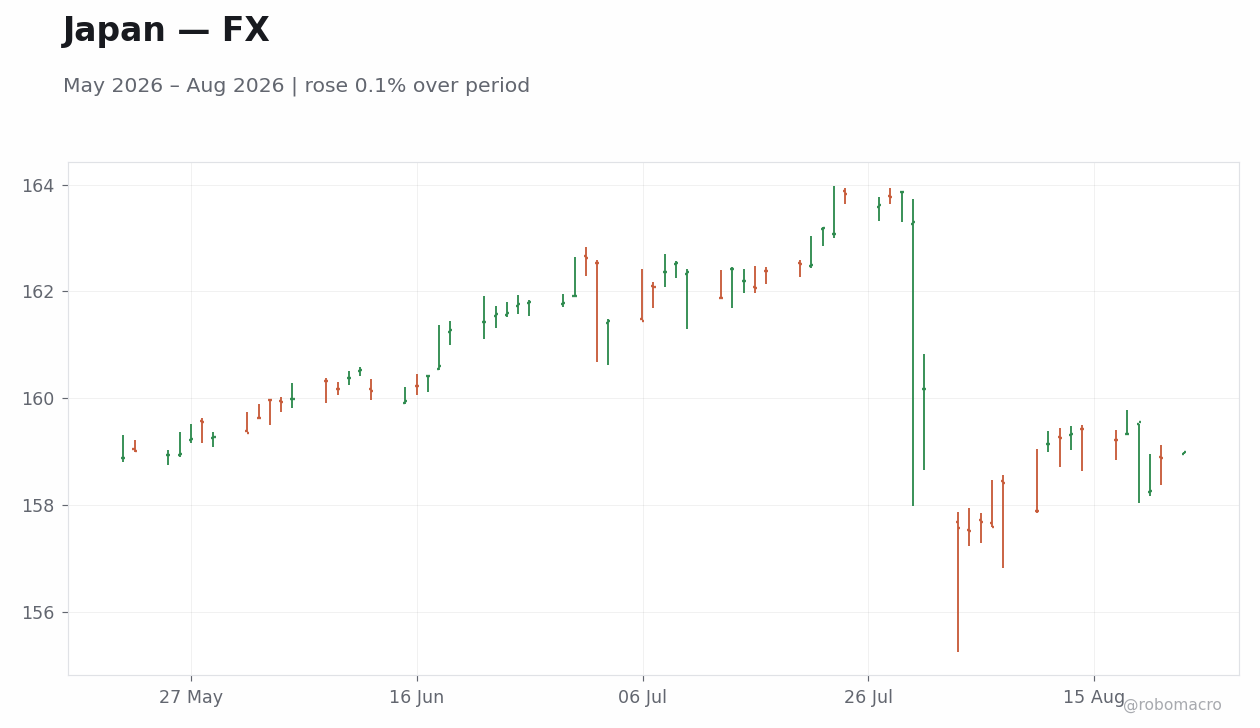
  • Japan’s preliminary GDP growth missed forecasts sharply.
  • Machinery orders rebounded and exceeded expectations, signaling resilient capital spending.
  • July inflation data showed a pickup that reinforced the Bank of Japan’s case for further policy normalization ahead of its next meeting.

Week in Review

GDP shortfall highlights domestic softening. Japan’s preliminary GDP growth came in below consensus and prior readings, underscoring weaker domestic demand and export momentum during the week of August 17–21.

Machinery orders deliver strong rebound. Machinery orders rebounded and exceeded forecasts, pointing to sustained business investment despite the GDP miss.

Trade data shows export resilience. Exports rose while the trade balance narrowed more than expected, driven by semiconductor and vehicle shipments.

Equity markets decline amid yield repricing. The Nikkei 225 fell 4.63 percent week-over-week to close at 66016.36 as 10-year JGB yields held near recent levels.

Currency stabilizes near recent levels. USD/JPY traded in a narrow range before settling at 158.99, reflecting limited net movement despite volatility in risk assets.

Commodity prices advance. Brent crude rose 3.87 percent to 94.39 while gold gained 5.95 percent to 4680.60, providing external support amid yen stability.

Inflation pickup emerges as key signal. July inflation data confirmed a modest acceleration that aligned with prior wholesale price trends and supported ongoing normalization expectations.

Fiscal concerns surface alongside data. Markets noted Japan’s planned fiscal 2027 assumed bond interest rate, adding to pressure on JGB yields during the period.

Risk sentiment weakens equities further. The Nikkei 225 posted successive daily declines mid-week before partial recovery, illustrating sensitivity to mixed growth signals.

Overall arc points to data dependence. The combination of the GDP shortfall and machinery orders beat left the growth picture mixed yet tilted toward resilience in external and investment channels.

BoJ Watch

The Bank of Japan received mixed signals from the week’s releases, with the GDP miss tempering near-term growth optimism while the machinery orders beat and export acceleration underscored capital-spending strength. July inflation data showed a pickup that directly supports the case for additional policy-rate adjustments at upcoming decisions. Officials maintained their data-dependent stance with no scheduled speeches altering forward guidance during the period. The combination of resilient external demand and softening domestic output leaves the rate path anchored to subsequent inflation and activity prints rather than any single release. No changes to the policy rate occurred, and the quarterly outlook remained unchanged from prior communications.

RoboMacro AI Economic Research

Global Macro Watch

Week of August 17–21, 2026 robomacro.com

Calendar data unavailable

Week Ahead: Key Releases
DateReleasePriorCons.
2026-08-26Speech by BoJ's Himino--
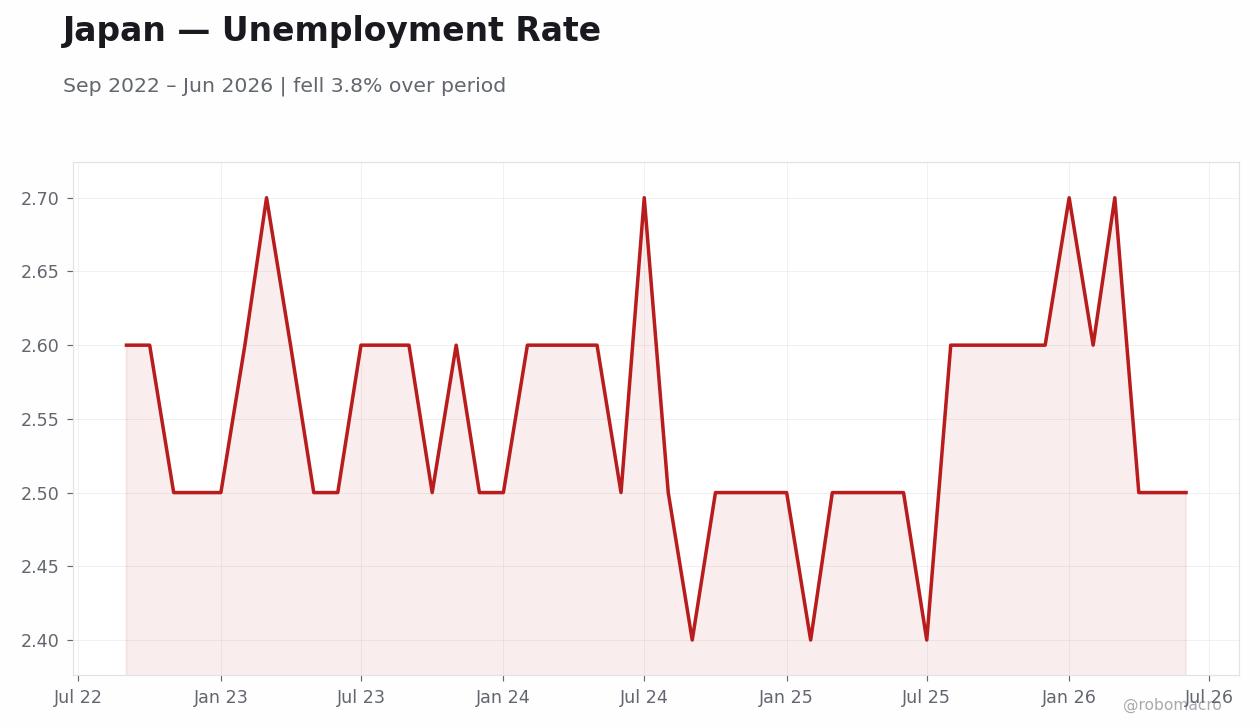
2026-08-27Unemployment Rate2.52.5
2026-08-28Consumer Confidence Index34.9-
2026-08-28Housing Starts Year-over-Year18.6-
2026-08-30Industrial Production Month-over-Mo1.9-
2026-08-30Retail Sales Year-over-Year0.50-
Chart 7

The Week Ahead

Attention next week centers on the high-impact speech by BoJ’s Himino on August 26, which will provide fresh insight into the policy stance ahead of upcoming decisions. Unemployment Rate data due August 27 will test labor-market resilience and inform wage pressures relevant to the Bank of Japan’s inflation target. Consumer Confidence Index and Housing Starts Year-over-Year releases on August 28 will offer early reads on household sentiment and construction activity for coming quarters. Industrial Production Month-over-Month Preliminary and Retail Sales Year-over-Year figures on August 30 will clarify whether the recent GDP dip proves temporary or signals broader softening. These releases matter because they directly feed into the Bank of Japan’s assessment of whether current policy settings remain appropriate or require further adjustment. Markets will parse any upside surprises in activity or inflation data for implications on the timing of the next policy move. The absence of other major central-bank events keeps focus squarely on Japanese indicators and official commentary.

Risks & Themes

The GDP miss introduces downside risk to the growth outlook if domestic demand continues to lag, potentially delaying further Bank of Japan tightening. Conversely, sustained strength in machinery orders and exports could support an earlier normalization step if inflation remains firm. Fiscal pressures evident in the assumed bond rate for fiscal 2027 raise upside risks to yields and could complicate policy transmission. The yen’s limited reaction to the data mix suggests markets may be underweighting the cumulative impact of inflation acceleration on the rate path. An upside surprise in next week’s industrial production or retail sales would tilt the balance toward faster tightening, while further labor-market softening would reinforce caution. Overall, the week’s arc leaves the outlook balanced but sensitive to whether growth weakness proves transitory.

RoboMacro AI Economic Research

Global Macro Watch

Week of August 17–21, 2026 robomacro.com
Canada
Market Scorecard
AssetLevelWoW
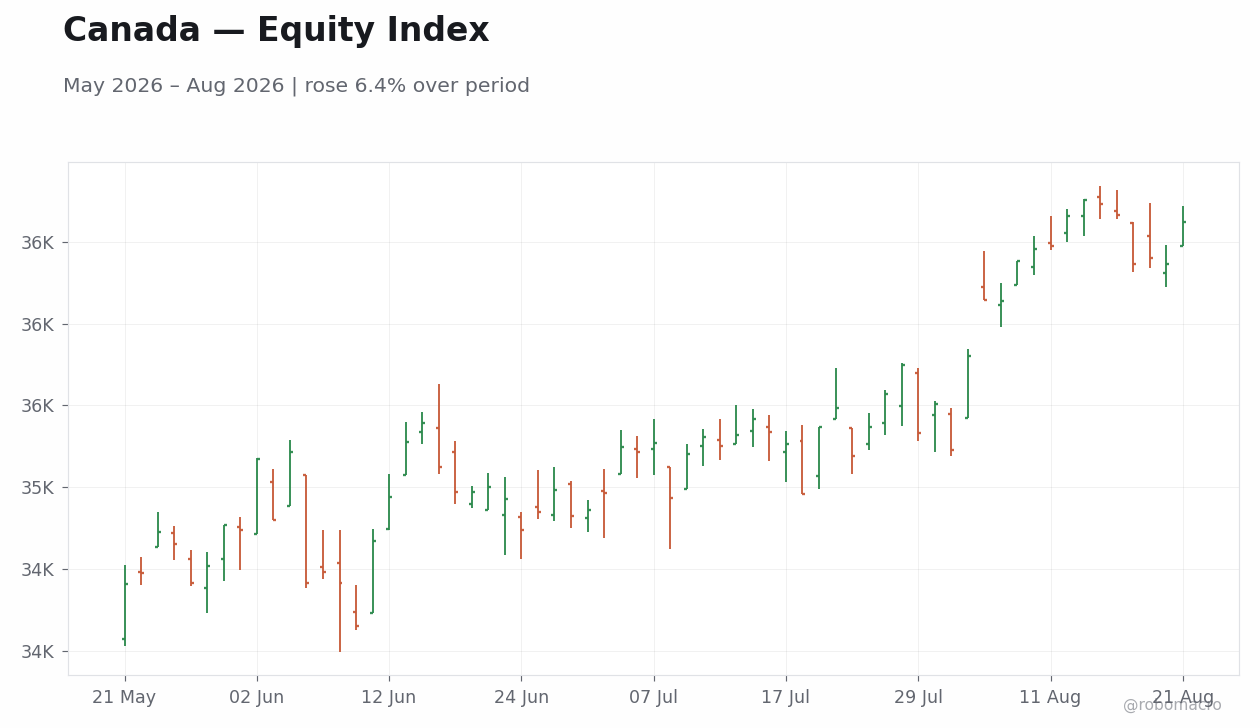
S&P/TSX36620.2-0.1%
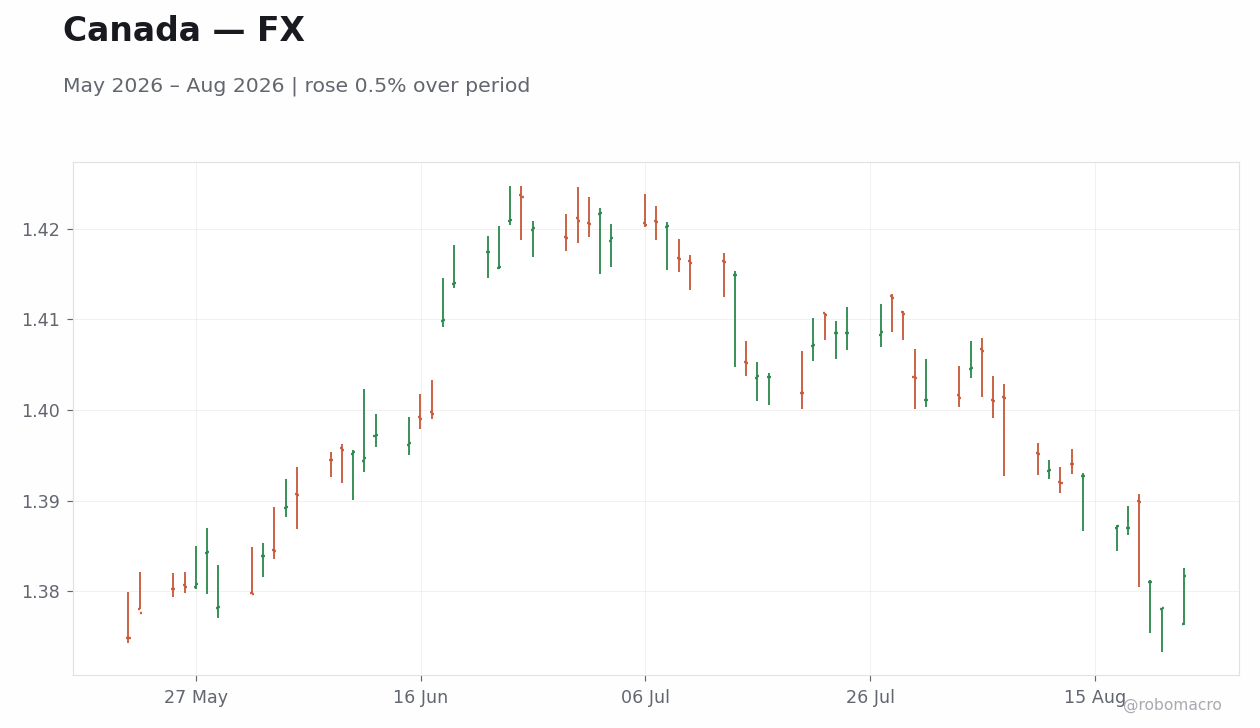
USD/CAD1.38-0.4%
EUR/CAD1.61+0.5%
WTI Crude87.06+3.0%
Natural Gas2.81+4.5%
Gold4680.6+6.0%
Brent Crude94.39+3.9%
Bitcoin77300.52+23.1%
Chart 1
Chart 2
Chart 4
  • Inflation data surprised higher while housing starts declined.
  • Energy prices advanced, supporting CAD at 1.38 and lifting the S&P/TSX to 36620.2.
  • Bank of Canada held the policy rate steady with no shift in forward guidance, reinforcing data dependence ahead of the next meeting.

Week in Review

Inflation Print Surprises Higher Inflation rose year-over-year and beat consensus, with the month-over-month rate positive and core measures firming. The print remained inside the upper half of the target range yet removed any near-term relief narrative.

Housing Activity Weakens Sharply Housing starts declined and missed consensus, extending the prior reading lower. The New Housing Price Index showed continued monthly softness.

Energy Prices Drive Cross-Asset Moves WTI crude and Brent advanced, providing direct support to CAD which closed the week at 1.38. The S&P/TSX finished at 36620.2.

Retail and Credit Data Still Pending Final retail sales and the Senior Loan Officer Survey were expected to clarify whether consumer spending cooled after the inflation release.

Tariff Concerns Overlay Domestic Prints News flow highlighted ongoing US-Canada tariff negotiations and retaliatory measures, adding external uncertainty to the domestic data flow.

Policy Signal Remains Unchanged The Bank of Canada maintained the policy rate through the period, consistent with its emphasis on incoming figures.

Data Arc Confirms Mixed Growth Picture Hotter inflation coincided with softer residential investment, leaving the overall growth-inflation balance little changed.

Through-Line Points to Sustained Data Dependence The week’s releases reinforced that both inflation and activity prints will continue to shape the path to upcoming decisions.

BoC Watch

The Bank of Canada left the policy rate unchanged and offered no adjustment to forward guidance. Inflation rose year-over-year and core measures arrived above expectations yet remained consistent with the upper end of the target range, while housing starts signaled further softening in residential investment. Officials continued to stress that decisions rest on the full set of incoming data, with no indication that the energy-led inflation rebound or the construction shortfall would alter the sequencing of upcoming meetings. The combination of firmer prices and weaker housing activity therefore sustains the data-dependent stance into the next policy round.

RoboMacro AI Economic Research

Global Macro Watch

Week of August 17–21, 2026 robomacro.com

Calendar data unavailable

Week Ahead: Key Releases
DateReleasePriorCons.
2026-08-27Current Account Balance-7.2bn-5.5bn
2026-08-28GDP Growth Annualized-0.10-
2026-08-28GDP Growth Quarter-over-Quarter0-
2026-08-28GDP Month-over-Month0.300.20
2026-08-28GDP Month-over-Month Preliminary--
Chart 6
Chart 7

The Week Ahead

Current Account Balance on Thursday will provide the first look at external balances after the inflation surprise. GDP Growth Annualized, GDP Growth Quarter-over-Quarter, and GDP Month-over-Month releases on Friday will update the growth trajectory into the second half of the year. The preliminary GDP Month-over-Month figure carries particular weight for assessing whether housing weakness is feeding through to broader activity. These prints arrive ahead of the next Bank of Canada meeting and will help calibrate the balance between the recent inflation overshoot and softening residential indicators. Markets will watch for any revision to the prior growth readings. The data will inform whether the current policy rate setting remains appropriate for coming quarters.

Risks & Themes

Hotter inflation raises the possibility that price pressures remain stickier than earlier anticipated if energy effects persist, while the drop in housing starts increases downside risk to residential investment and related consumption. Escalating US-Canada tariff rhetoric adds an external layer that could weigh on export-oriented sectors and CAD. Private-credit concerns flagged by the Bank of Canada introduce a separate financial-stability channel. The week’s mixed prints leave open both an upside inflation scenario that delays easing and a downside growth scenario that accelerates it.

RoboMacro AI Economic Research

Global Macro Watch

Week of August 17–21, 2026 robomacro.com
Mexico
Market Scorecard
AssetLevelWoW
IPC Bolsa65729.18+2.3%
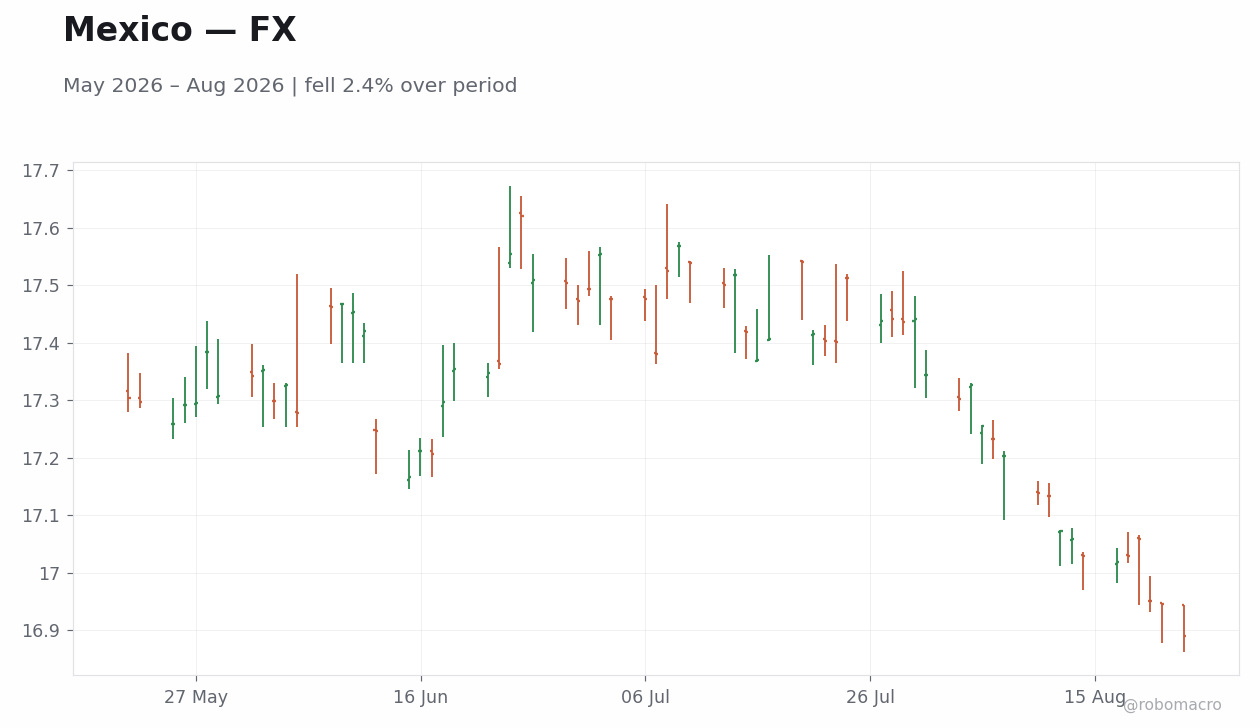
USD/MXN16.89-0.8%
EUR/MXN19.74+0.2%
WTI Crude87.06+3.0%
Silver69.53+5.2%
Gold4680.6+6.0%
Brent Crude94.39+3.9%
Bitcoin77278.61+23.0%
Chart 1
Chart 2
  • IPC Bolsa closed the week at 65,729.18, up 2.29 percent from the prior Friday, while USD/MXN eased to 16.89.
  • Mexico’s yield curve steepened as the short-term rate declined and the long-term rate rose.
  • Banco de Mexico maintained its policy rate, with inflation leaving a narrow gap to target.

Week in Review

Quiet Domestic Calendar Shapes External Focus Mexican markets operated without scheduled economic releases from August 17 through August 21, directing attention to USMCA consultations and potential new duties on Chinese goods. The IPC Bolsa posted modest daily declines mid-week amid thin volumes before recovering to end higher. USD/MXN eased through the latter part of the week, supported by firmer commodity prices.

Commodity Linkages and Curve Dynamics WTI crude advanced to 87.06 while Brent rose to 94.39, providing support for energy-linked peso flows. Gold climbed to 4,680.60, lifting mining-related equity sentiment. The Mexico yield curve steepened, with the short-term rate declining and the long-term rate rising.

Nearshoring and Trade Signals Persist News flow centered on Mexico evaluating curbs on selected Chinese imports during the ongoing USMCA review. Semiconductor suppliers expanded operations in Chihuahua, reinforcing industrial momentum. Remittances continued to supply external support while the absence of domestic data prints left positioning cautious. The configuration left the peso resilient against regional peers despite headline uncertainty over matching US-Canada tariff terms.

Banxico Watch

Banco de Mexico left the policy rate unchanged through the week, consistent with the latest inflation reading. No Banxico speakers or minutes were released, so forward guidance remained anchored to the prior data-dependent stance. The narrow gap between observed inflation and target, combined with steady export values in the latest reading, supplied no fresh impetus for an immediate adjustment. Officials continued to cite the need for additional prints before recalibrating parameters ahead of upcoming decisions. The latest inflation outcome reinforced the view that current settings remain appropriate for the coming quarters.

RoboMacro AI Economic Research

Global Macro Watch

Week of August 17–21, 2026 robomacro.com

Calendar data unavailable

Week Ahead: Key Releases
DateReleasePriorCons.
2026-08-27Trade Balance4.1bn-
Chart 5

The Week Ahead

The Trade Balance release scheduled for August 27 will provide the first domestic data point after the empty calendar. Markets will assess whether the figure confirms continued export resilience or signals softening momentum. Any surprise in the balance could influence peso flows and Mbono yields ahead of the next Banco de Mexico decision. External USMCA developments and commodity price follow-through will continue to shape MXN crosses given Mexico’s energy and manufacturing linkages. Nearshoring announcements from Chihuahua suppliers may surface in corporate updates and affect equity sentiment. The configuration leaves participants focused on growth signals that could alter the balance of risks for the policy rate path in coming quarters.

Risks & Themes

Trade policy uncertainty around US-Canada tariff alignment and potential new Chinese duties introduces downside risk to nearshoring inflows and peso stability. Commodity volatility, with Brent and gold both advancing, could amplify MXN swings if energy prices reverse. The steepening yield curve signals shifting fiscal financing expectations that may pressure long-term rates further if domestic data disappoint. Upside scenarios hinge on continued semiconductor and nearshoring expansions that offset external headwinds.

RoboMacro AI Economic Research

Global Macro Watch

Week of August 17–21, 2026 robomacro.com
Brazil
Market Scorecard
AssetLevelWoW
Bovespa170448.88+2.2%
USD/BRL5.14-1.6%
EUR/BRL6.0-0.6%
Vale14.59+6.1%
Petrobras19.15+4.9%
WTI Crude87.06+3.0%
Gold4680.6+6.0%
Bitcoin77278.61+23.0%
Chart 1
Chart 2
  • Commodity price gains lifted Bovespa and strengthened the real, with Vale and Petrobras advancing.
  • The central bank activity index confirmed modest Q2 expansion after stronger Q1 readings, while the trade surplus forecast was upgraded on higher commodity exports.
  • Banco Central do Brasil held the policy rate with forward guidance remaining data-dependent amid productivity-driven inflation risks.

Week in Review

Commodity-driven equity and currency gains Bovespa advanced to close the week higher as iron-ore and oil prices supported Vale and Petrobras. WTI crude and gold rose, providing external tailwinds that outweighed thin domestic data flow. USD/BRL strengthened, a weekly appreciation that reflected firmer real flows after the soft Q2 print.

Soft Q2 activity reading tempers growth outlook The central bank activity index showed modest second-quarter expansion, confirming the economy lost steam relative to stronger first-quarter readings and aligning with prior-week expectations of a mid-cycle slowdown. No high-impact releases occurred, leaving price action driven by external commodity moves and fiscal headlines. Bovespa posted gains across most trading sessions, illustrating the commodity-led recovery after an initial dip.

Fiscal and trade signals remain in focus The trade surplus forecast was upgraded on commodity strength, supporting the real even as banks curbed riskier lending amid rising household debt. Short-term rates eased across the week, reflecting limited immediate policy pressure. Bitcoin’s weekly surge added risk-on color but did not alter local fixed-income dynamics. Overall, the week’s arc showed external commodity gains offsetting domestic growth softness without shifting the policy-rate trajectory.

BCB Watch

Banco Central do Brasil held the policy rate this week, with minutes and deputy commentary underscoring data dependence and productivity-driven inflation risks. The modest Q2 activity index print reinforced the view that growth without productivity gains continues to sustain above-target pressures, keeping the central bank on hold. Officials noted that high policy rates alone do not fully explain tight credit conditions, pointing instead to structural barriers in housing finance. The absence of fresh inflation or labor data left forward guidance unchanged, with the central bank reiterating that decisions rest on incoming figures. Trade-surplus upgrades and commodity strength provided some relief on the external side but did not alter the domestic inflation assessment. The configuration sustains a data-dependent stance into the next meeting.

RoboMacro AI Economic Research

Global Macro Watch

Week of August 17–21, 2026 robomacro.com

Calendar data unavailable

Week Ahead: Key Releases
DateReleasePriorCons.
2026-08-27Unemployment Rate5.4-
Chart 6

The Week Ahead

Unemployment Rate data scheduled for August 27 will provide the first labor-market update since the soft Q2 activity reading and will inform assessments of domestic demand momentum. Consensus expectations center on stability near recent levels, with any surprise likely to influence views on consumption and services inflation ahead of upcoming decisions. Trade and fiscal statements from the finance ministry are also expected and could affect real positioning if they alter perceptions of external accounts or primary deficits. Commodity price moves in iron ore and oil will continue to drive export-related equities and currency flows. Global equity and Treasury moves may spill into local rates, particularly if US yields remain elevated. The data slate remains otherwise light, keeping attention on external drivers until clearer domestic catalysts emerge. These releases matter for the Banco Central do Brasil rate path because they will test whether the recent growth slowdown persists into coming quarters or shows signs of stabilization.
Risks & Themes

The week’s commodity gains reduced near-term imported-inflation risks but left the outlook exposed to any reversal in oil or iron-ore prices that could pressure the real and widen fiscal gaps. Upside scenarios center on sustained export strength supporting the trade surplus and allowing the central bank to maintain its hold without additional tightening. Downside risks include further fiscal slippage ahead of the election cycle, which could reprice debt sustainability concerns and weigh on longer-term rates. Markets appear to be under-weighting the persistence of productivity-driven inflation pressures highlighted in central bank commentary, suggesting scope for sharper repricing if labor data surprise to the upside. Structural credit constraints noted by bank executives add another layer that could slow consumption even if the policy rate stays on hold.

RoboMacro AI Economic Research

Global Macro Watch

Week of August 17–21, 2026 robomacro.com
Argentina
Market Scorecard
AssetLevelWoW
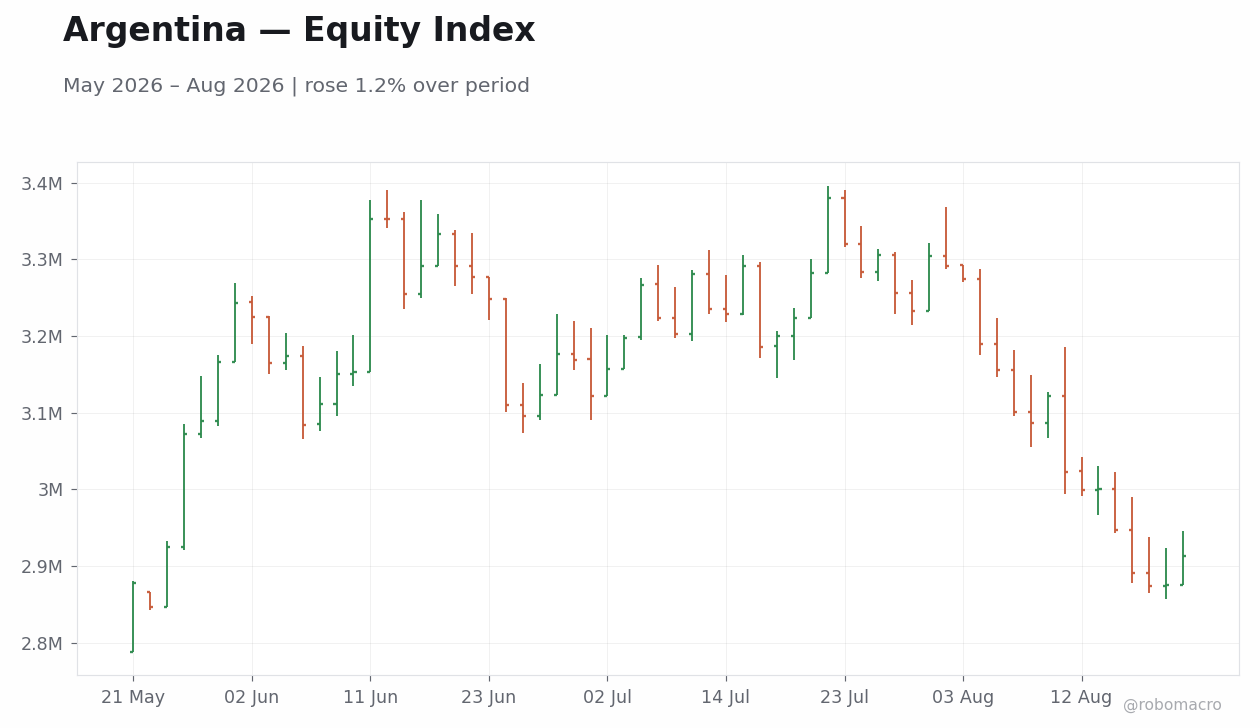
MERVAL2913184.0+0.7%
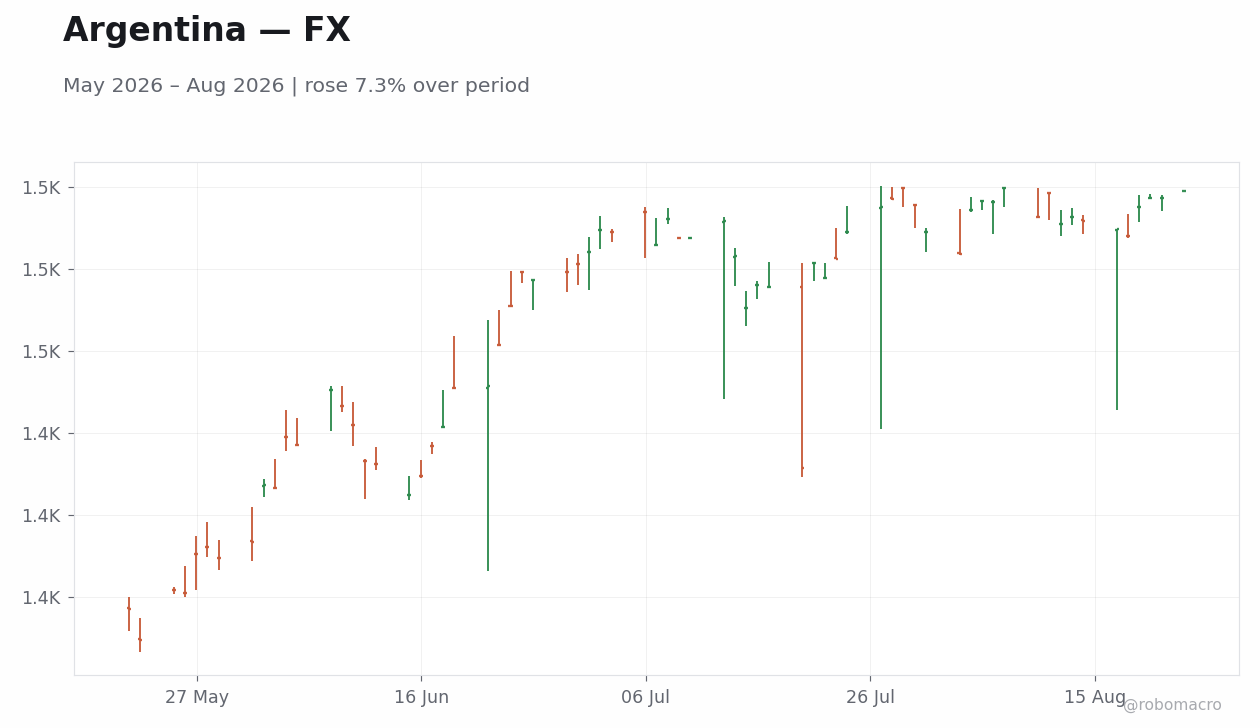
USD/ARS1499.0+0.6%
EUR/ARS1750.76+4.6%
Gold4680.6+6.0%
Brent Crude94.39+3.9%
Soybean1239.5+3.2%
Bitcoin77278.61+23.0%
Chart 1
Chart 2
  • Commodity price gains lifted soybean futures and Brent crude, bolstering export-tax receipts and BCRA reserve accumulation even as the MERVAL closed the week only modestly higher.
  • The official USD/ARS rate rose with EUR/ARS advancing, reflecting modest peso softening amid thin volumes and no domestic data releases.
  • Central Bank of Argentina reserve management stayed data-dependent, supported by soybean inflows and multilateral disbursements without any policy-rate adjustment or forward-guidance shift.

Week in Review

Equity Market Weakness Amid Labor Concerns The MERVAL declined early in the week before recovering to close higher, with volumes thin and participation limited ahead of the weekend. Persistent job losses under President Milei weighed on sentiment despite fiscal consolidation progress.

Peso and FX Dynamics The official USD/ARS rate advanced steadily across the five sessions while EUR/ARS climbed, narrowing the parallel-market gap modestly but still signaling ongoing depreciation pressure. No INDEC releases occurred, so price action reflected external flows and positioning rather than fresh inflation or activity prints.

Commodity Support for Reserves and Fiscal Accounts Soybean futures rose and Brent crude gained, directly supporting export registrations and tax collections that fund the primary surplus streak. Gold advanced and Bitcoin surged, providing additional tailwinds for commodity-linked assets and some retail flows away from peso holdings.

Absence of Data Releases Shapes Positioning The empty economic calendar kept focus on BCRA weekly reserve updates and Treasury bill auctions, with participants monitoring soybean export proceeds and IMF-related commentary for clues on net international reserves. Fiscal consolidation efforts continued to anchor credibility as LETRAS auctions cleared, yet the absence of fresh activity data left growth concerns unaddressed.

Broader Narrative Arc Overall the week confirmed that external commodity strength can offset domestic equity weakness and labor-market risks without triggering immediate policy recalibration at the Central Bank of Argentina.

BCRA Watch

The Central Bank of Argentina maintained its data-dependent stance with no policy-rate decision or speaker appearances during the week. Weekly monetary and reserve data releases, expected mid-week, showed continued accumulation from soybean inflows and multilateral disbursements that supported defense of the crawling peg. Officials provided no new forward guidance, leaving the policy signal unchanged from prior months. The absence of inflation or activity prints reinforced the focus on reserve targets ahead of the next meeting. Data on export-tax collections and primary-surplus performance supplied the clearest evidence that fiscal consolidation remains on track to meet IMF arrangement benchmarks.

RoboMacro AI Economic Research

Global Macro Watch

Week of August 17–21, 2026 robomacro.com

Calendar data unavailable

The Week Ahead

Monday brings Malaysia coincident and leading index releases that may influence broader commodity demand sentiment relevant to Argentine exports. Tuesday and Wednesday feature Finland producer and export price prints alongside Singapore core inflation, offering indirect signals on global price pressures that could affect BCRA reserve dynamics. Thursday includes additional Asia-Pacific inflation and trade data that markets will parse for clues on external demand. No high-impact Argentine releases are scheduled, keeping attention on BCRA reserve updates and Treasury debt operations. Traders will monitor any acceleration in soybean export registrations and LETRAS auction demand for signs of improved peso appetite ahead of upcoming decisions. Global risk sentiment and oil-price volatility will likely dictate near-term ARS and equity direction while the Central Bank of Argentina stays data-dependent.

Risks & Themes

Higher soybean and crude prices reduce near-term pressure on the primary fiscal balance yet leave the outlook exposed to any reversal in commodity momentum. Labor-market weakness remains the clearest domestic risk, with unemployment cited as Milei’s primary political vulnerability despite earlier inflation and fiscal gains. The modest peso softening observed this week could accelerate if global risk appetite fades or if IMF Article IV talks signal slower reserve rebuilding. Markets appear to underweight the persistence of industrial production contraction, which may challenge growth expectations in coming quarters even as export-tax revenues provide a buffer. Upside scenarios hinge on sustained commodity strength and continued primary-surplus outperformance that could support faster reserve accumulation ahead of the next policy meeting.

RoboMacro AI Economic Research

Global Macro Watch

Week of August 17–21, 2026 robomacro.com
Colombia, Chile and Peru
Market Scorecard
AssetLevelWoW
MSCI Chile41.44+2.3%
MSCI Peru94.0+5.4%
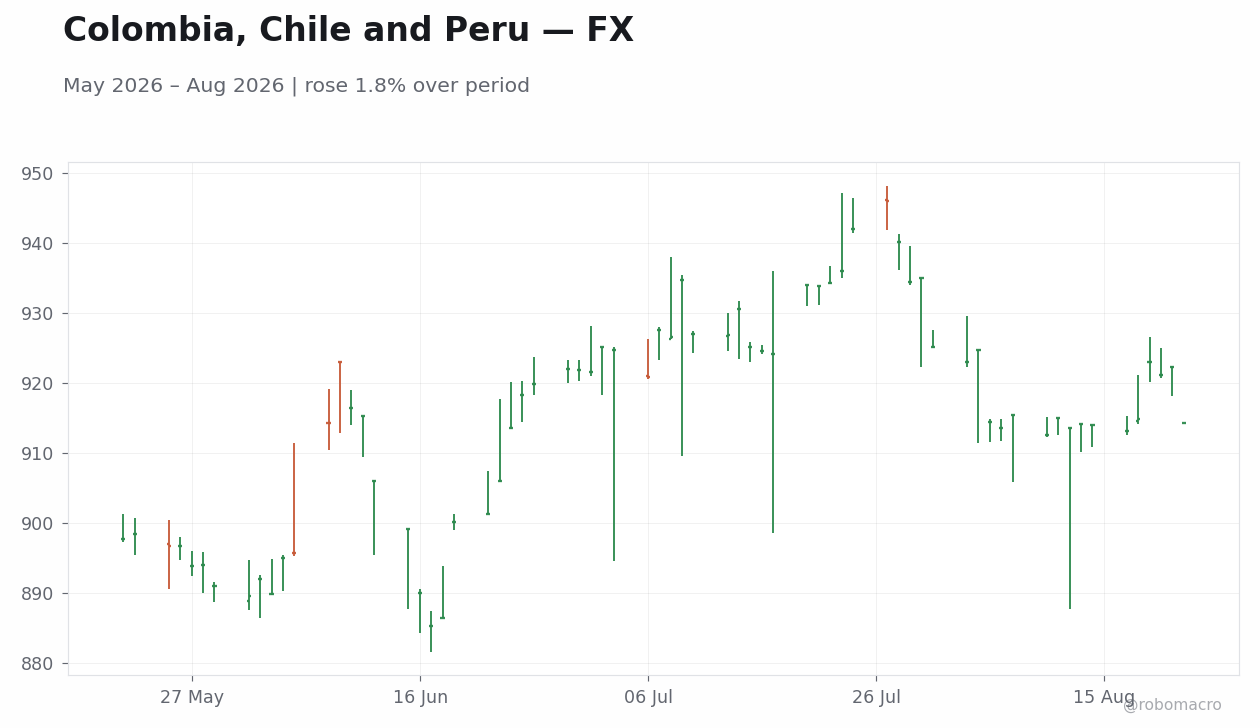
USD/COP3038.2-2.9%
USD/CLP914.28+0.1%
USD/PEN3.35+1.6%
Copper6.59-0.3%
Gold4680.6+6.0%
Brent Crude94.39+3.9%
Bitcoin77228.95+22.9%
Chart 1
Chart 2
  • Commodity price swings dominated Andean asset performance, with gold advancing 5.95 percent week-over-week to 4680.60 and Brent crude rising 3.87 percent to 94.39 while copper declined 0.26 percent to 6.59.
  • MSCI Peru climbed 5.39 percent to 94.00 and MSCI Chile gained 2.27 percent to 41.44, while MSCI Colombia held flat at 9.02.
  • BanRep, BCCh and BCRP left policy rates unchanged, reinforcing the data-dependent stance across the region.

Week in Review

Commodity price volatility drove regional asset moves. Equity indices in Chile and Peru advanced on net commodity gains even as copper posted a modest weekly decline to 6.59. MSCI Peru rose 5.39 percent to 94.00 while MSCI Chile increased 2.27 percent to 41.44, reflecting gold’s 5.95 percent advance to 4680.60 and Brent’s 3.87 percent gain to 94.39. MSCI Colombia remained unchanged at 9.02.

FX markets showed divergent currency performance. USD/COP fell 2.93 percent to 3038.20 on the week, while USD/CLP rose 0.13 percent to 914.28 and USD/PEN increased 1.58 percent to 3.35. These shifts occurred against thin trading volumes and no domestic data releases.

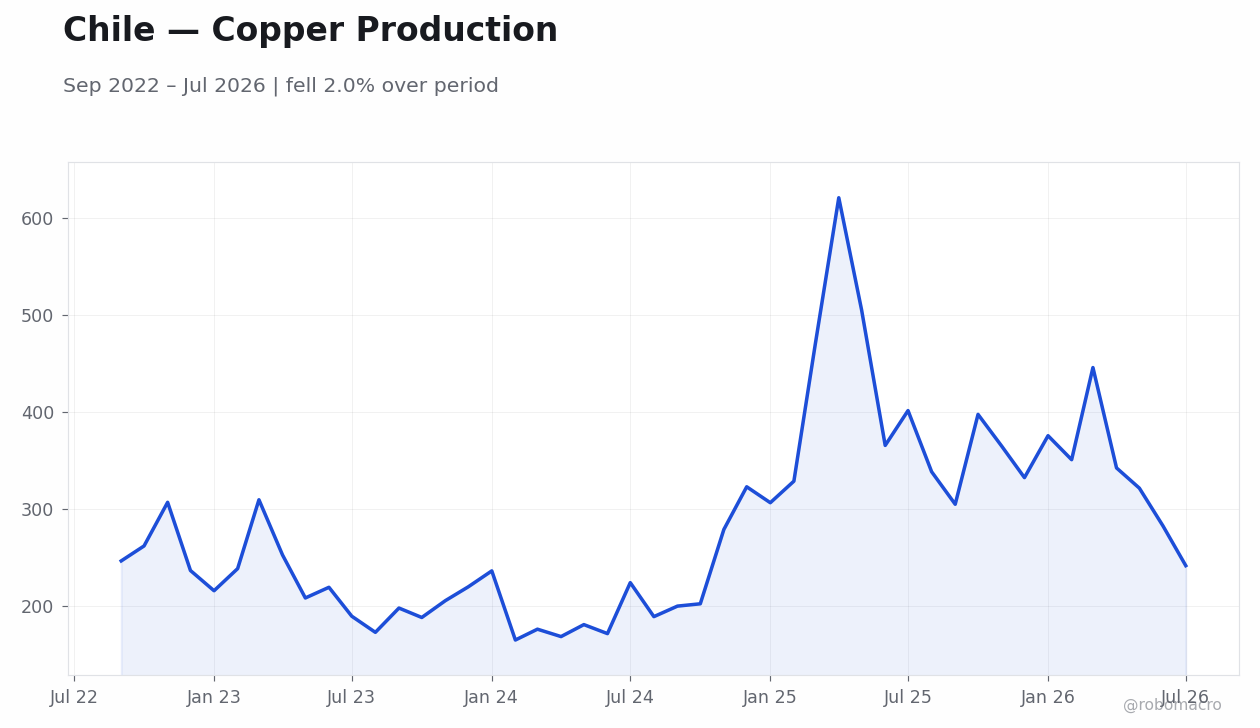
Fiscal and external accounts faced external commodity influences. Colombia’s oil-linked revenues received support from Brent at 94.39, while Chile’s Codelco royalties and Peru’s mining exports tracked copper at 6.59. The absence of high-impact releases left price action as the primary driver.

Central bank parameters remained stable across the region. Policy rates stayed unchanged at BanRep, BCCh and BCRP. The quiet data calendar reinforced the multi-week pattern of policy patience.

Regional equity flows stayed light amid external drivers. Bitcoin’s 22.94 percent weekly surge to 77228.95 provided additional risk-on sentiment but remained secondary to commodity channels.

Andean Central Banks Watch

BanRep, BCCh and BCRP maintained unchanged policy parameters with no forward guidance adjustments communicated. The empty domestic data calendar left officials without fresh inflation or activity prints to reassess the rate path ahead of upcoming decisions. Prior-week minutes and statements across the three banks continued to emphasize data dependence, with no speakers altering the message this week. Commodity-driven external accounts showed mixed signals—Brent strength at 94.39 supported Colombia’s fiscal inflows while copper at 6.59 narrowed royalty expectations for Chile and Peru—yet these developments did not prompt immediate policy commentary. The configuration leaves the three central banks positioned to monitor incoming growth and inflation releases before any recalibration of the current stance.

RoboMacro AI Economic Research

Global Macro Watch

Week of August 17–21, 2026 robomacro.com

Calendar data unavailable

Chart 5
Chart 7

The Week Ahead

The next week features a sparse Andean calendar with no high-impact releases scheduled for Colombia, Chile or Peru, directing attention to external commodity flows and any central bank communications. Markets will track copper and gold price action for implications on Chile’s fiscal revenues and Peru’s mining exports ahead of the next policy meetings. Colombia’s oil revenue outlook remains sensitive to Brent levels at 94.39 relative to budget assumptions. Any follow-up statements from BanRep, BCCh or BCRP on reserve management or external balances could provide directional signals. Global risk sentiment and China demand indicators will likely influence regional spreads and currency volatility in the absence of local data.

Risks & Themes

The week’s commodity gains reduced near-term downside pressure on external accounts yet left Chile and Peru exposed to any reversal in copper at 6.59. Thin trading volumes amplified daily FX swings, raising the possibility of overshoots in USD/PEN and USD/CLP that could feed into imported inflation readings. The continued absence of domestic data leaves the three central banks reliant on external signals, creating scope for policy expectations to shift rapidly once activity prints resume. Markets appear to underweight the interaction between sustained Brent strength at 94.39 and Colombia’s budget gap while over-weighting gold’s support for Peru’s current account.

RoboMacro AI Economic Research

Global Macro Watch

Week of August 17–21, 2026 robomacro.com
United Kingdom
Market Scorecard
AssetLevelWoW
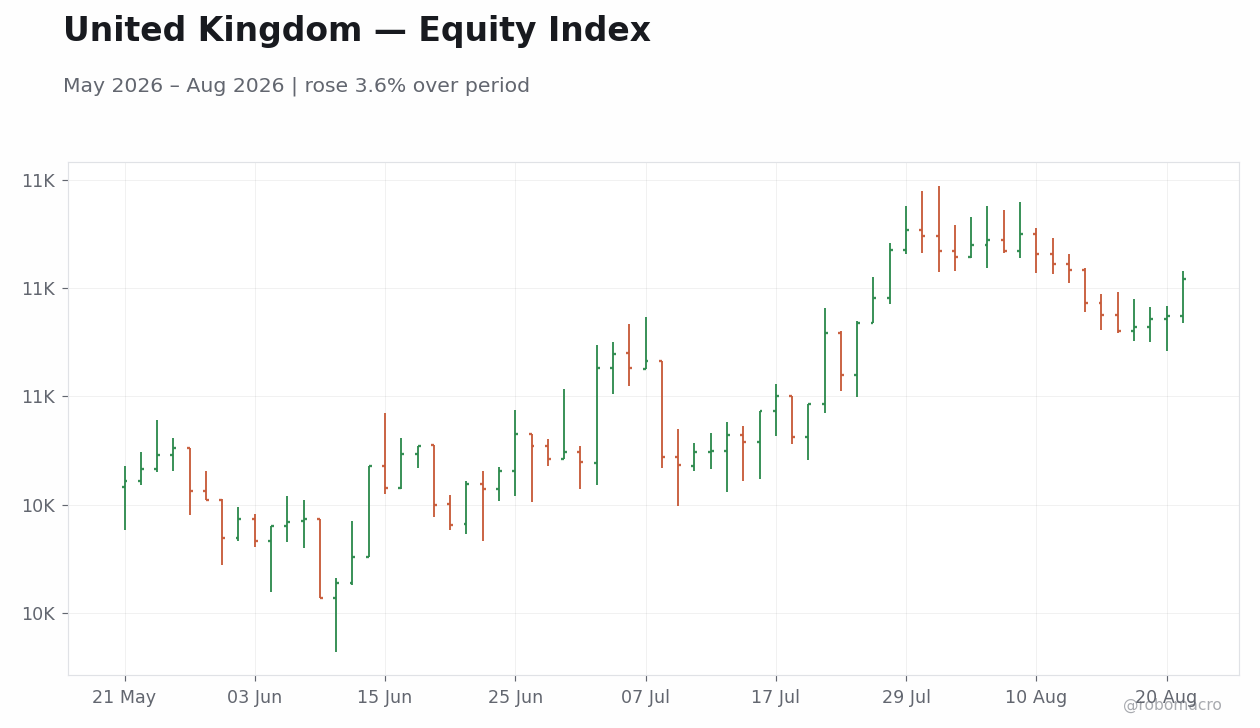
FTSE 10010816.6+0.9%
FTSE 25024718.8+0.1%
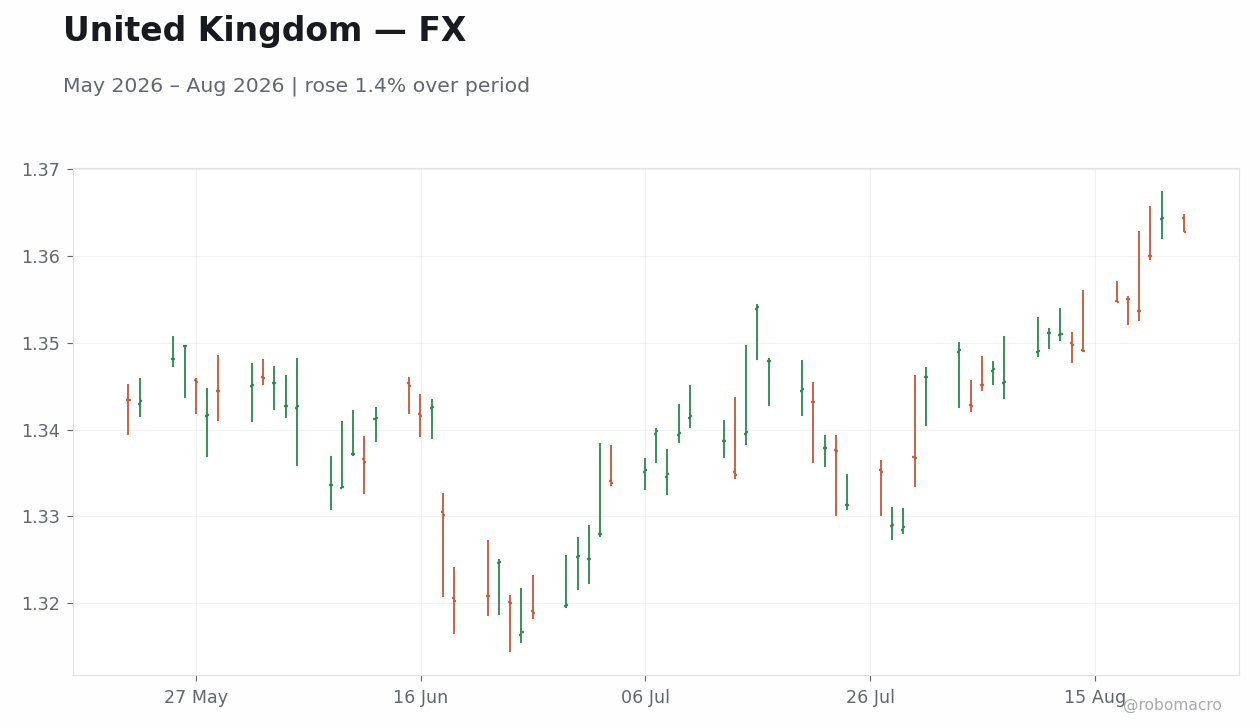
GBP/USD1.36+0.6%
GBP/EUR1.17-0.3%
GBP/JPY216.36+0.3%
Brent Crude94.39+3.9%
Gold4680.6+6.0%
UK Nat Gas2.81+4.5%
Bitcoin77220.54+22.9%
Chart 1
Chart 2
Chart 3
  • UK labor market data showed unemployment holding steady while employment growth slowed, missing consensus expectations.
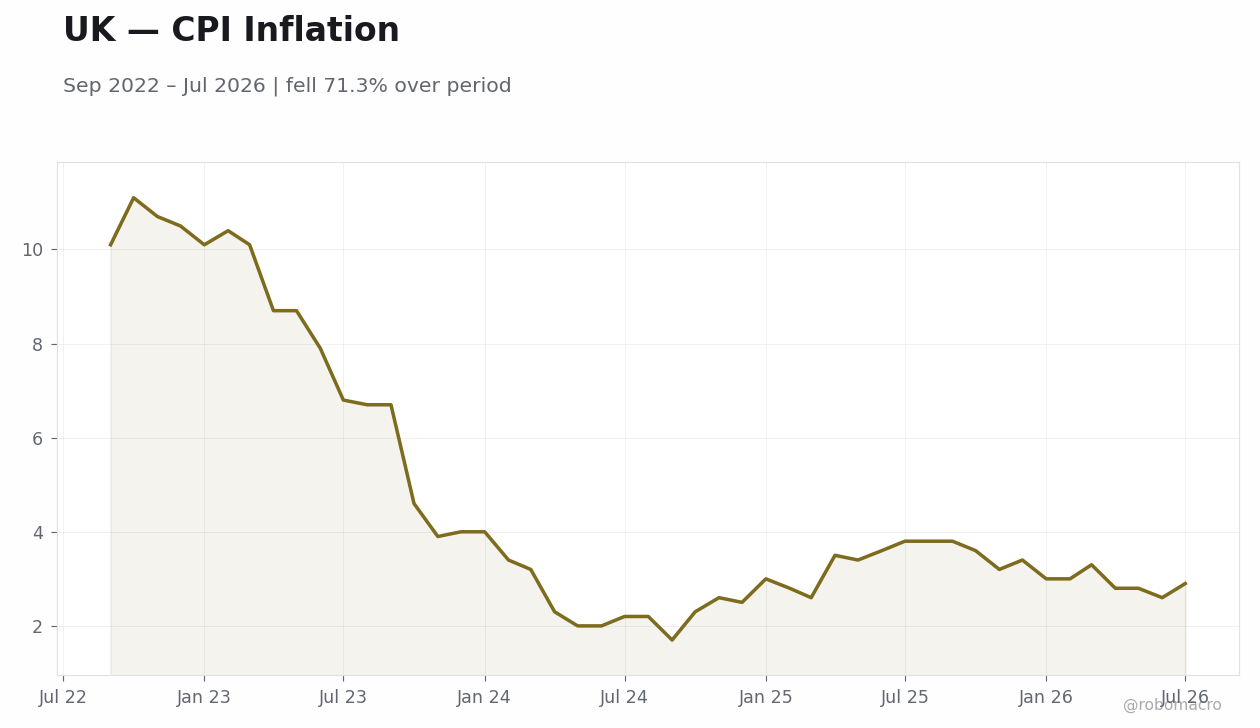
  • July CPI rose year-over-year and month-over-month in line with consensus, reaching a four-month high.
  • Average earnings growth eased year-over-year, aligning with forecasts and reducing near-term wage pressure signals.
  • FTSE 100 advanced while the 10-year gilt yield remained stable and Brent crude climbed amid global commodity strength.

Week in Review

Labor market shows resilience amid cooling momentum. UK employment growth slowed in the latest reading while the unemployment rate stayed unchanged and missed consensus. Average earnings growth including bonuses eased year-over-year, aligning with forecasts and easing wage concerns. These prints reinforced a gradual cooling narrative without triggering abrupt policy shifts.

Inflation re-accelerates in line with expectations. July CPI rose year-over-year and month-over-month, both matching consensus and reaching a four-month high. Core CPI held year-over-year slightly above forecast, leaving underlying pressures intact. The combination of steady unemployment and firmer prices supported views that the Bank of England would keep its policy rate on hold.

Markets absorb mixed signals without major repricing. The FTSE 100 advanced over the week while sterling moved higher against the dollar. Gilt yields stayed anchored. Cross-asset moves reflected data dependence rather than decisive trend changes.

BoE Watch

The Bank of England maintained its data-dependent stance following the labor and inflation releases. No policy meeting occurred during the week, leaving the policy rate unchanged at prior levels. Forward guidance continued to emphasize incoming figures on growth and prices. Steady unemployment and easing earnings growth reduced immediate wage-driven inflation risks. CPI matching consensus reinforced the view that underlying pressures warrant continued vigilance. Market participants interpreted the prints as consistent with a hold on the policy rate into subsequent meetings. Speakers reiterated that decisions rest on the full data set rather than single releases.

Data Review

Labor data showed unemployment unchanged against consensus and prior print. Employment growth missed the prior pace by a wide margin. Average earnings including bonuses eased year-over-year exactly in line with forecast. The CPI print delivered headline inflation matching consensus and rising from prior levels. Core inflation reached year-over-year levels slightly above expectation, while the monthly rate hit forecast. These outcomes indicate the economy remains in a mid-expansion phase with sticky services prices near prior levels. The data keep the Bank of England on a data-dependent path with limited immediate pressure for rate adjustments. Growth resilience from the prior quarter continues to offset softer labor momentum.

RoboMacro AI Economic Research

Global Macro Watch

Week of August 17–21, 2026 robomacro.com

Calendar data unavailable

Chart 5
Chart 6
Chart 7

The Week Ahead

Attention turns to upcoming distributive trades and housing market data, which will test retail sector momentum and provide fresh signals on the housing market. These releases follow the recent retail sales contraction. Flash PMIs already released showed modest expansion in both manufacturing and services. Any surprises in housing or distributive trades could influence expectations for the next Bank of England decision. Global commodity moves, including Brent crude, will also feed into imported price pressures. The sequence keeps the focus on whether growth resilience persists.

Risks & Themes

The labor slowdown raises downside risks to consumption if the trend extends. Upside inflation surprises remain possible given the CPI print and sticky core. Positioning appears balanced after gilt yields held steady and equities advanced modestly. Volatility in Brent crude could transmit imported inflation risks. Flow data show continued safe-haven demand for gold. Mispricing signals are limited, with markets correctly anticipating the consensus-matching CPI outcome. The configuration favors a cautious stance into the housing and distributive trades prints.

Cross-Asset

Equities posted modest net gains with the FTSE 100 closing at 10816.6, up 0.9% week-over-week. The FTSE 250 ended at 24718.8 after a 0.06% weekly advance. Bonds showed stability as the 10-year gilt yield held steady throughout the week. FX markets saw GBP/USD finish at 1.36, up 0.6% from the prior week close. GBP/EUR eased 0.3% to 1.17 while GBP/JPY rose 0.32% to 216.36. Commodities strengthened with Brent crude advancing 3.87% to 94.39 and gold surging 5.95% to 4680.6.

Global Context

Brent crude strength reflected ongoing supply concerns that spilled into UK energy prices. Gold’s weekly gain highlighted global safe-haven flows that supported sterling’s advance. US-Canada trade developments added minor external uncertainty without direct UK impact. Broader developed-market data dependence kept cross-border rate differentials stable. No major geopolitical escalations altered UK-specific flows in the past seven days.

RoboMacro AI Economic Research

Global Macro Watch

Week of August 17–21, 2026 robomacro.com
Sweden, Norway, Denmark and Finland
Market Scorecard
AssetLevelWoW
OMX Stockholm 303292.34+0.8%
Oslo Bors2093.58+0.2%
OMX Copenhagen 251906.85+0.5%
OMX Helsinki 256408.7+0.5%
USD/SEK9.45-0.7%
USD/NOK9.29-1.6%
EUR/SEK11.06+0.4%
EUR/NOK10.85-0.7%
Brent Crude94.39+3.9%
Gold4680.6+6.0%
Bitcoin77215.62+22.9%
Chart 1
Chart 2
Chart 4
  • Riksbank held the policy rate with the accompanying statement leaving the tightening option open despite subdued Swedish inflation.
  • Brent crude advanced, lifting Oslo Bors while USD/NOK declined.
  • Nordic equities closed the week higher, supported by gains in gold.

Week in Review

Riksbank Policy Decision The Riksbank held the policy rate after Swedish inflation confirmed the subdued price trend. The statement kept the tightening option open, consistent with the data-dependent stance observed across developed markets in prior weeks.

Equity and Currency Moves OMX Stockholm 30 rose to 3292.34 over the week while OMX Helsinki 25 gained to 6408.70. USD/SEK declined to 9.45 and EUR/SEK rose to 11.06, reflecting krona stability after the decision.

Norwegian Energy Support Brent crude climbed to 94.39, helping Oslo Bors advance to 2093.58 and USD/NOK fall to 9.29. Norway’s inflation remained the reference point for Norges Bank calibration amid firmer oil revenue.

Danish and Finnish Alignment OMX Copenhagen 25 rose to 1906.85 and OMX Helsinki 25 closed at 6408.70 as Danish and Finnish activity stayed tied to euro-area conditions.

Cross-Asset Context Gold advanced to 4680.60 and Bitcoin rose to 77215.62, drawing some flows away from Nordic currencies during thin summer volumes. The week’s data confirmed the mid-expansion phase described in the prior three reports, with no consensus misses on the Riksbank outcome and inflation prints reinforcing the existing policy parameters.

Nordic Central Banks Watch

The Riksbank left the policy rate unchanged on August 20 and reiterated that future adjustments would rest on incoming inflation and growth prints. Swedish inflation supplied the evidence base for the hold. Norges Bank maintained its stance with inflation and Brent providing fiscal support. Danmarks Nationalbank and the Bank of Finland continued to align with euro-area parameters, with no independent signals issued during the week. The data showed persistent disinflation in Sweden and stable energy-driven inflation in Norway, leaving both central banks on a data-dependent path into the next decisions.

RoboMacro AI Economic Research

Global Macro Watch

Week of August 17–21, 2026 robomacro.com

Calendar data unavailable

Chart 8

The Week Ahead

Finland Export Prices Year-over-Year, Import Prices Year-over-Year and Producer Price Index Year-over-Year are scheduled for August 24 and will update cost pressures ahead of the next ECB and Bank of Finland assessments. Malaysia Coincident Index and Leading Index releases on the same day offer indirect signals for Nordic export demand. No high-impact Swedish, Norwegian or Danish prints appear before August 28. The Riksbank and Norges Bank will monitor these figures for any shift in the balance between subdued domestic prices and external energy support. Danish and Finnish calendars remain light, keeping attention on euro-area developments that affect Danmarks Nationalbank and the Bank of Finland. Markets will assess whether the soft Swedish inflation trend persists or whether Brent stability alters Norwegian inflation dynamics. The releases matter for the timing of any future policy adjustments at the upcoming meetings.

Risks & Themes

Soft Swedish inflation raises the possibility that the Riksbank may keep the easing cycle on hold longer than earlier quarters if external demand weakens further. Brent could sustain NOK support but also embed higher imported inflation that challenges Norges Bank’s steady stance. Equity gains in Stockholm and Helsinki may overstate resilience if summer volumes mask underlying export softness. The configuration leaves limited room for surprise easing at the next Riksbank or Norges Bank decisions unless subsequent inflation prints fall below the recent range.
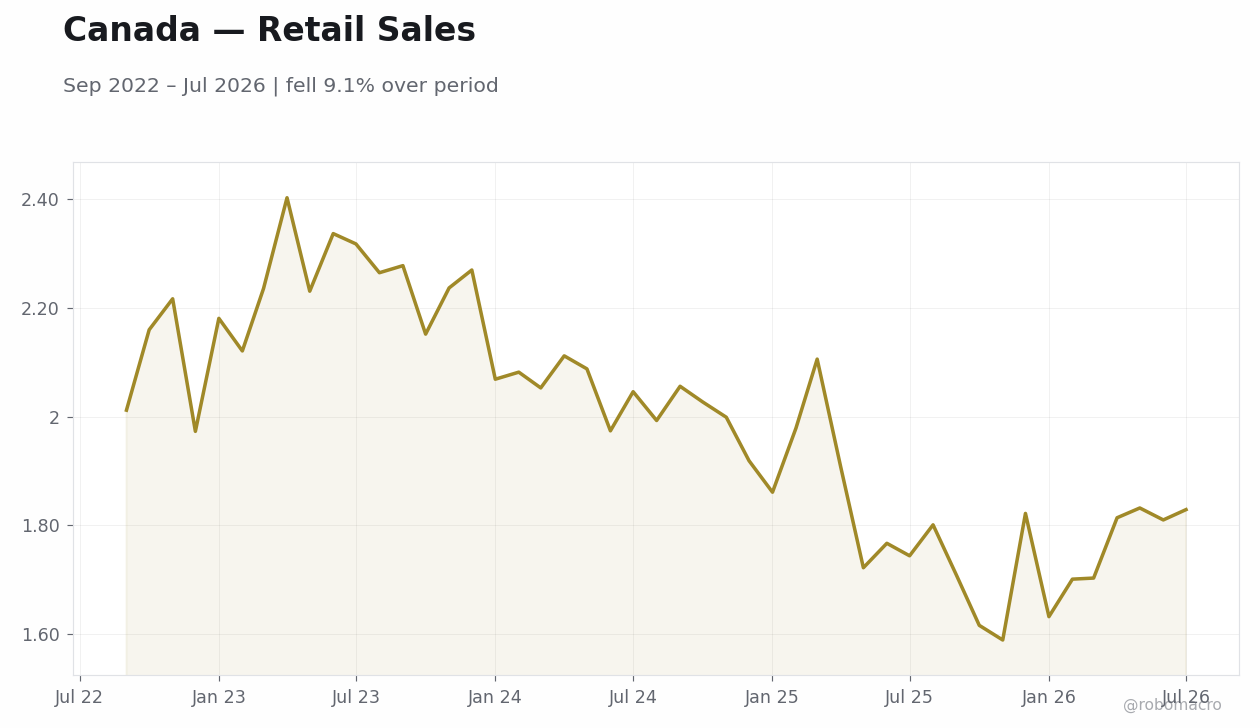
RoboMacro AI Economic Research

Global Macro Watch

Week of August 17–21, 2026 robomacro.com
Poland, Czech Republic, Hungary, Romania and Turkey
Market Scorecard
AssetLevelWoW
BIST 10014514.8+2.7%
iShares Poland44.42+1.1%
EUR/PLN4.31+0.0%
EUR/HUF362.31+0.1%
EUR/CZK24.09-0.4%
USD/TRY48.05+0.4%
Brent Crude94.39+3.9%
Gold4680.6+6.0%
Bitcoin77255.69+23.0%
Chart 2
Chart 4
  • Polish equities advance while BIST 100 rises amid sustained regional resilience.
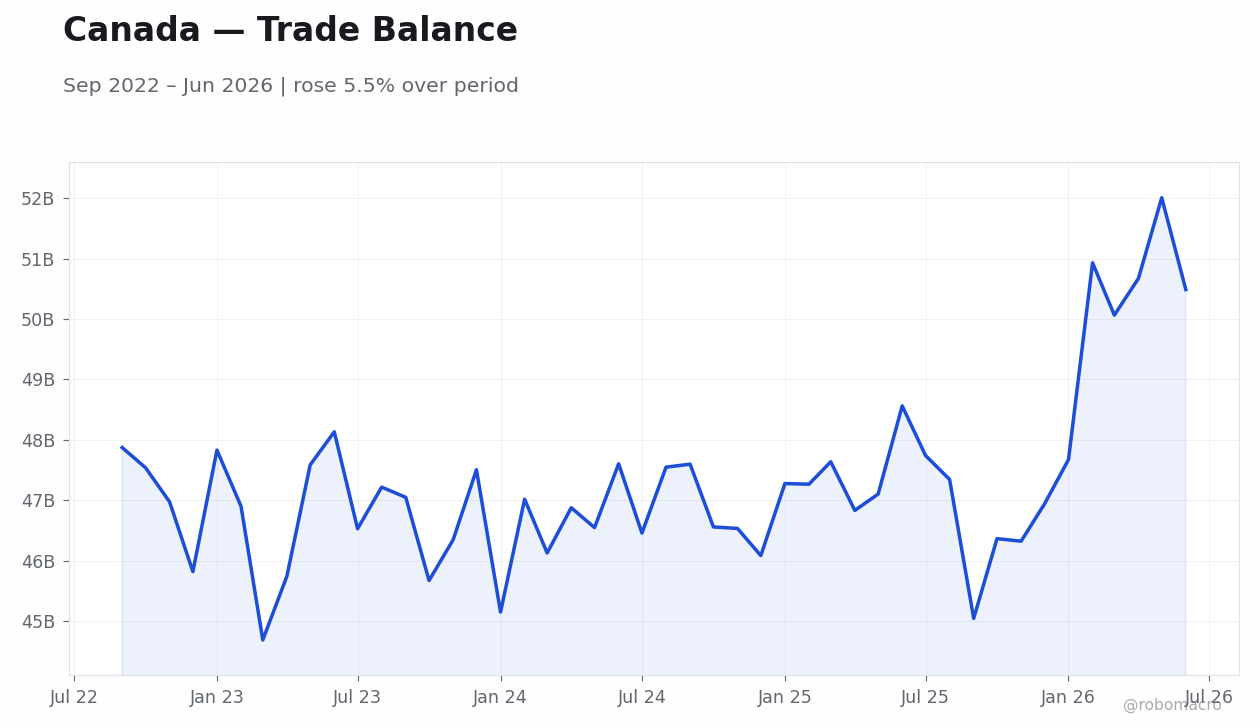
  • Poland and Hungary 10-year yields decline as spreads compress versus bunds.
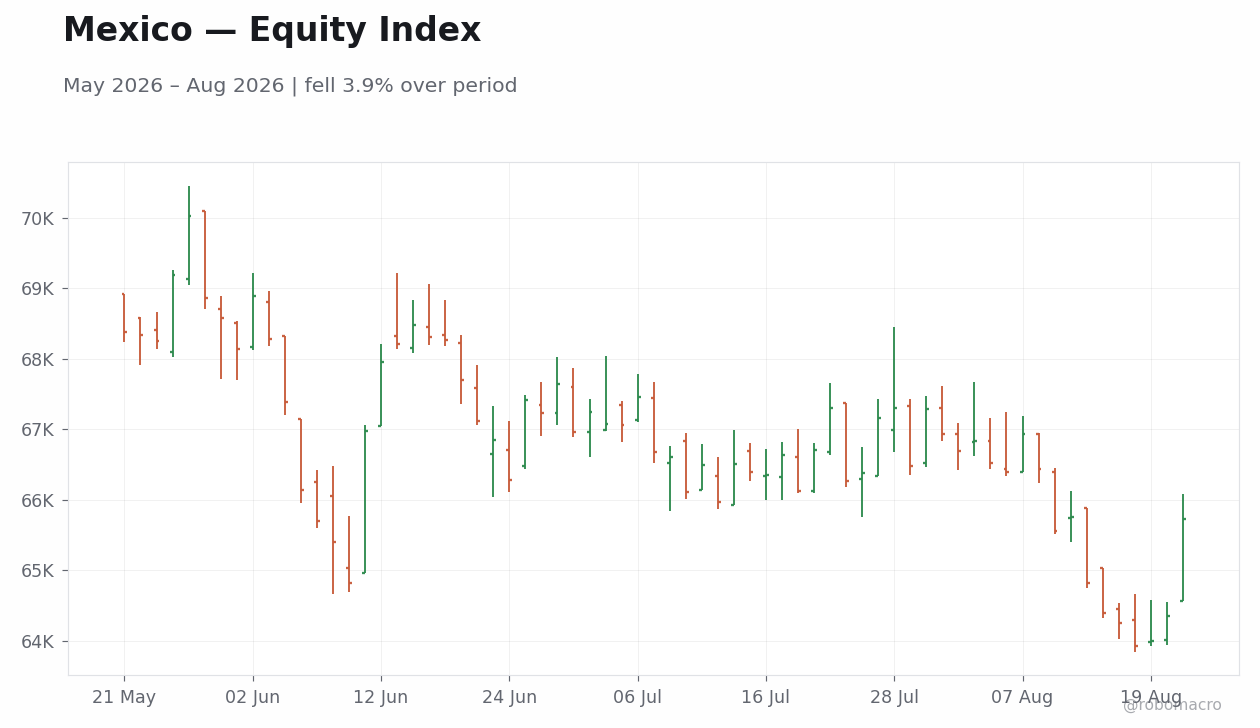
  • NBP, CNB, MNB, BNR and CBRT maintain unchanged policy rates with data-dependent forward guidance.
  • Brent crude climbs and gold advances, lifting external support for commodity-exposed assets.

Week in Review

Equity markets show resilience Regional equities posted net gains over the five sessions ending 21 August 2026. The iShares Poland ETF closed at 44.42 after a 1.05% weekly advance while the BIST 100 reached 14,514.80 for a 2.71% gain. Daily moves included a 2.22% rise in the Polish ETF on 19 August and a 2.34% BIST 100 increase the same day. Thin summer volumes amplified price action on limited news flow.

Fixed-income markets register yield compression Poland and Hungary 10-year yields declined, narrowing spreads versus German bunds and reflecting reduced risk premia. EUR/PLN closed at 4.31 with a modest 0.03% weekly change while EUR/HUF finished at 362.31 after a 0.07% move.

FX and external drivers shape sentiment EUR/CZK declined 0.42% to 24.09 while USD/TRY rose 0.40% to 48.05. Brent crude advanced 3.87% to 94.39 and gold climbed 5.95% to 4,680.60. Bitcoin surged 22.98% to 77,255.69.

Growth divergence persists across the region Poland maintained stronger momentum than Hungary amid quiet data releases. No high-impact prints emerged from the Czech Republic, Romania or Turkey during the week. EU fund disbursement discussions continued to influence Polish and Hungarian positioning. The configuration left markets focused on external demand and energy prices rather than domestic releases.

Emerging Europe Central Banks Watch

NBP, CNB, MNB, BNR and CBRT left policy rates unchanged during the week. No central-bank speakers altered forward guidance and no minutes introduced new signals. Data dependence remained the common theme across all five institutions. The Czech Republic and Romania saw no domestic releases that would shift CNB or BNR parameters. Turkey’s CBRT continued to monitor lira weakness at USD/TRY 48.05 alongside elevated inflation. The week’s external energy-price increase at Brent 94.39 added to imported-inflation vigilance without prompting immediate commentary shifts. Medium-term rate paths therefore stayed anchored to incoming prints rather than any fresh guidance.

Data Review

No high-impact economic data releases occurred across Poland, Czech Republic, Hungary, Romania or Turkey between 17 and 21 August 2026. The absence of prints left markets reliant on prior-quarter trends and external indicators. The quiet calendar reinforced the view that domestic cycles remain in mid-expansion with no immediate revision to growth or inflation trajectories. Prior-week data dependence across the region continued to frame expectations for stable policy parameters. Commodity price increases provided the clearest external impulse, with Brent at 94.39 supporting import-cost monitoring in energy-dependent economies. The lack of surprises preserved the baseline outlook of contained inflation pressures and steady labor-market conditions heading into the final week of August.

RoboMacro AI Economic Research

Global Macro Watch

Week of August 17–21, 2026 robomacro.com

Calendar data unavailable

Week Ahead: Key Releases
DateReleasePriorCons.
2026-08-25Unemployment Rate5.85.8
2026-08-25Central Bank Interest Rate Decision5.85.5
Chart 5

The Week Ahead

No high-impact releases appear for Poland, the Czech Republic, Hungary or Romania. Turkey will publish the final balance-of-trade reading. Central-bank speakers from NBP, CNB and MNB may provide incremental color ahead of the next ECB meeting. EU cohesion-fund disbursement updates could influence Polish and Hungarian sentiment. Energy import data and Black Sea transit developments may surface in regional commentary. The quiet calendar leaves external drivers, including Brent crude at 94.39 and gold at 4,680.60, as primary focus areas.

Risks & Themes

The week’s data absence leaves positioning sensitive to external shocks. Brent crude’s advance raises imported-inflation risks for energy-dependent economies. Gold’s rise supports reserve narratives in Poland but offers limited offset for Turkey’s lira pressure at USD/TRY 48.05. Thin liquidity may amplify FX and yield moves on any surprise news. Upside scenarios center on continued Polish growth outperformance and further EU fund inflows. Downside risks include renewed energy-price spikes or delays in cohesion-fund disbursements. Market mispricing signals remain limited given the quiet calendar and stable policy expectations. Volatility considerations favor selective carry trades where real-rate differentials stay supportive.

Cross-Asset

Equities delivered the clearest weekly gains. The iShares Poland ETF rose 1.05% to 44.42 while the BIST 100 advanced 2.71% to 14,514.80. Daily standout moves included the 2.22% Polish ETF gain and 2.34% BIST 100 increase on 19 August. Bonds saw yield compression. FX markets remained range-bound: EUR/PLN closed at 4.31, EUR/HUF at 362.31 and EUR/CZK at 24.09. USD/TRY edged 0.40% higher to 48.05. Commodities provided external tailwinds as Brent crude rose 3.87% to 94.39 and gold climbed 5.95% to 4,680.60. Bitcoin’s 22.98% surge to 77,255.69 reflected broader risk appetite but offered limited direct read-through for regional assets.

Global Context

Brent crude’s weekly gain tightened external conditions for import-dependent economies across the region. Gold’s advance provided reserve support but highlighted ongoing uncertainty. No major developed-market policy shifts emerged to alter regional rate differentials. Trade dynamics remained stable with no new tariff or supply-chain disruptions reported in the last seven days. Geopolitical risks around energy transit continued to frame fiscal vigilance in Poland and Romania.

RoboMacro AI Economic Research

Global Macro Watch

Week of August 17–21, 2026 robomacro.com
South Africa
Market Scorecard
AssetLevelWoW
JSE Top 40110387.1+3.2%
USD/ZAR16.01-1.1%
EUR/ZAR18.68-0.3%
Platinum1895.7+6.4%
Gold4680.6+6.0%
Brent Crude94.39+3.9%
Naspers78476.0-1.0%
Bitcoin77242.59+23.0%
Chart 1
Chart 2
  • South Africa’s inflation moderated in July, coming in below consensus.
  • The JSE Top 40 rose 3.2% week-over-week as gold and platinum advanced.
  • The South African Reserve Bank held its policy rate steady with no speakers or guidance shifts during the week.

Week in Review

Inflation Moderation Confirmed South Africa’s July inflation rate printed below the 4.5% consensus. The outcome aligned with a moderation path after the prior reading and reflected softer contributions from food, municipal tariffs, and fuel.

Equity and Commodity-Led Rally The JSE Top 40 climbed to close the week at 110387.1, delivering a 3.2% weekly gain. Mining equities benefited as gold and platinum advanced, with the index posting gains on August 19 and August 21. Naspers ended lower after mixed sessions.

Currency and Yield Dynamics USD/ZAR finished 1.1% lower on the week at 16.01. EUR/ZAR eased. The policy rate remained unchanged while the curve recorded modest steepening. Net gold and forex reserves had risen in July, adding a modest external buffer.

External Trade and Policy Context An AGOA extension preserved duty-free access for agricultural exports, while a soybean export agreement with China supported the current-account outlook. No domestic data prints occurred during the week, leaving commodity prices and cross-border flows as the dominant drivers. The configuration sustained the mid-cycle expansion without injecting fresh policy impulses.

SARB Watch

The South African Reserve Bank left the policy rate unchanged throughout the week. July CPI arrived below consensus and confirmed a moderation path after the prior annual rate. No SARB speakers delivered remarks, and the central bank focused instead on advancing payment-system upgrades aimed at efficiency and inclusion. The data release reinforced the existing data-dependent stance ahead of upcoming decisions, with the cooling print reducing immediate pressure on the rate path. Officials have continued to emphasize incoming figures as the sole determinant of any future adjustments.

RoboMacro AI Economic Research

Global Macro Watch

Week of August 17–21, 2026 robomacro.com

Calendar data unavailable

Week Ahead: Key Releases
DateReleasePriorCons.
2026-08-28Trade Balance17.8bn-
Chart 6
Chart 7

The Week Ahead

The Trade Balance release scheduled for August 28 will provide the next domestic data point. The print matters for the South African Reserve Bank rate path because sustained surpluses support the current-account balance and reduce imported inflation risks in coming quarters. Malaysia’s Coincident and Leading Index readings on August 24 may offer indirect signals on regional demand that could influence South African export prospects. No high-impact central-bank events appear on the immediate calendar, leaving attention on global commodity flows and any follow-through commentary on payment-system reforms. The soybean export agreement with China continues to feature as a positive trade signal that could lift agricultural revenues. Market participants will monitor whether the inflation moderation sustains into the next meeting cycle or requires recalibration of forward guidance.

Risks & Themes

The July CPI undershoot shifts the outlook toward a more gradual rate path provided subsequent prints remain contained. Upside risks center on renewed energy-price gains, with Brent crude advancing on the week and potentially reintroducing imported inflation pressures. Downside scenarios include further softening in domestic demand if unemployment trends persist. Commodity dependence remains elevated, as evidenced by the JSE Top 40’s gain tied directly to gold and platinum advances. The market appears to underweight the possibility that persistent external surpluses could allow earlier policy flexibility than currently signaled by official communications.

RoboMacro AI Economic Research

Global Macro Watch

Week of August 17–21, 2026 robomacro.com
Australia and New Zealand
Market Scorecard
AssetLevelWoW
ASX 2009058.9-0.2%
NZX 5013972.66+1.8%
AUD/USD0.72+1.1%
NZD/USD0.6+1.5%
AUD/NZD1.2-0.5%
BHP65.16+4.8%
Gold4680.6+6.0%
Brent Crude94.39+3.9%
Bitcoin77242.59+23.0%
Chart 1
Chart 2
Chart 4
  • Australian July employment contracted against a consensus expectation of a gain, lifting the unemployment rate.
  • Westpac Consumer Confidence Index rose, with the monthly change measure advancing.
  • RBA Deputy Governor Hauser reiterated persistent hawkishness on inflation risks in remarks delivered on 18 August.

Week in Review

Labour Market Cooling Emerges Australian July employment data delivered a clear downside surprise, with a decline versus the prior gain and consensus for an increase. The unemployment rate moved higher while full-time employment still added positions. These prints followed the prior week’s resilience and aligned with the broader mid-phase expansion described in recent global data flows.

Consumer Sentiment Rebounds Westpac Consumer Confidence Index climbed after the RBA held the cash rate. The improvement occurred even as labour-market momentum eased, suggesting households viewed the policy hold as supportive.

Equity and Currency Divergence The ASX 200 closed the week at 9058.9, down 0.16 percent week-over-week, while the NZX 50 advanced to 13972.66 for a 1.83 percent gain. AUD/USD reached 0.72, up 1.15 percent over the period, and NZD/USD finished at 0.60, up 1.51 percent.

Commodity Tailwinds Strengthen Gold rose to 4680.6, a 5.95 percent weekly advance, and Brent crude settled at 94.39 after a 3.87 percent gain. BHP shares ended at 65.16, up 4.76 percent week-over-week, reflecting firmer iron-ore sentiment.

Regional Policy Context Holds RBA Assistant Governor Hauser’s 18 August remarks emphasised ongoing inflation vigilance without altering the data-dependent stance. New Zealand short-term rates eased amid contained domestic releases.

Through-Line Remains Data Dependence The week’s mixed Australian prints—soft employment offset by firmer confidence—reinforced the same tolerance for divergent signals observed in prior global cycles. No consensus misses on inflation or activity altered the RBA or RBNZ forward guidance parameters.

ANZ Central Banks Watch

RBA Deputy Governor Hauser’s 18 August speech highlighted risks of further rate pressure should inflation outcomes crystallise above target, consistent with the July cash-rate hold. The subsequent Australian employment miss and unemployment rise supplied fresh evidence of labour-market softening that officials will weigh at upcoming decisions. RBNZ maintained its mortgage rules unchanged and offered no shift in the OCR stance. Westpac consumer confidence data showed household resilience that may temper any near-term easing signal from the RBA. Both central banks continue to frame policy parameters around incoming prints rather than pre-committing to adjustments ahead of the next meetings. The combination of softer employment and firmer sentiment leaves the rate path anchored to subsequent releases on inflation and activity.

RoboMacro AI Economic Research

Global Macro Watch

Week of August 17–21, 2026 robomacro.com

Calendar data unavailable

Week Ahead: Key Releases
DateReleasePriorCons.
2026-08-24RBA Meeting Minutes--
2026-08-25Speech by RBA's Jacobs--
2026-08-25Construction Work Done Quarter-over3.40.40
2026-08-25Inflation Rate Month-over-Month-0.10-
2026-08-25Inflation Rate Year-over-Year3.83.2
2026-08-25RBA Trimmed Mean Consumer Price Ind0.30-
2026-08-25RBA Trimmed Mean Consumer Price Ind3.6-
2026-08-26RBA Bulletin--
Chart 5
Chart 7

The Week Ahead

Monday brings RBA Meeting Minutes that will detail the reasoning behind the most recent hold and any discussion of labour-market risks. Tuesday features a speech by RBA’s Jacobs that markets will parse for updates on the inflation outlook. Wednesday releases Australian Construction Work Done quarter-over-quarter alongside Inflation Rate month-over-month and year-over-year prints. The RBA Trimmed Mean CPI measures will provide the underlying gauge. Thursday delivers the RBA Bulletin, offering staff analysis of economic conditions that directly informs the next policy decision. These releases will shape assessments of whether cooling employment data warrants any adjustment to the current policy rate settings in coming quarters. New Zealand data remain light, leaving focus on Australian inflation outcomes for RBNZ spillovers via regional growth and commodity channels. The sequence will test whether the prior week’s labour softening extends into price and activity metrics that influence both banks’ forward guidance.

Risks & Themes

The employment contraction raises downside risks to growth if subsequent prints confirm a sustained labour-market slowdown. Upside commodity moves, with Brent and gold advancing, could support terms of trade and fiscal receipts, cushioning any activity weakness. Persistent inflation above consensus expectations on next week’s release would challenge the RBA’s tolerance for mixed data and reinforce the hawkish tone from Hauser. New Zealand’s trade balance release next week may highlight export resilience that offsets softer Australian momentum. The configuration leaves both central banks exposed to data surprises that could shift the balance between hold and adjustment at upcoming decisions.

RoboMacro AI Economic Research

Global Macro Watch

Week of August 17–21, 2026 robomacro.com
China, Hong Kong and Taiwan
Market Scorecard
AssetLevelWoW
Shanghai Composite3905.2-1.9%
Hang Seng26009.46+2.2%
TAIEX45224.29-1.4%
USD/CNY6.71-0.5%
USD/HKD7.84-0.1%
Copper6.59-0.3%
Brent Crude94.39+3.9%
Gold4680.6+6.0%
Bitcoin77198.38+22.9%
Chart 1
Chart 2
  • Mainland activity data showed continued softness, with industrial production and retail sales both missing expectations and extending the recent softening trend.
  • The PBoC held the 1-year and 5-year Loan Prime Rates steady, consistent with ongoing reserve-absorption operations.
  • Shanghai Composite declined while the Hang Seng Index advanced, with the TAIEX also lower.
  • Brent crude and gold both rose, while copper declined modestly.

Week in Review

July activity data confirmed demand weakness. Mainland industrial production and retail sales both missed consensus forecasts, extending the softening trend visible in prior weeks. Fixed-asset investment contracted further and the house price index declined. Equity markets absorbed the data unevenly, with the Shanghai Composite ending lower on the week.

Policy signals remained steady amid inflows. The PBoC left both Loan Prime Rates unchanged and continued reverse-repo operations to manage liquidity. USD/CNY declined on the week, supported by fixing operations that absorbed foreign-currency inflows. Reserve-asset accumulation remained elevated, underscoring authorities’ focus on currency stability. Hong Kong’s aggregate balance stayed elevated, keeping HKMA intervention risk low.

Regional equities diverged on external factors. The Hang Seng Index advanced as select names provided support, while the TAIEX declined on semiconductor export concerns. Cross-strait trade flows remained quiet. The week reinforced data dependence guiding both markets and policy expectations.

Greater China Central Banks Watch

The PBoC held the 1-year Loan Prime Rate at 3.0% and the 5-year at 3.5%, matching prior levels. Reserve-absorption operations continued, lifting reserve assets while the yuan remained near its strongest level in several years. HKMA kept policy parameters unchanged, with the aggregate balance elevated and reducing near-term intervention risk. The week’s data misses have reinforced a data-dependent stance across the three central banks, with no adjustment to forward guidance. Medium-term rate path expectations remain anchored to incoming activity prints.

Data Review

Mainland July industrial production missed consensus and pointed to continued manufacturing softness. Retail sales advanced at a subdued pace, highlighting weak household demand. Fixed-asset investment contracted further and the house price index declined. These misses reinforced the view that the economy remains in a soft patch. The PBoC held the 1-year LPR and 5-year LPR steady. Growth outlook signals point to below-trend expansion, keeping pressure on authorities to monitor incoming prints before any adjustment to the policy rate path.

RoboMacro AI Economic Research

Global Macro Watch

Week of August 17–21, 2026 robomacro.com

Calendar data unavailable

The Week Ahead

No high-impact data releases are scheduled for mainland China, Hong Kong or Taiwan. Markets will monitor PBoC reverse-repo operations for liquidity signals. Hong Kong’s exchange operator will be watched for any follow-through on recent earnings. Taiwan cabinet semiconductor export forecasts could influence TAIEX sentiment. Regional FX desks will track USD/CNY fixing tolerance. The absence of major prints leaves focus on any policy-related commentary and global trade developments.

Risks & Themes

This week’s data misses have shifted the outlook toward greater downside risk for near-term growth. Upside scenarios hinge on faster fiscal follow-through, while downside cases center on prolonged property weakness. Market mispricing signals appear in the divergence between equity gains in Hong Kong and mainland declines. Volatility remains elevated in bitcoin, which rose 22.89% to 77198.38. Flow considerations favor the yuan amid reserve accumulation.

Cross-Asset

Equities showed mixed weekly net changes, with the Shanghai Composite closing at 3905.2 after a 1.94% decline while the Hang Seng Index rose 2.19% to 26009.46. The TAIEX finished at 45224.29 after a 1.38% weekly drop. Bonds saw limited movement. USD/CNY closed at 6.71 after a 0.46% weekly decline. USD/HKD remained at 7.84 after a 0.09% weekly dip. Brent crude rose 3.87% to 94.39 while copper ended at 6.59 after a 0.26% weekly decline. Gold advanced 5.95% to 4680.6.

Global Context

Ongoing trade and technology tensions continued to influence Greater China asset pricing. Cross-border spillovers remain focused on export and commodity channels.

RoboMacro AI Economic Research

Global Macro Watch

Week of August 17–21, 2026 robomacro.com
South Korea
Market Scorecard
AssetLevelWoW
KOSPI6912.95+0.6%
KOSDAQ801.94-3.9%
USD/KRW1385.98-2.1%
Samsung281500.0+4.8%
SK Hynix1730000.0+4.1%
Brent Crude94.39+3.9%
Gold4680.6+6.0%
Bitcoin77198.38+22.9%
Chart 1
Chart 2
  • KOSPI closed the week at 6,912.95 after advancing 0.63 percent, while the won strengthened 2.08 percent to 1,385.98.
  • KOSDAQ declined 3.87 percent to 801.94.
  • Samsung rose 4.84 percent to 281,500 won and SK Hynix gained 4.09 percent to 1,730,000 won.

Week in Review

Equity and currency moves KOSPI advanced 0.63 percent to close at 6,912.95. KOSDAQ declined 3.87 percent to 801.94. Samsung rose 4.84 percent to 281,500 won and SK Hynix gained 4.09 percent to 1,730,000 won. USD/KRW fell 2.08 percent to 1,385.98.

Policy and liquidity backdrop No high-impact domestic data releases occurred between August 17 and 21. The data arc shows equity gains alongside currency appreciation.

BoK Watch

Bank of Korea officials released no statements or minutes during the week. Equity gains alongside currency appreciation leave the policy rate path dependent on subsequent inflation and activity releases ahead of the next meeting. The data do not yet indicate any shift in the Bank of Korea’s data-dependent stance.

RoboMacro AI Economic Research

Global Macro Watch

Week of August 17–21, 2026 robomacro.com

Calendar data unavailable

Week Ahead: Key Releases
DateReleasePriorCons.
2026-08-24Consumer Confidence Index107-
2026-08-25Business Confidence82.0-
2026-08-26Central Bank Interest Rate Decision2.8-

The Week Ahead

Monday brings the Consumer Confidence Index, which will gauge household sentiment after the won’s recent appreciation. Tuesday’s Business Confidence release offers an early read on corporate hiring and investment plans. Thursday features the Bank of Korea interest rate decision. Stronger-than-expected confidence prints could reinforce the case for holding rates steady into coming quarters. Weaker readings would highlight downside risks from household debt servicing costs. The sequence will set the tone for how the Bank of Korea balances growth momentum against contained inflation in upcoming decisions.

Risks & Themes

The won’s 2.08 percent appreciation introduces downside pressure on future GDP and GDI prints. Upside scenarios center on sustained equity gains; downside scenarios hinge on renewed equity volatility or external yield spikes that could weigh on consumption. Markets appear to underweight the interaction between equity performance and potential domestic demand durability into the next policy cycle.

RoboMacro AI Economic Research

Global Macro Watch

Week of August 17–21, 2026 robomacro.com
Indonesia, Thailand, Malaysia, Philippines, Singapore and Vietnam
Market Scorecard
AssetLevelWoW
JCI6525.69+1.2%
KLCI1736.48+0.6%
STI5688.96-1.4%
USD/IDR17700.0-0.7%
USD/THB32.66-1.4%
USD/MYR4.03-1.2%
USD/PHP61.65+0.3%
USD/SGD1.27-0.8%
Brent Crude94.39+3.9%
Gold4680.6+6.0%
Bitcoin77198.37+22.9%
Chart 1
Chart 2
  • Thailand posted the weakest ASEAN growth outcome of the period as external price pressures weighed on momentum.
  • Bank Indonesia maintained its policy stance and leaned on FX operations as the rupiah strengthened modestly against the dollar.
  • Brent crude and gold posted strong weekly gains, delivering support for commodity-exposed ASEAN economies even as domestic demand indicators softened.

Week in Review

Thailand growth shortfall sets regional tone. Thailand recorded the lowest growth rate among major ASEAN economies as elevated energy prices weighed on momentum despite tourism gains. The quarterly outcome left the Bank of Thailand on a dovish hold path ahead of its next decision.

Malaysia inflation eases while currencies strengthen. Malaysia inflation moderated further while the ringgit posted a solid weekly gain. These contained price pressures aligned with broader ASEAN disinflation trends and supported non-rate policy continuity at Bank Negara Malaysia.

Indonesia policy continuity anchors rupiah. Bank Indonesia maintained its policy settings and emphasized FX tools, with the rupiah finishing the week stronger. External balances remained under pressure yet currency stability allowed the central bank to retain its data-dependent stance without immediate adjustment.

Equity and commodity divergence shapes flows. JCI rose 1.18% to 6,525.69 while KLCI gained 0.61% to 1,736.48 and STI fell 1.38% to 5,688.96. Brent crude climbed 3.87% to 94.39 and gold rose 5.95% to 4,680.60, delivering tailwinds for commodity-linked ASEAN exporters even as Singapore equities lagged.

Regional data dependence persists into late August. The week’s prints reinforced mid-cycle expansion conditions with no central bank altering forward guidance, leaving BI, BoT, BNM, BSP, MAS and SBV focused on incoming releases rather than immediate recalibration. Softer growth in Thailand and contained inflation in Malaysia together confirmed that external energy impulses have not yet overridden domestic stability signals.

ASEAN Central Banks Watch

Bank Indonesia maintained its policy settings and reiterated its preference for FX interventions to defend the rupiah. The Bank of Thailand faces an upcoming decision that will be watched for any updated assessment of growth risks. Bank Negara Malaysia faces no immediate pressure to adjust after inflation eased. The Bangko Sentral ng Pilipinas will be monitored for any response to peso movements near 61.65 per dollar. MAS and SBV maintained unchanged parameters amid the absence of high-impact releases, consistent with the broader ASEAN pattern of data dependence rather than preemptive shifts. This week’s contained inflation prints and commodity-driven currency support reinforced the signal that none of the six central banks see near-term justification for altering existing policy rates.

RoboMacro AI Economic Research

Global Macro Watch

Week of August 17–21, 2026 robomacro.com

Calendar data unavailable

Week Ahead: Key Releases
DateReleasePriorCons.
2026-08-26Central Bank Interest Rate Decision1.01.0
2026-08-27Central Bank Interest Rate Decision4.85.0
Chart 6

The Week Ahead

Malaysia coincident and leading indices are due Monday, providing early signals on domestic momentum ahead of the next Bank Negara Malaysia meeting. Singapore core inflation data will inform MAS policy calibration amid the STI’s 1.38% weekly decline. No high-impact releases are slated for Indonesia, Thailand or Vietnam, leaving the focus on whether commodity support at Brent 94.39 sustains external balances. The sequence of data will clarify whether recent inflation moderation and stable policy settings extend the current pause across the region. Officials at all six central banks will continue to tie any future adjustments to the next round of growth and external data rather than pre-set calendars.

Risks & Themes

Higher Brent levels at 94.39 introduce upside inflation risks that could challenge the dovish tilt at BoT and BNM if energy pass-through accelerates in coming quarters. Thailand’s softer growth raises downside scenarios that may prompt earlier easing if tourism offsets prove insufficient. External imbalances in Indonesia could pressure BI toward additional FX measures if rupiah stability erodes. Equity divergence, with JCI advancing while STI declined, highlights potential capital flow rotation that may test MAS and BSP tolerance for currency volatility. The absence of coordinated policy shifts this week leaves markets exposed to any surprise deviation in upcoming decisions, particularly if incoming indices reveal faster momentum loss than the mid-expansion baseline assumes.

RoboMacro AI Economic Research

Global Macro Watch

Week of August 17–21, 2026 robomacro.com
India
Market Scorecard
AssetLevelWoW
Nifty 5024252.0-0.1%
Sensex77540.83-0.2%
USD/INR95.68+0.2%
EUR/INR111.77+4.5%
Reliance1316.00.0%
HDFC Bank726.95-0.3%
Brent Crude94.39+3.9%
Gold4680.6+6.0%
Bitcoin77198.37+22.9%
Chart 1
Chart 2
  • India’s July merchandise trade deficit widened to a six-month high while the current account deficit increased in Q1FY27, underscoring external pressure from a sharp rise in April-July oil imports.
  • The rupee traded in a narrow band against the dollar as the RBI ended its FX swap window early and conducted spot and forward sales, supporting reserves that rose over the period.
  • Equity benchmarks closed the week modestly lower with the Nifty 50 down 0.15 percent, while Brent crude advanced 3.87 percent amid sustained RBI liquidity tightening.

Week in Review

External Account Strain from Energy Prices India’s July merchandise trade deficit reached a six-month high on rising imports, directly widening the current account deficit in Q1FY27. Oil import costs increased sharply in April-July as Brent crude advanced over the week.

RBI FX Management and Liquidity Tightening The RBI responded by ending its FX swap window earlier than scheduled and stepping up spot and forward sales, keeping USD/INR in a narrow range before closing at 95.68. Foreign-exchange reserves expanded, confirming the central bank’s capacity to defend the managed float. Short-term rates remained unchanged with no adjustment in the policy corridor.

Equity and Commodity Price Action Nifty 50 declined 0.15 percent to 24,252.00 while Sensex fell 0.24 percent to 77,540.83. Gold rose 5.95 percent to 4,680.60 and Bitcoin surged 22.89 percent to 77,198.37, reflecting broader risk-off flows tied to the oil impulse.

Growth and Inflation Signal Absence No major domestic data prints occurred between 17 and 21 August, leaving the HSBC Composite, Manufacturing and Services PMI flashes scheduled for 21:00 ET on 21 August as the first growth read since July. Deficient monsoon conditions raised food inflation risks, yet rural demand indicators remained resilient per external analysis. The configuration left markets focused on external balances rather than domestic momentum.

RBI Watch

The Reserve Bank of India maintained the policy rate with no adjustment to the corridor. Officials advanced the FX swap deadline and increased spot-forward sales to limit rupee depreciation, actions that tightened domestic liquidity while forex reserves still expanded. The July trade deficit and Q1FY27 current account shortfall highlighted imported inflation risks from Brent at 94.39, yet no MPC speakers or minutes altered the data-dependent stance. These interventions signal continued priority on exchange-rate stability over immediate liquidity relief ahead of the next policy decision. The absence of fresh guidance leaves the rate path anchored to incoming prints on inflation and external accounts.

RoboMacro AI Economic Research

Global Macro Watch

Week of August 17–21, 2026 robomacro.com

Calendar data unavailable

Week Ahead: Key Releases
DateReleasePriorCons.
2026-08-28Industrial Production Year-over-Yea7.36.2
2026-08-28Manufacturing Production Year-over-7.8-
Chart 8

The Week Ahead

Monday through Thursday feature no scheduled high-impact Indian releases, allowing markets to absorb the HSBC PMI flashes and any follow-through in oil prices. Friday brings Industrial Production Year-over-Year alongside Manufacturing Production Year-over-Year. These prints will provide the first concrete gauge of second-half industrial momentum after the oil-driven external deterioration. A downside surprise would reinforce the case for steady policy settings at the next Reserve Bank of India meeting by highlighting growth risks. Conversely, a beat would support the view that domestic activity remains sufficiently resilient despite higher oil import costs. Traders will also monitor rupee invoicing flexibility for exporters and any further RBI open-market operations. The data dependence established in prior weeks will therefore extend directly into the upcoming decisions.

Risks & Themes

Sustained Brent prices above recent levels raise the prospect of further current-account widening and imported inflation that could delay any easing at the next Reserve Bank of India meeting. Early termination of the FX swap window has already tightened liquidity, amplifying downside risks to credit growth if reserves begin to decline. On the upside, resilient rural demand and any HSBC PMI beat could offset external weakness and keep the policy rate on hold without additional tightening. Markets appear to underweight the cumulative effect of the oil import surge on the trade balance. The configuration leaves the rupee vulnerable to further oil spikes while the central bank’s reserve buffer provides a temporary buffer.

RoboMacro AI Economic Research

Global Macro Watch

Week of August 17–21, 2026 robomacro.com
Turkey
Market Scorecard
AssetLevelWoW
BIST 10014514.8+2.7%
USD/TRY48.05+0.4%
EUR/TRY56.16+1.5%
GBP/TRY65.53+1.2%
Gold (TRY)4680.6+6.0%
Brent Crude94.39+3.9%
EUR/USD1.17+0.9%
Bitcoin77231.81+22.9%
Chart 1
Chart 2
  • CBRT resumed weekly repo auctions at the 37% policy rate, marking a clear step to normalize funding after prior extraordinary measures.
  • BIST 100 advanced 2.71% week-over-week to close at 14,514.80 while USD/TRY rose 0.40% to 48.05, showing equity outperformance with contained currency pressure.
  • Balance of Trade Final due August 28 is expected to narrow from the prior print, providing the first material data input ahead of the next policy decision.

Week in Review

Equity resilience amid limited data flow BIST 100 posted a net 2.71% gain to 14,514.80 across four trading sessions. Daily moves remained contained and the index finished higher on three of four days.

Currency stability despite external shocks USD/TRY rose 0.40% to 48.05 over the week, while EUR/TRY rose 1.47% to 56.16 and GBP/TRY gained 1.16% to 65.53. The limited TRY depreciation occurred against a backdrop of Brent crude rising 3.87% to 94.39, suggesting external price pressure did not translate into immediate currency stress.

Policy normalization signal dominates narrative The decision to resume weekly repo operations at the 37% policy rate provided the clearest domestic anchor, coinciding with Gold (TRY) advancing 5.95% to 4,680.60 as investors adjusted holdings. No high-impact Turkish data releases occurred between August 17 and 21, leaving the funding shift as the dominant driver of sentiment.

Geopolitical overlay remains secondary Israel-Turkey tensions surfaced mid-week yet produced no measurable deviation in daily BIST or TRY closes beyond the established ranges. The configuration left markets focused on the CBRT’s operational adjustment rather than external risk premia.

CBRT Watch

The Central Bank of the Republic of Turkey resumed weekly repo auctions at the 37% policy rate, explicitly framing the move as a return toward standard funding conditions. Officials indicated the step follows an assessment that the most acute external pressures have subsided. No additional speakers or minutes were released during the week, leaving the auction decision as the sole policy communication. The absence of any inflation or activity prints this week means the data flow offered no new information to alter the existing rate path. The operational shift therefore signals a preference for measured normalization while keeping the policy rate itself unchanged.

RoboMacro AI Economic Research

Global Macro Watch

Week of August 17–21, 2026 robomacro.com

Calendar data unavailable

Week Ahead: Key Releases
DateReleasePriorCons.
2026-08-28Balance of Trade Final-10.4bn-7.4bn

The Week Ahead

Monday brings no Turkish releases. The Balance of Trade Final on Friday, August 28, is expected to narrow from the prior print, offering the first concrete gauge of external balances since the prior month. A narrower deficit would reinforce the view that external adjustment continues, supporting the CBRT’s normalization stance ahead of upcoming decisions. Conversely, a wider shortfall could highlight persistent import pressures and keep vigilance on the current account path. No other high-impact indicators are scheduled, so the trade print will serve as the primary domestic input for assessing whether the 37% policy rate remains appropriate through coming quarters. Markets will also monitor any follow-through commentary on the repo auction framework for further signals on the pace of normalization.

Risks & Themes

The CBRT’s funding normalization reduces one layer of extraordinary policy accommodation, yet leaves the 37% policy rate exposed if the August 28 trade data disappoints. Geopolitical tensions with Israel could reprice risk premia quickly given the proximity of military developments in Syria. Brent at 94.39 already embeds an energy impulse that could feed into imported inflation, testing the durability of the current external adjustment. The modest 0.40% weekly move in USD/TRY suggests markets are not yet pricing sustained depreciation pressure, but any widening of the trade gap could challenge that position in coming quarters.

RoboMacro AI Economic Research

Global Macro Watch

Week of August 17–21, 2026 robomacro.com
Gulf Cooperation Council
Market Scorecard
AssetLevelWoW
Saudi Aramco26.4+1.0%
MSCI Saudi38.31+0.8%
MSCI UAE19.49-0.1%
MSCI Qatar17.14-1.8%
MSCI Kuwait37.14+0.5%
Brent Crude94.39+3.9%
WTI Crude87.06+3.0%
Gold4680.6+6.0%
USD/SAR3.75+3.2%
USD/AED3.67+0.0%
USD/KWD0.31-0.5%
Bitcoin77240.12+23.0%
Chart 1
Chart 2
  • Brent crude advanced on supply concerns after attacks on UAE oil tankers in the Strait of Hormuz.
  • Aramco-Maaden joint venture reinforced non-oil diversification momentum.
  • GCC central banks maintained unchanged policy parameters with no forward guidance adjustments.

Week in Review

Geopolitical supply risks drive energy prices higher. Attacks on UAE oil tankers in the Strait of Hormuz triggered immediate condemnation from Saudi Arabia, Qatar and Kuwait, lifting Brent crude and sustaining further gains. The 3.87 percent weekly advance in Brent reinforced fiscal revenue expectations for GCC exporters while WTI crude settled at 87.06 after a 3.03 percent weekly rise.

Equity markets show selective resilience amid energy strength. Saudi Aramco closed at 26.4 after a 0.98 percent weekly gain, supporting MSCI Saudi at 38.31 with a 0.76 percent advance. MSCI UAE ended at 19.49 after a 0.15 percent weekly decline while MSCI Qatar fell 1.81 percent to 17.14 and MSCI Kuwait rose 0.52 percent to 37.14.

Diversification initiatives advance alongside oil moves. Saudi non-oil contribution advanced under Vision 2030, coinciding with the Aramco-Maaden joint venture announcement targeting hard-rock minerals. Point-of-sale spending confirmed continued domestic activity momentum.

Safe-haven flows lift gold and Bitcoin. Gold rose 5.95 percent weekly to 4680.6 while Bitcoin climbed 22.96 percent to 77240.12, reflecting broader risk hedging that left regional currencies stable near peg levels with USD/SAR at 3.75.

Data calendar remains empty across GCC economies. No high-impact releases occurred between August 17 and 21, leaving market direction determined by external oil and geopolitical developments rather than domestic indicators.

GCC Central Banks Watch

GCC central banks held policy rates steady with no speakers or minutes released during the week. The absence of inflation or activity data prints left forward guidance unchanged and data-dependent, consistent with the prior multi-week pattern of tolerance for mixed external signals. Elevated Brent levels support fiscal balances that underpin monetary stability under currency pegs, reducing near-term pressure for any parameter shifts ahead of upcoming decisions. Officials continued to emphasize incoming figures as the sole basis for adjustments, with no comments altering the hold stance observed across the region.

RoboMacro AI Economic Research

Global Macro Watch

Week of August 17–21, 2026 robomacro.com

Calendar data unavailable

The Week Ahead

The next week features limited high-impact releases across GCC economies, with attention centered on any follow-through from the Aramco-Maaden joint venture and ongoing Red Sea routing adjustments. Malaysian coincident and leading indices on August 24 will provide indirect signals on Asian demand that matters for GCC export volumes. Finnish producer price data the same day may offer early indications of imported inflation trends relevant to GCC inflation outlooks. Markets will monitor OPEC+ compliance rhetoric ahead of the September ministerial meeting for any signals on production quotas that could influence the rate path through fiscal channels. Quiet domestic calendars leave sovereign spreads and equity flows sensitive to Brent movements. Geopolitical statements from regional governments remain the dominant variable for policy expectations into coming quarters.

Risks & Themes

The week's oil surge from Hormuz-related supply concerns shifts the near-term outlook toward firmer fiscal positions that could delay any easing considerations at upcoming decisions. Upside scenarios center on sustained Brent levels if tensions persist, supporting non-oil project funding. Downside risks include escalation that disrupts UAE aviation routes and widens sovereign spreads beyond current stability. Markets appear to underweight the persistence of Red Sea and Hormuz routing adjustments, which could extend volatility in gold and Bitcoin flows observed this week into the period ahead.

RoboMacro AI Economic Research

Global Macro Watch

Week of August 17–21, 2026 robomacro.com
Week Ahead CalendarAugust 24 – August 28, 2026
Time Country Event Our Est. Consensus Prior Impact
MONDAY, AUGUST 24
08:30🇺🇸Chicago Fed National Activity Index-0.02●●○
17:00🇰🇷Consumer Confidence Index106.8●●○
21:30🇦🇺RBA Meeting Minutes CB●●●
TUESDAY, AUGUST 25
00:00🇦🇺Speech by RBA's Jacobs CB●●●
02:45🇫🇷Consumer Confidence Index8786●●○
03:30🇵🇱Unemployment Rate5.85.8●●○
04:00🇩🇪IFO Business Climate Level87.286.6●●●
08:00🇭🇺Central Bank Interest Rate Decision CB5.55.8●●●
08:00🇺🇸Speech by Fed's Barkin●●○
08:15🇺🇸ADP Employment Change Weekly9,500●●○
09:00🇺🇸S&P/Case-Shiller Home Price Year-over-Year1.71.6●●○
10:00🇺🇸CB Consumer Confidence90.8●●○
10:00🇺🇸New Home Sales Level620,000628,000●●○
10:00🇺🇸New Home Sales Month-over-Month1.6●●○
16:00🇺🇸Speech by Fed's Barkin●●○
16:30🇺🇸API Weekly Crude Oil Stocks-3.3M●●○
17:00🇰🇷Business Confidence82●●○
21:30🇦🇺Construction Work Done Quarter-over-Quarter0.403.4●●○
21:30🇦🇺Inflation Rate Month-over-Month-0.10●●○
21:30🇦🇺Inflation Rate Year-over-Year3.23.8●●○
21:30🇦🇺RBA Trimmed Mean Consumer Price Index Month-over-Month0.30●●○
21:30🇦🇺RBA Trimmed Mean Consumer Price Index Year-over-Year3.6●●○
WEDNESDAY, AUGUST 26
03:00🇹🇭Central Bank Interest Rate Decision CB11●●●
06:00🇬🇧CBI Distributive Trades Level-24-26●●○
07:00🇺🇸MBA 30-Year Mortgage Rate6.8●●○
08:30🇺🇸Core PCE Price Index Month-over-Month0.200.10●●●
08:30🇺🇸Durable Goods Orders Month-over-Month0.700.30●●●
08:30🇺🇸GDP Growth Quarter-over-Quarter Second Estimate1.52.1●●●
08:30🇺🇸Personal Income Month-over-Month0.300.20●●●
08:30🇺🇸Personal Spending Month-over-Month0.200.30●●●
08:30🇺🇸Corporate Profits Quarter-over-Quarter Preliminary0.50●●○
08:30🇺🇸Durable Goods Orders excluding Transp Month-over-Month0.500.60●●○
08:30🇺🇸GDP Price Index Quarter-over-Quarter Second Estimate3.6●●○
08:30🇺🇸PCE Price Index Month-over-Month0.10-0.10●●○
08:30🇺🇸PCE Price Index Year-over-Year3.7●●○
10:30🇺🇸EIA Weekly Crude Oil Inventory4.4M●●○
10:30🇺🇸EIA Weekly Gasoline Inventory688,000●●○
11:45🇺🇸Speech by Fed's Barkin●●○
12:15🇨🇭SNB Martin Speech CB●●●
21:00🇰🇷Central Bank Interest Rate Decision CB2.8●●●
21:30🇦🇺RBA Bulletin●●○
21:30🇯🇵Speech by BoJ's Himino CB●●●
●●● High impact    ●●○ Medium impact    CB Central bank event    Our Est. = RoboMacro model forecast. Shown only where a model covers the release; a blank means we publish no estimate for it.    Source: RoboMacro Economic Calendar
RoboMacro AI Economic Research

Global Macro Watch

Week of August 17–21, 2026 robomacro.com
Week Ahead CalendarAugust 24 – August 28, 2026
Time Country Event Our Est. Consensus Prior Impact
THURSDAY, AUGUST 27
02:00🇩🇪GfK Consumer Confidence-29.5-29.6●●●
02:30🇵🇭Central Bank Interest Rate Decision CB54.8●●●
06:00🇫🇷Unemployment Benefit Claims5,900●●○
08:00🇧🇷Unemployment Rate5.4●●○
08:00🇲🇽Trade Balance4.1B●●○
08:30🇨🇦Current Account Balance-5.5B-7.2B●●○
08:30🇺🇸Goods Trade Balance Advance-99.0B-101.4B●●○
08:30🇺🇸Retail Inventories excluding Autos Month-over-Month Advance-0.40●●○
08:30🇺🇸Weekly Jobless Claims209,000206,000●●○
08:30🇺🇸Wholesale Inventories Month-over-Month Advance0.100.20●●○
19:30🇯🇵Unemployment Rate2.52.5●●○
FRIDAY, AUGUST 28
01:00🇯🇵Consumer Confidence Index34.9●●●
01:00🇯🇵Housing Starts Year-over-Year18.6●●○
02:00🇬🇧Nationwide Housing Prices Month-over-Month0.10●●○
02:00🇬🇧Nationwide Housing Prices Year-over-Year1.8●●○
02:45🇫🇷Inflation Rate Year-over-Year Preliminary2.1●●●
02:45🇫🇷Inflation Rate Month-over-Month Preliminary0.600.60●●○
03:00🇪🇸Inflation Rate Month-over-Month Preliminary0.30●●○
03:00🇪🇸Inflation Rate Year-over-Year Preliminary4.23.6●●○
03:00🇨🇭KOF Leading Indicators Level103.7103.5●●○
03:00🇹🇷Balance of Trade Final-7.4B-10.4B●●○
03:55🇩🇪Unemployed Persons Level3.0M●●○
03:55🇩🇪Unemployment Level Change8,0006,000●●○
03:55🇩🇪Unemployment Rate6.46.4●●○
05:00🇮🇹Business Confidence89.6●●○
05:00🇮🇹Consumer Confidence Index94.2●●○
06:00🇪🇸Business Confidence-2.6●●○
06:30🇮🇳Industrial Production Year-over-Year6.27.3●●○
06:30🇮🇳Manufacturing Production Year-over-Year7.8●●○
08:00🇿🇦Trade Balance17.8B●●○
08:30🇨🇦GDP Growth Annualized-0.10●●●
08:30🇨🇦GDP Growth Quarter-over-Quarter0●●●
08:30🇨🇦GDP Month-over-Month0.200.30●●○
08:30🇨🇦GDP Month-over-Month Preliminary●●○
09:45🇺🇸Chicago PMI Index5757.6●●○
10:00🇺🇸Non Farm Payrolls Annual Revision Prel+52k M-911,000●●●
10:00🇺🇸Speech by Fed's Chair Warsh●●●
10:00🇺🇸Michigan Consumer Sentiment Final5155.2●●○
SUNDAY, AUGUST 30
19:50🇯🇵Industrial Production Month-over-Month Preliminary1.9●●○
19:50🇯🇵Retail Sales Year-over-Year0.50●●○
●●● High impact    ●●○ Medium impact    CB Central bank event    Our Est. = RoboMacro model forecast. Shown only where a model covers the release; a blank means we publish no estimate for it.    Source: RoboMacro Economic Calendar
RoboMacro AI Economic Research

Global Macro Watch

Week of August 17–21, 2026 robomacro.com

Disclosures & Important Information

AI-Generated Content: This publication is 100% generated by artificial intelligence systems and should not be considered as financial advice, investment recommendation, or professional research. All analysis, forecasts, and commentary are algorithmically produced.

Data Sources: Market data from public exchange and market-data providers. US Treasury yields from the Federal Reserve (FRED constant-maturity series). Macroeconomic data from central banks and national statistics offices. Economic calendar data from RoboMacro Economic Calendar. All data subject to revision and may be delayed.

No Warranty: RoboMacro makes no warranty, express or implied, regarding the accuracy, completeness, or reliability of the information contained in this publication. Data may be delayed, incomplete, or contain errors. Past performance is not indicative of future results.

Not Financial Advice: Nothing in this publication constitutes investment advice, tax advice, legal advice, or any other form of professional advice. Any opinions expressed are AI-generated and do not represent the views of any individual or organisation. Readers should consult qualified professionals before making investment decisions.

Nowcasts and Model Output: The US labour nowcast is the median of a ten-model ensemble. Activity indices are composite z-scores of weekly public high-frequency indicators, seasonally adjusted, published only for weeks meeting a minimum indicator-coverage threshold; the as-of date and coverage are shown on every row. All model output carries significant uncertainty.

Contact: [email protected] | robomacro.com

Publication: Global Macro Watch is published weekly on Sundays, covering the preceding Monday-to-Friday week. © 2026 RoboMacro. All rights reserved.